IJEDR1702096
International Journal of Engineering Development and Research (www.ijedr.org)553
Study Of Bearing Rolling Element Defect Using
Emperical Mode Decomposition Technique
Purnima Trivedi, Dr. P K Bharti Mechanical Department
Integral university
Abstract— Bearing failure is one of the major causes of breakdown in rotating machinery. Failure of bearings can results in costly downtime. Therefore condition monitoring of bearings plays an important role in machine maintenance. In condition monitoring the observed signal is often corrupted by noise during the transmission system. It is important to detect the elementary fault in advance before failure occurs. Therefore it is important to understand the behavior of the occurrence of faults and condition monitoring of the bearings. Among the various methods available for diagnosis and condition monitoring of bearing elements, vibration measurement is the most common one. The present study is focused on the fault diagnosis of taper roller bearings (NBC Bearing number: 30205). The experimental study has been made for the analysis of groove defect on the roller. Width and depth of the defect were approximately 1.40 mm and 0.30 mm respectively and were throughout the length of the roller. These defects were produced by using the Electric Discharge Machining (EDM). The present research work involves the application of Empirical Mode Decomposition (EMD) technique along with the envelope for the analysis of groove defect on the rollers. EMD is adaptive signal decomposition method, which is able to decompose non-linear and non-stationary data into a sequence of amplitude modulation/ frequency modulation (AM/FM) components or a like. These independent components to be obtained are called intrinsic mode functions (IMFs). The selection of appropriate IMFs is also done in order to extract the exact location of defects on the rollers. The selection of the IMF is based on the maximum kurtosis criteria. Kurtosis reveals the occurrence of defects in rotating machinery. For the normal bearing kurtosis is near about 3 and bearing with considerable defect have higher value of kurtosis. Thus kurtosis can be taken as the selection criteria for the selection of IMF. Therefore IMF with maximum kurtosis was selected for the analysis of defects in the rollers.
The proposed method is also compared with the traditional FFT which was directly applied to the raw signal of the faulty bearing. By comparison, between the proposed method and FFT, it is concluded that, the EMD method gives better result as well as defects can be easily identified by EMD. Whereas, it is difficult to identify defects by FFT. The results obtained by the proposed method are very close to the theoretical values of the defects. The roller defect frequency, for single roller groove deviate 2.1 % from the theoretical value of the roller defect frequency.
Keywords---- Fast Fourier Transformation (FFT), Empirical Mode Decomposition (EMD), Intrinsic Mode Functions (IMFs), Kurtosis, Electric Discharge Machining (EDM), Condition Monitoring, Envelope detection, Hidden Markov Models, Artificial
Neural Network, Ball pass frequency inner race (BPFI), Discrete wavelet transforms (DWT), Crest factor.
1.INTRODUCTION
1.1 Background: A bearing is a machine element which supports other moving machine elements. It permits relative motion between the contact surfaces of the machine elements. Rolling element bearing is vital component for power transmitting systems within the machine tools. Rolling element bearings are used today in the design of increasingly complex arrangements, such as high speed, and high temperature, heavy loadings and requiring continuous operations. A clear understanding of vibrations associated with them is highly needed. There is also a growing tendency that many rotating machines supported by the rolling element bearings are now being designed for working at high speed.
IJEDR1702096
International Journal of Engineering Development and Research (www.ijedr.org)554
1.2.1 Vibration analysis:
Vibration produced by rolling bearings can be complex and can result from geometricalimperfections during the manufacturing process, defects on the rolling surfaces or geometrical errors in associated components. Noise and vibration is becoming morecritical in all types of equipment since it is often perceived to be synonymous withquality and often used for predictive maintenance. Vibration condition monitoring ispopular for its versatility and its effectiveness. Meanwhile, vibration in machines causes periodic stresses in machine parts, which lead to fatigue failure. Vibration of machines is a parameter, which often indirectly represents the health of machines and is generally capable of detecting more kinds of machine faults when compared with the other techniques. Vibration monitoring also has advantages as a non-destructive, clean, relatively simple and cost effective technique [Hale, V. et al.1995]. Vibration monitoring of rolling element bearings are typically conducted using a case mounted transducer: an accelerometer, velocity pickup, and sometimes adisplacement sensor. Acceleration signals, obtained from case mounted sensors, emphasize high frequency sources, while displacement signals emphasize lower frequency sources, with velocity signals falling between the extremes. There is a large amount of information contained in the vibration signals that are obtained by monitoring at the various key points of a machine [Chen and Mo, 2004]. Every machine in standard condition has a certain vibration signature and when fault initiates or develops in them its signature changes. The increased level of vibration and introduction of additional peaks in signal is an indication of defect [Friswell M. et al. 2010].
1.2.2 Frequency domain analysis:Spectral analysis of vibration signal is widely used in bearing diagnostics. It was foundthat frequency domain methods are generally more sensitive and reliable than time domain methods. The advent of modern Fast Fourier Transform (FFT) analyzers hasmade the job of obtaining narrowband spectra easier and more efficient. In [Alfredson R. J. et al. 1985] it was demonstrated that the spectrum of the monitoredsignal changes when faults occur. In [Tandon N. et al. 1999] a bearing mathematical model incorporating: the effect of the bearing geometry, shaft speed, bearing load distribution, types of loads (both radial and axial), the shape of the generated pulses,transfer function of the path and the exponential decay of vibration due to the dampingproperty of the bearing was designed. This technique is very accurate if the rpm of theshaft does not change over time or does not change at least during each updatedduration of time analysis [Igarashi, T. et al. 1982].
In [Brown D. N. 1989] itwas reported that defects on rolling elements can generate a ball spin frequency (BSF)or some multiple of it. It was shown that the spectrum can be either a narrow bandsingle spike or a series of narrow band spikes spaced at BSF or FTF. In [Taylor J. I. 1980] it was shown that when more than one ball defects was present, sums of BSF were generated. The BSF could be generated if the cage is broken at rivet. Defects onthe balls are often accompanied by a defective inner race and/or outer race defect. In[Smith J. D. et al. 1984] it was reported that spectral analysis of bearings with multiple defects on different components is usually complex.
Frequencies generated in differentdefective components will add and subtract, therefore some spectrum will contain more than one of the basic frequencies i.e., BPFO, BPFI, BPFB, FTF. In some cases theharmonics of basic frequencies i.e., lx, 2x, 3x, etc., can be identified in the spectrum. In [Osugawu C. et al. 1982], one reason for the absence of defect frequencies in the direct spectrum was found to be due to the averaging and shift effect produced by thevariation of the impact period and intermodulation effect.
Figure 1. General vibration fault diagnosis procedure
IJEDR1702096
International Journal of Engineering Development and Research (www.ijedr.org)555
representative of the energy. This method has been applied with limitedsuccess for the detection of localized defects [Miyachi T. et al. 1986]. However it isexpected that high value of RMS corresponds to an overall deterioration of themachine. However, in some cases this criterion had limited success [Tandon N. et al. 1993]. The crest factor is a modified quantity of RMS and is defined as a ratio of themaximum peak of the signal to its RMS value. The value of the crest factor can beregarded as a feature for condition monitoring or fault diagnosis. In [Mathew J. et al.1984] it was shown that crest factor can be used as an alternative measurement insteadof RMS level of vibration. It was found that crest factor can be used in fault detectionrolling element bearing with limited access. The fourth moment, normalized withrespect to the fourth power of standard deviation is quite useful in fault diagnosis. Thisquantity is called kurtosis. Kurtosis is a compromise measure between the insensitivelower moments and the over-sensitive higher moments. It was reported that the kurtosiscan be a good criterion to distinguish between a damaged and a healthy bearing [HengR.B.W et al. 1998]. It was reported in [Williams T. et al. 2001] that a healthy bearing with Gaussian distribution will have a kurtosis value about 3. When the bearingdeteriorates this value goes up to indicate a damaged condition. The value reducesagain when the defect is well advanced. Therefore, this is most effective in identifyingimpending failure, when the kurtosis significantly exceeds a value of 3. Typical plot of the time domain is shown in the figure 2Figure 2. A typical time domain signal for defect free bearing
1.2.4 Statistical parameters:Statistical analyses of vibration signals are useful for detecting rolling elements bearingfaults. It mainly includes Kurtosis, Skewness, Variance, Root Mean Square (RMS), and Crest Factor Statistics, which provides useful information for vibration analysis in fault diagnosis of bearing. Root mean square (RMS) value, crest factor, kurtosis, skewness, standard deviation, etc. are the most commonly used statistical measures used for fault diagnosis of rolling element bearings. Statistical moments like kurtosis, skewness and standard deviation are descriptors of the shape of the amplitude distribution of vibration data collected from a bearing, and have some advantages over traditional time and frequency analysis, such as its lower sensitivity to the variations of load and speed, the analysis of the condition monitoring results is easy and convenient, and no precious history of the bearing life is required for assessing the bearing condition [Kankar P. K. et al. 2011]
2 Bearing fault analysis: Each time a defect strikes its mating element, a pulse of short duration is generated thatexcites the resonances periodically at the characteristic frequency related to the faultlocation. The resonances are thus amplitude modulated at these frequencies. Bydemodulation at one of these frequencies the signal containing information of the faultcan be obtained. Enveloping procedure can be used to demodulate the bearing signal[Mcfadden P. D. et al. 1984]. Envelope analysis is an effective method for the faultdiagnosis of rolling bearings. With the traditional envelope analysis, a bearing fault canbe inspected by the peak value of an envelope spectrum. For obtaining an envelope signal, a band-pass filter with an appropriate central frequency and the frequencyinterval needs to be decided from experimental testing which yields subjective
influences on the diagnosis results [Mcfadden P. D. et al. 2000]. Recently, a new signal analysis method called the empirical mode decomposition (EMD) has been brought out by Huang [Huang N. E. et al. 1998]. The EMD is a self-adaptive signal analysis method which is based on the local time scale of the signal and decomposes a multi-component signal into a number of intrinsic mode functions (IMFs). Each IMF represents a mono-component function versus time. The spectral band for each IMF ranges from high to low frequency and changes with the original signal itself. Therefore, the EMD is a powerful signal analysis method for treating non-linear and non-stationary signals. In applications, the EMD has been successfully applied to numerous investigation fields, such as acoustic, biological, ocean, earth-quake, climate, fault diagnosis, etc. [Huang N. E. et al. 2005]. There are several types of defects that can occur on a bearing, such as wear, cracks or pits on races or rolling elements. When a rolling element strikes to a defect on one of the races, or a defective roller strike to the races (inner race, outer race), this strike creates impulses. Since the rolling element bearing rotates, those impulses will be periodic with a certain frequency called fundamental defect frequencies.
2.1 Bearing frequency
2.1.1 Operating frequency:Operating frequency of bearing is the frequency of shaft at which shaft rotates, If the shaft is rotating at RPM, then operating frequency of bearing will be
𝑓
𝑛=
𝑠60
( I)
IJEDR1702096
International Journal of Engineering Development and Research (www.ijedr.org)556
2.1.2 Fundamental train frequency (FTF): It is also known as cage frequency and is equivalent to the angular velocity of the individual ball centers [Geramitchioski T. et al. 2011].Suppose,
𝑓𝑛= The rotating frequency of the bearing shaft(Hz),
𝐷 =Pitch circle diameter of the bearing, 𝑑 =Mean roller diameter,
𝛽 =Contact angle between inner race and outer race, 𝑧 =Number of rollers,
Then FTF/ Bearing component frequency is given by [Wang D. et al. 2009]
𝐹𝑇𝐹 =𝑓𝑛
2(1 − 𝑑
𝐷𝑐𝑜𝑠𝛽) (II)
2.1.3 Ball pass frequency outer race (BPFO): The ball pass frequency of the outer race is defined as the frequency of the balls passingover a single point on the outer race. The BPFO can be described as the number of ballsmultiplied by the difference frequency between the cage and the outer race, can bedefined as [Wang D. et al. 2009]
𝐵𝑃𝐹𝑂 =𝑧𝑓𝑛
2 (1 − 𝑑
𝐷𝑐𝑜𝑠𝛽) (III)
2.1.4 Ball pass frequency inner race (BPFI): The ball pass frequency of the inner race is defined as the frequency of the balls passingover a single point on the inner race of the bearing. Ball pass frequency of inner race(BPFI) is defined as [Wang D. et al. 2009]
𝐵𝑃𝐹𝐼 =𝑧𝑓𝑛
2 (1 + 𝑑
𝐷𝑐𝑜𝑠𝛽) (IV)
2.1.5 Ball spin frequency (BSF): The angular velocity of a ball about its own axis is called ball spin frequency (BSF), and is given [Wang D. et al. 2009] by:
𝐵𝑆𝐹 =𝐷𝑓𝑛
2𝑑 (1 − ( 𝑑 𝐷𝑐𝑜𝑠𝛽)
2
) (V)
2.1.6 Defect frequency: The defect frequencies of the rolling element are the same as their rotationalfrequencies, expect for the BSF. If the inner race of the bearing is defective, the BPFIamplitude increases, because roller contacts the defect as they rotate around thebearings. Similarly if there is a defect in the outer race, the BPFO is excited because ofthe presence of defect on outer race.When one or more rollers have defects such as groove defects (Cracks), or spall (i.e. a missing chip of material from the roller), the defect impacts both the inner race and theouter race each time one revolution of the rolling element is made. Therefore the defectfrequency for the roller is visible at 2 times (2× BSF) the BSF rather than the roller spinfrequency [Plant Engineers Hand Book by R. Kaith Mobely (2001 edition)].The above equations for bearing frequencies are based on the assumption of pure point/rolling contact and having no slip between the ball/rollers and races.
IJEDR1702096
International Journal of Engineering Development and Research (www.ijedr.org)557
Fourier analysis has a
serious drawback. In
transforming to the frequency
domain, time information is
lost. When looking at a Fourier transform of a signal, it is impossible to tell when a particular event took place.
2.3 Detection of bearings faults using envelope analysis: Fundamental to the ED is the concept that each time a defect in a rolling elementbearing makes contact under load with another surface in the bearing, an impulse isgenerated. This impulse is of extremely short duration compared with the intervalbetween impulses, and its energy is distributed at a very low level over a wide range offrequencies. It is this wide distribution of energy, which makes bearing defects sodifficult to detect by conventional spectrum (FFT) analysis in the presence of vibration from other machine elements. Fortunately, the impact usually excites a resonance in thesystem at a much higher frequency than the vibration generated by the other machineelements, with the result that some of the energy is concentrated into a narrow bandnear bearing resonance frequency. As a result of bearing excitation repeated burst ofhigh frequency vibrations are produced, which is more readily detected. Take forexample the bearing that is developing a crack in its outer race. Each time a ball passesover the crack, it creates a high-frequency burst of vibration, with each burst lasting fora very short time. In the simple spectra of this signal one would expect a peak at BPFOinstead we get high frequency haystack‘ because of excitation of bearing structuralresonance. The signal produced is an amplitude-modulated signal with bearingstructural resonance frequency as the carrier frequency and the modulation ofamplitude is by the BCF (message signal). Envelope Detection, the technique for amplitude demodulation is always used to find out the repeated impulse type signals. The ED involves three main steps. First step is to apply a band-pass filter, which removes the large low-frequency components as well as the high frequency noise only the burst of high frequencyvibrations remains as shown in Fig. 4 (b). In the second step, we trace an "envelope" around the bursts in the waveform (Fig. 4 (c)) to identify the impact events asrepetitions of the same fault. In the third step, FFT of this enveloped signal is taken, toobtain a frequency spectrum. It now clearly presents the BPFO peaks (and harmonics) as shown is Fig. 4 (d).
Figure 4. Envelope detection process (a) Unfiltered Time Signal (b) Band passed Time Signal (c) Envelope of Band passed Signal (d) Envelope Spectrum
The bearing structural resonance frequency is selected as the central frequency of the band-pass filter. Traditionally, impact tests are carried out on bearing to identify the resonant frequency. However, impact tests are not a necessity; the resonant frequency can be identified from inspection of the unfiltered signal‘s spectrum [McFadden P. D. et al. 1984]. There are different ways to extract the envelope; traditionally band-pass filtering, rectifying and low-pass filtering is used to carry out the demodulation.
IJEDR1702096
International Journal of Engineering Development and Research (www.ijedr.org)558
However, Hilbert transform has also been used very effectively for ED [Proakis J. G.et al. 2000]. In present work, Hilbert Transform is used to extract the envelope.2.3.1 Measuring a vibration signal for envelope detection: An accelerometer and a tachometer are used to measure the vibration signal androtational speed of a rolling element bearing. Choose a sampling rate that is at least twotimes higher than the highest frequency component of interest. Also use theaccelerometer with a high cut off frequency to cover the frequency band that the envelope detection technique uses.
2.3.2 Hilbert transform: A piece of signal 𝑥(𝑡) and its Hilbert transform 𝐻[𝑥(𝑡)] is expressed as [Kerschen G. et al. 2009]:
𝑯[𝒙(𝒕)] =𝟏
𝝅∫ 𝒙(𝝉)
𝒕−𝝉 𝒅𝝉 +∞
−∞ (VI)
Where 𝒕 and 𝝉are the time and translation parameters respectively.
It is well known that the Hilbert transform is a time-domain convolution that maps one real-valued time history into another and it is also a frequency-independent 90⁰ phase shifter. So, it does not influence the non-stationary characteristics of modulating signals. In actual application, modulation is usually caused by machine faults. Hence, in order to find fault related signatures, demodulation has to be done [Wang D. et al. 2009]. Fortunately, this requirement may be completed by construction of analytic signal, which is given by
𝑩(𝒕) = 𝒙(𝒕) + 𝒊𝑯[𝒙(𝒕) = 𝒃(𝒕)𝒆𝝓(𝒕) (VII)
where,𝒃(𝒕) = √𝒙𝟐(𝒕) + 𝑯𝟐[𝒙(𝒕)],
𝝓 = 𝒂𝒓𝒄 𝒕𝒂𝒏 𝑯[𝒙(𝒕)] 𝒙(𝒕)
And 𝒊 = √−𝟏, 𝒃(𝒕) is the envelope of 𝑩(𝒕).
The Fourier transform of signal 𝑩(𝒕) is notified by 𝑩^(𝒊𝝎)and its properties are provided as [Heng R.B.W et al. 1998 ]:
0
,
0
0
),
(
2
)
(
^
X
i
i
B
Where
denotes the angular frequency ofB
^
(
i
)
andX
(
i
)
is the Fourier transform of 𝒙(𝒕)
On one hand, the Hilbert transform can demodulate modulated signals and extract modulating signals. And on the other hand [Wang Dong et al. 2009] in their researchobserve that the spectrum analysis of an envelope signal obtained from an analytic signal is able to enhance the amplitude of an original signal by Eq. VIII, which maybe useful to increase the amplitude of bearing fault signatures for visual inspection.
2.3.3 Empirical Mode Decomposition (EMD): The empirical mode decomposition is an adaptive signal decomposition method, which is able to decompose non-linear and non-stationary data into a sequence of amplitude modulation/ frequency-modulation (AM/FM) components or alike. These independent components to be obtained are called intrinsic mode functions, which must satisfy the two conditions [Huang N. E. et al. 1998]. Empirical mode decomposition procedure can be explained with the help of flow chart as described following:
IJEDR1702096
International Journal of Engineering Development and Research (www.ijedr.org)559
4. Experimental facilities and
measurements: The
experimental setup consists of motor
(1- phase 4-pole induction
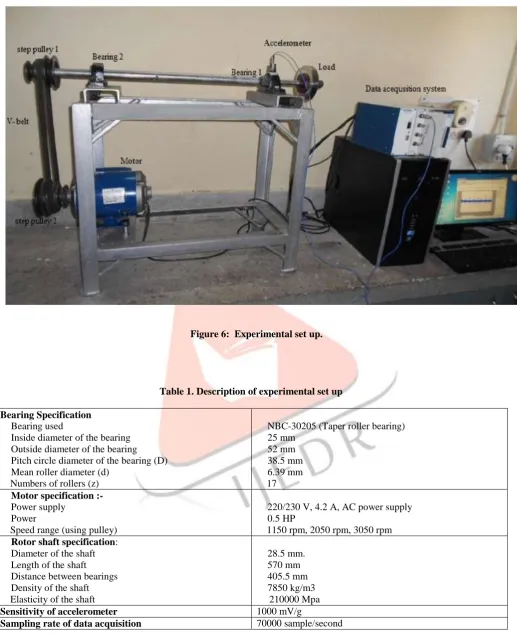
motor), two taper roller bearings, shaft, and V-belt pulley with having three speeds options. The material of shaft is mild steel. 4.1 Description of experimental set up
IJEDR1702096
International Journal of Engineering Development and Research (www.ijedr.org)560
Figure 6: Experimental set up.Table 1. Description of experimental set up
Bearing Specification Bearing used
Inside diameter of the bearing Outside diameter of the bearing Pitch circle diameter of the bearing (D) Mean roller diameter (d)
Numbers of rollers (z)
NBC-30205 (Taper roller bearing) 25 mm
52 mm 38.5 mm 6.39 mm 17 Motor specification :-
Power supply Power
Speed range (using pulley)
220/230 V, 4.2 A, AC power supply 0.5 HP
1150 rpm, 2050 rpm, 3050 rpm Rotor shaft specification:
Diameter of the shaft Length of the shaft Distance between bearings Density of the shaft Elasticity of the shaft
28.5 mm. 570 mm 405.5 mm 7850 kg/m3 210000 Mpa
Sensitivity of accelerometer 1000 mV/g
Sampling rate of data acquisition 70000 sample/second
IJEDR1702096
International Journal of Engineering Development and Research (www.ijedr.org)561
defects had been produced on the roller of the bearings. The approximate width and depth of the defect was 1.40 mm and 0.3 mm respectively. Figure 6 shows the different defects on the rollers of the bearing:Figure 7. Roller defect at 0o
5. Result and discussion: In this work, Empirical Mode Decomposition (EMD) technique has been used for the identification of the defectsin rollers of the bearings. Asfrom the EMD, different IMFs are obtained, then after selecting the appropriate IMF, envelope spectrum (FFT) and envelop (in time domain) of selected IMF are alsoplotted. The result (envelope spectrum) is also compared with the traditional FFT obtained directly from the raw signal. From the analysis it is observed that it is difficultto identify the defects on the roller by traditional FFT. However it can be easilydetected by EMD method.The experimental rotating frequency ′𝑓𝑛′ is 34.17 Hz and the sample rate is 70000samples/second. The defect frequency of the roller can be calculated from
equation(V) and fundamental train frequency/ cage frequency can be calculated from equation(II). In these equations the contact angle (𝛽) of the taper roller bearings is assumed to be zero. The values of 𝐷, 𝑑 are given in table 2. Theoretical bearing characteristicsfrequencies (BCF) for defects are shown in table 2.
Table 2. Theoretical BCF for faults
Fault Type Single roller groove defect (at 0o) Roller defect frequency for
𝑓𝑛=34.17 Hz
200.2 Hz Time interval of impacts 0.005 sec Samples between impacts 350 FTF for 𝑓𝑛= 34.17 Hz 14.2 Hz
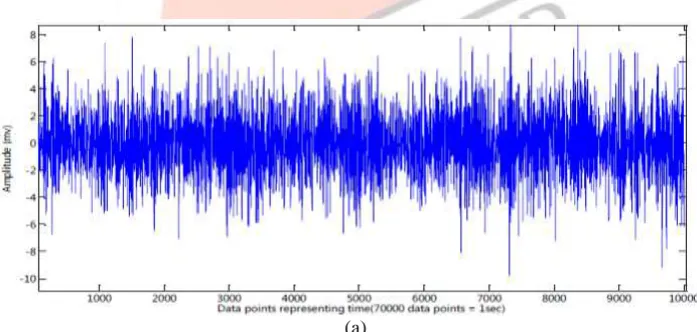
5.1 Identification of the single groove defect on the roller: Time domain waveform of an acceleration signal picked up from a 30205-taper rolling bearing without defect and with single groove defect of approximate width 1.4 mm and depth 0.3 mm on the roller is shown in Figure 7(a) and 7(b) respectively. No distinct impulse is observed in the raw signal of defect free bearing as shown in figure 7 (a). The amplitude of this signal lies in the range of +9 to -10 mV. The raw signal for bearing with single roller groove defect as shown in figure 7 (b) has high amplitude impulses and also its magnitude lies in the range of +35 to -30 mV which is much higher in comparison to amplitude of the signal for the defect free bearing. This indicates presence of defect on the defect in the bearing. Further for the defect identification Empirical Mode Decomposition technique is applied.Raw signal of the non-defective bearing is shown in below figure.
IJEDR1702096
International Journal of Engineering Development and Research (www.ijedr.org)562
(b)Figure 8. Raw signals of the non-defective bearing (Figure (a)) and bearing with single roller groove defect (Figure (b))
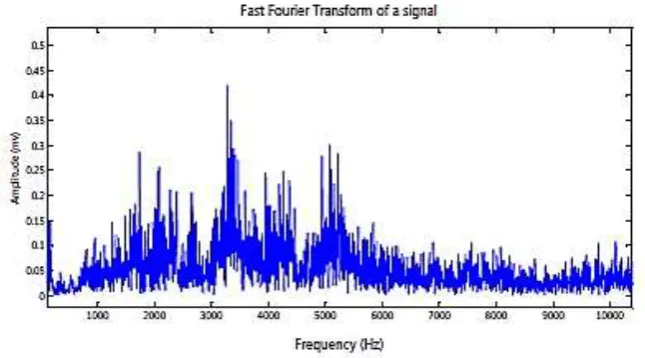
FFT of the defective signal (shown in figure 7 (b)) is obtained and the corresponding plot is shown in Figure 8. In this plot we didn‘t see any peak at the defect frequency. In Figure 8 the roller defect frequency (200.2 Hz) is hardly visible and most likely to be missed out in presence of more noise. Further, the peaks at BCF and its harmonics are so small that looking for a trend of amplitude is quite difficult. Thus it is evident that simple FFT analysis is not a suitable technique for bearing faults analysis.
Empirical mode decomposition (EMD) of the raw signal is carried out and the corresponding IMFs (1-4) are shown in Figure 9. Only first four IMFs are shown because defect frequency lie in the higher IMFs. As lower IMFs contain lower frequency component so lower IMFs are neglected. IMF selection in the present work is carried out according to the maximum kurtosis criteria as shown in Table 3. In this case IMF1 is selected out of other IMFs according to maximum kurtosis criteria.
IJEDR1702096
International Journal of Engineering Development and Research (www.ijedr.org)563
Figure 10. Time waveform of the first 4 IMFs for single roller groove defectTable 3. Kurtosis of the first 4 IMFs for defect on the rollers
IMF IMF1 IMF2 IMF3 IMF4
Kurtosis for single roller groove defect (at 0o) 62.934 20.341 16.518 20.998
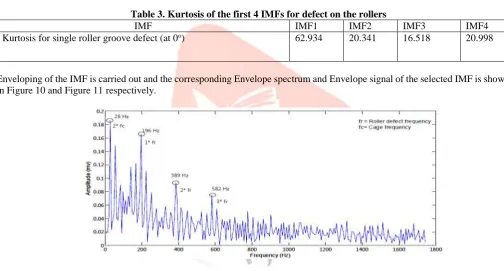
Enveloping of the IMF is carried out and the corresponding Envelope spectrum and Envelope signal of the selected IMF is shown in Figure 10 and Figure 11 respectively.
In the envelope spectrum (shown in figure 10) we observe a highest peak at 28 Hz. Which is second harmonics of cage frequency (14.2 Hz) and another high peak at 196 Hz, which is close to theoretical defect frequency of 200.2 Hz. Thus peak at 196 Hz in this plot indicate roller defect frequency. In this plot we observe roller defect frequency
IJEDR1702096
International Journal of Engineering Development and Research (www.ijedr.org)564
Figure 12. Envelope signal of the IMF1 for single roller groove defectEnvelope signal of the selected IMF of 0.1428 seconds duration is shown in Figure 11. Here highest peak is observed at A, which is due to defective roller impact at the outer race at top position in front of accelerometer. Roller after completing one complete cage rotation (5043 data points) reach again at the top in front of accelerometer, the same criteria can be observed by high magnitude peak at C. In between these peaks we see another high peak at B whose magnitude is less than peak at A and C, which indicate defective roller is at bottom position. Magnitude of the peak at B is less than peak at A and C, this because accelerometer is uni-axial and it can capture only vertical acceleration. Vertical acceleration is maximum at top and bottom
vertical position, since accelerometer in mounted on the top of the bearing casing so vibration produced at the bottom position get damped while reaching the accelerometer due to damping effect of bearing structure. So peak at B is due to defective roller at the bottom position. Roller impact interval (Ti) (Impact interval is the time interval between the two impacts) of 358 data points (0.00511 seconds) is calculated by taking average from 12 bursts when defective roller strikes at the top and bottom position on the bearing, which also indicates defective frequency of 195.7Hz (approximately 196 Hz).
5. 2 Results: From the above discussion it is concluded that, when the FFT is directly applied to theraw signal, it is not able to identify the defects in the bearings. But using empiricalmode decomposition (EMD) technique the defects in the rollers at different positionscan be identified. So it appears that EMD is very powerful signal processing technique in the fault diagnosis of the rolling elements of bearings. In the present work we haveused EMD along with envelope analysis to detect the faults of the roller bearings. Theexperimental result shows that the proposed method can effectively diagnose the faults on the rolling element bearing. Experiments in this study have verified that theproposed procedure of using the suitable IMF is a superior approach for theidentification of defects in the bearings. As far the accuracy of the proposed method is concerned, there is inappreciable deviation in the results from the theoretical values as shown in the table 4.
Table 4. Compression of theoretical and experimental defect frequency
Fault type Theoretical value of defect frequency
Experimental value of defect frequency
Percentage (%) deviation Single roller
groove defect (0⁰)
200.2 196 2.1
6 CONCLUSIONS: Overall conclusions of the conducted work are as follows:
Empirical Mode Decomposition (EMD) is a self-adaptive signal processing method that can be applied to non-linear and non-stationary processes effectively. It improves traditional FFT method in applying harmonic functions to show all kinds of faulty signals into a sequence of amplitude modulation/frequency modulation.
Frequency band range in each IMF ranges from high to low frequency in the signal. EMD can be combined with the envelope analysis as a detecting tool for the bearing fault analysis.
Maximum kurtosis criteria for the selection of IMF give batter result. Higher value of kurtosis reveals the presence of defects in the bearings. The IMF with maximum kurtosis is used for the analysis of defect. For single roller groove defect IMF1 has the maximum kurtosis value of 62.934.
IJEDR1702096
International Journal of Engineering Development and Research (www.ijedr.org)565
The results obtained by the proposed method are very close to the theoretical values of the defects. The roller defect frequency, for single roller groove deviate 2.1 % from the theoretical value of the defect frequency.
REFERENCES
[1] Hale, V. and Mathew, J. 1995. High and low speed bearings, in Condition Monitoring Frontiers, the second Forum. Melbourne, Australia pp. 21-30.
[2] Chen, C. and Mo. 2004. A method for intelligent fault diagnosis of rotating machinery. Digital Signal Processing. 14(3): 203–210
[3] Friswell, M. I., Litak, G. and Sawicki, J. T. 2010. Crack identification in rotating machines with active bearings. Proceeding ISMA, Leuven (Belgium). pp. 2843-2856
[4] Alfredson, R. J. and Mathew, J. 1985. Time domain methods for monitoring the condition of rolling element bearings. Mechanical Engineering Transactions Institution of Engineers, Australia. ME 10 (2): 102-107.
[5] Tandon, N. and Choudhury, A. 1999. A review of vibration and acoustic measurement methods for the detection of defects in rolling element bearings. Tribology International. 32 (8): 469-480
[6] Igarashi, T. and Hamada, H. 1982. Studies on the vibration and sound of defective rolling bearings. (First report: vibration of ball bearings with one defect) Bull. JSME. 25(204): 994-1001.
[7] Brown, D. N. 1989. Envelope analysis detects bearing faults before major damage occurs. Pulp & Paper. 63: 113- 117. [8] Taylor, J. I. 1980. Identification of the bearing defects by spectral analysis. ASME Journal of Mechanical Design. 102:
199-203.
[9] McFadden, P. D., and Smith, J. D. 1984. Vibration monitoring of rolling element bearings by the high frequency resonance techniques-a review. Tribology International. 17: 3-10.
[10] Osugawu, C., and Thomas, D. 1982. Effect of inter-modulation and quasi-periodic instability in the diagnosis of the rolling element incipient defect. Trans ASME, Journal of Mechanical Design. 104 (2): 296-302.
[11] Miyachi, T. and Seki, K. 1986. An investigation of the early detection of defects in ball bearings using vibration monitoring - practical limit of detectability and growth speed of defects. Proceedings of the International Conference on Rotor dynamics, JSMEIFToMM Tokyo. pp. 403-408.
[12] Mathew, J., and Alfredson, R. J. 1984. The condition monitoring of rolling element bearings using vibration analysis. ASME, Journal of Vibration an Acoustics. 106: 447-453.
[13] Heng, R. B. W. and Nor, M. J .M. 1998. Statistical analysis of sound and vibration signals for monitoring rolling element bearing condition. Applied Acoustics. 53: 211-226.
[14] Williams, T., Ribadeneira, X., Billington, S., and Kurfess, T. 2001. Rolling element bearing diagnostics is run-to-failure lifetime testing. Mechanical System and Signal Processing. 15(5): 979-993.
[15] Kankar, P.K., Sharma, S. C., Harsha, S.P. 2011. Rolling element bearing fault diagnosis using wavelet transform. Neurocomputing. 74: 1638–1645.
[16]McFadden, P. D., and Smith, J. D. 1984. Vibration monitoring of rolling element bearings by the high frequency resonance techniques-a review. Tribology International. 17: 3-10
[17] Mcfadden, P. D., and Toozhy, M. M. 2000. Application of synchronous averaging to vibration monitoring of rolling element bearings. Mechanical Systems and Signal Processing. 14(6): 891–906.
[18] Huang, N. E., Shen, Z., Long, S. R. 1998. The empirical mode decomposition and the Hilbert spectrum for nonlinear and non-stationary time series analysis. Proceeding of the Royal Society London. (454) pp. 903–95
[19] Huang, N.E., Samuel, S. P. S. 2005. Hilbert-Huang transform and its applications. Singapore: World Scientific. [20] Geramitchioski, T. and Trajcevski, L. 2011. Prediction of rolling bearings defect in motor-fan using vibration signal
analysis. Machine Design. 3(3): 211-216.
[21] Wang, D., Miao, Q., Fan, X. and Huang, H. Z. 2009. Rolling element bearing fault detection using an improved combination of Hilbert and Wavelet transforms. Journal of Mechanical Science and Technology. 23: 3292-3301. [22] Mobely, R. K. 2001. Plant Engineers Hand Book. Butterworth-Heinemann.
[23] Cochran, W. T., Colley J. W. and Favin D. L. 1967. What is the Fast Fourier Transform? IEEE Transactions on Audio and Electro Autistic. AU-15, NO. 2.
[24] Proakis, J. G. and Salehi, M. 2000. Contemporary Communication Systems.Book Ware Companion Series.
[25]Kerschen, G., Vakakis, A. F., Lee, Y. S., McFarland, D.M. and Bergman, L.A. 2009. Toward a Fundamental Understanding of the Hilbert-Huang Transform in Nonlinear Structural Dynamics. Journal of Vibration and Control. 15: 1563-1579.