INTERNATIONAL RESEARCH JOURNAL OF PHARMACY
www.irjponline.com
ISSN 2230 – 8407
Research Article
PHYTOCHEMICAL ANALYSIS AND MOLECULAR DOCKING STUDIES OF SELECTED COMPOUNDS OF CENTELLA ASIATICA
L. Vijayakumar 1*, R. Mira Nishvanthi 2 and M.K.S. Pavithra 1
1Department of Biotechnology, Bannari Amman Institute of Technology, Sathyamangalam, India 2Faculty of Science, The University of Western Australia, Perth WA, Australia
*Corresponding Author Email: [email protected]
Article Received on: 07/09/17 Approved for publication: 02/10/17
DOI: 10.7897/2230-8407.0810190
ABSTRACT
The secondary metabolites of Centella asiatica is used as a brain stimulant in traditional medicine due to its efficacy and versatility. Alzheimer disease (AD) is a chronic neurodegenerative disease in which the brain cells degenerate, die and eventually leads to significant loss in mental functions related to memory, language, orientation and judgment. Reduced synthesis of acetylcholine is found to be one of the causes of Alzheimer’s disease, the condition in which there is an increase in level of acetylcholinesterase (AChE) leading to cognitive impairments due to the damage of cholinergic neurons. In addition to this, a number of other changes also promote deterioration of neuronal functions such as intracellular formation of neurofibrillary tangles, loss of neuronal synapses and pyramidal neurons and extracellular deposits of β-amyloid senile plaques. Synthetic drugs have attracted the research community to design safe and effective drugs for AD. In the present study, an attempt to identify natural neuroprotective compound was made on a set of 4 ligands from the plant Centella asiatica collected from ChemSpider Database. Among the 4 ligands in combination with 3 receptors, the madecassoside was found to have highest binding affinity i.e. -10.4, -10.3 and -12.0 with all the target proteins viz. AChE (4PDE), Tau protein (4F2L) and APP protein (3SUZ), respectively. The interaction of amino acid residues near their binding sites was also found.
Keywords: Centella asiatica,Alzheimer’s Disease, AChE, APP protein, Tau protein, Auto Dock Vina
INTRODUCTION
Natural products are produced by various forms of life such as plants, animals and microorganisms. Due to their diverse chemical nature, they thrive to become a major source for new drug discovery.1 In India, among various other life forms, plants
are being used as the source of natural products (called phytochemicals) in accordance with the traditional knowledge about their therapeutic uses.2 Recent researches show that
several phytochemicals protects human beings from diseases which are produced by the plants for their self defense.3 World
Health Organisation (WHO) estimated that about 80% of people from developing countries use traditional medicines at primary level for disease treatments due to their compatibility and less side effects.4
Centella asiatica (Gotu kola) is an annual herbaceous plant native of tropical and sub tropical countries. The major phytochemicals from the plant being exploited for its therapeutic nature are asiatic acid, asiaticoside, madecassic acid and madecassoside.5 It is used in the traditional medicinal systems of
India and China for various purposes, viz., treatment of eczema, ulcers wounds, diarrhea and leprosy, improvement of blood flow and as brain tonic. Antitumour, antifilarial, cytotoxic and antioxidant property of the plant were also reported.6
Alzheimer disease (AD) is a threat with medical, social and public health concern. It is a form of dementia that results in severe and permanent loss of cognitive functions leading to forgetfulness and irreversible loss of memory.7 The incidence of
AD increases with age and it was found to be extremely
progressive after the age of 65 and highly prevalent among females than males.8,9,10
Inspite of various well characterized histological features of AD, three major hypotheses have been reported to be the primary cause. Initiation of disease progression through cholinergic signal deficiency is the oldest hypothesis, the other two alternative hypothesis implies that the initiation of cascade by either tau protein or β-amyloids.
Based on cholinergic hypothesis, damage of cholinergic neurons results from increase in the level of AchE that lead to cognitive impairment. The current treatment practices target neurotransmitter systems that rely only upon control of symptoms which do not play any role in reversion or slowing down its progression.11 Acetylcholinesterase inhibitors intervene
with acetylcholine breakdown thus help to improve reminiscence function and attention in AD patients.12
Bioactive compounds isolated from Centella asiatica were studied by various researchers. But there were no report on molecular docking studies of those compounds against proteins involved in Alzheimer’s disease. Hence, the present work focus on designing a drug against AD using lead compounds isolated from C. asiatica.
MATERIALS AND METHODS
Collection and Processing of Plant Material
washed methodically to remove dirt and debris under running tap water and dried at room temperature. Dried leaves were then milled, sieved and stored at room temperature in an air tight container.
Preparation of Plant Extract
The dried leaf powder (500 g) was extracted using 70% aqueous ethanol at 40ºC for 2 h. Crude extract was then obtained from the filtrate at 40ºC under reduced pressure using a rotary evaporator and stored at 4ºC in a refrigerator for further use. A known quantity of dried extract was suspended in water and continuously partitioned with ethyl acetateand n-butanol . Each solute fraction was then concentrated to obtain ethyl acetate and butanol fractions under vacuum.13
Determination of Total Phenol Content
Total phenol concentration in the three fractions viz. 70% ethanol, ethyl acetate and butanol was determined by spectrophotometric method adopted with suitable modifications.13,14 For analysis, each sample was prepared in
triplicates and the mean value of absorbance was obtained. To 0.5 ml of the sample, 3 ml of distilled water and 0.5 ml of 2N Folin-Ciocalteu’s reagent was added, kept aside at room temperature (RT). After 8 min, 1.5 ml of 20% NaHCO3 was
added to the reaction mixture and incubated at RT for 2 h. Following incubation, absorbance of the resulting blue colored complex was measured at 765 nm. Standard calibration curve was prepared using gallic acid (GA). The total phenolic concentration of the samples were read (mg/ml) from calibration curve based linear equation and expressed as mg gallic acid equivalents.
Determination of Total Flavonoid Content
TFC of the samples were assessed by a colorimetric method reported earlier.15 To 4 ml of distilled water in 10 ml volumetric
flasks, 1 ml aliquot of the samples and 0.3 ml of 5% of NaNO2
was added. After each five minutes interval, 0.3 ml 10% AlCl3
and 2 ml 1M NaOH was added. Total volume was made up to 10 ml using distilled water, mixed well and absorbance was measured at 510 nm. Standard calibration curve was prepared using quercetin. Total flavonoid concentration was calculated using calibration curve based linear equation and expressed as mg quercetin equivalents.
Estimation of Antioxidant Activity
Antioxidant activity of the leaf extracts were measured by modified DPPH (1,1-diphenyl-2-picrylhydrazyl) method.16 In a
test tube, to varying concentrations of the extract, freshly prepared DPPH solution was mixed together and incubated in dark at room temperature for 20 min. After incubation using UV-VIS spectrophotometer, a decrease in absorption was measured at 517 nm and the percentage inhibition was calculated using the following formula:
% inhibition = (Ac – As) x 100 / Ac
Where As and Ac is the absorbance of DPPH solution with and
without extract, respectively. Ascorbic acid was used as a standard and percentage inhibitions of the standard and samples were plotted against concentrations. IC50 (half-maximal
inhibitory concentration) was calculated as the amount of every sample (antioxidant) required to reduce 50% of the initial DPPH
concentration. The experiment was performed in triplicate and the result was represented as Mean values + Standard deviation.
Qualitative Analysis of Leaf Extract by HPLC
Butanol fraction of the C. asiatica leaf extract was qualitatively analyzed for detecting the presence of active ingredients by gradient liquid chromatographic system. High-performance liquid chromatography (Model 1220 LC series; Agilent, Califonia, USA) with 10 ml sample loop and a diode array detector was used. The reagents used were HPLC grade and filtered using 0.45 mm Millipore filter before use. Chromatographic separation was performed using with YMC - ODS column (250 mm X 4.6 mm) and the mobile phase was a gradient of acetonitrile/water as mentioned in Table 1. The flow rate was maintained at 1.3 ml/min, the column temperature and wavelength of the detector was 26ºC and 210 nm, respectively.
Docking Studies
The binding affinity of ligand and protein was determined by using AutoDock Vina.17 3D SDF format of four active
ingredients (ligands) from the plant Centella asiatica were collected from PubChem database http://puBChEm.ncbi. nlm.nih.goc/. Auto Dock Pdb format of the molecules were fetched using https://cactus.nci.nih.gov/translate/. Three proteins (AChE, APP and Tau) that are associated with Alzheimer’s disease were retrieved from Protein Data Bank and docked with the ligands taken from Pubchem database (https://pubchem .ncbi.nlm.nih.gov/). PMV-1.5.6 was used to predict the Pymol interaction of the active ingredients with binding pockets on the active sites of three proteins.
RESULTS AND DISCUSSION Total Phenolic and Flavonoid Content
Ethanol, ethyl acetate and butanol fractions of C. asiatica leaves were prepared to measure total phenolics, flavonoid content and antioxidant property. Total flavonoid and phenol content values with different extracts were shown in Table 2. TPC values were obtained from the standard curve equation, y = 6.8189x with R2= 0.9945 and expressed as mg/g GA equivalent. The
concentration of phenolic content in different extracts ranged from 9.7 to 178.9 mg/g in the following increasing order Butanol fraction > 70% Ethanol fraction > Ethyl acetate fraction. Ethyl acetate fraction was found to be containing the highest concentration of phenolics than ethanol and butanol fractions.
Total flavonoid content (TFC) was determined from the calibration curve y = 0.0276x-0.072 with R2 = 0.9923 and
expressed in terms of quercetin equivalent as mg/g. TFC of various fractions was found to be in the following order, 70% Ethanol fraction > Butanol fraction > Ethyl acetate fraction with highest and lowest concentration range of 382.4 and 43.5, respectively. Among three different leaf extracts of C. asiatica, ethyl acetate fraction contains high concentration of phenolics and flavonoids. According to the earlier reports, concentration of phenolics and flavonoids in the solvent extracts depends on their solubility nature and type of the solvent used. 18,19,20
Antioxidant Activity
of percentage of inhibition and IC50 values. Ethyl acetate
fraction showed the maximum DPPH radical inhibition of 94.78% and neutralized 50% of free radicals at 48.13 μg/mL. IC50 values were not calculated for ethanol and butanol extracts
due to their moderate to low antioxidant activity (Table 2).
Based on the earlier reports, it was found that the plant extract obtained using polar solvent contain high concentration of phenolic substances that have a considerable linear association with antioxidant activity due to their scavenging ability.21,22 The
high phenolic concentration (178.9 mg GAE/g) of ethyl acetate fraction shows linear relationship between phenolic content and antioxidant activity. It was found that flavonoids also produce significant antioxidant property depending on their structure and substitution pattern of –OH groups.23 Data pertaining to total
flavonoid estimation shows that TFC of ethanol extract was lower than butanol fraction, but the antioxidant activity was found to be higher. From the earlier reports, it was assumed that butanol extract of C. asiatica leaves contain flavonoid glycosides that disturbs the double bond exist between C-2 and C-3 and a free –OH group at C-3 of flavonoids.13 These
activities limits the inhibition of oxidation processes by flavonoids present in butanol fractions and thus results in the dropping off antioxidant activity.
HPLC Analysis of Phytochemicals
Compared with the HPLC report of crude ethanolic fraction, butanolic fraction shows enriched concentration of triterpenes, asiaticoside, asiatic acid, madecassoside and madecassic acid (Figure 1). This confirms the removal of undesirable impurities during the extraction of triterpenes with butanol. Asiaticoside starts crystallizing out in the aqueous layer. Repeated washing with butanol shall recover asiaticoside from butanol fraction.
Further, purification processes shall be carried out to isolate the triterpenes each in its pure form.
Docking Studies on Compounds Against Proteins Involved in Alzheimer’s Disease
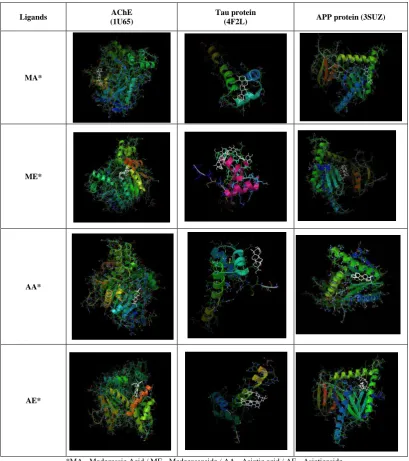
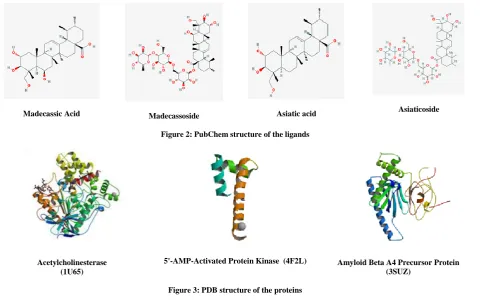
An attempt to identify a natural neuroprotective compound was made on a set of 4 ligands from the plant, C. asiatica, collected from PubChem Database (Figure 2). These compounds were docked against human AChE (4PDE), Tau protein (4F2L) and APP protein (3SUZ) retrieved from Protein Data Bank (Figure 3) using Auto Dock Vina. Their binding affinity and interaction of amino acid residues near their binding sites were also found.17
Based on pymol interaction predicted by PMV-1.5.6 (Table 3) and Castp, the following amino acid residues ASN 482, PRO 469, GLU 491, ARG 479, TYR 479, TRP 600, LEU 518, ASN 490, PHE 307, LEU 308, SER 215, PRO 216, LEU 314, ARG 219, LEU 213, SER 218, PHE 222, GLN 176, MET 149, LEU 180, TYR 337, TYR 341, TYR 124, TYR 286, LEU 289, HIS 287, ARG 347, THR 234, GLN 389, VAL 379, LCU 540, PRO 235, TRP 532, PRO 312, THR 371, PHE 300, ALA 323, LEU 326, ARG 332, HOH 533, HOH 508, LEU 308, SER 309, HOH 522, TYR 312, PHE 308, ALA 323, PRO 319, LEU 326, ILE 548, PHE 521, TYR 460, ILS 461, ASN 623, GLY 641, THR 625, ILE 638, LYS 640, THR 634, SER 545, ILE 548, PHE 521, GLY 518, LYS 391, LEU 642, ILE 638 and THR 624 were found to be present in the binding pocket.
Among 4 ligands studied in combination with 3 receptors, madecassoside was found to have the highest binding affinity i.e., -10.4, -10.3 and -12.0 with all the target proteins viz. AChE (1U65), Tau protein (4F2L), and APP protein (3SUZ), respectively (Table 4).
Table 1: Gradient conditions for HPLC
Time (Min)
Pump A Water(%)
Pump B Acetonitrile (%)
0 84 16
20 70 30
40 58 42
59 50 50
70 15 85
76 84 16
Table 2: Total flavonoid/phenolic content and antioxidant activities of different fractions
Sample Total Flavonoid+
(mg/g)
Total Phenol+
(mg/g)
% DPPH Radical Inhibition* Butanol Fraction 79.2+0.62 9.7+0.33 13.23 70% Ethanol Fraction 43.5+0.94 27.2+0.29 43.25 Ethyl Acetate Fraction 382.4+1.28 178.9+0.82 94.78
+Each value is the average of 3 analysis+Std. deviation
Table 3: Pymol visual image of protein and ligand docking
Ligands AChE
(1U65)
Tau protein
(4F2L) APP protein (3SUZ)
MA*
ME*
AA*
AE*
*MA - Madecassic Acid / ME - Madecassoside / AA - Asiatic acid / AE - Asiaticoside
Table 4: Binding affinity between various proteins and ligands predicted using pymol
Ligands Proteins
AChE (1U65) Tau protein (4F2L) APP protein (3SUZ)
Madecassic Acid -6.6 -6.0 -8.3
Madecassoside -10.4 -10.3 -12.0
Asiatic acid -6.3 -6.3 -7.9
Asiaticoside -10.5 -8.9 -11.8
Madecassic Acid Madecassoside Asiatic acid Asiaticoside
Figure 2: PubChem structure of the ligands
Acetylcholinesterase (1U65)
5'-AMP-Activated Protein Kinase (4F2L) Amyloid Beta A4 Precursor Protein (3SUZ)
Figure 3: PDB structure of the proteins
CONCLUSION
Since the therapeutic role of various phytochemicals from
Centella asiatica were carried out by different researchers, the present study focused on evaluating antioxidant property of various extracts and also docking of active ingredients against proteins involved in alzheimer’s disease. On comparison with 70% ethanol and butanol fractions, ethyl acetate fraction showed high phenolic content and DPPH activity. Further, biochemical analysis shall be carried out to validate the compounds in ethyl acetate fraction. From the study, it was also found that madecassoside has high affinity against the selected proteins which may be recommended as one of the potential therapeutic agent for treating AD.
REFERENCES
1. Li J, Vederas J. Drug Discovery and Natural Products: End of an Era or an Endless Frontier?. Science [Internet]. 2009 [cited 19 September 2017];325(5937):161-165. Available from: http://science.sciencemag.org/content/
325/5937/161.long
2. Sharma RK, Arora R. Herbal Drugs - A Twenty First Century Perspective. 1st ed. New Delhi: Jaypee Brothers Medical Publishers; 2006.
3. Narasinga Rao. Bioactive phytochemicals in Indian foods and their potential in health promotion and disease prevention. Asia Pacific Journal of Clinical Nutrition [Internet]. 2003 [cited 19 September 2017];12 (1):9-22. Available from: http://apjcn.nhri.org.tw/server/apjcn/ 12/1/9.pdf
4. Yadav, N.P., Dixit, V.K,. Recent approaches in herbal drug standardization. International Journal of Integrative Biology [Internet]. 2008 [cited 19 September 2017]; 2(3):195-203.
Available from:
http://staff.cimap.res.in/PublicationFiles/Journal_of_Integrat ive_Biology.pdf
5. Biradar S. Extraction of Some Secondary Metabolites &Thin Layer Chromatography from Different Parts of Centella Asiatica L. (URB). American Journal of Life Sciences [Internet]. 2013 [cited 19 September 2017];1(6):243. Available from: http://www.science publishinggroup.com/journal/paperinfo?journalid=118&doi =10.11648/j.ajls.20130106.11
6. Ullah MO, Sultana S, Haque A, Tasmin S. Antimicrobial, cytotoxic and antioxidant activity of Centella asiatica. European Journal of Scientific Research 2009, 30(2):260-264.
7. Korolev IO. Alzheimer’s Disease: A Clinical and Basic Science Review. Medical Student Research Journal 2014; 4:024-033.
8. Ott, A., Breteler, M., van Harskamp, F., Claus, J., van der Cammen, T., Grobbee, D. and Hofman, A. (1995). Prevalence of Alzheimer's disease and vascular dementia: association with education. The Rotterdam study. BMJ, [online] 310(6985), pp.970-973. Available at: https://www.ncbi.nlm.nih.gov/pmc/articles/PMC2549358/pd f/bmj00588-0024.pdf [Accessed 19 Sep. 2017].
9. Querfurth, H. and LaFerla, F. (2010). Alzheimer's Disease. New England Journal of Medicine, [online] 362(4), pp.329-344. Available at: http://www.nejm.org/doi/full/10.1056/ NEJMra0909142 [Accessed 19 Sep. 2017].
10.Hebert, L., Scherr, P., McCann, J., Beckett, L. and Evans, D. (2001). Is the Risk of Developing Alzheimer's Disease Greater for Women than for Men?. American Journal of Epidemiology, 153(2), pp.132-136.
11.Holtzman, D., Morris, J. and Goate, A. (2011). Alzheimer's Disease: The Challenge of the Second Century. Science Translational Medicine, [online] 3(77), pp.77sr1-77sr1. Available at: https://www.ncbi.nlm.nih.gov/pmc /articles/PMC3130546/ [Accessed 19 Sep. 2017].
at: http://science.sciencemag.org/content/298/5594/789/tab-pdf [Accessed 19 Sep. 2017].
13.Dewi, R. and Maryani, F. (2015). Antioxidant and
α-Glucosidase Inhibitory Compounds of Centella Asiatica. Procedia Chemistry, [online] 17, pp.147-152. Available at:
http://ac.els-cdn.com/S1876619615002788/1-s2.0- S1876619615002788-main.pdf?_tid=ee90a61e-9e07-11e7-bb95-00000aab0f26&acdnat=
1505914436_680ba84e30119c67fb0d62693d81d7b6 [Accessed 19 Sep. 2017].
14.Singleton, V., Orthofer, R. & Lamuela-Raventós, R. (1999) Analysis of total phenols and other oxidation substrates and antioxidants by means of folin-ciocalteu reagent. [online] 299, pp.152-178. Availablefrom:http://www.scirp.org /(S(351jmbntvnsjt1aadkposzje))/reference/ References Papers.aspx?Reference ID=1272476. [Accessed 2017 09 -19].
15.Zhishen, J., Mengcheng, T. and Jianming, W. (1999). The determination of flavonoid contents in mulberry and their scavenging effects on superoxide radicals. Food Chemistry, [online] 64(4), pp.555-559. Available at: http://dns2.asia.edu.tw/~ysho/YSHO-English/1000%20 China%20(Independent)/PDF/Foo%20Che64,%20555.pdf [Accessed 19 Sep. 2017].
16.Shimada, K., Fujikawa, K., Yahara, K. and Nakamura, T. (1992). Antioxidative properties of xanthan on the autoxidation of soybean oil in cyclodextrin emulsion. Journal of Agricultural and Food Chemistry, [online] 40(6), pp.945-948. Available at: http://pubs.acs.org/doi/abs/ 10.1021/jf00018a005 [Accessed 19 Sep. 2017].
17.Vanaja, D. and Yellamma, K. (2012). Molecular Docking Studies on Evolvulus Alsinoides Compounds Against TAU Protein in Alzheimer’s Disease. International Journal of Scientific Research, [online] 3(1), pp.21-24. Available at: https://www.researchgate.net/publication/311791458_Molec ular_docking_studies_on_compounds_extracted_from_the_ herbal_plant_Evolvulus_alsinoides_against_proteins_involv ed_in_Alzheimer's_disease [Accessed 19 Sep. 2017]. 18.Zhou, K. and Yu, L. (2004). Effects of extraction solvent on
wheat bran antioxidant activity estimation. LWT - Food
Science and Technology, [online] 37(7), pp.717-721. Available at: https://www.deepdyve.com/lp/elsevier/effects- of-extraction-solvent-on-wheat-bran-antioxidant-activity-35ikZwOZNn [Accessed 19 Sep. 2017].
19.Mohsen, S. and Ammar, A. (2009). Total phenolic contents and antioxidant activity of corn tassel extracts. Food Chemistry, [online] 112(3), pp.595-598. Available at: https://www.cabdirect.org/cabdirect/abstract/20093024122 [Accessed 19 Sep. 2017].
20.Gao, M. and Liu, C. (2005). Comparison of Techniques for the Extraction of Flavonoids from Cultured Cells of Saussurea medusa Maxim. World Journal of Microbiology and Biotechnology, [online] 21(8-9), pp.1461-1463. Available at: https://link.springer.com/article/ 10.1007%2Fs11274-005-6809-1 [Accessed 19 Sep. 2017]. 21.Siriwardhana, S. and Shahidi, F. (2002). Antiradical activity
of extracts of almond and its by-roducts. Journal of the American Oil Chemists' Society, [online] 79(9), pp.903-908. Available at: https://www.researchgate.net/publication/ 225333250_Antiradical_activity_of_extracs_of_
22.almond_and_its_by-products [Accessed 19 Sep. 2017]. 23.Osun, M., Ercisli, S., Sengul, M., Ozer, H., Polat, T. and
Ozturk, E. (2009). Antioxidant Properties and Total Phenolic Content of Eight Salvia Species from Turkey. Biological Research, [online] 42(2). Available at: http://www.scielo.cl/pdf/bres/v42n2/art05.pdf [Accessed 19 Sep. 2017].
24.Sharififar, F., Dehghn-Nudeh, G. and Mirtajaldini, M. (2009). Major flavonoids with antioxidant activity from Teucrium polium L. Food Chemistry, [online] 112(4), pp.885-888. Available at: https://www.cabdirect.org/ cabdirect/abstract/20093029936 [Accessed 20 Sep. 2017].
Cite this article as:
L. Vijayakumar et al. Phytochemical analysis and molecular docking studies of selected compounds of Centellaasiatica. Int. Res. J. Pharm. 2017;8(10):103-108 http://dx.doi.org/10.7897/ 2230-8407.0810190
Source of support: Nil, Conflict of interest: None Declared