INTERNATIONAL RESEARCH JOURNAL OF PHARMACY
www.irjponline.com
ISSN 2230 – 8407
Research Article
GREEN ROUTE FOR EFFICIENT SYNTHESIS OF BIOLOGICALLY ACTIVE SCHIFF BASE LIGAND
DERIVED FROM 2 – HYDROXY ACETOPHENONE: STRUCTURAL, SPECTROSCOPIC,
ANTI MICROBIAL AND MOLECULAR MODELING STUDIES
M. Sravanthi
1, B. Kavitha
2and P. Saritha Reddy *
11
Department of Chemistry, Osmania University, Hyderabad, Telangana State, 500007, India
2
Department of Chemistry, University College for Women, Osmania University, Koti, Hyderabad, Telangana State,
500095, India
*Corresponding Author Email: [email protected]
Article Received on: 10/01/19 Approved for publication: 22/02/19
DOI: 10.7897/2230-8407.1003107
ABSTRACT
A Novel Schiff base as ON donor was synthesized by green methodology by condensation of 2-hydroxyacetophenone with Furfurylamine via microwave assisted reaction in fruit juice medium. Thus an efficient, green, cost-effective and eco-friendly method has been developed, using some common fruit juices as current approach of synthesizing Schiff base which has given a new direction in the field of green chemistry. This method was also compared with conventional method and grinding method for determination of production efficiency and production economic. The Schiff base was characterized based on the results obtained from CHN analysis, NMR, FTIR, LCMS and electronic spectral data. The geometry of the Schiff base was evaluated using molecular calculation with Argus lab software. The Schiff base ligand was tested for antibacterial activity against Gram positive
bacteria Staphylococcus aureus and Bacillus subtilis and Gram negative bacteria Escherichia coli and Pseudomonas aeruginosa, and antifungal activity
against Fusarium oxysporum and Fusarium recini, where the ligand showed good biological activity.
Keywords: Microwave methods, fruit juices, 2-hydroxyacetophenone, Schiff base, Argus lab software, antimicrobial activity.
INTRODUCTION
Green Chemistry approach is an eco-friendly approach and has tremendous applications for the synthesis of various organic compounds and key intermediates in recent past. This technique involves an alternative reaction media to replace hazardous and expensive solvents routinely used in organic synthesis1. Solvent
free reactions need shorter reaction time, simpler and more efficient workup procedures, more improved selectivity’s and easier separations and purifications than conventional solvents2.
Recently fruit juices are known to be potential organic solvents for the synthesis of compounds of pharmaceutical importance3.
The wide spread applications of different natural acid catalyst like fruit juices4 are due to their non-toxic, safe, inexpensive and
environmental benign nature.
Schiff base is a nitrogen analogue of aldehyde or ketone in which C=O is replaced by C=N-R group, formed by the condensation of an aldehyde or ketone with a primary amine5. Schiff bases and
their bio-active complexes have been studied extensively over the past decade. Schiff bases are useful chelators because of their ease of preparation, structural varieties, varied denticities and subtle steric and electronic control on their frame work. Many Schiff base ligands have been reported by virtue of their potential in industrial applications6, pharma, drug and catalysis. Schiff base
ligands have shown wide variety of applications in the medicinal and biological fields such as antibacterial7, anti-proliferative8,
antimalarial, antifungal9, anticancer10, anti-inflammatory,
antiviral and antipyretic properties. Considering the numerous applications of Schiff bases in various fields of chemistry, there has been tremendous interest in developing efficient methods for
their preparation. The principles of Green chemistry apply to most of the synthetic routes with microwave irradiation. Microwave assisted reactions are cleaner, last only very few minutes, have high yield and produced minimum waste. Another method which can be more advantageous is synthesis of Schiff bases by employing fruit juice’s as green catalyst for green approach.
Our present work focuses on the green synthesis of Schiff base from 2-hydroxyacetophenone, a bidentate ligand11 and
Furfurylamine using green catalysts like fruit juices of lemon, orange, amla12 and a comparative study of the formed Schiff base
via condensation reaction and green methods. The structure of the synthesized ligand was confirmed by elemental analysis, spectral techniques and its anti -microbial activity was studied.
MATERIALS AND METHODS
Pseudomonas aeruginosa (gram negative), Staphylococcus aureus and Bacillus subtilis (gram positive)bacteria and fusarium oxysporum and fusarium recini fungal species.
Synthesis of Schiff base condensation method
The Schiff base (HL”) was prepared (Figure 1) by refluxing a mixture of equimolar quantities of 2-hydroxyacetophenone (1.3615gm, 0.01M) and Furfurylamine (0.9712, 0.01M)13 in hot
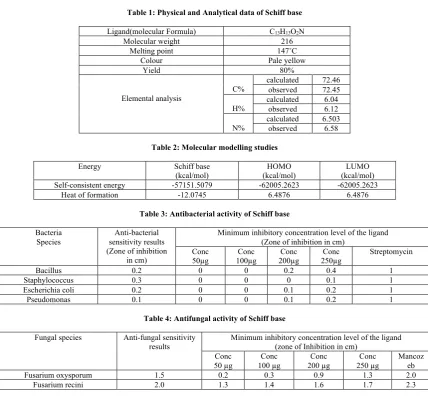
ethanol in presence of 3-4 drops of glacial acetic acid. After 6-8h of refluxing, the reaction mixture was poured in ice cooled water and pale yellow solid which separated, was filtered, washed with ethanol and ether. The product was recrystallized from hot ethanol. The elemental analysis (S:1) was carried out for the newly synthesized ligand and analytical data was tabulated in Table 1.
Synthesis of Schiff base by Grinding method
The equimolar (1:1) ratio of 2-hydroxyacetophenone and Furfurylamine was grounded14 in a motor-pestle for about 1hr
until the reaction mixture solidifies little and left overnight for the completion of the reaction. The reaction progress was monitored by TLC. The product obtained is recrystallized from hot ethanol.
Synthesis of Schiff base by Microwave method
The equimolar (1:1) ratio of 2-hydroxyacetophenone and Furfurylamine was mixed in presence of 2drops of glacial acetic acid in a crucible and was then irradiated in the microwave oven
of 250W capacity .The completion of the reaction was monitored by TLC. In a span of 14-15mins the reaction was completed resulting in pale yellow solid with yield 80%-85%.
Synthesis of Schiff base in presence of Fruit juice
Preparation of catalyst: Lemon, orange and amla fruits were procured locally. lemon were pressed in fruit juicer and filtered with cotton to get liquid juice15,while orange fruits were peeled
off with knife and slices were pressed in juicer and filtered through muslin cloth. The hard fleshy green material of amla fruit (5g) was boiled with water( 50ml),cooled and filtered with muslin cloth to get clear juice which acts as catalyst.
Synthesis of Schiff base with lemon, orange and aq.extract of amla under solvent free condition: Equimolar amounts of 2-hydroxyacetophenone (0.1mol) with Furfurylamine (0.1mol) were taken in 100ml beaker. Variable amounts of (0.5ml,1ml,1.5ml,2.0ml) of natural acid catalyst i.e., lemon juice was added to the reaction mixture and kept for stirring16 at room
temperature for 2 mins and microwaved 17 for 4-6 mins for
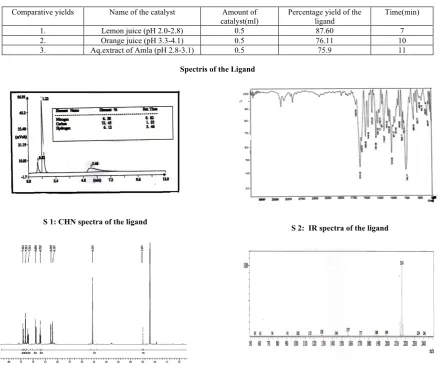
completion of the reaction . Reaction progress is monitored by TLC. Melting point of the product was checked by open capillary tube. The process is repeated with orange and amla juice. The results are tabulated in Table: 5.
Table 1: Physical and Analytical data of Schiff base
Ligand(molecular Formula) C13H13O2N
Molecular weight 216
Melting point 147˚C
Colour Pale yellow
Yield 80%
Elemental analysis
C%
calculated 72.46
observed 72.45
H%
calculated 6.04
observed 6.12
N%
calculated 6.503
observed 6.58
Table 2: Molecular modelling studies
Energy Schiff base
(kcal/mol) (kcal/mol) HOMO (kcal/mol) LUMO
Self-consistent energy -57151.5079 -62005.2623 -62005.2623
Heat of formation -12.0745 6.4876 6.4876
Table 3: Antibacterial activity of Schiff base
Bacteria Species
Anti-bacterial sensitivity results (Zone of inhibition
in cm)
Minimum inhibitory concentration level of the ligand (Zone of inhibition in cm)
Conc
50µg 100µg Conc 200µg Conc 250µg Conc Streptomycin
Bacillus 0.2 0 0 0.2 0.4 1
Staphylococcus 0.3 0 0 0 0.1 1
Escherichia coli 0.2 0 0 0.1 0.2 1
Pseudomonas 0.1 0 0 0.1 0.2 1
Table 4: Antifungal activity of Schiff base
Fungal species Anti-fungal sensitivity
results
Minimum inhibitory concentration level of the ligand (zone of Inhibition in cm)
Conc 50 µg Conc 100 µg Conc 200 µg Conc 250 µg Mancoz eb
Fusarium oxysporum 1.5 0.2 0.3 0.9 1.3 2.0
Table 5: Comparative yields of the ligand in various fruit juice media
Comparative yields Name of the catalyst Amount of
catalyst(ml)
Percentage yield of the ligand
Time(min)
1. Lemon juice (pH 2.0-2.8) 0.5 87.60 7
2. Orange juice (pH 3.3-4.1) 0.5 76.11 10
3. Aq.extract of Amla (pH 2.8-3.1) 0.5 75.9 11
Spectris of the Ligand
S 1: CHN spectra of the ligand
S 2: IR spectra of the ligand
S3: 1H-NMR spectra of the ligand S4: LCMS spectra of the ligand.
S5: Electronic spectra of the ligand
2-hydroxy acetophenone furfurylamine
Fig 1: Formation of The Ligand
OH O
O
NH2
OH N
Ligand HOMO LUMO
Fig 2: Molecular modelling structures of the Ligand, HOMO, LUMO
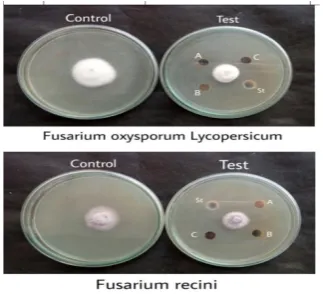
Fig 3: Zone Of Inhibition Against bacterial and fungal species.
Fig 4: Zone of Inhibition against bacterial and fungal strains
Fig 5: Comparative antimicrobial activity of the Ligand.
RESULTS AND DISCUSSION
Physical Properties and Elemental Analysis
The results obtained from CHN analysis (S :1) of the synthesized ligand was described in Table 1. The melting point of the ligand was found to be 147ºc.The analytical data and data obtained from spectral analysis suggests its molecular formula to be C 13H 13O 2N. The proposed structure of Schiff base is given in Figure 1.
FT-IR studies
IR spectrum of the Schiff base ligand (S :2) showed a sharp band at 1614cm-1 which is assigned to ʋ(C=N) mode of the azomethine
group and a band at 3153 cm-1(s) is assigned to phenolic ʋ(OH).A
broad band at 1267 cm-1 due to ʋ(C-O) phenolic group18.
NMR and Mass studies
The 1H NMR(CDCl
3) spectra of the ligand (S:3) showed broad
singlet at 11.02 ppm due to phenolic hydroxyl proton-OH in the
keto moiety of the ligand and all the aromatic protons were accounted for and absorbed at δ6.5 -7.5 ppm,CH3 proton at δ2.3
ppm; and CH2 proton at δ4.55 ppm11,19 . The mass spectra of the
ligand (S: 4) was carried out in a polar aprotic solvent, acetonitrile as ESI-MS. The spectra showed the peak attributed at 216m/z of (M-1) and this peak was in line with the proposed structure of the ligand.
UV – Visible studies
The electronic transition study of the ligand (S: 5) was carried out in methanol. Two distinct bands were observed at 390 nm and 280 nm. The two bands correspond to the n-π*(-C=N) and π-π*
(phenyl ring)11 transitions of the azomethine chromophore
respectively.
Molecular modelling studies
The possible structure of the Schiff base was evaluated using molecular calculation with Argus Lab software20.The structure
calculations were performed with AM1 (Austin Method 1) approximation, for the synthesized ligand. The electron density surfaces of highest occupied molecular orbitals (HOMO) and lowest unoccupied molecular orbitals (LUMO), are also generated for the ligand (Figure 2). The Self consistent field (SCF) energy value and heat of formation Hf for the optimized
structure are reported for the ligand, HOMO and LUMO (Table 2).
Antimicrobial Testing
The biological activity of Schiff base synthesized has been studied for the antibacterial and antifungal activities by well diffusion method21. Fresh Culture of microbes having 5X10⁻⁵
colonies was mixed with nutrient agar medium and poured into plates. Wells were made in the cooled agar plates (1cm). 10mg of the compound of was dissolved in 2mL DMSO and 100uL was loaded in the well. The activity or sensitivity was observed after 24 – 48h incubation at 370C. MIC ranges of concentrations were
tested. The zone of inhibition was recorded in centimeters’ 22,23
(Figure 3 & 4). The obtained zone of inhibition (in cm) of Schiff base was compared with commercially available controls24. The
antimicrobial data of ligand is given in Table 3 & 4.The ligand exhibited good antimicrobial activity.
CONCLUSION
The Microwave method using fruit juices as catalyst proves to be simple, efficient and ecofriendly compared to conventional method of synthesizing the ligand by condensing 2-hydroxyacetophenone with Furfurylamine. The ligand under study was characterized by elemental analysis, IR, H1 – NMR,
mass spectra and electronic spectral studies. The in-vitro antimicrobial results showed that the ligand showed good biological activity against Gram positive, Gram negative and fungal strains.
ACKNOWLEDGEMENT
Authors are thankful to HCU, Hyderabad; CFRD and Department of Chemistry, Osmania University for providing spectral and analytical data.
REFERENCES
1. Vahabi,V. and Hatamjafari,F., Microwave assisted convenient one –pot synthesis of coumarin derivatives via Pechmann condensation catalyzed by FeF3 under solvent free conditions and antimicrobial activities of the products.Molecules,2014,19,13093-13103.
2. Patil,S.,Jadhav,S.D. and Patil,U.P., Natural acid catalyzed synthesis of Schiff base under solvent–free condition: As a green approach. Archives of Applied science Research,2012,4,1074-1078.
3. Patil,S., Jadhav, S.D., and Mane,S.Y., Pineapple juice as a natural catalyst:an excellent catalyst for Biginelli reaction. International Journal of Organic Chemistry,2011,1,125-131. 4. Rammohan Pal*.,Fruit juice: a natural ,green and biocatalyst
system in organic synthesis, open journal of organic chemistry,2013,1(4):47-56.
5. Enamul Hassains, chaluvarajuKC, Niranjan MS, Zaranappa, Santosh C, International research Journal of Pharmacy., 2013,4(11).
6. Mohsin Abbas khan, Samar Akhtar,Khadija Shahid., Synthesis, characterization and In-vitro biological assay of Triphenyltin derivatives of phenylhydrazones ;International journal of pharmaceutical sciences and research.,28(1),Sep-Oct 2014:147-151.
7. Mabrouk MS, Soad G.A., Safaa.SH., Synthesis, characterisations, biological and molecular docking studies of some amino acid Schiff bases with their cobalt(II) complexes, Advances in Biological Chemistry,2017,(7),182-194. 8. Ashu.C.,Anshul. S., Schiff bases: An emerging potent class
of Pharmaceuticals, International Journal of Current Research in Medical Sciences.,2017,3(5),60-74.
9. Suman.M.,Bharti.J.,Amar.S.M.,Archana.S., Review study on metal complexes synthesized from therapeutically important Schiff bases., The Pharmaceutical and Chemical Journal,2016,3(4),119-214.
10.Mohammad Nasiruddin*, Didarulalam Chowdhury, Md. Moniruzzman Rony., Complexes of Schiff bases derived from 2-hydroxy aldehyde and propane-1,2-diamine:synthesis,characterization and antibacterial screening, American Journal of Chemistry and Applications,2014,1(2),12-18.
11.A.M.Hamil, K.M. Khalifa, A .AL-Houni and M.M.El-ajaily, ynthesis, Spectoscopic investigation and antimicrobial activity of Schiff base complexes of cobalt(II) and copper(II)ions, Rasayan Journal of Chemistry,Vol.2, No.2,2009,261-266.
12.Suman, Anjani, Suprita, Sheetal, Sheetal, Susheel Gulatiand
Rajvir singh., Green and envirommentally bening organic synthesis by using fruit juice as biocatalyst: a review, International research journal of pure and applied chemistry 16(1):1-15, 2018.
13.Adesh Kumar, Shanu Das and Rajesh Dhakarey.,Studies on Mn(II),Co(),Ni() and Cu() Complexes of Schiff bases derived from furfurylamine with benzaldehyde and phenyl glyoxal, Asian journal of chemistry,Vol.20,No.7,2008,5019-5026. 14.Harshita Sachdeva, Rekha Saroj, Saritakhaturia and Diksha
Dwivedi., Operationally simple green synthesis of some Schiff bases using grinding chemistry technique and evaluation of antimicrobial activities, Green processing and synthesis,2012,1,469-477.
15.Azadeh Alikhani, Naserforouhifar, Hoda Pasdar.,Lemon juice as a natural catalyst for synthesis of Schiff base: green chemistry apporaoch, International journal of advanced engineering research and science ,vol.5,issue-2,feb-2018. 16.Garima Yadhav1,JyotiV.Mani2.,Green synthesis of Schiff
bases by using natural acid catalysts, International journal of scientific research ,2013, ISSN (online)2319-7064.
17.Suman, Sheetal, Suprita, Susheel Gulati, Rajvir Singh., Go green with green catalysis: A focus and review on advancement of biocatalysts, International journal of scientific research 2016:79.57.
18.A.P.Mishra and Monika Soni.,Synthesis,Structural,and biological studies of some Schiff bases and their maetalcomplexes,Metal based drugs,vol,2008,article id 875410.
19.Manoj Kumar Agarwala, Manish Kaushik, Amitsinghale.,Synthesis of Schiff’s base ligands by condensation of 2-hydroxyacetophenone and chiral diamines, Indian streams research journal,vol.2, issue 8,sept 2012 20.Arguslab 4.0 Marky Thomson, Planaria software IC, Seattle,
WA.
21.B.K.Park, P.M. Kitteringham, O.NEILL., Metabolism of fluorine containing drugs, Annual review of pharmacology and toxicology, 2001,41:443.
22.MohamedK. Awad, MahmudF. Abdel-Aal, FatenM. Atlam, HendA.Hekal., Molecular docking molecular modeling vibrational and biological studies of some new heterocyclic aminophosphonates, Spectrochimica Acta part A:Molecular and Biomolecular spectroscopy 2016, 206, 78-88.
Co, Zn complexes containing acetylacetone and pyridine ligands with DNA duplex, Journal of photochemistry and photobiology B: Biology, 2016,160:110-120.
24.Y.T.Liu.J.Sheng,D.W.Yin.H.Xin,X.M.Yang,Q.Y.Qiao,Z.J.Y ang.,Ferroenyl chaconne-based Schiff bases and their metal complexes, highly efficient, solvent-free synthesis, characterization, biological research, Journal of Organometallic chemistry, 2018,856, 27-33.
Cite this article as:
M. Sravanthi et al. Green route for efficient synthesis of biologically active Schiff base ligand derived from 2 – hydroxy acetophenone: Structural, spectroscopic, anti microbial and molecular modeling studies. Int. Res. J. Pharm. 2019;10(3):215-220 http://dx.doi.org/10.7897/2230-8407.1003107
Source of support: Nil, Conflict of interest: None Declared