Reducing Invasive Care for Low-risk
Febrile Infants Through
Implementation of a Clinical Pathway
Kathryn E. Kasmire, MD, MS,a,b,cEric C. Hoppa, MD,a,dPooja P. Patel, BS,bKelsey N. Boch, MD,bTina Sacco, RN, BS, CPHQ,a Ilana Y. Waynik, MDa,dabstract
BACKGROUND AND OBJECTIVES:Significant variation in management of febrile infants
exists both nationally and within our institution. Risk stratification can be used to identify low-risk infants who can be managed as outpatients without lumbar puncture (LP) or antibiotics. Our objective was to reduce invasive interventions for febrile infants aged 29 to 60 days at low risk for serious bacterial infection (SBI) through implementation of a clinical pathway supported by quality improvement (QI).
METHODS:The evidence-based clinical pathway was developed and
implemented by a multidisciplinary team with continuous-process QI to sustain use. Low-risk infants who underwent LP, received antibiotics, and were admitted to the hospital were compared pre- and postpathway implementation with SBI in low-risk infants and appropriate care for high-risk infants as balancing measures.
RESULTS:Of 350 included patients, 220 were pre- and 130 were postpathway
implementation. With pathway implementation in July 2016, invasive interventions decreased significantly in low-risk infants, with LPs decreasing from 32% to 0%, antibiotic administration from 30% to 1%, and hospital admission from 17% to 2%. Postimplementation, there were 0 SBIs in low-risk infants versus 29.2% in high-low-risk infants. The percentage of high-low-risk patients receiving care per pathway remained unchanged. Improvement was sustained for 12 months through QI interventions, including order-set development and e-mail reminders.
CONCLUSIONS:Implementation of a clinical pathway by using QI methods resulted in sustained reduction in invasive interventions for low-risk febrile infants without missed SBIs. Clinical pathways and QI can be key strategies in the delivery of evidence-based care for febrile infants.
Fever is a common reason for emergency department (ED) visits in infants.1,2Fever in infants can be a presenting sign of a serious bacterial infection (SBI), which must be
identified and treated promptly to prevent morbidity and mortality. Numerous strategies for the risk stratification of febrile infants have been proposed and studied, with
common criteria being referred to as the Rochester, Boston, and Philadelphia criteria.3–7These criteria vary in regard to use of lumbar puncture (LP), empirical antibiotic administration, and hospital admission, with LP and antibiotics not being recommended for low-risk infants by Rochester
criteria.3,4,8All of these algorithms have good sensitivity for SBI but lack
aConnecticut Children’s Medical Center, Hartford, Connecticut;dDepartment of Pediatrics,bSchool of Medicine, University of Connecticut, Farmington, Connecticut; and c
Penn State Health Milton S. Hershey Medical Center, Hershey, Pennsylvania
Dr Kasmire conceptualized and designed the study, conducted the initial analyses, drafted the initial manuscript, and reviewed and revised the manuscript; Drs Hoppa and Waynik conceptualized and designed the study, conducted the initial analyses, coordinated and supervised data collection, and reviewed and revised the manuscript; Dr Boch, Ms Patel, and Ms Sacco designed the data collection instruments, collected data, assisted with the initial analyses, and critically reviewed the manuscript; and all authors approved thefinal manuscript as submitted and agree to be accountable for all aspects of the work.
DOI:https://doi.org/10.1542/peds.2018-1610 Accepted for publication Nov 29, 2018
Address correspondence to Kathryn E. Kasmire, MD, MS, Penn State Health Milton S. Hershey Medical Center, 500 University Dr, H043, Hershey, PA 17033. E-mail: [email protected] PEDIATRICS (ISSN Numbers: Print, 0031-4005; Online, 1098-4275).
Copyright © 2019 by the American Academy of Pediatrics
FINANCIAL DISCLOSURE:The authors have indicated they have nofinancial relationships relevant to this article to disclose.
FUNDING:No external funding.
POTENTIAL CONFLICT OF INTEREST:The authors have indicated they have no potential conflicts of interest to disclose.
specificity, resulting in a number of infants without SBI undergoing extensive testing and treatment. Although the risks of missing SBI are significant compared with the risks of evaluation and treatment, aggressive evaluation and intervention can cause unnecessary pain to infants, stress to caregivers, adverse events, and significant cost to the health care system.9The risks associated with evaluation and empirical treatment likely contribute to the significant variability in care provided to febrile infants, resulting in many febrile infants not receiving appropriate evaluation for SBI.10–13
The epidemiology of SBIs in young infants has changed since the development of the most commonly used criteria with a predominance of urinary tract infection
(UTI)–associated pathogens, a decrease in bacteremia, and an overall low incidence of bacterial meningitis.14,15In keeping with this changing epidemiology, evaluation for UTI and bacteremia remain essential; however, criteria exist to identify low-risk infants in whom LP may be avoided. Growing evidence reveals that the use of stepwise evaluation by using risk stratification without initial LP in infants ages 29 to 60 days is safe, with LP and empirical antibiotic administration being reserved for high-risk infants.8,16,17In particular, the Rochester criteria, with the use of white blood cell count, band count, and urinalysis to risk stratify infants, has been shown to have$97% negative predictive value for SBI.3,4,18–21
Clinical pathways are a useful strategy to improve the delivery of evidence-based care, with numerous examples of successful implementation seen in the pediatric ED setting.22–25Given the widespread variation in the management of febrile infants, the use of a clinical pathway could be a beneficial strategy to reduce variability. Byington et al17showed that
implementing a pathway based on modified Rochester criteria decreased overall cost while improving
appropriate testing and treatment of high-risk infants without increasing missed SBIs. Similar pathways are in use at other institutions.17,26–28
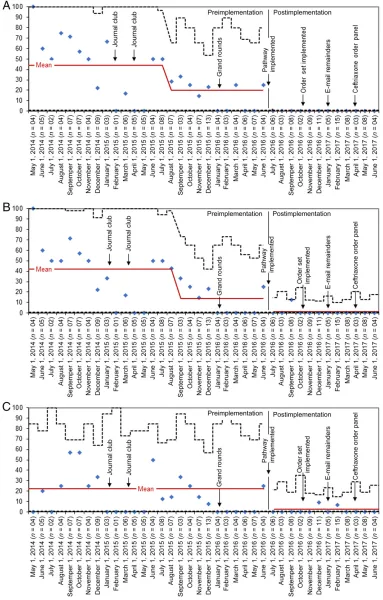
At our institution, a clinical pathway for the evaluation and management of neonates#28 days old with fever was implemented in 2014, but the management of febrile infants .28 days of age was not standardized; providers at our institution varied greatly in their care of this group. In particular, care for low-risk infants had high variability, with low-risk infants undergoing LP 100% of the time in some months versus 0% in other months, and monthly antibiotic use ranged from 0% to 100% (Fig 1). To improve care for febrile infants aged 29 to 60 days, an evidence-based clinical pathway was developed and implemented at our institution, and continuous quality improvement (QI) was used to support the implementation of the pathway, including promoting use and sustainability. Our aim in implementation was to reduce LP, antibiotic administration, and hospital admission for infants at low risk for SBI to,10% in 12 months without missing SBIs.
METHODS
Context
This QI project was conducted at a single urban, tertiary children’s hospital with an annual ED volume of 61 000 patients. Our ED evaluates a number of infants with fever, including patients referred from primary care providers and transfers from numerous community EDs. Many infants are admitted for further care, whereas some are discharged if pediatrician follow-up can be arranged. The institution uses numerous other clinical pathways, which are reviewed and approved by a clinical effectiveness committee.
This QI project was deemed exempt from full review by our institutional review board.
Study Population
The study population consisted of febrile infants aged 29 to 60 days meeting inclusion criteria for the febrile-infant clinical pathway: fever $38.0°C (rectal; before arrival or in the ED) and gestational age$37 weeks. Exclusions included evaluation initiated at an outside ED or recent previous ED visit, history of immunodeficiency, identified focal infection, underlying chronic medical disease, current antibiotic therapy, gestational age ,37 weeks, or a clinical diagnosis of bronchiolitis.
Planning the Intervention
Before our QI initiative, significant variability existed in care for febrile infants aged 29 to 60 days at our institution. To standardize and improve care for febrile infants, an evidence-based clinical pathway (based on modified Rochester criteria)3,17,18was developed over a period of 17 months (starting in February 2015) with input from key stakeholders from the divisions of emergency medicine, hospital medicine, and infectious disease. The initial development phase engaged stakeholders in the ED, including pediatric emergency medicine physicians and fellows, and pediatric hospitalists. Journal club sessions were held for hospitalists and ED physicians (in February 2015 and April 2015, respectively) to review evidence in febrile-infant
FIGURE 1
FIGURE 2
pathway review and approval was obtained following standard hospital process through the institution’s clinical effectiveness committee. A hospital-wide grand rounds presentation in January 2016 on febrile-infant management was given, which was focused on presentation of the proposed pathway and the supporting evidence.
Interventions
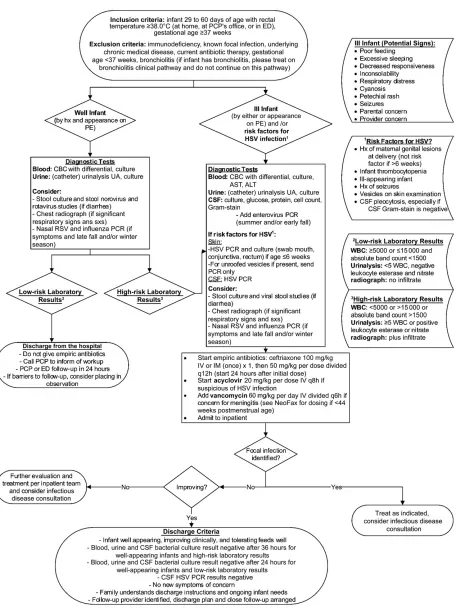
The clinical pathway (Fig 2) was implemented in July 2016. As with all of our clinical pathways, an educational PowerPoint presentation was provided to pathway end users via e-mail and posted on the hospital intranet at time of pathway
implementation. QI interventions occurred in plan-do-study-act cycles to improve and sustain pathway adherence, including implementation of a pathway order set in the electronic medical record in November 2016, monthly e-mail reminders about the pathway for residents rotating through the ED (starting in January 2017), and a ceftriaxone order panel (which was introduced in April 2017).
Study of the Interventions
Evaluation and management of febrile infants aged 29 to 60 days was assessed retrospectively for 2 years before implementation (from May 2014 to June 2016) and compared with the postimplementation period, which was assessed prospectively for 1 year. Data collected included completion of LP, administration of antibiotics, hospital admission, and adherence to modified Rochester criteria as presented in our institution’s pathway (Fig 2), with adherence being defined as the collection of all necessary
laboratories and/or cultures, correct use of LP, the correct use of
antibiotics, and hospital admission when indicated. Additional data were collected as necessary for risk stratification (white blood cell and band counts, urinalysis results, and general appearance) as well the ultimate presence of SBI and demographic information. After pathway implementation, data were collected weekly by our quality department and reviewed by a collaborative ED and hospitalist team. A clinical data coordinator designated patients as low or high risk on the basis of the treating
provider’s documentation and laboratory results. If a discrepancy was found, physician consensus was used (according to the pathway definitions of low and high risk). Data were analyzed periodically to drive additional plan-do-study-act cycles and interventions.
Eligible patients were identified from all ED patients 29 to 60 days of age by using chief complaint of fever or a relevantInternational Classification of Diseases, 10th Revisioncode (including fever, UTI, bacteremia, meningitis, and pneumonia). Charts were reviewed for inclusion and exclusion criteria.
Measures
The primary outcome measure was the percentage of low-risk infants who received LP or antibiotics or were admitted to the hospital. Before pathway implementation, there was frequent use of LP and antibiotic administration for infants who could be classified as low risk (Fig 3A). The specific goal was to decrease LP, antibiotic use, and hospital admission for low-risk infants aged 29 to 60 days to,10% by increasing the percentage of febrile infants managed according to the clinical pathway FIGURE 3
from 60% to 90% in 12 months. ED length of stay (LOS) was assessed as a secondary outcome. Process measures included pathway adherence and order-set use. Pathway adherence was defined as having all of the following: collection of complete blood count, urinalysis, and blood and urine cultures as well as appropriate use of LP, antibiotics, and hospital admission based on risk classification.
SBI in low-risk infants was assessed pre- and postpathway implementation as a balancing measure, with SBI being defined as a true-positive blood or cerebrospinal
fluid culture result or a positive urine culture result ($100 000 colony-forming units [CFUs] per mL of a pathogenic bacteria or$10 000 CFUs/mL with positive urinalysis results). The lower cutoff for urine cultures was used because our laboratory does not specify counts between 10 000 and 100 000 CFUs/mL, and recent studies have revealed that true UTIs in infants commonly have counts,100 000 CFUs/mL.29,30 To detect a doubling of SBIs in low-risk infants with 80% power and 95% confidence, a sample size of
∼3000 would be required, which was not feasible in our study time frame. In light of this limitation, we also tracked care for high-risk infants (LP, antibiotics, and hospital admission) as balancing measures.
Analysis
Demographic and clinical characteristics, LOS, process measures, and balancing measures were compared between the pre- and postimplementation groups by using ttests andx2tests or Fisher’s exact tests for comparisons withn,5 and with statistical significance set at a= .05. Statistical process control charts were used to assess the impact of the intervention on outcome and process measures. Control limits were set at 3 SDs from the mean. Standard rules were used to determine special
cause variation, including$8 values above the baseline centerline.31
RESULTS
Outcome Measures
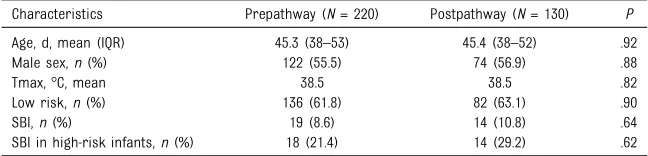
During the 3-year study period, 350 febrile infants aged 29 to 60 days were included, 220 before (62.9%) and 130 after (37.1%) pathway implementation (Table 1). We excluded 120 infants (total pre- and postpathway), most commonly because of prematurity (n= 52) and bronchiolitis (n= 43). There were no significant differences in demographic and clinical
characteristics between the pre- and postimplementation groups,
including in age, sex, maximum temperature, proportion of low-risk infants, or prevalence of SBI (Table 1).
Before pathway implementation, low-risk infants frequently underwent testing and treatment not indicated by modified Rochester criteria (Fig 3). The most common reasons for deviation from modified Rochester criteria were LP performed and antibiotics administered in low-risk infants and a lack of hospital admission for high-risk infants (Fig 3A). Of 136 low-risk infants before pathway implementation, 44 (32%) underwent LP, 41 (30%) received antibiotics, and 23 (17%) were admitted to the hospital. Improvements were seen in all measures after pathway
implementation, with 0 (0%) low-risk infants undergoing LP, 1 (1%) receiving antibiotics, and 2 (2%) being admitted to the hospital out of
82 low-risk infants, all of which were below the aim of 10% (Fig 1). The control charts show special cause variation at the time of pathway implementation with decreased interventions after pathway implementation for LP, antibiotics, and admission for low-risk infants (Fig 1). LPs, antibiotic use, and hospital admission remained at low rates after pathway implementation, during which time additional QI cycles were conducted, including order-set implementation, e-mail reminders, and a ceftriaxone order panel to further improve pathway adherence (Figs 1 and 4).
Average ED LOS decreased from 295 minutes before pathway implementation to 272 minutes after implementation for all patients (P= .03). For patients discharged from the ED, LOS decreased significantly from 279 minutes before implementation to 237 minutes after (P,.001). ED LOS increased for admitted patients from a mean of 320 minutes before implementation to 359 minutes after (P= .01).
Process Measures
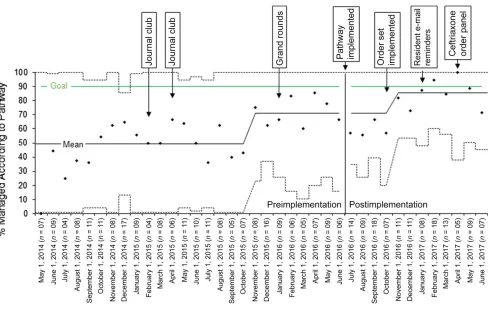
Modified Rochester criteria were followed more often after pathway implementation, increasing from 55.4% at baseline to 76.2% after pathway implementation (P,.001; Fig 4). The most common deviations from the pathway after
implementation were in the care of high-risk infants, including incorrect antibiotic dosing and a lack of hospital admission when indicated (Fig 3B). The statistical process
TABLE 1Demographic and Clinical Characteristics
Characteristics Prepathway (N= 220) Postpathway (N= 130) P
Age, d, mean (IQR) 45.3 (38–53) 45.4 (38–52) .92 Male sex,n(%) 122 (55.5) 74 (56.9) .88
Tmax, °C, mean 38.5 38.5 .82
Low risk,n(%) 136 (61.8) 82 (63.1) .90
SBI,n(%) 19 (8.6) 14 (10.8) .64
SBI in high-risk infants,n(%) 18 (21.4) 14 (29.2) .62
control chart for pathway adherence reveals an upward shift in mean adherence in November 2015 before pathway implementation (which could be attributable to educational interventions occurring before pathway implementation) and again after implementation in November 2016, indicating special cause variation (Fig 4). An order set became available in the electronic medical record in November 2016 and was used for 32% of patients postpathway
implementation.
Balancing Measures
After pathway implementation, there were no missed SBIs. There was 1 missed SBI before pathway
implementation: an infant classified as low risk on the basis of well appearance and low-risk laboratory results then diagnosed with Citrobacterbacteremia, which was
subsequently treated successfully. In the postimplementation period, 1 questionable case was ultimately considered a contaminant (urine culture with 10 000 CFUs/mL Enterococcus faecaliswith trace leukocyte esterase on urinalysis) because the infant recovered quickly without antibiotics.
Appropriate care for high-risk infants remained consistent despite our effort to reduce invasive interventions for low-risk infants. For infants classified as high risk by using our pathway, rates of all recommended interventions were not significantly different after pathway implementation: LP performed in 73% vs 83%, appropriate antibiotic administered in 77% vs 85%, and hospital admission for 70% vs 77% pre- and postimplementation, respectively (P..05 for all comparisons).
DISCUSSION
By using continuous-process QI to support the implementation of an evidence-based clinical pathway, we successfully achieved our goal of reducing LPs, antibiotic use, and hospital admission for febrile infants who are at low risk for SBI on the basis of modified Rochester criteria. This was achieved without detriment to the identification of SBIs or care for high-risk infants. Multiple QI interventions contributed to
sustained improvement during the 1-year postimplementation period.
This QI initiative had a number of strengths that contributed to
achieving our goal. Most importantly, engagement of ED stakeholders (including pediatric emergency medicine physicians and fellows) and pediatric hospitalists occurred throughout the pathway development period. The plan for pathway FIGURE 4
development was initiated by a multidisciplinary team, education on the evidence and rationale was presented at several stages of development, and input from both pediatric emergency medicine physicians and pediatric hospitalists was sought and incorporated. When the pathway was implemented, the standardized hospital process for pathway use was followed, allowing for dissemination throughout the hospital. In addition, prospective weekly tracking of outcomes after implementation allowed for
continuous process improvement and further interventions aimed at sustaining improvement.
Our results emphasize the utility of the implementation of a clinical pathway supported by QI efforts to achieve improvement in providing evidence-based care. Although we did note improvements in care for low-risk febrile infants before the study initiation and during the pathway development period, improvement in reductions in invasive care for low-risk infants reached a consistent level only with pathway implementation, which was sustained through additional QI cycles (Figs 1 and 4). Some of the discussion and education for providers (including journal clubs and grand rounds) may have led to the adoption of modified Rochester criteria before pathway
implementation.
Previous studies have also revealed benefit in the use of clinical pathways for the reduction of unnecessary testing or interventions in pediatrics, including reducing broad-spectrum antibiotic use for pneumonia, computed tomography scans for appendicitis and head injury, catheterization to test for UTIs, and decreased use of antibiotics for low-risk febrile infants.22,25,32–34
The implementation of the clinical pathway reduced ED LOS for patients who were discharged from the ED. Factors that may have contributed to
this include earlier initiation of workup by residents due to comfort with pathways and order sets, reduced time spent on LPs and antibiotic administration, and earlier disposition due to the standardization of risk-stratification and admission criteria. Although we did not track this during the study period, standing nursing triage orders aligned with the pathway allowed for nurses to obtain blood and urine testing before provider evaluation. Evaluation of nursing triage order use could provide further opportunity for improvement in LOS. However, ED LOS remained high for admitted patients, and although outside factors unrelated to the pathway (such as inpatient bed availability) may have contributed, the improvement for discharged patients may have come at the expense of longer stays for admitted patients, possibly due to waiting for laboratory results to be risk stratified before performing LP rather than completing all tests on initial evaluation.
Care for low-risk infants was positively impacted by our QI initiative. However, room for improvement remains for high-risk infants, with persistent variability in antibiotic dosing and administration, use of LP, and hospital admission being observed. In addressing these differences in management, further discussion with providers regarding reasons for not following the pathway will help to plan further
interventions. The low specificity of Rochester and other
risk-stratification criteria may encourage providers to make exceptions for high-risk infants given the still relatively low likelihood of SBI. Newer risk-stratification tests, such as procalcitonin, hold promise,20and once available, modification of our pathway to incorporate advances could help further standardize care. For antibiotic dosing variability, additional plan-do-study-act cycles with interventions aimed at antibiotic
dosing standardization were initiated, including the development of an order panel for ceftriaxone to aid in appropriate dose selection. Pathway order-set use remained low at the end of our tracking period, presenting another area for
improvement.
This study does have several important limitations. Although we did show significant improvements with our QI interventions, including pathway implementation, outside factors (such as national trends toward fewer interventions for infants.28 days old with fever) may have contributed to this improvement given the trend in reduced
interventions for low-risk infants before the study’s conception. The pathway was successfully
implemented with no missed SBIs after implementation; however, the study is not powered to detect a difference in missed SBIs. In tracking the results after pathway implementation, bias could have been present in classifying patients as high-risk on the basis of appearance, although data collection by our quality department may have helped to minimize this bias, and the proportion of low- and high-risk patients was similar pre- and postpathway implementation. Because this project was conducted at an academic children’s hospital, the results may not be generalizable to other institutions or
community EDs.
CONCLUSIONS
The implementation of an evidence-based clinical pathway supported by continuous-process QI resulted in a sustained reduction in invasive interventions (LP, antibiotic administration, and hospital
support clinical pathway
implementation can be a key strategy in the delivery of evidence-based care for febrile infants.
ABBREVIATIONS
CFU: colony-forming unit ED: emergency department LOS: length of stay
LP: lumbar puncture QI: quality improvement SBI: serious bacterial infection UTI: urinary tract infection
REFERENCES
1. Krauss BS, Harakal T, Fleisher GR. The spectrum and frequency of illness presenting to a pediatric emergency department.Pediatr Emerg Care. 1991; 7(2):67–71
2. Nelson DS, Walsh K, Fleisher GR. Spectrum and frequency of pediatric illness presenting to a general community hospital emergency department.Pediatrics. 1992;90(1, pt 1): 5–10
3. Dagan R, Powell KR, Hall CB, Menegus MA. Identification of infants unlikely to have serious bacterial infection although hospitalized for suspected sepsis.J Pediatr. 1985;107(6):855–860
4. Dagan R, Sofer S, Phillip M, Shachak E. Ambulatory care of febrile infants younger than 2 months of age classified as being at low risk for having serious bacterial infections. J Pediatr. 1988;112(3):355–360
5. Baskin MN, O’Rourke EJ, Fleisher GR. Outpatient treatment of febrile infants 28 to 89 days of age with intramuscular administration of ceftriaxone.J Pediatr. 1992;120(1):22–27
6. Baker MD, Bell LM, Avner JR. Outpatient management without antibiotics of fever in selected infants.N Engl J Med. 1993;329(20):1437–1441
7. Baker MD, Bell LM, Avner JR. The efficacy of routine outpatient management without antibiotics of fever in selected infants.Pediatrics. 1999;103(3):627–631
8. Huppler AR, Eickhoff JC, Wald ER. Performance of low-risk criteria in the evaluation of young infants with fever: review of the literature.Pediatrics. 2010;125(2):228–233
9. Paxton RD, Byington CL. An examination of the unintended consequences of the rule-out sepsis evaluation: a parental perspective.Clin Pediatr (Phila). 2001; 40(2):71–77
10. Pantell RH, Newman TB, Bernzweig J, et al. Management and outcomes of care of fever in early infancy.JAMA. 2004;291(10):1203–1212
11. Aronson PL, Thurm C, Alpern ER, et al; Febrile Young Infant Research Collaborative. Variation in care of the febrile young infant,90 days in US pediatric emergency departments. Pediatrics. 2014;134(4):667–677
12. Greenhow TL, Hung YY, Pantell RH. Management and outcomes of previously healthy, full-term, febrile infants ages 7 to 90 days.Pediatrics. 2016;138(6):e20160270
13. Jain S, Cheng J, Alpern ER, et al. Management of febrile neonates in US pediatric emergency departments. Pediatrics. 2014;133(2):187–195
14. Greenhow TL, Hung YY, Herz AM. Changing epidemiology of bacteremia in infants aged 1 week to 3 months. Pediatrics. 2012;129(3). Available at: www.pediatrics.org/cgi/content/full/ 129/3/e590
15. Greenhow TL, Hung YY, Herz AM, Losada E, Pantell RH. The changing
epidemiology of serious bacterial infections in young infants.Pediatr Infect Dis J. 2014;33(6):595–599
16. Baraff LJ. Management of fever without source in infants and children.Ann Emerg Med. 2000;36(6):602–614
17. Byington CL, Reynolds CC, Korgenski K, et al. Costs and infant outcomes after implementation of a care process model for febrile infants.Pediatrics. 2012;130(1). Available at: www. pediatrics.org/cgi/content/full/130/1/ e16
18. Jaskiewicz JA, McCarthy CA, Richardson AC, et al; Febrile Infant Collaborative Study Group. Febrile infants at low risk for serious bacterial infection–an appraisal of the Rochester criteria and
implications for management. Pediatrics. 1994;94(3):390–396
19. Byington CL, Enriquez FR, Hoff C, et al. Serious bacterial infections in febrile infants 1 to 90 days old with and without viral infections.Pediatrics. 2004;113(6):1662–1666
20. Gomez B, Mintegi S, Bressan S, Da Dalt L, Gervaix A, Lacroix L; European Group for Validation of the Step-by-Step Approach. Validation of the“
step-by-step”approach in the management of
young febrile infants.Pediatrics. 2016; 138(2):e20154381
21. Garra G, Cunningham SJ, Crain EF. Reappraisal of criteria used to predict serious bacterial illness in febrile infants less than 8 weeks of age. Acad Emerg Med. 2005;12(10):921– 925
22. Murray AL, Alpern E, Lavelle J, Mollen C. Clinical pathway effectiveness: febrile young infant clinical pathway in a pediatric emergency department. Pediatr Emerg Care. 2017;33(9): e33–e37
23. DeLaroche AM, Sivaswamy L, Farooqi A, Kannikeswaran N. Pediatric stroke clinical pathway improves the time to diagnosis in an emergency department. Pediatr Neurol. 2016;65:39–44
24. Mohan S, Nandi D, Stephens P, MʼFarrej M, Vogel RL, Bonafide CP.
Implementation of a clinical pathway for chest pain in a pediatric emergency department.Pediatr Emerg Care. 2018; 34(11):778–782
25. Ramarajan N, Krishnamoorthi R, Barth R, et al. An interdisciplinary initiative to reduce radiation exposure: evaluation of appendicitis in a pediatric emergency department with clinical assessment supported by a staged ultrasound and computed tomography pathway.Acad Emerg Med. 2009;16(11): 1258–1265
26. Scarfone R, Gala R, Murray A, Funari M, Lavelle J, Bell L; Children’s Hospital of Philadelphia. ED pathway for evaluation/treatment of febrile young infants (0-56 days old). Available at: www.chop.edu/clinical-pathway/febrile- infant-emergent-evaluation-clinical-pathway. Accessed June 8, 2017
fever pathway. 2017. Available at: www. seattlechildrens.org/pdf/neonatal-fever-pathway.pdf. Accessed September 17, 2017
28. Aronson PL, Thurm C, Williams DJ, et al; Febrile Young Infant Research Collaborative. Association of clinical practice guidelines with emergency department management of febrile infants#56 days of age.J Hosp Med. 2015;10(6):358–365
29. Swerkersson S, Jodal U, Åhrén C, Sixt R, Stokland E, Hansson S. Urinary tract infection in infants: the significance of
low bacterial count.Pediatr Nephrol. 2016;31(2):239–245
30. Tullus K. Low urinary bacterial counts: do they count?Pediatr Nephrol. 2016; 31(2):171–174
31. Benneyan JC, Lloyd RC, Plsek PE. Statistical process control as a tool for research and healthcare improvement. Qual Saf Health Care. 2003;12(6): 458–464
32. Ambroggio L, Thomson J, Murtagh Kurowski E, et al. Quality improvement methods increase appropriate
antibiotic prescribing for childhood pneumonia.Pediatrics. 2013;131(5). Available at: www.pediatrics.org/cgi/ content/full/131/5/e1623
33. Jennings RM, Burtner JJ, Pellicer JF, et al. Reducing head CT use for children with head injuries in a community emergency department.Pediatrics. 2017;139(4):e20161349
DOI: 10.1542/peds.2018-1610 originally published online February 6, 2019;
2019;143;
Pediatrics
Ilana Y. Waynik
Kathryn E. Kasmire, Eric C. Hoppa, Pooja P. Patel, Kelsey N. Boch, Tina Sacco and
of a Clinical Pathway
Reducing Invasive Care for Low-risk Febrile Infants Through Implementation
Services
Updated Information &
http://pediatrics.aappublications.org/content/143/3/e20181610 including high resolution figures, can be found at:
References
http://pediatrics.aappublications.org/content/143/3/e20181610#BIBL This article cites 32 articles, 15 of which you can access for free at:
Subspecialty Collections
sub
http://www.aappublications.org/cgi/collection/quality_improvement_ Quality Improvement
e_management_sub
http://www.aappublications.org/cgi/collection/administration:practic Administration/Practice Management
sub
http://www.aappublications.org/cgi/collection/emergency_medicine_ Emergency Medicine
following collection(s):
This article, along with others on similar topics, appears in the
Permissions & Licensing
http://www.aappublications.org/site/misc/Permissions.xhtml in its entirety can be found online at:
Information about reproducing this article in parts (figures, tables) or
Reprints
DOI: 10.1542/peds.2018-1610 originally published online February 6, 2019;
2019;143;
Pediatrics
Ilana Y. Waynik
Kathryn E. Kasmire, Eric C. Hoppa, Pooja P. Patel, Kelsey N. Boch, Tina Sacco and
of a Clinical Pathway
Reducing Invasive Care for Low-risk Febrile Infants Through Implementation
http://pediatrics.aappublications.org/content/143/3/e20181610
located on the World Wide Web at:
The online version of this article, along with updated information and services, is
by the American Academy of Pediatrics. All rights reserved. Print ISSN: 1073-0397.