The Effect Of Job Proficiency, Commitment, And
Cooperative Relationship To Project Performance
Siti Haerani
Abstract: Contractor selection is very important to ensure work can be done on time, on budget, and meet the quality. This research aims to analyze and understand in depth the effect of job proficiency, commitment, and cooperative relationship to project performance. PT. Vale is one of the mining companies located in Sorowako, Indonesia, where the research was conducted. The data needed is obtained from a sample of employees who are specifically involved in handling the procurement of construction services. The technique of collecting data using questionnaires and documentation. These data are analyzed using the Multiple Linear Regression tool with the SPSS Program software application. The research findings show that the variables of job proficiency, commitment, and cooperative relationship simultaneously significantly affect the performance of the project with the coefficient of determination R2 of 0.565. Cooperative relationship partially has no significant effect to project performance while job proficiency and commitment partially has significant and positive effect to project performance. Job proficiency consist of five indicators w hich are availability of qualified personnel, appropriate equipment, Health, Safety and Environmental management, financial capacity to finance the project, and project management capabilities. Commitment consist of two indicators which are contractor’s loyality to the Owner, and the willingness of the contractor to change the work method for better job result. Cooperative relationship consist of three indicators which are the contractor has ever did similar project on the Owner, the contractor has never been legally disputed with the owner, and the contractor does not have a poor track record of the other project owners. The novelty of this study lies not only in the main variables used in predicting project performance, but also on indicators of each variable. The object of this research is also different, where this study focuses on constructive projects while previous research generally uses a variety of proj ects. The findings of this study are very useful as a basis for consideration in selecting prospective contractors who will be given the task of working on the project more successfully.
Keywords: Contractor selection, Cooperative relationship, job proficiency, commitment, project performance —————————— ——————————
1.
INTRODUCTION
The construction services industry is one part of the industry that contributes to the growth of the economy of Indonesia. The role of construction sector to national economic development can be seen from its contribution to Gross Domestic Product. The contribution of the construction sector to the national GDP grew from 9.98% in 2013 to 10.05% in 2014. The average growth rate of the construction sector in 2014 reached 6.6% (BPS, 2015). The construction industry not only plays a role in the implementation of government infrastructure projects, but also the private sector such as mining and metal ore processing. In the field of mining, construction companies provide support in the form of construction services of processing plants, road construction services, port development services, and other services that support the operations of mining companies. PT Vale Indonesia, as a mining company holding the work contract, in carrying out its business activities using the services of the company in the field of construction services. PT Vale selects contractors through an auction system considering the technical aspects and bid price of bidders. The technical criterion has a total weight of 25% and the price criterion has a total weight of 75%. However, contractors who have been selected through the auction process often fail to run the project in a timely manner, at the right cost and with the appropriate quality. As a result of the unfairness of this partner's work for PT Vale may result in additional costs, disruptions to the company's operations, the company's good name, and so forth.
This research specifically analyzes the influence of contractors' selection criteria by project owners in the form of contractor capacity, commitment, and cooperative relationships. The project owner who became the object of this research is PT Vale Indonesia which operates in Sorowako, South Sulawesi.
2.
LITERATURE
REVIEW
2.1 Project Performance
Vleems (2018), Anonymous (2005) describes that project performance measurement is an effective tool that can be used to help organizations understand project successes or failures in the past and use that understanding to plan improvements and development in the future. Project performance is influenced by many factors, therefore it is important to identify critical factors that affect project performance (Cheng, without years, Anonymous, 2005), because project Schedule Variance (SV) is the difference between the planned value at a certain time (PV) and the progress achieved (EV)is measured by three indicators: cost, time, and quality that are the basis of criteria for project success and are iron triangles (triple constraint). PMBOK (2013) states that a project is successful if the project can be completed according to the criteria of scope, time, cost, quality, resources, and risk constraints agreed upon with the project owner. According to PMBOK (2013), Anonymous (2005), project performance can be analyzed by Earned Value Management (EVM), is a method of measuring project performance and progress based on scope, schedule and resources. While Schedule Variance (SV) and Schedule Performance Index (SPI) are used to measure time performance. Schedule Variance (SV) is the difference between the planned value at a certain time (PV) and the progress achieved (EV), the positive SV signifies the project is done ahead and the negative SV signifies the project is behind schedule. SPI is the ratio between EV and PV. SPI is less than one (SPI <1) indicating that the progress achieved is less than the planned value (inefficient, behind schedule). SPI is worth __________________________________
more than one (SPI> 1) indicating the value of progress achieved is greater than the planned value (efficient, ahead schedule). Cost Performance can be measured by Cost Variance (CV) and Cost Performance Index (CPI). CV is reflected through the difference between the progress value achieved (EV) and the actual cost that has been incurred at a certain time (AC). CV positively means that progress made is greater than surplus, under budget cost and the negative CV indicates an over budget project. CPI is the ratio between EV and AC. A CPI of less than one (SPI <1) signifies an over-budget project. A CPI of more than one (SPI> 1) signifies an under budget project. This research uses three indicators of project performance which are cost, quality, and time.
2.2 Job Proficiency
Job proficiency are defined by Van Scotter and Motowidlo (1996) as one of the criteria for measuring task performance. Task performance is the skill and ability to run a specific job and differentiated between one another (Sonnentag and Frese , 2002). Wibowo (2007) describes competence as an ability to carry out work or tasks in accordance with the demands of skills, knowledge and work attitudes of a job. In addition, competence according to Spencer and Spencer (Moeheriono, 2009), is interpreted as the characteristics that underlie the effectiveness of individual performance in their work. In other words, competency is a basic characteristic of individuals who have a causal relationship with criteria used as a reference for performance effectiveness, or superior performance in the workplace or in certain situations. This study uses five indicators of the contractor's capability: qualified workforce ownership, adequate equipment ownership, implementation of K3L management, financial capacity to finance the project, and project management capabilities.
2.3 Commitment
According to Borman and Motowidlo in Gaffar (2004), commitment is a criterion for measuring contextual performance. Contextual performance is an activity that does not contribute directly to the company's core activities but supports the organization, social and psychological environment in which the organization pursues its goals. Contextual performance involves not only the attitudes of employees who assist their co-workers or become members of a reliable organization, but also provide ideas to improve the job procedure (Sonnentag and Frese , 2002) Commitment in this research is defined as the seriousness of the contractor to finish the job given by the owner of the project. The indicators used in this study are contractor loyalty to the project owner, and the willingness of the contractor to make changes on methods for better results.
2.4 Cooperative Relationship
Cooperative relationship is an important part of networking factors. Companies are not only seen on the basis of profit and market relationships, but also concentrate on social relations (Granovetter, 1985). According to Gaffar (2004) one of the criteria of contractor selection by the project owner that is identified as the most dominant based on the ranking is the contractor's expertise in collaboration with the project owner, consultant, government and community. The cooperation relationship in this research is defined as the relationship between the contractor and the project owner. Cooperation relationships are measured through three indicators: the
contractor has worked on the project from the same project owner, the contractor has never been legally disputing with the project owner, and the contractor has no bad track record with other project owners.
3.
FRAMEWORK
AND
HYPOTHESES
Based on the literature review that has been conducted, the conceptual framework of this research is prepared as follows: Hypothesis :
H1: Working ability, commitment, and cooperative relationship simultaneously have a significant effect on project performance
H2: Partial work ability has significant effect on project performance
H3: Partial commitment has a significant effect on project performance
H4: Partial cooperation relationship has significant effect on project performance
4.
METHODS
5.
RESULTS
Table 1 shows the sample characteristics used in this study. Total respondents who inversed questionnaires were 41 out of 51 samples. Education level of respondents is S1 as much as 80.49%, S2 as much as 17.07%, and S3 as much as 2.44%. More than 75% of respondents have work experience of more than 10 years. A total of 19.51% of respondents have a position as chairman of the procurement committee, and 80.49% of respondents as members and others.
Table 1. Characteristics of respondents
Table 3 shows the results of multicollinearity test, from table 3 it is known that all variables have tolerance> 0.1 (greater than one) and VIF <10 (less than ten) so it can be stated that all variables do not experience multicollinearity (Ghozali, 2007).
Table 3. Multicollinearity Test Results
Table 4 shows the results of heteroscedasticity test with the Glejser method. Testing with the Glejser method is done by regressing between independent variables with their absolute residual values (ABS_RES). If the significance of the regression value is greater than 0.05 (> 0.5), it means that there is no Heteroscedasticity. Conversely, if the significance value is less than 0.05 (<10), Heteroscedasticity occurs. Based on these provisions, it is concluded that there is no Heteroscedasticity among all the variables tested in this study because all of them have significance values above 0.05 as listed in Table 4.
Table 4. Heteroscedasticity test results
The results of the normality test with Kolmogorov-Smirnov One-Sample (1-Sample K-S) showed a significant probability value of 0.09> 0.05 then the data distribution is stated to meet the assumption of normality. Based on the multicollinearity test, heteroscedasticity, and normality it can be concluded that the data obtained can be analyzed by multiple linear regression. Multiple linear regression with the help of SPSS resulted in the value of coefficient and t value of each variable, the value of R2, and the value of F arithmetic respectively in the following tables (5, 6, and 7).
Table 5. The Coefficient Value of the Regression Results
From Table 5, we get the regression model equation as follows:
Where Y is a project performance, X1 job proficiency, X2 is a commitment, and X3 is a cooperative relationship. From table 6 it is known that the value of R2 is 0.565. This means that job proficiency, commitment, and cooperative relationships affect project performance by 56.5%, while the remainder (43,5%) is caused by other variables not included in this study.
Table 6. R2 Value of Regression Results
From Table 7 we know that the F value is 16,010 and Sig. 0,000. Given the value of F table for the number of samples 41, the number of independent variables 3 and the significance of 0.05 of 3.252. The value of F arithmetic> F table and Sig. <0.05 so that H0 is rejected and H1 accepted. This means that job proficiency, commitment, and cooperative relations simultaneously have a significant effect on project performance.
Table 7. The Value of F Arithmetic Results Regression
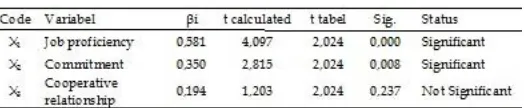
Table 8. T Test Results
6.
DISCUSSION
AND
CONCLUSION
6.1 Discussion
From the validity and reliability test, it is known that all indicators that have research instruments have met the validity and reliability requirements. Validity and reliability is supported by the characteristics of respondents in the form of educational level, work experience, and position in the procurement committee. It is known that 100% of respondents are educated at least S1. This level of education indicates the ability of respondents in understanding the questionnaire and providing representative information. In terms of work experience, more than 75% of respondents have work experience of more than 10 years. In terms of position in the committee, 19.51% had been the head of the procurement committee. Variables of job proficiency, cooperative relationship and commitment have significant effect on project performance. Job proficiency variables have also a significant and positive partial influence on project performance, which means the improvement of job proficiency will improve project performance. The workability of contractors has a major impact on project performance. Working ability can improve the performance of projects undertaken by contractors. The higher the contractor's working ability the better the project performance. This may be attributed to several employment indicators that include the availability of qualified workers, appropriate equipment, health and safety (OHS) health management, financial capacity to finance the project, and project management capabilities. The findings of this study corroborate the findings of previous research that project completion time performance is influenced by contractor competitiveness (Alam, 2011), lack of manpower becomes the factor causing delays in completion of the Public Works project in the Surakarta Residency (Suyatno, 2010), the skill of the less skilled workforce affecting project delays (Zulvantino and Syahrizal, 2015), and the financial capacity to finance viable projects and equipment affect the performance of projects (Gaffar, 2004). Other studies that have contributed to the important influence of knowledge, skills and attitudes (Moura, Carneiro and Diniz, 2018), professionalism (Zuofa and Ochieng, 2014) and management style (Radujković and Sjekavica, 2017) as part of the soft skills of human resources for project performance and success (Junior and Carvalho, 2013). One of the factors affecting performance is competence (Gaol, 2014). Wibowo (2007) describes competence as the ability to complete work tasks according to the knowledge, skills and work attitudes required by the job. A qualified workforce is needed to ensure that work is done properly so that the project runs effectively and efficiently. Unskilled or unqualified workforce can result in unsuitable work, so that reworking is needed which will impact on the addition of cost and time. Decent tools are needed to facilitate work especially for complex jobs that people cannot do manually. The use of adequate tools can accelerate the implementation of the construction which ultimately can improve project performance especially in terms of time. The financial ability of the contractor to finance the project is required
other project owner can complete the project well if they`have job proficiency and commitment. According to PMBOK (2013), knowledge areas that need to be mastered by project management professionals are communication management and stakeholder management. However, this knowledge area needs to be integrated with other knowledge areas so that the project objectives can be maximally achieved. This theory supports the findings of this research that variables of cooperative relationships need to be integrated with other variables so that project performance can be achieved maximally.
7.
CONCLUSION
From the results of this study obtained the following conclusions:
a. Contractor’s job proficiency, commitment, and cooperative relationship simultaneously have a significant simultaneous influence on project performance.
b. Contractor's job proficiency partially has a positive and significant influence on project performance
c. Contractor commitment partially has a significant and positive impact on project performance.
d. Contractor’s cooperative relationship with the project owner partially does not have a significant effect on project performance
e. The influence of job proficiency, commitment, and cooperative relationship to project performance is shown by equation of multiple linear regression model in this research is 56,5%.
This study uses three independent variables that are suspected to have a significant influence on project performance. These three variables are used as criteria in selecting the contractor by the project owner. The results showed that the cooperative relationship variable does not significantly affect the performance of the project. Results of multiple linear regression resulted in R2 value of 0,565, which means that there are other variables that affect the project performance of 43.5% is not taken into account in this study. For further research on project performance, it is advisable to add other variables related to the stage of construction, controlling, project control. This research object is also limited to PT Vale Indonesia construction project. In order for generalizations to be more representative of the various types of projects, it is advisable that further research involves other types of projects.
8
REFERENCES
[1]. Alam, Toni. (2011). Identifikasi faktor-faktor risiko proyek rancang bangun pada PT. XYZ yang berpengaruh terhadap kinerja waktu. Tesis. Jakarta: Program Pascasarjana Universitas Indonesia.
[2]. Anonymous., (2005). Measures of Project Management Performance and Value: A Benchmark of Current Business Practices. Center for Business Practices, p.1-34
[3]. Atkinson, Roger. (1999). Project Management: cost, time and quality, two best guesses and a phenomenon, its time to accept other success criteria. International journal of project management Vol 17 (6): 337-342.
[4]. Badan Pusat Statistik. (2015). Statistik Konstruksi 2014. Jakarta: Badan Pusat Statistik.
[5]. Chen, Hong Long., (without years). Predictors of Project Performance and The Likelihood Of Project Success. Taiwan: Department of Business and Management, National University of Tainan.
[6]. Deshariyanto, Dwi., dan Fansuri, Zubaidillah. (2014). Faktor-faktor yang mempengaruhi waktu pelaksanaan proyek konstruksi di dinas PU Bina Marga Kabupaten Sumenep. Univerisitas Wiraraja Sumenep.
[7]. Gaffar, A. R. (2004). Pengaruh Kriteria Pemilihan Kontraktor oleh Pemilik Proyek terhadap Kinerja Mutu Tesis. Jakarta: Program Pascasarjana Universitas Indonesia.
[8]. Ghozali, Imam. (2007). Aplikasi Analisis Mulitivariat dengan Program SPSS Edisi 4. Semarang: BP Universitas Diponegoro.
[9]. Granovetter, Mark. (1985). Economic Action and Social Structure: The Problem of Embeddedness. American Journal of Sociology Vol 91 (3): 481-510. [10].Junior, Roque Rabechini., and Carvalho, Marly
Monteiro de. (2013). Understanding the Impact of Project Risk Management on Project Performance: an Empirical Study. Journal of Technology Management & Innovation. Vol. 8, Special Issue ALTEC. p 64-78.
[11].Kerzner, Harold. (2009). Project Management, a System Approach to Planning, Scheduling, and Controlling, 10th Edition. New Jersey: John Wiley & Sons, Inc.
[12].Lingga L. Dela E. (2014). Pengaruh Komitmen Karyawan, Budaya Kerja dan Motivasi terhadap Kinerja Pegawai Keuangan BPR di Tanjungpinang, [Online] Available form: URL: HYPERLINK
(http://jurnal.umrah.ac.id/wp-
content/uploads/gravity_forms/1-ec61c9cb232a03a96d0947c6478e525e/2014/08/jurna l-memei.pdf. Accessed 10 Nov. 2017].
[13].Meidiana, Karina. (2015). Pengaruh Insentif dan Komitmen Karyawan terhadap Kinerja Karyawan Mirota Batik Malioboro Yogyakarta. Skripsi. Yogyakarta: Fakultas Ekonomi Universitas Negeri Yogyakarta.
[14].Moeheriono. (2009). Pengukuran Kinerja Berbasis Kompetensi. Bogor: Penerbit Ghalia Indonesia. [15].Moura, Ralf Luis de., Carneiro, Teresa Cristina
Janes., and Diniz, Bruna Demoner. (2018), Influence of The Project Manager’s Personal Characteristics on Project Performance, Gest. Prod., São Carlos, Vol. 25, No. 4, p. 751-763.
[16].Project Management Institute. (2013). A Guide to the Project Management Body of Knowledge (PMBOK Guide), 5th Edition. USA: Project Management Institute, Inc.
[17].Radujković, Mladen., and Sjekavica, Mariela (2017). Development Of A Project Management Performance Enhancement Model By Analysing Risks, Changes, And Constraints, Građevinar, Vol. 69, No. 2, p. 105-120.
[19]. Sonnentag, Sabine., and Frese Michael. 2002. Psychological Management of Individual Performance. USA: John Wiley & Sons.
[20]. Suyatno. (2010). Analisis faktor penyebab keterlambatan penyelesaian proyek gedung (Aplikasi model regresi). Tesis. Semarang: Program Pascasarjana Universitas Diponegoro.
[21]. Sweis, Rateb J., (2015). An Investigation of Failure in Information Systems Projects: The Case of Jordan. Journal of Management Research, Vol. 7, No. 1 p 173-185, ISSN 1941-899X 2015.
[22]. Van Scotter, J. R. and Motowidlo, S. J. (1996). Interpersonal Facilitation and Job Dedication as Separate Facets of Contextual Performance. Journal of Applied Psychology, Vol 81 (5): 525-531.
[23]. Vleems, Maran., (2018). Measuring Project Performance: A Method of Project Comparison. Thesis, Program: Open University of the Netherlands, faculty of Management, Science & Technology Master of Business Process Management & IT.
[24]. Wibowo. (2007). Manajemen Kinerja. Jakarta : PT. Raja Grafindo Parsada.
[25]. Zulvantino., dan Syahrizal. (2015). Analisa faktor-faktor risiko yang mempengaruhi keterlambatan proyek gedung (studi kasus : pelaksanaan proyek konstruksi gedung di kota Medan). USU Medan. [26]. Zuofa, T., and Ochieng, E. G., (2014). Project Failure:
The Way forward and Panacea for Development. International Journal of Business and Management; Vol. 9, No. 11, p. 59-71.J.M.P. Martinez, R.B. Llavori, M.J.A. Cabo, and T.B. Pedersen, "Integrating Data Warehouses with Web Data: A Survey," IEEE Trans. Knowledge and Data Eng., preprint, 21 Dec. 2007, doi:10.1109/TKDE.2007.190746.(PrePrint)
[27]. Irwansyah, D., Erliana, C. I., Sari, A. E., Hamdani, D., Susena, K. C., Irwanto, T., ... & Sudrajat, D. (2019, November). Efforts to Improve Service Quality with Fuzzy Approach and Service Quality Methods at Dunia Barusa Inc. In Journal of Physics: Conference Series (Vol. 1363, No. 1, p. 012071). IOP Publishing. [28]. YUSUF, M., & PUTRA, A. H. P. K. (2019). The Impact
of Product Quality, Price, and Distribution on Satisfaction and Loyalty. 유통과학연구, 17, 17-26. [29]. MASHUR, R., GUNAWAN Bata Ilyas, M. H., &
Muhammad ASHOER, F. I. T. R. I. A. N. Y. (2019). Moving From Traditional to Society 5.0: Case study by Online Transportation Business. Journal of Distribution Science, 17(9), 93-102.
[30]. Meiyani, E., & Putra, A. H. P. K. (2019). The Relationship Between Islamic Leadership on Employee Engagement Distribution in FMCG Industry: Anthropology Business Review. 유통과학연구, 17(5), 19-28.
[31]. Arfah, A., & Putra, A. H. P. K. (2019). Analysis of Productivity and Distribution of Female Workers in FB’s Industries. Journal of Distribution Science, 17(3), 31-39.
[32]. MANSUR, D. M., SULE, E. T., KARTINI, D., OESMAN, Y. M., Putra, A. H. P. K., & CHAMIDAH, N. (2019). Moderating of the Role of Technology Theory to the Existence of Consumer Behavior on
e-commerce. Journal of Distribution Science, 17(7), 15-25.