363
Volume LIX 38 Number 7, 2011
CFC RULES IN THE CONTEXT OF THE
PROPOSED CCCTB DIRECTIVE
V. Sobotková
Received: August 31, 2011
Abstract
SOBOTKOVÁ, V.: CFC rules in the context of the proposed CCCTB directive. Acta univ. agric. et silvic. Mendel. Brun., 2011, LIX, No. 7, pp. 363–370
In the proposal for a Council Directive on a Common Consolidated Corporate Tax Base (CCCTB) there have been introduced a specifi c anti-abuse provisions, CFC rules. These rules are aimed at tax evasions and tax avoidance. The basic principle is the protection of the tax base against erosion through practices of artifi cial income shi ing. Generally, CFC rules prevent tax avoidance in a state of a shareholder by denying the deferred taxation of profi ts generated by its controlled company, which is a resident in a tax preference jurisdiction. Even thought the CCCTB directive would be aided easier and low-costs cross-border business as well as it would be restricted the harmful tax competition there are questions whether it is advisable to introduce these rules into such system of the CCCTB, whether these rules are compatible with the CCCTB and whether it is regulated properly. So, the focus of this paper rests on the interaction of the proposed CCCTB directive with existing CFC rules in the European Union. The paper deals with pros and cons, economic and legal perspectives these rules in the context of the proposed CCCTB directive.
anti-abuse provisions, anti-avoidance rules, CCCTB, CFC rules, tax evasions
In the fi eld of the European Union there has been appeared an eff ort to creation of a harmonized corporate tax base that would be aided easier and low-costs business in the European Single Market. The Working Group (CCCTB WG) which was established for that purpose has been worked on this scheme for many years, already since year 2004. The European Commission published its results in the long-awaited proposal for a Council Directive on a Common Consolidated Corporate Tax Base (CCCTB) on 16 March 2011. This proposed system of the CCCTB is a system of common rules for computing the tax base of companies which are the European tax resident and branches of third-country companies located in the European Union. Under the CCCTB, groups of companies would have to apply a single set of tax rules across the European Union and deal with only one tax administration (so called one-stop-shop). The companies that will opt for the CCCTB system will be regulated only by the common rules and not by the national corporate tax arrangements. This will ensure that
the administrative costs for companies will be reduced. Business operating across national borders will benefi t both from the reduction of company tax related compliance costs and from the consolidation of profi ts and losses, which will be defi nitely positive for companies. Even thought the proposed CCCTB directive would be aided low-costs cross-border business as well as it would be restricted the harmful tax competition, nevertheless, there have been introduced anti-abuse provisions as a protection of the CCCTB base.
of calculating the tax base. SAAR rules include the rules about disallowance of interest deduction (co called thin capitalization rules) and about controlled foreign company (CFC) legislation. The specifi c anti-abuse rules will always apply in conjunction with GAAR rules. The thin capitalization rules limitation in the tax a deductibility interests and CFC rules prevent tax avoidance in a state of a shareholder by denying the deferred taxation of profi ts generated by its controlled company, which is a resident in a tax preference jurisdiction.
Defi nitely, GAAR and SAAR rules in the proposed CCCTB are aimed at tax evasions and tax avoidance. Nevertheless, there is a question whether it is advisable to introduce these rules into such system of the CCCTB, whether these rules are compatible with the CCCTB and whether it is regulated properly.
The focus of this paper is only on CFC rules and the main idea is the verifi cation of interaction of the existing CFC rules in the Member States with the proposed CFC rules in the CCCTB directive. The paper deals with pros and cons, economic and legal perspectives CFC rules in the context of the proposed CCCTB.
MATERIALS AND METHODS
The fundamental principle of the CCCTB system was determined within the paper. The CFC rules were defi ned in its context, i.e. the conditions for their application and the procedure for calculating of the CFC’s income for a CCCTB base. At the same time the common characteristics of CFC rules in the European Union Member States were identifi ed. Subsequently, there was performed a comparative analysis of CFC rules in the CCCTB system and in the Member States. Based on this analysis there were found essential diff erences in the application of CFC rules in the CCCTB system and in the Member States. Interactions of CFC rules were investigated in the CCCTB system compared to CFC rules in the Member States. Pros and cons of these rules were evaluated under the CCCTB and their economic consequences have been established in terms of corporate.Due to use of comparative analysis an impact on the CCCTB base was evaluated for the application of CFC rules within this system. I.e. on the model examples was verifi ed whether the CFC rules within the CCCTB are more stringent or not. All the calculations were made based on valid legislation about CFC rules of certain state, related to the eff ective date on 1th April 2011 available from scientifi c database IBFD (area of Economic Surveys), and according to procedures laid down in Art. 82 and 83 of the proposed CCCTB directive published on 16 March 2011.
There were used standard scientifi c methods that allow objective and systematic qualitative and quantitative description of the existent issue. To meet the aim of the paper, the method of analysis,
comparison, description and modelling was used. To draw conclusions synthesis method was applied.
Theoretical backround
The basic principle of the CCCTB and the protection of the CCCTB base
According to Panayi (2008) is the CCCTB a proposal to provide companies with establishments in at least two Member States with the option to compute their group taxable income according to one set of rules. The CCCTB is expected to be confi ned to EU companies (whether or not under ultimate EU ownership) and permanent establishments (PEs), with the option to extend the regime to partnerships.
The CCCTB as a set of common rules establishing an EU-wide consolidated tax base will be an alternative to the current 27 national corporate tax systems and the use of “separate accounting” in allocating revenues to associated enterprises. Consolidation is an essential element of such a system, since the major tax obstacles faced by companies in the European Union can be tackled only in that way. It eliminates transfer pricing formalities and intra-group double taxation.
As stated in the proposed CCCTB directive (2011), eligibility for consolidation is determined in accordance with a two-part test based on control (more than 50 % of voting rights) and ownership (more than 75 % of equity) or rights to profi ts (more than 75 % of rights giving entitlement to profi t). The two thresholds should be met throughout the tax year; otherwise, the company should leave the group immediately.
The consolidated tax base (CCCTB base) will include all revenues which aren’t expressly exempted and these revenues will be reduced by deductible expenses. According to the proposed CCCTB directive (2011), the exempted income should be the income consisting in dividends, the proceeds from the disposal of shares held in a company outside the group and the profi ts of foreign permanent establishments. The common corporate tax base will be then re-distributed among the respective Member States according to a pre-established sharing mechanism based on a formula.
and SAAR rules and also proceeds from the sale of assets a er leaving the group (Art. 67 of the CCCTB directive), disallowance of exempt share disposals (Art. 75 of the CCCTB directive) and disallowance of interest deduction (Art. 81 of the CCCTB directive).
Defi nition of CFC rules in the proposed CCCTB directive
Considerations for a common CFC rules have been discussed at many meetings CCCTB WG. The CFC rules have been developed for a variety of purposes. As stated Lang and et al. (2008), in some case, the policy focus has been on tax avoidance transactions, tax haven abuse and the unwillingness to allow migration of passive income, in other cases, the policy focus has been represented a boarder limitation on the deferral of tax on income realized through foreign subsidiaries to achieve equity and economic effi ciency in the form of capital export neutrality.
Due to this diff erence of opinions there exist as proponents so opponents for common CFC rules. According to these authors proponents of capital neutrality argue that CFC rules are necessary to protect the very principles of worldwide taxation, while opponents argue that CFC rules infringe tax sovereignty, destroy capital import neutrality, prevent fair tax competition and confuse deferral of tax and abuse.
On the basis of discussions of CCCTB WG, proponents and opponents of CFC rules have been introduced common CFC rules in the CCCTB directive as the protection CCCTB base against tax evasions. Art. 82 and 83 of the proposed CCCTB directive contains such a rule concerning controlled foreign companies. Art. 82 includes conditions triggering the application of the CFC regime and Art. 83 sets out the calculation of the CFC tax base. Generally, this regime sets that the non-distributed income of an entity qualifying as a CFC is subject to tax without any further distinction in proportion to a tax payer’s profi t entitlement to the entity.
The CFC legislation will be applied only to subsidiaries resident in a third country if the following requirements will be fulfi lled (Weber et al., 2011):
• Control requirement (directly or indirectly): 50 % voting rights or 50 % capital, 50 % right to the profi ts.
• Low tax jurisdiction: corporate tax rate lower than 40 % of the averege EU corporate or a special regime allowing for a substantially lower level of taxation than the general regime.
• More than 30 % of the income accruing to the entity is „tainted“ (i.e. interests, royalties, dividends and income from the disposal of shares, income from movable property, income form immovable property and income from insurance, banking and other fi nancial activities).
• The entity’s principal class of shares is not regularly traded on more or more recognized stock exchanges.
The author adds that CFC rules are not applicable if the third country is party to the European Economics Area Agreement and there is an agreemnet on the exgange of information comparable to the exchange of information on request provided in the Mutual Assistance Directive.
As stated in Art. 83, the CFC income to be included in the CCCTB base shall be calculated according to the general rules in the CCCTB directive in proportion to the entitlement of the taxpayer to share in the profi ts of the foreign entity. Possible losses of the foreign entity shall not be included in the tax base but shall be carried forward and taken into account when applying Art. 82 in subsequent years.
Defi nition of CFC rules in the EU Member States
The CFC rules were fi rst introduced in United States in 1962. The second state which implemented the CFC legislation into the national law was Germany in 1972. Other European countries and so non-European countries established CFC rules in domestic law for the following years. At the present, CFC rules are applied in twelve European countries, in Germany already mentioned, further in France, United Kingdom, Sweden, Norway, Finland, Spain, Portugal, Denmark, Hungary, Estonia and Italy. Even though there CFC legislation exists in many variants these rules have the main objective aim. Their common target is the protection of the domestic tax base against tax distortion.
According to Lang (2004), under the CFC legislation a resident taxpayer’s income arising through direct or indirect control of foreign entity located in a state or territory granting a privileged tax regime should be taxed in the hands of the resident taxpayer.
The CFC legislation of state “one” is not necessarily comparable to that of state “two”. Diff erences in an application of CFC rules in the Member States could be found in several categories, i.e. in conditions for application of CFC rules (Sobotková, Solilová 2011):
• Shareholder and control. • Defi nition of a CFC’s company. • CFC income and CFC losses.
• Low taxation and preferential tax regimes. • Exceptions.
According to Gebhardt (2010), there are also states which have been regulating the control at the level of 20 % in their tax law as in Italy.
The CFC’s company is perceived as a foreign entity in which shareholder holds (directly or indirectly) more than 50 % of the voting rights, capital or profi ts. This defi nition of the CFC’s is the same for most states, nevertheless some countries, namely Finland, France, Hungary, Italy, Portugal and Spain, include other legal forms than “entities”, i.e. partnerships, foundations, trusts, associations and even permanent establishments (Gebhardt, 2010).
The location of the CFC’s in a tax preference jurisdiction advises the application of CFC rules. The question is how to determine preferential tax treatment. The determining this regime is diff erent from state to state. As stated Gebhardt (2010), the determining the low taxation in the foreign country depends on objective characterization of a low-tax country, an objective fi scal criteria and if no exchange of information. With respect to the objective characterization of preferential tax regime, countries which apply the jurisdictional approach use black or white lists to designate countries with low tax regimes. Besides this criterion which specifi es the preference tax regime there exists usually the second condition for tainted tax regime, the eff ective tax rate. The eff ective tax rate is based on a comparison between the domestic tax rate on the CFC’s recalculated foreign income under national rules and the tax rates in the CFC’s residing country and usually ranges between 50 % and 75 % of the domestic corporate income tax rate (Gebhardt, 2010; Sobotková, Solilová, 2011).
Generally, the taxable CFC income which is included into the resident shareholder’s tax base is mostly all an income, i.e. both active and passive income as well as the revenues acquired by the sale of property or the rendition of services (so called the entity approach). However, in some cases predominates the entity approach i.e. that only tainted income is attributed to the tax base. On the basis of the taxation of these two approaches there exist relatively considerable diff erences in the EU Member States. The diff erences concern a distinction between active and passive income in the sense that each states defi ne this income otherwise1. Further, even thought the practical
eff ect of CFC rules is always the same, it can be that the method for arriving at the tax base diff ers and due to that some EU Member States refer to piercing the CFC’s corporate veil and others deem a notional dividend distribution2.
Likewise, the exceptions cause the increases contrast of application of the CFC legislation in the EU Member States. The exceptions can be divided into the several types with regard to the
jurisdictional approach and the transactional approach. Regarding to the fi rst point mentioned, as stated Gebhardt (2010), this exclusion is linked to the higher taxation of income in a jurisdiction assigned to a white list or not included in a black list. The transactional approach is based on the non-tainted income and the active business income. Many countries exclude from taxation the income of CFC’s company which established in the European Union. This called “safe harbour”. These exempts which enable prevent the application CFC rules are used in many variations and combinations in the Member States therefore it is very diffi cult to specify concrete diff erences.
Another problem is the losses from business of CFC’s company. It is questionable whether losses may be deductible at the level of the shareholder or at that of the CFC itself. Despite this question Member States generally do not allow the deductibility of losses incurred by a CFC at level of the domestic shareholder (Gebhardt, 2010).
RESULTS AND DISCUSSION
Pros and cons for common CFC rules There is a question whether the tax planning between CCCTB group members and non-consolidated affi liated companies off a third countries will be distort for the CCCTB base. With respect to this there is a question if common CFC rules are needed. Sure, there are the political reasons for the common CFC legislation however it is unclear whether there is the economic reason as well.
In the case of mobile investments, it is extremely attractive if the EU-company can move these investments into the foreign country where is the lower level taxation. These moves of capital could result in the erosion of the tax base. One could argue that the protection of the common tax base is ensured by switch-over clause in Art. 73 and by general anti-abuse rules in Art. 80 of the CCCTB directive. Nevertheless, these provisions exist alongside CFC rules and do not extend such protection like CFC rules in the specifi c situations.
Besides that the switch-over clause is applied only in the case of distributed income derived from a permanent establishment or a major shareholding, the problem of the switch-over clause consists in the shortfall of defi nition of the average statutory corporate tax rate, i.e. in the defi nition of low corporate taxation in foreign country where the foreign income is generated. The switch-over clause does not provide any real economic activity test and would restrict genuine investment behaviour. For a measurement of the economic activity or passivity
of the foreign company and its tax abuse there are more suitable to apply CFC rules so that the genuine investments wouldn’t be restricted.
Likewise, general anti-abuse rules are targeted on artifi cial transactions and compliance with arm’s length principle. Even thought the scope of this rules is broad, in a fact rules could not be applied in specifi c situations which relate to the non-distributed income. So, for complete protection of the CCCTB base there is required the protection, from the point of view of non-distributed income of the foreign CFC’s company, to apply CFC rules.
Additional, arguments for a common CFC rules are based on a general aim of the CCCTB system. The CCCTB is an important initiative on the path towards removing obstacles to the completion of the Single Market. The CCCTB means the partial harmonization in the area of the direct taxation. Due to this and the many diff erences of CFC rules in the Member States it is very suitable to introduce the common CFC rule in the context of the CCCTB. Diverging CFC provisions in the Member States creates the obstacles to the Single Market and it is undesirable. Also, it is no possible so that the CCCTB system would be without common CFC rules because the Member States would have lost a certain anti-abuse shield. Currently, CFC rules are implemented already in twelve Member States that it can’t be ignored. Within the CCCTB directive there CFC rules would facilitate combating potential abusive tax structures by including a CFC’s non-distributed income directly in the tax base of its shareholder. It is so necessary to protect the tax base against tax evasions by common CFC rules in the context of the CCCTB.
On the other hand, it is expected that the CCCTB regime will produce the reduction of compliance and administrative costs for corporations. The common CFC regime would be produced the same. So, the common CFC rules should not create a harsher tax environment.
Although the proposed CCCTB system will only harmonize the tax base, there is no intention to extend harmonisation to the rates, it will mean the partial restriction of the fi scal sovereignty of the Member States. Each Member States will be applying its own rate to its share of the tax base of taxpayers. This will be ensured a fair tax competition among the Member States. Nevertheless at the present time, the tax burden of the Member States and the moving of capital is rather depends on the structure of the tax base than on the tax rate. In case of the optional
CCCTB, the loss of the fi scal sovereignty would not be so great, but if the CCCTB will be mandatory as the Commission envisages for the future it would mean de facto the loss of fi nancial autonomy of the Member States. This problem aff ects the common CFC legislation, i.e. the elimination of the tax deferral by the Member States. It is so question whether the states will support the common CFC regime because individual CFC rules are more attractive than common CFC rules for the Member States. On the other hand, if the proposed CCCTB directive will be passed it will be better from an economic perspective for the Member States so that the CFC legislation will became a part of the CCCTB directive.
The con for above mentioned is that the Member States will apply two diff erent CFC rules, in the context of the CCCTB directive and in the context of the national jurisdiction. This will increase the costs of tax administration.
Within the tax administration, the interpretation and the case law will be not created by the national tax administrations and the national courts but by Brussels offi cials and by ECJ case law. This would be the disadvantage for some Member States.
Moreover, the capital export neutrality, according to the some opponents, isn’t secured within the common CFC legislation. It is important the exempting a higher amount of foreign income for the capital export neutrality. In case of common CFC rules it is not secured.
Due to pros and cons for common CFC rules, I think the CFC legislation would be a part of the CCCTB directive. The harmonization of the corporate tax base within the CCCTB should not only concern an approximate of the tax base but also an approximate and the harmonization of the anti-abuse provisions. The harmonization should touch all the level of the corporate taxation of the Member States. Otherwise, the harmonization will not be properly ensured and will lack the economical purpose.
The scope and the economic eff ects of common CFC rules
The application of the CFC regime may not lead to higher taxation than in a comparable domestic situation. The common CFC rules should not create a harsher tax environment. Further, CFC rules can usefully comprise “safe harbour” criteria. With respect to this CFC rules in the CCCTB only apply to subsidiaries resident in a third country. I: Pros and cons for common CFC rules
Pros Cons
Target on non-distributed income Loss of the fi scal sovereignty
The CFC rules within the CCCTB operate outside the scope of the fundamental freedoms since the freedom of establishment is only relevant within the European Union. Given that it is defi ned the control and passive activities within common CFC rules, a potential confl ict with the freedom of capital movement in third-country situations would be moderated. For the elimination of this confl ict there is so determined the escape clause. In the light of this, an escape clause grants a waiver to countries of the European Economic Area which exchange information on request to the standard of the Mutual Assistance Directive.
Nevertheless, this narrow scope of the CFC rules that could in turn encourage corporations to create constructs which would lead to tax evasions. One might argue that for these situations there is for this the switch over clause and GAAR rules. Another argument for the application CFC rules only in the third country is that, generally, the average statutory corporate tax rate in the Member States has now fallen to 23.1 %.3 With respect to the defi nition of
the law tax regime in the common CFC legislation within the CCCTB, the statutory corporate tax rate in the Member States will not range below this defi ned
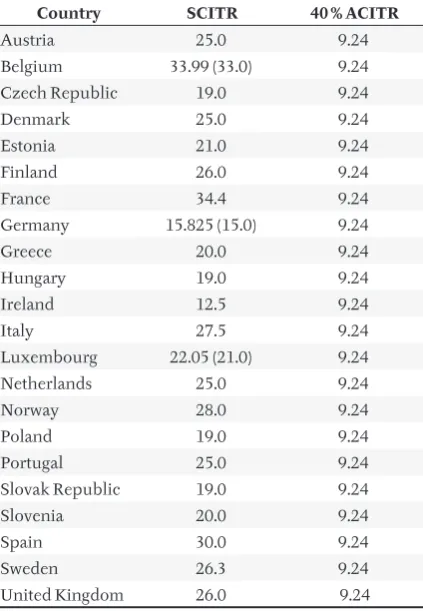
border, i.e. below 40 % of the average statutory tax rate in the European Union, i.e. below 9.24 %. This assertion can be demonstrated on example in the table II.
One might argue that base on above mentioned the common CFC regime is no strict so as national CFC rules in the Member States.
Besides, there would be problem with an interpretation of the term “entity resident in a third country”. It is obvious that the income from the foreign permanent establishment will be exempted. So, the third-entity resident is a controlled company. The controlled company is defi ned as company on which the shareholder owns more than directly or indirectly 50 % of the capital, voting rights or profi ts. It is questionable, capital and profi ts not always ensure the control on the foreign company’s decision. This condition of the control is the same also in the EU Member States, so there is no diff erent. The control is so defi ned with the respect to the freedom of the capital movement in third country situations. CFC rules will apply if the resident shareholder, directly or indirectly, holds a majority of voting rights.
For common CFC rules it is useful as the entity so the transactional approach, nevertheless, the most Member states apply only entity approach. The entity approach minimizes the compliance and administrative burden, but either tainted income will escape tax or the non-tainted income will be taxable. Even thought the transactional approach is seemed with the notion of tax avoidance as developed by the ECJ case law, despite the broad range of tainted income from the CFC’s company, for common CFC rules there have been mainly targeted “passive income”.
Particularly questionable it is the defi nition of low-tax countries. The conditions for defi nition the preferential tax regime is diff erent in all the Member States. Within common CFC rules have been established the defi nition of law taxation as the tax burden which is less than 40 % of this average burden or as lower level of taxation than that of the general regime.
Even thought in the Member States there is no possible to include the losses, the common CFC legislation make possible to carry forward the losses for the future years. This is benefi cial for the resident-shareholders. From of the point, the common CFC regime is no strict so as the national CFC rules.
To prevent double taxation, tax exemption continues to apply to amounts of income already taxed under CFC rules. Dividend distributions will be exempted by the CFC up to the extent that the profi t corresponds to income already been taxed under CFC rules. And the proceeds from disposals II: Statutory corporate income tax rate 2011[%]
Country SCITR 40 % ACITR
Austria 25.0 9.24
Belgium 33.99 (33.0) 9.24
Czech Republic 19.0 9.24
Denmark 25.0 9.24
Estonia 21.0 9.24
Finland 26.0 9.24
France 34.4 9.24
Germany 15.825 (15.0) 9.24
Greece 20.0 9.24
Hungary 19.0 9.24
Ireland 12.5 9.24
Italy 27.5 9.24
Luxembourg 22.05 (21.0) 9.24
Netherlands 25.0 9.24
Norway 28.0 9.24
Poland 19.0 9.24
Portugal 25.0 9.24
Slovak Republic 19.0 9.24
Slovenia 20.0 9.24
Spain 30.0 9.24
Sweden 26.3 9.24
United Kingdom 26.0 9.24
Source: OECD Tax Database, Corporate income tax rate, table II.1 and owns calculation.
of shares in the CFC will be exempted up to the amount of undistributed income already been taxed under CFC rules.
Additional, common CFC rules may overlap with the application of the national CFC rules, so there is need for coordination. The following example shows this fact and illustrates that common CFC rules are no strict so as national CFC rules.
Example
The German-resident company A holds directly 30 % of the share capital in the Hong Kong’s corporation. The other German-resident corporation B owns 80 % capital in an Austrian corporation which holds 80 % capital in the Hong Kong’s corporation.
The German-resident B indirectly holds 64 % of Hong Kong’s company’s capital. So, the condition of the control is fulfi lled.
The Hong Kong’s company non-distributed income is derived only from the fi nancial activities and the entity’s principal class of shares is not regularly traded on recognized stock exchanges. There is a question whether common or national CFC rules will apply on the German-resident taxpayer B.
It is quite evident that common CFC rules under the CCCTB will not apply because the conditions for the application of the CFC rules have not been fulfi lled. On the other hand, the national CFC rules would be used when there the CCCTB group not exists. Under the general fi ndings, the national CFC
rules are stricter than the common CFC rules. The Member States would lose the part of the fi nancial sovereignty in the sense that they can’t regulate the defi nition of the tax preferences regime in the foreign country of CFC’s company. This problem will only touch the defi nition of the low taxation in third countries. The most Member States have been introduced in their CFC legislation so called clause of safe harbour. I.e. the CFC legislation is not mostly applied on the CFC’s company from the European Union. As well as, common CFC rules are only targeted on the CFC’s company from the third states. In the case that the CFC’s corporation would be established in the European Union, the national CFC rules will not apply to the German shareholder.
CONCLUSION
In the proposal for a Council Directive on a Common Consolidated Corporate Tax Base (CCCTB) there have been introduced a specifi c anti-abuse provisions, CFC rules. These rules are aimed at tax evasions and tax avoidance. The basic principle is the protection of the tax base against erosion through practices of artifi cial income shi ing. Generally, CFC rules prevent tax avoidance in a state of a shareholder by denying the deferred taxation of profi ts generated by its controlled company, which is a resident in a tax preference jurisdiction. Even thought the CCCTB directive would be aided easier and low-costs cross-border business as well as it would be restricted the harmful tax competition there are questions whether it is
30 % 80 %
Potential
80 %
CCCTB
group
Third country
European Union
German-resident A
German-resident B
Austria company
Hong Kong’s comp.
1: Structure of the shareholders on the CFC’s company
III: The condition for the application of CFC rules
German CFC rules Common CFC rules
Conditions Fulfi lled Conditions Fulfi lled
Control – 64 % of capital yes Control – 64 % of capital yes
Low taxation – statutory corporate tax rate below 25 % (tax rate in Hong Kong is 16.5 %)
yes
Low taxation – 40 % average corporate tax rate is 9.24 % (Hong Kong’s tax rate is more than 9.24 %)
no
Passive income yes Passive income yes
advisable to introduce these rules into such system of the CCCTB, whether these rules are compatible with the CCCTB and whether it is regulated properly. So, the focus of this paper rests on the interaction of the proposed CCCTB directive with existing CFC rules in the European Union. The paper deals with pros and cons, economic and legal perspectives these rules in the context of the proposed CCCTB directive.
Under the general fi ndings, the national CFC rules are stricter than the common CFC rules. The Member States would lose the part of the fi nancial sovereignty in the sense that they can’t regulate the defi nition of the tax preferences regime in the foreign country of CFC’s company. This problem will only touch the defi nition of the low taxation in third countries. The most Member States have been
introduced in their CFC legislation so called clause of safe harbour. I.e. the CFC legislation is not mostly applied on the CFC’s company from the European Union. As well as, common CFC rules are only targeted on the CFC’s company from the third states.
Due to pros and cons for common CFC rules, I think the CFC legislation would be a part of the CCCTB directive. The harmonization of the corporate tax base within the CCCTB should not only concern an approximate of the tax base but also an approximate and the harmonization of the anti-abuse provisions. The harmonization should touch all the level of the corporate taxation of the Member States. Otherwise, the harmonization will not be properly ensured and will lack the economical purpose.
REFERENCES
European Commisson, 2010: Anti-abuse Rules in the CCCTB, 30 August 2010, No. CCCTB/RD/004/ doc/en.
European Commission, 2011: Proposal for a Council Directive on a Common Consolidated Corporate Tax Base (CCCTB), 16 March 2011, No. COM 2011/121.
GEBHARDT, F., 2010: CCCTB and CFC taxation. Wien: WU University. Master thesis.
LANG, M. et al., 2004: CFC Legislation, Tax Treaties and EC Law. Wien: Kluwer Law International, 656 pp. ISBN 90-411-2284-2.
LANG, M. et al., 2008: Common Consolidated Corporate Tax Base. Wien: Linde Verlag Wien, 1101 pp. ISBN 978-3-7073-1306-2.
PANAYI, CH., 2008: The Common Consolidated Corporate Tax Base – Issues for Member States Opting Out and Third Countries. European Taxation. 48, 3: 114–123. ISSN 0014-3138.
SOBOTKOVÁ, V., SOLILOVÁ, V., 2011: Komparace CFC pravidel ve vybraných státech EU. [CD-ROM]. Teoretické a praktické aspekty veřejných fi nancí. ISBN 978-80-245-1763-6.
WEBER, D. et al., 2011: Proposal for a Council Directive on a Common Consolidated Corporate Tax Base (CCCTB) – Comments. Highlights and Insights on European Taxation. 4, 6: 5–85. ISSN 1879-0665.
Address