prepublications
author N.A. Taatgen
title Explicit learning in ACT-R
status to be published in U. Schmidt et al., Mind modelling
Explicit Learning in ACT-R 1
Explicit Learning in ACT-R
Niels A. Taatgen
Cognitive Science and Engineering
University of Groningen, the Netherlands
Abstract
A popular distinction in the learning literature is the distinction between implicit and
ex-plicit learning. Although many studies elaborate on the nature of imex-plicit learning, little
atten-tion is left for explicit learning. The unintenatten-tional aspect of implicit learning corresponds well
to the mechanistic view of learning employed in architectures of cognition. But how to account
for deliberate, intentional, explicit learning? This chapter argues that explicit learning can be
ex-plained by strategies that exploit implicit learning mechanisms. This idea is explored and
mod-elled using the R theory (Anderson, 1993). An explicit strategy for learning facts in
ACT-R’s declarative memory is rehearsal, a strategy that uses ACT-ACT-R’s activation learning
mecha-nisms to gain deliberate control over what is learned. In the same sense, strategies for explicit
procedural learning are proposed. Procedural learning in ACT-R involves generalisation of
ex-amples. Explicit learning rules can create and manipulate these exex-amples. An example of these
explicit rules will be discussed. These rules are general enough to be able to model the learning
of three different tasks. Furthermore, the last of these models can explain the difference between
adults and children in the discrimination-shift task.
Introduction
One of the basic assumptions all architectures of cognition share is that all learning can
be described with a fixed set of mechanisms. The term ‘mechanism’ refers to the fact that
learn-ing is unintentional and is always at work. The term ‘fixed’ refers to the fact that learnlearn-ing never
changes, and is the same for each person, regardless of age or intelligence. This view of
intelli-gence seems to be at odds with the general view of learning in psychology. The hallmark of
learning is adaptation, the capacity of the organism to change its behaviour to suit a particular
environment. This does not necessarily imply that learning itself is susceptible to adaptation.
But work from developmental psychology clearly suggests that learning changes with age. One
classical experiment that shows the way children learn differs from adults is discrimination-shift
learning (Kendler & Kendler, 1959). We will discuss this experiment in more detail later on. A
Although we have no complete control over learning, the idea that we have no control at all
seems to be too strong.
The distinction between implicit and explicit learning is centred around this issue.
Implic-it learning is unconscious and unintentional, so is consistent wImplic-ith the mechanistic and fixed
view of learning in architectures of cognition. In explicit learning, on the other hand, goals and
intentions determine what is learned. Moreover, many studies suggest that explicit learning is
much more powerful than implicit learning (see for an overview Shanks & John, 1994). Some
things can’t be learned by implicit learning, but can be learned by explicit learning. Finally,
things that can be learned implicitly can often be learned faster explicitly.
Another aspect of learning that seems to be at odds with mechanistic learning is learning
through insight. Many learning mechanisms model gradual learning. Learning in the PDP
neu-ral network tradition is gradual (Rumelhart & McClelland, 1986), and chunking in Soar is
in-spired by, and can explain the power law of practice (Newell & Rosenbloom, 1981). A property
of insight learning is a sudden qualitative shift. Take for example match stick algebra (MSA),
as discussed in Knoblich and Ohlsson (1996). In MSA, subjects have to correct equations of
Ro-man numbers made out of match sticks by moving a single match stick. Initially, subjects only
try to moves that leave individual symbols intact, for example by changing I+II=I into I+I=II.
This corresponds well to what is normally allowed in algebra. It takes a lot of time and effort
for subjects to discover that symbols can be broken up, for example that an X can be changed
into a V by moving a single match stick, so that X+I=VI can be changed into V+I=VI. Once a
subject has discovered this, he can apply this immediately in later problems.In other words, the
subject has learned something about a certain constraint in the context of MSA. This type of
learning is not gradual, but step wise.
So the central question of this chapter is how learning mechanisms in architectures of
cog-nition can be made consistent with an adaptive view of learning that allows for flashes of
in-sight. Or, stated in another way, we need a theory of explicit learning. We will concentrate the
discussion on the ACT-R architecture (Anderson, 1993), but some aspects may apply to other
architectures as well.
Since mechanisms in architectures are fixed, we have to seek for other ways to explain
adaptation in learning. The only thing that changes over time in an architecture is the knowledge
in its memory. An explanation of changes in learning has to be an explanation in terms of
chang-es in the content of memory. As a consequence, the learning capabilitichang-es of an individual can be
learn-Explicit Learning in ACT-R 3
ing strategies in its memory. What is the nature of these explicit learning strategies? There are
two possibilities. The first possibility is, that an explicit strategy can directly effect memory. In
that case, we might have a rule in procedural memory that can directly change other rules by
adding conditions, changing weights, etc. This, however, doesn’t seems to be a good option.
One of the essential properties of procedural memory is, that it cannot access its contents
direct-ly. To be able to intentionally change a rule we need such a direct access. Moreover, it would
violate one of the basic assumptions of an architecture of cognition, that the learning
mecha-nisms in the architecture are sufficient. So we have to focus on a second, more likely possibility,
that explicit learning is built on top of implicit learning in the sense that it learns by using
im-plicit learning mechanisms.
A relatively simple example might explain this point. It is a well-known fact that people
aren’t very good at remembering facts that cannot easily be related to other knowledge they
have. The whole tradition of theories about short-term memory that started with Miller’s
mag-ical number seven is based on this fact (Miller, 1956). Atkinson and Shiffrin (1968) introduced
the mechanism of rehearsal, to account for the fact that some facts in short-term memory do get
stored in long-term memory, and others do not. Closer scrutiny however shows, that rehearsal
isn’t really a mechanism in the sense discussed earlier. Rehearsal isn’t always at work, most of
the time it isn’t. People only rehearse if they have consciously decided to do so. So rehearsal
isn’t mechanistic, it is tied to intentions. Neither is rehearsal fixed. It turns out small children do
not use rehearsal at all, so it must either be a dormant strategy that surfaces at some point, or a
strategy that children acquire at some point during development. So rehearsal is a typical
exam-ple of learning that is not part of the architecture, but rather a strategy represented in memory.
We will return to this issue after a brief introduction of learning in the ACT-R architecture.
Learning in ACT-R
The ACT-R architecture has two memory systems, a declarative memory and a procedural
memory. Associated to each of these memory systems is a number of learning mechanisms that
add and maintain the knowledge in them. ACT-R is based on the theory of rational analysis
(An-derson, 1990), and the learning mechanisms of ACT-R are no exception to this. According to
rational analysis, the cognitive system is optimised to its environment. So a careful examination
of the environment can shed as much light on the cognitive system as studying the cognitive
Implicit learning in declarative memory
A first example of the role of rational analysis in ACT-R is declarative memory. Elements
in declarative memory, called chunks, closely resemble nodes in a semantic network. Each
chunk has an activation value. This value represents the odds that the chunk will be needed in
the current context. To be able to estimate this value, the learning mechanisms have to keep a
close track of the environment. The activation value of a chunk has two parts, the base-level
ac-tivation and acac-tivation through associations with other chunks. The latter is context-dependent:
once a certain chunk is part of ACT-R’s current context, all chunks with an association to this
chunk gain activation temporarily, since the presence of an associated chunk increases their
chance of being needed. The base-level activation of a chunk is based on its past use. Two
fac-tors play a role: how many times a chunk was needed in the past, and how long ago this was.
The learning rule used in ACT-R is derived from Bayesian statistics. Anderson shows that this
rule both reflects regularities in the environment and empirical data from memory experiments.
Association strengths are learned using similar rules. ACT-R uses activation values of chunks
to order the chunks in the matching process, because the activation value determines the time it
takes to retrieve the chunk.
Implicit learning in procedural memory
As the name implies, knowledge in production memory is represented by production
rules. Associated with each rule are a number of parameters. The strength parameter is used to
reflect past use of a rule, and is governed by the same laws as the base-level activation of
chunks. The a, b, q and r parameters of a rule reflects its past cost-benefit characteristics. The a
and b parameter represent the current and future cost of a rule, and the q and r parameters the
chance of succeeding and reaching the goal. Bayesian statistics are again used to estimate these
parameters. The cost-benefit parameters are used in conflict resolution. For each rule that is
al-lowed to match, an expected outcome is calculated using the equation:
expected outcome = PG-C
In this equation, P is the estimated chance of success, calculated from q and r, G the estimated
value of the goal and C the estimated cost of reaching the goal, calculated from a and b.
New rules are learned by the production compilation mechanism. This involves
general-isation of examples in declarative memory. The examples are stored in specialised chunks,
de-pendency chunks, that contain all the information needed: an example goal, an example
Explicit Learning in ACT-R 5
create a solution, and sometimes additional subgoals that must be satisfied before the main goal
can be reached.
Figure 1 shows and example of deriving a rule for doing a simple addition. The chunk
dependency2+3 points to example-goal1 in which the addition 2+3 must still be calculated. In
example-solution1 the answer is supplied in the answer slot. The additional fact needed to
de-rive the rule is the fact that 2+3 equals 5. When the dependency chunk is added to declarative
memory, the rule production-problem-production1 will be derived and added to production
memory. Note that all identifiers starting with an =-sign are variables, and can be matched with
arbitrary chunks in declarative memory.
How can ACT-R’s learning mechanisms, which are clearly implicit in nature, give rise to
explicit, intentional learning? The next section will explore this question.
Explicit learning in ACT-R
Explicit learning in declarative memory
The implicit mechanisms to calculate the activation of a chunk in declarative memory
pro-vide a good estimate of the chance the chunk will be needed. But sometimes it is not enough to
rely on the environment to cue the right facts the right number of times. As has already been
observed in the introduction, rehearsal can provide a strategy that can help us memorise facts.
Since base-level activation is calculated from the number of times a certain fact is retrieved, re-dependency2+3 isa dependency goal example-goal1 modified example-solution1 constraints fact2+3 example-goal1 isa addition-problem arg1 two arg2 three answer nil example-solution1 isa addition-problem arg1 two arg2 three answer five fact2+3 isa addition-fact addend1 two addend2 three sum five (p addition-problem-production1 =example-goal-variable> isa addition-problem arg1 =two-variable arg2 =three-variable answer nil =fact2+3-variable> isa addition-fact addend1 =two-variable addend2 =three-variable sum =five-variable ==> =example-goal-variable> answer =five-variable)
Figure 1. Example of ACT-R’s production compilation process. The left column shows
hearsal can emulate extra uses of a certain fact. In other words, rehearsal tricks the
base-level-learning mechanism into increasing the activation of a certain chunk.
Craik and Lockhart (1972) have observed that the effectiveness of rehearsal depends on
the level of processing. Simple maintenance rehearsal turns out to be much less effective than
elaborate rehearsal, in which subjects try to associate the new fact with existing facts. This
dis-tinction can be easily explained in ACT-R, since elaborate rehearsal not only increases the
base-level activation, but also increases associations with other chunks.
In a previous study I have showed how rehearsal can be modelled in ACT-R (Taatgen,
1996). Rehearsal is implemented by a set of production rules that create subgoals to do the
re-hearsal. The basic rehearsal productions can be enhanced by task-specific rules that can do
elab-orate rehearsal. The model was able to reproduce the data from classical free-recall
experiments, and provide explanations for the primacy and recency effect. Rehearsal is clearly
intentional in this model: it only occurs if ACT-R decides to push a rehearsal goal.
Explicit learning in procedural memory
The production compilation mechanism creates rules from dependency chunks in
declar-ative memory. The architecture, however, does not specify how dependencies are created. This
is not necessary, since dependencies are just chunks in declarative memory. Dependencies may
be picked up from the environment, or may be supplied by a parent or teacher. On the other
hand, chunks may be created and manipulated by production rules. So an explicit theory of
learning procedural rules involves dependency-manipulating rules in production memory.
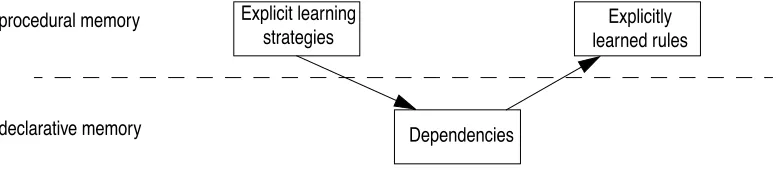
These rules create dependencies that are compiled into new rules by the production compilation
mechanism (figure 2). Again, strategies in procedural memory manipulate the implicit
mecha-nisms: in stead of slowly gathering and generalising regularities from the environment,
inten-tionally created rules are learned.
The process described here is closely related to the concept of mental models
(Johnson-Laird, 1983). A mental model is a mental construct that helps us predicting properties and procedural memory
declarative memory
Explicit learning strategies
Dependencies
Explicitly learned rules
Explicit Learning in ACT-R 7
events in the outside world. A dependency created by explicit learning strategies is a kind of
mental model.
How to decide whether to do explicit learning?
Since explicit learning is intentional, a decision has to be made at some point to start a
learning attempt. We’ll concentrate the discussion on explicit strategies for procedural
knowl-edge, but similar points may be made on the decision to do rehearsal.
The easiest case that indicates an explicit strategy is needed, is when we get a certain
out-come which turns out to be different from our expectations, an expectation-failure, in terms of
Schank (1986). Often, however, indications aren’t as clear. At some point we have to make a
decision that our current approach isn’t working, and something else is needed.
Decisions in ACT-R are based on a cost-benefit analysis of the available options. So
sup-pose we present a new task to a subject. We have supplied some information to the subject about
the task. The subject has several options. Should he just start an attempt in accomplishing the
task using the information he has? Should he ask for advise, or go to the library to find more
information? Or should he first reflect on the task, to come up with some new strategies?
Sup-pose we restrict our analysis to two possible strategies: search and reflection. If the subject
chooses search, he attempts to accomplish the task given his current knowledge about the task.
If he chooses reflection on the other hand, he will try explicit learning strategies to come up with
new rules.
In Taatgen (1997), I describe a model that calculates the expected outcome of either
strat-egy over time. I will briefly summarise the results here. The expected outcome has three
com-ponents, as mentioned before, P, the chance of reaching the goal using the strategy, G, the
estimated value of the goal, and C, the estimated cost of a strategy. Since G is not related to a
strategy, we will concentrate on P and C. For search, the cost is relatively constant, and typically
low. The chance of success of search, however, decreases over time if the goal is not reached,
reflecting the fact that repeated failure is a strong indication that the current knowledge is false
or insufficient. An assumption of reflection is, that it needs existing knowledge to work with.
You can’t get something out of nothing. This knowledge can have several sources, as we will
see later on. For now, we will assume that the only source of knowledge is implicit knowledge
gained through search. So if we have little implicit knowledge to work with, the cost of
reflec-tion is high, since it is difficult to come up with something useful. As our explicit knowledge
A final assumption of the model is, that search increases implicit knowledge, reflection
increases explicit knowledge, and explicit knowledge is more powerful. This enables us to
de-scribe the increase of knowledge over time, related to the conflict resolution mechanism that
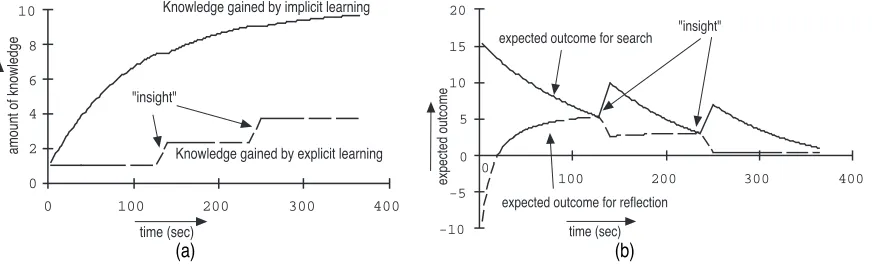
selects the strategy with the highest expected outcome. Figure 3 shows an example of the results
of the model. Figure 3a shows the growth of knowledge about a specific problem, and figure 3b
shows the expected outcome of search and reflection. The discontinuities in both graphs
indi-cate a change of strategy.
A nice aspect of this model is, that it can give a rational account of the
explore-impasse-insight-execute stages often identified in problem solving that requires insight. In the explore
stage, the subject still thinks his existing knowledge is the best way to reach the goal, in the
im-passe stage he decides that the existing knowledge is insufficient, and in the insight stage
reflec-tion starts in an attempt to gain new explicit knowledge. Finally, in the execute stage the search
process continues using the newly gained knowledge.
An ACT-R model of a simple explicit strategy
The model discussed above is just a mathematical model, and only represents the amounts
of several types of knowledge with their cost-benefit characteristics. To see if the approach
dis-cussed here really works, we have to make a detailed ACT-R model in which actual learning
occurs. The main parts of interest in such a model are the dependency-creating rules, since these
rules form the explicit learning part of the model. These rules have to be quite general, since
they must be applicable to a wide range of problems. So general rules are in principle
context-independent. To be able to work though, they operate on context-dependent knowledge in
de-0 2 4 6 8 10
0 100 200 300 400
"insight"
time (sec)
Knowledge gained by implicit learning
Knowledge gained by explicit learning
amount of knowledge
-10 -5 0 5 10 15 20
0
100 200 300 400
expected outcome for search
expected outcome for reflection "insight"
time (sec)
expected outcome
Figure 3. Results of the model. (a) shows growth of knowledge over time, and (b) shows
the conflict resolution process.
Explicit Learning in ACT-R 9
clarative memory. Possible sources of knowledge are:
- Task instructions and examples
- Relevant facts and biases in declarative memory
- Feedback
- Old goals and old dependencies for the same problem
The beam task
The task we will start with is a beam task. The assumption is, that the model initially has
no task-specific rules about beam-problems. So the only procedural knowledge the model has
is a number of general rules. Later on, we will use the same general rules for other tasks. The
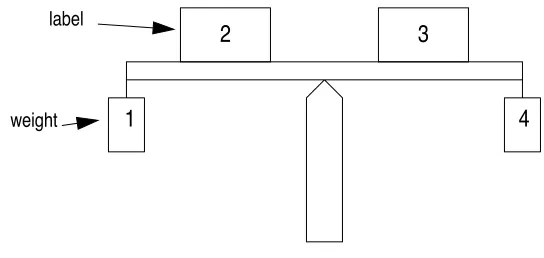
problem is relatively easy: a beam is given, with weights on the left and the right arm. Attached
to the arms of the beam are labels, each with a number on it. The task is to predict whether the
beam will go left, right, or remains in balance. The number on the labels have no influence on
the outcome. Figure 4 shows an example of a beam. Although the task is easy if we know
some-thing about weights and beams, it is much more difficult if we know nosome-thing at all.
The general rules used to learn this task are the following:
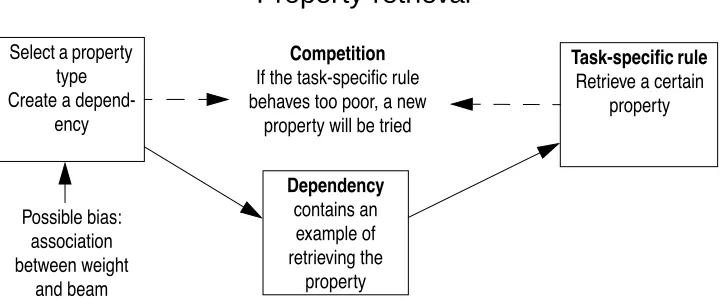
Property-retrieval
If there is a task that has a number of objects, create a dependency that contains an
exam-ple of retrieving a certain property of each of the objects. In the case of the beam task, the objects
are the arms of the beam, and weight and label are possible properties. So this rule creates a rule
that directs attention to a certain aspect of the task.
Find-fact-on-feedback
If feedback indicates that the answer is incorrect, and also contains the correct answer, set
up a dependency that uses the goal and the answer as examples. Also, retrieve some fact that
serves as a constraint in the dependency. To be able to generate correct rules for the beam task,
2 3
1 4
weight label
we need to retrieve the fact that a certain number is greater than another number, in order to
pre-dict correctly whether the beam will go left or right.
Both general rules involve retrieving an arbitrary chunk from declarative memory, either
a property or a fact. Normally the retrieval of arbitrary chunks will not produce the right rules.
The chunks retrieved are however not arbitrary, since ACT-R’s activation mechanism ensures
the chunk with the highest activation is retrieved. Since activation represents the odds that a
chunks is needed, the chunk with the highest odds of being needed is retrieved. This activation
can itself again be manipulated by explicit declarative memory strategies like rehearsal.
In the model this is reflected by the fact that both property-retrieval and
find-fact-on-feed-back can be influenced by prior knowledge. If there is an association strength between beam
and weight, indicating knowledge that a beam has something to do with weight,
property-re-trieval will choose weight in favour of label. If there is an association strength between beam
and greater-than, a greater-than fact will be retrieved by find-fact-on-feedback.
Since the general rules are just production rules, they can be in direct competition with the
task-specific rules they generate. So if property-retrieval generates a rule X to retrieve the label,
X will compete with property-retrieval. So if X is doing a bad job, which it will if it retrieves
the label that has no relevance at all to solving the problem, its evaluation will decrease, and it
will eventually lose the competition, in which case property-retrieval will create an example of
retrieving weight. Although find-fact-on-feedback is only activated if feedback indicates an
in-correct answer, so when an expectation-failure occurs, the rules it produces are in competition
with each other. The rule with the highest success rate will eventually win.
Figure 5 summarises the property-retrieval rules, and figure 6 summarises the
find-fact-on-feedback rules. Figure 6 shows the case in which a “Don’t know” rule fires. If in stead an
incorrect answer is predicted, a dependency is created in the same manner. Apart from the
gen-eral rules, the model contains lisp functions to generate random beams, and production rules to
give feedback. When the model produces an incorrect answer, it will try the same beam again
until it can predict the right outcome.
Simulation results
The general rules turn out to be sufficient to learn the task. The following rules are
exam-ples of (correct) rules learned by the model. The rule generated by property-retrieval is a rule
that retrieves the weight property for both arms of the beam, and stores them in the goal:
Explicit Learning in ACT-R 11 TYPE SOLVE-BEAM OB1 =O6-VARIABLE OB2 =O7-VARIABLE PROP1 NONE PROP2 NONE =P7-VARIABLE> ISA PROPERTY OF =O6-VARIABLE TYPE WEIGHT VALUE =ONE-VARIABLE =P8-VARIABLE> ISA PROPERTY OF =O7-VARIABLE TYPE WEIGHT VALUE =SIX-VARIABLE ==> =OLDGOAL10-VARIABLE> PROP1 =ONE-VARIABLE PROP2 =SIX-VARIABLE PROPTYPE WEIGHT)
Again note that all identifiers starting with an =-sign are variables. One of the rules generated
by find-fact-on-feedback is a rule that predicts when the right arm of the beam will go down.
Property-retrieval
Select a property type Create a
depend-ency Dependency contains an example of retrieving the property Task-speciÞc rule
Retrieve a certain property
Competition
If the task-speciÞc rule behaves too poor, a new
property will be tried
Possible bias: association between weight
and beam
Figure 5. How property-retrieval works
Find-fact-on-feedback
3 2 3 2 ÒleftÓ ÒDonÕt knowÓ rule Þres Find-fact-type: greater-than Find-fact: 3 greater-than 2Possible bias
association between beam and
greater-than
Dependency
Example of answering left if left arm has a greater weight than
the right arm
Task speciÞc rule
Answer left if left arm has a greater weight than the right
arm
(P GEN-GOAL-PRODUCTION12 =OGOAL11-VARIABLE> ISA GEN-GOAL TYPE SOLVE-BEAM OB1 =O6-VARIABLE OB2 =O7-VARIABLE PROP1 =ONE-VARIABLE PROP2 =SIX-VARIABLE ANSWER NONE
PROPTYPE WEIGHT =F61-VARIABLE> ISA GEN-FACT TYPE GT-FACT SLOT1 =SIX-VARIABLE SLOT2 =ONE-VARIABLE ==>
=OGOAL11-VARIABLE> ANSWER RIGHT)
The model was tested in several conditions, differing in the bias given for the properties
and the fact-type. The following table summarises the conditions:
P+ Association between beam and weight
P- Association between beam and label, so a bias for the wrong property
F+ Association between beam and greater-than
F- Association between both beam and greater-than, and beam and number, so two
pos-sible fact-types were favoured.
F-- No associations between beam and fact-types, four fact-types are possible.
Each experiment has a P- and an F-condition. Each experiment has been run 30 times for
50 trials. Figure 7 shows the results. As can be seen in the graph, in the P+F+ condition
ACT-R learns to solve the task quite rapidly, and the fact that the model doesn’t reach a 100% score
within a few trials is only due to the fact that beams are generated randomly, only occasionally
Trial number
Percentage correct
0 0.1 0.2 0.3 0.4 0.5 0.6 0.7 0.8 0.9 1
1 3 5 7 9 11 13 15 17 19 21 23 25 27 29 31 33 35 37 39 41 43 45
P-F+ P-F-P+F+ P-F--
Explicit Learning in ACT-R 13
producing a beam in which balance is the correct answer. Performance decreases if the model
has less initial information. In the case of the P-F-- condition, the model often fails to find the
correct rules for the task.
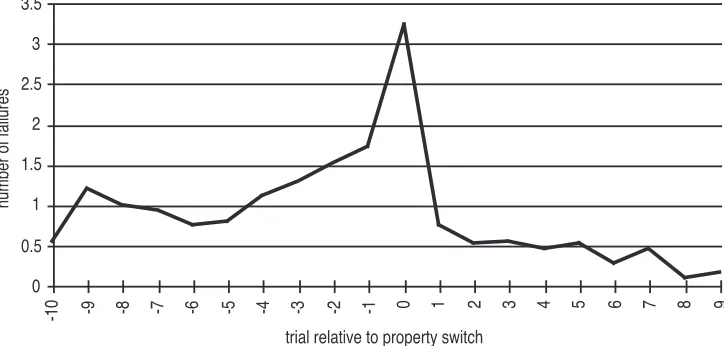
The results in the figure above suggest a gradual increase of performance. This is however
not the case, but a result of averaging 30 runs. If individual runs are examined, each has a certain
point where performance increases dramatically. To make this clear the following graph depicts
the average number of incorrect tries for each trial in the P-F+ condition, averaged with respect
to the point where the model switches from examining the label property to examining the
weight property. So at x=0 the model creates a dependency that contains an example of
retriev-ing weight.
The dependency is created at the moment that the model has failed several times to predict
the right answer. As a result, the evaluation of the rule that retrieves the labels drops and the
general rule can propose a new dependency. In a sense, this process resembles the
impasse-in-sight state of inimpasse-in-sight problem solving.
The card task
General rules are of course only general if they can be used for several different tasks. So
the same rules were used for a new task, a card-classification task. In this task, cards with
pic-tures must be sorted into two categories. The picpic-tures are either one or two squares or circles,
which are either red or green and either large or small. The criterion to sort on is the colour
(red=yes; green=no), which the subject has to discover. The same general rules can be used to
learn this task. First, a property must be selected, so either colour, shape, size or number. After
trial relative to property switch
number of failures
0 0.5 1 1.5 2 2.5 3 3.5
-10 -9 -8 -7 -6 -5 -4 -3 -2 -1 0 1 2 3 4 5 6 7 8 9
that, the relevant aspect is tied to the answer. The following rules are examples of rules learned
by the model:
(P GEN-GOAL-PRODUCTION167 =OLDGOAL1167-VARIABLE> ISA GEN-GOAL TYPE SOLVE-CAT OB1 =O164-VARIABLE PROP1 NONE =P165-VARIABLE> ISA PROPERTY OF =O164-VARIABLE TYPE COLOUR VALUE =GREEN-VARIABLE ==> =OLDGOAL1167-VARIABLE> PROP1 =GREEN-VARIABLE PROPTYPE COLOUR) (P GEN-GOAL-PRODUCTION169 =OGOAL167-VARIABLE> ISA GEN-GOAL TYPE SOLVE-CAT OB1 =O164-VARIABLE PROP1 =GREEN-VARIABLE ANSWER NONE PROPTYPE COLOUR =GREEN-VARIABLE> ISA GEN-FACT TYPE COLOUR SLOT1 GREEN ==> =OGOAL167-VARIABLE> ANSWER NO) Discrimination-shift learning
On of the advantages of explicit learning strategies compared to implicit learning is, that
they can handle change more easily. If something in the environment is no longer valid, an
ex-plicit strategy may react by proposing new knowledge to replace the old. An example of a task
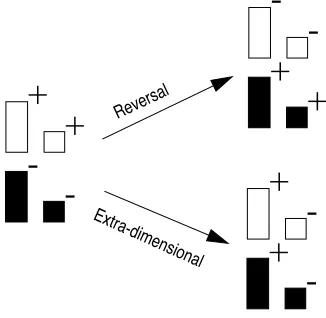
in which the rules change is discrimination-shift learning (Kendler & Kendler, 1959). Figure 9
shows an example of this task. Subjects have to learn to discriminate the four stimuli in two
re-+
+
-+
+
+
-+
-Reversal Extra-dimensionalExplicit Learning in ACT-R 15
inforcement categories, for example white is positive and black is negative. In this sense it
closely resembles the card task discussed previously. After the subject has made 10 consecutive
correct predictions, the reinforcement scheme is changed: either a reversal-shift, in which all
stimuli that received previous positive reinforcement get negative reinforcement and vice-versa,
or an extra-dimensional shift, in which the dimension is changed on which the reinforcement is
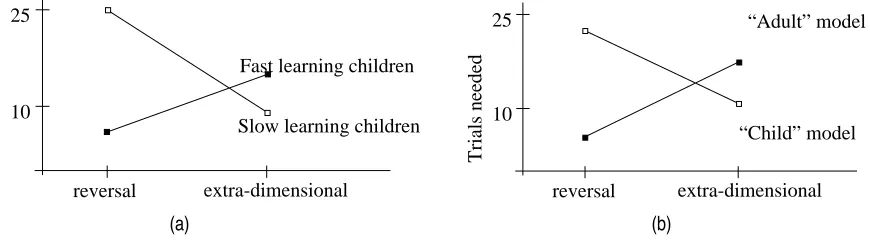
given, in the example from white to large. It turns out that adults and older children are faster at
learning the reversal-shift condition, while young children and animals are faster at the
extra-dimensional shift. Figure 10a shows the results of an experiment by Kendler and Kendler
(1959). The ACT-R model of adult behaviour uses the same 8 production rules as used in the
beam-task, implementing the property-retrieval and find-fact-on-feedback strategies. It learns
rules that are quite similar to the rules for the card task. The small-child/animal model uses only
2 of the 8 production rules, implementing only limited find-fact-on-feedback strategy. So the
latter model hardly uses any explicit reasoning at all, but rather stores regularities in the
envi-ronment in dependency chunks. The results of these models are shown in figure 10b.
Despite the fact that the discrimination-shift task is generally not considered to be an
in-sight problem, it nevertheless requires the subject to notice that something has changed, and to
discover the new relations. So it can be seen, in a sense, as an elementary insight problem.
Conclusions
The goal of cognitive modelling is to create computer simulations of cognitive processes.
A criterion for a good model is of course whether the results of the simulation match the
empir-ical data. A second criterion, that becomes increasingly more important, is the question whether
the model can learn the knowledge it needs. A model that uses a large set of specialised
produc-tion rules is less convincing than a model that gathers its own knowledge. The learning
mecha-Trials needed
reversal extra-dimensional 10
25
Fast learning children
Slow learning children
Trials needed
reversal extra-dimensional 10
25 “Adult” model
“Child” model
(a) (b)
Figure 10. Trials needed to learn the discrimination-shift task, (a) from the Kendler &
nisms that are part of the architecture are often not capable of doing this job by themselves, so
they need augmentation. In this chapter, it is argued that the mechanisms of the architecture
cor-respond to implicit learning. These mechanisms can be augmented by explicit learning, that is
implemented by knowledge in memory that directs the implicit learning mechanisms. The
fol-lowing table summarises the memory systems and learning mechanisms and strategies in
ACT-R.
Implicit mechanisms Explicit strategy
Declarative memory Base-level learning Maintenance rehearsal
Association learning Elaborate rehearsal
Procedural memory Parameter learning Practice
Production compilation Dependency-manipulating rules
Although implicit mechanisms are fixed, explicit strategies have to be learned. So
indi-viduals probably differ in their explicit strategies, although they may well have lots of them in
common. Rehearsal, for example, is a strategy used by almost all adults, though it is clearly not
something we were born with. An interesting question is, whether the same property is also true
for the dependency-manipulating rules. Is there a sequence of rules that unfolds during
devel-opment? The model of discrimination-shift task at least hints in this direction. On the other hand
we may well expect large individual differences. Experiments in which subjects have to solve
difficult problems often show that every subject solves a problem in a different way.
An interesting question is how the issues discussed here can be related to other
architec-tures. The emphasis on learning models is often attributed to the ascent of neural network
mod-els. A neural network model typically starts out with an untrained network, that gains
knowledge by experience. Neural networks are powerful in the sense that a three-layer network
can learn any function if properly configured. This power is also a weakness, especially is you
take the time to learn something into account. Neural networks usually do not have any
goal-structures, so lack the mechanisms to be able to focus learning. To summarise: neural networks
do a very good job at implicit learning, but the step towards explicit learning is difficult to make
because of the absence of any goals or intentional structures.
In the Soar architecture on the other hand, goals and deliberate reasoning are even more
important than in ACT-R (Newell, 1990; see for an extensive comparison of ACT-R and Soar
Explicit Learning in ACT-R 17
rules prove to be insufficient and, more importantly, if there is any knowledge present on how
to deliberate. So if ACT-R has to choose between actions A and B, a cost benefit analysis
be-tween the rule “do A” and the rule “do B” will decide. Only if both rules prove to perform badly,
explicit learning strategies will try to find a more sophisticated rule. A Soar model on the other
hand will always try to make a deliberate and rational choice between A and B, a process that
may require a lot of processing and specific task knowledge. A Soar model that has to choose
between A and B, and has no particular additional knowledge, will get into a infinite sequence
of impasses. Soar’s single learning mechanism is chunking, which summarises the processing
done between an impasse and its resolution into a new production rule. Although chunking is a
mechanism, it is only activated after an impasse has been resolved, so after a deliberate problem
solving attempt. Since chunking is Soars only learning mechanism, this may cause trouble. For
example, to learn simple facts, for which ACT-R has a separate declarative memory, Soar needs
the elaborate scheme of data-chunking. Data-chunking eventually produces rules like “IF bird
THEN note is has wings”. To be able to learn this, however, a lot of deliberating has to be done
by production rules that or not part of the architecture. So in a sense Soar walks the reverse
way: in stead of building explicit learning on top of implicit learning, it accomplishes typical
implicit learning tasks by elaborate explicit schemes. The critical reader will be able to find
more examples of Soars problems with simple satisficing behaviour in Johnson (1998).
Since many other architectures like EPIC (Meyer & Kieras, 1997) currently support no
learning at all, ACT-R presently seems to be the best platform to support explicit learning
strat-egies on a basis of implicit learning. To be able to fully sustain explicit learning though, some
technical issues in ACT-R must be resolved. Most notably a mechanism must be included to
create new chunk-types. The models discussed in this chapter circumvented this problem by
us-ing a generic goal type (GEN-GOAL) for all goals.
This chapter may be a starting point for several strands of further research. A more
thor-ough inventory of possible general rules has to be made. This leads to a further question: where
do the general rules themselves originate? This question is best studied in a developmental
set-ting. Is it possible to specify a sequence of general rules that are learned during development,
that can account for the fact that older children can handle more abstract concepts? A good
start-ing point would be to make a model of the complete balanced-beam task (Siegler, 1976) that
can explain the stage-wise learning aspects of this task.
Norman (1993) distinguishes experiential and reflective cognition in a human-computer
chapter, and reflective cognition to reflection and explicit strategies. According to Norman,
de-signers have to ask themselves the question whether their design is supposed to support
experi-ential or reflective processes, and create it accordingly. Current methods for task analysis used
in human-computer interaction typically do not support any learning. In this sense our research
apparatus for human-computer interaction can only model experiential cognition. To be able to
model the user as an active learner, however, a modelling environment is needed that supports
explicit leaning. The Soar architecture provides a deliberate learning environment, and is used
as such already. The ACT-R architecture may well be a good alternative, since it provides a
more flexible model of explicit learning that can account for individual differences, and can also
model implicit learning phenomena.
References
Anderson, J.R. (1990). The adaptive character of thought. Hillsdale, NJ: Lawrence Erlbaum.
Anderson, J.R. (1993). Rules of the Mind. Hillsdale, NJ: Lawrence Erlbaum.
Atkinson, R.C. & Shiffrin, R.M. (1968). Human memory: A proposed system and its control
processes. In K.W. Spence & J.T. Spence (Eds.), The psychology of learning and motivation
New York: Academic Press.
Craik, F.I.M. & Lockhart, R.S. (1972). Levels of processing: a framework for memory research.
Journal of verbal learning and verbal behavior, 11, 671-684.
Knoblich, G. & Ohlsson, S. (1996). Can ACT-R have insights? In U. Schmid, J. Krems & F.
Wysotzki (eds.), Proceedings of the first European Workshop on Cognitive Modeling (report
no. 96-39, pp. 161-169). Berlin, Technische Universitaet Berlin, Fachbereich Informatik.
Johnson, T. (1997). A comparison between ACT-R and Soar. Chapter 2.1 of this book.
Johnson-Laird, P. (1983). Mental models. Cambridge, MA: Harvard university press.
Kendler, T.S. & Kendler, H.H. (1959). Reversal and nonreversal shifts in kindergarten children.
Journal of experimental psychology, 58, 56-60.
Meyer, D.E. & Kieras, D.E. (1997). A computational theory of executive cognitive processes
and multiple-task performance: part 1. Basic Mechanisms. Psychological Review, 104, 3-65.
Miller, G.A. (1956). The magical number seven plus or minus two: Some limits on our capacity
for processing information. Psychological review, 63, 81-97.
Newell, A. (1990). Unified theories of cognition. Cambridge, MA: Harvard university press.
Newell, A. & Rosenbloom, P.S. (1981). Mechanisms of skill acquisition and the law of practice.
Explicit Learning in ACT-R 19
Norman, D.A. (1993). Things that make us smart. Reading, MA: Addison-Wesley.
Rumelhart, D.E. & McClelland, J.L. (1986). Parallel distributed processing: Explorations in
the microstructure of cognition. Cambridge, MA: MIT Press.
Schank, R.C. (1986). Explanation patterns: understanding mechanically and creatively.
Hills-dale, NJ: Erlbaum.
Shanks, D.R. & John, M.F.S. (1994). Characteristics of dissociable human learning systems.
Behavioral and Brain Sciences, 17(3), 367-447.
Siegler, R.S. (1976). Three aspects of cognitive development. Cognitive Psychology, 8,
481-520.
Taatgen, N.A. (1996). A model of free-recall using the ACT-R architecture and the
phonologi-cal loop. In H.J.v.d. Herik & T. Weijters (Eds.), Proceedings of Benelearn-96, (pp. 169-178).
Maastricht, the Netherlands: Universiteit Maastricht, MATRIKS.
Taatgen, N.A. (1997). A rational analysis of alternating search and reflection in problem
solv-ing. In Michael Shafto & Pat Langley (eds.), Proceedings of the 19th annual conference of the
TCW-1997-1 B. Dunin-Keplicz & L.C. Verbrugge
A reconfiguration algorithm for the maintenance of collective commitments TCW-1997-2 N.A. Taatgen
Explicit learning in ACT-R
University of Groningen
Cognitive Science and Engineering (TCW) Grote Kruisstraat 2/1
9712 TS Groningen The Netherlands
+31 50 3635877 fax 3636784