United Kingdom ISSN 2348 0386 Vol. VII, Issue 11, November 2019
Licensed under Creative Common Page 685
http://ijecm.co.uk/
EFFECT OF INVENTORY MANAGEMENT PRACTICES ON
WAREHOUSE EFFICIENCY OF TEA PROCESSING
COMPANIES IN KENYA: A CASE STUDY OF TEA
PROCESSING COMPANIES IN KISII COUNTY
Kenneth Boro
Department of Social Sciences, Jomo Kenyatta University of Agriculture and Technology, Kenya [email protected]
Wallace Atambo
Department of Social Sciences, Jomo Kenyatta University of Agriculture and Technology, Kenya [email protected]
Abstract
An inventory constitutes significant assets of tea processing firms in Kenya. These processing
companies have inventory management practices; few have managed to implement those
practices to achieve warehouse efficiency, as indicated by literature which indicates Tea
processing firms face problems of fluctuating inventories, inaccurate forecasts and low
utilization of stockpiles; it is unclear on the link between inventory management practices and
warehouse efficiency in these firms. This study explored these inventory management
practices, with the specific objectives as: to determine the effect of Activity Based Costing
practice on warehouse efficiency of tea processing companies in Kenya; to assess the effect
of Just In Time practice on warehouses efficiency of tea processing companies in Kenya; to
establish effects of Bin Card practice on warehouse efficiency of Tea processing companies
and to determine the effect of vendor managed inventory practice on warehouse efficiency in
tea processing firms. The target population was 204 employees that constituted 8 Warehouse
managers, 60 Procurement Officers, 80 Warehouse and Stores personnel, 12 Distributors and
44 Sales and Marketers from Ogembo Tea Factory, Itumbe Tea Factory, Eberege Tea Factory
Licensed under Creative Common Page 686 size was 68 respondents. The data were obtained through questionnaires from those who are
involved in the warehouse management and analyzed using descriptive and inferential
statistics. The research found that Activity Based Costing Practice positively influences
warehouse efficiency.
Keywords: Inventory Management, Warehouse Efficiency, Tea Processing Companies, Kenya
INTRODUCTION
Warehouses are vital components of today's supply chain (Richards, 2011). Today's trend indicates increasing market volatility, product range proliferation and shortening lead times that have an effect on the roles of a warehouse for it to perform. Different activities take place here and thus, require different nature of facilities, staff as well as equipment to suit each function and to make the work easier and the working environment safe. Warehouse operations may easily be the most expensive element of the supply chain (Rushton, 2010). Richards (2011) states that the pressure is on warehouse managers to improve productivity and accuracy, reduce cost and inventory while improving customer services. The successful management of these warehouses is critical regarding the level of service provided, as well as the cost incurred and will result in efficiency in inventory management. Warehouses vary in their nature and forms of classification such as by the product type; by the stage in the supply chain; by geographical location and by function. Warehouses are designed to meet specific requirements in the supply chain. Emmett (2011) classifies such operations as goods in or receiving. A store manager should specify the packaging, items per carton as well as any specific labelling required; putting away into the storage area; order selection and picking or packing; and goods outward or dispatch so as to achieve efficiency.
Licensed under Creative Common Page 687 Muller (2011) puts inventory costs into two classes: ordering costs and holding costs. Ordering is independent of the actual value of the goods. This cost includes the salaries of the purchasing personnel and costs of expediting the inventory. The holding costs include the cost of capital in inventory, storage costs and costs of handling stocks. Other expenses are losses through theft, obsolescence, and taxes. According to Rushton et al. (2010), four principal elements make up the inventory holding cost. They include costs of the actual value of that stock; service cost, which is one for managing the stock like insurance; storage cost, which includes the cost of space, handling. The other warehousing costs involved are storage of the actual product; risk cost, which results in from theft, goods deterioration, stock obsolescence and damage. Therefore, practicing efficiency in a warehouse accounts for about 20 to 30 per cent of logistics costs, while the carrying costs for the inventory accounts for another 18 to 20 per cent.
Inventory is an accounting term for the value or quantity of raw materials, components, assemblies, consumables, work-in-progress and finished stock that is kept or stored for use as the need arises (Lyson, 2000). It is impossible to have goods arrive in a system exactly when demand for them occurs. Inventory is, therefore, part and parcel of an organization. For inventory to be managed well, inventory control practices are employed by the inventory control organization within the framework of one of the basic inventory models, fixed order quantity system or fixed order period system. Inventory control practices represent the operational aspect of inventory management and help realize efficiency in warehouse activities. Without it, customers will have to wait for long periods before their orders are fulfilled. Better management of inventories would release capital for use elsewhere thus improving the productivity of an organization (Ghosh and Kumar, 2003). Today, the global business environment is characterized by different competitive pressures and sophisticated customers demanding speedy solutions. Processing firms are hence progressively turning to inventory management practices such as Activity Based Costing Analysis, Fast Slow and Non-moving of goods analysis, Bin card system, Vendor Managed Inventory Practice and Just In Time practice, to enable them control materials used and stored in the company to provide the requirements, what is needed, when and where it is needed, employing a minimum of residual stock and hence incurring the least possible cost (Agha, 2010). Miller (2010) reveals that the profitability of any organization is directly and indirectly affected by the inventory management system operated by that firm.
Licensed under Creative Common Page 688 customers but ordering items required for production or use just when they are needed. Following its origin and development in Japan, mainly in the 1960s and 1970s and at Toyota, JIT migrated to the Western industry in the 1980s, where its features were put into effect in many processing companies. The vast usage of this term, JIT processing throughout the 1980s disappeared fast in the 1990s, as the new term called lean manufacturing became established as "a more recent name for JIT." Toyota production system (TPS) has been mostly used as a synonym for both JIT and lean manufacturing. According to Kortz (2003), Just in time purchasing recognizes high costs associated with holding high inventory level and as such it has become important in most organizations to order inventory just in time of production so as to cut costs of holding inventory like storage lighting, heating, security, insurance and staffing.
ABC analysis is on the Pareto principle of 80-20 rule. The Pareto principle was first applied to inventory systems by Dickie (1951) for General Electric and it was called ABC analysis, Kiris (2013). Its purpose is to ascertain the status of items kept in inventory in addition to determining what particular attention should be there by each group of inventory (Banjoko, 2004). It states that 80% of the overall consumption value is based only on 20% of the total items. A small portion of the items may represent the highest value of money and a large number of items may be a small portion of the money value. A items represent money value which is highest and constitutes 70%, B items represent only 20%, while C items have money value which is lowest and is at 10%, represents about 70% of items. A items should have tight inventory control under more experienced management. Reorders should be more frequent. B items need medium attention for control for their management. An important aspect of class B is the monitoring of potential evolution toward class A or, on the contrary, toward the class C. This is because Inventory management practices should hence be used to maximize the return on investment at minimum cost, Devnani et al. (2010). Class C items require minimum attention and may be kept under simple observation. Reordering is less frequent. This analysis helps to exercise selective control over items, which have a sizable investment, helps to point out obsolete stocks quickly, provides sound basis for allocation of funds and human resources, and enables the maintenance of high inventory turnover rate and provides a means of ensuring that actual flow of inventory in an organization conform with the plans, Nweze (2004). It is however associated with limitations such as considering only money value of items and neglecting their importance for the production process or assembly or functioning as well as not categorizing them based on their needs and hence the purpose of ABC categorization may be defeated.
Licensed under Creative Common Page 689 maintain, the stock should be replenished, and how large orders should be, (Chase and Aquilano, 1995). It is whereby the suppliers hold inventory on site or near the customer, allowing the customer to have quick access to the inventories. This allows the customer to pull inventories as required and only pays for what is consumed only, thus reducing inventory investment and increasing inventory turns. In VMI arrangements, the supplier has a responsibility to replenish stock, which includes ordering, managing the logistics to ship the materials as well as counting inventory. This process ensures that the right quality of the relevant stock is available at the right time and in the right place, (Orga, 2006).
Inventory management practices are therefore crucial to a firm because its mismanagement threatens a firm's viability (Sprague and Wacker, 1996). Flores and Whybark (1986) stated that ABC classification considers multiple criteria, such as lead time, criticality, commonality, obsolescence and substitutability which aid in more exhaustive inventory and managerial control since too many inventories consume physical space, create a financial burden, and increases a possibility of damage, spoilage as well as loss. In this context, lean production principle has also been linked to reduced inventories, and on the other hand, too little stocks often disrupt processing operations and increase the likelihood of poor customer service. A survey of 351 management accountants by the National Association of Accountants (NAA) in a cross-section of industries to assess current inventory management practices in the U.S indicated that: just-in-time inventory management techniques are increasing in popularity, as are automated time-phased inventory re-order system. The survey further established that 85 per cent of respondents have no plans to change their inventory controls and that actual business experience relies upon more than inventory quantitative models. In addition, the survey established that some inventory management practices such as assessing inventory levels and balancing stock-out costs against expenses related to higher inventory levels are seldom used in practice (Romano, 2011).
Statement of the Problem
Licensed under Creative Common Page 690 have been challenges to achieve warehouse efficiency in many processing companies, but it is unclear how this efficiency can be attributed to inventory management practices. This warehouse efficiency or lack of it has resulted to supplies that get lost, shrinkage, inventory that goes unchecked, stock-outs occurrence and critical equipment locations being uncertain (Dorothy, 2015). All of this leads to inefficiency in operations and additional costs. Literature shows that the Kenya Tea Development Agency managed factories face problems of fluctuating inventory, inaccurate forecasts and low utilization of inventories collected due to inadequate coordination of tea factory’s operations (Kagira, 2012), also this may be associated to
management practices.
Organizations are therefore not satisfied with the contribution inventory makes towards the overall performance of the firms. The wrong quantities of wrong items often found on warehouse shelves, some obsolete, a lot of surplus inventory and dead stock in the warehouse(s), backorders and lost sales are common features in warehouses. This contribute to high costs of operation and losses to firms, thereby resulting to inventory investment and its control systems for a business making up a big percentage of the total budget, Bai &Zhong, (2008). Inventory management practices ensure the number of items ordered matches the actual number of items counted physically and required. Shortages can indicate a problem, or inaccurate inventory management practices; possessing a high amount of inventory for long periods is not good for business due to obsolescence and spoilage costs. Mathuva, (2013) showed that the relationship between inventory management practices and operational performance of business firms has not been clear for a long time. More studies also reveal that the relationship between inventory management practices and performance has produced mixed results (Gill, 2010). This indicates that little is known about effect of inventory management practices and warehouse efficiency, therefore the study aimed to determine that.
Objectives of the Study
Main Objective of the Study
The main objective of this study was to determine the effect of inventory management practices on warehouse efficiency of tea processing firms in Kenya.
Specific Objectives of the Study
The study was further guided by the following specific objectives:
1.
To determine the effect of Activity Based Costing practice on warehouse efficiency of teaLicensed under Creative Common Page 691
2.
To assess the effect of Just In Time practice on warehouses efficiency of tea processingcompanies in Kenya.
3.
To establish effects of Bin Card practice in the warehouse of Tea processing companies.4.
To determine the effect of Vendor Managed Inventory Practice on warehouse efficiencyin tea processing firms.
LITERATURE REVIEW
Theoretical Literature Review
Lean Theory
Lean production theory was developed by Henry Ford in 1913. Womack et al. (1990) show that it was to reduce inventories by eliminating buffer stock since as inventory level is reduced there will be profit making due to interest savings and a reduced storage fees, handling, and wastage. These savings have been estimated in literature to be in the range of 20 to 30 percent (Brigham, 1993). The proponents of this Inventory system argue that excessive inventory will adversely affect the net cash flows of a firm. On the cost side, the costs of holding inventory, like the capital costs and the physical cost (storage, insurance, and spoilage) are reduced. In the recent years, some systems have been developed to deal with the excess inventory problem.
Management oriented systems include the Just-In-Time (JIT), the Materials Requirements Planning systems (MRP) and Enterprise resource planning, ERP that have been used to improve the efficiency of the theory. Just-In-Time refers to a collection of practices that eliminate waste. These organization-wide practices encompass the entire supply chain. The elements of JIT include shared product design with suppliers and customers, the movement towards single sourcing proximate suppliers, reduced machine set-up times and total preventive maintenance. It is an inventory strategy that is implemented to improve the return on investment of business by reducing inventory and the carrying costs, and to achieve Just In Time practice; the process should show what is going on within the process. JIT can lead to great improvements in a processing organization's return on investments, quality, efficiency, and effectiveness. It stresses that production should create items that arrive when needed, and not too early or too late. Quick communication of the consumption of first stock, which triggers new stock to be ordered, is key to JIT and inventory reduction. JIT emphasis on shortening of lead times, improvement, and simplicity through supplier partnership (Bicheno, 1996). This saves on space and cost, indicating effectiveness in a warehouse.
Licensed under Creative Common Page 692 technology which is aimed at minimizing inventory and maintaining delivery schedules and relates the dependent requirements for materials and components comprising an end product to time periods over planned horizon by forecasts provided by marketing and sales units, and other information provided, as shown by Lysons & Gillingham, (2003). The system is based on the recognition that demands an item may rely on the request of other inventories. Emphasizing the final product is related to parts that are incorporated. The inventory quantities required are specified by future demand. The application for stock items is determined by the production schedule for the final product. Lean inventory systems like JIT and MRP result in lower inventory levels that are manageable. The material handling costs, as well as warehousing costs, are significantly reduced. These increases return on assets through decreased conversion costs. Koumanakos (2008) tested a hypothesis that efficient inventory management improved firm's financial performance. He collected the financial information on all medium to large Greek firms for the period 2000 to 2002. For each year, all processing companies operating in any one of the three representative industrial sectors in Greece namely food, textiles and chemicals were selected for the study. The findings obtained by cross-section linear regressions revealed that when there is more level of inventory preserved, i.e., departing from a lean system, by a firm, then there is a lower rate of returns. The criticism leveled against the lean theory is that it can only be applicable when there are a close and long-term collaboration and sharing of information between a firm and its trading partners.
Theory of Economic Order Quantity (Wilson’s EOQ Model)
F. W. Harris developed this model in 1913 to determine optimal inventory levels that should be kept by the organization. Blackburn (2010), agreed that EOQ is one of the models widely used to manage inventory in many industries. EOQ model is also known as Wilson EOQ model, which critically analyzed the model, according to Arsham (2006). The use of the model has shown an increase in some costs as other charges decline, an example of ordering costs dropping with the holding costs rising and the total inventory cost curve have the least point. It is also called the point where total inventory costs are minimized. EOQ is the level of stockpiles that reduces the total of inventory holding costs and ordering costs.
Licensed under Creative Common Page 693 that it leaves out the need to have a buffer stock, which is maintained to cater for variations in case of lead-time and demand, hence making it difficult to be observed in practice. The Economic Order Quantity model requires that for every item kept in the stores, there is need to determine the reorder level and that of the right quantity to order. The model assumes that all other variables are always constant even though uncertainties are shared and regular all business. For example, risk includes a change in demand, damage during transportation and delay in delivery. Change of the request will, therefore force EOQ to be adjusted to buffer against the uncertain business atmosphere. Due to uncertainties experienced in business environment improved economic order quantity is an EOQ model that is used where fluctuation in demand is a common occurrence.
Transaction Cost Analysis (TCA)
In the early 1970s, a mathematical economist, Williamson, came up with TCA into the equilibrium model and set up his transactional cost economics in the new theory of the firm. This approach ensures all costs are kept to a minimum. Halldorsson, et al. (2007) explains that (TCA) is an approach that provides that the cost across the supply chain in different areas is minimal especially in economics and organizational studies. Williamson (1975) suggested that organizations could reduce their transaction costs by vertical integration and increase the level of trust at the same time. This kind of integration can reduce the costs of inventory management while increasing the service standards of both internal and external customers and releasing capital to be used in other areas of the organization. The organizational supply chain can, however, reduce transaction through vertical integration and increasing the level of trust among supply chain participants and through horizontal integration and economy of scale gained from the aggregation of supply and demand. Transaction Cost Analysis has some criticisms, and one of them focuses mainly on independent and dependent economic factors and fails to include personal and social relations, another criticism suggested by Skjoett-Larsen (1999).
Empirical Literature Review
Pawan (1996) however, found out that there was a gap in the application of inventory control techniques for the efficient management of purchase and store activities in materials management department. The inventory turnover of the unit indicated that the stock level of each item was not well maintained. The Economic Order Quantity (EOQ) was not correctly followed to save the ordering cost. No strict efforts had been made to clarify the store items into A, B and C category. Grablowsky, (2005) in his paper “Financial management of inventory”
Licensed under Creative Common Page 694 commonly used by large firms. It appears that small businesses rely mostly on simple controls, while large firms rely more on quantitative techniques, such as EOQ and linear programming, to provide additional information for decision-making, while small firms are more likely to use management judgment without the quantitative back-up. Of those small firms which did not use quantitative methods for determining inventory order and stock levels, the most common qualitative methods were "experience" and "executive judgment." This may cost an organization. Clifford C. et al., (2010) in their research paper "An inventory of theory in logistics and SCM research," analyzed the theoretical categories and presented to explain the type and frequency of theory usage. They concluded that over 180 specific approaches were found in the sampled articles. The principles grouped under the competitive and microeconomics categories made up over 40 percent of the theoretical incidences. This does not imply all materials utilize theory. The research found that theory was explicitly used in approximately 53 percent of the sampled articles. Mitra et al (2013), shows that Inventory Analysis and Control has become inevitable for a processing industry. In order to refrain from having an inventory go dead it is of utmost importance to stay abreast with the number and condition of items in that particular inventory. The study indicates that both periodic and continuous techniques can be used for appraising the stats of the stocks. Once the figures are accurately determined it is important to determine the level at which a particular item’s stock needs to be maintained. For which calculations and
analysis are mandatory. The case study discusses ABC (Based on Consumption) and HML (High, medium and Low analysis, Based on Unit Price) analysis methods of inventory control analysis of an Electric Multiple Unit processing industry. It explains that priorities of the items change according to different inventory analysis techniques and the management of the company decides which process to follow taking into account their budget, supply, demand, inventory and carrying capacity.
Chen, et al. (2005) analyzed the link between inventory and long-term stock returns of manufacturing firms. They used firm level Raw Material Inventory (RMI), Work-in-Process (WIP) and Finished Goods Inventory (FGI) data on a database and documented a 16 percent drop (from 96 to 81 days) in the average inventory level (days of inventory) of all publicly-traded US manufacturing firms over the 20-year period from 1982 to 2000. They also found that while firms with abnormally high inventory levels had reduced long-term stock returns, firms with slightly lower than average inventory outperformed companies with extremely low inventory, hence the need to have the right inventory.
Licensed under Creative Common Page 695 warehouse efficiency. Specific performance indicators were proved to rely on the level of inventory management practices. They established that Return on Equity had a strong correlation with the lean inventory system and strategic supplier partnerships. As such, they concluded that the performance of processing firms could, therefore, be stated as being a function of their inventory management practices.
Anichebe and Agu (2013) examined the effect of inventory management on organizational effectiveness in selected organizations in Enugu Nigeria. Using a detailed research and a sample size of two hundred and forty-eight respondents, they established that there is a significant relationship between good inventory management and organizational effectiveness. Inventory management was found to have a significant effect on organizational productivity. There was a high positive correlation between good inventory management and corporate profitability. They concluded that Inventory Management is very vital to the success and growth of organizations. This justifies the need to research on this inventory management practice since little literature exists on its implementation and use.
Obala, et al. (2015) found out effects of inventory management practices, that losses resulting from medicine expiration; drug damages; obsolesce; medicine purchased not meeting intended purposes; losses arising out of medicine theft lead to increased inventory shrinkage. The study indicates that accuracy of records has a positive effect on inventory management and up to date records and proper accounts records have a positive effect on inventory accuracy. However, the effect of record accuracy on inventory management varied across departments. According to Brooks et al. (2007), Inventory recording is undertaken by organizations to reduce the errors of stock management. However, the level of mistakes cut is not indicated.
METHODOLOGY
Research Design
The study adopted a descriptive case study design which enabled the researcher to keep track of the research activities and help to ensure that the research objectives are achieved as intended. Benjamin, (2000) explain that the descriptive studies are only restricted to fact finding. However, it may result in the formulation of important principles of knowledge and solutions to significant problems. This method is preferred because it allows for in-depth study of the case.
Target Population
Licensed under Creative Common Page 696 four tea processing firms in Kisii County, which include Ogembo Tea Factory, Itumbe Tea Factory, Eberege Tea Factory and Rianyamwamu Tea Factory. Warehouses, distribution departments, and procurement department were the areas of the study.
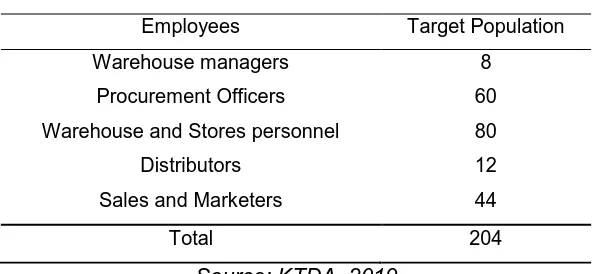
The respondents targeted were ones that deal with inventory, directly or indirectly. The target population was 204 employees from the four tea processing firms. A sampling frame describes the list of all population units from which the sample is selected (Cooper & Schindler, 2003). It also means a comprehensive list of individuals from which a sample is drawn, (Drost, 2011).
Table 1: Target population
Employees Target Population
Warehouse managers 8
Procurement Officers 60
Warehouse and Stores personnel 80
Distributors 12
Sales and Marketers 44
Total 204
Source: KTDA, 2019
Sampling Design
According to Kumar (2011), sampling is a process of selecting a few respondents from a bigger group to be the basis for predicting or estimating the prevalence of unknown piece of information, situation or outcome regarding a larger population in the study. Purposive sampling helps to focus the researcher's attention on the intended respondents and enables him to appreciate the economy of time and often leads to the collection of accurate information, (Oso, 2005). The study adopted (Nasuirma, 2000) model to determine the study sample size. (Nasuirma, 2000), asserts that the sample size can be determined by:
n= {NCv2}/ {Cv2+ (N-1) e2}
Where: N- is the target population (204) Cv- is the coefficient of variation (take 0.5)
e -is tolerance at desired level of confidence, at 95% level (take 0.05) n= {NCv2}/ {Cv2+ (N-1) e2}
= {204 x 0.52}/ {0.52 + (204-1) 0.052} = 51/0.7575
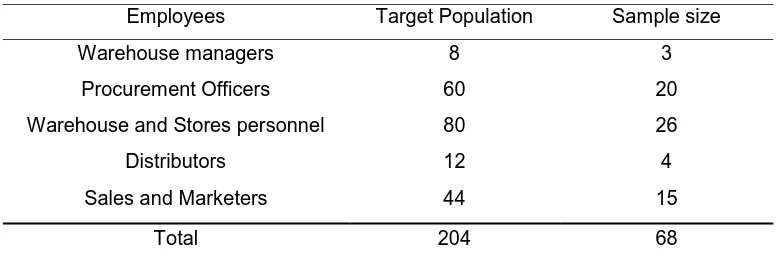
Licensed under Creative Common Page 697 Therefore, the study sample was 68 respondents consisting of 3 Warehouse managers, 20 Procurement Officers, 26 Warehouse and stores personnel, 4 Distributors, and 15 Sales & marketers.
Table 2: Sample size
Employees Target Population Sample size
Warehouse managers 8 3
Procurement Officers 60 20
Warehouse and Stores personnel 80 26
Distributors 12 4
Sales and Marketers 44 15
Total 204 68
Data Collection Tools
The study used both primary and secondary data. Primary data was collected using self-designed questionnaires that were administered by the researcher. The questionnaire answered questions related to the study objectives. The closed-ended questions were to provide alternatives of answers from which respondents selected the answer because they are easier to analyse, are economical in terms of time, low cost of training for research assistants to administer and less cost of administration generally (Vinten, 1995). They also facilitate data analysis, probe interviewee's independent views, give respondents freedom, the spontaneity of answers and ease the testing of hypotheses. The open-ended questions were also used to give respondents a chance to provide an insight into their interests, feelings, and backgrounds of the study (Donald and Delno, 2006). Secondary data was collected using document analysis technique for data from the company financial statements and books of accounts.
Reliability of Research Instruments
Licensed under Creative Common Page 698 Mugenda, 1999). Zinbarg (2005) shows that Cronbach's alpha is a coefficient of reliability that gives an unbiased estimate of data generalizability. An alpha coefficient that is higher than 0.7 indicates that the gathered data has relatively high internal consistency and could be relied upon, Ondieki, et al. (2015).
Validity of Research Instruments
Validity is the degree to which the tools used in research are expected to measure the content, probe issues and produce results they are expected to generate. Polit and Hungler, (1993) explain that validity of an instrument is the degree to which instruments measure what are extended intended to measure. The content validity of the research instruments was ascertained by experts’ advice.
Data Collection Procedures
The questionnaires developed were taken to the respondents in their places of work. This was done after obtaining a letter from the university to show that the work is entirely for academic work and respondents will not be victimized. They were requested of their work time to respond to those questionnaires. Follow-up communication was further done through phone calls to ensure that the questionnaires are duly filled as well as not lost.
Data Analysis and Presentation
Mugenda and Mugenda (2003) explain that data analysis is the process of bringing order, structure, and meaning to the mass of information collected. The data was analysed using computer aided software, the Statistical Package for Social Sciences SPSS Version 22 to generate descriptive statistics of the variables. Descriptive statistics were used to provide summary statistics of variables being studied in very simple form. The SPSS output were presented in Frequency distribution tables which gave a record of the frequency score for the response occurred. The computer aided software, SPSS offers extensive data handling capabilities and numerous statistical routine that can analyze from small data to enormous data statistics (Donald & Tromp, 2006).
RESULTS AND DISCUSSION
Effect of Activity-Based Costing on Warehouse Efficiency
Licensed under Creative Common Page 699 company, controls of a reasonable cost of items and item characteristics and usage quantity was determined.
Table 3: Classification based on Importance to the Company Influence Frequency Percent Cumulative per cent
Not Influential 1 1.5 1.5
Influential 65 98.5 100
While doing classification of inventory, Classification of the items by their importance to the company is influential, at 98.5%
Table 4: Controls of a Reasonable Cost of Items
Influence Frequency Percent Cumulative Percent
Not influential 3 4.5 4.5
Influential 63 94.5 100.0
This indicates that Controls of a reasonable cost of items make companies carry a large stock of items is influential in warehouse efficiency classification of the items by their importance to the company is influential at 94.5% when classifying inventory by their classes.
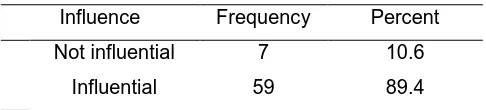
Table 5: Item Characteristics and Usage Quantity Influence Frequency Percent Not influential 7 10.6
Influential 59 89.4
This indicates that item characteristics and usage quantity of a stock is influential in warehouse efficiency at 89.4%. Classification of the items on the basis of their importance to the company has the highest percentage of 98.5%. Controls of a reasonable cost of items make companies carry a large stock of items has the second influence of 94.5% and finally Item characteristics and usage quantity of a stock influences warehouse efficiency at 89.4%.
well-Licensed under Creative Common Page 700 known technique to classify according to which important items are in class 'A', moderately important items are in 'B' and relatively unimportant items are in class 'C'. This is however different from the perspective view of Handanhal et al. (2014) in their work: ABC analysis for inventory management on bridging the gap between research and classroom, who believe that the classification of ABC inventory should be categorised in a manner that class A should be high in demand, price, obsolescence, spoilage, criticality, scarcity, replenishment cost, lead time, variability (of demand, price, lead time). Low: serviceability, number of suppliers, substitutability. class B should be moderate: demand, price, criticality, scarcity, replenishment cost, lead time, variability (of demand, price, lead time), serviceability, number of suppliers, substitutability while class C should be high in serviceability, number of suppliers, substitutability and low in demand, price, obsolescence, spoilage, criticality, scarcity, replenishment cost, lead time, variability (of demand, price, lead time).
Just In Time Influence Warehouse on Effectiveness on Stock Management
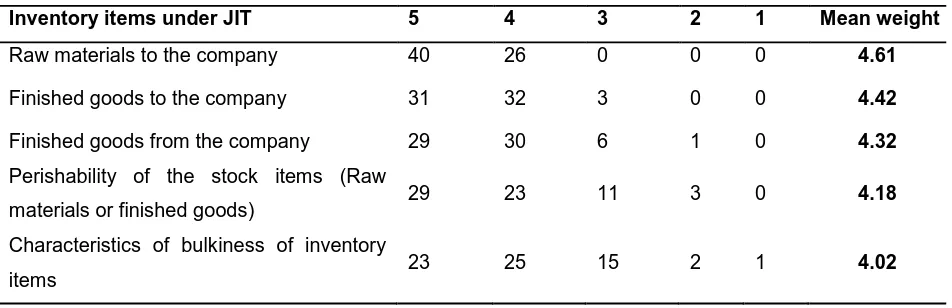
Just In time influences the effectiveness of warehouse management mostly in raw materials to the company, with a mean weight of 4.61, followed by finished goods to the company with a mean weight of 4.42. It also influences finished goods from the company with mean weight of 4.32 and perishability of stock items at a mean weight of 4.18. It least influences bulkiness of inventory items with mean weight of 4.02.
Table 6: JIT influence on warehouse effectiveness
Inventory items under JIT 5 4 3 2 1 Mean weight
Raw materials to the company 40 26 0 0 0 4.61
Finished goods to the company 31 32 3 0 0 4.42
Finished goods from the company 29 30 6 1 0 4.32
Perishability of the stock items (Raw
materials or finished goods) 29 23 11 3 0 4.18
Characteristics of bulkiness of inventory
items 23 25 15 2 1 4.02
Licensed under Creative Common Page 701 and people by hand required doing the same plan, and hence the concentration is on the raw materials to reduce the overall inventory in a JIT manufacturing system.
BIN card Practice and Warehouse Efficiency
The study sought to determine the frequency of use of BIN card on warehouse efficiency. The response rate that was obtained indicates that the use was most frequent, with usage rate of 81.8%.
Table 7: The level of usage of bin card system in the company Frequency Percent
Less frequent 1 1.5
Frequent 11 16.7
Most frequent 54 81.8
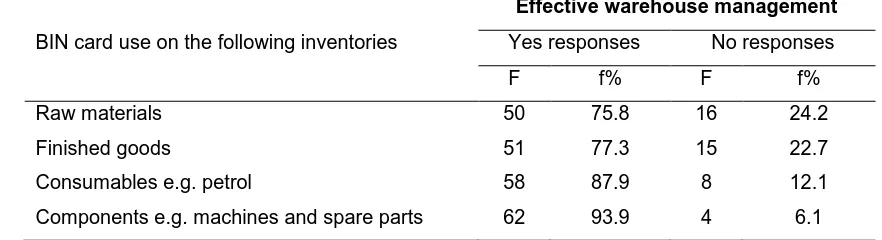
BIN card Practice on Different Inventory Types
Bin card system is practiced most on components such as machines and spare parts, at 93.9%, followed by consumables at 87.9% then finished goods at 77.3% and finally raw materials that are least with 75.8%.
Table 8: BIN card Practice Use and Inventory Types
Effective warehouse management
BIN card use on the following inventories Yes responses No responses
F f% F f%
Raw materials 50 75.8 16 24.2
Finished goods 51 77.3 15 22.7
Consumables e.g. petrol 58 87.9 8 12.1
Components e.g. machines and spare parts 62 93.9 4 6.1
The study reveals that the BIN card is highly practiced in all inventories in the warehouse to achieve warehouse efficiency, with the least percentage of practice at 75.8% being raw materials.
Vendor Managed Inventory Practice and Warehouse efficiency
Licensed under Creative Common Page 702 most practiced at 95.45%. Counting done by employees who are not responsible for custody of particular items is less frequently practiced at 60.61 and has a mean weight of 3.97 and it contributes moderately to the influence on warehouse efficiency. Materials released from warehouse upon approval by responsible official of the department is more influential on warehouse efficiency with a mean weight of 4.34, and the frequency of participation is 92.42%. These activities are however more influential in contributing to warehouse efficiency. Inventory records being always reconciled has a mean weight of 4.25 in its influence to warehouse management and hence more influential in warehouse efficiency. Its frequency of practicing is however high at 87.88%. There is comparison of quantity of goods received against the receiving reports from the warehouse which also has a mean weight of 4.37 influences on warehouse efficiency and 87.88% of frequently being practiced, hence more influential in contributing to warehouse efficiency. Inventory records are periodically reviewed for slow moving items have a mean weight of 4.15 and so its influence is also more, and the level of practice is at 68.18%. Those who believe it is less practiced are 31.82%. On the issue of management monitoring and approving write offs of obsolete and inactive inventories, it is frequently practiced at 84.85% and a mean weight of 4.17 and hence equally mere influential. However, those who believe it is less frequently practiced constitute 15.15%. All items are physically counted manually has an influence on warehouse efficiency of mean weight 4.27 and frequency of practice at 87.88% and hence it is also contributing more towards warehouse efficiency. The highest numbers of respondents, 28 believe that comparison of quantity of goods received against the receiving reports from the warehouse is most influential in terms of warehouse efficiency.
SUMMARY OF FINDINGS
The major findings on objective one reveal that Activity Based Costing practice is frequently used in tea processing companies where all classes of inventory are influenced by Activity Based Costing practice and all the inventory classes in Activity Based Costing Practice require effective warehouse management to achieve warehouse efficiency. Classification of inventory in Activity Based costing practice also majorly relies on the importance of goods to the company as opposed to the classification based on Item characteristics and usage quantity or Controls of a reasonable cost of the items.
Licensed under Creative Common Page 703 Practice and lack of application of ICT in warehouses affect the effective execution of the associated functions and hence the overall performance of the warehouse management is affected. There is a positive link between periodic reviews on inventories and Just In Time Inventory Management Practice, which is more influential on warehouse efficiency. Planning is more influential in contributing to warehouse efficiency in Just In Time practice, and it contributes heavily in Transport, Production, Procurement, Distribution, and Requirement planning for the goods that are needed. This, in turn, affects the whole performance of a warehouse in tea processing companies. Putting security measures in place for Just In Time practice has a positive effect on warehouse efficiency. This includes proper systems in place to control the stock levels, having the stock in the right place, doing requisition by only the authorized personnel, checking stock as well as having security systems in place against any calamity to improve the overall warehouse efficiency, which is all more influential on warehouse efficiency. Therefore, Activity Based Costing practice influences warehouse efficiency.
The major findings on objective three show that BIN card practice is frequently used on Raw materials, finished goods, consumables as well as components in tea processing companies. It improves the overall performance of warehouse efficiency positively. This is by reducing chances of mistakes being made as entries, improvement in control over stock and identification of the different items of materials. It facilitates maintaining bin card records such as registers of inventory, delivery notes, a record showing rates of depreciation for major classes of fixed assets and records of delivery documentation list as well as records of packing list have to influence in contributing into warehouse efficiency. It also helps user items movement. Documentation influences warehouse efficiency by contributing to maintaining records of the authority for transaction, maintaining records of specialized control documents as well as Maintaining stock control documentation.
The major findings on objective four reveal that strategic supplier partnership contributes more to warehouse efficiency in Vendor Managed Inventory Practice through supplier involvement and proper information sharing. Quality information sharing has an influence in warehouse efficiency in Vendor Managed Inventory Practice. This is also agreed by the scholars that it is an important component of effective supply chain integration. Therefore, Activity Based Costing practice influences warehouse efficiency.
CONCLUSION
Licensed under Creative Common Page 704 the overall performance of the warehouse. All the inventory classes in Activity Based Costing Practice also depend on an effective Activity Based Costing practice to achieve warehouse efficiency.
Considering the key findings of Just In Time inventory management practice, tea processing firms should employ Just In Time inventory management practice since it influences warehouse efficiency. This is shown by its application on all types of inventory that enables it to achieve effective warehouse management. The use of ICT in Just In Time also positively influences warehouse management and lack of its application will lead to a poor interchange of information between the suppliers and the procuring entity and hence high level of inefficiency and ineffectiveness of the management processes and affects the inventory management practice. There is also a positive link between periodic reviews on inventories and Just In Time Inventory Management Practice which always influences the overall efficiency of the warehouses positively. Planning affects warehouse efficiency in Just In Time practice. It contributes in Transportation time to, and time spent waiting in the queue, Time spent on the production line; Time used to deliver the finished goods and hence and hence the overall performance of a warehouse. Proper security measures in place for Just In Time practice affects the performance of a warehouse positively in terms of its efficiency through the indicators such as proper systems in place, having the stock in the right place, doing requisition by only the authorised personnel, checking the stock and having security systems in place against any calamity.
As established from the main findings of BIN card inventory management practice, tea-processing firms should embrace the use of BIN card to manage their inventories as it influences warehouse efficiency. This is because there is a positive impact on the performance of warehouses when Bin Card System is employed, and it prevents theft, pilferage, and wastage. BIN card records such as registers of inventory registers of inventory, delivery notes, a record showing rates of depreciation for major classes of fixed assets and records of delivery documentation list as well as records of packing list are vital in contributing to warehouse efficiency. User Items movement documentation in BIN card system also has a positive effect by contributing more to warehouse efficiency regarding maintaining records of the authority for the transaction, maintaining records of specialized control documents as well as Maintaining stock control documentation.
Licensed under Creative Common Page 705 information sharing contributes more to warehouse efficiency in Vendor Managed Inventory Practice and should, therefore, be continuously practiced.
RECOMMENDATIONS
Based on the findings and conclusion of Activity Based Costing practice, the study recommends the firms to maximize the use of Activity Based Costing Practice to boost warehouse efficiency of tea processing firms.
As findings and conclusion of Just In Time practice reveal, the study recommends the firms to optimize the use of Just In Time practice on warehouse efficiency of tea processing firms.
Based on the findings and conclusion on BIN card system, the study recommends that the firms should maximize the use of BIN card Practice to enhance warehouse efficiency of tea processing firms.
Based on the findings and conclusion of vendor managed inventory practice, the study recommends that the firms to maximize the use of vendor managed inventory Practice to warehouse efficiency of tea processing firms and the overall performance of the firms particularly those firms in the logistics chain.
Way forward: Based on the results, conclusions and recommendations, and the limitations of the current study, the study suggests that different studies be conducted incorporating inventory management practices on warehouse efficiency for organizations other than tea factories.
REFERENCES
Anichebe, N.A. & Agu, O.A. (2013). Effect of Inventory Management on Organizational Effectiveness. Information and Knowledge Management, 3 (8), 92 – 100
Apreutesei, P. et al. (2010) Application of kanban system for managing inventory, Series I: Engineering Sciences: Vol. 3 (52)
Aragon Sanchez, A., Barba Aragon, I., & Sanz Valle, R. (2003), "Effects of training on business results", International Journal of Human Resource Management, Vol. 14 No.6, pp.956-80.
Aviv Y.,& Federgruen A. (1998). The Operational Benefits of Information Sharing and Vendor Managed Inventory (VMI) Programs, Working Paper.
Bai, L., & Zhong, Y. (2008). Improving inventory management in small business. Baily, P.,& Farmer, D. (1980). Managing materials in industry. London: Gower Press.
Baily, P., Farmer, D., Barry, C., Jessop, D., & David, J. (2008). Procurement principles and management. Harlow: Pearson Education.
Ballou, R.H, (1999). Business Logistics Management: Planning, Organizing, and Controlling the Supply Chain, 4th ed., Prentice-Hall, Upper Saddle River, NJ.
Licensed under Creative Common Page 706 Bernstein F., Chen F.,& Federgruen A. (2006). Coordinating Supply Chains with Simple Pricing Schemes: The Role of Vendor-Managed Inventories, Management Science, 52(10), 1483-1492.
Best, J.W., & Kahn, J. V., (1986). “Research in Education,” 5th Ed. New Delhi: Prentice Hall of India. Pvt. Ltd Bicheno, J. (1996). Supplier partnerships. National institute for manufacturing management, London
Blackburn, J. (2010) “Fundamentals of
Purchasing and Inventory Control for Certified Pharmacy Technicians” Texas Tech University, Health Sciences Center, School Of Pharmacy. Available at http://www.jdeducation.com
Blair N., & Crocker G.J (2000). Crop rotation effects on soil carbon and physical fertility of two Australian soils. Aust. J. Soil Res. 38:71-84.
Bloomberg, D., LeMay, S., & Hanna, J. (2002). Logistics, supper saddle river: Prentice Bowersok, P.( 2000). Purchasing and Supply Management, 6th edition, McGraw-Hill.
Boyer, S. (2010).Research opportunities in supply chain management", Journal of the Academy of Marketing Science, Vol. 38
Brigham, E.F & Gapenski L.C (1993). Intermediate Financial Management. New York: Dryden Press. Brownell, J. (2005), Strengthening the Purchase Supplier Partnership. A working paper Cornell University. Brownell, J. (2005). Strengthening the purchase supplier partnership, A working paper Cornell University.
Cachon, G. (2001). “Stock Wars: Inventory Competition in a Two-echelon Supply Chain with Multiple Retailers”, Operations Research, 49(5), 658-674.
Cardinaels E., Roodhooft F.,& VanHerck G. (2014). Drivers of cost system development in hospitals: results of a survey, Health Policy, Vol. 69, No. 2, pp. 239-252.
Carter, R.J., & Price, P.M. (1993). Integrated materials management. London: Pitman.
Cetinkaya S.,& Lee C. (2000). Stock Replenishment and Shipment Scheduling for Vendor Managed Inventory Systems, Management Science, 46(2), 217-232.
Chase Richard B., & Aquilano Nicholas J. (1995), Production and Operations Management, USA: Von Hoffmann Press, Inc.
Chase, R.B., Aquilano, N.J. & Jacobs F.R. (1998), Production and Operations Management, Irwin/McGraw Hill, New York, NY. (Placeholder1)
Chen, H., Frank, M. Z., & Wu, O. Q. (2005). What Actually Happened to the Inventories of American Companies between 1981 and 2000? Management Science, 51(7), 1015-1031.
Chen, H., Frank, M.Z., Wu, O.Q., (2005) U.S. Retail and wholesale inventory performance.
Cheung K. L.,& Lee H. L. (2002). The Inventory Benefit of Shipment Coordination and Stock Rebalancing in a Supply Chain, Management Science, 48(2), 300-306.
Cheverton, Peter, & Jan Paul Van der Velde (2010). Understanding the Professional Buyer: What Every Sales Professional Should Know About How the Modern Buyer Thinks and Behaves.Kogan Page Publishers.
Christian Partner Development Agency, C. (2008). Report on small scale sector in Kenya.
Classen, M.J., Weele, A.J., & Raaij, E.M. (2008). Performance outcomes and success factors of vendor managed inventory (VMI). Supply chain management: International journal, 13, 406-414.
Clifford D.C., Brent W., Wesley S. Randall, & Rodney T., (2010) "An inventory of theory in logistics and SCM research", International Journal of Logistics Management, The, Vol. 21 Iss: 3, pp.404 - 489
Cole, G.A. (1997). Personnel management theory and practice. (4th Ed). London: Ashford Colour Press Company. Distribution Management. Kogan Page Publishers. Efficiency and Minimizing Costs in the Modern Warehouse. Kogan Page Publishers
Coleman, B. (2000). Determining the Correct Service Level Target. Production and Inventory Collis, David. (2016). Lean Strategy, Harvard Business Review 94, no. 3: 62–68.
Collis, J. & Hussey, R. (2009). Business Research: A practical guide for undergraduate and post graduate students. Hampshire: Palgrave Macmillan
Licensed under Creative Common Page 707 Coyle, J.J., Bardi, E.J., & Langley, C. J. Jr. (2003). The management of business logistic: a supply chain perspective (7th ed.). Mason: South-Western.
Coyle, John J., C. John Langley, Brian Gibson, Robert A. Novack, & Edward J. Bardi. (2008). Supply Chain Management: A Logistics Perspective. Cengage Learning.
Devnani, M.,Gupta, A.K. & Nigah, R. (2010), “ABC and VED Analysis of the Pharmacy Store of a Tertiary Care Teaching, Research and Referral Healthcare Institute of India”, Journal of Young Pharmacists, vol. 2, 2, pp. 201-205.
Dobler& Burt. (2006). Purchasing management. (6th Ed.). McGraw hill international Edition.
Dong Y., & Xu K. (2002). A supply chain model of vendor managed inventory, Transportation Research Part E: Logistics and Transportation Review, 38(2), 75-95.
Dorothy O., Esther W. & Elizabeth W. (2015) Effect of inventory management practices on organizational performance in public health institutions in Kenya: a case study of Kenyatta National Hospital. ISSN: 2201-6333 (Print) ISSN: 2201-6740
DuBrin, Andrew J. (2008). Essentials of Management. Cengage Learning.
Eckert, S.G (2007). Inventory Management and its effects on customer satisfaction. Journal of Public policy Vol 1 no.3
Emmett, S. (2011). Excellence in Warehouse Management: How to Minimise Costs and Maximise Value. John Wiley & Sons.
Eroglu, C., & C. Hofer (2011). Lean, Leaner, Too Lean? The Inventory-Performance Link Revisited, Journal of Operations Management 29, 356–369.
Farrington, B., &Lysons, K. (2006). purchasing and supply chain management. London: Pearson Education.
Feng, Y., Amours, S.D.,& Beauregard, R. 2010. Simulation and performance evaluation of partially and fully integrated sales and operations planning. International Journal of Production Research 48 (19): 5859–5883.
Flores, B.E.,& Whybark, D.C., (1986). Multiple criteria ABC analysis. International Journal of Operations and Production Management, 6, 3, 38-46.
Frahm, S. (2003). Vendor Managed Inventory (VMI): Three steps in makingit work, http://scm.ncsu.edu/scm-articles/article/vendor-managed- inventory-vmi-threesteps-
Fry M. J., Kapuscinski R.,& Lennon T. L. (2001). Coordinating Production and Delivery Under a (z, Z)-Type Vendor-Managed Inventory Contract, Manufacturing and Service Operations Management, 3(2), 151-173. Ghosh, A.K. & Kumar, P. (2003). Production management, New Delhi: Anmol Publication Pvt. Ltd.
Gill, A., Biger, N., & Mathur, N. (2010). The relationship between working capital management and profitability: Evidence from the US. Business economic journal,1-9.
Government of Kenya Supplies Manual. (2010). Kenya Procurement Journal. Quarterly PPOA Bulletin Issue: Government Printer.
Grablowsky, (2005). Financial Management of Inventory, International Journal of Production Economics, Volumes 93-94, Pages 239-252
Greenwood L (2010). Are Africa’s commodities an economic blessing? BBC Africa Business Report. http://www.bbc.co.uk/news/business- 10710488. Hall in-making-it-work
Gunasekaran, A., Lai, K.H., & Cheng, T.C.E. (2008). Responsive supply chain: A competitive strategy in a networked economy. Omega, 36(4), 549–564.
Gupta, S. & Gupta, S. (2012). Effective Inventory Visibility- Its Impact on Profitability. International Indexed & Referred Research Journal, 4 (39), 59-60
Halldorsson A., Kotzab H, Mikkola. H. J. &SkjottLarsen.T (2007). Complementary theories to supply chain management, Supply Chain Management: An International Journal 12/4 (2007) 284–296.
Handanhal, R. (2014) ABC Analysis For Inventory Management: Bridging The Gap Between Research And Classroom, American Journal Of Business Education. Montclair State University
Hernandez, A. (1989), Just In Time Manufacturing, Prentice-Hall, Englewood Cliffs, NJ.
Licensed under Creative Common Page 708 Hudrdogan, G. (2010). Inventory management through vendor managed inventory in a supply chain with stochastic demand, Unpublished.
International Journal of Operations & Production Management 32 (6): 676–695
Irungu, B. K., & Wanjau, L. I. (2011). Effectiveness of vendor managed inventory systems in retail supermarkets in Kenya. International journal of business and public management, 1, 85-89.
Jabareen Y. (2009). Building a Conceptual Framework: Philosophy, Definitions. Jessop, D., & Morrison, A. (1994). Storage and supply of materials: (6th ed). London. Joannes, V. (2012). Economic Order Quantity (EOQ), definition and formula.
John, W. (2015). Wiley Encyclopedia of Management.
Jones, T.C., & Dugdale, D. (2002), “The ABC bandwagon and the juggernaut of modernity”, Accounting, Organizations and Society, No. 27, pp. 121-163.
Jonsson, P.,& Mattsonz, S. (2008). Inventory management practices and their implications on perceived
Kagira, E., Kimani, S., & Kagwithi, S. (2012). Sustainable methods to address challenges facing small holder tea sector in Kenya: A supply chain management approach. Journal of management sustainability, 2.
Kerlinger F.N. (1986). Foundation of Behavioural Research. 3rd Ed. New York: Holt, Reinhart and Winston. Kimberly, A. (2016) What Is Demand: Explanation and Impact.
Kiris, S. (2013). “Multi Criteria Inventory Classification by Using a Fuzzy Analytic network Process (ANP) Approach”, Informatica, Vol. 24, 199-217.
Kleywegt A. J., Nori V. S., & Savelsbergh M. W. (2002). The Stochastic Inventory Routing Problem with Direct Deliveries, Transportation Science, 36(1), 94-118.
Kothari, C.R (2008). Research methodology. Methods and Techniques. New Delhi: New Age. International Publishers.
Kothari, C.R (1992). An introduction to operational Research. New Delhi: Vikas publishing
Kothari, C.R., (2004). Research Methodology-Methods and Techniques, New Delhi, Wiley Eastern Limited. Kotler, P. (2002). Marketing Management. 2nd Edition. The Millennium Edition. New Delhi: Prentice Hill of India Koumanakos, D.P. (2008). The Effect of Inventory Management on Firm Performance. International Journal of Productivity and Performance Management, 57(5), 355-369.
Koumanakos, D.P (2008).The effect of inventory management on firm performance International Journal of productivity and performance Management, Vol 57 (pp 355 369) Emerald Group Publication
Kruger, G.A. (2005). A statistician looks at inventory management, Quality Progress, 38,2,36
Kumar. R (2011). Research Methodology. A step –by step guide for beginners (3rd Ed.) London: Sage Laurel, B. (2011). Design Research: Methods and Perspectives: Cambridge. Mass. MIT Press.
Li, S., & Lin, B. (2006). Accessing information sharing and information quality in supply chain management. Decision Support Systems, 42(3), 1641–1656
Lyson, K. (2000). Purchasing and supply chain management. London: Pearson Educational Limited. Management Journal, 41(1):169-176
Lysons, K & Gillingham, M. (2003). Purchasing and supply chain management. London: Prentice Hall
Mathuva, D. (2013). Determinants of corporate inventory holdings: Evidence from a developing country. The international journal of applied economics and finance, 7, 1-22.
Miller, R. (2010). Inventors Control: Theory and Practice. New Jersey: Prentice Hall.
Morris, C. (1995). Quantitative Approach in Business Studies: London: Pitman Publisher. Nigeria Bottling Company. 2004. Annual Report.
Mugenda, O. & Mugenda, A. (2003). Research Methods. Quantitative and Qualitative Approaches. Nairobi: African Culture for Technology Studies.
Licensed under Creative Common Page 709 Noum, W.L. (2007). Social Research Methods: Qualitative and Quantitative Approaches. Boston: Alyn & Bacon Publishers.
Nweze A.U. (2004), Quantitative Approach to Management Accounting, Enugu: Amazing Grace Printing and Publishing Co.
Obala, D., Waiganjo, E. & Wachiru, E. W. (2015) Effect of inventory management practices on organizational performance in public health institutions in Kenya: a case study of Kenyatta national hospital
Ogbo, A.I & Onekanma I.V. (2014) “The Impact of Effective Inventory Control Management on Organizational Performance”: Mediterranean Journal of Social Sciences, MCSER Publishing, Rome-Italy, Vol. 5 No 10 June 2014 Ondieki J.,&Oteki E. (2015), Impact of Inventory Management on the Effectiveness of Supply Chain Management Practices in the Public Sector, A Case Study of Ministry of Finance: International Journal of Recent Research in Commerce Economics and Management, Vol. 2, Issue 1
Onwubolu, G.C., & Dube, B.C. (2006). Implementing an improved inventory control system in a small company: A Case Study. Production Planning & Control, 17(1), 67-76
Orga C.C. (2006), Productions Management A Quantitative Approach, Enugu: Veamarks Publishes.
Orodho, J.A. (2004). Techniques of writing research: Proposals and Reports on Education and Social Sciences.1st Ed. Masola Publishers, Nairobi, Kenya.
Oso, W.Y. & Onen, D. (2005).A General Guide to writing Research Proposal And Reports: Options Press and Publishers. Kisumu, Kenya.
Pawan, K. (1996). Analytical Study of Inventory Management in Punjab State Electricity Board. Finance India, 5(2), 412-417.
Pereira, J.V. (2009). The New supply chain’s frontier: Information management. International Journal of Information Management, 29(5), 372–379
Plossl, B. (2005), Management, New York: Prentice Hall Inc. planning performance. International Journal of Production Research 46 (7): 1787–1812.
Polit, D.F. & Hungler, B.P. (1993), “Nursing research: Principles and methods”, 3rd edition. Philadelphia: Lippincott. Ragu-Nathan, B., Ragu-Nathan, T.S., & Rao, S.S. (2006). The impact of supply chain management practices on competitive advantage and organizational performance. Omega, 34(2), 107–124
Rajeev, N.P. (2010). Inventory management performance in machine tool SMEs: What factors do influence them? Journal of Industrial Engineering and Management, 3(3); 542-560
Ramanathan,, U. (2012). Supply chain collaboration for improved forecast accuracy of promotional sales. Richards, G. (2011). Warehouse Management: A Complete Guide to Improving Warehouses
Ritter, N. (2010). "Understanding a widely misunderstood statistic: Cronbach's alpha". Paper presented at Southwestern Educational Research Association (SERA) Conference 2010: New Orleans, LA (ED526237)
Rosenblatt, B.S (1977). Modern Business: A Systems Approach.2nd Edition, Boston: Houghton Mifflin Co.
Rushton, A., Croucher, P., & Baker, A. P. (2011). The handbook of logistics and Distribution management. London: Kogan page Ltd.
Rushton, Alan, Phil Croucher, & Peter Baker (2010). The Handbook of Logistics
Saleemi, N.A. (2007). Storekeeping and stock control simplified. Nairobi: Saleemi Publications Ltd.
Schroeder, R.G (2000). Operations Management: Contemporary Concepts and Cases. USA: International Edition. ShibamayMitra, Sujit Kumar Pattanayak & Papiya Bhowmik (2013) Inventory control using ABC and HML analysis: a case study on a manufacturing industry International Journal of Mechanical and Industrial Engineering (IJMIE) ISSN No. 2231-6477, Vol-3, Iss-1
Skjoett, L.T. (1999) “Supply Chain Management: A new Challenge for Researchers and Managers in Logistics”. The International Journal of Logistics Management, 10(2), 41 54
Stank, F. (2001). Purchasing and Supply Management, 6th edition, McGraw-Hill Stevenson, J. W. (2006). Operations Management. Irwin: McGraw-Hill.
Licensed under Creative Common Page 710 Temeng, V.A., Eshun, P.A. & Essey, P.R.K. (2010). Inventory Management, International Research Journal of Finance and Economics, http://www.eurojournals.com/finance.htm
Timothy,L., Patrick, B.O., Nebat, G.M.,& Virginia, K.W. (2013). The Impact of Inventory Management Practices on Financial Performance of Sugar Manufacturing Firms in Kenya. International Journal of Business, Humanities and Technology Vol.3 No.5;
Vikram, T. &Srinagesh G., (2007). ASP, The Art and Science of Practice: Recoupling Inventory Control Research and Practice: Guidelines for Achieving Synergy, Interfaces, Vol. 37, No. 2, March-April 2007, pp. 176-186)
Vinten, G (1995). Open Versus Closed Questions- An Open Issue? Management decision. Vol 33 no. 4 pp.27-31. MCB University Press. ISSN 00025-1747.
Vohra, N.D., (2008). Quantitative Techniques in Management New Delhi, Tata Mc Graw- Hill Publishing Co. Ltd. Waller, M., Johnson, M. E., Davis T. (1999). Vendor-managed Inventory in the Retail Supply Chain, Journal of Business Logistics, 20, 183–203.
William, C. (2012). Complete & Unabridged: Collins English Dictionary Digital Edition Sons and Co. Ltd. 1979, 1986 HarperCollins Publishers 1998, 2000, 2003, 2005, 2006, 2007, 2009, 2012