ISSN (Online) : 2319 - 8753
ISSN (Print) : 2347 - 6710
I
nternationalJ
ournal ofI
nnovativeR
esearch inS
cience,E
ngineering andT
echnologyAn ISO 3297: 2007 Certified Organization, Volume 2, Special Issue 1, December 2013
Proceedings of International Conference on Energy and Environment-2013 (ICEE 2013)
On 12th to 14th December Organized by
Department of Civil Engineering and Mechanical Engineering of Rajiv Gandhi Institute of Technology, Kottayam, Kerala, India
SETTING TIME, COMPRESSIVE
STRENGTH AND MICROSTRUCTURE
OF GEOPOLYMER PASTE
Sahana .R
Research scholar, Department of Civil Engineering, National Institute of Technology, Calicut, Kerala, India
ABSTRACT
Cement is the most popular construction material due to several reasons. But it is not a sustainable material and energy intensive. Each ton of cement produces an equal amount carbon-di- oxide, during its production. Geopolymer is one among them having several advantages such as reasonable strength gain in a short time, good volume stability, excellent durability etc. This paper, report on the study of the processing of geopolymer using fly ash, GGBS and alkaline activator with geopolymerization process. The geopolymer pastes were prepared using different binder combinations mixed with the alkaline solution. The setting time of geopolymer paste increases with the increase of GGBS content and then decreases. However the compressive strength of the paste increases with the increase in GGBS content. The compressive strength of the paste was found to be as high as 57.6 MPa at the age of 28 days which was cured in ambient conditions. The microstructure of the paste showed formation of new amorphous alumina-silicate and calcium silicate hydrates.
Key words: geopolymer paste, setting time, compressive strength and microstructure.
1.INTRODUCTION
Ordinary Portland cement is the main ingredient used in the production of concrete, the most widely used construction material in the world after water. Portland cement, an essential constituent of concrete is not an environmentally friendly material. Nuruddin et.al-2010 reported that the production of cement not only depletes significant amount of natural resources but also liberates a considerable amount of carbon dioxide (CO2 ) and other greenhouse gases in to the atmosphere as a result of decarbonation of limestone and the combustion of fossil fuels.
deteriorates when exposed to the severe environments, either under the normal or severe conditions. Cracking and corrosion have significant influence on its service behaviour, design life and safety. In this regard cement has been partially replaced by active nano powders or supplementary cementing materials such as ground granulated blast furnace slag (GGBS), silica fume, rise husk ash, metakaolin or fly ash.The most commonly used by-products are fly ash and ground granulated blast furnace slag. It is now believed that new binders are indispensable for enhanced environmental and durability performance.
Geopolymers are another form of cementitious materials and has many advantages. These cements have been proposed as more ecologically friendly alternative material as their production does not involve limestone calcinations. Alkali-activated aluminosilicate binders are cement-like materials that can be formed by the reaction of calcined clays (e.g. metakaolin) or industrial wastes (e.g. fly ash) or metallurgical slag with alkaline solution.
Geopolymer binders are used together with aggregates to produce geopolymer concrete. They are ideal for building and repairing infrastructures and for pre-casting units, because they have very high early strength. Their setting times can be controlled and they remain intact for very long time without any need for repair. Geopolymer, with properties such as abundant raw resource, little CO2 emission, less
energy consumption, low production cost, high early strength, fast setting. The term “geopolymer” was
coined by Davidovits in 1978
2.1 PREPARATION OF ALKALINE ACTIVATOR SOLUTION
Distilled water was used to prepare alkaline activator solutions to avoid any mineral interference. The Alkali activator solution has to be prepared 24 hours advance before use. The Sodium hydroxide is available in small flakes and Sodium Silicate in crystal forms depending on the required solution of different morality has to be prepared. The ratio of sodium silicates and sodium hydroxide by mass was maintained as 0.4 throughout the work.
2.2 PREPARATION OF PASTE
The binder and the materials (Fly ash, GGBS, Meta kaolin, Silica fume, Red soil, Clay) with different proportions by weight were mix in dry condition in a mixing try thoroughly till the homogeneous dry mixes obtained. An alkaline solution of required quantity is taken and mixed with homogeneous dry mix properly with hand to eliminate the clustering of finer particles. The binders are used in different ratios with different combination and the fluid binder ratio is also varied .
As per IS 4031-1988 part (4) the normal consistency which permits the Vicat's plunger of 10mm diameter to penetrate to a point 5mm to 7 mm from the bottom of Vicat's mould. And as per IS 4031-1988 part (5) the setting time is calculated using vicat apparatus.This test was conducted as per the guidance given in IS 3495-1976 part (1) . The specimens were placed flat face horizontal. Load was applied axially at a uniform rate till failure occurred and the maximum load at failure is noted. The load at failure was the maximum load at which the specimen fails to produce any further increase in the indicated reading on the testing machine.
A series of geopolymer paste specimens were prepared by varying their mix composition for studying the effect of alkali content and changing processing parameters such as curing time and curing temperature on development of compressive strength and microstructure. For making geopolymer paste specimens of various test series, fly ash, GGBS and alkaline activating solution in desired proportion were first mixed. The fresh paste mix had good consistency and glossy appearance. The fresh paste was then filled in 50mmx50mmx50mm steel moulds and vibrated for two minutes on vibration table to remove entrapped air. Different binder ratio was taken for fly ash and GGBS, fly ash and metakaoline, fly ash and silica fume the geopolymer paste was prepared and was moulded in 50mm cube.
Scanning Electron Microscopy (SEM) is performed to ascertain the microstructure properties of the produced polymeric pastes of the samples.The SEM samples must be prepared in powder form. The prepared samples were cut into 0.5 mm thick slices and then grinded into powder form for the test requirement. The combination of Fly ash and GGBS which varies from 100 percent of fly ash to 100 percent of GGBS, using 12M solution a 50mm cubes were cast and compressive strength were determined after 7days. The combination of 70:30 (fly ash: GGBS) cubes were cast and compressive strength were determined at 1, 3, 7, 14 and 28days for 12M. Two more cubes were cast for the same combination, one cube was tested after keeping it for three days of ambient curing and the other cube was tested after keeping it for oven drying for 24hours at 600C. Then for fly ash 70 percent and 30 percent of GGBS cubes were cast using 6M, 8M, 10M, 12M, 14M and compressive strength were determined after 7days. After testing, samples were taken for microstructural analysis using SEM.
3 .TEST RESULTS AND DISCUSSION
• Normal consistency and Setting times on different binder composition
• Microscopic study using Scanning Electron Microscopy image
• Compressive strength at different ages
The normal consistency and setting times are determined for combination of fly ash and GGBS pastes
using Vicat‘s apparatus. Here alkaline solution is used instead of water. Normal consistency conducted is
similar as we determined for cement normal consistency. As fly ash and GGBS content are cementitious materials. The fluid binder is taken as 85% of Normal consistency.
.The fluid binder here is taken as 85 percentage of normal consistency percentage for all combination of fly ash and GGBS. At the combination of 70% GGBS and 30% fly ash the fluid used is about 38% of alkaline solution. The normal consistency range from 38 to 40% and the fluid binder ratio used is 0.32-0.38.
As the percentage of GGBS content increases, the initial setting time also increases. It is seen that at 40 percent of GGBS and 60 percent of fly ash the initial setting time is optimum. Beyond 40 percent of GGBS, the initial setting time is decreased. The reason behind the decreasing of initial setting time will be studied further. The initial setting time obtained is around 5- 58 min.The variation of final setting time is similar to that of the initial setting time. The final setting time obtained around 65-105 min.
3.1 STRENGTH DEVELOPMENT
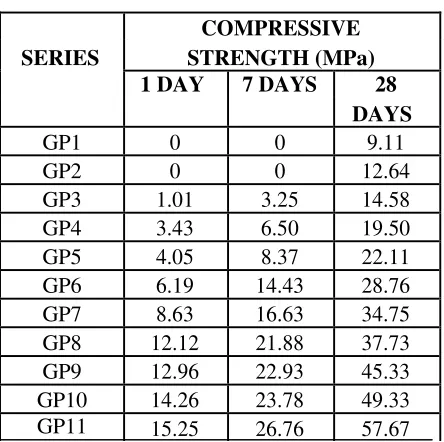
The strength development using two binders was determined. Table 3 is for the series GP1 to GP11. The fly ash and GGBS was varied from 0%-100%. As the percentage of GGBS increased the strength development also increased. The strength developed at the age of one day is around 0- 15.25 MPa. The strength gained in percentage at the age of 7 days is from 43-69 %. After 7 days the strength gained at the age of 28 is ranged from 53-78%.
Table 3: Results for series GP1 toGP11
COMPRESSIVE SERIES STRENGTH (MPa)
1 DAY 7 DAYS 28 DAYS
GP1 0 0 9.11
GP2 0 0 12.64
GP3 1.01 3.25 14.58
GP4 3.43 6.50 19.50
GP5 4.05 8.37 22.11
GP6 6.19 14.43 28.76
GP7 8.63 16.63 34.75
GP8 12.12 21.88 37.73
GP9 12.96 22.93 45.33
GP10 14.26 23.78 49.33
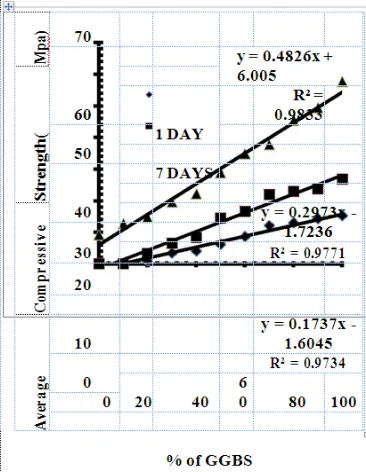
Fig 5: Variation of average compressive strength with percentage of GGBS for different ages
Fig.5 gives the variation of average compressive strength at the age of 7 and 28 days with percentage of GGBS respectively. As the percentage of GGBS is increased and percentage of fly ash decreased, the compressive strength keeps on increasing. The maximum strength obtained is about 28MPa at the age of 7 days. As the percentage of GGBS is increased and percentage of fly ash decreased, the compressive strength keeps on increasing. The maximum strength obtained is about 57.6 MPa at the age of 28 days for 100 percent GGBS.
Fig 6 gives the variation of strength with percentage of GGBS. The variation of strength with GGBS is linear. The correlation coefficients are more than 0.97.
3.2 SEM IMAGES
The microstructure images of paste containing fly ash and GGBS (100-0) at the age of 7 days for the magnification (1:2000) .As the GGBS content increases there is densification of the paste. This can be observed through microstructure. The densification of the paste is pre dominant after 80% of GGBS and more. It can bethat densification is maximum and paste looks like a solid rock. Due to which the corresponding strength is as high around 26.76 MPa at the age of 7 days .
The microstructure image of the paste containing fly ash and GGBS (70:30) at the age of 7 days for the magnification (1:3000) for different molarities. It is clear from the image that the paste contains from finer particles closely spaced as the molarity increases. It is evident even in strength development. This is due to availability of more salt for geopolymerisation
The microstructure images of geopolymer paste of fly ash and GGBS (70:30) with different ages. It is evident from this picture that microstructure is refined with age. This reflects the densification of microstructure reducing voids results in higher strength. This argument is true with the strength development also.
3.3 CORRELATION OF COMPRESSIVE STRENGTH AND MICROSTRUCTURE OF GEOPOLYMER PASTE
Scanning electron Microscopy (SEM) image gives an approximate idea about the size of particles. The shape of the particle in the material can be easily identified with the study. The images can be taken for the required magnification.
4. CONCLUSIONS
It is possible to make open air cured geopolymer paste with the combination of fly ash and GGBS
The setting characteristics of fly ash+GGBS increases with the percentage of GGBS till 40% and decreases thereafter.
The strength of Geopolymer paste increases with the increase of GGBS
Since the range of the compressive strength of the geopolymer mortar is 0.51-57.7 MPa, any combination of materials can be used to get any target strength in this range.
The microstructure of the paste indicates that densification achieved with the increase in GGBS content, age, molarity and thermal input.
The compressive strength and microstructure of the paste are correlated and found that strength and porosity are inversely proportional.
Setting characteristics are correlated with strength and found that they are directly proportional.
REFERENCE
1. M.F. Nuruddin, Sobia Qazi, N.Shafiq, A. Kusbiantoro-Polymeric Concrete: Complete Elimination of Cement for Sustainable Futures-ICSBI
, KL Conference-Canadian Journal on Civil Engineering Vol.12, [2010],102-108 pp.
2. Davidovits, J- “Chemistry of geopolymeric systems, terminology” In Proceedings Second International Conference, Geopolymer ’99,
Davidovits, J., Davidovits, R. and James, C. (Eds.), Geopolymer Institute, Saint-Quentin: France, [1999] 9- 39pp.
3. H.M.Khater, Sayieda.R.Zedane-Geopolymerization of Industrial By-Products and Study of their Stability upon Firing Treatment-
International Journal of Science and Technology Volume 1 No. 2, February, [2012]-109-117pp.
4. Mohd Mustafa Al Bakri Abdullah , Liyana Jamaludin , Kamarudin Hussin , Mohamed Bnhussain , Che Mohd Ruzaidi Ghazali and Mohd
Izzat Ahmad- Fly Ash Porous Material
using Geopolymerization Process for High Temperature Exposure- Int. J. Mol. Sci. [2012],
5. IS: 4031 – 1988 (PART 4). Method of physical test for hydraulic cement- Determination of standard consistency of cement paste, Bureau of
Indian Standards, New Delhi, 1988.
6. IS: 4031 – 1988 (PART 5). Method of physical test for hydraulic cement: Determination of initial and final setting time, Bureau of Indian
Standards, New Delhi, 1988.