Cathodic
Protection
Applications
Using Platinum Anodes
By H.
S.
Preiser,
P.E.Bureau of Ships, U.S. Navy Department, Washington, D.C.
The introduction of platinum-clad anode materials has opened up wide possibilities to the designer of cathodic protection systems. The economic advantages and excellent performance of composite anodes of platinum
on tantalum or titanium are reviewed i n this article.
The commercial development of cathodic protection for industrial applications has heretofore been hindered by the choice of anode materials available to the corrosion engineer. Galvanic anode materials such as zinc, magnesium and aluminium alloys have been used successfully in marine and under- ground cathodic protection applications but due to their relatively high cost, frequent renewal and large bulk their widespread universal use has been limited severely.
The same argument applies to the so-called impressed current or energised anode systems of cathodic protection. Although many suit- able anode materials exist such as graphite, steel and high silicon-iron, and lead alloys, one deficiency or other in each of these materials has precluded their general use.
Economic Advantages
of Platinum Clad Anodes
Platinum and palladium-platinum alloys, because of their unique physical and electro- chemical properties, have been proposed as anode materials and have been successfully applied in several instances (I, 2). In spite of their desirable properties of electrochemical inertness, electrical conductivity and mech- anical workability, the high cost generally associated with these materials has neverthe- less restricted their application to specialised fields; however, in more recent years, the availability of platinum-clad materials at much reduced costs has led to increased
appearance of these anodes in cathodic pro- tection systems (3, 4, 5, 6 ) . The cost of these platinum-clad materials was proportional to the thickness of the cladding specified and to the complexity of completely cladding difficult geometric shapes. The serious drawback to platinum-clad materials prior to relatively recent developments was that a pore-free cladding had to be applied over common basis materials such as silver or copper in order to prevent their electrochemical deterioration. Sealing the edges of clad silver or copper was also troublesome.
These objections to platinum-clad anodes were finally overcome by the commercial introduction of “rectifier” metals such as tantalum and titanium, which led to the development of platinum-coated anodes of these materials. Tantalum and titanium ex- hibit an interesting property when anodised in sea-water and most aqueous media. An insulating oxide is formed on the surface which gradually increases in electrical resist- ance until current can no longer pass into the electrolyte. These insulating oxides are stable up to certain puncture voltages, above which film rupture occurs and electrochemical de- terioration of the exposed metal ensues. The oxide formed on titanium in sea-water is stable up to 12 volts applied across the film
(7). Tantalum on the other hand exhibits stability up to 130 volts in certain acid media
I
The nuclear-powered U.S. submarine ‘Seawolf’. seen here with the -Yautilus’ in Long Island Sound, is
Ftted with an automatically controlled platinum anode cathodic protection system (Oflcial U.S. Navy photograph)
forms at a characteristic voltage. When a rupture occurs at a particular voltage, instead of electrochemical deterioration taking place a new oxide of a different colour forms at the next corresponding voltage level and so on up to 130 volts. These protective oxides can conduct electronic current when in contact with another metal despite their non-conduct- ing nature in an electrolyte.
The combination of platinum cladding or plating on titanium or tantalum has resulted in a low-cost anode capable of passing high current densities without deterioration of the basis metal. These platinum coatings no longer depend on continuity nor do they have to be pore-free to perform inertly. The low electrode-electrolyte interface resistance be- tween platinum and sea-water or other con- ductive aqueous media permits the stable oxide layer to form on the supporting titanium or tantalum because the voltage across the oxide is kept within safe limits.
Patents relating to the use and fabrication of composite titanium and tantalum anodes have been issued during the past two decades
(9, 10, 11, 12). The recent advances in in- expensive commercial production of tantalum and titanium combined with ingenious ways
of applying thin layers of platinum over them
has made these inert anode materials instantly available at low cost to the corrosion engineer. Platinum has been applied on these metals by rolling, plating, vapour deposition and welding.
Although tantalum and titanium anodes with 50 micro-inches thickness of vapour- deposited platinum facing have been used successfully in equipment for the electro- chemical demineralisation of sea-water and brackish water, little operational evidence is available on minimum thickness of platinum required for cathodic protection purposes, for example in sea-water under velocity condi- tions; however, some success using 0.00025 inch of commercially available platinum rolled on tantalum has been reported (13). Re- search work has been proposed for examining weight loss of composite platinum-titanium or tantalum anodes under maximum current densities as a function of platinum thickness and method of coating basis materials.
Chemical Behaviour
of Anode
Materials
Before we get into suggested areas of
chemical behaviour of the materials so that the designer can be aware of some of the inherent differences between them.
From the viewpoint of cathodic protection and other allied electrochemical processes platinum is inert to electrolysis in most media, including fused salts. I n fact, no single acid can attack platinum; it dissolves only in aqua regia. Platinum is extremely resistant to chlorine and oxychloride environments which make it versatile in sea-water electrolytes. It
is not susceptible to hydrogen embrittlement. Tantalum is inert to a wide variety of reagents except certain acids containing hydrofluoric acid or free sulphur trioxide. Over the temperature range commonly used in solution processes tantalum is not attacked by nitric acid, even when fuming, by hydro- chloric acid, aqua regia, chlorine oxide, bromine, hypochlorous acid or hydrogen peroxide, to name a few, almost with no limitation on the concentration.
Tantalum has poor resistance t o concen- trated alkaline solutions and is dissolved by molten alkalis. However, dilute alkali solu- tions apparently have almost negligible effect. The affinity of tantalum for hydrogen makes
it extremely susceptible to embrittlement. This is readily brought about when tantalum is made cathodic in a galvanic or electrolytic cell. I n certain instances such as for electro- analytic copper determinations, tantalum can be used successfully as a cathode if the initial copper deposit can be made at relatively high current densities. The inert oxide film which forms on a tantalum anode is its prime characteristic in making inexpensive inert anodes for cathodic protection and chlorine production applications.
Commercially pure titanium has outstand- ing resistance to sea-water and marine at- mospheres. It is not affected to any great extent by chlorine dioxide, sodium and cal- cium hypochlorite and hot metallic chloride solutions up to concentrations of 80 per cent. It is quite resistant to attack by chromic acid up to concentrations 36.5 per cent and hy- drochloric acid up to 3 per cent at room temperature. The metal is rapidly attacked by hot or concentrated solutions of hydro- chloric acid but is almost completely resistant in aqua regia. Titanium is attacked by all concentrations of hydrofluoric acid. Exposure to hydrogen peroxide, boiling hydroxides,
Comparative Properties of Commercially Pure
Platinum, Tantalum and Titanium
Density, gm/cc
. . .
Melting point, "C
. . .
Thermal conductivity, C.G.S. units
. . . .
Coefficient of expansion (0-IOOT).
. . .
Specific heat, cal!gm/"C at 20°C
Electrochemical equivalent, mg/coulomb . . . .
. . .
Electrical resistivity, rnicrohm-centimetres at 20°C
Temperature coefficient of resistance, (0-I00"C)
Tensile strength-annealed, tons/in2
. . . .
Young's Modulus, l b j i n Z
. . .
-
PI atin u rn
21.4
I769
0.17
8.9 x
0.032
0.5058
10.6
0.0039
10
22 x 1 0 6
Tantalum
16.6
2996
0.13
6.5 x
0.036
0,3749
15.5
0.0038
22
27 x l o G
Titanium
4.5
I660
0.04
8.9 x
0.126
0.1241
55
0.0033
35
nitric acid in all concentrations at elevated temperatures, or water saturated with hydro- gen sulphide and sulphur dioxide, or molten sulphur has a negligible to slight effect on the metal. I n fact, any oxidising substance gener- ally does not attack titanium due to the formation of natural protective oxide film on the metallic surfaces; however, non- oxidising acids such as phosphoric acid above
30 per cent and sulphuric acid above 5 per cent, or in any concentration at elevated tem- peratures, attack titanium vigorously. This attack can be reduced to negligible levels by making the titanium the anode in an electro- lytic cell. A potential of 1.5 volts between anode and cathode is considered a practical value (14). Titanium is not as susceptible as tantalum to hydrogen embrittlement and is readily polarised when coupled galvanically to more anodic materials.
The ingenuity of the engineer and scientist is the only limitation as to the type of anode that can be fabricated for specific application. The common forms available are plate, foil, wire, rod and tubing as well as expanded and woven mesh. Fig. I illustrates an expanded platinum-clad tantalum mesh anode. In addition any cross-sectional shape that is
extrudable can be made for special purposes. These common forms can be fabricated as discs, rings, hemispheres and spheres, tapered wires, crimped or specially formed tubes, spirals, helices and a myriad of geometric shapes to fit compactly, neatly and efficiently into any protection scheme.
Insulating supports for these members should be a dielectric material not affected by the environment of the electrolyte in
Fig. 1 Detail of expanded platinum-clad tuntalum anode. Thickness of platinum i s 0.00025 inch.
which it is immersed or by the anode or cathode reaction products resulting from cathodic protection. I n sea-water applica- tions the polyester resins exhibit good chemi- cal resistance against anode oxychloride re- action products and the epoxy resins are recommended for resistance to cathodic hydroxide reaction products (15).
Since specific designs of anodes applicable to various structures mentioned are subjects of patent disclosures, the details of construc- tion are not available. However, two com- mercially produced items in the marine field are receiving widespread attention.
Protection of
Active
Ships
In the application of cathodic protection to
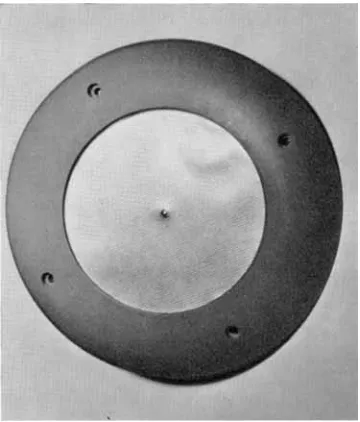
active ships, a platinum-clad tantalum anode mounted in a streamlined holder has been developed. This anode holder assembly, shown in Figs. 2 and 3, consists of a seven- inch disc of 0.015 inch tantalum which has been clad with a 0.0025 inch layer of platinum. During the rolling operation the surface was embossed with a series of closely spaced squares. Embossing was used to assist easy liberation of gaseous products formed a t the anode during electrolysis. The anode proper
is mounted in a resistant, rigid polyvinyl chloride holder which is in the shape of a disc with an ogival cross section. A tantalum prong welded to the centre of the back of the anode disc surface protrudes from the holder. This prong mates with a connector in a specially designed waterproof stuffing
A
r
Fig. 2 A hull-mounted platinum-clad tantalum anode. The embossing of the surface assists liberation of gaseous products formed during electrolysis. (Metals and Controls Corporation)
tube which is welded into the hull. Thc anode is then bolted to the hull with recessed bolts which are potted over with epoxy-resin. A series of four to eight anodes are thus fitted to the hull of a ship-the number de- pending on the underwater area to be pro- tected-and are connected internally to a suitable D.C. power source.
Another marketable product is the pipc plug anode used for the protection of pumps. This type of anode, shown in Fig. 4, consists of a platinum-clad disc mounted in a plastic pipe plug which terminates in a suitable con-
PLATINUM C t A O TANTALUM AMODE
I
TUREADED F I Fig. 3 CromMion .f rhe
hull-mounted platinum-clad
nector. These pipe plugs are threaded into bossings fitted on a pump casing and are connected together through a harness lead to the positive side of a D.C. power supply. T h e negative terminal is earthed against pump casing and rotor. This arrangement will
provide cathodic protection to the internals of the pump. No operational data are avail- able, but tests on a salt water circulating pump are to be scheduled shortly.
This article is intended to focus attention on the unlimited possibilities for novel cathodic protection designs which are now
open to the corrosion engineer. T h e economic
and tantalum or titanium, their excellent per- formance as inert anode materials i n a large variety of electrolytes and their ease of form- ing into optimum geometric configurations make these truly engineering materials of a
new dimension. United States Navy.
advantages Of com p o si t eanodes Of platinum Fig-. 4 A plug-type anode for the c&&ic protee
tion of pumps, Jitted with u platinum-clad disc. (Metals and Controls Corporation)
T h e opinions expressed i n this paper are the personal views of the author and do not necessarily reflect the official views of the
I R. H. McLeod
. .
. .
* ...
t E. R. Shepard and H. J. Graeser, Jr..
.
3 E. E. Nelson ..
. .
. ...
d D. P. Graham. F. E. Cook and H. S.Preiser
..
..
. .
H. S. Preiser and F. E. Cook.
.
56 H. S. Preiser
.
.
. .
. .
7 J. B. Cotton . . . . . . 8 J. Evard
..
. .
. .
9 H. W. Boessenkool and G. Durst
10 G. Baum
..
..
. .
11 A. M. Suggs and R. S. Dean . . 12 P. C. Kerk
. .
..
. .
13 H. S. Preiser and B. H. Tytell
14 J. B. Cotton .. . . . .
15 H. S. Preiser and M. Stander.
.
..
..
..
. .
..
. .
..
. .
. .
..
..
..
References
Cathodic Protection Equipment, Water 6. Sewage
Works, 1949J96, (5)Y I77
Design of Anode Systems for Cathodic Protection of Underground and Water Submerged Metallic StructGres, Corrosion, 1950, 6, 36C-375
An Impressed Current Cathodic Protection System Applied to a Submarine, Corrosion, 1957, 13, 52-54
Cathodic Protection in the U.S. Navy: Research- Development-Design, Trans. Soc. Naval Arch.,
1956: 643241-317
Cathohc Protection of an Active Ship Using a Trailing Platinum Anode, Corrosion, 19 57, 13,
cc-61
Inshuble Trailing Anode for Cathodic Protection of Ships, U.S. Patent 2,863,819, 1958
Platinum-faced Titanium for Electrochemical Anodes,
Platinum Metals Rev., 1958, 2, 45-47
Private Communication to Author, from Fansteel Metallurgical Corporation
Solid Phase Bonding of Metals, U.S. Patent 2,691,815, I954
Anodes for Forming Percompounds, U.S. Patent
1,477,099, I923
Electrode for Electrochemical Oxidation, U.S. Patent
2,636,856, 1953
Electrode for Electrolytic Baths, U.S. Patent 1,970,804, I934
Some Platinum Anode Designs for Cathodic Protec- tion of Active Ships. Paper presented a t the Northeast Regional Meeting, National Association of Corrosion Engineers, Boston, Mass., October
Anodic Polarisation of Titanium, Chem. 6. Ind., 1958, 68-69
Applications of Plastics in Marine Cathodic Protection Systems, J . Amer. Sac. Naval Eng., 1956, 68,