© 2016 IJSRSET | Volume 2 | Issue 3 | Print ISSN : 2395-1990 | Online ISSN : 2394-4099 Themed Section: Engineering and Technology
Performance of Fly ASH Based Concrete with Fiber under
Elevated Temperature
C. Manthirikumar, J. Jeyanthi
Department of Civil Engineering, Mepco Schlenk Engineering College, Sivakasi, Tamilnadu, India
ABSTRACT
Concrete when exposed to elevated temperature, mechanical properties gets reduced which results in structural failure. The strength of concrete is improved by means of addition of pozzolonic material. Pozzolonic material reduces the pores in the concrete structure and hence improves durability. Here, flyash is added as it facilitates the replacement of cement with flyash to a greater extent. In addition to that fibers like as steel and carbon fibres are added in concrete to achieve better workability, tensile strength, compressive strength, Thermal resistance. The aim of this paper is to experimentally investigate the behaviour of fiber reinforced concrete subjected to elevated temperature at 250oC, 500oC sustained for a period of 2 and 3 hours. The cement is replaced by 10, 20 and 30% of flyash by weight of cement. The cubes and cylinders were cast and cured under normal conditions for a period 28, 58 and 90 days and it is tested for their compressive and split tensile strength respectively. The test result shows that the maximum strength was attained at 20% of replacement of cement. The cube specimens after curing subjected to a temperature of 250oC and 500oC for duration of 2 to 3 hours were also tested for its compressive strength. Analytical model was also developed using ANSYS. The results obtained from finite element analysis shows good agreement with that of experimental results.
Keywords : Fly Ash, Steel Fiber, Carbon Fiber
I.
INTRODUCTION
Ordinary Portland cement possesses great demand in construction industry. Production of one ton cement leads to the emission of one ton of carbon-di-oxide which pollutes the air and also results in global warming. To overcome this, several steps are being taken by the technologist and environmentalist to reduce air pollution and global warming which is caused by production of cement. In recent years, replacement of cement with pozzolonic material was found to be the ecofriendly method for reducing the emission of carbon-di-oxide. In thermal power plants, coals are pulverized in the combustion chamber to produce a by product called flyash. This is an industrial waste produced when coal is used for burning in the thermal power plants which affects environment. Which leads to serious problems in surrounding? Even though is used as supplement of flyash based concrete production this gives various economical and technological benefits. Concrete structures such as chimneys in manufacturing plants,
reactive chamber in nuclear thermal power plants, pressure vessels, storage tank used for hot crude oil and hot water coal gasification are subjected to the temperature range between 100 to 200oC. Concrete properties get changed between the temperature ranges of 100- 200oC. Above 200oC, there is decrease in physical and chemical properties so that the structure may fail permanently. In order to overcome this problem fibers like as steel, carbon fibres and mineral admixture such as fly ash are added in concrete. This mix would help to overcome the problem of workability, tensile strength, compressive strength, thermal resistance and achieving higher strength.
II.
METHODS AND MATERIAL
A. Objective And Scope of the Project
scope of the project is to improve the performance of the concrete used in the structures such as chimneys, power plant etc. which are subjected to elevated temperature and this results in long life of the structures.
B. Materials Used
53 grade cement confirming to IS: 12269 was used in the study. Crushed aggregate of size having water absorption and specific gravity of 1.8%, 2.65 respectively. Locally available river sand falling under Zone II, having Specific gravity and water absorption of 2.68,0.68% respectively was used. Fly ash used in this project was taken from Mettur Thermal Power Plant in Tamilnadu. Mix proportion was carried out as per IS 10262-2010. Fly ash was added as a replacement by mass of cement obtained from the proportion. A concrete mix of compressive strength 30 MPa at the age of 28 days is proportioned. Steel fibers of 0.5mm diameter with aspect ratio of 80 and carbon fiber of 0.010mm diameter are used.
mix ratio
cement Fine aggregate
Coarse aggregate
w/c
1 1.82 2.28 0.45
C. Experimental Programme
The main objective of testing was to know the behaviour of concrete with replacement of cement with flyash and fibers at elevated temperatures. The specimens were tested for its compressive strength and split tensile strength.
Casting of Specimen:
In this study, a flyash based concrete of M30 grade was considered. This mix design for the above grade of concrete was done using IS method. The mix proportion obtained was 1:1.82:2.28:0.45 (cement: fine aggregate: coarse aggregate: water). The quantity of materials arrived from the mix proportion is about 440kg/m3 of cement content and 197 litres/m3 of water content. In this study the percentage of replacement of cement by flyash was taken as 10 %, 20% and 30%. In this experimental investigation a total of 136 (99 numbers of flyash based concrete and 36 numbers flyash based
150*150*150mm were cast and 27cylindrical specimens were cast for flyash based concrete and 6 cylindrical Specimens were cast for flyash based concrete with fibers using the above design mix proportion. For casting fiber reinforced concrete specimens, steel fibers of 0.5mm diameter with aspect ratio 80 was used and also carbon fiber of 0.010mm diameter was used. The cubes & cylinders were cured for 28, 56&90 days. After curing they were air dried for surface moisture by visual inspection. The cubes were exposed to heating, for duration of 2&3 hours at temperature level of 250oC and 500oC respectively. After heating, the cubes were brought to room temperature and then tested for compressive strength. The percentage of steel fiber and carbon fiber in the ratio of (1.15&0.4) were used.
III.
RESULTS AND DISCUSSION
Temperature is one of the main factor that influence the strength. High temperature induces a loss of strength (both in compression and tension) and At high temperatures, chemical transformation of the gel weakened the matrix bonding, which brought about a loss of strength of fly ash concrete.
different temperature. There was increase in compressive strength after adding fibers in both normal and elevated temperature.
Table1.Compressive strength of cube specimen with and without flyash replacement for different curing
periods at normal temperature
Table 2. Compressive strength of cube specimen with and without flyash replacement for 28 days at under
elevated temperature.
Table 3. Compressive strength of cube specimen with and without flyash replacement for 58 days at under
elevated temperature.
Table 4. Compressive strength of cube specimen with and without flyash replacement for 90 days at under
elevated temperature.
Table 5. Compressive strength of fiber reinforced concrete at normal temperature
Table 6. Compressive strength of fiber reinforced concrete under elevated temperature for different curing
periods.
Figure 1. compressive strength of cubes at normal temperature
Figure 2. Days VS Compressive strength – 250OC-2 hrs duration
Figure 4. Days VS Compressive strength – 500OC-2 hrs duration
Figure 5. Days VS Compressive strength – 500OC-3 hrs duration
Split Tensile Strength
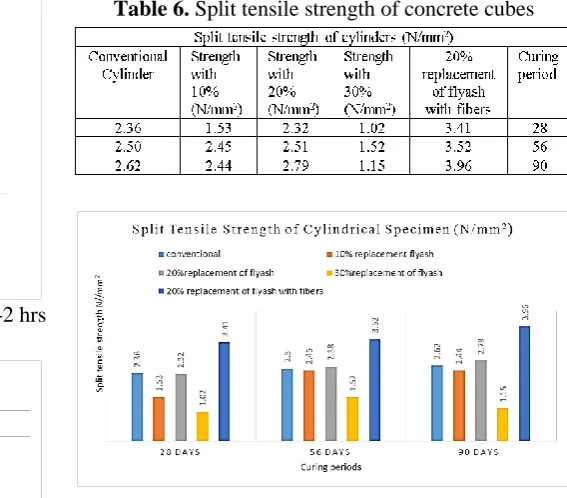
In this study, the values of split tensile strength for different fly ash contents (0%,10%, 20% and 30%) at the end of different curing periods (28, 56 and 90days) are given. The results have also been plotted which shows the variation in split tensile strength with cement replacements at different curing ages respectively. The split tensile strength was calculated based on the average value of three specimens. It is evident that split tensile strength of concrete mixtures with 10% and 30% of flyash as cement replacement was lower than the control mixture (M-30) at all ages whereas the split tensile strength of concrete mixture with 20% flyash replacement was higher than the control mix and that the strength of all mixtures continued to increase with the age. Split tensile strength was much lesser for 10% and 30% while comparing with 20% flyash replacement at different curing periods. There was further increase in split tensile strength after adding fibers in the 20% replacement.
Table 6. Split tensile strength of concrete cubes
Figure 6. split tensile strength of concrete
Analytical Work Using Ansys Software
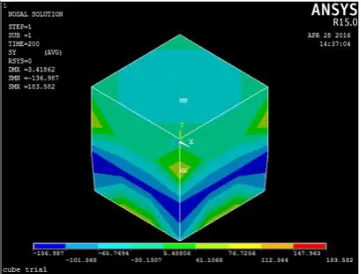
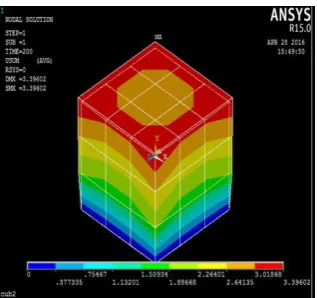
The cube was modelled using ANSYS software. In this Thermal analysis was carried out. The two specimens were chosen for analysis and thermal test was done at temperature conditions of one specimen at 250oC and 500oC on other. After that a maximum load 34.5N//mm2 was applied on the each specimen and results obtained were analysed. The parameters like displacement, deformation, nodal displacement, X component stress and Y component stress for each specimen were checked.
Figure 8. Nodal temperature at 250oC
Figure 9. X component stress at 250o
Figure 10. Y component stress at 250oC
Figure 11. Deformation at 250oC Temperature
Figure 12. Displacement at 500oC
Figure 13. Nodal temperature at 500oC
Figure 14. X component stress at 500oC
Figure 16. Deformation at 500oC Temperature
IV.
CONCLUSION
These experiments have been performed to investigate the compressive strength, split tensile strength and weight loss. The compressive strength of fibre reinforced concrete cube specimen subjected to elevated temperature ranging from 250oC and 500oC for two heating durations 2 and 3 hours were found. Based on the experiment results the following conclusion may be obtained for this study.
1. The compressive strength of fiber reinforced concrete decrease as the exposure temperature increase.
2. Increase in heating time decrease the compressive strength of fiber reinforced concrete.
3. Increase in the cement content increases the initial compressive strength of fiber reinforced concrete but decreases after heating due to the increase in temperature and heating time.
4. Out of the cement replacement with flyash of 10,20 and 30 percentage, the maximum strength was attained at the 20% replacement of flyash
5. The extended curing period of 56, and 90 days for the cube specimen with 20% flyash content, only marginal improvement in their final strength was observed.
6. The addition of steel and carbon fibers to the concrete with 20% replacement of flyash shows considerable increase in the compressive strength and split tensile strength of concrete.
7. An analytical model was developed using ANSYS and the results obtained were in good agreement with the experimental results.
V.
REFERENCES
[1] Chi-Sun Poon, Salman Azhar, Mike Anson,
Yuk-Lung Wong, Comparison of the strength and durability performance of normal-and high-strength pozzolanic concretes at elevated temperatures, cement and concrete research, accepted 18 June 2001.
[2] BaharDemirel ,OguzhanKelestemur ,Effect of
elevated temperature on the mechanical properties of concrete produced with finely ground pumice and silica fume, Fire safety journal 45(2010)385-391,online 15 Sept 2010.
[3] Kalifa Pierre, CheneGregoire, Christophe Gallein
their paper entitled “High-temperature behavior of HPC with polypropylene fibres from spalling to microstructure”, Cement and Concrete Research 31(2001) 1487-1499,accepted 25 June 2001.
[4] Vishwanath K. N., Suresh N. in their paper entitled,
Fly ash composite concrete under sustained elevated temperature,International Journal of Engineering Research and Technology, Vol.1 Issue 5,July-2012.
[5] Md. AkhtarHossain, Mohammad Nural Islam, Md.
RajibulKarim, in their paper entitled, Fire resistance of cement mortar containing high volume fly ash,
31st Conference on Our World in
Concrete&Structures: 16-17 August 2006,
Singapore.
[6] PothaRaju M., Shobha M. andRambabuin K.
Flexural strength of fly ash concrete under elevated
temperatures, Magazine of Concrete