Anupama et al. World Journal of Engineering Research and Technology
VIRTUAL MACHINE BASED DATA SAMPLING APPROACH TO
IMPROVE QUERY PERFORMANCE FOR VIRTULIZED HADOOP
Anupama S1*, Kavya G2, Kannika J S3, Arjun T R4 and Malatesh S H5
1234
B. E, Student of M.S.E.C, Bengaluru, India.
5
HOD (BE, MTech., PhD), Department of Computer science and Engineering, M.S.E.C,
Bengaluru, India.
Article Received on 14/03/2016 Article Revised on 04/04/2016 Article Accepted on 24/04/2016
ABSTRACT
MapReduce emerges as an important distributed programming
paradigm for large-scale data analysis applications. As an open-source
implementation of MapReduce, Hadoop presents an attractive usage
system for many enterprises. There are some drawbacks in a traditional Hadoop cluster
deployed with a large scale of physical machines, such as burdensome cluster management
and fluctuating resource utilization. Virtualized Hadoop cluster not only simplifies cluster
management, but also facilitates cost-effective workload consolidation for resource
utilization. In Hadoop system, the data locality and query performance are the critical factors
impacting on performance of MapReduce applications.
KEYWORDS: MapReduce, Hadoop system.
I. INTRODUCTION
Big data is a huge collection of data in the form of volume variety and velocity, for
World Journal of Engineering Research and Technology
WJERT
www.wjert.org
SJIF Impact Factor: 3.419*Corresponding Author
Anupama S.
B.E, Student of M.S.E.C,
In companies like yahoo, google, facebook came across huge amount of data. google uses
google file system for storing data and processed by mapreduce after that they produce white
paper for further study of google file system and mapreduce.
Dowg cutting accepted and invented or modified HDFS and Mapreduce. Later hadoop
became an open source.
II. SYSTEM IMPLEMENTATION
Implememtation of the project include:
a. DispersalArchitecture
b. DataSampling
c. Sqoop Transfer
a. Dispersal Architecture
A virtualized Hadoop cluster is built with dispersal architecture which deploys computing node
and storage node in same VMs. This deployment model overcomes those disadvantages of
traditional manner. On the one hand, it has strong scalability, which allows of respectively
fluctuating amount of computing nodes or storage nodes. On the other hand, live migration is
very agile when a computing node is migrated without considering any other storage node
VMs.
Here, we build virtualized Hadoop cluster with dispersal architecture, and its deployment model
can be demonstrated by Fig. 1. In this figure, different kinds of arrows indicate different kinds
of data locality. Using dispersal architecture, there is not node locality, but server locality can
be acted as node locality which is equivalent in traditional deployment manner. To improve
data locality in virtualized Hadoop cluster, we can live migrate computing node VM to
physical server running storage node VM stored a data replication needed by that computing
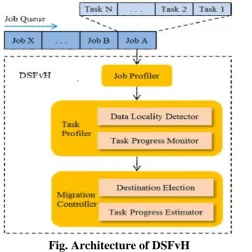
Fig. Architecture of DSFvH
a. JobProfiler: The main function of Job Profiler module is analyzing the job submitted to DSFvH from Job Queue, parsing out the tasks included in this job, as well as input data blocks
for each task. In Hadoop system, the Job Tracker is the service that farms out MapReduce tasks
to specific nodes in the cluster, ideally the nodes that have the data, or at least are in the same
rack.
b. Task Profiler: The Task Profiler module is responsible for detecting the data locality of
all tasks, and mainly monitoring tasks without server locality. It will identify the stragglers
which run notably slower than other similar tasks. This module consists of two sub-modules:
Data Locality Detector and Task Progress Monitor.
c. Data Locality Detector: It detects the data locality types of all tasks included in this job,
according to distribution of input data replicas and deployment location of computing node
VM.
b. Data Sampling
Hive is full of unique tools that allow users to quickly and efficiently perform data queries and analysis. In order to make full use of all these tools, it’s important for users to use best
practices for Hive implementation.
Data sampling has two layers.
a. Data Partitioning
b. Data Bucketing
c. Data bucketing with Partitioning
a. Data Partitioning
Hive partitioning is an effective method to improve the query performance on larger tables.
Partitioning allows you to store data in separate sub-directories under table location. It greatly
helps the queries which are queried upon the partition key(s). Although the selection of
partition key is always a sensitive decision, it should always be a low cardinal attribute, e.g. if
your data is associated with time dimension, then date could be a good partition key. Similarly, if data has association with location, like a country or state, then it’s a good idea to
have hierarchical partitions like country/state.
b. Data Bucketing
Bucketing improves the join performance if the bucket key and join keys are common.
Bucketing in Hive distributes the data in different buckets based on the hash results on the
bucket key. It also reduces the I/O scans during the join process if the process is happening
on the same keys (columns).
Additionally it’s important to ensure the bucketing flag is set (SET hive.enforce.
bucketing=true;) every time before writing data to the bucketed table. To leverage the bucketing in the joint operation we should SET hive.optimize.bucketmapjoin=true. This setting hints to Hive to do bucket level join during the map stage join. It also reduces the scan
cycles to find a particular key because bucketing ensures that the key is present in a certain
bucket.
Hashing: On the basis of hash function value the particular data of a table will be inserted into particular bucket.
Data Bucketing with Partition: Embedding both Partitioning and bucketing within a single table also be know as data skewing.
c. Sqoop Transfer
1. Sqoop Import: Sqoop is designed to import tables from a database into Hive.
2. Sqoop Export: Sqoop is designed to import tables from a Hive into Database
III. SYSTEM REQUIREMENTS Functional requirements
A description of the facility or feature required. Functional requirements deal with what the
system should do or provide for users. They include description of the required functions,
outlines of associated reports or online queries, and details of data to be held in the system
automated creation of a Cloudera Hadoop environment
addition of VM's to an existing Hadoop environment
deletion of VM's from an existing Hadoop environment
deletion of an entire Hadoop environment
variability in the number of machines created in the setting up process.
automated load balancing for physical machines
define the environment name
check redundancy on environment names
provide an interface for managing the features
provide an interface to interact with the Hadoop scheduler
Installing and running Hive Queries
Installing and running Sqoop Commands
Non-functional requirements
Non-functional requirements define the overall qualities or attributes of the resulting system.
run over in browser
run over in command line
intuitive navigation
coherent information
clear information
error information
extensible
scalable
service always available
Run over i386 and x64
Secure machines interaction
IV. CONCLUSION
In this Project to improve performance of MapReduce applications in virtualized Hadoop
cluster, we argue that improved data locality for both Map and Reduce phases of the job is
very necessary in such system. In this Project, we build virtualized Hadoop cluster with
dispersal architecture which deploys computing node and storage node in respective VMs.
We propose a novel task scheduling approach which aims to improve data locality in
virtualized Hadoop cluster through migrating the computing node VM to the physical server
running VM acted as storage node that holds a data replica needed by that computing node at
appropriate moment. Meanwhile, we also included data sampling to achieve data portioning
and data bucking increases the performance of a distributed Hadoop file system. This also
increases the performance of MapReduce in the virtualized Hadoop Cluster systems.
V. FUTURE ENHANCEMENT
In our future work, we plan to improve the performance of our approach for machine
learning MapReduce applications and investigate the feasibility of DSFvH with the next generation of Hadoop’s compute platform.
VI. REFERENCE
1. Ron C. Chiang, H. Howie Huang, “TRACON: Interference-Aware Scheduling for
Data-Intensive Applications in Virtualized Environments”, in Proceedings of ACM
International Conference for High Performance Computing, Net working, Storage and
2. Ganesh Ananthanarayanan, Sameer Agarwal, Srikanth Kandula, Albert Greenberg, Ion
Stoica, Duke Harlan, and Ed Harris, “Scarlett: Coping with Skewed Content Popularity
in Map Reduce Clusters”, in Proceedings of the 6th European Conference on Computer
Systems (EuroSys), Salzburg, Austria, Apr. 2011; 287–300.
3. M. Zaharia, A. Konwinski, A. Joseph, R. Katz, and I. Stoica,“Improving Map Reduce Performance in Heterogeneous Environments”, in Proceedings of the 8th USENIX
Symposium on Operating Systems Design and Implementation (OSDI), San Diego,