INTERVENTIONAL STUDY OF QUALITY OF LIFE AMONG PATIENTS WITH
ERECTILE DYSFUNCTION
1
*Dr. Asim Hussain, 2Dr. Touqeer Yousaf and 3Dr. Muhammad Farukh Ibtasam
1
PMDC # 91927-P.
2
PMDC # 90988-P.
3
PMDC # 90997-P.
Article Received on 21/10/2018 Article Revised on 11/11/2018 Article Accepted on 02/12/2018
INTRODUCTION
Male erectile dysfunction (ED) is defined as the persistent inability to attain and maintain an erection sufficient to permit satisfactory sexual performance. Male erectile dysfunction (ED) has presented a challenge to clinicians because of the interplay between physical, sexual and emotional factors. Also, the etiology of ED is diverse and is influenced by medical, psychological and lifestyle factors.[1]
Epidemiological data have shown that a high prevalence and incidence of ED worldwide. The first scale, community based study of ED was the Massachusetts Male Aging Study (MMAS). The study reported an overall prevalence of 52% ED in non-institutionalized 40:70 year-old men in the Boston area in the USA. It was found that the prevalence of minimal, moderate and complete ED were 17.2%, 25.2%, and 9.6% respectively.[2] It has predicted that the worldwide
prevalence of erectile dysfunction will be 322 million cases by the year 2025.[3] It was estimated that the prevalence rate of complete ED in India was 13.4% while moderate ED was (10.3%).[4]
The quality of Life (QoL) means different things to different people and takes on different meanings according to the area of application. To a town planner, for example, it might represent access to green space and other facilities. In the context of clinical trials we are rarely interested in QoL in such a broad sense and instead, are concerned only with evaluating those aspects that are affected by disease or treatment for the disease. This may sometimes be extended to include indirect consequences of the disease, such as unemployment or financial difficulties.[5]
WHO defines Quality of life as individuals’ perception of their position in life in the context of the culture and value systems in which they live and in relation to their
ISSN 2455-3301
WJPMR
WORLD JOURNAL OF PHARMACEUTICAL AND MEDICAL RESEARCH
www.wjpmr.com
*Corresponding Author: Dr. Asim Hussain
PMDC # 91927-P.
ABSTRACT
Objectives: to estimate the effect of the intervention on the improvement of the quality of life among the studied workers. Methods: 136 male patients complaining erectile dysfunction, not receiving treatment before and have no contraindication to medical therapy, all of them were diagnosed by history taking, medical examination with the aid of the 5-items international index of erectile function (IIEF -5) questionnaire. They were subjected to the quality of life assessment Questionnaire (WHO QOL). The examined workers were subjected to the specific treatment of erectile dysfunction for six months, then these workers have subjected again to (IIEF-5) and WHO QOL questionnaires. Results: There was statistical significance difference among the examined workers regarding the physical pain before and after the intervention. Also, it was shown that there was statistical significance difference as regard dissatisfaction with sleep before and after treatment. It was found that there was statistical significance difference before and after treatment as regards the aspect of having negative feelings. It was found that there was statistical significance difference between the examined workers before and after treatment as regards the aspect of dissatisfaction with sex life. Conclusion: Some aspects of physical, psychological and social domains of quality of life of the studied workers were improved after the intervention with statistical significance difference.
goals, expectations, standards and concerns, it is a broad ranging concept affected in a complex way by the person’s physical health, psychological state, level of independence, social relationships, personal beliefs and their relationship to salient features of their environment.[6]
The quality of Working Life is not a unitary concept but has been seen as incorporating a hierarchy of perspectives that not only include work-based factors such as job satisfaction, satisfaction with pay and relationships with work colleagues, but also factors that broadly reflect life satisfaction and general feelings of well-being.[7] More, work-related stress and the relationship between work and non-work life domains have also been identified as factors that should conceptually be included in Quality of Working Life.[8]
The quality of working life was defined as satisfaction of these key needs through resources, activities, and outcomes stemming from participation in the workplace. Needs were seen covering health & safety, economic and family, social, esteem, actualization, knowledge and aesthetics, although the relevance of non-work aspects is played down as attention is focused on quality of work life rather than the broader concept of quality of life.[9] The immediate objectives of the present study were; to assess the effect of erectile dysfunction on the different domains of quality of life among the studied workers and to estimate the effect of the intervention on the improvement of the quality of life among the studied workers.
METHODS
Type of the study: The present study is nonrandomized
intervention study was conducted during the period from February 2017 to December 2017. The site of the study: the practical part of the present study was conducted at Mayo hospital, Lahore. Selection of patients: Patients of the study were selected based on the following inclusive criteria: age range from 25-55 years, complaining of erectile dysfunction of three months duration and not receiving medical treatment for ED before in an appropriate way. Exclusion criteria: Genital anatomical deformities, Primary sexual disorder other than ED, Major psychiatric and psychological disorders, Treatment with nitrates and any history of occupational exposure to chemicals or toxins. Sample size estimation: The sample size was estimated based on the following items: average prevalence rate of erectile dysfunction in India was 30%[4] and using margin of sampling error tolerated 10%. By using the sample size equation.[10] the minimum sample size required was 81 and to avoid bias the sample size was increased to be 200 patients.
Methods: Erectile dysfunction was diagnosed by using
questionnaire of international index of erectile function (IIEF- 5).[11] The quality of life was assessed by using the WHO QOL questionnaire.[12] Each patient was subjected to both questionnaires before and after six months of the intervention. Also, all patients were subjected to the following: history taking, general and local medical examination. All patients included in the present study were received oral medical treatment as a first line therapy for their erectile dysfunction. Description of the
intervention: The selected patients were advised to
receive the described medical treatment as an on-demand therapy for their erectile dysfunction one hour before sexual activity. All patients were monthly examined for consecutive six months. At the end of six months, the patients were subjected again to the questionnaire of IIEF and WHO QOL questionnaire. Statistical analysis: Epi Info program, Microsoft Windows on a personal computer was used to analyze the collected data which were coded, entered, analyzed and tabulated. Mean ± St.D and chi2 were the statistical methods used during the present study. A P value <0.05 was considered as the accepted level of significance during the study. Study
constrains: Fiftyfive patients after they were included in
study and had started the prescribed treatment, they were dropped out as they did not attend to the outpatient clinic for follow-up, so the present study cancelled them and the total number of actually completed the study were 136 patients (>1.5 times the minimal sample size required).
RESULTS
The present study shows that age range among the studied group was 26-55, mean age was 46.03±6.9, about 70% of the studied workers were urban, and 75.2 % were smokers. It was found that the Degrees of erectile dysfunction (ED) before treatment were;
Table 1: Effect of the intervention on the physical aspects of quality of life among the studied workers.
Physical Aspects of quality of life
Pre-intervention N = 136
Post-intervention N
= 136 Chi2 p-value 11.6
0.0006*
N. % N. %
Feeling that physical pain prevents from
doing what is needed 115 79.3 135 93.1
Need medical treatment to function in daily
life 138 95.2 138 95.2 Not applicable
Does not having enough energy for every-
day life 136 93.8 136 93.8 Not applicable
Poor ability to get around 85 58.6 86 59.3 0.1 0.9
Dissatisfaction with sleep 73 50.3 53 36.6 5.6 0.01*
Dissatisfaction with ability to perform daily
living activities 56 38.6 56 38.6 Not applicable
Dissatisfaction with capacity for work 48 33.1 47 32.4 0.02 0.9
N.B. one patient may suffer one or more of the items of physical affection, *: significant
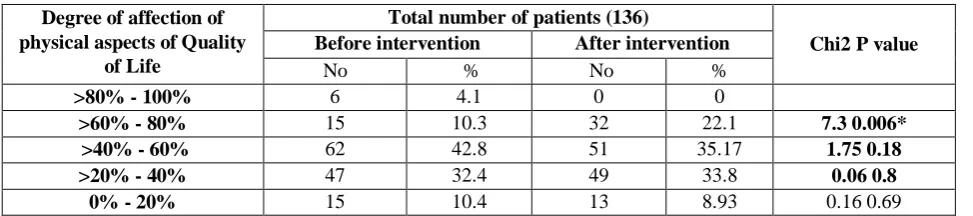
Table (2) shows that after the intervention, there was aspects of quality of life with statistical significance an
improvement in the degree of affection of physical difference in the group of affection (> 60% - 80%).
Table 2: Degree of affection of physical aspects of quality of life before and after intervention.
Degree of affection of physical aspects of Quality
of Life
Total number of patients (136)
Chi2 P value
Before intervention After intervention
No % No %
>80% - 100% 6 4.1 0 0
>60% - 80% 15 10.3 32 22.1 7.3 0.006*
>40% - 60% 62 42.8 51 35.17 1.75 0.18
>20% - 40% 47 32.4 49 33.8 0.06 0.8
0% - 20% 15 10.4 13 8.93 0.16 0.69
*: significant
Table (1) shows that there was statistical significance difference as regard the physical pain before and after the
intervention, also it shows a statistical significance difference as regard dissatisfaction with sleep.
Table 3: Degree of affection of physical aspect of Quality of life in relation to erectile dysfunction before and after intervention.
Degree of physical affectio n of
Quality of life (%)
Degree of erectile dysfunction before intervention (Total N. = 136)
Degree of erectile dysfunction after intervention (Total N. = 136)
Mild Mild to
moderate moderate Severe No ED Mild
Mild to
moderate moderate Severe
>80 -100 0 3
(2.06%) 3 (2.06%) 0 0 0 0 0 0
>60 – 80 0 0 0 15
(10.3%) 6(4.3%) 0 0 6 (4.3%)
20 (13.7%)
>40 – 60 0 14(9.65 %) 17(11.7 % 31
(21.8)% 16(11.3) 10(6.8) 6 (4.3%) 0
19 (13.1%)
>20 – 40 0 9 (6.2%) 8 (5.51%) 30(20.6)% 20(13.8) 10(6.89) 6 (4.3%) 0 13
(8.96%)
0 - 20 6(4.3
% 0 6 (4.3%) 3(2.06%)
6
(4.3%) 0 0 6(4.3%)
Table 4: Effect of the intervention on the psychological aspect of quality of life among the studied group.
Psychological aspect of quality of life
Pre-intervention N. = 136
Post-intervention
N. = 136 Chi2 pvalue
N. % N. %
Not enjoying life 113 77.9 94 64.8 6.09 0.1
Feeling that life not to be meaningful 81 55.9 77 53.1 0.2 0.63
Not able to concentrate 31 21.4 30 20.7 0.02 0.8
Not able to accept body appearance 36 24.8 35 24.1 0.02 0.89
Self dissatisfaction 73 50.3 64 44.1 1.1 0.28
Having negative feelings (blue mood, despair
,anxiety, depression) 144 99.3 134 92.4 8.6 0.003*
N.B. one patient may suffer more than one item of psychological aspect of quality of life., *: significant
Table (3) shows the degree of affection of physical aspect of quality of life in relation to the degree of erectile dysfunction before and after treatment. It was found that before treatment, the higher proportion (21.8%) of the examined workers was present in the group of affection >40% – 60% and they had severe erectile dysfunction. It was noticed that after treatment, the proportion of severe ED decreased to be (13.7%). Also, it was found that after intervention; (13.1%) of the examined workers were in the group of affection (>%40 – 60%), (13.8%) in the group of affection (>20% - 40%) and (13.8%) in the group of affection (0% - 20%) and they had severe erectile dysfunction, no erectile dysfunction, and severe erectile dysfunction respectively.
Table (4) shows the effect of the intervention on the psychological aspects of quality of life among the studied group. It was found that there was statistical significance difference before and after treatment as
regards the aspect of having negative feelings, it was recorded that other aspects were statistically insignificant but with improvement in the proportion of all aspects of the psychological domain of quality of life.
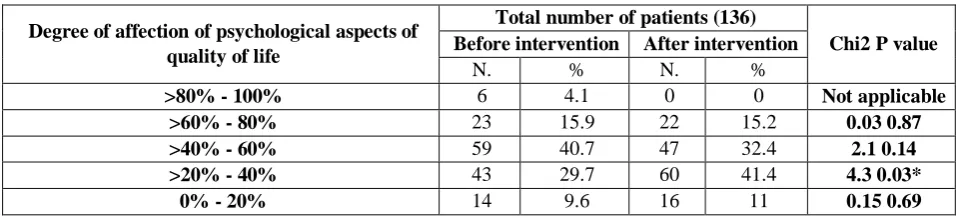
Table (5) shows Degree of affection of psychological aspects of quality of life before and after treatment. It was observed that before treatment most of the patients (40.7%) were found in the group of affection (>40% - 60%), and after treatment, most of the patients (41.4%) were found in the group of affection (>20% - 40%). It was found that the group of affection (>20% - 40%) was observed statistical significance difference before and after treatment.
Table 5: Degree of affection of psychological aspects of quality of life before and after intervention.
Degree of affection of psychological aspects of quality of life
Total number of patients (136)
Chi2 P value Before intervention After intervention
N. % N. %
>80% - 100% 6 4.1 0 0 Not applicable
>60% - 80% 23 15.9 22 15.2 0.03 0.87
>40% - 60% 59 40.7 47 32.4 2.1 0.14
>20% - 40% 43 29.7 60 41.4 4.3 0.03*
0% - 20% 14 9.6 16 11 0.15 0.69
*: significant
Table 6: Degree of affection of psychological aspect of quality of life in relation to erectile dysfunction before and after intervention.
Degree of Affection of psychological aspect of quality
of life (%)
Degree of erectile dysfunction before intervention (total N.=136)
Degree of erectile dysfunction after intervention (total N.=136)
Mild Mild to
moderate Moderate severe No ED Mild
Mild to
moderate moderate severe
>80 - 100 0 0 0 6
(4.13) 0 0 0 0 0
>60 - 80 0 6 (4.13%) 3 (2.06%) 14
(9.65%)
1 (0.68%)
1
(0.68%) 1 (0.68%) 3 (2.06%) 16 (11.03%)
>40 - 60 0 9 (6.2%) 19
(13.1)%
31 (21.37)%
15 (10.34%)
8
(5.51)% 3 (2.06%) 3 (2.06%) 18 (12.41%)
>20 – 40 0 11
(7.58%)
14 (9.65%)
18 (12.41%)
24 (16.55%)
17
(11.72%) 4 (2.7%) 0
15 (10.34%)
0 – 20 7
(4.82%) 0 0 7 (4.82%)
8
(5.51)% 2 (1.3%) 2 (1.3%) 0 4 (2.7%)
Table (7) shows Effect of the intervention on the social after treatment as regards the aspect of dissatisfaction aspect of quality of life among the studied workers. It with sex life. It was reported that other aspects were was
found that there was statistical significance statistically insignificant. difference between the examined workers before and
Table 7: Effect of the intervention on the social aspect of quality of life among the studied group.
Social aspect of quality of life
Pre-intervention N. = 136
Post-intervention N.
= 136 Chi2 pvalue
N. % N. %
Having a degree of unsatisfaction with personal
relationships 65 44.8% 65 44.8% Not applicable
Dissatisfaction with sex life 142 97.9% 96 66.2% 49.5 0.00*
Dissatisfaction with the support they got from
friends 90 62.1% 87 60.0% 0.13 0.7
N.B. one patient may suffer more than one item of social affection, *: significant
Table (8): Degree of affection of social aspects of quality of life before and after intervention.
Degree of affection of social aspects of quality of life
Total number of patients (136)
Chi2 P value
Before intervention After intervention
N. % N. %
>80% - 100% 26 17.9 21 14.5 0.63 0.42
>60% - 80% 43 29.7 22 15.2 8.7 0.003*
>40% - 60% 51 35.2 55 37.9 0.24 0.62
>20% - 40% 25 17.2 36 24.8 2.5 0.11
0% - 20% 0 0 11 7.6
*: significant
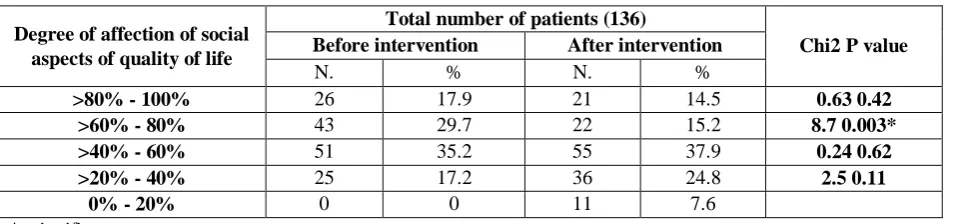
Table (8) shows the degree of affection of social aspects of quality of life before and after treatment. It was noted that before treatment most of the examined workers (35.2%) were found in the group of affection (>40% - 60%). After treatment, most of the patients (37.9%) are found in the group of affection (>40% - 60%). It was observed that there was statistical significance difference
in the group of affection (>60% - 80%) before and after treatment.
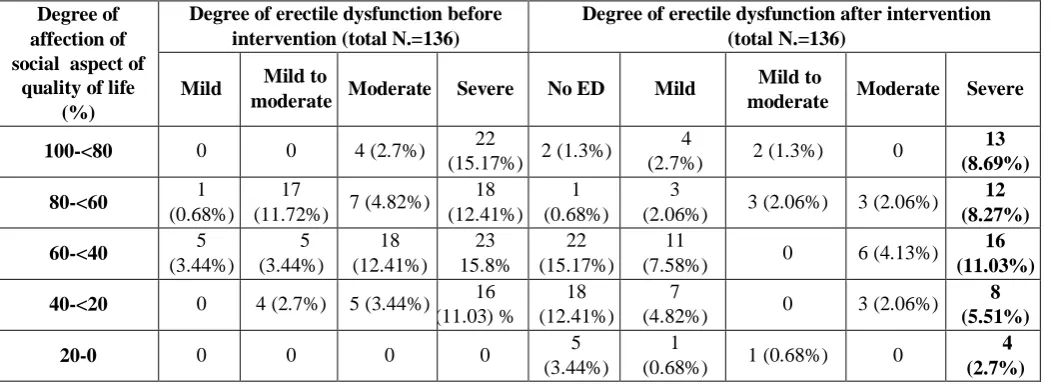
erectile dysfunction. After treatment (15.1%) of the examined workers had been present in the group of
affection (>40% - 60%) and they had no erectile dysfunction.
Table 9: Degree of affection of social aspect of quality of life in relation to erectile dysfunction before and after intervention.
Degree of affection of social aspect of
quality of life (%)
Degree of erectile dysfunction before intervention (total N.=136)
Degree of erectile dysfunction after intervention (total N.=136)
Mild Mild to
moderate Moderate Severe No ED Mild
Mild to
moderate Moderate Severe
100-<80 0 0 4 (2.7%) 22
(15.17%) 2 (1.3%)
4
(2.7%) 2 (1.3%) 0
13 (8.69%)
80-<60 1
(0.68%)
17
(11.72%) 7 (4.82%) 18 (12.41%)
1 (0.68%)
3
(2.06%) 3 (2.06%) 3 (2.06%) 12 (8.27%)
60-<40 5
(3.44%) 5 (3.44%) 18 (12.41%) 23 15.8% 22 (15.17%) 11
(7.58%) 0 6 (4.13%)
16 (11.03%)
40-<20 0 4 (2.7%) 5 (3.44%) 16
(11.03) %
18 (12.41%)
7
(4.82%) 0 3 (2.06%)
8 (5.51%)
20-0 0 0 0 0 5
(3.44%)
1
(0.68%) 1 (0.68%) 0
4 (2.7%)
DISCUSSION
The results of the present study showed that erectile dysfunction has a negative impact on domains (physical, psychological, and social) of the quality of life and the range of affection was (40%-60%).
As regards the physical aspect of quality of life before treatment, most of the studied workers were affected by a degree of 40%-60% [table2] and this could be attributed to the findings of the present study which found that: patients with erectile dysfunction have a physical pain prevents them from doing what is needed (79.3%), patients that need medical treatment to function in daily life (95.2%) and patients that don’t have enough energy for everyday life (93.8%) [table1]. These results agreed with a study which investigated the relationship between sexual dysfunction and quality of life among men and women and found that men with erectile dysfunction experienced deficits in their objective levels of wellbeing as well as energy for everyday life and to a lesser extent, in their levels of health and safety.[13] It was recorded in the present study that after treatment, the physical aspect of quality of life among most of the studied workers (35.17%) were still present in the group of affection (>40%-60%) and this might be attributed to the findings of the present study after intervention which found that: physical pain still prevents patients from doing what is needed (93.1%) , patients need medical treatment to function in daily life (95.2%) , and patients didn't have enough energy for everyday life were (93, 8%) [table1]. These results could be explained by the fact that treatment is not an energetic treatment. It was recorded in the present study that there was statistical significance difference (P<0.01) between the studied workers before
and after treatment regarding the aspect of dissatisfaction with sleep (before treatment the proportion was 50.3% while it was 36.6% after treatment) [table1] and this might be attributed to the regaining of the erection which might be relieved the anxiety and created appropriate mood for better sleep (Table 1). This agrees with a study which studied life satisfaction with male sexual dysfunction, and it found that the satisfaction with sexual life has been shown to be an important predictor of satisfaction with life as a whole and it is reflected in many aspects of life especially satisfaction with sleep.[14]
of 20-40% [table5] and this might be attributed to the findings of the present study which recorded that; patients still not enjoying life (64.8%), patients feel that their lives not to be meaningful (53.1%), patients that had negative feelings (92.4%) and patients with self-dissatisfaction “self-esteem” (44.1%) [table4]. As regards the aspect of self-esteem, the results of the present study disagrees with another study which found that treatment improves selfesteem, confidence, and relationships in men with erectile dysfunction and this contriver might be due to using another type of questionnaire which focused only the aspects of self-esteem, confidence, and relationships.[17] It was found that there was statistical significance difference between the studied workers before and after treatment towards the aspect of having negative feelings such as depression and anxiety and this agrees with a study which found that satisfaction with the quality of erection gained by treatment correlates with emotional wellbeing.[18]
As regards the social aspect of quality of life before intervention, it was found in the present study that majority of the patients (35.2%) were present in the group of affection (40%-60%) (table8) and this could be attributed to the findings of the present study which concluded that: 97.9% were unsatisfied with their sex life, and 62.1% of them were unsatisfied with the support they got from their friends (table7). This agrees with a study which found that erectile dysfunction greatly affect and decreasing patient satisfaction with their sexual life and their partners also it has a negative impact on their social relationships (19). After intervention, majority of the patients were present in the group of affection (40%60%) [table8], and this might be attributed to the findings of the present study which declared that ; 60% of the studied workers were still unsatisfied with the support they got from friends and 66.2% of them still unsatisfied with their sex life (table7 ). Also, it was reported in the present study that there was statistical significance difference between the studied workers before and after treatment (p<0.01) towards the aspect of dissatisfaction with sex life (table7). This agrees with a study which stated that treatment improves satisfaction with sex life and men’s attitude towards sex.[20] Finally, ED has presented a challenge to clinicians because of the interplay between physical, sexual, and emotional factors. Also, the etiology of ED is diverse and is influenced by medical, psychological and lifestyle factors and, due to the sensitive nature of the problem, is likely to have an impact on both their individual well-being and broader aspects of the quality of their working lives.
CONCLUSION
Diagnosis, investigation, and treatment of erectile dysfunction among workers could be a step towards the improvement of the quality of life among the examined workers, but further studies are still needed.
REFERENCES
1. Hatzimouratidis D, Kyriakos Moysidis, Apostolos Apostolidis et al.: Sildenafil Failures May Be Due to Inadequate Patient Instructions and Follow-Up: A Study on 100 Non-Responders; European Urology, 2005; 47(4): 518-523.
2. O'Donnell AB, Araujo AB, Goldstein I and McKinlay JB: The validity of a single-question self-report of erectile dysfunction. Results from the Massachusetts Male Aging Study. J Gen Intern Med, 2005; 20(6): 515-9.
3. Lewis RW: Epidemiology of sexual dysfunction in Asia compared to the rest of the world. Asian J Androl, 2010; Nov 15; 17(2): 20916.
4. Shaeer KZ, Osegbe DN, Siddiqui SH, Razzaque A, Glasser DB, and Jaguste V: Prevalence of erectile dysfunction and its correlates among men attending primary care clinics in three countries; India, Pakistan, and Nigeria. Int J Impot Res, 2003; 15 Suppl 1: S8-14.
5. Bonomiae, Patrick DL, Bushnell DM and Martin M: Quality of life measurement: will we ever be satisfied? Journal of Clinical Epidemiology, 2000; 53(1): 19-23.
6. Helena A, Figueira A, Tania S, et al.,: Quality of life (QOL) axiological profile of the elderly population served by the Family Health Program (FHP) in Brazil Archives of Gerontology and Geriatrics, 2009; 49: 368–372.
7. Danna, K. & Griffin, R. W: Health and well-being in the workplace: A review and synthesis of the literature. Journal of Management, 1999; 25: 357-384.
8. Loscocco, K. A., and Roschelle, A. N: Influences on the Quality of Work and Nonwork Life: Two Decades in Review. Journal of Vocational Behavior, 1991; 39: 182-225.
9. Sirgy, M. J., Efraty, D., Siegel, P and Lee, D: A new measure of the quality of work life (QoWL) based on need satisfaction and spillover theories. Social Indicators Research, 2001; 55: 241-302.
10. Vaughan J P. and Morrow R H: Manual of epidemiology for district health management, 1989; 178.
11. Carson C: Urological and Medical Evaluation of Men with Erectile Dysfunction; Rev Urol, 2002; 4(3): S2–S8.
13. McCabe MP: Intimacy and quality of life among sexually dysfunctional men and women. J Sex, 1997; 23(4): 276–290.
14. Fugl-Meyer AR, Lodnert G, and Bra¨nholm IB: On life satisfaction in male erectile dysfunction. Int J Impotence Res., 1997; 9: 141.
15. Laumann EO, Wilton L and Waite LJ: Sexual dysfunction among older adults: prevalence and risk factors from a nationally representative U.S. probability sample of men and women.J Sex Med, 2008; 5(10): 2300-11.
16. Althof SE: Quality of life and erectile dysfunction. Urology, 2002; 59: 803-10.
17. Rosen RC. Quality of life assessment in sexual dysfunction trials. Int J Impot Res, 1998; 10(Suppl 2): S21–S23.
18. Cappelleri JC, Althof SE, O’Leary MP: Sildenafil citrate improves self-esteem, confidence, and relationships in men with erectile dysfunction: results from an international, multi-center double-blind, placebo-controlled trial. J Sex Med, 2006; 3: 521–9.