www.nat-hazards-earth-syst-sci.net/10/203/2010/ © Author(s) 2010. This work is distributed under the Creative Commons Attribution 3.0 License.
and Earth
System Sciences
The 6 April 2009 earthquake at L’Aquila: a preliminary analysis
of magnetic field measurements
U. Villante1,2, M. De Lauretis1,2, C. De Paulis1,2, P. Francia1,2, A. Piancatelli1,2, E. Pietropaolo1,2, M. Vellante1,2, A. Meloni3,2, P. Palangio3,2, K. Schwingenschuh4, G. Prattes4, W. Magnes4, and P. Nenovski5
1Dipartimento di Fisica, Universit`a L’Aquila, L’Aquila, Italy 2Area di Ricerca in Astrogeofisica, L’Aquila, Italy
3Istituto Nazionale di Geofisica e Vulcanologia, Roma, Italy 4Institut f¨ur Weltraumforschung, Graz, Austria
5Geophysical Institute, Sofia, Bulgaria
Received: 10 October 2009 – Revised: 21 December 2009 – Accepted: 11 January 2010 – Published: 9 February 2010
Abstract. Several investigations reported the possible iden-tification of anomalous geomagnetic field signals prior to earthquake occurrence. In the ULF frequency range, can-didates for precursory signatures have been proposed in the increase in the noise background and polarization parame-ter (i.e. the ratio between the amplitude/power of the vertical component and that one of the horizontal component), in the changing characteristics of the slope of the power spectrum and fractal dimension, in the possible occurrence of short du-ration pulses. We conducted, with conventional techniques of data processing, a preliminary analysis of the magnetic field observations performed at L’Aquila during three months preceding the 6 April 2009 earthquake, focusing attention on the possible occurrence of features similar to those identified in previous events. Within the limits of this analysis, we do not find compelling evidence for any of the features which have been proposed as earthquake precursors: indeed, most of aspects of our observations (which, in some cases, ap-pear consistent with previous findings) might be interpreted in terms of the general magnetospheric conditions and/or of different sources.
1 Introduction
In the last two decades several papers reported the possible identification of anomalous geomagnetic field signals prior to earthquake occurrence (reviews by Hattori and Hayakawa, 2007; Fraser-Smith, 2008, 2009, and papers therein ref-erenced) and large networks of ground-based instruments
Correspondence to: U. Villante
and even some satellite-based systems have been recently dedicated to these scopes (Bleier and Freund, 2005; Bleier and Dunson, 2005; Reichhardt, 2003; Parrot and Ouzounov, 2006; Zlotnicki et al., 2006).
In the ultra low frequency range (ULF, 1 mHz<f <10 Hz), emissions preceding strong and destructive earthquakes were originally proposed for the Loma Prieta event (M=6.9, ac-cording to USGS Catalog; distance of instrumentation from the epicentre,d≈7 km; Fraser-Smith et al., 1990; Bernardi et al., 1991) and further corroborated for other strong earth-quakes, such as Spitak (M=6.8; d≈128 km; Molchanov et al., 1992; Kopytenko et al., 1993), Guam (M=7.8;d≈65 km; Hayakawa et al., 1996, 1999; Miyahara et al., 1999; Ida et al., 2005), Biak (M=8.2; d≈100 km; Hayakawa et al., 2000), Chia-yi (M=7.6; d≈8 km; Yen et al., 2004), Bovek (M=5.2; d≈153 km; Prattes et al., 2008), Alum Rock (M=5.6;d≈2 km; Bleier et al., 2009), and others. Accord-ing to these analysis, ULF precursor signals might basically consist of one or more of the following aspects:
– A substantial increase in the noise background starting from days to several weeks preceding earthquake cov-ering almost the entire ULF range (Loma Prieta, Spi-tak, Guam, Alum Rock), followed by an anomalous dip in the range 0.2–5 Hz starting one day ahead the earth-quake (Loma Prieta).
– An increase to a high level of activity in the range≈10– 50 mHz starting few hours before the earthquake (Loma Prieta, Spitak).
204 U. Villante et al.: Magnetic field measurement during L’Aquila earthquake approximate range of frequency≈10–100 mHz; Guam,
Bovec) and the emission of presumably earthquake as-sociated waves with main frequency in the range 20– 50 mHz (Guam).
– A gradual decrease of the slope of the power spec-trum during the process of earthquake preparation (1–1.5 month) and an increase of the fractal dimension (Guam, Biak).
– An increased occurrence of negative or positive (or a combination of positive and negative) pulses of short duration, identified on the East/West component (D) approximately 15 days before the earthquake (Alum Rock).
As a matter of fact, although no firm evidence for a clear association between these features and the earthquake oc-currence has yet been provided, all the experimental ele-ments summarized in previous paragraphs have been consi-dered as candidates for precursory signatures (Fraser-Smith, 2009). However, the absence of common features for dif-ferent events makes controversial the entire subject. On the other hand, the possible detection of precursory signals is obviously expected to be related to the strength and charac-teristics of the seismic events as well as to the distance of the epicentre from the geomagnetic observatory. Fraser-Smith et al. (1994), who examined the Northridge event (M=6.7), concluded that, assuming that ULF magnetic fields were pro-duced, their amplitudes were too small to produce obvious increases in the ULF background noise atd≈81 km from the epicentre. Nevertheless, an analysis conducted by Johnston et al. (2006) did not reveal any indication for an ULF activity preceding the Parkfield earthquake (M=6.0; 28 September 2004) immediately above the hypocenter and along a magne-tometric array of≈60 km. In addition, according to Thomas et al. (2009a), the geomagnetic field measurements of the Loma Prieta earthquake (the most frequently cited identifi-cation of a magnetic precursor) might be also interpreted in terms of anomalous magnetic signals not related to the earth-quake (Thomas et al., 2009b also proposed the absence of anomalous signals at Guam), eventually due to a coincidental geomagnetic solar-terrestrial disturbance (Campbell, 2009).
From a theoretical point of view, several physical mech-anisms have been proposed to explain the possible appear-ance of geomagnetic signals (in general) prior the earth-quake occurrence; they include electrokinetic and magneto-hydrodynamic effects resulting from fluid motions through the crust, piezomagnetism, stress-induced increase in local crustal conductivity, microfracturing, and others (Draganov et al., 1991; Park, 1993; 1996; Fenoglio et al., 1993, 1995; Johnston, 1997; Merzer and Klemperer, 1997; Molchanov and Hayakawa, 1994, 1995a, 1998; Egbert, 2002; Surkov et al., 2003; Simpson and Taflove, 2005). Basically, how-ever, the expected effects are mainly correlated with the onset
of quasi-static magnetic field variations and ULF emissions would eventually appear as transient features.
In this context, given the importance of all the aspects which might be related to the earthquake prediction, we found interesting to provide the results of the ULF mea-surements conducted close to the epicentre (d≈6 km) during three months preceding the earthquake of 6 April 2009 which devastated L’Aquila (AQU, Italy, LT=UT+1; geomagnetic coordinates: 36.33◦N; 87.37◦E) and its territory (including the Physics Department) and caused more than 300 deaths (including 47 students of the local university). In this pre-liminary analysis, adopting conventional techniques of data processing, we focus attention on the possible occurrence of features similar to those identified in previous events; more sophisticated analysis of this event and thorough compar-isons with simultaneous measurements at other stations will be presented in forthcoming papers.
The central Apennines, that belongs to the Lazio-Abruzzi Mesozoic carbonate platform domain, is dominated by the roll-back of the Adriatic subduction toward the east. This re-gion shows an arc-like belt of seismicity in the upper crust that follows the mountain range and is characterized by nor-mal faults directed along pre-existing compressive tectonic structures (Anzidei et al., 2009). In the Abruzzi sector, mainly calcareous deposits constitute most of the thrust sys-tem. Near L’Aquila, an elongated northwest southeast trend-ing intramontane basin is present; its alluvial to lacustrine Quaternary filling deposits are up to 100 m thick. The de-posits are formed mainly by loose gravelly sands interlayered with palustrine silty-clayey lenses and blocky calcareous de-bris (Rapolla et al., 2009, and papers therein referenced). De Luca et al. (2005) who examined accelerometric record-ings of earthquakes with moderate and intermediate magni-tude at both local and regional distances, revealed a signif-icant ground-motion amplification effect at low frequencies (≈0.6 Hz) in the city of L’Aquila, consistent with a sedimen-tary basin, filled by lacustrine sediments, with a maximum depth of about 250 m.
2 The seismic event and the ULF measurements
“An earthquake measuring 6.3 on the Richter scale hit cen-tral Italy last night causing thousands of people to lose their homes and more than 250 deaths. Most of the dam-age surrounds the city of L’Aquila, which includes one of the oldest centers of learning in Europe, the University of L’Aquila. More than 4000 buildings in the city have col-lapsed” (Physics Today, 8 April 2009).
Such earthquake occurred on 6 April 2009, 01:32 UT: ac-cording to the Istituto Nazionale di Geofisica e Vulcanolo-gia (INGV), it was classified as anML=5.8,MW=6.3 event, with a depth of 8.8 km. It was preceded by a persistent seis-mic activity for approximately three months: namely, be-tween 16 January and 5 April 2009, 34 seismic events with
2<ML<3 (and 9 withML>3) were registered in the territory. The main shock (the largest event in this region since the last destructive earthquake occurred in 1703) was followed by a large numbers of aftershocks with remarkable events on 7 April 17:47 UT (ML=5.3) and on 9 April 00:52 UT (ML=5.1).
At AQU magnetic field measurements are routinely con-ducted at the Geomagnetic Observatory (INGV) and at the ULF station of the University of L’Aquila. As shown in Fig. 1, the Geomagnetic Observatory/ULF station are lo-cated ≈6.0 km from the epicentre of the strongest event. The magnetic field observations presented hereafter are those of the tri-axial fluxgate and induction magnetometers of the ULF station. Measurements from both instruments are recorded at a sampling frequency of 1 Hz from the same acquisition system. The fluxgate magnetometer has a rms instrumental noise of ∼20 pT in the frequency band 1– 500 mHz; more specifically, according to the usual classifica-tion scheme for continuous pulsaclassifica-tions (Pc1: 200–500 mHz; Pc2: 100–200 mHz; Pc3: 20–100 mHz; Pc4: 7–20 mHz; Pc5: 1–7 mHz), the rms noise is∼10 pT (Pc1 band),∼10 pT (Pc2), ∼10 pT (Pc3), ∼5 pT (Pc4), ∼3 pT (Pc5). The rms of the quantization noise is ∼0.3 pT. The induction mag-netometer has an amplitude/frequency response almost lin-ear (∼6 V/nT/Hz) in the frequency range 0–0.2 Hz. The rms instrumental noise is∼1 pT (Pc1),∼1 pT (Pc2),∼3 pT (Pc3), ∼5 pT (Pc4), ∼10 pT (Pc5). The rms of the quan-tization noise is less than 0.5 pT in the frequency range 1– 500 mHz. According to Villante and Vellante (1998) and Vil-lante et al. (2004), the man-made contamination determines in the ULF bands a weekly modulation with minimum power values on Sundays and reduced power level on Saturdays; such contamination would provide an additional noise dur-ing weekdays (daytime hours) of∼1 pT (Pc1),∼2 pT (Pc2), ∼3 pT (Pc3), while no significant contamination was deter-mined in the lower frequency bands and, in general, during nighttime hours.
In the present analysis data have been organized in fre-quency bands corresponding to the Pc1-Pc5 classification. For the higher frequency bands (Pc1-Pc2) we will mostly consider measurements from the induction magnetometer, more suitable for higher frequency fluctuations (as confirmed by the rms noise), and measurements from both instruments in the other bands (Pc3-Pc5). The spectra of the geomag-netic field components have been evaluated over 60-min in-tervals between 1.7 and 500 mHz. For the scopes of the present investigation, in each frequency band the polariza-tion parameter R is determined by the ratio between the vertical and the total horizontal signal amplitude, namely R=(PZ/(PH+PD))1/2. The scale exponent of the mag-netic field observations has been evaluated by means of the Detrended Fluctuation Analysis method (DFA), as originally proposed by Peng et al. (1995); in particular, we conside-red a range of temporal scales from 10 to 500 s and the fast algorithm developed by Little et al. (2006). A preliminary
Fig. 1. The position of the epicentre of the major events with respect
to the position of the Geomagnetic Observatory and ULF station.
analysis revealed the post-midnight interval 00:00–03:00 UT (01:00–04:00 LT) at AQU as less affected by ULF events of magnetospheric origin (except for the possible occurrence of Pi2 events, 7–25 mHz) and man-made contamination: conse-quently, as in previous investigations (Hayakawa et al., 1996, 1999; Prattes et al., 2008), we mostly focused our attention on such “quiet” interval for the identification of possible ULF emissions of lithospheric origin.
3 The experimental observations
3.1 The results of a statistical analysis
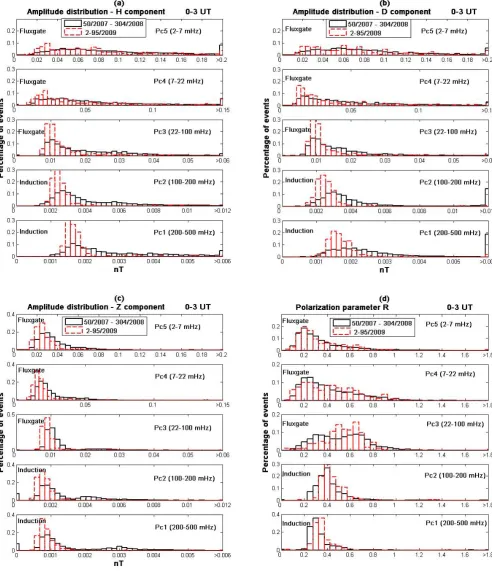
In order to identify the possible occurrence of an explicit variation in the amplitude of ULF signals in the time inter-val preceding earthquake and characterized by a persistent seismic activity, we compared (Fig. 2a–c) the histograms of the amplitude distribution in different frequency bands (00:00–03:00 UT) as obtained during 2007–2008 (we ex-cluded November and December 2008 in that affected, al-though occasionally, by seismic activity) with those ob-tained during the three months interval preceding earthquake (2 January–5 April 2009). In general, such histograms show that the Z component (less influenced by magnetospheric and ionospheric signals), is typically characterized by lower am-plitudes with respect to the other components in all frequency bands. The comparison between different intervals does not reveal any statistical evidence for an increased ULF activity preceding the earthquake in any frequency band or compo-nent; rather, such observations would suggest a general ten-dency for a lower ULF activity.
206 U. Villante et al.: Magnetic field measurement during L’Aquila earthquake
Fig. 2. Panels (a)–(c): histograms of the distributions of the amplitude of the geomagnetic field components in different frequency bands.
Panel (d): histogram of the distribution of the polarization parameterR. Black line: data for 2007–2008; red line: data for January–5 April 2009.
represent the effect of the instrumental noise during quiet conditions. In the lower frequency bands,R shows broader distributions with higher values around≈0.2 (Pc4 and Pc5 band). For comparison, Prattes et al. (2008), who considered as polarization parameter the ratio of the power of compo-nents between 10–50 mHz, determined mean plus standard deviation values between≈0.6 and≈1.2 at three European stations. As for the field components, the comparison be-tween different intervals does not suggest increasedRin the interval preceding the earthquake, although greater percent-ages of values between ≈0.4–0.7 are detected in the Pc3 band.
3.2 The long term behavior
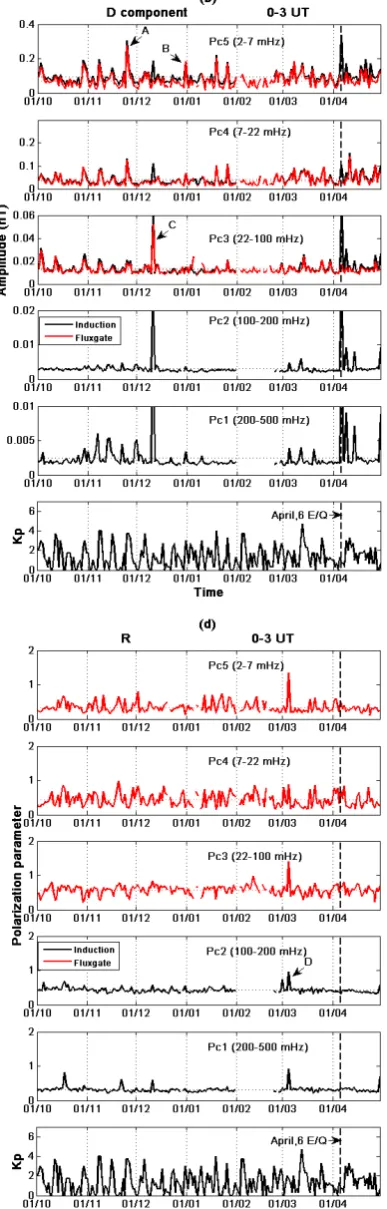
Figures 3a–c show the long term behaviour of the amplitude of the field components and geomagnetic activity index Kp (six months preceding the earthquake; 00:00–03:00 UT). The close correspondence between observations obtained with different magnetometers in the Pc3-Pc5 bands (practically coincident for the H and D component) make us sure that the estimated signal amplitudes, in general, are not signif-icantly influenced by instrumental aspects. The co-seismic shaking effect observed on the induction magnetometer mea-surements for the major event is practically absent in the flux-gate measurements.
A visual inspection of the experimental results suggests, with few exceptions, a general correspondence, more ex-plicit in the Pc3-Pc5 band, between signal amplitudes and Kp index (Saito, 1969). Some evidence for higher values in the weeks preceding the earthquake (Fraser-Smith et al., 1990) might be tentatively identified in the Pc4 and Pc5 band (H component) during March 2009. However, similar in-creases are detected also in different intervals; in addition, it is worth noting that the peak value of the Pc5 activity (13 March) corresponds to the peak value of the Kp index in the entire six months interval.
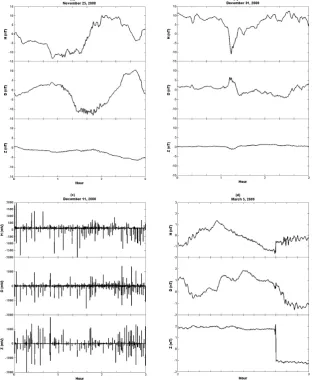
Some prominent peaks, identified by arrows, appear in Fig. 3. Those occurring in the Pc5 band on 25 Novem-ber (H and D component, event A) and on 30 DecemNovem-ber (H component, event B) might appear somewhat greater than expected, given the corresponding Kp level: neverthe-less, such high values come from a wave activity (event A, Fig. 4a) and a bay-like variation (event B, Fig. 4b), re-spectively which are typical manifestations of the magneto-spheric dynamics as observed during nighttime intervals at our latitudes. On the hand, a quick look analysis of mea-surements at other European observatories reveals in both cases practically the same traces. Extreme signal amplitudes are detected in all components on 11 December (event C), more explicitly in the Pc1-Pc3 band: such high values, however, basically come from an intense lightning activity (1755 lightnings within 100 km from AQU between 00:00– 03:00 UT; 186 within 50 km; SIRF-Sistema Italiano Rileva-mento Fulmini, http://www.fulmini.it/default.asp; EUCLID
network for lightning data for Europe, http://www.euclid. org/contacts.html#ita) providing signal sequences such as in Fig. 4c (induction magnetometer) which mostly consist of positive and negative changes (or both) of short dura-tion (≈3–10 s). We would then conclude that the results of Fig. 3a–c do not reveal amplitude increases unambigu-ously related to the earthquake occurrence (Fraser-Smith et al., 1990; Bernardi et al., 1991; Molchanov et al., 1992; Hayakawa et al., 1996, 2000; Bleier et al., 2009).
Similarly, the polarization parameterR(Fig. 3d) does not show any clear tendency to increase during weeks preced-ing the earthquake in any frequency band (Hayakawa et al., 1996). Nevertheless, an explicit enhancement occurs on 5 March (event D; see also Fig. 3c). The 1-s data in Fig. 4d reveal that this effect comes from a sharp variation of the ge-omagnetic field (affecting more explicit the vertical compo-nent with a sharp change of level of≈3 nT) which is detected by both instruments. A similar feature might be tentatively interpreted in terms of lithospheric processes; nevertheless, the comparison with the absolute field measurements per-formed in situ by INGV rather suggests contamination from a highly localized artificial disturbance.
3.3 The short term behavior
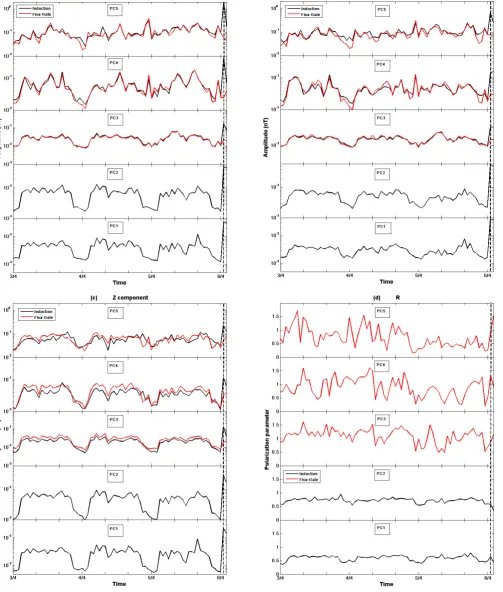
Figure 5a–c show the signal behaviour for the entire three days (00:00–24:00 LT) preceding the event: as can be seen, in addition to the well known daily modulation related to ionospheric and magnetospheric processes (less evident in the Pc4-Pc5 bands) as well as to man-made contamination (more explicit at higher frequencies, Villante et al., 2004), the experimental results do not reveal any increase of activity starting few hours before the earthquake (Fraser-Smith et al., 1990; Bernardi et al., 1991; Molchanov et al., 1992). Sim-ilarly, the polarization parameter (Fig. 5d), although irregu-lar (Pc3-Pc5 band), does not show any remarkable enhance-ment; in addition, the lower values detected around midnight in the Pc1 and Pc2 band confirm this time interval as the most suitable for the identification of anomalous Z signals of lithospheric origin at the highest frequencies.
3.4 The slope of the power spectrum and the DFA analysis
208 U. Villante et al.: Magnetic field measurement during L’Aquila earthquake
Figure 3
Figure 3
Fig. 3. Panels (a)–(c): the amplitude of components in different frequency bands (00:00–03:00 UT). Dotted lines (when identifiable)
corre-spond to the median values. In the bottom plot: the behaviour of the Kp index. Panel (d): the polarization parameterR. Black line: data from the induction magnetometer; red line: data from the fluxgate magnetometer. Arrows identify events discussed in the text.
Figure 4
Fig. 4. Panels (a), (b), and (d): 1-s measurements from the fluxgate magnetometer. Panel (c): 1-s measurements from the induction
magnetometer.
of the Kp index (bottom panel) suggests a general tendency for greater values during more active magnetospheric condi-tions and some evidence for a 27-day modulation (confirmed by the results of the spectral analysis, not shown; Hayakawa et al., 1996, 2000). As a matter of fact, the polynomial fit approximation of the experimental points (solid lines in Fig. 6) reveals a long term variation with smaller values of both indices approximately during summer 2007 and greater values during January–March 2008: the amplitude of such modulation is smaller for the Z component. In the present scenario the identification of any peculiar earthquake related feature might be highly ambiguous: in particular, we do not find any clear evidence for a gradual decrease of the slope of the power spectrum and of the DFA index in the process of earthquake preparation (1–2 months, Hayakawa et al., 1996, 2000).
3.5 The occurrence of short duration pulses
210 U. Villante et al.: Magnetic field measurement during L’Aquila earthquake
Figure 5
Fig. 5. Panels (a)–(c): the hourly average of the amplitude of components in different frequency bands (00:00–24:00 UT) for the three days
preceding the earthquake. Panel (d): the polarization parameterR. Black line: data from the induction magnetometer; red line: data from the fluxgate magnetometer. The dotted lines on the right identify the earthquake occurrence.
U. Villante et al.: Magnetic field measurement during L’Aquila earthquake 211
Fig. 6. Top panel: the behaviour of the spectral indexβfor the field components. Central panel: the behaviour of the DFA indexα. Bottom panel: the Kp index. Solid lines identify the polynomial best fit approximation to the experimental points.
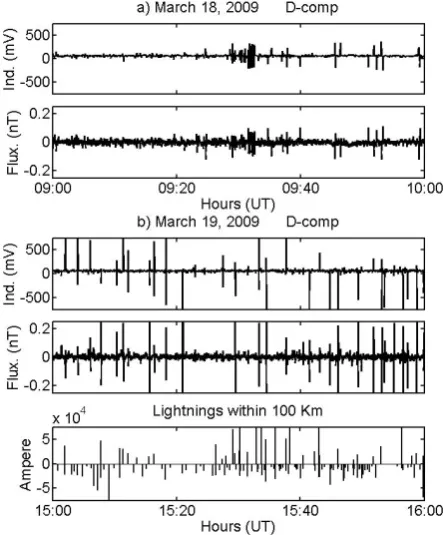
frequency range). The results of the induction magnetome-ter (Fig. 7; basically confirmed by fluxgate measurements) reveal a trend of the daily rate of pulses for a general in-crease in the time interval preceding the event, with peak values in the D component≈20 days before the earthquake (18 and 19 March). According to SIRF, no lightning activ-ity occurred within 100 km on 18 March, while a significant lightning activity was registered between 11:28–23:30 UT on 19 March (1952 lightnings within 100 km). Figure 8 shows 1 h of measurements for both days: on 19 March, in substan-tial association with the lightning occurrence, sharp pulses were detected from both the induction and the fluxgate mag-netometer (with a typical amplitude smaller than 1 nT); on the other hand, the pulses detected on 18 March, in absence of lightning activity, reveal different features (in terms of a smaller amplitude and a tendency to be clustered in short time intervals), suggesting other natural sources or artificial contamination.
4 Discussion
212 U. Villante et al.: Magnetic field measurement during L’Aquila earthquake
Fig. 7. The daily rate of occurrence (24 h) of short duration pulses
in the geomagnetic field components (induction magnetometer). In the bottom panel the Kp index.
useful for a better understanding of the physical processes related to the earthquake preparation and occurrence.
On the other hand, in addition to the strength of the earth-quake and to the distance of the geomagnetic measurements from the epicentre, the possible identification of earthquake related ULF signals is also remarkably influenced by the depth of the hypocenter (assuming that the sources of mag-netic signals were located in and around hypocenters) and by the local electrical conductivity (σ) of the Earth’s crust. For example, Fraser-Smith (2009) estimated that a magnetic signal propagating in an “earth material” characterized by σ=0.1 S/m, the signal amplitude at≈0.01 Hz is reduced to roughly one third of its initial amplitude in≈16 km, where at ≈10 Hz this reduction takes place in only≈0.5 km. Clearly, different conductivity values would deeply alter the trend of attenuation. This is an additional feature which makes highly ambiguous the comparison between different events (note, for example, that the depth of the hypocenter was≈17 km for the Loma Prieta event,≈10 km at Spitak, and≈50 km at Guam).
In this context, we conducted, with conventional tech-niques, a preliminary analysis of the ULF observations per-formed at L’Aquila during the 6 April 2009 earthquake, fo-cusing attention on the possible occurrence of features sim-ilar to those identified in previous events. Such earthquake was not as strong as most of those examined in previous
in-Fig. 8. 1-h samples of the comparison between the lightning
oc-currence and the identification of pulses in the D component in the induction and fluxgate magnetometer. Panel (a): 18 March 2009; panel (b): 19 March 2009 (no lightning activity).
vestigations: in the meanwhile, it occurred close to the lo-cal Geomagnetic Observatory (at a depth of≈9 km) where ULF measurements have been routinely conducted (and anal-ysed) by different instrumentations over many years, allow-ing comparisons between measurements performed in the time interval preceding the event with those obtained over several years with the same instrumentation.
Within the limits of the present investigation, we did not find any compelling evidence for any of the ULF features which have been proposed as earthquake precursors, in that most of aspects of our observations (which in some cases appear consistent with previous findings are interpretable in terms of the general magnetospheric conditions or contam-ination by lightnings and, eventually, artificial sources. In particular, the polarization ratio identified, one month before the earthquake, a sharp change in the magnetic field elements which, in absence of careful analysis of the high resolution data and comparison with other measurements, would have been erroneously interpreted in terms of possible lithospheric processes. On the other hand, in general, caution should be adopted before drawing conclusions for similar signals. Indeed, although variations of the order of few nT in the geo-magnetic field (≈1–5 nT) have been associated with tectonic (and volcanic) activity in the Earth’s crust, there are cases in which similar features can hardly be imputed to litho-spheric processes (Molchanov et al., 1995b; Hayakawa and Fujinawa, 1994; Johnston, 1997; Masci et al., 2006, 2009).
On the other hand, it is clear, that in order to ascertain the real occurrence of precursory aspects and their statisti-cal significance, it is important to conduct preliminary analy-sis of the characteristics of the observing stations in terms of influence/contamination from other natural sources and man-made disturbances, relationship between the local ULF power level and the global geomagnetic activity (Kp and other indices; daily, 27-day, annual and solar-cycle modula-tion of ULF manifestamodula-tions of external and magnetospheric origin), comparison between ground and space observations (for single events) to ascertain the possible penetration of ternal waves into the magnetosphere, etc. In addition, the ex-pected ULF disturbances related to earthquakes (if any) are generally weak and sophisticated signal processing methods and a lot of experience are required to evaluate the source of ULF emission (Harada et al., 2004; Hattori and Hayakawa, 2007; Nenovski et al., 2007; Prattes et al., 2008). In forth-coming papers we will pay careful attention to these aspects: indeed, in our opinion, whatever the answer, a better under-standing of the possible identification of geomagnetic signals (in general) related to earthquakes represents an important aspect which deserves significant scientific and social rele-vance.
Acknowledgements. This research activity at L’Aquila is supported
by the Consorzio “Area di Ricerca in Astrogeofisica”.
Edited by: P. F. Biagi
Reviewed by: T. Bleier and another anonymous referee
References
Anzidei, M., Boschi, E., Cannelli, V., Devoti, R., Esposito, A., Gal-vani, A., Melini, D., Pietrantonio, G., Riguzzi, F., Sepe, V., and Serpelloni, E.: Coseismic deformation of the destructive April 6, 2009 L’Aquila earthquake (central Italy) from GPS data, Geo-phys. Res. Lett., 36, L17307, doi:10.1029/2009gl039145, 2009. Bernardi, A., Fraser-Smith, A. C., McGill, P. R., and Villard, O.
G.: ULF magnetic field measurements near the epicenter of the Ms 7.1 Loma Prieta earthquake, Phys. Earth Planet. In. 68, 45– 63, 1991.
Bleier, T. and Dunson, C.: ELF magnetic field monitoring of the San Simeon M6.4 quake from both Quakesat and a ground net-work, in: Proceedings of the International Workshop on Seismo-Electromagnetics, Tokyo, Japan, March 2005.
Bleier, T., Dunson, C., Maniscalco, M., Bryant, N., Bambery, R., and Freund, F.: Investigation of ULF magnetic pulsations, air conductivity changes, and infra red signatures associated with the 30 October Alum Rock M5.4 earthquake, Nat. Hazards Earth Syst. Sci., 9, 585–603, 2009,
http://www.nat-hazards-earth-syst-sci.net/9/585/2009/.
Bleier, T. and Freund, F. T.: Earthquake alarm, IEEE Spectrum, 22–27, December 2005.
Campbell, W. H.: Natural magnetic disturbances fields, not precur-sors, preceding the Loma Prieta earthquake, J. Geophys. Res., 114, A05307, doi:10.1029/2008JA013932, 2009.
De Luca, G., Marcucci, S., Milana, G., and Sano, T.: Evidence of low-frequency amplification in the city of L’Aquila, Central
Italy, through a multidisciplinary approach including strong- and weak-motion data, ambient noise, and numerical modelling, B. Seismol. Soc. Am., 95(4), 1469–1481, 2005.
Draganov, A. B., Inan, U. S., and Taranenko, Yu. N.: ULF mag-netic signatures at the earth surface due to ground water flow: a possible precursor to earthquakes, Geophys. Res. Lett. 18, 1127– 1130, 1991.
Egbert, G. D.: On the generation of ULF magnetic variations by conductivity fluctuations in a fault zone, Pure Appl. Geophys., 159, 1205–1227, 2002.
Fenoglio, M. A., Fraser-Smith, A. C., Beroza, G. C., and Johnston, M. J. S.: Comparison of ultra-low frequency electromagnetic sig-nals with the aftershock activity during the 1989 Loma Prieta earthquake sequence, B. Seismol. Soc. Am., 83, 347–357, 1993. Fenoglio, M. A., Johnston, M. J. S., and Byerlee, J. D.: Magnetic and electric fields associated with changes in high pore pressure in fault zones: application to the Loma Prieta ULF emissions, J. Geophys. Res., 100, 12951–12958, 1995.
Fraser-Smith, A. C.: The ultralow-frequency magnetic fields asso-ciated with and preceding earthquakes, in: Electromagnetic Phe-nomena associated with earthquakes, edited by: Hayakawa, M., Trasworld Research Network, 1–20, 2009.
Fraser-Smith, A. C.: Ultralow-frequency magnetic fields preceding large earthquakes, EOS T. Am. Geophys. Un., 89(23), p. 211, 2008.
Fraser-Smith, A. C., Bernardi, A., McGill, P. R., Ladd, M. E., Hel-liwell, R. A., and Villard, O. G.: Low-frequency magnetic field measurements near the epicenter of the Ms7.1 Loma Prieta earth-quake, Geophys. Res. Lett., 17, 1465–1468, 1990.
Fraser-Smith, A. C., McGill, P. R., Helliwell, R. A., and Villard Jr., O. G.: Ultra-low frequency magnetic field measurements in southern California during the Northridge earthquake of 17 Jan-uary 1994, Geophys. Res. Lett., 21(20), 2195–2198, 1994. Harada, M., Hattori, H., and Isezaki, N.: Transfer function approach
to signal discrimination of ulf geomagnetic data, Elsevier, Phys. Chem. Earth, 29, 409–417, 2004.
Hattori, K. and Hayakawa, M.: Recent progress and state of the art of seismo-electromagnetics, IEEJ Transactions on Fundamentals and Materials, 127(1), 4–6, 2007.
Hayakawa, M. and Fujinawa, Y. (Eds.): Electromagnetic Phe-nomena Related to Earthquake Prediction, TERRAPUB, Tokyo, Japan, p. 677, 1994.
Hayakawa, M., Ito, T., Hattori, K., and Yumoto, K.: ULF electro-magnetic precursors for an earthquake at Biak, Indonesia on 17 February 1996, Geophys. Res. Lett., 27, 1531–1534, 2000. Hayakawa, M., Ito, Y., and Smirnova, N.: Fractal analysis of ULF
geomagnetic data associated with the Guam Earthquake on Au-gust 8, 1993, Geophys. Res. Lett., 26(18), 2797–2800, 1999. Hayakawa, M., Kawate, R., Molchanov, O. A., and Yumoto, K.:
Results of ultralow-frequency magnetic field measurements dur-ing the Guam earthquake of 8 August 1993, Geophys. Res. Lett., 23, 241–244, 1996.
Ida, Y., Hayakawa, M., Adalev, A., and Gotoh, K.: Multifractal analysis for the ULF geomagnetic data during the 1993 Guam earthquake, Nonlin. Processes Geophys., 12, 157–162, 2005, http://www.nonlin-processes-geophys.net/12/157/2005/. Ida, Y., Yang, D., Li, Q., Sun, H., and Hayakawa, M.: Detection of
214 U. Villante et al.: Magnetic field measurement during L’Aquila earthquake
Earth Syst. Sci., 8, 775–777, 2008,
http://www.nat-hazards-earth-syst-sci.net/8/775/2008/.
Johnston, M. J. S.: Review of electric and magnetic fields accom-panying seismic and volcanic activity, Surv. Geophys., 18, 441– 475, 1997.
Johnston, M. J. S., Sasai, Y., Egbert, G. D., and Mueller, R. J.: Seismomagnetic Effects from the Long-waited 28 September 2004 M 6.0 Parkfield Earthquake, B. Seismol. Soc. Am., 96(4B), S206–S220, doi:10.1785/0120050810, 2006.
Kopytenko, Yu. A., Matiashvili, T. G., Voronov, P. M., Kopytenko, E. A., and Molchanov, O. A.: Detection of ultra-low frequency emissions connected with the Spitak earthquake and its after-shock activity, based on geomagnetic pulsation data at Dusheti and Vardzia, Phys. Earth Planet. In., 77, 85–95, 1993.
Little, M., McSharry, P., Moroz, I., and Roberts, S.: Nonlinear, biophysically-informed speech pathology detection, in: Proceed-ings of ICASSP 2006, IEEE Publishers, Toulouse, France, 2, II-1080–1083, 2006.
Masci, F., Palangio, P., and Di Persio, M.: Magnetic anomalies pos-sibly linked to local low seismicity, Nat. Hazards Earth Syst. Sci., 9, 1567–1572, 2009,
http://www.nat-hazards-earth-syst-sci.net/9/1567/2009/. Masci, F., Palangio, P., and Meloni, A.: The INGV tectonomagnetic
network: 2004-2005 preliminary dataset analysis, Nat. Hazards Earth Syst. Sci., 6, 773–777, 2006,
http://www.nat-hazards-earth-syst-sci.net/6/773/2006/.
Merzer, M. and Klemperer, S. L.: Modeling low-frequency magnetic-field precursors to the Loma Prieta earthquake with a precursory increase in fault-zone conductivity, Pure Appl. Geo-phys., 150, 217–248, 1997.
Miyahara, S., Tanaka, Y., Saita, K., Yumoto, K., and Tachira, H.: On ULF magnetic field variations with the Guam earthquake of 8 August 1993, in: Atmospheric and Ionospheric Electromagnetic Phenomena Associated with Earthquakes, edited by: Hayakawa, M., Terra Sci., Tokyo, 189–201, 1999.
Molchanov, O. A. and Hayakawa, M.: Generation of ULF seismo-genic electromagnetic emission: a natural consequence of mi-crofracturing process. In: Electromagnetic Phenomena Related to Earthquake Prediction, edited by: Hayakawa, M. and Fuji-nawa, Y., TERRAPUB, Tokyo, Japan, 537–563, 1994.
Molchanov, O. A. and Hayakawa, M.: Generation of ULF elec-tromagnetic emissions by microfracturing, Geophys. Res. Lett., 22(22), 3091–3094, 1995a.
Molchanov, O. A. and Hayakawa, M.: On the generation mech-anism of ULF seismogenic electromagnetic emissions, Phys. Earth Planet. In., 105, 201–210, 1998.
Molchanov, O. A., Hayakawa, M., and Rafalsky, V. A.: Penetra-tion characteristics of electromagnetic emissions from an under-ground seismic source into the atmosphere, ionosphere and mag-netosphere, J. Geophys. Res., 100(A2), 1691–1712, 1995b. Molchanov, O. A., Kopytenko, Y. A., Voronov, P. M., Kopytenko, E.
A., Matiashvili, T. G., Fraser-Smith, A. C., and Bernardi, A.: Re-sults of the ULF magnetic field measurements near the epicenter of the Spitak (Ms=6.9) and Loma Prieta (Ms=7.1) earthquakes: comparative analysis, Geophys. Res. Lett., 19, 1495–1498, 1992. Nenovski, P., Blagoeva, I., Vellante, M., Villante, U., Schwingen-schuh, K., Boudjada, M., and Wesztergom, V.: Identification of sources of geomagnetic variations using detrended fluctua-tion analysis (DFA), WDS’07 Proceedings of Contributed
Pa-pers, Part II, 7 pp., 2007.
Park, S. K.: Precursors to earthquakes: seismoelectromagnetic sig-nals, Surv. Geophys., 17, 493–516, 1996.
Park, S. K., Johnston, M. J. S., Madden, T. R., Morgan, F. D., and Morrison, H. F.: Electromagnetic precursors to earthquakes in the ULF bands: a review of observations and mechanisms, Rev. Geophys., 31, 117–132, 1993.
Parrot, M. and Ouzounov, D.: Surveying the Earth’s electro-magnetic environment from space, EOS T. Am. Geophys. Un., 87(52), p. 595, 2006.
Peng, C.-K., Havlin, S., Stanley, H. E., and Goldberger, A. L.: Quantification of scaling exponents and crossover phenomena in nonstationary heartbeat time series, Chaos, 5, 82–87, 1995. Prattes, G., Schwingenschuh, K., Eichelberger, H. U., Magnes, W.,
Boudjada, M., Stachel, M., Vellante, M., Wesztergom, V., and Nenovski, P.: Multi-point ground-based ULF magnetic field ob-servations in Europe during seismic active periods in 2004 and 2005, Nat. Hazards Earth Syst. Sci., 8, 501–507, 2008,
http://www.nat-hazards-earth-syst-sci.net/8/501/2008/.
Rapolla, A., Di Fiore, V., Di Nocera, S., Matano, F., Paoletti Cugri, V., and Tarallo, V.: The April 2009 Abruzzi, Italy, Earthquake: Impact on Site Seismic Hazard Estimation, EOS T. Am. Geo-phys. Un., 90(45), 410–411, 2009.
Reichhardt, T.: Satellites aim to shake up quake predictions, Nature, 424, p. 478, 2003.
Saito, T.: Geomagnetic pulsations, Space Sci. Rev., 10, 319–342, 1969.
Simpson, J. J. and Taflove, A.: Electrokinetic effect of the Loma Prieta earthquake calculated by an entire-Earth FDTD solu-tion of Maxwell’s equasolu-tions, Geophys. Res. Lett., 32, L09302, doi:10.1029/2005GL022601, 2005.
Surkov, V. V., Molchanov, O. A., and Hayakawa, M.: Pre-earthquake ULF electromagnetic perturbations as a result of in-ductive seismomagnetic phenomena during microfracturing, J. Atmos. Sol.-Terr. Phy., 65, 31–46, 2003.
Thomas, J. N., Love, J. J., and Johnston, M. J. S.: On the reported magnetic precursor of the 1989 Loma Prieta earthquake, Phys. Earth Planet. In., 173, 207–215, 2009a.
Thomas, J. N., Love, J. J., Johnston, M. J. S., and Kiyohumi, Y.: On the reported magnetic precursor of the 1993 Guam earthquake, Geophys. Res. Lett., 36, L16301, doi:10.1029/2009GL039020, 2009b.
Villante U. and Vellante, M.: An analysis of working days contam-ination in the micropulsation band, Ann. Geofis., 48, 325–332, 1998.
Villante, U., Vellante, M., Piancatelli, A., Di Cienzo, A., Zhang, T. L., Magnes, W., Wesztergom, V., and Meloni, A.: Some aspects of man-made contamination on ULF measurements, Ann. Geo-phys., 22, 1335–1345, 2004,
http://www.ann-geophys.net/22/1335/2004/.
Yen, H.-Y., Chen, C.-H., Yeh, Y.-H., Liu, J.-Y., Lin, C.-R., and Tsai, Y.-B.: Geomagnetic fluctuations during the 1999 Chi-Chi earth-quake in Taiwan, Earth Planets Space, 56, 39–45, 2004. Zlotnicki, J., Le Mou¨el, J. L., Kanwar, R., Yvetot, P., Vargemezis,
G., Menny, P., Fauquet, F., and Parrot, M.: Ground-based electro-magnetic studies combined with remote sensing based on Deme-ter mission: away to monitor active faults and volcanoes, Planet. Space Sci., 54, 541–557, doi:10.1016/j.pss.2005.10.022, 2006.