Electrical Load Forecasting between 2015 and
2035 for Turkey using Mathematical Modelling
and Dynamic Programming
Hayri Oğurlu Nurettin Çetinkaya
Corresponding Author Assistant Professor
Department of Electrical Engineering Department of Electrical and Electronics Engineering Regional Directorate of Turkish Electricity Transmission
Company, Konya, TURKEY
Selcuk University, Konya, TURKEY
Abstract
This study, tried to explain the importance of planning studies about providing electrical energy to consumers with high quality, constantly and economic. The most important aspect of the planning, it is known that the load forecast. Up to now, many different load forecasting methods have been used. Some of these can be listed as Model for Analysis of Energy Demand (MAED), Artificial Neural Networks (ANN), Particle Swarm Optimization (PSO), Ant Colony Optimization (ACO), Nonlinear Regression (NLR) and Optimized Grey Method (OGM). In this article; proposed model for load forecasting was created using Mathematical Model (MM) and Special Coefficients Dynamic Programming (SCDP). The data obtained by these two models are compared with other models. Accordingly, using energy consumption data for the past year, MM and SCDP models are created and energy forecast is made for next year.
Keywords: Electric Load Forecasting, Non Linear Regression, Particle Swarm Optimization, Artificial Neural Network, Ant Colony Optimization, Special Coefficients Dynamic Programming, Mathematical Model
________________________________________________________________________________________________________
I.
INTRODUCTION
Energy production, transmission and distribution planning are critical elements in developing countries. Therefore, a study about effective and efficient use of electrical energy has been one of the most important items on the agenda today. Total energy consumption has getting an important level of economic development of countries. Therefore, the relationship of economic development with electric energy is increasing.
Electricity demand in Turkey continues to increase, in parallel with urbanization, population, industrialization and wealth. Electricity consumption in Turkey for last 40 years has grown at a rate of mean 10% per year. Last 20 years, this growth rate declined to approximately 8.5%.
With the understanding of the importance of the issue of planning, significant developments in this area has started to experience. Various studies used different methods in this area were tried to be explained. There are many methods for making forecast. This method can be categorized in to two main parts: parametric methods and artificial intelligence methods. The artificial intelligence methods are further classified in to neural networks [1, 2, 3], genetic algorithms [4], wavelet networks [5], fuzzy logics [6], ANFIS [7], expert system [8]. The parametric methods are based on connections of the load demand to its affecting factors like population and income by a mathematical model [9, 10]. Parametric load forecasting methods can be generally categorized by regression methods and time series prediction methods [11].
II.
LOAD FORECASTING STUDIES APPLIED IN TURKEY
Especially in recent years, many different methods were used for “electrical load forecasting". These methods are mostly made by linear and nonlinear regression analysis, genetic algorithm, artificial neural networks and fuzzy logic method. A list of the studies on load forecasting in Turkey is given in Table 1.
Table - 1 Load Forecasting Studis
Ref. Method Forecasting For Data Forecasted Year
[13] Genetic Algorithm Energy Demand 1970-2001 2002-2025
[15] Artificial Neural Networks Net Energy Consumption 1975-2003
[16] Linear Mathematical Model Electric Energy Demand 1980-2001 2004-2020
[17] Artificial Neural Networks Energy Demand 1975-2003 2004-2020
(Total and Industrial)
[20] Ant Colony Optimization Energy Demand 1979-2005 2006-2025
[21] Artificial Neural Network Net Energy Consumption 1968-2005 -
[22] Particle Swarm Optimization Energy Demand 1979-2005 2006-2025
[23] Artificial Neural Networks Energy Consumption 1975-2006 2007-2025
[24] Fuzzy Logic Method Annual Energy Demand 1975-2007 2008-2020
Genetic algorithm model has been used for "forecasting energy consumptions" by Canyurt [12]. Ozturk estimated electric energy demand by using genetic algorithm using GNP, population and import-export data [13]. Sozen forecast the total energy consumption by using ANN model [14]. Tunc created "a linear mathematical model" to predict future electric demand of Turkey [15]. Sozen and Arcaklioglu developed equations for forecasting consumption of electric energy until 2020 by using ANN technique [16]. Erdogdu illustrated and used an ARIMA model for predict net electricity consumption [17]. Akay and Atak developed a grey prediction (GP) approach for forecast Turkey’s total electric consumption [18]. Toksari modeled an ant colony optimization model (ACO) to forecast energy load of Turkey [19]. ANN was used to predict net energy consumption of Turkey by Sozen and Arcaklioglu [20]. Particle Swarm Optimization (PSO) was proposed by Unler [21]. Kavaklioglu performed a study; to develop ANN models by using economic indicators for forecast electricity consumption [22]. Turkey’s short term annual electricity demand was predicted by applying fuzzy logic methodology [23].
III.
ELECTRICAL LOAD FORECASTING
The first and most important step of the power system planning is “load forecasting”. The prediction of electricity demand studies assessed in three classes; short-term forecast: hourly, daily or weekly, medium-term forecast: a monthly, quarterly, annual and long-term forecast: more than one year periods [24]. For an effective system planning, estimating the peak load and the total energy requirement is needed. This is also very important for planning the production system.
For short-term load forecasting; time factor, electrical data and other factors such as customer classes, come to the fore. Medium and long-term forecasts; take into historical data, electrical data, different customers, application area, economic data and forecasts of their future. The factors influence on load forecasting are social development plan, past years' data, industrial plans, population and demographic changes, urban and rural area rates technological developments, electricity price, climate and seasonal changes and time.
Some of these factors have directly and significantly impact on the estimates. Some of them have indirect and weaker effect on the estimates. In addition, the above factors are interactions between each other. This situation leads to the emergence of more complex equations for the estimates.
IV.
PROPOSED LOAD FORECASTING MODELS
Two methods are proposed for load forecasting in this paper. Firstly mathematical modeling and lastly special coefficients dynamic programming are explained. There are many different ways as mentioned above. However, MM and SCDP provides a practical way to obtain highly realistic results. A plurality of data must be used to obtain accurate results. However, this data is not always easy to obtain. The reliability of data to be used is another problem. Therefore, using the most reliable data should be trying to achieve the most accurate results.
Variables to be used for the applications are given below. Independent variables are Gross Domestic Product (GDP) and population data. Dependent variables are the last 15 years the value of the total energy consumption and peak energy values. For GDP data; Turkey's economic growth on average of 3%, 7% and 10% will be assumed. Coefficients on the independent variables will be calculated with the formula in the multivariate regression model. These are:
3 3 2
2
1 ˆ ˆ
ˆ x b x b
b n
y
(2)3 3 2 2 2 1 2
2 x bˆ x2bˆ x x bˆ
yx
(3)3 2 2 3 2 1 3 3 ˆ ˆ ˆ 3b x b x x b x
yx
(4)To calculate the accuracy of the results of the estimate, Main Absolute Error (MAE) and Main Absolute Percentage Error (MAPE) equations are used.
MAE =1
n∑ |ei| n
i=1 (5)
MAPE =1
n∑ |
ei yi| 100 n
i=1 (6)
The used data are peak energy consumption, total energy consumption, GDP and population data between 1999 and 2014 years. Obtained values are GDP projections and population projections between 2015 and 2035 years.
Table - 2
The data used for forecasting
Years PED [MW]
TED [GWh]
GDP [TL]
POP (x1000) 1999 18.938 118.485 1.071 63.366 2005 25.174 160.794 1.320 68.582 2010 33.392 210.434 1.448 73.723 2014 41.003 254.278 1.640 77.323
Table 3 shows the population estimates for the years 2015-2035. In addition, estimates of GDP in the same year are also can be seen. These estimates are presented in three different scenarios.
Table - 3
2015-2035 Projection data (POP & GDP)
Years GDP [TL] POP (x1000)
Scenario 1 Scenario 2 Scenario 3
2015 1.689 1.755 1.804 78.152
2020 1.958 2.461 2.905 82.077
2025 2.270 3.452 4.679 85.569
2030 2.632 4.842 7.536 88.428
2035 3.051 6.346 12.136 90.680
Peak Load Demand Forecast (PLD):
The mathematical model will be created by the linear regression equation. Here b2 shows the population, b3 represents the value of GDP. Mathematical model according to the data available are given below:
46.074,7 14,629
) 3 (b 0,768 ) 2 (b
f(x) (7)
Values written in the above equation and the results obtained are given in Table 4. These results are compared with the actual values. Calculated MAPE value shows that equation gives results close to real values.
Table - 4
Error rate of the PED forecast results
Years Real Values MM Relative Error MAPE (%)
1999 18.938 18.258 680
3,658
2005 25.174 25.907 733
2010 33.392 31.727 1.665
2014 41.003 37.301 -3.702
As can be seen in Table 5, when GDP and population data used in estimating equations; results are very close to the MAED results. If the number of energy-related data will be used to estimate increases, estimated results will be closer to the real value. However, to be more useful equation, these two variables are suitable for use as the main input variable. If different reliable data obtained with; it can be used in the equation as independent variables.
Table - 5 Forecasted values for PED
Year PED [MW]
TEIAS [MW] 2015 39.617 41.850 2018 47.237 49.290 2020 52.965 55.060 2023 62.735 64.040 2025 70.141 70.120 2030 92.665
2035 122.906
Total Energy Demand Forecast (TED):
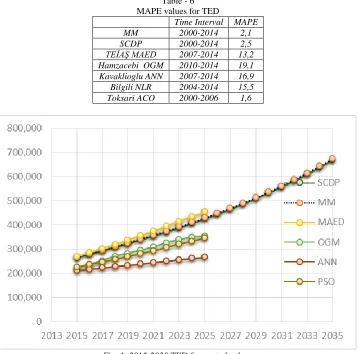
The second kind of data will be estimated using a mathematical model, the annual total energy demand. Up to 2014 GDP, population, energy data has been used to create a mathematical model. This equation is given below.
439.586,38 61,608
) (b 7,676 ) (b
f(x) 2 3 (8)
Table - 6 MAPE values for TED
Time Interval MAPE
MM 2000-2014 2,1
SCDP 2000-2014 2,5
TEİAŞ MAED 2007-2014 13,2 Hamzacebi OGM 2010-2014 19,1 Kavaklioglu ANN 2007-2014 16,9 Bilgili NLR 2004-2014 15,5 Toksari ACO 2000-2006 1,6
Fig. 1: 2015-2035 TED forecasted values
Dynamic programming with respect to time can be performed forecasting problem solving. The coefficients proposed new algorithm makes it possible to intervene following are available to improve the accuracy of these solutions. This coefficient should be able to estimate the socio-economic situation of the region made a very good level of analysis. Proposed dynamic programming algorithm with special coefficients solution method was developed. Load forecasting problem is solved with SCDP given below.
1) Step 1 Start, read time-dependent variables (population, income, etc.) 2) Step 2 Calculate the rate of change of variable
3) Step 3 Determining the amount of activity 4) Step 4 Take the weight coefficients 5) Step 5 Calculate the energy consumption 6) Step 6 If n=last number then go to step 9, 7) Step 7 n=n+1, g oto step 2
8) Step 8 Compose consumption, stop.
The results obtained from a mathematical model for the years 2015-2035 are shown in Table 7. According to this table SCDP and MM gives results very close to MAED results. MAPE values were calculated for the forecast results and these values are shown in Table 8. Results of MAED model is taken as the base value for the MAPE value calculation.
Table - 7
Forecasted values for TED [GWh]
Year MM SCDP MAED
Table - 8
MAPE values comparison for 2015-2035 years. (Base value = MAED)
Method MM SCDP OGM ANN PSO
MAPE 3,82 2,87 17,8 32,2 20,5
V.
CONCLUSION
In this study; between 2015 and 2035 years, amount of the total annual energy consumed and the amount of energy consumed in peak days were forecasted. TEIAS and TSI data are used between the years 1999-2014. The data obtained from the estimates is compared with the other studies which have done using different methods. Comparison is made with many previous studies such as ANN, OGM, PSO and MAED. When examined the error rates of the proposed mathematical modeling, it’s clearly seen that it can be used in practice. According to these results, the GDP and population data revealed quite realistic results when used for mathematical models. The MAPE ratio of the MM and SCDP compared with other methods; MM gave a lower error value. MM and SCDP models, both in terms of practicality and to obtain more accurate results can be considered more advantageous.
REFERENCES
[1] Badran I, El-Zayyat H, Halasa G. Short-term and medium-term load forecasting for Jordan's power system. American Journal of Applied Sciences 2008; 5 (7): 763-768.
[2] Kermanshahi B, Iwamiya H. Up to year 2020 load forecasting using neural nets. Electrical Power & Energy Systems 2002; 24: 789-797. [3] Hamzacebi C. Forecasting of Turkey’s net electricity energy consumption on sectoral bases 2007. Energ Policy; 35: 2009-2016.
[4] Gupta A, Sarangi PK. Electrical load forecasting using genetic algorithm based back-propagation method. Journal of Engineering and Applied Sciences 2012; 7: 1017-1020.
[5] Ghods L, Kalantar M. Different methods of long-term electric load demand forecasting; a comprehensive review. Iranian Journal of Electrical & Electronic Engineering 2011; 7: 249-259.
[6] Sachdeva S, Singh M, Singh UP, Arora AS. Efficient load forecasting optimized by fuzzy programming and OFDM transmission. Advances in Fuzzy Systems 2011; 1-6.
[7] Akdemir B, Cetinkaya N. Long-term load forecasting based on adaptive neural fuzzy inference system using real energy data. Energy Procedia 2012; 14: 794-799.
[8] Kandil MS, El-Debeiky SM, Hasanien NE. Long-term load forecasting for fast developing utility using a knowledge-based expert system. Power Syst 2002; 17: 491-496.
[9] Al-Hamadi HM, Soliman SA. Long-term/mid-term electric load forecasting based on short-term correlation and annual growth. Electr Pow Syst Res 2005; 74: 353–361.
[10] Ghods L, Kalantar M. Methods for long-term electric load demand forecasting; a comprehensive investigation. IEEE International Conference on Industrial Technology; 21-24 April 2008; Chengdu, China. IEEE. pp. 1-4.
[11] Ediger V, Tatlidil H. Forecasting the primary energy demand in Turkey and analysis of cyclic patterns. Energ Convers Manage 2002; 43: 473-487. [12] Canyurt OE, Ceylan H, Ozturk HK, Hepbasli A. Energy demand estimation based on two-different genetic algorithm approaches. Energ Source 2004; 26:
1313–20.
[13] Ozturk HK, Ceylan H, Canyurt OE, Hepbasli A. Electricity estimation using genetic algorithm approach: a case study of Turkey. Energy 2005; 30: 1003– 12.
[14] Sozen A, Arcaklioglu E, Ozkaymak M. Turkey’s net energy consumption. Appl Energ 2005; 81:209–21.
[15] Tunc M, Camdali U, Parmaksizoglu C. Comparison of Turkey’s electrical energy consumption and production with some European countries and optimization of future electrical power supply investments in Turkey. Energ Policy 2006; 34:50–9.
[16] Sozen A, Arcaklioglu E. Prospects for future projections of the basic energy sources in Turkey. Energ Source 2007; 2: 183–201.
[17] Erdogdu E. Electricity demand analysis using co-integration and ARIMA modelling: a case study of Turkey. Energ Policy 2007;35:1129–46 [18] Akay D, Atak M. Grey prediction with rolling mechanism for electricity demand forecasting of Turkey. Energy 2007; 32:1670–5.
[19] Toksari MD. Ant colony optimization approach to estimate energy demand of Turkey. Energ Policy 2007; 3: 3984–90.
[20] Sozen A, Arcaklioglu E. Prediction of net energy consumption based on economic indicators (GNP and GDP) in Turkey. Energ Policy 2007; 35: 4981–92. [21] Unler A. Improvement of energy demand forecasts using swarm intelligence: the case of Turkey with projections to 2025. Energ Policy 2008; 36: 1937–44. [22] Kavaklioglu K, Ceylan H, Ozturk HK, Canyurt OE. Modeling and prediction of Turkey’s electricity consumption using Artificial Neural Networks. Energ
Convers Manage 2009;50:2719.
[23] Kucukali S, Baris K. Turkey’s short-term gross annual electricity demand forecast by fuzzy logic approach. Energ Policy 2010; 38:2438–45.