ISSN (e): 2250-3021, ISSN (p): 2278-8719
Vol. 06, Issue 06 (June. 2016), ||V2|| PP 46-53
Hybrid Artificial Intelligence Based on Evolutionary Approach in
Optimizing Multiple Resources of Projects
Thi Minh-Truc Huynh
1, Duc-Hoc Tran
1*, Thi Thao-Nguyen Nguyen
1,
Quynh-Chau Truong
11
(Faculty of Project Management, The University of Da Nang-University of Science and Technology, 54 Nguyen Luong Bang Rd, DaNang, VietNam)
*Email: [email protected]
Abstract:
-
Resource leveling problems are attractive and important part of construction project planning. Resource leveling is the process used within project scheduling to reduce fluctuations in resource usage over the period of project implementation. This study presents a new hybrid intelligence model, named as Artificial Bee Colony with Differential Evolution, to handle the multiple resources leveling in multiple projects problems (ABCDE-MRLMP). The proposed algorithm integrates crossover operation from differential evolution (DE) with original artificial bee colony (ABC) to balance exploration and exploitation phase of the optimization process. The ABCDE-MRLMP algorithm is compared with benchmark algorithms considered and previous findings using two construction case studies. The experimental results demonstrate the efficiency and effectiveness of the proposed model. The ABCDE-MRLMP is a promising alternative approach to handling resource leveling project scheduling problems.Keywords: -
Multiple resources levelling, Scheduling, Artificial Bee Colony, Optimization, Differential Evolution, Construction management.I.
INTRODUCTION
The process of smoothing out resources, known as resource levelling, has been studied extensively [1-4]. Resource levelling attempts to minimize both the demand peak and the fluctuations in the pattern of resource usage [5] by optimizing noncritical activities within their available floats while keeping the project duration unchanged. Research on resource levelling has focused mainly on three aspects: (1) single-resource levelling in project scheduling [6], (2) multiple-resource levelling in project scheduling [7], and (3) single-resource levelling in multiple-project scheduling. However, multiple-single-resource levelling in multiple-project scheduling (MRLMP) is the most typical scenario in the construction and manufacturing industries, a situation that is relatively more complex and difficult to solve and that lacks a standard handling procedure [8, 9]. Thus, developing a more efficient optimization algorithm for MRLMP problems and to attain better resource levelling problem solutions are essential to improving the management of construction project resources.
The application of Evolutionary Algorithms (EAs) to resource levelling has attracted increasing attention in recent years [10, 11]. Based on the principles of natural evolution, EAs are stochastic optimization techniques that have successfully resolved optimization problems in diverse fields [12]. However, EAs suffer from certain weaknesses. Geng, Weng [10] identified premature convergence and poor exploitation as the main obstacles preventing EAs from coping effectively with complex optimization problems. Thus, developing a methodology for multiple-resource levelling in multiple-project problems and a more efficient algorithm to attain better resource levelling problem solutions are essential to improving the management of construction project resources.
bees. This characteristic makes ABC good at exploration but poor at exploitation and thus inadequate for problems that must apply existing information to find a better solution. Additionally, ABC converges relatively slowly for certain complex issues [18].
Although meta-heuristic methods have been proven to have superior features than other traditional methods, they also suffer some limitations. In addition, numerous researchers have found that a skilled combination of two meta-heuristics may be beneficial and perform significantly better than single pure meta-heuristic algorithm in handling real-world and large-scale problems [19-22]. Therefore, hybridization with other algorithms offers the potential to further improve the performances of ABC and DE. The superior performance of hybridized ABC and DE over other algorithms in engineering problems have been widely reported and verified [18]. An extensive review of the literature done for this study found that many reports of impressive hybridized ABC-DE performance in benchmark functions and practical applications, however, this algorithm has yet to be applied to solving the resource levelling problem. Therefore, this paper applies the hybridized ABC-DE algorithm in a model that is designed to solve the MRLMP problems problem.
The remainder of this paper is organized as follows: Section 2 describes the multiple resources levelling in the multiple projects problem. Section 3 provides a detailed description of the proposed algorithm for the resource levelling problem. Section 4 uses two numerical case studies to demonstrate model performance. The final section presents conclusions and suggests directions for future work.
II.
PROBLEM
FORMULATION
An enterprise consists of total of n projects. Each project includes multiple activities and each activity uses
p resources. Symbols used in related formulas include: the set of activities in the project k is {(ik, jk)} = {Ak, …,
Zk}; Rm(t) is the demand for resource m by all n projects on day t; Rmt(ik, jk) is the demand for resource m by activity (ik, jk) on day t; Rm(ik, jk) is the demand for resource m by activity (ik, jk) on one day. TE(ik, jk), TL(ik, jk),
TS(ik, jk), TF(ik, jk), T(ik, jk), S(ik, jk) represent early start time, late start time, actual start time, actual finish time, duration, and slack time of (ik, jk), respectively. The precedence set of activity (ik, jk) is {(psetk, ik)}. Multiple-resource levelling in multiple-project scheduling differs from conventional Multiple-resource levelling techniques primarily as follows [8]:
Firstly, due to differing levels of resource demand, assimilation must transform absolute demand into relative demand in order to enable all the p resources to be comparable in terms of quantity. The relative demand of resource m in all n projects on day t may be expressed as:
m a x
( ) ( ) / m
m m
S R t R t R (1)
where Rmaxm = max{Rm(t)} denotes the maximum demand for resource m in total n projects on one day and λ is an amplifying coefficient within [1,100] used to increase simulation accuracy. The above formula limits the relative demand for each resource in a total of n projects on every single day to between 0 and λ.
Secondly, the weight score wm measures the degree of importance for each resource. This paper uses the analytical hierarchy process (AHP) to obtain the weights of different resources. Larger weight scores correlate to greater priority.
The mathematical formulation of the objective function for multiple-resource levelling in multiple-projects scheduling is:
2
1 1
1
( ( ) )
p T
m m m
t m
M in R I w S R t S R
T
(2)subject to:
( , ) ( , ) ( , )
E k k s k k L k k
T i j T i j T i j (3)
m a x { ( , ) ( , )} ( , ) ( , )
s k k s k k s k k L k k
T p s e t i T p s e t i T i j T i j (4)
1 , 1
1
R ( t) ( , ) ; ( )
k k
n T
m m t k k m m
k i j t
R i j S R S R t
T
(5)( , ) : ( , ) ( , ) ( , )
0 : ( , ) ( , )
m k k s k k f k k
m t k k
s k k f k k
R i j if T i j t T i j
R i j
if t T i j o r t T i j
(6)
(k, k) L(k, k) E(k, k)
where T is equal to the difference between the maximum of the latest finish time and the minimum of the earliest start time for all n projects.
III.
THE
HYBRID
ARTIFICIAL
BEE
COLONY
WITH
DIFFERENTIAL
EVOLUTION
FOR
MULTIPLE
RESOURCES
LEVELING
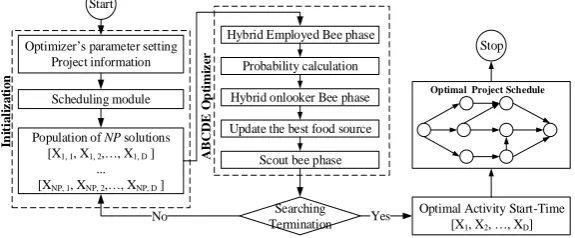
This section describes the newly proposed ABCDE optimization algorithm in detail. The ABCDE is the core optimizer in the ABCDE-MRLMP model. Fig. 1 shows the overall operational architecture of the proposed algorithm.
Population of NP solutions [X1, 1, X1, 2, , X1, D ]
... [XNP, 1, XNP, 2, , XNP, D ]
No TerminationSearching Optimal Activity Start-Time[X
1, X2, , XD] Hybrid Employed Bee phase
Probability calculation
Hybrid onlooker Bee phase
Scout bee phase
A
B
C
D
E
O
p
ti
m
iz
er
Optimizer s parameter setting Project information
Scheduling module
Update the best food source
Optimal Project Schedule
In
it
ia
li
z
a
ti
o
n
Yes Start
Stop
Fig. 1 Flowchart for the ABCDE-MRLMP
Inputs required by the ABCDE-MRLMP optimization model include activity relationship, activity duration, and resource demand. In addition, the user must provide search engine parameter settings such as maximum number of search generations Gmax and population size (NP). The scheduling procedure uses these inputs in the calculation process to obtain the project duration and resource amount required for each activity. The model operates automatically.
Before starting the search process, a uniform random generator creates an initial population of feasible solutions. A solution for the resource levelling problem is represented as a vector with D elements as follows:
,1 , 2 , [ i , i , ..., i D]
X X X X (8)
where D is the number of decision variables in the problem at hand. D is also the number of non-critical activities in the project network. The index i denotes the ith individual in the population. The vector X represents the start time of D non-critical activities in the network. Because the original DE operates with real-value variables, a function is employed to convert the start times of those activities from real values to integer values that are constrained within the feasible domain.
, ( ( ) [ 0 ,1] ( ( ) ( ))) i j
X R o u n d L B j r a n d U B j L B j (9)
where Xi,j is the start time of activity j at the individual ith. rand[0,1] denotes a uniformly distributed random number between 0 and 1. LB(j) and UB(j) are the early start time and late start time for activity j. In multiple resources levelling in the multiple projects scheduling problem, two constraint conditions limit the actual start time of all activities: (1) actual start time must be between the early and late start times and (2) actual start time is limited by the actual start time of its predecessor activities. The first constraint is simple to handle because limits are fixed prior to calculation. However, the minimum limit of the second constraint is unknown prior to calculation and thus more difficult to elicit. For the decision variables of ABCDE on each dimension is determined in turn, when calculating the actual start time of one activity, actual start time of all activities in its predecessor set TS(psetk, ik) have been computed, the max{TS(psetk, ik)+ T(psetk, ik)} has been confirmed simultaneously.
3.1 Hybrid employed bee phase
The DE crossover-mutation operators mutates the population to produce a set of mutant vectors. A mutated
vector G 1 i
V is created using equation ViG1 XrG1 F(XrG2 XrG3) that corresponds to the target vectorViG. The
1 , 1 ,
,
( [ 0 , 1)
1, 2 , ...,
G
i j j r a n d
G
i j G
i j
v if r a n d C R o r j j
u j D
x o th e r w is e
(10)
3.2 Probability calculation
Employed bees return to their hive and share food source information with onlooker bees. The information sharing stage of the ABCDE algorithm generates collective intelligence. The probability value influences the behaviour of onlooker bees, which select food sources based on probability. The probability value is calculated as:
0 .9 * ( ) / m a x ( ( )) 0 .1
i i i
P F it X F it X (11)
where Fit(Xi) is the fitness value of the ith solution (food source).
3.3 Hybrid onlooker bee phase
An onlooker bee selects a food source depending on the probability value Pi associated with that food source. ABCDE produces an onlooker bee by using Eq. (10). After evaluating the nectar amount of possible new position, the greedy selection is applied and the onlooker bee either updates the new position by removing or retaining the old solution.
3.4 Update the best food source position
The best food source position is updated after termination of the onlooker bee phase. A new best food source position replaces the old if the former provides an equal or better amount of nectar. Otherwise, the old remains valid.
3.5 Scout bee phase
If food source Xi,j (solution Xi,j) shows no improvement further through a continuous pre-determined number of cycles, then the food source abandoned by its bee is replaced with a new food source discovered by the scout bee, Eq. (9).
3.6 Stopping condition
The optimization process terminates when the user-designated stopping criterion is met. Termination of the optimization process presents the final optimal solution to the user.
IV.
CASE
STUDIES
Two case studies adapted from Guo, Li [8] was used to demonstrate the capability of the newly developed ABCDE-MRLMP model. The first case consists of two projects with same duration needing to be started simultaneously in an enterprise. Each activity in both projects uses three resources (R1 human, R2 fund, R3 equipment), and the importance of each resource is set as w1=0.637, w2=0.258, w3=0.105, respectively. The second case includes two projects with different durations and starting day. Every activity in example 2 uses two resources (R1 human, R2 fund), and the importance of R1 is the same as the importance of R2, w1=w2=0.5. In both case studies, each activity has a certain duration D that is indicated above the arrow line. Fig. 2 and Fig. 3 show the precedence relationships of the network projects in both cases, respectively.
a) Network of Project 1, Case 1
1 2 3 4 5 6 7 8 9 10 11 12 13
1
14 15 16 17 18
2 3 4 5 6 7 8 10 9 11
A1(2/8/4/6)
B1(2/7/2/5) C1(1/6/3/5)
F1(3/7/3/4)
H1(2/14/5/10)
I1(4/18/3/3)
G1(1/4/2/3)
D1(4/20/4/8) E1(2/7/2/5) J1(3/15/2/5)
0
Time (R1/R2/R3/D)
b) Network of Project 2, Case 1 1
0 1 2 3 4 5 6 7 8 9 10 11 12 13 14 15 16 17 18
2 3 5 7 8 6 9 10
A2(4/10/4/4)
E2(2/5/3/5)
D2(3/7/3/4)
C2(5/20/5/3)
H2(4/16/4/5)
G2(4/12/3/3)
B2(2/6/3/5) F2(4/13/5/3) I2(2/8/3/5) 4
Time (R1/R2/R3/D)
Fig. 2 Networks of two projects-Case 1
b) Network of Project 2, Case 2
2 3 4 5 6 7 8 9 10 11 12 13
1
14 15 16
2
4 3
6
7 8
A2(5/15/3)
C2(4/22/4)
E2(3/12/4)
B2(4/8/4) D2(2/7/4) G2(8/20/5)
Time (R1/R2/D)
5 F2(3/5/5)
17 18 19 20
a) Network of Project 1, Case 2
1 2 3 4 5 6 7 8 9 10 11 12 13
1
14 15 16
2
3 4
5
7 8
9 10
A1(3/10/5)
B1(3/16/4) C1(8/8/4)
G1(4/12/3)
F1(2/16/6)
D1(6/8/4) E1(7/13/4) I1(1/6/2)
0
Time (R1/R2/D)
6
Fig. 1 Networks of two projects-Case 2
Consequently, the objective functions for both case studies are calculated as follows:
Case1:
2 1 8
1 1
2 2
1 2 2 3 3
0 .6 3 7 ( ( ) ( ) ) 1
m in
1 8t 0 .2 5 8 ( ( ) ( ) ) 0 .1 0 5 ( ( ) ( ) )
S R t S R t
R I
S R t S R t S R t S R t
s.t 1 1
1 1 1
1 1 1
1 2
2 2
2 2
0 ( ) 7 0 ( ) 6
0 ( ) 3 ( ) 4 ( ) 1 0
( ) 5 ( ) 8 0 ( ) 3
0 ( ) 1 5 5 ( ) 9
0 ( ) 9 5 ( ) 7
0 ( ) 1 5 5 ( ) 1 3
s s
s s s
s s s
s s
s s
s s
T A T F
T B T B T G
T B T C T H
T I T D
T A T G
T C T H
Case 2: 2 0 2 2
1 1 2 2
1 1
m i n 0 .5 ( ( ) ( ) ) 0 .5 ( ( ) ( ) ) 2 0t
R I S R t S R t S R t S R t
s.t
1 1 1
1 1
1 2
2 2
0 ( ) 1 1 ( ) 4 ( ) 1 0
0 ( ) 6 0 ( ) 5
8 ( ) 1 3 5 ( ) 1 1
2 ( ) 1 7 5 ( ) 1 6
s s s
s s
s s
s s
T A T B T C
T B T G
T H T C
T A T E
4.1 Optimization result of ABCDE-MRLMP
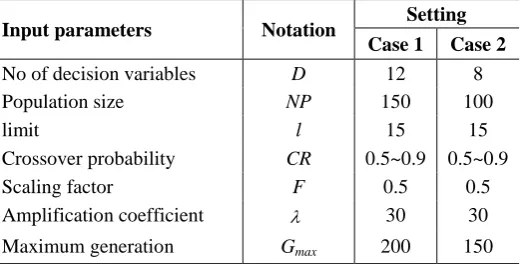
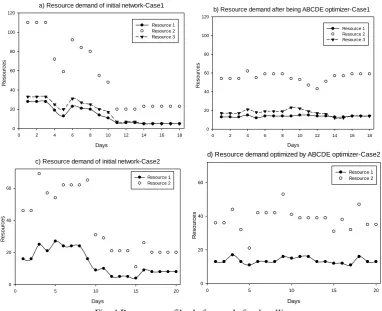
Application of the ABCDE -MRLMP model significantly reduces fluctuation in resource use. This study used parameters for the ABCDE optimizer based on proposed values from the literature and several experiments as shown in Table 1. Fig. 4 shows the network resource profile for the projects at initialization and after levelling using ABCDE-MRLMP optimization.
Table 1 Parameter settings for ABCDE-MRLMP
Input parameters Notation Setting
Case 1 Case 2
No of decision variables D 12 8 Population size NP 150 100
limit l 15 15
Crossover probability CR 0.5~0.9 0.5~0.9 Scaling factor F 0.5 0.5 Amplification coefficient 30 30
Maximum generation Gmax 200 150
Table 2 and Table 3 lists the optimal results, i.e. optimal non-critical-activity start times obtained from proposed model and other benchmark algorithms on case 1 and case 2, respectively. RIm in Table 2 and Table 3 is the resource intensity for single resource m.
In the first case, the optimal resource intensity (RI) obtained by ABCDE-MRLMP was 94.9%, 2.0%, 2.0%, 6.9%, 14.4% less than the initial schedule, ABC, DE, PSO, and GA, respectively as shown in Table 2. In the second case, the RI obtained by proposed model was 84.3% better than the initial schedule.
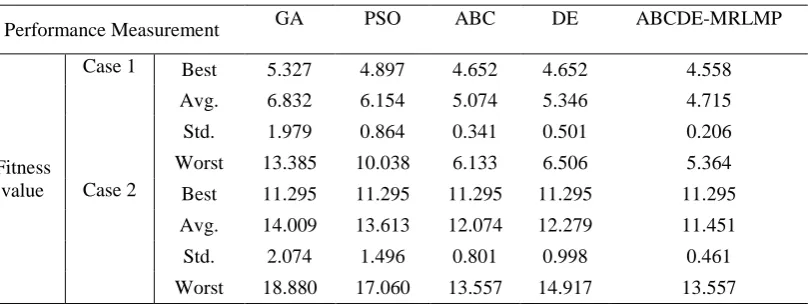
To evaluate the stability and accuracy of each algorithm, optimization performance was expressed in terms of best result found (best), average result (avg), standard deviation (std), and worst result (worst) after 30 runs (Table 4). The best and worst results demonstrate the capacity of each algorithm to find the optimal solution for all of the performance measurement metrics. Average and standard deviation are two additional characteristics that describe solution quality. Standard deviation occurs in cases when algorithms are not able to generate optimal solutions in all executions.
value of 0.206 in case 1 and obtained the lowest fitness solution with a value of 11.451 and the smallest deviation value of 0.461 in case 2.
a) Resource demand of initial network-Case1
Days
0 2 4 6 8 10 12 14 16 18
R
e
s
o
u
rc
e
s
0 20 40 60 80 100 120
Resource 1 Resource 2 Resource 3
b) Resource demand after being ABCDE optimizer-Case1
Days
0 2 4 6 8 10 12 14 16 18
R
e
s
o
u
rc
e
s
0 20 40 60 80 100 120
Resource 1 Resource 2 Resource 3
c) Resource demand of initial network-Case2
Days
0 5 10 15 20
R
e
s
o
u
rc
e
s
0 20 40 60
Resource 1 Resource 2
d) Resource demand optimized by ABCDE optimizer-Case2
Days
0 5 10 15 20
R
e
s
o
u
rc
e
s
0 20 40 60
Resource 1 Resource 2
Fig. 4 Resource profiles before and after levelling
Table 2 Comparison of best performance for algorithms on case 1
Items RI RI1 RI2 RI3
Actual start time of non-critical activities
A1 B1 C1 F1 G1 H1 I1 A2 C2 D2 G2 H2
Initial 89.46 76.95 1169 123.8 0 0 5 0 4 0 0 0 0 5 5 5
GA 5.327 1.06 13.76 9.17 0 3 8 0 9 0 15 8 12 9 6 13
PSO 4.897 0.84 26.65 7.95 0 0 8 6 10 3 12 0 15 8 5 13
DE 4.652 0.84 21.97 5.73 0 3 9 0 10 0 12 8 15 9 6 13
ABC 4.652 0.84 21.97 5.73 0 3 9 0 10 0 12 8 15 9 6 13
ABCDE-MRLMP 4.558 0.62 21.31 9.51 3 0 8 0 8 0 12 8 15 9 5 13
Note that RI is resource intensity.
Table 3 Comparison of best performance for algorithms on case 2
Items RI RI1 RI2 Actual start time of non-critical activities A1 B1 C1 G1 H1 A2 C2 E2
Initial 71.70 60.04 366.43 0 0 5 0 4 0 0 0
GA, PSO, DE, ABC,
Table 4 Comparison of results for the ABCDE-MRLMP and benchmarked algorithms
Performance Measurement GA PSO ABC DE ABCDE-MRLMP
Fitness value
Case 1 Best 5.327 4.897 4.652 4.652 4.558
Avg. 6.832 6.154 5.074 5.346 4.715
Std. 1.979 0.864 0.341 0.501 0.206
Worst 13.385 10.038 6.133 6.506 5.364 Case 2 Best 11.295 11.295 11.295 11.295 11.295
Avg. 14.009 13.613 12.074 12.279 11.451
Std. 2.074 1.496 0.801 0.998 0.461
Worst 18.880 17.060 13.557 14.917 13.557
Note that Avg. is average, Std. is standard deviation.
V.
CONCLUSION
This paper uses ABCDE to solve the problem of resource levelling in the context of multiple-projects scheduling. The proposed algorithm integrates crossover operations from differential evolution (DE) with the original artificial bee colony (ABC) in order to balance the exploration and exploitation phases of the optimization process. Hybrid algorithm ABCDE has better global search ability and local search ability than original ABC and DE algorithms. Two application cases are analyzed to illustrate the effectiveness of the proposed model and to demonstrate the capabilities of the model in generating an optimal schedule that eliminates undesirable resource fluctuations and resource idle times. Experimental results and a comparison of results indicate that the ABCDE-MRLMP effectively improves the performance of the original ABC and DE beyond the levels of performance attained by other benchmark algorithms.
The ABCDE has broad application potential because the model is easily modifiable for solving many other classes of single-objective optimization problems in the construction management field such as resource-allocation and resource-constrained problems.
ACKNOWLEDGEMENTS
The authors wish to acknowledge the University of Science and Technology-The University of Da Nang (DUT) for financially supporting this work. Appreciation is also expressed to Faculty of Project Management’s research group at DUT for assistance provided during this investigation. Finally, the authors would like to thank anonymous referees for their valuable comments.
REFERENCES
[1] Savin, D., S. Alkass, and P. Fazio, Construction resouce leveling based using neural networks. Can. J. Civ. Engrg., 23(3), 917-925, 1996.
[2] Son, J. and M.J. Skibniewski, Multiheuristic Approach for Resource Leveling Problem in Construction Engineering: Hybrid Approach. Vol. 125. 1999: ASCE. 23-31.
[3] Doulabi, S.H.H., A. Seifi, and S.Y. Shariat, Efficient Hybrid Genetic Algorithm for Resource Leveling via Activity Splitting. Vol. 137. 2011: ASCE. 137-146.
[4] Gather, T., J. Zimmermann, and J.-H. Bartels, Exact methods for the resource levelling problem. Journal of Scheduling, 2011. 14(6): p. 557-569.
[5] Yan, L., et al. Optimization of resource allocation in construction using genetic algorithms. in Machine Learning and Cybernetics, 2005. Proceedings of 2005 International Conference on. 2005.
[6] Damci, A. and G. Polat, Impacts of different objective functions on resource leveling in construction projects: a case study. Journal of Civil Engineering and Management, 2014. 20(4): p. 1-11.
[7] Ponz-Tienda, J.L., et al., The Resource Leveling Problem with multiple resources using an adaptive genetic algorithm. Automation in Construction, 2013. 29(0): p. 161-172.
[9] Woodworth, B.M. and C.J. Willie, A Heuristic Algorithm For Resource Leveling in Project, Multi-Resource Scheduling. Decision Sciences, 1975. 6(3): p. 525-540.
[10] Geng, J.-q., L.-p. Weng, and S.-h. Liu, An improved ant colony optimization algorithm for nonlinear resource-leveling problems. Computers & Mathematics with Applications, 2011. 61(8): p. 2300-2305. [11] Leu, S.-S., C.-H. Yang, and J.-C. Huang, Resource leveling in construction by genetic algorithm-based
optimization and its decision support system application. Automation in Construction, 2000. 10(1): p. 27-41. [12] Das, S. and P.N. Suganthan, Differential Evolution: A Survey of the State-of-the-Art. IEEE Transactions on
Evolutionary Computation, 2011. 15(1): p. 4-31.
[13] Storn, R.M. and K. Price, Differential Evolution - A Simple and Efficient Heuristic for Global Optimization over Continuous Spaces. Journal of Global Optimization, 1997. 11: p. 341–359.
[14] Mohamed, A.W., RDEL: Restart Differential Evolution algorithm with Local Search Mutation for global numerical optimization. Egyptian Informatics Journal, 2014. 15(3): p. 175-188.
[15] Mohamed, A.W., H.Z. Sabry, and T. Abd-Elaziz, Real parameter optimization by an effective differential evolution algorithm. Egyptian Informatics Journal, 2013. 14(1): p. 37-53.
[16] Karaboga, D. and B. Basturk, A powerful and efficient algorithm for numerical function optimization: artificial bee colony (ABC) algorithm. Journal of Global Optimization, 2007. 39(3): p. 459-471.
[17] Karaboga, D. and B. Akay, A comparative study of Artificial Bee Colony algorithm. Applied Mathematics and Computation, 2009. 214(1): p. 108-132.
[18] Li, Y., Y. Wang, and B. Li, A hybrid artificial bee colony assisted differential evolution algorithm for optimal reactive power flow. International Journal of Electrical Power & Energy Systems, 2013. 52(0): p. 25-33. [19] Li, X. and M. Yin, Hybrid differential evolution with artificial bee colony and its application for design of a
reconfigurable antenna array with discrete phase shifters. Microwaves, Antennas & Propagation, IET, 2012. 6(14): p. 1573-1582.
[20] Bettemir, Ö. and R. Sonmez, Hybrid Genetic Algorithm with Simulated Annealing for Resource-Constrained Project Scheduling. Journal of Management in Engineering, 2014: p. 04014082.
[21] Mohammadi, H.R. and A. Akhavan, Parameter Estimation of Three-Phase Induction Motor Using Hybrid of Genetic Algorithm and Particle Swarm Optimization. Journal of Engineering, 2014. 2014: p. 6.
[22] J.Jithendranath and K.H. Reddy, Differential Evolution approach to Optimal Reactive Power Dispatch with Voltage Stability enhancement by Modal Analysis. International Journal of Engineering Research and Applications, 2013. 3(4): p. 66-70.
[23] Price, K.V., R.M. Storn, and J.A. Lampinen, Differential Evolution A Practical Approach to Global Optimization. 2005: Springer-Verlag Berlin Heidelberg.
[24] Karaboga, D. and B. Basturk, On the performance of artificial bee colony (ABC) algorithm. Applied Soft Computing, 2008. 8(1): p. 687-697.