Abstract—A mobile ad hoc network (MANET) is characterized by its dynamic and decentralized topology, which allows exchanging information between mobile nodes without any pre existing telecommunications infrastructure. However, mobile devices have constrained resources like memory, energy, bandwidth, etc., that must be optimally used in situations where a MANET is needed. For that reason, we propose a greener method for content sharing in MANETs that reduces energy consumption of nodes. We evaluate our m
simulations using J-Sim environment. Simulation results show that our method uses more efficiently the nodes resour
centralized content sharing technique.
Key words—collaborative content retrieval
distribution, J-Sim, mobile ad hoc network, node category.
I. INTRODUCTION
OWADAYS, portable and mobile devices are very common in our lives. Due to the technological convergence, those devices integrate several wireless technologies like Bluetooth, WiFi, GSM, HDSPA, etc. which allow connectivity almost anywhere. However, it is necessary
to maintain such connectivity even where no
telecommunications infrastructure exists, so that users can keep connected and exchanging information[1]
Mobile ad hoc networks give a solution to that necessity, although with constraints. These constraints are
limitations of the physical resources of the network elements (users devices). So, how to use efficiently the network resources in such environments? How to allow users
contents through their devices with less energy consumption? Trying to answer these questions, we propose a collaborative method for content sharing in mobile ad hoc networks for reducing memory usage, processing time and bandwidth throughput on network elements. The less an element uses those resources, the less energy consumption an element has. That is why we call our method greener, compared to a centralized content sharing procedure.
Thus, this paper is organized as follows: we briefly introduce some concepts on ad hoc networking and the used
1
J. E. Ortiz, Ph. D. (c) in Systems and Computing Engineering, M. Sc. in Telecommunications Engineering, M. Sc. in Statistics, Universidad Nacional de Colombia. He is assistant professor of the Department of Systems and Industrial Engineering, Universidad Nacional de Colombia, Bogota
2 M Florez, PhD. in Telecommunications Engineering, Universidad Nacional
Colombia. He is Associated Professor of the Department of Systems and Industrial Engineering, Universidad Nacional de Colombia, Bogota
A Method for Collaborative Distribution and
Retrieval of
Jorge E. Ortiz T
N
117506-8989 IJECS-IJENS © December 2011 IJENS
A mobile ad hoc network (MANET) is characterized by its dynamic and decentralized topology, which allows information between mobile nodes without any pre-existing telecommunications infrastructure. However, mobile devices have constrained resources like memory, energy, bandwidth, etc., that must be optimally used in situations where a t reason, we propose a greener method for content sharing in MANETs that reduces energy consumption of nodes. We evaluate our method through Sim environment. Simulation results show that our method uses more efficiently the nodes resources than a
content retrieval, content
Sim, mobile ad hoc network, node category.
portable and mobile devices are very common in our lives. Due to the technological convergence, those devices integrate several wireless technologies like Bluetooth, WiFi, GSM, HDSPA, etc. which allow connectivity almost anywhere. However, it is necessary
to maintain such connectivity even where no
telecommunications infrastructure exists, so that users can [1].
Mobile ad hoc networks give a solution to that necessity, although with constraints. These constraints are related to the limitations of the physical resources of the network elements (users devices). So, how to use efficiently the network resources in such environments? How to allow users to share contents through their devices with less energy consumption?
Trying to answer these questions, we propose a collaborative method for content sharing in mobile ad hoc networks for reducing memory usage, processing time and bandwidth throughput on network elements. The less an ment uses those resources, the less energy consumption an element has. That is why we call our method greener, compared to a centralized content sharing procedure.
follows: we briefly introduce some concepts on ad hoc networking and the used
J. E. Ortiz, Ph. D. (c) in Systems and Computing Engineering, M. Sc. in Telecommunications Engineering, M. Sc. in Statistics, Universidad Nacional de He is assistant professor of the Department of Systems and Industrial Engineering, Universidad Nacional de Colombia, Bogota – Colombia (e-mail: M Florez, PhD. in Telecommunications Engineering, Universidad Nacional de Colombia. He is Associated Professor of the Department of Systems and Industrial Engineering, Universidad Nacional de Colombia, Bogota – Colombia (e-mail:
simulation environment J-Sim; the second section describes our proposed method; in section III,
simulation scheme; sections IV and V
results of our method; and, at the end, we present some conclusions and recommendations for future work.
A. Mobile Ad Hoc Networks
An ad hoc network is a wireless network that forms temporally, without any pre-existing or centralized infrastructure, to exchange information between its nodes Nodes (i.e., network elements) have routing capabilities and they may be either static or mobile.
network is arbitrary self-organized due to the mobility of the nodes which, generally, move randomly
with such a behavior is known as MANET (Mobile Ad hoc NETwork)[5].
There are many circumstances where MANETs are suitable[6]. For example, people that want to share information with others through their mobile devices in spaces where signal power of cellular service or WLAN is very weak[7]. In those cases, an isolated MANET may be built via certain wireless interfaces like Bluetoth or WiFi, without any centralized control element[8], Fig. 1
could be a coverage-extended network through multi routing of mobile nodes. As shown in Fig. 1
a gateway extending the coverage o to node B and node C[9], [10].
A Method for Collaborative Distribution and
of Information in MANETs
Jorge E. Ortiz T
1., Mauro Florez Calderón
2.
Fig. 1.Operation modes of a MANET: (a) isolated mode; to other networks through gateway nodes.
Node A NodeB NodeE
Node A
Wireless Acess Point (a)
(b)
Sim; the second section describes our proposed method; in section III, we explain the designed and V expose the simulation results of our method; and, at the end, we present some conclusions and recommendations for future work.
network is a wireless network that forms existing or centralized ange information between its nodes[2]. network elements) have routing capabilities and they may be either static or mobile. With mobile nodes, organized due to the mobility of the nodes which, generally, move randomly[3], [4]. A network with such a behavior is known as MANET (Mobile Ad hoc
There are many circumstances where MANETs are . For example, people that want to share information with others through their mobile devices in spaces where signal power of cellular service or WLAN is very . In those cases, an isolated MANET may be built via certain wireless interfaces like Bluetoth or WiFi, without any , Fig. 1(a). Another situation extended network through multi-hop le nodes. As shown in Fig. 1(b), node A acts as nding the coverage of the wireless access point
A Method for Collaborative Distribution and
ANETs
a) isolated mode; (b) interconnected B
Node C Node D
Node A
NodeB
International Journal of Electrical & Computer Sciences IJECS
B. MANETs Simulation in J-Sim
J-Sim (formerly known as JavaSim) is a simulation environment developed entirely in Java and based on Autonomous Component Arquitecture (ACA)
imitates the Integrated Circuit (IC) design architecture where components are defined in terms of contracts and can be individually designed, implemented, tested, and incrementally deployed in a software system. A system can be composed of individual components in the same way a hardware module is composed of IC chips. J-Sim also has a generalized packet switched network model for network modeling and simulation. That model defines the generic structure of a node and the generic network components that can be used as a base to implement customized components.
There are some advantages of J-Sim compared against other simulation packages, which were taken into account when we chose the simulation environment to test our method
• It is a free software package that includes many libraries and APIs to facilitate networks implementation.
• As Java-based environment, complex components and scalar networks are easily built through object
programming.
• J-Sim supports either discrete event simulation or real t simulation.
• It makes possible the simulation of semi
like files transfer between two different directories of the operating system through the designed simulator.
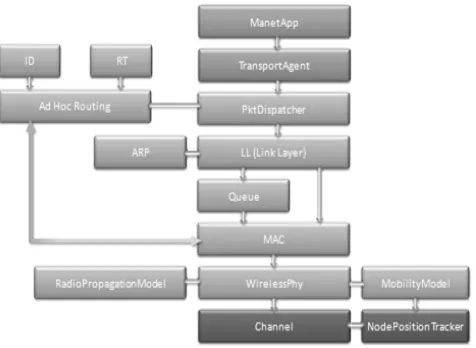
On the other hand, there is not a defined framework for MANETs simulation in J-Sim. For this reason, we suggest a general framework for MANET simulation as shown
which is based on a Wireless Sensor Network
framework proposed in [13], [14]. Most of the components on several layers are included either in the core or in the Wirel Extension packet of J-Sim. ManetApp would be the specific application for the designed MANET to be simulated. In this case, we implement our method as a component on the ManetApp layer.
Fig. 2.General structure of a MANET node for simulation in J
International Journal of Electrical & Computer Sciences IJECS-IJENS Vol: 11 No: 0
117506-8989 IJECS-IJENS © December 2011 IJENS Sim (formerly known as JavaSim) is a simulation
environment developed entirely in Java and based on Autonomous Component Arquitecture (ACA)[11]. The ACA imitates the Integrated Circuit (IC) design architecture where components are defined in terms of contracts and can be ividually designed, implemented, tested, and incrementally deployed in a software system. A system can be composed of individual components in the same way a hardware module is Sim also has a generalized packet el for network modeling and simulation. That model defines the generic structure of a node and the generic network components that can be used as a base
Sim compared against other on packages, which were taken into account when we
our method[12]:
e that includes many libraries and APIs to facilitate networks implementation.
based environment, complex components and scalar networks are easily built through object-oriented
Sim supports either discrete event simulation or real time
ossible the simulation of semi-real scenarios, like files transfer between two different directories of the operating system through the designed simulator.
On the other hand, there is not a defined framework for Sim. For this reason, we suggest a general framework for MANET simulation as shown in Fig. 2, which is based on a Wireless Sensor Network (WSN) . Most of the components on several layers are included either in the core or in the Wireless Sim. ManetApp would be the specific application for the designed MANET to be simulated. In this case, we implement our method as a component on the
II. PROPOSED M
The proposed method tries to relieve the critical
that MANET nodes face when they need to share information without any available infrastructure, using optimally their energy resources. Such a situation could be, for example, a rescue mission within a disaster area. The rescue workers may have mobile devices for communicating and sharing information each other throughout the mission.
have been proposed for similar situations
A. Considerations
For our proposed method, we take into account some considerations, as follows:
a) Each node in the MANET has a category t
its resources capability (processor, memory, bandwidth, battery autonomy, etc.) The higher resources capability a node has, the higher node category is.
b) The ID (or network address) of each node is related to its own category. High numbers of
categories.
c) Any required content (information item) is divided into portions.
d) Amount of portions that a node will contain, depends on node category.
e) Content portions are distributed following a probability model.
f) All the portions exist along de MANET, i.e., the retrieval of portions results in the recovery of entire content. g) There may be redundant copies of a portion within the
MANET, but not within a node.
B. Mathematical Model
According to consideration e), we have chosen the discrete geometric distribution as probability model for this work. The geometric density function is given by (1), where
a parameter and ∈ 1, 2, 3, … MANET[18].
1
The behavior of this function fits into the exposed considerations. However, due to MANET nodes are a finite quantity, we must modify the density function
function , so that the sum of all node probabilities (from node 1 to node ) lets be equal to 1 and, therefore, consideration f) is accomplished:
So, to make possible (2), we have rewritten the density function as a truncated density function:
General structure of a MANET node for simulation in J-Sim.
No: 06 28
I J E N S METHOD
The proposed method tries to relieve the critical situation that MANET nodes face when they need to share information without any available infrastructure, using optimally their energy resources. Such a situation could be, for example, a rescue mission within a disaster area. The rescue workers may obile devices for communicating and sharing information each other throughout the mission.Some methods situations, e.g.[15], [16], [17].
For our proposed method, we take into account some
Each node in the MANET has a category that depends on (processor, memory, bandwidth, battery autonomy, etc.) The higher resources capability a node has, the higher node category is.
The ID (or network address) of each node is related to its own category. High numbers of ID correspond to high
Any required content (information item) is divided into
Amount of portions that a node will contain, depends on
Content portions are distributed following a probability
st along de MANET, i.e., the retrieval of portions results in the recovery of entire content. There may be redundant copies of a portion within the MANET, but not within a node.
According to consideration e), we have chosen the discrete geometric distribution as probability model for this work. The ensity function is given by (1), where ∈ 0, 1 is represents nodes of the
1
The behavior of this function fits into the exposed erations. However, due to MANET nodes are a finite quantity, we must modify the density function into a new , so that the sum of all node probabilities (from ) lets be equal to 1 and, therefore,
1 2
So, to make possible (2), we have rewritten the density as a truncated density function:
117506-8989 IJECS-IJENS © December 2011 IJENS In (3),is the cumulative distribution function for the
-th element:
4
III. SIMULATION
We simulate our method by two stages. First stage is about portions distribution, which occurs after MANET creation. The second stage, portions retrieval, takes place when a node makes a content request.
A. Portions Distribution
Portions distribution implements mathematical model explained in section II-B. We use the inverse transform technique to generate random variables for geometric distribution function: a value from random variable with distribution , can be obtained generating a random number ~ U0, 1 and applying (5)[19], [20].
5
We assume that content is previously divided into $ portions, which have similar characteristics. Algorithm distributes portions one by one, in rising sort,$
1, 2, 3, … , % . Portions may be redundant with & copies. Each time the algorithm generates a valuefrom random variable , it allocates to node the copy & of portion %, denoted as ',(. Hence, is recalculated, as shown in (6), and afterwards
)',(*becomes 0. As a result, portions will not be redundant in a same node, as per consideration g).
1
)',(* 6
We want to make a remark regarding copies allocation: the actual number of a node to be allocated is ,, instead of , and it is given by (7). In this manner, the algorithm matches considerations b) and d).
, + 1 7
B. Portions Retrieval
Whenever a node , makes a content request, it carries the retrieval algorithm out. We assume that node , knows the total amount of portions$ and the portions that it has. Due to the quantity of portions that a node has depends on its ID, node, starts requesting portions to node, + 1, then node, +
2, then node , + 3, and so on. This procedure is executed until the retrieval of all portions is completed or until node is reached. If node is reached and the content is incomplete, node , continues requesting portions from node , 1to node 1 or until all portions are retrieved.
It could seem more suitable to start requesting portions from
node , which would have more portions, but we have considered recovering content in this collaborative way, so that nodes with high category get less busy. This consideration is very important, taking into account that those nodes could need their resources for performing special tasks within MANET because of their capabilities.
C. Simulation Scenarios
The general scenario for simulating our method has the following features:
• MANET with 33 nodes, 33
• Parameter 0.1 for portions distribution
• Node category just depends on node storage capacity
• Ad hoc routing protocol: GPSR
• Standard IEEE 802.11 on MAC layer
• Transport protocol: TCP
• Content type: image file (2.1 MB)
• Total content portions $ 480
• Node 1 makes the content request (the worst case since it would have less portions than other nodes)
Additionally, we use the file system to simulate a semi-real scenario, i.e., 33 directories act as nodes memory to store file portions. In this fashion, nodes transfer content portions from one directory to another through our J-Sim simulator. Files transfer is supported by a FTP component on ManetApp layer. We have designed several specific scenarios in order to test and compare our method. The first scenario simulates a centralized sharing procedure.Other specific scenarios are wholly based on the general simulation scenario but with variable number of portion copies&. Thus, we simulate the method when & 0 (no copies, only original portions), & 1 (one copy per portion), & 2 (two copies per portion) and
& 3 (three copies per portion).
IV. RESULTS
In this section, we show the obtained simulation results for each scenario. Basically, we focus on how portions are distributed among the 33 nodes and thethroughput onnode ,1 during portions retrieval. Node ,1 is the highest node that delivers portions before content recovery is completed.
A. Centralized Distribution and Retrieval
In this scenario, node 33 contains the entire content and there are no portions in the other nodes. Node 1 makes a content request directly to node ,1 33 and a single file is transferred.Node 33 transferred the complete content to node 1 in approximately 21 s. Fig. 3 depicts the results we obtained after simulating this scenario.
B. Proposed Method with & = 0
International Journal of Electrical & Computer Sciences IJECS
average, to node 1 in5.65 s.Fig. 4 shows the results of this simulation scenario.
C. Proposed Method with & = 1
For this scenario, ,1 32. This node transferred, on average, 14 portions to node 1, as shown in Fig. 5.
time after transfer was 1.58 s.
Fig. 3. Simulation results of centralized scenario: ( distributed per node. (b) Throughput on ,1 33
Fig. 4. Simulation results of proposed method with portions distributed per node. (b) Throughput on ,1 33 (a)
(b)
Node
(a)
(b)
Node
International Journal of Electrical & Computer Sciences IJECS-IJENS Vol: 11 No: 0
117506-8989 IJECS-IJENS © December 2011 IJENS Fig. 4 shows the results of this
. This node transferred, on as shown in Fig. 5. Elapsed
D. Proposed Method with & = 2
Node ,1 31delivered, on average, 4 portions to node 1 in about 0.46 s, Fig. 6.
E. Proposed Method with & = 3
This last simulation scenario gave as a result transferred from node ,1 30 to node 1 in 0.28 s, Fig. 7. (a) Average portions
Fig. 4. Simulation results of proposed method with & 0: (a) Average 33
Fig. 5.General structure of a MANET node for simulation in J Fig. 5. Simulation results of proposed method with portions distributed per node. (b) Throughput on
Fig. 6. Simulation results of proposed method with portions distributed per node. (b) Throughput on
Node (a)
(b)
(a)
(b)
Node
No: 06 30
I J E N S delivered, on average, 4 portions to node 1 in
ation scenario gave as a result 2 portions to node 1 in 0.28 s, Fig. 7. General structure of a MANET node for simulation in J-Sim. Fig. 5. Simulation results of proposed method with & 1: (a) Average
b) Throughput on ,1 32
Simulation results of proposed method with & 2: (a) Average b) Throughput on ,1 31
V. RESULTS ANALYSIS
There are some obtained data that we want to compare the values of bandwidth usage time for each scenario. These values are important because they determine the usage percentage of bandwidth resource with respect to centralized content sharing. Fig. 8 shows bandwidth usage comparison for each scenario.
As mentioned in section IV-A, with a centralized scenario, node 33 employed its bandwidth for about 21 s to deliver the entire content. With our collaborative method and
& 0, same node only needed 5.65 s for delivering last portions to node 1 in order to complete the content.
that node 33 used about 73% less its bandwidth for responding to a content request. Note that the worst case of our method is, precisely, when & 0.
Fig. 7. Simulation results of proposed method with portions distributed per node. (b) Throughput on ,1 30
Fig. 8.Bandwidth usage time in ,1 for different scenarios (a)
(b)
Node
Centralized
c = 0
c = 1
c
117506-8989 IJECS-IJENS © December 2011 IJENS e want to compare,like
for each scenario. These values are important because they determine the usage percentage of bandwidth resource with respect to centralized bandwidth usage time
A, with a centralized scenario, about 21 s to deliver the entire content. With our collaborative method and being
needed 5.65 s for delivering last portions to node 1 in order to complete the content. It means that node 33 used about 73% less its bandwidth for responding to a content request. Note that the worst case of our method is,
VI. CONCLUSIONS
We have exposed the benefits of our method and its advantages regarding the usage of nodes resources like bandwidth and memory. With our proposed method, nodes employ less memory and less bandwidth to respond to content requests from other nodes. Consequently, nodes have energy consumption during content delivery.
Node categorization allows prioritizing tasks and functions of nodes within the MANET, since high category nodes can continue working on their assignments with minimal interruption because of content requests.
A centralized content retrieval procedure may be faster than our method but, instead of getting busy a single node for a long time, our method gets busy several nodes for short times, according to their categories.
Results show that redundant information reduces response in high nodes. However, this redundancy must be limited, otherwise the method would optimize bandwidth usage but not memory usage.
We intend to show that the decentralized work is much more efficient in these systems compared to fully centralized approach. The positive role of the redundancy of information distributed throughout the network allows nodes to reach higher level responsibilities.
VII. FUTURE W
In this work, we haveassumed fixed values for Similar to&, those parameters could become variables future work. Taking as variable, simulation scenarios would be more realistic (in a real MANET, nodes randomly get in and get out thanks to mobility). Changing the value of several levels of node heterogeneity can be obtained (if
0, all node categories are similar; if category is very different than lower one
Although redundant portions improve the performance of retrieval process, it is necessary to find an optimal value of
&so that no memory trade-off exists. That value should depend on , and $, in such a way that
mathematical function, & , , $. For the simulations we have made
into portions with similar characteristics likefile
that content partition can be determined by a mathematical model that allows portions to have a
proposed for nodes in MANET.Thus, some portions could be “more important” than others and there would be a categorization for distributing and retrieving them.
We have considered the storage capacity as the unique differentiator element for node categories. More sophisticated scenarios should consider other factors like battery autonomy, bandwidth capacity of wireless interface
capabilities, users roles etc.
Portions retrieval algorithm that we
intuitive. It would be interesting to explore some probabilistic model for retrieving portions, like the find algorithm suggested in [21].
Finally, we wonder, what would happen if the assumption Fig. 7. Simulation results of proposed method with & 3: (a) Average
30
for different scenarios = 2
c = 3
ONCLUSIONS
We have exposed the benefits of our method and its advantages regarding the usage of nodes resources like bandwidth and memory. With our proposed method, nodes ory and less bandwidth to respond to content requests from other nodes. Consequently, nodes have lower energy consumption during content delivery.
prioritizing tasks and functions since high category nodes can continue working on their assignments with minimal interruption because of content requests.
A centralized content retrieval procedure may be faster than but, instead of getting busy a single node for a our method gets busy several nodes for short times,
Results show that redundant information reduces time response in high nodes. However, this redundancy must be otherwise the method would optimize bandwidth
We intend to show that the decentralized work is much more efficient in these systems compared to fully centralized approach. The positive role of the redundancy of information distributed throughout the network allows nodes to reach
WORK
In this work, we haveassumed fixed values for and . , those parameters could become variables in a as variable, simulation scenarios would a real MANET, nodes randomly get in Changing the value of , several levels of node heterogeneity can be obtained (if →
, all node categories are similar; if → 1 the highest category is very different than lower ones).
improve the performance of retrieval process, it is necessary to find an optimal value of off exists. That value should depend , in such a way that & could be expressed as a
For the simulations we have made so far, content is divided characteristics likefile size. We think that content partition can be determined by a mathematical ows portions to have a category, such as we have .Thus, some portions could be “more important” than others and there would be a categorization for distributing and retrieving them.
We have considered the storage capacity as the unique lement for node categories. More sophisticated factors like battery autonomy, bandwidth capacity of wireless interfaces, processor
Portions retrieval algorithm that we have proposed is quite tuitive. It would be interesting to explore some probabilistic model for retrieving portions, like the find algorithm
International Journal of Electrical & Computer Sciences IJECS-IJENS Vol: 11 No: 06 32
117506-8989 IJECS-IJENS © December 2011 IJENS
I J E N S of recovering the entire content is not taken into account yet?
How to mitigate loss of information due to a changing and unpredictable topology of the MANET?
REFERENCES
[1] J.E. Ortiz, Una Introducción a Internet, Bogotá: Facultad de Ingeniería, Universidad Nacional de Colombia, 2003.
[2] A. Boukerche, D. Camara, A.A. Loureiro, and C.M. Figueiredo, “Algorithms for Mobile Ad Hoc Networks,” Algorithms and
Protocols for Wireless and Mobile Ad Hoc Networks, A. Boukerche,
Ed., Wiley, 2008, pp. 1-20.
[3] Ó.J. Calderón C. and V. Quintero, “Un nuevo aspecto de la movilidad: redes AD HOC - conceptos,” Revista Colombiana de Tecnologías de
Avanzada, vol. 1, Jan. 2004, pp. 59-64.
[4] J.E. Ortiz and L. Bobadilla, “Simulación y evaluación de redes ad hoc bajo diferentes modelos de movilidad,” Investigación e Ingeniería, Dec. 2003.
[5] C.S.R. Murthy and B.S. Manoj, Ad Hoc wireless networks, Prentice Hall PTR, 2004.
[6] M. Gerla, “AD HOC NETWORKS: Emerging Applications, Design Challenges and FutureOpportunities,” Ad hoc networks: technologies
and protocols, P. Mohapatra and S. Krishnamurthy, Eds., Springer,
2005, pp. 1-22.
[7] M.G. Rubinstein and J.F.D. Rezende, “Quality of service in Ad Hoc 802.11 networks,” Journal of the Brazilian Computer Society, vol. 9, 2003, pp. 41-52.
[8] B.A. Correa, L. Ospina, and R.C. Hincapié, “Survey of clustering techniques for mobile ad hoc networks,” Revista Facultad de
Ingeniería Universidad de Antioquia, 2007, pp. 145-161.
[9] D. Cavalcanti, A. Kumar, and D.P. Agrawal, “Integrated Heterogeneous Wireless Networks,” Wireless ad hoc networking:
Personal-Area, Local-Area, and the Sensory-Area Networks, S. Wu
and Y. Tseng, Eds., Auerbach Publications, 2007, pp. 483-503. [10] H. Ammari, “A survey of current architectures for connecting wireless
mobile ad hoc networks to the Internet,” International Journal of
Communication Systems, vol. 20, 2007, pp. 943-968.
[11] Distributed Real-time Computing Lab (DRCL), “J-Sim Offcial Website,” http://sites.google.com/site/jsimofficial/.
[12] J. Lessmann, P. Janacik, L. Lachev, and D. Orfanus, “Comparative Study of Wireless Network Simulators,” Networking, 2008. ICN 2008.
Seventh International Conference on, 2008, pp. 517-523.
[13] A. Sobeih, J. Hou, Lu-Chuan Kung, Ning Li, Honghai Zhang, Wei-Peng Chen, Hung-Ying Tyan, and Hyuk Lim, “J-Sim: a simulation and emulation environment for wireless sensor networks,” Wireless
Communications, IEEE, vol. 13, 2006, pp. 104-119.
[14] A. Sobeih, Mahesh Viswanathan, D. Marinov, and J. Hou, “J-Sim: An Integrated Environment for Simulation and Model Checking of Network Protocols,” Parallel and Distributed Processing Symposium,
2007. IPDPS 2007. IEEE International, 2007, pp. 1-6.
[15] M. Fiore, C. Casetti, and C. Chiasserini, “Efficient Retrieval of User Contents in MANETs,” INFOCOM 2007. 26th IEEE International
Conference on Computer Communications. IEEE, 2007, pp. 10-18.
[16] M. Fiore, F. Mininni, C. Casetti, and C. Chiasserini, “To Cache or Not To Cache?,” INFOCOM 2009, IEEE, 2009, pp. 235-243.
[17] D. Virmani and S. Jain, “Comparison of Proposed Data Dissemination Protocols for Sensor Networks Using J-Sim,” Advance Computing
Conference, 2009. IACC 2009. IEEE International, 2009, pp.
1179-1186.
[18] A.M. Mood, F.A. Graybill, and D.C. Boes, Introduction to the theory
of statistics, McGraw-Hill, 1974.
[19] A.M. Law and W.D. Kelton, Simulation modeling and analysis, McGraw-Hill, 2000.
[20] R.Y. Rubinstein and D.P. Kroese, Simulation and the Monte Carlo
method, Wiley-Interscience, 2008.