Original Article
CODEN: IJPNL6
PRELIMINARY STUDY ON THREE ERITREAN PLANTS WITH ANTIBACTERIAL
ACTIVITY
Prof. Berhane Girmai*
1,
Fisehaye Seyoum
2, Gabriel Dawit
21
Asmara College of Health Sciences, Eritrea
2
School of Pharmacy, Asmara College of Health Sciences, Eritrea
*Corresponding author e-mail: [email protected]
Received on: 15-09-2015; Revised on: 10-11-2015; Accepted on: 20-12-2015
ABSTRACT
The aim of this study is to evaluate the antibacterial activity of B.papyrifera, S.singuenaand T.emetica on selected microorganisms, E.coli (gram negative) and S.aureus (gram positive) with crude extracts at different concentration. The crude extract of each plant was prepared by cold extraction using three solvents of different polarity (distilled water, methanol (95%) and petroleum ether). The anti-bacterial sensitivity test was carried out by well method at different concentration of (25, 50, and 100) mg/ml. The results have shown that all the plants have significant anti-bacterial activity with methanol and water extract of the plants, but no any activity was shown by petroleum ether extracts of all the plants under study. Therefore the methanol and water extract of the selected plants have significant activity against E.coli and S.aureus.
Key words: Boswelliapapyrifera, Sennasinguenna, Trichelliaemetica, Antibacterial, Methanol extract, Water extract and petroleum ether extract
INTRODUCTION
Plants have been an important source of medicine for thousands of years. Even today, the World Health Organization estimates that up to 80% of people still rely mainly on traditional remedies such as herbs for their medicines. The use of plant based medicine is a popular health care approaches in most parts of the world and is the most common form of treatment in many developing countries. Even in this time of domination of manmade materials, plants and plant products are still in greater demand. The use of plants and their extract for healing by herbalists, traditional healers and other specialists was the main method of treating various illnesses before the advent of modern medicine. Also in this period of time this continues specially in the rural areas. This is common in Eritrea specially in case of the healing of fractures, wounds and other pains. The skills of healing with herbs is acquired informally and improved up on normally. The present manual of natural medicines seeks rather to justify their uses on a sound basis of accurate
chemical analysis and precise elementary research. Until now medicinal herbs have come down to us from time as processing only traditional value and as exercising merely empirical effect. Their selection has been commended solely by shrewd discrimination and by practice over successive centuries. But today a closer analysis in the laboratory and advanced skill provided by experts have resolved several plants into their component parts and have chemically determined the medicinal nature of these parts both singly and collectively. So that the study and the practice of curative medicinal herbs may now fairly take rank as an exact science and may command the full confidence of the sick for supplying trustworthy aid and succour in their times of bodily need.
LITERATURE REVIEW
For these selected plants Boswelliapapyrifera, Sennasinguena and Trichelliaemetica there is no any scientific report for their antibacterial activity.
International Journal of Pharmacy
1. Boswelliapapyrifera
Botanical description: Boswelliapapyrifera belongs to a tropical family called Bruceraceae. This is distinguished by the presence of resin ducts in the bark. The bark is whitish to pale brown, peeling off in large flakes; slash red-brown and exuding a fragrant resin. Boswelliapapyrifera is a monocious
species with sweet scented flowers which are white to pink, arranged on long red flower stalks, in loose panicles at the end of branches.
Distribution and Habitat: Boswelliapapyrifera is
one of those species with multiple economic in many parts of Africa. It is found in Eritrea, Ethiopia, Nigeria, Cameroon, Central African Republic, Chad, Sudan, and Uganda. In Eritrea it is dominant on steep rocky slopes of western escarpment, like Tsebab, Badime, Halibmentel, Mereb River, Shilalo, Augaro, Jengeren etc.
Uses:
Frankincense production: Frankincense constitutes 3-8% volatile oil, 60-70% alcohol-soluble resin and 27-35% water soluble gum.
Traditional medicine: Various plant parts and products are utilized for traditional medicinal purposes. The leaves and roots of the species are used against lymphadenopathy while the resin is used as a febrifuge.
2. Sennasinguena
Botanical description: Sennasingueana is a shrub or a tree 1-15 m high; branch glabrous to densely pubescent crown open; bark reddish, becoming grey-brown and rough with age.
Distribution and Habitat: S.singueana is a species of the drier tropical Africa regions. In Africa it distributed along Native: Angola, Botswana, Comoros, Eritrea, Ethiopia, Kenya, Malawi, Mozambique, Namibia, Tanzania, Uganda, Zambia, and Zimbabwe. In Ethiopia and Eritrea, it is a component of the mid- and highland dry evergreen forests. In Eritrea it grows around river Anseba, Mensae, Halhal, Karneshim, Dekemhare, Segenaiti, Dimbezan, Halibmentel etc.
Uses: S.singueana has many medicinal uses throughout Africa. Traditionally used for the treatment of a form of skin cancer and the root bark is used against convulsions, gonorrhoea, bilharzia, heartburn, stomach-ache, constipation, wounds and snake bites. The ash from the burnt roots mixed with porridge provides a remedy for stomach pains. Scientific reports indicate that the plant has anthelminthic properties, antiprotozoal activity
against cestodes of Hymenolepisdiminuta, antiplasmodial, antinociceptive, antipyretic, antioxidant, Hepatoprotective properties, antiulcer effects and reduce both gastric free-HCl and total acids.
3. Trichiliaemetica
Botanical Description Trichiliaemetica grows along streams and rivers as well as in woodland, coastal forest, mountain forest and savannah. The growth rate is fast, maximum height is 8-20m. The dark grey to brown bark is smooth but can become rougher as the tree ages.
Distribution and Habitat:Trichiliaemetica is found in sub-Saharan Africa from Senegal to the Red sea,
Trichiliaemetica prefers a sunny or semi-shaded position, Trichiliaemetica grows extremely fast, it can however withstand long periods of drought when mature. In Eritrea it is mainly found at the foot of eastern escarpments like FilfilSolomuna, Ela-aro, Mutsub, Ghindae, Anseba River (Daarit), and Halibmentel.
Uses: Trichiliaemetica has a wide variety of uses. The skinned seeds are edible. When they are soaked in water or ground, they enhance the flavour of spinach dishes. The oil that is extracted from the seed kernels and husks is excellent for soap and candle making as well as being used as superior furniture oil. The oil is also widely used in cosmetics and as a food preservative. The powdered bark of this remarkable tree is used as an emetic and is effective for the treatment of rheumatism.
METHODOLOGY
Materials and chemicals: Petroleum ether, methanol, distilled water, formalin aldehyde Mueller Hinton agar, SDA (Sabourand dextrose agar), Normal saline, phosphorus buffered saline and Amoxicillin. Materials used Rota vapour, Vacuum pump, and shaker, petri dishes, oven and Auto clave.
Plant collection and authentication: B.Paprifera, S.singuena, and T.emetica Barks were collected from Halibmentel, Anseba Region-Eritrea, on 12 to 16 of September 2013.The plants were authenticated by Botanist Mr Biniam (MSc) from Department of Biology, Eritrea institute of technology (EIT).
methanol, and distilled water of increasing polarity for 48 hour with the help of shaker, and then the extracts were filtered with the help of the vacuum pump. After filtration since the extraction method used was cold extraction the extracts were concentrated in the Rota vapour at 40oc with the help of vacuum pump to yield a dry extract.
Antibacterial test (ABT): Two standard bacteria
S.aureus (ATCC 10231) Gram positive and E. coli
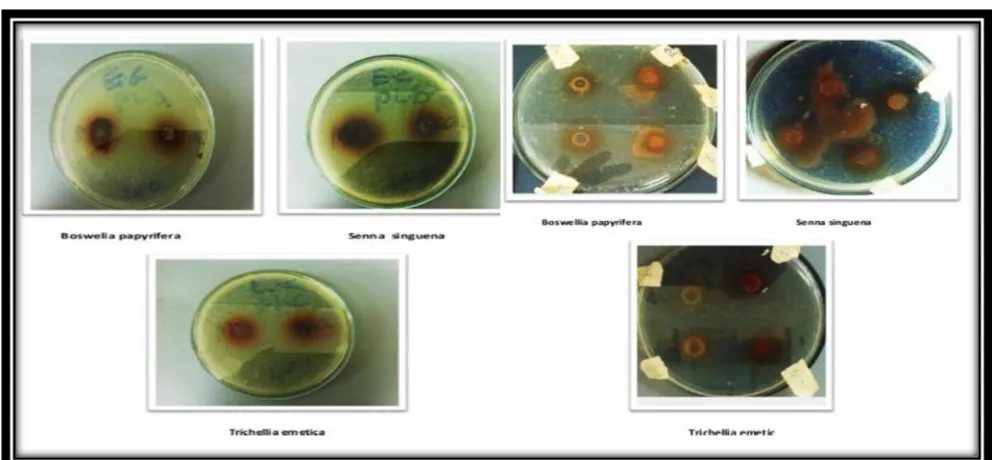
(ATCC 25922) Gram negative was procured from Freud hallows IOL laboratory in Asmara. Antibacterial activity was tested by well method with media Muller Hinton agar four times. The bacteria agar Medias were impregnated to the wells with crude extracts of different concentration (100 mg/ml, 50 mg/ml and 25 mg/ml) for each bacteria. 100 micro litres of each crude extract were dropped in the holes in the Muller Hinton agar media for the cultured bacteria. Amoxicillin is used for the positive control in order to compare with the extract results. The culture media incubated at 37°C, for 24hrs Sensitivity test of bacteria was done with the crude extracts. The mean of inhibition zone was measured using a ruler for the crude extracts.
DISCUSSION
The purpose of this research was to demonstrate the traditional practices and uses on these plants for their antibacterial activity in scientifically sound way. So in this research extraction of the three plants
Boswelliapapyrifera, Sennasinguenna and Trichliaemetica have done using three different solvents for each plant. The solvents were Petroleum ether, Methanol (95%) and Water according to their polarity increment, by using different instruments and chemicals the extraction was processed. At last using the rota vapour it was concentrated and dried at 400c. The crude dry extract obtained was higher in methanol extract and lower in petroleum ether extracts. In comparing the obtained products according to the polarity of the solvents these plants are richer with polar compounds than nonpolar compounds, water is the most polar one and methanol is a moderate polar which can solubilize both the polar and nonpolar compound that is the reason for the methanol extract to have the highest yield value. For the sensitivity test two micro-organisms have selected which are E.coli, and S.aureus. The selecting of bacteria was depending on their resistance and their classification as gram positive (S.aureus) and
gram negative (E.coli) bacteria. E.coli is one of the highly resistant bacterium and S.aureus is less resistant one. Muller Hinton agar has a positive control which is a good media for microbial growth,
and also the solvents water, methanol and petroleum ether have no any negative impact on the growth of the selected microbes.
The method used for carrying out of the sensitivity test was well method. This method is preferable for its short time consuming. This type of method is having wells where the crude extract and standard drugs are placed or dropped for diffusing to the media; this method gives a better result than the disc diffusion method. Muller Hinton agar media was the type of the media we have used for the test and it was prepared according the manufacturer instruction at the concentration of 38g/litre. In the antimicrobial test we were trying to work with the aseptic techniques to reduce contamination in the growth media. The growth of bacteria in the incubator was taken place at 370c.
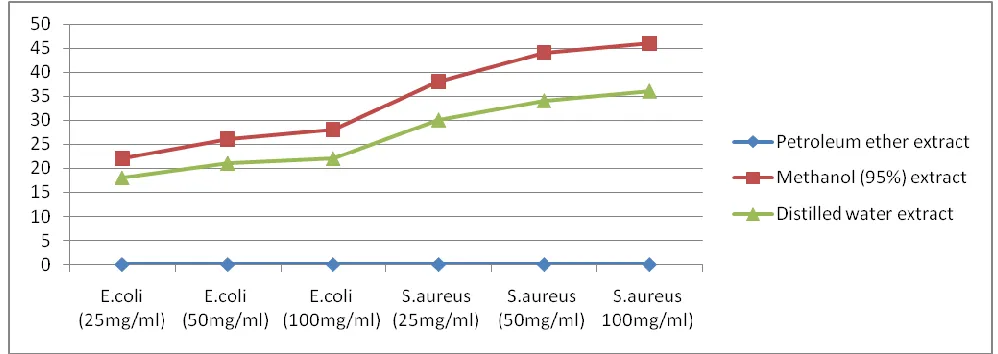
As we come to the result generally all the plants have shown antimicrobial activity with different strength of concentrations. Methanol extract was predominating in all the antibacterial activity but the petroleum ether extract of all the plants didn’t show any zone of inhibition. According to the microbes the
S.aureus found to be less resistant to the extract of methanol and water. But the E.coli is somehow resistant compare to S.aureus. Regarding S.aureus all the plants are effective with both water and methanol extract. E.coli is inhibited by extract of methanol and water of each plant at the highest concentration used in this experiment (i.e.100mg/ml).
The concentrations were prepared at different strengths of 100mg/ml, 50mg/ml, and 25mg/ml. We have applied all the extract concentrations over the
E.coli and S.aureus.
The maximum inhibition zone diameter has been attained by Sennasinguenaa gainst the microbes in water and methanol extract at all concentrations. But there is no much significant difference between the 100mg/ml and 50mg/ml of Sennasinguena.
Trichelliaemetica has less antibacterial activity than
Sennasinguena and Boswelliapapyrifera, Boswelliapapyrifera has activity in both water and methanol extract for the selected microorganism.
CONCLUSION
All the selected plants for the study i.e.
Boswelliapapyrifera, Sennasinguena and
Tricheliaemetica have antibacterial activity with both extracts of water and methanol. Petroleum ether extracts of all the plants have no any activity against
than in water and very low amount for petroleum ether extract. The compounds responsible for antibacterial activity are extended between the borders of high Polar to moderate polar compounds. The compounds which are dissolved in nonpolar solvent (petroleum ether) from the selected plants have not any antibacterial activity. For all the extract their antibacterial activity is concentration independent.
ACKNOWLEDGEMENT
Authors thank the almighty God for his daily guidance and our further acknowledgement to Asmara college of Health Sciences, especially to school of pharmacy and school of Allied Health profession.
Table 1: Crude dry extracts with different solvents from 100g mass of each plant bark Solvents
Petroleum ether Methanol (95%) Distilled water
Plants A.S.U D.C.E A.S.U D.C.E A.S.U D.C.E
B.papyrifera, 400ml 2.03g 400ml 16.25g 450ml 9.35g
S.singuena 400ml 0.65g 400ml 15.32g 450ml 6.19g
T.emetica 600ml 0.71g 500ml 8.21g 600ml 4.89g A.S.U= amount of solvent used, D.C.E= dry crude extract
Table 2: Inhibition zone diameter of B.papyrifera extracts in mm
Petroleum ether extract Methanol (95%) extract Distilled water extract Concentration in
mg/ml
100 50 25 100 50 25 100 50 25
Bacteria
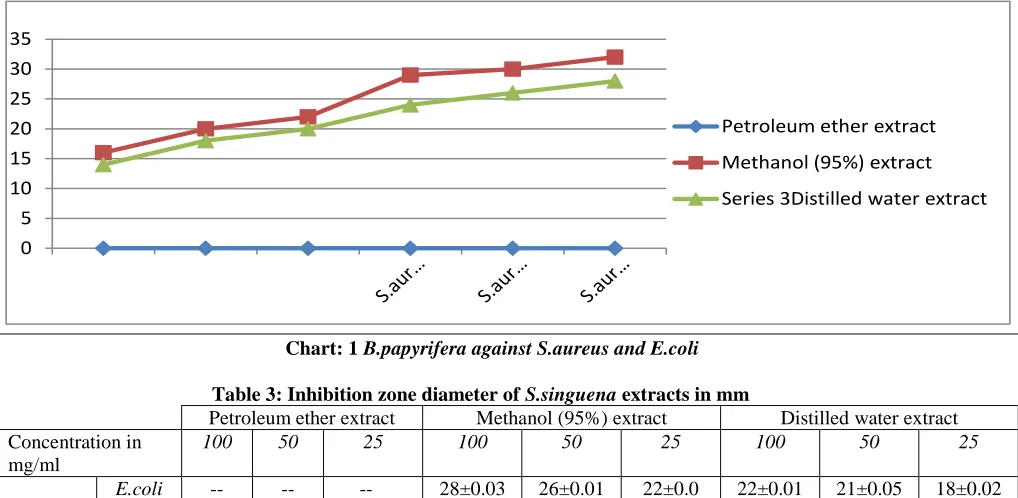
E.coli -- -- -- 22±0.01 20±0.02 16±00 20±0.01 18±0.03 14±0.03
S.aureus -- -- -- 32±00 30±0.03 29±0.01 28±0.05 26±00 24±0.04 --: no activity
Results expressed in mean ± standard deviation
0 5 10 15 20 25 30 35
Petroleum ether extract
Methanol (95%) extract
Series 3Distilled water extract
Chart: 1 B.papyrifera against S.aureus and E.coli
Table 3: Inhibition zone diameter of S.singuena extracts in mm
Petroleum ether extract Methanol (95%) extract Distilled water extract Concentration in
mg/ml
100 50 25 100 50 25 100 50 25
Bacteria
E.coli -- -- -- 28±0.03 26±0.01 22±0.0 22±0.01 21±0.05 18±0.02
S.aureus -- -- -- 46±0.02 44±0.03 38±0.0 36±0.02 34±0.0 30±0.06 --: no activity
Chart: 2 S.singuena against S.aureus and E.coli
Table 4: Inhibition zone diameter of T.emetica extracts in mm.
Petroleum ether extract Methanol (95%) extract Distilled water extract
Concentration in mg/ml 100 50 25 100 50 25 100 50 25
Bacteria
E.coli -- -- -- 18±0.0 5
16±0.0 5
12±0.0 4
12±0.01 9±0.04 --
S.aureus -- -- -- 34±0.0 31±0.0 3
28±0.0 6
18±0.04 14±0.0 --
--: no activity
Results expressed in mean ± standard deviation
0 10 20 30 40
E.coli (25mg/ml)
E.coli (50mg/ml)
E.coli (100mg/ml)
S.aureus (25mg/ml)
S.aureus (50mg/ml)
S.aureus 100mg/ml)
Petroleum ether extract
Methanol (95%) extract
Distilled water extract
Figure 1 crude extracts against S.aureus
Figure 2 crude extract against E.coli
REFERENCES:
1. Abulude. F.O. Phytochemical screening and mineral contents of leaves of some Nigerian woody plants. Research Journal of Phytochemistry, 2007; 1 (1): 33 – 39.
2. Ahmad.I and Aquil. F In vitro efficacy of bioactive extracts of 15 medicinal plants against Esbetal-producing multidrug-resistant enteric bacteria Microbiol Res 2006; 3: 79 – 98
3. Ajayi IA, Ajibade O, and Oderinde RA, Preliminary Phytochemical Analysis of some Plant Seeds. Res.J.Chem.Sci; 2011; 1(3):58-62.
4. Balunas MJ, Kinghorn AD, Drug Discovery from Medicinal Plants. Life Sci; 2005; 78:431-441.
6. Bekele-Tesemma A, Birnie A, Tengnas B. Useful trees and shrubs for Ethiopia. Regional Soil Conservation Unit (RSCU), Swedish International Development Authority (SIDA). 1993; 2: 123-127
7. Bent S, Tiedt T, Odden M, Shlipak M. "The relative safety of ephedra compared with other herbal products".
Ann Intern Med 2003; 138 (6): 468–71.
8. Butterweek, Derendorf, et al Pharmacokinetic Herb-drug Interactions: Are Preventive Screenings Necessary and Appropriate. PlantaMedica; 2004; 70:784-791.
9. Cordell, G. A., Quinn-Beattie, M. L. and Farnsworth, N. R. the potential of alkaloids in drug discovery. Phytotherapy Research, 2001; 15: 183–205. doi:10.1002/ptr.890
10. Cravotto G, Boffa L, Genzini L, Garella D "Phytotherapeutics: an evaluation of the potential of 1000 plants". J Clin Pharm Ther 2010; 35 (1): 11–48. Doi: 10.1111/j.1365-2710.2009.01096.
11. D.K.Bhatt, et al herbal and medicinal plants of India, New Delhi 2007; 1; 50-72.
12. Dabai, Y.U.S. Muhammad and B.S. Aliyu, Antibacterial activity of anthraquinone fraction of Vitexdoniana. Pakistan Journal Biological Science, 2007; pp: 1-3.
13. Dan Bensky, Steven Clavey, Erich Stoger, and Andrew Gamble. Chinese Herbal Medicine: MateriaMedica, Third Edition 2004; 6; 122-145
14. Denwick PM. (2002) Natural Products: A Biosynthetic Approach. 2nd Ed. John Wiley & Sons Ltd, England; 241-243.
15. Duru UN, Orji JC, Obi RK. Larvicidal Potential of Crude Extracts of Azadirachtaindica (Neem). World J Pharm and Pharm Sci; 2012; 1 (3): 1188-1197.
16. Elvin-Lewis, M. "Should we be concerned about herbal remedies".Journal of Ethnopharmacology 2001; 75 (2-3): 141–164. doi:10.1016/S0378-8741(00)00394-9
17. Ernst E. "Herbal medicines: balancing benefits and risks". Novartis Found. Symp. 2007; 282: 154–67; discussion 167–72, 212–8. doi:10.1002/9780470319444
18. Farnsworth NR, Akerele O, Bingel AS, et al. Medicinal plants in therapy. Bull World Health Organ. 1985; 63: 965-981
19. Adeyanju O. Olutayo, Michael A and Khan IZ. Preliminary phytochemical and antimicrobial screening of the leaf extract of Cassia singueana Del. African Journal of Pure and Applied Chemistry. 2011; 5(4): 65 - 68. 20. Grainge M. Ahmed S.Handbook of Plants with Pest Control Properties. John Wiley and Sons, New York;
1988; P 41.
21. Norwegian working group on antibiotics. Susceptibility testing of bacteria and fungi.ScandJ Infect Dis; 1997; 103 (suppl):13-23.
22. Marshall, N. Searching for a cure: Conservation of medicinal wildlife resources in East and Southern Africa. A TRAFFIC Species endangered report, Nairobi, Kenya, September 1998; p 3.
23. Satish, S.K.A. Raveesha and G.R. Janardhana, Antibacterial activity of plant extracts on phytopathogenic Xanthomonascampestrispathovars. Letters in applied microbiology, 2002; 28: 145-147.
24. Springbob, Karen &Kutchan, Toni M. "Introduction to the different classes of natural products". In Lanzotti,Virginia. Plant-Derived Natural Products: Synthesis, Function, and Application. Springer. 2009; p.3. ISBN 9780387854977.
25. W.C. Evans: pharmacognosy 15th edition, China 2004; pp: 135- 150.
26. W.T. Fernie, medicinal plants and plant based medicines, India New Delhi 2008; 74: 116.
27. Yang Shou-Zhong and Bob Flaws (translator) Blue Poppy. The Divine Farmer's MateriaMedica: A Translation of the ShenNong Ben Cao (Blue Poppy's Great Masters Series), 1998; 23:251
28. Youssef HMA, Amina M and El-shafae AM. Biological evaluation of constituents from Grewiamollis, Journal of Chemical and pharmaceutical research, 2012; 4(1); 508
29. Rick Nq. Drug discovery to approval, Biopharmaceutical manufacturing centre USA. 2004; ISBN-0-471-60150-0, 1: 9-20.
30. The American Society of Pharmacognosyhttp://www.pharmacognosy.us/what-is-pharmacognosy/
31. Documenting Traditional Medical Knowledge –
WIPOhttp://www.who.int/mediacentre/factsheets/fs134/en/index.html 32. Flora of Zimbabwe: Species information: Cestrum