* Corresponding author
E-mail: [email protected] (G. La Scalia)
2019 Growing Science Ltd. doi: 10.5267/j.ijiec.2019.5.001
International Journal of Industrial Engineering Computations 10 (2019) 453–472
Contents lists available at GrowingScience
International Journal of Industrial Engineering Computations
homepage: www.GrowingScience.com/ijiec
Facility layout problem: Bibliometric and benchmarking analysis
G. La Scaliaa*, R. Micalea
and
M. EneaaaDepartment of Engineering – University of Palermo, Viale delle Scienze, bld. 8, 90128 – Palermo -Italy
C H R O N I C L E A B S T R A C T
Article history: Received March 3 2019 Received in Revised Format April 2 2019
Accepted May 6 2019 Available online May 6 2019
Facility layout problem is related to the location of departments in a facility area, with the aim of determining the most effective configuration. Researches based on different approaches have been published in the last six decades and, to prove the effectiveness of the results obtained, several instances have been developed. This paper presents a general overview on the extant literature on facility layout problems in order to identify the main research trends and propose future research questions. Firstly, in order to give the reader an overview of the literature, a bibliometric analysis is presented. Then, a clusterization of the papers referred to the main instances reported in literature was carried out in order to create a database that can be a useful tool in the benchmarking procedure for researchers that would approach this kind of problems.
© 2019by the authors; licensee Growing Science, Canada
Keywords:
Facility Layout Problem Bibliometric analysis Instances
Benchmarking procedure
1. Introduction
454
those referred to the multi-object context in which other qualitative factors, such as adiacence or distance rating between departments, plant safety, and flexibility of layouts for future design changes, are also considered
(
Jolai et al., 2012; Aiello et al., 2013; Azevedo et al., 2017). These above-mentioned features vary from one application to the other thus making the benchmarking of the performance of each approach a tough issue (Aiello et al., 2013). Hence, to evaluate the performance of different approaches, the results have to be compared with those obtained from previous literature researches characterized by the same layout evolution, the same input data and the same objective functions. The comparison is usually made on the basis of a set of instances in which different setups of the FLP are reported. However, in many articles there is a gap in the benchmarking procedure due to the use of random data set or real cases setup. Referred to a real case study it is generally justified only when dealing with an extremely innovative problem for which there are no references in literature. The robustness of the approach proposed strongly depends on the above considerations and for this reason a database of the instances present in literature and of the papers referred to the same instances for each class of problems is here proposed. This paper reviews the research progress on the FLP in the last 60 years and focuses on the benchmarking procedure adopted in terms of instances used. We collect papers belonging to the same class of problems and we identify those referred to the same instances. This is the first time in which a bibliometric analysis is conducted on the FLP and it represents a framework of the main indicators that characterize publications in this field. The present paper is structured as follows. Section 2 describes the methodology for showing a general overview on the research trends in the last sixty years. Section 3 reports the analysis of the papers presented in the previous section in terms of instances adopted for the benchmarking procedure. Finally, the paper ends with the Conclusions in Section 4 identifying potential gaps in literature and proposing new research topics.2. Data and methodology
The dataset for this study was retrieved searching “Facility layout problem” in the field article title,
abstract, keywords of Scopus, which is one of the most widely used search engine among the scientific
community. The time horizon from 1963 to 2019 was selected. Among all types of publications, we limited this study to the articles and reviews wrote in English on journals considering 5 subject areas (Engineering, Computer Science, Decision Sciences, Business Management and Accounting and Mathematics) obtaining a sample database of 922 works. Then, such database was exported and analysed through the freely available software VOSviewer, for the construction and the visualization of bibliometric maps (Van Eck and Waltman, 2010). This software is able to draw bibliometric distance-based maps, giving attention to their graphical presentation facilitating the comprehensibility.
2.1 Geographical landscape
Fig. 1 shows the evolution of the concentration of the papers in three different time windows (1963-1983; 1984-2004; 2005- 2019). In particular, the number of countries in which research on the FLP was conducted is almost quadrupled from 1963 to today. We have considered papers that are cited at least once and countries with a minimum number of 10 publications. Under these assumptions, in the first time window, only 4 countries meet the thresholds whereas in the second and in the third one the number of countries becomes 13 and 15 respectively. This trend confirms the importance of the FLP and the interest of many researches in this field.
G. La Scalia et al. / International Journal of Industrial Engineering Computations 10 (2019) 455
(a)
(b)
(c)
Fig. 1. Geographic landscape a) 1963-1983; b) 1984-2004; c) 2005- 2019
2.2 Research trends
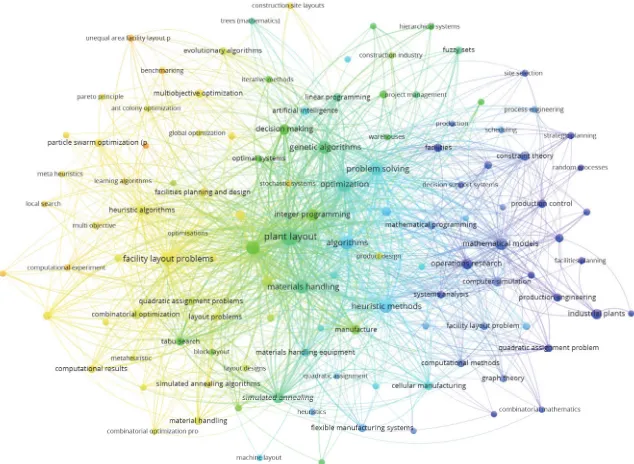
To identify the main research trends over the last two decades, we conducted a co-occurrence analysis of all the keywords in the database.
456
Results are shown in Fig. 2, where the relatedness between items is calculated with respect to the number of documents in which they occur together. We set a threshold to 10 as the minimum number of occurrences and we limit the set to the most connected keywords. We obtain a total number of 117 keywords. However, some terms in the map result duplicated. Particularly, VOSviewer does not distinguish among singular and plural. Therefore, to overcome this problem, we removed manually four of these keywords that correspond to the ones with a lower weight. All the other settings are given by default. The distance among items was calculated on the basis of the association strength (Van Eck & Waltman, 2010), representing the ratio between the number of co-occurrences of term i and term j and the total number of occurrences of i multiplied for the total number of occurrences of j. The higher the association strength between two nodes of the network is, the shorter their distance is. The colour scale refers to the average year of publications. Therefore, Fig. 2 provides an overview of the most cited keywords over the last twenty years, enabling to infer the most debated research topics. On the basis of the map of keywords, the identified research trend shows an increasing interest in solving dynamic facility layout problems based on meta-heuristic and evolutionary approaches (Tayal & Singh, 2018; Turanoğlu & Akkaya, 2018). Moreover, the last researches involved multi-objective optimization approachs paying attention to the instances-based benchmarking procedure (Liu & Liu, 2019; Liu et al., 2018; Samanta et al., 2018; La Scalia et al., 2019).
2.2 Citations overview
The sample of 922 publications receives in total 22,003 citations of which 15,380 in the last ten years. In this research we have used the tool available on Scopus for analysing these documents in terms of citations, authors and sources over the years. Fig. 3 refers to the last decade and shows a general increasing trend, in particular 2018 is the year with the highest number of citations.
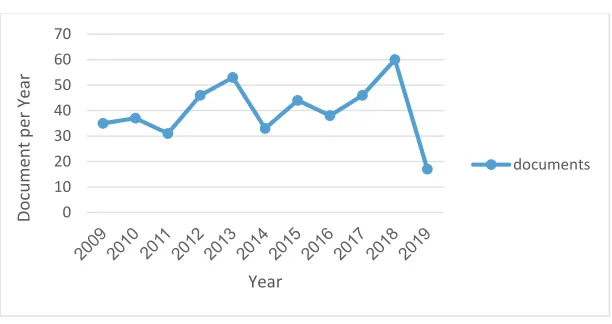
Fig. 3. Citations overview in the last ten years The same year results the most prolific with 58 papers published (Fig. 4).
Fig. 4. Documents by years (2009-2019)
0 500 1000 1500 2000 2500
Citations
Year
citations
0 10 20 30 40 50 60 70
Document
per
Ye
ar
Year
G. La Scalia et al. / International Journal of Industrial Engineering Computations 10 (2019) 457
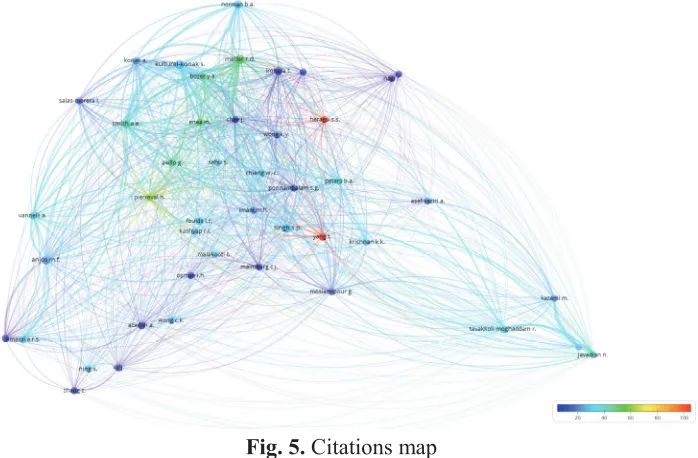
Finally, Fig. 5 shows the citation map, whose purpose is to identify the most prolific authors publishing in the field of the FLP. To explore the authors’ landscape, we conduct a citation analysis, given the widespread assumption that the number of citations reflects the publication’s notoriety and, therefore, the influence of an author’s work (Van Nunen et al., 2017). The software VosViewer was set considering a minimum number of documents for each author equal to 1 and a minimum number of citations of 50. In this map, the size of the bubble, relative to a given author, is determined by the number of publications. The link reflects, instead, which authors have worked on the same work, whereas the colour shows the average number of citations that the publication received from the other authors in the map. In particular, the colour red corresponds to an average number of citations of more than 150, whereas the colour blue corresponds to a number inferior to 20. Moreover, the distance between two authors reflects the tendency of these authors to cite each other.
Fig. 5. Citations map
On the basis of these assumptions, the most significant papers in terms of citation belong to three authors:
SS. Heragu, T. Yang and H Pierraval. Table 1 reports the most relevant contributions, according to the
number of citations indicated by the Scopus database. The table also indicates the research areas, which are: Engineering (E), Mathematic (M), Computer Science (CS), and Decision Science (DS).
Table 1
Main references on FLP
Reference Citation Research area
Kusiak & Heragu, 1987 407 M,DS
Yang & Hung, 2007 259 M, E, CS
Drira, Pierreval and Hajri-Gabouj, 2007 340 E, CS
2.3 Journals
458
Fig. 6. Journals map
Each journal has a colour that indicates the average publication date. The more the colour tends to yellow, more recent the publications are. The font size and the dimension of the bubble in the figure represent the number of publications, whereas links represent the citations obtained in other journals.
Fig.7. Documents per year by source (1963-2019)
0 1 2 3 4 5 6 7 8 9 10
1970 1974 1978 1982 1986 1990 1994 1998 2002 2006 2010 2014 2018
Docum
e
nt
s
Years
International Journal Of
Production Research
European Journal Of
Operational Reasearch
Computer And Industrial
Engineering
International Journal Of
Advanced Manufacturing
Technology
Computers And Operations
Research
IIE Transactions Institute Of
Industrial Engineers
Expert Sysems with
Applications
Automation in Construction
Journal Of Intelligent
Manufacturing
Journal Of Manufacturing
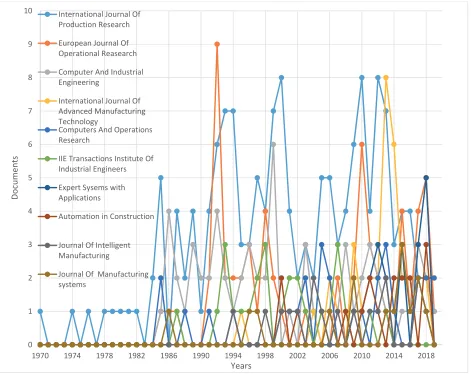
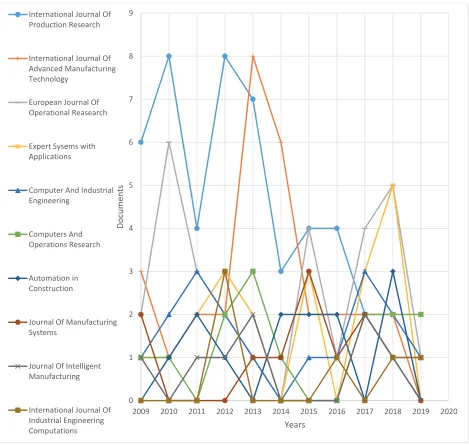
G. La Scalia et al. / International Journal of Industrial Engineering Computations 10 (2019) 459 As instance, the International Journal of Production Research, with 155 published papers, is located in the centre of the map because of the high number of citations in the other journals present in the same map. We have refined these results using the analyser tool of scopus, comparing the 10 most prolific journals on the whole time horizon (1963-2019) with those that have most documents in the last ten years. Results are reported in the following figures (Fig. 7 and Fig. 8).
Fig. 8. Documents per year by source (2009-2019)
The comparison between the above figures shows that, in the last decade, the only change in the top ten of the most prolific journals on FLP is represented by the introduction of International Journal of Industrial Engineering Computations.
3. General overview of the benchmarking procedure
The benchmarking analysis applied to the facility layout problem consists in comparing the results obtained with the proposed approach with those present in literature to prove the achieved improvement.
0 1 2 3 4 5 6 7 8 9
2009 2010 2011 2012 2013 2014 2015 2016 2017 2018 2019 2020
Do
cu
m
en
ts
Years
International Journal Of
Production Research
International Journal Of
Advanced Manufacturing
Technology
European Journal Of
Operational Reasearch
Expert Sysems with
Applications
Computer And Industrial
Engineering
Computers And
Operations Research
Automation in
Construction
Journal Of Manufacturing
Systems
Journal Of Intelligent
Manufacturing
International Journal Of
Industrial Engineering
460
In this section we have analysed the paper involved in this research in order to show how many papers adopt a benchmarking procedure in their approach. Figure 9 shows that only 60% of the published papers on the SFLP make comparisons, complete or partial, on instances present in literature.Of the remaining 40%, 15% refers to a real case study and 25% to randomly generated data sets.
Fig. 9. General overview SFLP Fig. 10. General overview DFLP
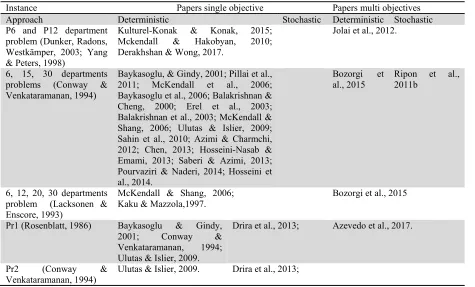
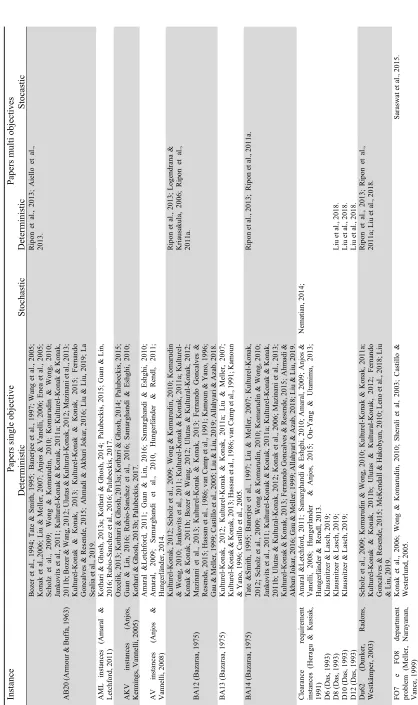
For DFLP (Fig. 10), only 63% of published articles make comparisons, complete or partial, on instances present in literature. Of the remaining 37%, 15% refers to a real case study and 22% to randomly generated data sets. To carry out benchmarking operations it is necessary to refer to the same instance. This aspect is what pushed to present the instances used in literature, subdivided in static and dynamic problems. Then for each instance a cloud of papers was built subdividing them on the basis of the type of objective function used (single or multi) and the type of data used (deterministic or stochastic). Tables 2 and 3 report the instances for the DFLP and the SFLP respectively.
Table 2
Instances for the DFLP
Instance Papers single objective Papers multi objectives
Approach Deterministic Stochastic Deterministic Stochastic
P6 and P12 department problem (Dunker, Radons, Westkämper, 2003; Yang & Peters, 1998)
Kulturel-Konak & Konak, 2015; Mckendall & Hakobyan, 2010; Derakhshan & Wong, 2017.
Jolai et al., 2012.
6, 15, 30 departments problems (Conway & Venkataramanan, 1994)
Baykasoglu, & Gindy, 2001; Pillai et al., 2011; McKendall et al., 2006; Baykasoglu et al., 2006; Balakrishnan & Cheng, 2000; Erel et al., 2003; Balakrishnan et al., 2003; McKendall & Shang, 2006; Ulutas & Islier, 2009; Sahin et al., 2010; Azimi & Charmchi, 2012; Chen, 2013; Hosseini-Nasab & Emami, 2013; Saberi & Azimi, 2013; Pourvaziri & Naderi, 2014; Hosseini et al., 2014.
Bozorgi et
al., 2015 Ripon et al., 2011b
6, 12, 20, 30 departments problem (Lacksonen & Enscore, 1993)
McKendall & Shang, 2006; Kaku & Mazzola,1997.
Bozorgi et al., 2015
Pr1 (Rosenblatt, 1986) Baykasoglu & Gindy,
2001; Conway & Venkataramanan, 1994; Ulutas & Islier, 2009.
Drira et al., 2013; Azevedo et al., 2017.
Pr2 (Conway &
G. La Sc al ia et al . / Int erna tion al Journa l o f In du stri al E ng ine eri ng C om put at ions 10 (2019) 461 Ta b le 3 Ins tan ces for th e SFLP Instance Pa per s sing le o bj ec tiv e Pa per s m ult i o bjec tive s D ete rm in is ti c St ocha st ic D ete rm in is ti c Stocas tic A B 20 (A rm our & B uf fa , 19 63) B oze r e t a l., 19 94; T at
e & Smi
th, 19 95 ; B an erj ee et al ., 199 7; Wa ng e t a l., 2 005; K on ak e
t al.,2006; L
iu
&
M
ell
er
, 2007; A
njos &
V
an
elli, 2006; E
nea e t a l., 2005; S cho lz e t a l., 2 009 ; W ong & K om arudin, 2010; K om ar
udin & W
on g, 20 10 ; Ja nkovits e t al
., 2011; K
ulture l-K on ak & K ona k, 2011 a; K ult ur el -K on ak & K on ak, 2011b; B oze r & Wa ng, 2012 ; U lu ta s & K ul tur al -K on ak
, 2012; M
az in ani e t a l., 20 13; K ult ur el -K on ak & K on ak, 20 13; K ul tur el -K on ak & K on ak, 20 15; Fe rn an do G on ca lv es & Re se nd e, 2015 ; A hm adi & A kb ar i Jok ar , 2 016; L
iu & L
iu, 2019; La Sc ali a e t a l., 2019. R ip on et a l., 2013; A iel lo et a l., 2013. A M L inst an ce s (Am ar al & Le tc hf ord , 20 11) K oth ar i & G hosh, 2013a ; K otha ri & G ho sh, 2014; Pa lubec ki s, 20 15; G uan & Lin, 2016 ; R ubio -Sa nc he z e t a l., 201 6; Pa lubec kis, 2017. AK V i ns ta nc es (A nj os , K enning s, V ann elli, 2005) Oz ce lik, 2013; K ot ha ri & G hosh, 2013a ; K ot ha ri & G hosh, 20 14; Pa lu be ck is, 20 15; G ua n & L in, 2016; R ubio-Sa nc hez e t al. , 20 16; S am ar gh andi & E sh gh i, 20 10 ; K oth ar i & G ho sh, 2013b; Pa lub ec kis, 2017. A V inst an ce s (A njos & V ann elli, 2008) Am ar al & L et ch for d, 2011; G ua n & Lin, 2016; Sam argh andi & Eshghi, 20 10 ; Am ar al , 2009 ; Sa ma rgha ndi e t al ., 2010 , H ung er lä nde
r & Re
nd l, 20 11; H unge rl än de r, 201 4. BA 12 (Baz ar aa , 1 975 ) K ult ur el -K on ak, 2012; Sc ho lz e t a l., 2009; W ong & Kom arudin, 20 10; K om aru din & W ong, 2010 ; Ja nkovits e t al ., 2011; K ultur el-K on ak & K on ak, 201 1a ; K ul tur el -K on ak & K on ak, 2011 b; B oz er & W ang, 2012; U luta s & K ultur al-K ona k, 2 012; Maz in ani e t a l., 2013 ; K ult ur el -K on ak & K on ak, 2013; F er na ndo G onca lv es & Re se nd e, 20 15; H assa n et a l., 1986 ; v an Cam p et a l., 1 991; K am oun & Y ano, 19 96 ; Ga
u & Me
lle r, 1999 ; Ca stillo e t a l., 2005; L iu & L iu, 2019; A lla hy ar i & A za b, 201 8. R ip on e t a l., 2013; L og endr an a & K ria us akula, 2006 ; R ipon e t al ., 2011a . BA 13 (Baz ar aa , 1 975 ) K ult ur el -K on
ak, 2012; K
ulture l-K ona k & K on ak , 2011a ; L iu & Me ll er , 20 07; K ult ur el -K on ak & K on ak, 2013; Ha ss an e t a l., 1986; va n Cam p e t a l., 19 91; Ka m ou n & Ya no , 1996; Ca stil lo e t a l., 2005. BA 14 (Baz ar aa , 1 975 ) Ta te &S m ith, 199 5; Ba ne rjee e t al ., 1 997; L iu & Me ll er
, 2007; K
ulturel-K ona k, 2012 ; Sc hol z e t a l., 20 09; W on g & K om arudin, 20 10; K om arud in & W ong, 20 10 ; Ja nkovits e t al
., 2011; K
ulture l-K on ak & K ona k, 2011 a; K ult ur el -K on ak & K on ak, 2011b; U lut as & K ultur al-K on ak, 2 012 ; K ona k et a l., 2006; M az in ani e t a l., 20 13; K ult ur el -K on
ak & K
on ak, 2013; F erna ndo G onca lve s & Re se nd e, 2015; Ahm adi & A kb ar i Joka r, 2016; Ga u & Me ll er , 19 99 ; A ll ah ya ri & A za b,
2018; Liu & L
iu, 201 9. R ip on et a l., 20
13; R
ipon et a l., 2011a. Cl ear an ce r eq ui re m en t in st an ce s ( H er ag u & K us iak , 1991) Am ar al & L et ch fo rd, 201 1; Sa ma rgha ndi & E sh ghi, 2 010; A m ar al , 2 009; A njos & Va ne lli, 2008; H ung er la nd er & A njos, 2015; O u-Ya ng & U ta m im a, 2 01 3; H unge rl än de r & Re ndl, 2 013 . Nem ati an , 2014; D 6 ( D as , 19 93) K la usnit ze r & La sc h, 2019; D 8 ( D as , 19 93) K la usnit ze r & La sc h, 2019; L iu e t a l., 2 018. D 10 ( D as , 1993) K la usnit ze r & La sc h, 2019; L iu e t a l., 2 018. D 12 ( D as , 1993) L iu e t a l., 2 018. D u62 (D un ke r, Ra do ns, We st kä m pe r, 2 003) Sc ho lz e t al
., 2009; K
om ar udin & Wong, 20 10 ; K ult ur el -K on ak & K on ak, 2011a ; K ult ur el -K on ak & K on ak, 2011b; U lut as & K ultu ra l-K on ak, 2012; Fe rn an do G on ca lv
es & Re
se nde , 20 15; McK en da
ll & H
akobya n, 2 010; L eno e t a l., 2018; Liu & Liu , 2019. R ip on e t al. , 2013; R ipon e t a l., 2011a ; L iu e t a l., 2 018. F O 7 e FO 8 d epa rtm ent proble m (M el le r, N ar aya na n, V an ce , 1999) K on ak e t a
l., 2006; Wong &
K om arud in , 20 10; She ra li e t al
, 2003; Ca
462 FO
9 de pa rt m en t pr oble m (Me ll er, N ar aya na n, V an ce , 1999) She ra li e t a l, 2003; Ca stil
lo & W
est er lund, 2 00 5. Sa ra sw at e t a l., 20 15. O 7 e O 8 d ep art m ent pr oble m (Me ll er, Na ra ya na n, V an ce , 1999) She ra li et a l, 2 003; Ca stillo & We st er lund , 20 05; Li u & Me ll er ; 200 7; S cholz e t a l., 2009 ; K om aru din & W ong, 2010; B oze r & Wa ng, 201 2; F er na ndo G onc al ve s & Re se nd e, 20 15; Ca stillo e t a l., 2 005; L iu & L iu, 201 9; K la usnit ze r & La sc h, 2 019. R ip on et a l., 20 13; R ipon et al ., 2 011a; Sa ra sw at e t a l., 20 15. O 9 de pa rt m ent pr oble m (B oze r & Me ll er 1 997) She ra li et a l, 2 003; Ca stillo & We st er lund , 20 05; Li u & Me ll er ; 200 7; S cholz e t a l., 2009 ; K om aru din & W ong, 2010; B oze r & Wa ng, 201 2; F er na ndo G onc al ve s & Re se nd e, 201 5; Ca stillo e t a l., 2005 ; K on ak et a l.,20
06; Wong &
K om ar udin, 20 10; Ja nkovits et a l., 20 11; A hm adi & A kba ri Joka r, 20
16; Liu & Li
u, 2019; K la usnit ze r & Las ch, 201 9;. R ip on et a l., 20 13; R ipon et al ., 2 011a; Sa ra sw at e t a l., 20 15. FO 10, FO 11, O10 (M el le r, C he n, Sh er ali, 2 007) Ja nkovits e t a l., 2 011; Am ar al & L et chfo rd , 20 11 ; K la us nitz er & La sc h, 2019. F10 (Montre uil e t a l., 20 04) K ult ur el -K on ak & K on ak, 2011a ; K ultur el -K on ak & K ona k, 2011b; K ulture l-K onak & K on ak, 2013 ; K ulture l-K ona k & K ona k, 2015; K ulture l-K ona k, 201 2 . Forte nbe rr y in st an ce s (For te nbe rr y & C ox , 1985 ) Sure sh & Sa hu, 1993; Sing h & S ingh, 2 010; M at ai et a l, 201 3; Ma ta i, 2 015; Ha rm onsky & Tot he roa , 1992 . Im am & M ir , 1989 De ra khs ha n & W on g, 2017 . H O T ( M ir & I m am , 2001) A ll ah ya ri & Az ab , 20 18; D er akhsh an & W on g, 2017. L W 5 (L ov e & W ong, 1976 ) Soli m an pur e t al ., 200 5; R ubio -Sa nc he z et al.
, 2016; Sam
ar gh andi & E shghi, 20 10 ; Da tt a et a l., 2011; Sam ar gha ndi e t a l., 2010 ; H er agu & K usia k, 1991; H er agu &A lfa, 1992 ; K um ar e t a
l., 1995; A
m ar al , 20 06; Am ar al , 2008 ; Te
o, & P
on na m ba la m , 20 08; O u-Y
ang & U
tam ima , 20 13. Nem anti an, 2014 ; L W 11 ( L ov e & Wong, 197 6) Soli m an pur e t a l., 20 05; R ubio-Sa nchez e t a l., 20 16; Da tta e t a l., 2011; S am ar gh andi et a l., 2010 ; He ra gu & K usi ak , 1991 ; He ra gu &A lf a, 19 92; K um ar e t al ., 1 995; Am ar al
, 2006; A
m ar al , 2008; T eo, & Ponn am ba la m, 20 08; O u-Y ang & Uta m im a, 2013 . Nem anti an, 2014 ; M 11, M 15, M 25 de pa rt m en t proble m ( M elle r, 1 992 ) K on ak e t a l., 200 6; W
ong & K
om ar udin, 201 0; K ult ur el -K on ak & K on ak, 2011a ; K ult ur el -K on
ak & K
on ak, 201 1b; Kulture l-K ona k & K on ak, 2013; G au & Me ll er , 1999 ; K la usnitz er & La sc h, 2 019. QA P in st an ce s ( B ur ka rd et al ., 1991) Am ar al & L et chfor d, 2011; H unge rla nd er , 2014; H eragu &A lf a, 1992; Ra m ku m ar et a l., 20 09a ; R anku m ar e t a l., 2009 b; Si ngh & Sh ar m a, 2008; Ma ta i e t a l., 2013 . Ma ta i e t a l., 201 3. Sim pl e N ug ent in st an ce s (N uge nt, V ol lm ann, R um l,1968 ) K ha lil , 197 3; Sc ria bin & Ve rgin, 19 85; Solim an pu r et a l., 2005; Sa ma rgha nd i & E sh ghi, 20 10; Sam ar gha ndi et al. , 201 0; He ra gu & K usi ak, 19 88; K um ar et a l., 19 95; Singh & Sha rm a, 20 08; N egh ab at , 1 97 4; W ilhe lm & Wa rd, 19 87; Tsuc hiya , 19 96; Fe ng & C he , 2018. Ma ta i e t a l., 201 3. QA P Nu ge nt in st an ce s (N uge nt, V ol lm ann, R um l, 1968) K ha lil , 197 3; S cri abin & Ve rg in, 19 85; Solim anpu r e t a l., 2 005; Sa m arg ha nd i e t a l., 2010 ; H era
gu & K
usi ak , 1988; K um ar e t a l., 1995; Ne gh ab at , 1974; W ilh el m & Wa rd , 1 987; Tsuchiya
, 1996; H
era gu &A lf a, 19 92; G oet sc ha lc kx , 1992 ; R am ku m ar et a l., 2009a ; Ra mku m ar e t al. , 20 09 b; K on ak e t al ., 20 06; W ong & K om aru din, 2010 ; K ultur el-K ona k & K on ak, 2011a ; K ultur el-K on ak & K on ak, 2011 b; K ul tur el -K on ak & K on ak, 2013; M az in ani et a l., 2 013; H unge rla nd er , 2014 ; Ma ta i et a l., 2013 ; P alubec ki s, 2012; In go le & Sin gh, 2016; Fe ng & C he , 2018. . Ma ta i, 2015 .
P4 e P
15 (Am ar al, 2 006 ) Sa m arg ha nd i & E shg hi, 201 0; Sa m ar gha ndi e t a l., 2010; Am ar al
, 2008; O
u-Ya
ng &
U
tam
im
a, 2013; Ning &
Li, 2017. Nem ati an , 2014;
P20 e P30 de
pa rt m ent pr oble m (He ra gu, K usia k, 1991 ) He ra gu &A lfa, 19 92; K um ar e t al. , 1995 ; T
eo, & P
onna m ba lam , 2008 ; O u-Ya ng & U tam im a, 201 3; Am ar al & L et ch fo rd, 201 1; Solim an pur et a l., 2005 ; G ua n & Lin, 2016 ; A nj os & Ye n., 2009 ; D att a e t a l., 201 1; A nj os & Va ne lli , 200 8; A m ar al , 20 09; N in g & Li, 20 17.
S8 e S
8H ( Si m m ons, 1969 ) L ove & W ong, 19 76; H er agu & K usia k, 199 1; He ra gu & A lf a, 1992 ; K um ar e t al ., 1995 ; A m ar al
, 2006; A
G. La Sc al ia et al . / Int erna tion al Journa l o f In du stri al E ng ine eri ng C om put at ions 10 (2019) 463 Va ne
lli, 2008; H
unge rl an de r & A njos , 2015 ; H unge rl än de r & Re ndl, 20 13; N ing & L i, 2 017.
S9 e S
9H (Si m m ons, 1969 ) Te o, & Po nn am ba la m , 2008 ; L ove & W
ong, 1976; He
ragu & K usia k, 1991; He ra gu & Alfa, 1992 ; K um ar e t al ., 19 95; A m ar al , 20 06; Am ar al , 2 008; Ou-Ya ng & U tam im a, 20 13; Am ar al & L et ch ford, 2011; A njos et a l., 2005; S am ar gha ndi & E sh ghi, 201 0; A njos & V an elli, 2008 ; H unge rl ande
r & A
njos, 2015; Hu ng er lä nd er & Re ndl, 201 3; Sam argh andi e t a l., 2 010; Am ar al ., 2013. Nem anti an, 2014 ; S10 e S11 (Si m m ons, 1969 ) Te o, & Po nn am ba la m , 2008 ; L ove & W
ong, 1976; He
ragu & K usia k, 1991; He ra gu & Alfa, 1992 ; K um ar e t al ., 19 95; A m ar al , 20 06; Am ar al , 2 008; Ou-Ya ng & U tam im a, 20 13; Am ar al & L et ch ford, 2011; A njos et a l., 2005; S am ar gha ndi & E sh ghi, 201 0; A njos & V an elli, 2008 ; H unge rl ande
r & A
njos, 2015; Hu ng er lä nd er & Re ndl, 20 13; A m ar al ., 20 13; Solim an pu r e t a l., 2005 ; G ua
n & L
in, 201 6; A m ar al , 2009 . Nem anti an, 2014 ; SC 30 e S C 35 ( L iu & Me ll er , 2007) W ong & K oma rudin, 2010; K om ar udin & W ong, 2010; K ulture l-K ona k & K ona k, 2011 a; K ult ur el -K on ak & K on ak, 2011b; B oze r & W ang, 201 2; K ultur el -K ona k & K on ak
, 2013; K
ult ur el -K on ak & K ona k, 2015; Fe rna ndo G onca lv es & Re se nd e, 2015 ; K ultur el-K ona k, 20 12. R ip on e t a l., 2013; R ipon et al; 2011a . Sko insta nce s ( A njo s & Ye n, 2009) Am ar al & L et ch for d, 2 011; K otha ri & G hosh, 2013a; K ot ha
ri & G
hosh, 20 14; Pa lub ec kis, 201 5; G ua n & Lin, 2 01 6; R ubio-Sa nchez e t a l., 2016 ; K othar i & G ho sh, 2013b; H un ge rlä nd er & Re nd l, 2 01 1; H ung erl ände r 2014 ; K al it a & D at ta, 20 18; N in g & Li, 20 17; Pa lub ec kis, 2017 . TA M 20 e TA M 30 (T am , 1992) K ult ur el -K on
ak, 2012; K
ulture l-K ona k & K ona k, 201 1a ; K ulturel-K on ak & K ona k, 2011b; U lut as & K ulture l-K on ak, 2012 ; K ulture l-K on ak & K on ak, 2 013; Fe rn an do G on ca lv es & Re se nde , 2015 ; G au & Me lle r, 1999; M el le r & B oze r, 19 96; L iu & Sun, 20 12. L oge ndr an a & K ri aus ak ula , 2 006. T l inst an ce s ( T am , L i, 199 1) Sc ho lz e t a l., 2009; F er na ndo G onca lve s & Re se nd e, 2 015; K ado, 1995. L oge ndr an a & K ria us akula , 200 6; Gar ce s-P er ez et al ., 1 99 6; Sc hn ec ke & V om be rge r, 1997. V C 10 (V an Cam p, Ca rt er , V ann elli, 1991) Ta te & S m ith, 1995; Ba ne rj ee e t a l., 1997 ; L
iu & Me
ll er , 2 007; W on g & Kom aru din, 2010 ; K om ar udin & W ong, 2010 ; Jankovits et a l., 2011; K ona k e t a l, 2006; K ul tur el -K on ak & K on ak, 2011a ; K ulture l-Kona k & K on ak , 201 1b; B oze r & Wa ng , 2012; U lu ta s & K ultura l-K ona k, 20 12; M az in ani e t a l., 20 13 ; Fe rn ando G onca lv es & Re se nd e, 2015; A hm adi & A kb ari Joka r, 2016; Sc hol z e t a l., 2009; K am oun & Ya no, 1996 ; G au & Me ll er , 1999; Ca
stillo et a
l., 2005 ; L iu & L iu, 2019. R ip on e t a l., 2013; Loge ndra na & K ria us akula, 2006; R ipon e t a l., 2011 a; Sa ra sw at e t a l., 20 15. 8, 12,
15 e 20 de
pa rt m en t proble m ( C he n & Sha , 1999) Si ng h & Singh, 2010 ; Ma ta i et a l, 2013; M at ai , 2015; S ahin, 2011. 6, 12 d ep art m ent proble m (W el ga m
a & G
ibson, 19 93 ) Da s, 19 93; Ra ja se kh ar an e t a l., 1998 ; H u et a l., 2007; Je rin L en o et al. , 2016 . Nem ati an
, 2014; D
464
4. Conclusions
This paper explores the extant literature on the “Facility Layout Problem” to identify the main research trends over the last decades. Moreover, the analysis of the keywords allows to visualize the past research trends, and could even support researchers in the identification of potential gaps in literature. In particular, the distance among nodes in the map could show unexplored connections among research topics, whereas the bubble size could indicate a still little debated topic. As instance, future research could involve multi objective approaches, as well as the use of evolutionary methods to solve the FLP. The aim of the following research is also to offer a valid tool for identifying all the papers related to a specific instance in order to optimize the benchmarking procedure. In particular, 922 articles were analysed in order to present a broad and complete revision of the theme and 128 of them were clusterized according to the benchmarking procedure adopted. Revising this collection of publications distributed between 1963 and 2019, 49 clouds of papers belonging to the same instance were collected, divided for type of objective function and input data assumed. This collection shows how many and which publications have used instances for the benchmarking analysis, that is essential to test the methodological rigour of a given approach compared to others. The results reveal that in literature only a small number of authors compare their method with a significant number of instances. This evidence therefore suggests that the benchmarking method adopted until now cannot be considered sufficiently robust and has to be improved. Moreover, further developments could include the comparison of the results obtained through other databases (such as web of science), to provide an overarching analysis of the extant literature.
References
Ahmadi, A., & Akbari Jokar, M.R. (2016). An efficient multiple-stage mathematical programming method for advanced single and multi-floor facility layout problems. Applied Mathematical Modeling,
40(9-10), 5605-5620.
Aiello, G., Enea, M., & Galante, G. (2002). An integrated approach to the facilities and material handling system design. International Journal of Production Research, 40(15), 4007-4017.
Aiello, G., La Scalia, G., & Enea, M. (2013). A non dominated ranking Multi Objective Genetic Algorithm and electre method for unequal area facility layout problems. Expert Systems with
Applications,40(12), 4812–4819.
Allahyari, M.Z., & Azab, A. (2018). Mathematical modeling and multi-start search simulated anneling for unequal-area facility layout problem. Expert Systems with applicattions, 91(C), 46-62.
Amaral, A.R.S. (2009). A new lower bound for the single row facility layout problem. Discrete Applied
Mathematics, 157(1), 183-190.
Amaral, A.R.S. (2008). An exact approach to the one-dimensional facility layout problem. Operation
Research, 56(4), 1026-1033.
Amaral ARS. (2006). On the exact solution of a facility layout problem. European Journal of Operation
Research, 173 (2), 508-518.
Amaral, A.R.S. (2013). Optimal solutions for the double row layout problem. Optimization Letters, 7(2), 407–413.
Amaral, A.R.S., & Letchford, A.N. (2011). A polyhedral approach to the single row facility layout problem. Mathematical Programming Series A, 141(1-2), 453–477.
Anjos, M. F., & Vannelli, A., (2008). Computing Globally Optimal Solutions for Single-Row Layout Problems Using Semidefinite Programming and Cutting Planes. INFORMS Journal On Computing,
20(4), 611-617.
Anjos, M.F., & Vannelli A. (2006). A new mathematical-programming framework for facility-layout design. INFORMS Journal on Computing, 18(1), 111-118.
G. La Scalia et al. / International Journal of Industrial Engineering Computations 10 (2019) 465 Anjos, M.F., Kennings, A., & Vannelli, A. (2005). A semidefinite optimization approach for the
single-row layout problem with unequal dimensions. Discrete Optimization, 2(30), 113-122.
Armour, G.C., & Buffa E.S. (1963). A heuristic algorithm and simulation approach to relative location of facilities. Management Science, 9 (2), 294-309.
Azevedo, M.M., Crispim, J.A., & de Sousa, J.P. (2017). A dynamic multi objective approach for the reconfigurable multi facility layout problem. Journal of Manufacturing Systems, 42, 140-152.
Azimi, P., & Charmchi, H.R. (2012).A new optimization via simulation approach for dynamic facility layout problem with budget constraints. Modelling and Simulation in Engineering, 2012, 1-9. Balakrishnan, J., Cheng, C.H., Conway, D.G., & Lau, C.M. (2003). A hybrid genetic algorithm for the
dynamic plant layout problem. International Journal of Production Economics, 86(2), 107-120. Balakrishnan, J., & Cheng, C.H. (2000). Genetic search and the dynamic layout problem. Computers and
Operations Research,27(6), 587-593.
Banerjee, P., Zhou, Y., Krishnasami, K., & Montreuil, B. (1997). Genetically assisted optimization of cell layout and material flow path skeleton. IIE Transactions, 29(4), 277–291.
Baykasoglu, A., Dereli, T., & Sabuncu, I. (2006). An ant colony algorithm for solving budget constrained and unconstrained dynamic facility layout problems. Omega,34(4), 385-396.
Baykasoglu, A., & Gindy, N. N. Z. (2001). A simulated annealing algorithm for dynamic layout problem.
Computers & Operations Research, 28(14), 1403-1426.
Bazaraa, M.S. (1975). Computerized layout design: a branch and bound approach, A I I E Transactions,
7(4), 432-438.
Bernardi S., & Anjos M.F. (2012). A two-stage mathematical-programming method for the multi-floor facility layout problem. Journal of Operation Research Society, 64(3), 352-364.
Bozer, Y.A., & Meller, R.D. (1997). A re-examination of the distancebased facility layout problem. IIE
Transactions, 29(7), 549-560.
Bozer, Y.A., Meller, R.D., & Erlebacher, S.J. (1994). An improvement-type layout algorithm for single and multiple-floor facilities. Management Science, 40(7), 918-932.
Bozer, Y.A., & Wang, C.T. (2012). A graph-pair representation and MIPmodel- based heuristic for the unequal-area facility layout problem. European Journal of Operation Research, 218(2), 382-391. Bozer, Y.A., & Meller, R. D., Erlebacher, S. J. (1994). Improvement-type layout algorithm for single
and multiple-floor facilities. Management Science, 40(7), 918-932.
Bozorgi, N., Abedzadeh, M., & Zeinali, M. (2015). Tabu search heuristic for efficiency of dynamic facility layout problem. International Journal of Advanced Manufucturing Technology, 77(1-4), 689– 703.
Burkard, R.E., Karisch, S., & Rendl, F. (1991). QAPLIB - A Quadratic Assignment Problem Library,
European Journal of Operational Research, 55(1), 115-119.
Castillo, I., & Westerlund, T. (2005). An ε-accurate model for optimal unequal-area block layout design.
Computers & Operation Research, 32(3), 429-447.
Castillo, I., Westerlund, J., Emet, S., & Westerlund, T. (2005). Optimization of block layout design problems with unequal areas: A comparison of MILP and MINLP optimization methods. Computers
& Chemical Engineering, 30(1), 54-69.
Chen, C.W., & Sha, D.Y. (1999). A design approach to the multi-objective facility layout problem.
International Journal of Production Research, 37(5), 1175-1196.
Chen, G.Y. (2013). A new data structure of solution representation in hybrid ant colony optimization for large dynamic facility layout problems. International Journal of Production Economic, 142(2), 362-37.1
Conway, D.G., & Venkataramanan, M.A. (1994). Genetic search and the dynamic facility layout problem. Computers & Operations Research,21(8), 955-960.
Das, S. K. (1993). A facility layout method for flexible manufacturing systems. International Journal of
Production Research,31(2), 279-297.
466
Deb, S.K., & Bhattacharyya, B. (2005). Solution of facility layout problems with pickup/drop-off locations using random search techniques. International Journal of Production Research, 43(22), 4787-4812.
Derakhshan Asl, A., & Wong, K. Y. (2017). Solving unequal-area static and dynamic facility layout problems using modified particle swarm optimization. Journal of Intelligent Manufacturing, 28(6), 1317–1336.
Drira, A., Pierreval, H., & Hajri-Gabouj S. (2013). Design of a robust layout with information uncertainty increasing overtime: a fuzzy evolutionary approach. Engineering Application of Artificial
Intelligence, 12(1), 45–60.
Drira, A., Pierreval, H., & Hajri-Gabouj, S. (2007). Facility layout problems: A survey. Annual Reviews
in Control, 31(2), 255-267.
Dunker, T., Radons, G., & Westkämper, E. (2003). A coevolutionary algorithm for a facility layout problem. International Journal of Production Research, 41(15), 3479-3500.
Dutta, K.N., & Sahu, S. (1982). A multi-goal heuristic for facilities design problems: MUGHAL.
International Journal of Production Research, 20(2), 147-154.
Enea, M., Galante, G., & Panascia E. (2005). The facility layout problem approached using a fuzzy model and a genetic search. Journal of Intelligence Manufacturing, 16(3), 303–316.
Erel, E., Ghosh, J.B., & Simon, J.T. (2003). New heuristic for the dynamic layout problem. Journal of
the Operational Research Society, 54(12), 1275-1282.
Feng, J., & Che, A. (2018). Novel integer linear programming models for the facility layout problem with fixed-size rectangular departments. Computers & Operations Research, 95, 163-171.
Goncalves, F.J, & Resende, M.G.C. (2015). A biased randomkey genetic algorithm for the unequal area facility layout problem. European Journal of Operation Research, 246(1), 86-107.
Fortenberry, J.C, & Cox, J.F. (1985). Multiple criteria approach to the facilities layout problem.
International Journal of Production Research, 23(4), 773-782.
Garces-Perez, J., Schoenefeld, D.A., & Wainwright, R.L. (1996). Solving facility layout problems using genetic programming, Proceedings of the First Annual Conference, MIT Press Cambrige, Standorf, California, July 28-31, 1986, 182-190.
Gau, K.Y., & Meller, R.D. (1999). An iterative facility layout algorithm. International Journal of
Production Research, 37(16), 3739-3758.
Goetschalckx, M. (1992). An interactive layout heuristic based on hexagonal adjacency graphs.
European Journal of Operation Research,63(2), 304-321.
Guan, J., & Lin, G. (2016). Hybridizing variable neighborhood search with ant colony optimization for solving the single row facility layout problem. European Journal of Operation Research, 248(3), 899-909.
Harmonsky, C.M., & Tothero, G.K. (1992). A multi-factor plant layout methodology. International
Journal of Production Research, 30(8), 1773-1789.
Hassan, M.D.M., Hogg, G.L., & Smith, D.R. (1986). Shape: a construction algorithm for area placement evaluation. International Journal of Production Research, 24(5), 1283-1295.
Heragu, S.S., & Kusiak, A. (1988). Machine layout problem in flexible manufacturing systems.
Operations Research, 36(2), 258-268.
Heragu, S.S. (1997). Facilities design. Boston: BWS.
Heragu, S.S., & Alfa, A.S. (1992). Experimental analysis of simulated annealing based algorithms for the facility layout problem. European Journal of Operational Research, 57(2), 190-202.
Heragu, S.S., & Kusiak, A. (1991). Efficient models for the facility layout problems. European Journal
of Operational Research, 53(1), 1-13.
Hosseini Nasab, H., & Emami, L. (2013). A hybrid particle swarm optimization for dynamic facility layout problem. International Journal of Production Research, 51(14), 4325-4335.
Hosseini, S.M., Al Khaled, A., & Vadlamani, S. (2014). Hybrid imperialist competitive algorithm, variable neighborhood search, and simulated annealing for dynamic facility layout problem. Neural
G. La Scalia et al. / International Journal of Industrial Engineering Computations 10 (2019) 467 Hosseini-Nasab, H., Fereidouni, S., Fatemi Ghomi, S.M.T., & Fakhrzad M.B. (2018). Classification of
facility layout problems: a review study. International Journal of Advanced Manufacturing
Technology,94(1-4), 957-977.
Hu, G.H., Chen, Y.P., Zhou, Z.D., & Fang, H.C. (2007). A genetic algorithm for the inter-cell layout and material handling system design. International Journal of Advanced Manufacturing Technology,
34(11-12), 1153–1163.
Hungerlander, P., & Anjos, M.F. (2015). A semidefinite optimization based approach for global optimization of multi-row facility layout. European Journal of Operational Research, 245(1), 46-61. Hungerlander, P. (2014). Single row equidistant facility layout as a special case of single row facility
layout. International Journal of Production Research, 52(5), 1257-1268.
Hungerländer, P., & Rendl, F. (2011). Semidefinite relaxations of ordering problems. Mathematical
Programming B, 140(1), 77–97.
Hungerländer, P., & Rendl, F. (2013). A computational study and survey of methods for the single-row facility layout problem. Computational Optimization and Applications, 55(1), 1–20.
Imam, M.H., & Mir, M. (1989). Nonlinear programming approach to automated topologyoptimization.
Computer aided design, 21(2), 107-115.
Ingole, S., & Singh, D. (2016) Unequal area, fixed shape facility layout problems using the firefly algorithm. Engineering Oprimization, 49(7), 1097-1115.
Jankovits, I., Luo, C., Anjos, M.F., & Vannelli, A. (2011). A convex optimization framework for the unequal-areas facility layout problem. European Journal of Operational Research, 214(2), 199-215. Jerin Leno, I., Saravana Sankar, S., & Ponnambalam, S.G. (2016). An elitist strategy genetic algorithm
using simulated annealing algorithm as local search for facility layout design. International Journal
of Advanced Manufacturing Technology, 84(5-8), 787–799.
Jolai, F., Tavakkoli-Moghaddam, R., & Taghipour, M. (2012). A multiobjective particle swarm optimization algorithm for unequal sized dynamic facility layout problem with pickup/drop-off locations. International Journal of Production Research, 50(15), 4279-4293.
Kado, K. (1995). An investigation of genetic algorithms for facility layout problems. Master’s Thesis, University of Edinburgh.
Kaku, B.K., & Mazzola, J.B. (1997) A tabu search heuristic for the dynamic plant layout problem.
INFORMS Journal on Computing, 9(4), 374-384.
Kalita, Z., & Datta, D. (2018). A constrained single row facility layout problem. The international journal
of advanced manufacturing technology, 98(5-8),2173-2184.
Kamoun, M., & Yano, C.A. (1996). Facility layout to support just-in time. Transportation Science, 30(4), 315-329.
Khalil, T.M. (1973). Facilities relative allocation technique (FRAT). International Journal of Production
Research, 11(2), 183-194.
Kaveh, M., Majazi Dalfard, V., & Amiri, S. (2014) A new intelligent algorithm for dynamic facility layout problem in state of fuzzy constraints. Neural Computing & Applications,24(5),1179–1190.
Klausnitzer, A., & Lasch, R. (2019). Optimal facility layout and material handling network design.
Computers & Operations Research, 103, 237-251.
Komarudin, K., & Wong, Y. (2010). Applying ant system for solving unequal area facility layout problems. European Journal of Operation Research, 202(3), 730-746.
Konak, A., Kulturel-Konak, S., Norman, B.A., & Smith, A.E. (2006). A new mixed integer programming formulation for facility layout design using flexible bays. Operations Research Letters, 34(6), 660-672.
Koopmans, T. C., & Beckmann, M. (1957). Assignment problems and the location of economic activities.
Econometrica, 25(1), 53–76.
Kothari, R., & Ghosh, D. (2014). A scatter search algorithm for the single row facility layout problem.
Journal of Heuristics, 20(2), 125–142.
Kothari, R., & Ghosh, D. (2013b). Insertion based Lin–Kernighan heuristic for single row facility layout.
468
Kothari, R., & Ghosh D. (2013a). Tabu search for the single row facility layout problem using exhaustive 2-opt and insertion neighborhoods. European Journal of Operation Research, 224(1), 93-100. Kouvelis, P., Kurawarwala, A. A., & Gutierrez, G. J. (1992). Algorithms for robust single and multiple
period layout planning for manufacturing systems. European Journal of Operations Research,63(2), 287–303.
Kulturel Konak, S., & Konak, A. (2015). A large-scale hybrid simulated annealing algorithm for cyclic facility layout problems. Engineering Optimization, 47(7), 963-978.
Kulturel-Konak, S. (2012). A linear programming embedded probabilistic tabu search for the unequal-area facility layout problem with flexible bays. European Journal of Operational Research, 223(3), 614-625.
Kulturel-Konak, S., & Konak, A. (2011b). A new relaxed flexible bay structure representation and particle swarm optimization for the unequal area facility layout problem. Engineering Optimization,
43(12), 1263-1287.
Kulturel-Konak, S., & Konak, A. (2013). Linear programming based genetic algorithm for the unequal area facility layout problem. International Journal of Production Research, 51(14), 4302-4324. Kulturel-Konak, S., & Konak, A. (2011a). Unequal area flexible bay facility layout using ant colony
optimization. International Journal of Production Research, 49(7), 1877-1902.
Kumar, K.R., Hadjinicola, G. C., & Lin, T.L. (1995). A heuristic procedure for the single row facility layout problem. European Journal of Operational Research, 87(1), 65-73.
Kusiak, A., Heragu, S.S. (1987). The facility layout problem. European Journal of Operational
Research, 29(3), 229-251.
Lacksonen, T.A., & Enscore, E.E. (1993). Quadratic assignment algorithms for the dynamic layout problem. International Journal of Production Research, 31(3), 503-517.
La Scalia, G., Micale, R., Giallanza, A., & Marannano, G. (2019). Firefly algorithm based upon slicing structure encoding for unequal facility layout problem. International Journal of Industrial
Engineering Computations, 10(3), 349-360.
Leno, I.J., Sankar, S.S., & Ponnambalam, S.G. (2018). MIP model and elitist strategy hybrid GA–SA algorithm for layout design. Journal of Intelligent Manufacturing, 29(2), 369–387.
Liu, X., & Sun, X. (2012). A multi-improved genetic algorithm for facility layout optimization based on slicing tree, International Journal of Production Research, 50(18), 5173-5180.
Liu, J., & Liu, J. (2019). Applying multi-objective ant colony optimization algorithm for solving the unequal area facility layout problems. Applied Soft Computing Journal, 74, 167-189.
Liu, J., Zhang, H., He, K., & Jiang, S. (2018). Multi-objective particle swarm optimization algorithm based on objective space division for the unequal-area facility layout problem. Expert Systems with
Applications, 102(C), 179-192.
Liu, Q., & Meller, R.D. (2007). A sequence-pair representation and MIP-model-based heuristic for the facility layout problem with rectangular departments. IIE Transactions, 39(4), 377-394.
Logendrana, R., & Kriausakula, T. (2006). A methodology for solving the unequal area facility layout problem using distance and shapebased measures. International Journal of Production Research,
44(7), 1243-1272.
Love, R.F., & Wong, J. Y. (1976). On solving a one-dimensional space allocation problem with integer programming. Information Processing and Operations Research (INFOR), 14(2), 139-143.
Matai, R., Singh, S.P., & Mittal, M.L. (2013). A non-greedy systematic neighborhood search heuristic for solving facility layout problem. International Journal of Advanced Manufacturing Technology,
68(5-8), 1665–1675.
Matai, R. (2015). Solving multi-objective facility layout problem by modified simulated annealing.
Applied Mathematics and Computation, 261(C), 302-311.
G. La Scalia et al. / International Journal of Industrial Engineering Computations 10 (2019) 469 Mazinani, M., Abedzadeh, M., & Mohebali, N. (2013). Dynamic facility layout problem based on
flexible bay structure and solving by genetic algorithm. International Journal of Advanced
Manufacturing Technology, 65(5–8),929–943.
McKendall, A.R. Jr., & Hakobyan, A. (2010). Heuristics for the dynamic facility layout problem with unequal-area departments. European Journal of Operation Research, 201(1), 171-182.
McKendall, A.R. Jr., & Shang J. (2006). Hybrid ant systems for the dynamic facility layout problem.
Computers & Operations Research, 33(3), 790-803.
McKendall, A.R. Jr., Shang, J., & Kuppusamy, S. (2006). Simulated annealing heuristics for the dynamic facility layout problem. Computers & Operations Research, 33(8), 2431-2444.
Meller, R.D., & Bozer, Y.A. (1996). A new simulated annealing algorithm for the facility layout problem.
International Journal of Production Research, 34(6), 1675-1692.
Meller R., Narayanan V., Vance P. (1999). Optimal facility layout design. Operations Research Letters,
23(3–5), 117-127.
Meller, R.D., Chen, W., & Sherali, H.D. (2007). Applying the sequence-pair representation to optimal facility layout designs. Operations Research Letters, 35(5), 651-659.
Meller, R.D. (1992). Layout algorithms for single and multiple floor facilities. Department of Industrial and Operations Engineering, The University of Michigan.
Mir, M., & Imam, M.H. (2001). A hybrid optimization approach for layout design unequal area facilities.
Computers & Industrial Engineering, 39(1-2), 49-63.
Montreuil, B., Brotherton, E., Ouazzani, N., & Nourelfath, M. (2004). Ant zone layout metaheuristic: coupling zone-based layout optimization, ant colony system and domain knowledge, Canada Research Chair in Enterprise Engineering.
Neghabi, H., Eshghi, K., & Salmani, M.H. (2014). A new model for robust facility layout problem.
Information Sciences, 278, 498-509.
Neghabat, F. (1974). An efficient equipment layout algorithm, Operations Research, 22(3), 622-628. Nematian, J. (2014). A robust single row facility layout problem with fuzzy random variables.
International Journal of Advanced Manufacturing Technology, 72(1–4), 255–267.
Ning, X., & Li, P. (2017). A cross entropy approach to the single row facility layout problem.
International Journal of Production Research, 56(11), 3781-3794.
Nugent, C.E., Vollmann, T.E., & Runl, J. (1968). An experimental comparison of techniques for the assignment of facilities to locations. International Journal of Production Research, 16(1), 150-173. Obata, T. (1979). Quadratic Assignment Problems: Evaluation of Exact and Heuristic Algorithms, Ph.D.
Dissertation, Rensselaer Polytechnic Institute.
Ou-Yang, C., & Utamima, A. (2013). Hybrid estimation of distribution algorithm for solving single row facility layout problem. Computers & Industrial Engineering, 66(1), 95-103.
Ozcelik, F. (2013). A hybrid genetic algorithm for the single row layout problem. International Journal
of Production Research, 50(20), 5872-5886.
Palubeckis, G. (2017). Single row facility layout using multi start simulated anneling. Computers &
Industrial Engineering, 103, 1-16.
Palubeckis, G. (2012). A branch and bound algorithm for the singlerow equidistant facility layout problem. OR Spectrum, 34(1), 1–21.
Palubeckis, G. (2015). Fast local search for single row facility layout. European Journal of Operation
Research, 246(3), 800-814.
Pillai, V.M., Hunagund, I.B., & Krishnan, K.K. (2011). Design of robust layout for dynamic plant layout problem. Computers in Industry, 61(3), 813-823.
Pourvaziri, H., & Naderi, B. (2014). A hybrid multi-population genetic algorithm for the dynamic facility layout problem. Applied Soft Computing, 24(C), 457-469.
Rajasekharan, M., Peters, B.A., & Yang, T. (1998). A genetic algorithm for facility layout design in flexible manufacturing system. International Journal of Production Research, 36(1), 95-110.
Ramkumar, A.S., Ponnambalam, S.G., & Jawahar, N. (2009b). A new iterated fast local search heuristic for solving QAP formulation in facility layout design. Robotics & Computer Integrated
470
Ramkumar, A.S., Ponnambalam, S.G., & Jawahar, N. (2009a). A population-based hybrid ant system for quadratic assignment formulations in facility layout design. International Journal of Advanced
Manufacturing Technololgy, 44 (5-6), 548–558.
Ripon, K.S.N., Khan, K.N., Glette, K., Hovin, M., & Torresen, J. (2011a). Using pareto- optimality for solving multi-objective unequal area facility layoutproblem, Krasnogor, N., & Lanzi, P.L. (Eds.),
Proceedings of the 13th Annual Conference on Geneticand Evolutionary Computation GECCO’11,
ACM, New York, USA.
Ripon, K.S.N., Glette, K., Hovin, M., & Torresen, J. (2011b). Dynamic facility layout problem under uncertainty: a Pareto-optimality based multi-objective evolutionary approach. Central European
Journal of Computer Science, 1(4), 375–386.
Ripon, K.S.N., Glette, K., Khan, K.N., Hovin, M., & Torresen, J. (2013). Adaptive variable neighborhood search for solving multiobjective facility layout problems with unequal area facilities. Swarm and
Evolutionary Computation, 8, 1-12.
Rosenblatt, M.J. (1986). The dynamics of plant layout. Management Science, 32(1), 76-86.
Rosenblatt, M.J. (1979). The facilities layout problem: A multi-goal approach. International Journal of
Production Research, 17(4), 323-332.
Rubio-Sanchez, M., Gallego, M., Gortazar, F., & Duarte, A. (2016). GRASP with path relinking for the single row facility layout problem. Knowledge-Based Systems, 106(C), 1-13.
Saberi, E., & Azimi, P. (2013). An efficient hybrid algorithm for dynamic facility layout problem using simulation technique and PSO. Economic Computation & Economic Cybernetics Studies & Research,
47(4), 1-17.
Sahin, R. (2011). A simulated annealing algorithm for solving the bi-objective facility layout problem.
Expert Systems with Applications,38(4), 4460-4465.
Sahin, R., Ertogral, K., & Turkbey, O. (2010). A simulated annealing heuristic for the dynamic layout problem with budget constraint. Computers & Industrial Engineering, 59(2), 308-313.
Samanta, S., Philip, D., & Chakraborty, S. (2018). Bi-objective dependent location quadratic assignment problem: Formulation and solution using a modified artificial bee colony algorithm. Computers &
Industrial Engineering, 121, 8-26.
Samarghandi, H., & Eshghi, K. (2010). An efficient tabu algorithm for the single row facility layout problem. European Journal of Operation Research, 205(1), 98-105.
Samarghandi, H., Taabayan, P., & Jahantigh, F.F. (2010). A particle swarm optimization for the single row facility layout problem. Computers & Industrial Engineering, 58(4), 529-534.
Saraswat, A., Venkatadri, U., & Castillo, I. (2015). A framework for multi-objective facility layout design. Computers & Industrial Engineering, 90(C), 167-176.
Schnecke, V., & Vornberger, O. (1997). Hybrid genetic algorithms for constrained placement problems.
IEEE Transactions on Evolutionary Computation, 1(4), 266-277.
Scholz, D., Petrick, A., & Domschke, W. (2009). STaTS: a slicing treen and tabu search based heuristic for the unequal area facility layout problem. European Journal of Operation Research, 197(1), 166-178.
Scriabin, M., & Vergin, R.C. (1985). A cluster analytic approach to facility layout. Management Science, 31(1), 33-49.
Sherali, H.D., Fraticelli, B.M.P., Meller, R.D. (2003). Enhanced model formulations for optimal facility layout. Operations Research, 51(4),629-644.
Simmons, D.M. (1969). One-dimensional space allocation: An ordering algorithm. Operations Research,
17(5), 812-826.
Singh, S.P., & Singh, V.K. (2010). An improved heuristic approach for multi-objective facility layout problem. International Journal of Production Research, 48(4), 1171-1194.
Singh, S.P., & Sharma, R.R. (2008). Two-Level Modified Simulated Annealing Based Approach for Solving Facility Layout Problem. International Journal of Production Research, 46(13), 3563-3582. Solimanpur, M., Vrat, P., & Shankar, R. (2005). An ant algorithm for the single row layout problem in
G. La Scalia et al. / International Journal of Industrial Engineering Computations 10 (2019) 471 Suresh, G., & Sahu, S. (1993). Multi objective facility layout using simulated annealing International
Journal of Production Economics, 32(2), 239-254.
Tam, K.Y. (1992). A simulated annealing algorithm for allocating space to manufacturing cells.
International Journal of Production Research, 30(1), 63-87.
Tam, K.Y., & Li, S.G. (1991). A hierarchical approach to the facility layout problem. International
Journal of Production Research, 29(1), 165-184.
Tate, D.M., & Smith, A.E. (1995). Unequal-area facility layout by genetic search. IIE Transactions,
27(4), 465-472.
Tayal, A., & Singh, S.P. (2018). Integrating big data analytic and hybrid firefly-chaotic simulated annealing approach for facility layout problem. Annals of Operations Research,270(1-2), 489-514. Teo, Y.T., & Ponnambalam, S.G. (2008). A hybrid ACO/PSO heuristic to solve single row layout
problem. In IEEE International Conference on Automation Science and Engineering, Arlington, VA, USA, 23-26 August 2008, 597-602.
Tompkins, J. A., White, J. A., Bozer, Y.A., Frazelle, E. H., Tanchoco, J. M., & Trevino, J. (1996).
Facilities planning. New York: Wiley.
Tsuchiya, K., Bharitkar, S., & Takefuji, Y. (1996). A neural network approach to facility layout problems, European Journal of Operation Research, 89(3), 556-563.
Turanoğlu, B., & Akkaya, G. (2018). A new hybrid heuristic algorithm based on bacterial foraging optimization for the dynamic facility layout problem. Expert Systems with Applications, 98, 93-104. Ulutas, B.H., & Islier, A.A. (2009). A clonal selection algorithm for dynamic facility layout problems.
Journal of Manufacturing Systems, 28(4), 123-131.
Ulutas, B.H., & Kulturel-Konak, S. (2012). An artificial immune system based algorithm to solve unequal area facility layout problem. Expert System with Applications, 39(5), 5384-5395.
van Camp, D.J., Carter, M.W., & Vannelli, A. (1991). A nonlinear optimization approach for solving facility layout problems. European Journal of Operational Research, 57(2), 174-189.
Van Eck, N.J., & Waltman, L. (2010). Software survey: VOSviewer, a computer program for bibliometric mapping. Scientometrics, 84(2), 523–538.
van Nunen, K., Li, J., Reniers, G., & Ponnet, K. (2017). Bibliometric analysis of safety culture research.
Safety Science, 108, 248-258.
Wang, M.J., Hu, M.H., & Ku, M.M.H. (2005). A solution to the unequal area facilities layout problem by genetic algorithm. Computers in Industry, 56(2), 207-220.
Welgama, P.S., & Gibson, P.R. (1993). A construction algorithm for the machine layout problem with fixed pick-up and drop-off points. International Journal of Production Research, 31(11), 2575-2589. Wilhelm, M.R., & Ward, T.L. (1987). Solving quadratic assignment problems by simulated annealing.
IIE Transactions, 19(1), 107-119.
Wong, K.Y., Komarudin. (2010). Solving facility layout problems using flexible bay structure representation and ant system algorithm. Expert System with Applications,37(7), 5523-5527.
Wu, Y., & Appleton, E. (2002). The optimization of block layout and aisle structure by a genetic algorithm. Computers & Industrial Engineering, 41(4), 371-387.
Xie, W, & Sahinidis, NV. (2008). A branch and bound algorithm for the continuous facility layout problem. Computers & Chemical Engineering, 32(4-5), 1016-1028.
Yang, T., & Hung, C.C. (2007). Multiple-attribute decision making methods for plant layout design problem. Robotics and Computer-Integrated Manufacturing, 23(1), 126-137.
Yang, T., & Peters, B. (1998). Flexible machine layout design for dynamic and uncertain production environments. European Journal of Operational Research, 108(1), 49-64.
472
© 2019 by the authors; licensee Growing Science, Canada. This is an open access article distributed under the terms and conditions of the Creative Commons Attribution