Page 1
AN INCLUSIVE PERSPECTIVES OF DYSLEXIC PUPILS - CROSS-EUROPEAN TENDENCIES
Renate Hofmann1, Florentine Paudel2, Annelisa Evans³, Marietta Papadatou-Pastou4 1Teacher Training College, Vienna, Austria
2University of Vienna, Vienna, Austria
³Goldsmiths, University of London, United Kingdom
4National and Kapodistrian University of Athens, Athens, Greece
Abstract
In the debate about inclusion, due to the associated demand for educational justice, pupils with dyslexia come into focus, together with student with neurodevelopmental disorders or other disabilities. Due to the distinction between learning disability and specific learning disability, pupils who are diagnosed with a specific learning disability do not always receive adequate support, because of the unclear research which has not been able to provide consistent results on causes, support and opportunities. Therefor this article deals with the frameworks of dyslexic pupils in the countries: Austria, Greece, Italy, and the United Kingdom and tries to discuss the rights that should be afforded with inclusion.
Keywords: dyslexia, inclusion, special educational requirements, quality of teaching training programs
1. INTRODUCTION
Dyslexia experiences a wide discourse (e.g. Jones & Kindersley 2013; Gavin 2007) in different countries. So far, scientific research (e.g. Gavin & Fawcett 2008; Zakopoulou et al. 2011; Barbiero et al. 2012; Groth et al. 2013) has not been able to provide consistent results on causes, support and opportunities. For example in a psychologically oriented definition, dyslexia is diagnosed if the following criteria are met:
a learning-specific underachievement
an IQ over 70
a significant gap between the general learning and performance options. This can be determined by means of an intelligence test and the school part performances.
In some studies, this discrepancy criterion is subject to negative feedback, as results from various studies (e.g. Ehlert, Schroeders & Fritz-Stratmann 2012) show that children with so-called learning disability show the same deficits regardless of the level of intelligence. The authors of these studies recommend rethinking this criterion to diagnose dyslexia. Because of these missing common results the setting for dyslexic pupils and students may vary greatly from country to country.
Page 2
meaning. In its most general sense, it refers to a principle or philosophy of welcoming and adapting to diversity, and refusing to discriminate against some in favor of others” (Cigman 2010, p.158).
The UNESCO convention stated the following features relevant to inclusive quality education:
Every child has the right of access and quality to education.
Everyone has the right to access all levels of education.
Regular schools adopt measures, particularly in the fields of teaching, education, culture and information, to combat prejudices.
Regular schools with an inclusive orientation lead to an creating welcoming communities, combat discriminatory attitudes, builds an inclusive society and achieve education for all (UNESCO 2005).
In the present article this inclusive view in context of pupils with dyslexia is discussed.
2. PROFESSIONAL FRAMEWORK AND TEACHER TRAINING
The professional frameworks of the four countries are very different, so below a short overview is provided in order to discuss an inclusive perspective.
2.1 Austria
In Austria (Schiefer 2014) school psychologists can figure out if the problems in reading and/or writing are caused by a learning disability or dyslexia. If it is a disability (IQ <70) then there is the opportunity to get taught by a personalized curriculum. A pupil with a disability could be in a special school or regular school with specialized support. Disability in learning carries a formal certification and university will not be accessed. In the case of a learning disorder, like dyslexia is defined (like it was explained in the introduction) in Austria, a certification is confidential and is carried out through educational of life. Normally support of school stops at the end of school. However all children with a need whether they have a certification or not, have a right to support in the classroom, both personal and technological support. In schools, most teachers have no formal professional special needs training or expertise from apart from language therapist. During continuing trainings, teachers can acquire additional qualifications that allow them to organize and conduct courses for students with these problem areas. These courses are usually held after school hours and are typically attended at a voluntary basis. In primary school, the class teacher has to offer individualized support, despite the fact that the teachers don’t receive special knowledge in this field in their basic training. After the training they have the opportunity to take special courses on a voluntary basis. In Austria, there is a so-called disadvantage compensation, which provides that the evaluation of the writing mistakes has to be done in the last place. In the government's enactments (Gröpel 2014; Zeman & Bajlicz 2014) it is stated that the assessment emphasis should be on the content.
Pupils classified as learning disabled receive a personalized curriculum and support based on this status. From an inclusive perspective the right of access and quality to education is fulfilled. Due to this setting, students receive adopted learning environments that are adapted to their needs. For students with a learning disorder, these rights can only be determined with restrictions. In primary school, there is even more opportunity for the learning environments to be adapted to the needs of dyslexic pupils. However, in higher levels of education, most of the pupils are left to their own devices or the parents are told to seek out-of-school assistance. This is governed by the enactments, which can refer to these extracurricular supports if the school does not have enough resources. In the upper level, however, the assessment is influenced by the disadvantage compensation so that the writing mistakes are not decisive for the grading and alternative possibilities of reconciliation should be offered.
2.2 Greece
Page 3
National laws which underline the inclusion of students with disabilities and accommodations for students with dyslexia or other special learning difficulties in primary and secondary education are 3699/2008 and FEK315/2014. Τhe Greek law which underlines the inclusion and accommodations for students with dyslexia or other special learning difficulties in tertiary education is 4009/2011.
According to law 3699, students with disabilities or special educational needs are those who, at any point in their school life face considerable difficulties due to sensory, mental, cognitive or developmental disorders. Therefor, this law includes students with mental disability, sensory disability, impaired vision, hearing impairment, poor motor coordination, speech disorders, and special educational needs.
Special educational needs are learning difficulties like dyslexia, dysgraphia, dyscalculia, dysorthography, AD(H)D, and the high functioning spectrum of autism spectrum disorders . Students abandoned by their family, or abused, those with emotional or social disorders, complex cognitive disorders, offensive behavior are also considered to have special educational needs. Students having low grades due to external factors, like language, cultural, environmental differences are not considered as special educational needs students.
With regards to the accommodations afforded for students with Special Learning Difficulties, then different provisions are made for different levels of education. In primary education, children who are considered to have learning issues and have been officially diagnosed with SPLD, can be included in a special education class. The student attends to this class especially during language and math classes. No other accommodation is provided. The accommodation which is provided for students with dyslexia and special learning difficulties in the secondary education is only oral examination, the content of which is the same as the written examination taken by the rest of the students.
For the national examinations for admission in universities, oral exams are also provided for the same exam questions. There is a committee of 3 teachers and a secretary and the questions are answered orally, after the student is given reasonable time to prepare them. The relevant application is submitted to the pupil's academic secondary school accompanied by a public document certifying the existence of SLD, or a report (evaluation report) from a Center for Differentiating, Diagnosing and Supporting Special Educational Needs (KEDDY) operating in the offices of Prefectural Authorities and Prefectural of Section 2 of Article 12 of Law 3699/2008, or a certificate from a Medical Pedagogical Center, certified by the Ministry of Education, Lifelong Learning and Religious Affairs, in which a certificate indicating the SLD of the student, and the re-evaluation time. When there is a divergence of opinion between the KEDDY and the IPS for the same student, the right to appeal to a five-member Secondary Special Evaluation Diagnostic Committee (EDEA), which is established by decision of the Regional Director of Education, is given. The decision of the Secondary EDEA is final. In the event that there is a difference of opinion between the KEDDY and CIPD and no appeal is made to the five-member Secondary EADA, the opinion of the KEDDY prevails. In the event of recourse to the EDEA, the relevant application and the opinion shall be submitted to the headmaster of the respective academic secondary school no later than 10 days before the start of the promotion and examination exams of each year. The opinions of the KEDDY and of the Pediatric Centers (IED) are issued as a matter of priority upon request of the person concerned. For universities the law is not specific. It suggests oral examinations for students with dyslexia, since the diagnosis of dyslexia has been done prior to university admission. The exact procedure is determined by each university’s rules.
Last year, the Ministry of Education introduced a new curriculum concerning especially pupils with dyslexia. Most teachers are unaware of the law applicable to special education in Greece. There are no seminars for teachers referring exclusively to dyslexia and for this reason teachers do not receive the appropriate training. As a result, many children do not receive early diagnosis and face difficulties in transitioning to the university (Pappas, Papoutsi & Drigas 2018; Barbiero et al. 2019).
Page 4
thus the right to support and access all levels of education may not be recognized in all cases (Pappas, Papoutsi & Drigas 2018; Barbiero et al. 2019).
2.3 Italy
In Italy a law was established in 2010 (European Agency for Special Needs and Inclusive Education 2018), which recognizes dyslexia as specific learning disorder (SLD), among other disorders. The diagnosis of dyslexia is made by clinical psychologists. This law rules the inclusion of students with specific learning disabilities, compensative tools, dispensative measures, and the production of a personal didactic plan. For all grades of school a new professional was introduced in every educational facility (kindergarten, primary school, secondary school, etc.). This was a teacher enrolled in that institute with a specific expertise for special educational needs (SEN). This professional coordinates the inclusion of SEN pupils into the schools by managing a team of classroom support teachers. Teachers for SEN prepare a personal didactic plan for each pupil. A dyslexia special educational training is included in the training of primary school teachers. Although the school system in Italy takes dyslexia into account, two-thirds of dyslexia cases are not identified. Barbiero et al. (2019) argue that this results in a lack of adequate and timely intervention, internalized behaviors, school failure, and eventual drop out of dyslexic pupils. The evidence provided by this study shows that early diagnosis of children with specific learning disabilities is associated with appropriately designed interventions which improve self-confidence and social competence, provide better opportunities at school and at work and therefore improve the quality of life of the individual.
From the described framework, it can be concluded that, although the teachers who have the SEN expertise are specifically trained at primary level, the identification of the children is done by a clinical psychologist. However, many children (two-thirds) go through the system without being enrolled and connected without appropriate support. Children who have a specific learning disorder will not be recognized in all cases.
From a perspective of inclusion the right of quality to education cannot be seen as fulfilled, because of the lack of appropriate diagnose and therefor interventions. The right that regular schools adopt measures is also seen as not just in time in all cases.
2.4 England
In England (European Agency for Special Needs and Inclusive Education 2018) there are SENCOs (Special Educational Needs Coordinator) in schools. These coordinators are not necessarily experts in special educational needs. They are acting in an administrative role and are often in a senior management position. They are deployed according to the headmaster’s discretion (e.g., to advise staff on appropriate pedagogical measures or to work individually with pupils). They run a team of learning support assistants who gain training in varying SEN which are run by charities.
In primary schools there are very varying levels of assessment before a formal statement can be made. This can be a long process. Children are usually referred for dyslexia assessments by the teacher and/or parent. This usually takes place around the age of 8 at the earliest. There are numerous different tests which can cause confusion for example, internal school tests and tests carried out by official dyslexia assessors. Consequently, pupils often find themselves being tested several times in different ways.
In primary school can go ahead and assess without parental consent, though parental involvement and cooperation is sought. In secondary school, however, parental consent is required. From this perspective, dyslexic students receive support despite the lack of a clear diagnosis, which can also take place without parental involvement. This also means that the right to access to education, with appropriate support, is attempted to be fulfilled, although here too the type of diagnosis can lead to contradictory results and thus is not uniformly clarified. Furthermore, the teacher is not only responsible for dyslexic students, but there is a contact person (SENCO), who in turn offers other possibilities of assistance (additional qualified persons, information, etc).
Page 5
can develop strategies and can progress. However, there is training in how to work with classroom support assistants who have more specialized training in SEN within teacher training courses in primary and secondary. Pupils at secondary level will not receive any specific support under these arrangements, so access to education at this level may be limited. Students enrolling at the university can submit their dyslexia reports and these can be taken into account when applying for examinations. From a perspective of inclusion the right that regular schools adopt measures can be seen as fulfilled, because in England during the teacher training courses there are contents which try to show opportunities of support assistants.
Here it is England described, because the other 3 nations (Scotland, Northern Ireland and Wales) may do different things and may have other frameworks.
2.5 Synopsis
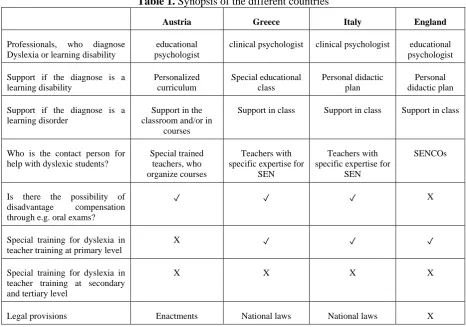
The following table is intended to provide an overview of the basic conditions of dyslexic students, which will be discussed in more detail below.
Table 1. Synopsis of the different countries
Austria Greece Italy England
Professionals, who diagnose Dyslexia or learning disability
educational psychologist
clinical psychologist clinical psychologist educational psychologist
Support if the diagnose is a learning disability Personalized curriculum Special educational class Personal didactic plan Personal didactic plan
Support if the diagnose is a learning disorder
Support in the classroom and/or in
courses
Support in class Support in class Support in class
Who is the contact person for help with dyslexic students?
Special trained teachers, who organize courses
Teachers with specific expertise for
SEN
Teachers with specific expertise for
SEN
SENCOs
Is there the possibility of disadvantage compensation through e.g. oral exams?
✓ ✓ ✓ X
Special training for dyslexia in teacher training at primary level
X ✓ ✓ ✓
Special training for dyslexia in teacher training at secondary and tertiary level
X X X X
Legal provisions Enactments National laws National laws X
Page 6
little attention. Furthermore, the diagnosis takes years, so it makes sense to familiarize teachers of secondary and tertiary education with the subject matter.
3. INCLUSIVE PERSPECTIVE
As a vision of inclusion of dyslexic students there was a common sense that all teachers should learn about dyslexia– not just in primary school teachers. Qualification of teachers should include practical knowledge on working with students with dyslexia – not only theoretical knowledge. In class, all pupils should be encouraged to participate, and teachers should be fluent in the use of strategies for this. In an inclusive society this should be considered the norm.
4. CONCLUSIONS
As part of the discussion on inclusion, i.a. in Austria, this has been established as part of teacher training. However, this involves dealing with diversity, which, however, takes little account of specific learning disorders. As a result, the associated rights are not sufficiently met in the countries represented.
REFERENCES
1. Barbiero, C, Montico, M, Lonciari, I, Monasta, L, Roberta P, et al. 2019, “The lost children: The under diagnosis of dyslexia in Italy. A cross-sectional national study”, PLoSONE 14(1), pp. 1-12. 2. Cigman, R. 2010, “Inclusion”, in P Peterson, E Baker & B McGaw (ed.), International
Encyclopedia of Education, 3rd edn, Elsevier, pp. 158-163.
3. Ehlert, A., Schroeder, U., Fritz-Stratmann, A. 2012, „Criticism of the discrepancy criterion of the diagnosis of dyslexia and dyscalculia”, Learning and Learning disorders, 1(3), 169-184.
4. European Agency for Special Needs and Inclusive Education 2018, Country information, viewed 14th February 2019, <https://www.european-agency.org/country-information>
5. Gavin, R 2007, “Dyslexia”, 2nd edn, Continuum, New York & London.
6. Gavin, R., Fawcett, A. J. 2008, “Dyslexia in Context: Research, Policy and Practice”, Whurr Publishers, London & Philadelphia.
7. Gröpel, W 2014, Decree I: Guidelines for the treatment of children with impaired acquisition and instructions for use of the written language, Vienna, viewed 14th February 2019, <http://www.schulpsychologie.at/fileadmin/upload/lernen_leistung/Legasthenie/erlass_aps.pdf> 8. Groth, K, Hasko, S, Bruder, J, Kunze, S, Schulte-Körne, G 2013, “On the effects of interventions
on reading and writing disorders: Evaluation of two funding concepts with a special focus on methodological aspects”, Learning and learning disorders, vol. 2(3), pp. 161-175.
9. Jones, A & Kindersley K 2013, “Dyslexia. Assessing and Reporting. The Patoss guide”, 2nd edn, Hodder Education, London.
10. Pappas, M. A., Papoutsi, C. & Drigas, A. S. 2018, “Policies, Practices, and Attitudes toward Inclusive Education: The Case of Greece”, Social Science, vol. 7 (90), pp. 1-15.
11. Schiefer, A 2014, “The school treatment of dyslexia - states in comparison guidelines and standards in the diagnosis, promotion and performance assessment in Austrian elementary schools”, master thesis, University of Vienna, Austria.
12. UNESCO 2005, Guidelines on Inclusion in Education, Paris, Unesco, viewed 16th February 2019,
Page 7
13. Zakopoulou, V, Anagnostopoulou, A, Christodoulides, P, Stavrou, L, Sarri, I, Mavreas, V & Tzoufi, M 2011, “An interpretative model of early indicators of specific developmental dyslexia in preschool age: A comparative presentation of three studies in Greece”, Research in Developmental Disabilities, vol. 32(6), pp. 3003-3016.
14. Zeman, M, Bajlicz, W 2014, Decree II: Guidelines for dealing with reading / writing difficulties (LRS) in the school context of the academic secondary school, Vienna, viewed 14th February
2019,