IRIS RECOGNITION SYSTEM AND COMPARISON OF
FEATURE EXTRACTION METHODS
Snehal S. Gaikwad, Dr. D. V. Jadhav
TSSM‘s Bhivarabai Sawant
College of Engg & Research, Narhe, Pune, India
Abstract- Biometric is the study of physical traits or behavioral characteristics of human beings. Among the biometrics, iris has highly accurate, reliable characteristics and remains stable over a person life. Iris recognition is the most reliable and accurate biometric security system. There are three modules in it-preprocessing, feature extraction, and Feature matching. This paper compares GLCM and Wavelet Transform to reduce FAR and improve accuracy.
Index Terms— Biometrics, GLCM, kNN classifier, Wavelet
Transform.
I. INTRODUCTION
Iris recognition (IR) is an image processing technology used as a biometric security system. Biometric security system is a science of identifying an individual based on the physiological or behavioral traits and has become reliable over the traditional token-based or knowledge based techniques like (passwords, key, cards, PIN etc). Iris recognition have wide range of application in national border control, computer login, cell phone or other wireless device based authentication, forensics, cryptography etc [1].
Iris has unique, stable, and non-invasive characteristics. Due to this reason iris recognition is the most promising, high security biometric technique than fingerprint recognition, face recognition, palm-print recognition etc. Human iris is the annular part between black pupil and white sclera as shown in fig. 1. Sclera has an extraordinary structure and provides many interlacing minute characteristics like freckles, coronas, stripes etc. Iris is said to have 266 unique spots.
Fig 1: image of human eye [2]
The aim of iris recognition system is to extract the artifact’s free features from the iris image and reduce the false rejections rate. To make iris recognition system, fast, robust and secured, wavelet transform have been used because it analyzes the image at various level of resolution. Bi-orthogonal wavelet is preferred due to its symmetric scaling and wavelet functions. GLCM is used to extract maximum features from iris texture. kNN classifier have been used for the classification of iris image data.
The paper is organized as follows; in Section II, iris recognition system is described. In Section III, methodology used in iris recognition system is described. In Section IV, the result and performance of the proposed method is discussed follow conclusion in Section V.
II. IRIS RECOGNITION SYSTEM
Iris recognition system shows in fig.2 consists of enrollment and authentication modules. During enrollment, iris image is captured, perform segmented and normalized, to extract the features from iris image. Then these extracted features are stored in database as references. During authentication (recognition), the features of new test iris image is compared with the features of iris stored in database during enrollment.
Fig 2: Block Diagram of Iris Recognition system
A. IMAGE ACQUISITION
B. IRIS SEGMENTATION
Iris is located between two circles one is iris-sclera boundary and another is iris-pupil boundary. In iris segmentation, the iris is located from the assimilated iris image.
C.IRIS NORMALIZATION
In iris normalization, iris image is remapping from Cartesian co-ordinates to polar co-ordinates.
D. FEATURE EXTRACTION
Iris has the different unique and stable features. During feature extraction, the features are extracted from the iris and stored it in the database..
E. CLASSIFICATION MATCHING
Once the features are extracted using different feature extraction algorithm, an iris image is transformed into a feature vector applied to classifier.[2]
III.METHODOLOGY
A. IRIS SEGMENTATION
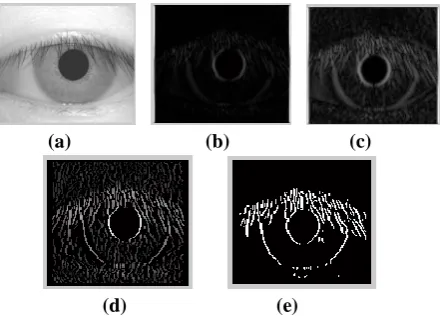
Segmentation is the process to locate the iris region from the whole eye image. The proposed algorithm for segmentation of iris used Canny Edge Detection and Hough Transformer.
CANNY EDGE DETECTION (CED): CED algorithm on an iris image, get the edge map of an image [3]. The steps involved in the CED are as follows.
1. Smoothing
The image captured by camera contains noise. While must be reduced. A Gaussian filter is applying on the image for smoothing.
2.Finding Gradients
By determining the gradients of the image, have to find the edges where grayscale intensity of the image changes most. After finding the gradient operator, the edges of the images is quite clearly indicate.
The gradient magnitude is determined by:
|G|= √G
2+ G
2And the direction of the edges is determined by:
θ = tan
−1(G
+ G
)
3. Non-Maxima Suppression
It is the technique used for thinning the edges of the images. Actually it converts the blurred edges into the sharp edges of images. This algorithm considers the gradient direction first and then uses 8-connected neighbourhood method. The intensity value of current pixel with the pixels in positive and negative direction. If the current pixel value is greater then save it and other values is getting suppress.
4. Thresholding
Potential edges are calculated by thresholding. CED uses double thresholding. Edge pixel stronger than the high threshold consider as strong and edge pixel low than the low threshold are blocked. The edge between two thresholds consider as weak.
5. Hysteresis
Hysteresis is the process of removing the false edges. In this process first consider threshold value from the output of Non-Maxima Suppression. Two threshold values are set. The upper threshold contains the true edges and the gaps. And the lower threshold contains the false edges. This gap is filled with the information by output of the lower threshold. Fig 3 shows the output of CED.
(a) (b) (c)
(d) (e)
Fig 3 : (a) input image, (b) smoothed image, (c) output of gradient magnitude, (d) output of nan-maxima suppression, (e) edge map.
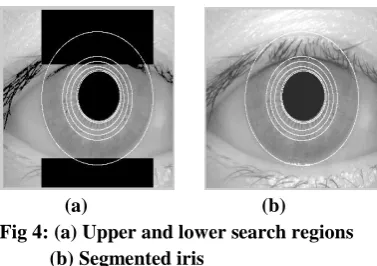
CIRCLE HOUGH TRANSFORM (CHT)
(a) (b)
Fig 4: (a) Upper and lower search regions (b) Segmented iris
B. IRIS NORMALIZATION
Normalization is the process of transforming the each pixel coordinates from the Cartesian to Polar. In proposed method, Daugman Rubber Sheet model is used. Actually there are dimensional consistencies between the two eye images. These consistencies are due to illumination, imaging distance, head tilt, rotation of eye and camera etc. Normalization process will produce same constant dimensions in same spatial location to the two same iris image captured by two different photographers. Normalized iris image shown in fig.5.
Fig 5 : normalized iris image.
C. IRIS FEATURE EXTRACTION
Feature extraction is performed on normalized iris image for the selection and extraction, is used to find out the important features to perform matching. Each eye contains its own unique specific characteristics. In these paper comparisons of two different feature extraction methods is shown:
DISCRETE Wavelet Transform
Wavelet transform is a mathematical function which satisfies the certain requirements of the signal and perform the decomposition of function. Wavelet transform is used in image processing because there is not as much of information is lost during the reconstruction of signals. Wavelet transform overcomes the resolution problem by using variable length window [6]. The function used to window the function is called wavelet.
In this paper, wavelet transform is used of bi-orthogonal types. Type of wavelet used in this research is Daubechies Wavelet. Daubechies, one of the brightest stars in the world of wavelet research. In this paper, the 4 level decomposition of image is performed shown in fig.6. And energy feature of an eye is calculated for the further classification. The energy of an image is given by-
Fig.6: 4-level decomposition of an iris image.
GLCM (Gray Level Co-occurrence Matrix)
GLCM is used to extract various textures features. GLCM of an image is computed using a displacement vector d,
defined by its radius δ and orientation θ.
Test image general form of GLCM From the co-occurrence matrix one can find the 12 different statistical features,[7] these are-
1) Energy:
2) Entropy
3) Contrast:
5) Homogeneity:
6) Correlation:
The following features are secondary and calculated from listed above;
7) Sum Average:
8) Sum Entropy:
9) Sum Variance:
10) Difference Variance:
Difference Variance = variance of g
x-y
11) Difference Entropy:
12) Maximum Correlation Coefficient:
Maximum Correlation Coefficient (MCC) = (second largest eigen value of Q )
0.5
D. IRIS TEMPLATE MATCHING PROCESS
One of the most fundamental means of image recognition within an image field is by template matching, in which a replica of an image is compared to all unknown images. In the proposed system, kNN algorithm is used for the classification of an image. The k-NN locates the k nearest instances to the query instance and determines its
Euclidean distance is used for calculating the distances given below.
IV. RESULTS AND TABLES
For the performances of iris recognition system, CASIA Iris V3 database is used. It contains 756 iris images of more than 108 subjects. To evaluate recognition rate 40 persons with 6 images samples per person is considered to create database and one image per person is used to test image.
The performance of iris recognition rate of 2 different feature extraction algorithms is compared;
METHODS FAR FRR ACCURACY COMPUTATION TIME
Wavelet Transform
0.039 0.006 99.97% 0.08sec GLCM
Algorithm
6.27 12.55 90.59% 0.38sec
V.CONCLUSION
This project has described a comparison of two different iris recognition techniques. FAR and FRR have been calculated for this methods. Wavelet transform with kNN algorithm is found to be best in terms of accuracy (99.97%) and computational time (i.e.0.08sec).
ACKNOWLEDGEMENT
Author would like to thank BSCONR for their kind support. Author also would like to thank iris database repository providers for making available a large iris database for our research purpose.
REFERENCES
1) Anil K. Jain, Arun Ross, and Salil Prabhaker, ”An Introduction to Biometric Recognition”, IEEE Trans. Circuits and Systems for Video Technology, vol. 14, no. 1, pp. 4-20, 2004.S.
2) J. Daugman. How iris recognition works. Proceedings of 2002 International Conference on Image Processing, Vol. 1, 2002.
3) J. Canny, A Computational Approach to Edge Detection., IEEE Transaction on Pattern Analysis and Machine Intelligence Vol. 8 (1986) 679-714
5) W. Boles and B. Boashash, a human identification technique using images of the iris and wavelet transform, IEEE trans. signal processing, vol. 46, no. 4, pp.1185-1188, 1998.
6) M. Kocionek, A. Materka, M. Strzelecki, and P. Szczypinski, Discrete wavelet transform derived features for digital image texture analysis, Proc. of Interational Conference on Signals and Electronic Systems, 18- 21 September 2001, Lodz, Poland, pp. 163-168.
7) A. Eleyan, H. Demirel, (2009) “Co-Occurrence based Statistical Approach for Face Recognition”, Computer and Information Sciences.
8) T.M. Cover, and P.E. Hart, “Nearest neighbor pattern classification”, IEEE Transactions on Information Theory, 13, pp. 21–27, 1967
9) Chinese Academy of Sciences Institute of Automation".Database of 756 Greyscale Eye Images. http://www.sinobiometrics.com Version 1.0, 2003. 10) Iris recognition" http://en.wikipedia.org/wiki/Iris