JETIR1711086 Journal of Emerging Technologies and Innovative Research (JETIR) www.jetir.org 505
New Direction in Computer Architecture
Assistant Professor
1Kulbhushan Singh
1Department of computer science
1, Swami Premanand Mahavidyalaya College
Mukerian
1Punjab
1, India
1Abstract
In this paper-computing environment as a worthy new direction for computer architecture research: personal mobile computing, where portable devices are used for visual computing and per-sonal communications tasks. Such a device supports in an integrated fashion all the functions provided to-day by a portable computer, a cellular phone, a digital camera and a video game. The requirements placed on the processor in this environment are energy efficiency, high performance for multimedia and DSP functions, and area efficient, scalable designs. Together, these trends will lead to a personal mobile-computing environment, a small device carried all the time that incorporates the functions of the pager, cellular phone, laptop computer, PDA, digital camera, and video game. The microprocessor needed for these devices is actually a merged general-purpose processor and digital-signal processor, with the power budget of the latter. The microprocessor needed for these devices is actually a merged general-purpose processor and digital-signal processor, with the power budget of the latter. Yet for almost two decades, architecture research has focused on desktop or server machines. We are designing processors of the future with a heavy bias toward the past. To design successful processor architectures for the future, we first need to
explore future applications and match their
requirements in a scalable, cost-effective way. The authors describe Vector IRAM, an initial approach in this direction, and challenge others in the very successful computer architecture community to investigate architectures with a heavy bias for the future.
We examine the architectures that were recently pro-posed for billion transistor microprocessors. While they are very promising for the stationary desktop and server workloads, we discover that most of them are un-able to meet the challenges of the new environment and provide the necessary enhancements for multimedia ap-plications running on portable devices.
We conclude with Vector IRAM, an initial example of a microprocessor architecture and implementation that matches the new environment.
1 Introduction
Advances in integrated circuits technology will soon provide the capability to integrate one billion transistors in a single chip [1]. This exciting opportunity presents computer architects and designers with the challenging problem of proposing microprocessor organizations able to utilize this huge transistor budget efficiently and meet the requirements of future applications. To ad-dress this challenge, IEEE Computer magazine hosted
The authors can be contacted through email at a special issue on “Billion Transistor Architectures” [2] in September 1997. The first three articles of the is-sue discussed problems and trends that will affect future processor design, while seven articles from academic research groups proposed microprocessor architectures and implementations for billion transistor chips. These proposals covered a wide architecture space, ranging from out-of-order designs to reconfigurable systems. In addition to the academic proposals, Intel and Hewlett-Packard presented the basic characteristics of their next generation IA-64 architecture [3], which is expected to dominate the high-performance processor market within a few years.
JETIR1711086 Journal of Emerging Technologies and Innovative Research (JETIR) www.jetir.org 506 In the second part of the paper we introduce a new
computing domain that we expect to play a significant role in driving technology in the next millennium: per-sonal mobile computing. In this paradigm, the basic personal computing and communication devices will be portable and battery operated, will support multimedia functions like speech recognition and video, and will be
sporadically interconnected through a wireless infras-tructure. A different set of requirements for the micro-processor, like real-time response, DSP support and en-ergy efficiency, arise in such an environment. We exam-ine the proposed organizations with respect to this en-vironment and discover that limited support for its re-quirements is present in most of them.
Finally we present Vector IRAM, a first effort for
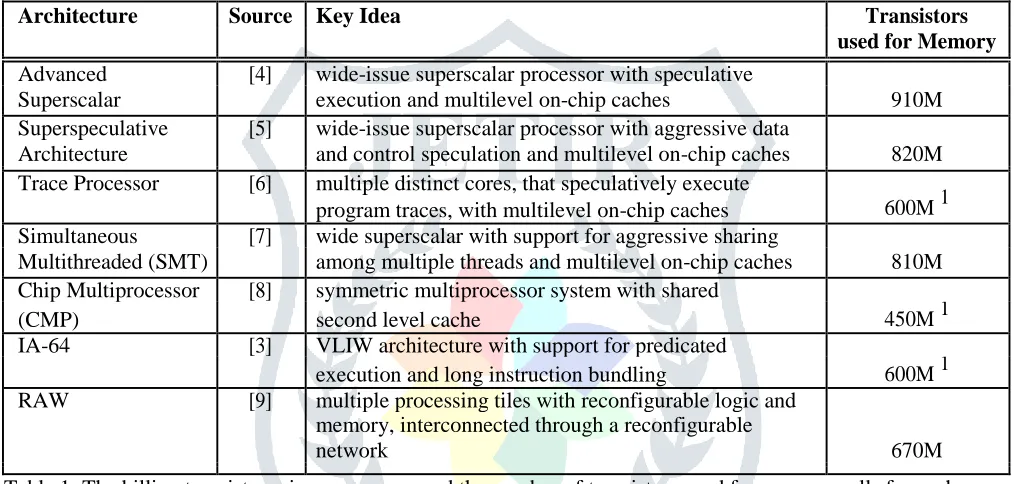
Table 1: The billion transistor microprocessors and the number of transistors used for memory cells for each
one1.We assume a billion transistor implementation for the Trace and IA-64 architecture.
Architecture Source Key Idea Transistors used for Memory
Advanced [4] wide-issue superscalar processor with speculative
Superscalar execution and multilevel on-chip caches 910M
Superspeculative [5] wide-issue superscalar processor with aggressive data
Architecture and control speculation and multilevel on-chip caches 820M
Trace Processor [6] multiple distinct cores, that speculatively execute
600M 1
program traces, with multilevel on-chip caches
Simultaneous [7] wide superscalar with support for aggressive sharing
Multithreaded (SMT) among multiple threads and multilevel on-chip caches 810M
Chip Multiprocessor [8] symmetric multiprocessor system with shared
(CMP) second level cache 450M 1
IA-64 [3] VLIW architecture with support for predicated
execution and long instruction bundling 600M 1
RAW [9] multiple processing tiles with reconfigurable logic and
memory, interconnected through a reconfigurable
JETIR1711086 Journal of Emerging Technologies and Innovative Research (JETIR) www.jetir.org 507
a microprocessor architecture and design that matches the requirements of the new environment. Vector IRAM combines a vector processing architecture with merged logic-DRAM technology in order to provide a scalable, cost efficient design for portable multimedia devices.
This paper reflects the opinion and expectations of its authors. We believe that in order to design suc-cessful processor architectures for the future, we first need to explore the future applications of computing and then try to match their requirements in a scalable, cost-efficient way. The goal of this paper is to point out the potential change in applications and motivate archi-tecture research in this direction.
2
Overview of the Billion Transistor
Processors
Table 1 summarizes the basic features of the billion transistor implementations for the proposed architec-tures as presented in the corresponding references. For the case of the Trace Processor and IA-64, descriptions of billion transistor implementations have not been pre-sented, hence certain features are speculated.
1These numbers include transistors for main
memory, caches and tags. They are calculated based on information from the ref-erenced papers. Note that
CMP uses considerably less than one bil-
The first two architectures (Advanced Superscalar and Superspeculative Architecture) have very similar characteristics. The basic idea is a wide superscalar or-ganization with multiple execution units or functional cores, that uses multi-level caching and aggressive pre-diction of data, control and even sequences of instruc-tions (traces) to utilize all the available instruction level parallelism (ILP). Due their similarity, we group them together and call them “Wide Superscalar” processors in the rest of this paper.
The Trace processor consists of multiple superscalar processing cores, each one executing a trace issued by a shared instruction issue unit. It also employs trace and data prediction and shared caches.
The Simultaneous Multithreaded (SMT)
processor uses multithreading at the granularity of issue slot to maximize the utilization of a wide-issue out-of-order superscalar processor at the cost of additional complex-ity in the issue and control logic.
The Chip Multiprocessor (CMP) uses the transistor budget by placing a symmetric multiprocessor on a sin-gle die. There will be eight uniprocessors on the chip,
all similar to current out-of-order processors, which will have separate first level caches but will share a
lion transistors, so 450M transistors is much more than half the bud-get. The numbers for the Trace processor and IA-64 were based on lower-limit expectations and the fact that their predecessors spent at least half their transistor budget on caches.
large second level cache and the main memory inter-face.
The IA-64 can be considered as the commercial rein-carnation of the VLIW architecture, renamed “Explic-itly Parallel Instruction Computer”. Its major innova-tions announced so far are support for bundling multi-ple long instructions and the instruction dependence in-formation attached to each one of them, which attack the problem of scaling and code density of older VLIW machines. It also includes hardware checks for hazards and interlocks so that binary compatibility can be main-tained across generations of chips. Finally, it supports predicated execution through general-purpose predica-tion registers to reduce control hazards.
The RAW machine is probably the most revolution-ary architecture proposed, supporting the case of re-configurable logic for general-purpose computing. The processor consists of 128 tiles, each with a process-ing core, small first level caches backed by a larger amount of dynamic memory (128 KBytes) used as main memory, and a reconfigurable functional unit. The tiles are interconnected with a reconfigurable network in an matrix fashion. The emphasis is placed on the soft-ware infrastructure, compiler and dynamic-event sup-port, which handles the partitioning and mapping of programs on the tiles, as well as the configuration se-lection, data routing and scheduling.
Table 1 also reports the number of transistors used for caches and main memory in each billion transistor processors. This varies from almost half the budget to 90% of it. It is interesting to notice that all but one do not use that budget as part of the main system mem-ory: 50% to 90% of their transistor budget is spent to build caches in order to tolerate the high latency and low bandwidth problem of external memory.
In other words, the conventional vision of comput-ers of the future is to spend most of the billion transis-tor budget on redundant, local copies of data normally found elsewhere in the system. Is such redundancy re-ally our best idea for the use of 500,000,000
JETIR1711086 Journal of Emerging Technologies and Innovative Research (JETIR) www.jetir.org 508 2
While die area is not a linear function of the transistor num-ber (memory transistors can be placed much more densely than logic transistors and redundancy enables repair of failed rows or columns), die cost is non-linear function of die area [10]. Thus, these 500M transistors are very expensive.
3 The Desktop/Server Computing
Domain
Current processors and computer systems are being optimized for the desktop and server domain, with SPEC’95 and TPC-C/D being the most popular bench-marks. This computing domain will likely be signifi-cant when the billion transistor chips will be available and similar benchmark suites will be in use. We play-fully call them “SPEC’04” for technical/scientific ap-plications and “TPC-F” for on-line transaction process-ing (OLTP) workloads.
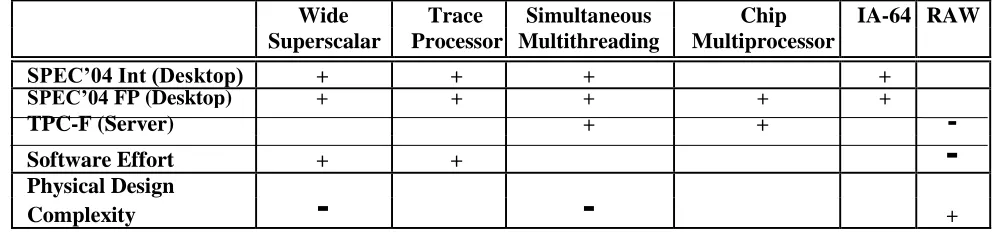
Table 2 presents our prediction of the performance of these processors for this domain using a grading
sys-tem of ”+” for strength, ” ” for neutrality, and ”
-
” forweakness.
For the desktop environment, the Wide Superscalar, Trace and Simultaneous Multithreading processors are expected to deliver the highest performance on integer SPEC’04, since out-of-order and advanced prediction techniques can utilize most of the available ILP of a single sequential program. IA-64 will perform slightly worse because VLIW compilers are not mature enough to outperform the most advanced hardware ILP tech-niques, which exploit run-time information. CMP and RAW will have inferior performance since desktop ap-plications have not been shown to be highly paralleliz-able. CMP will still benefit from the out-of-order fea-tures of its cores. For floating point applications on the other hand, parallelism and high memory bandwidth are more important than out-of-order execution, hence SMT and CMP will have some additional advantage.
For the server domain, CMP and SMT will pro-vide the best performance, due to their ability to utilize coarse-grain parallelism even with a single chip. Wide Superscalar, Trace processor or IA-64 systems will per-form worse, since current evidence is that out-of-order execution provides little benefit to database-like appli-cations [11]. With the RAW architecture it is difficult to predict any potential success of its software to map the parallelism of databases on reconfigurable logic and software controlled caches.
JETIR1711086 Journal of Emerging Technologies and Innovative Research (JETIR) www.jetir.org 509
Wide Trace Simultaneous Chip IA-64 RAW Superscalar Processor Multithreading Multiprocessor
SPEC’04 Int (Desktop) + + + +
SPEC’04 FP (Desktop) + + + + +
TPC-F (Server) + +
-
Software Effort + +
-
Physical Design
-
-
Complexity +
Table 2: The evaluation of the billion transistor processors for the desktop/server domain. Wide Superscalar proces-sors includes the Advanced Superscalar and Superspeculative processors.
livered if the applications are written in a multithreaded or parallel fashion. As the past decade has taught us, parallel programming for high performance is neither easy nor automated. For IA-64 a significant amount of work is required to enhance VLIW compilers. The RAW machine relies on the most challenging software development. Apart from the requirements of sophisti-cated routing, mapping and run-time scheduling tools, there is a need for development of compilers or libraries to make such an design usable.
A last issue is that of physical design complex-ity which includes the effort for design, verification and testing. Currently, the whole development of an advanced microprocessor takes almost 4 years and a few hundred engineers [2][12][13]. Functional and electrical verification and testing complexity has been steadily growing [14][15] and accounts for the major-ity of the processor development effort. The Wide Superscalar and Multithreading processors exacerbate both problems by using complex techniques like ag-gressive data/control prediction, out-of-order execution and multithreading, and by having non modular designs (multiple blocks individually designed). The Chip Mul-tiprocessor carries on the complexity of current out-of-order designs with support for cache coherency and multiprocessor communication. With the IA-64 archi-tecture, the basic challenge is the design and verifica-tion of the forwarding logic between the multiple func-tional units on the chip. The Trace processor and RAW machine are more modular designs. The trace pro-cessor employs replication of processing elements to reduce complexity. Still, trace prediction and issue, which involves intra-trace dependence check and reg-ister remapping, as well as intra-element forwarding in-cludes a significant portion of the complexity of a wide superscalar design. For the RAW processor, only a sin-
gle tile and network switch need to be designed and
replicated. Verification of a reconfigurable
organization is trivial in terms of the circuits, but verification of the mapping software is also required.
The conclusion from Table 2 is that the proposed bil-lion transistor processors have been optimized for such a computing environment and most of them promise impressive performance. The only concern for the fu-ture is the design complexity of these organizations.
4
A New Target for Future
Comput-ers: Personal Mobile Computing
In the last few years, we have experienced a significant change in technology drivers. While high-end systems alone used to direct the evolution of computing, current technology is mostly driven by the low-end systems due to their large volume. Within this environment, two im-portant trends have evolved that could change the shape of computing.
The first new trend is that of multimedia applica-tions. The recent improvements in circuits technol-ogy and innovations in software development have en-abled the use of real-time media data-types like video, speech, animation and music. These dynamic data-types greatly improve the usability, quality, productiv-ity and enjoyment of personal computers [16]. Func-tions like 3D graphics, video and visual imaging are al-ready included in the most popular applications and it is common knowledge that their influence on comput-ing will only increase:
“90% of desktop cycles will be spent on ‘media’ applications by 2000” [17]
JETIR1711086 Journal of Emerging Technologies and Innovative Research (JETIR) www.jetir.org 510
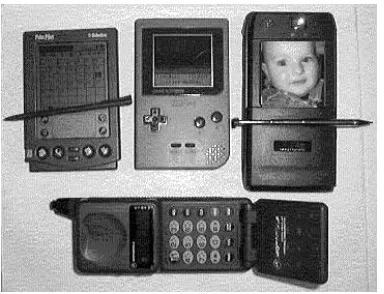
Figure 1: Personal mobile devices of the future will integrate the functions of current portable devices like PDAs, video games, digital cameras and cellular phones.
“many users would like outstanding 3D graphics and multimedia” [12]
“image, handwriting, and speech recognition will be other major challenges” [15]
At the same time, portable computing and commu-nication devices have gained large popularity. Inex-pensive “gadgets”, small enough to fit in a pocket, like personal digital assistants (PDA), palmtop computers, webphones and digital cameras were added to the list of portable devices like notebook computers, cellular phones, pagers and video games [18]. The functions supported by such devices are constantly expanded and multiple devices are converging into a single one. This leads to a natural increase in their demand for comput-ing power, but at the same time their size, weight and power consumption have to remain constant. For ex-ample, a typical PDA is 5 to 8 inches by 3.2 inches big, weighs six to twelve ounces, has 2 to 8 MBytes of mem-ory (ROM/RAM) and is expected to run on the same set of batteries for a period of a few days to a few weeks [18]. One should also notice the large software, operat-ing system and networkoperat-ing infrastructure developed for such devices (wireless modems, infra-red communica-tions etc): Windows CE and the PalmPilot development environment are prime examples [18].
Our expectation is that these two trends together will lead to a new application domain and market in the near future. In this environment, there will be a sin-gle personal computation and communication device, small enough to carry around all the time. This device will include the functions of a pager, a cellular phone,
a laptop computer, a PDA, a digital camera and a video game combined [19][20] (Figure 1) . The most impor-tant feature of such a device will be the interface and in-teraction with the user: voice and image input and out-put (speech and voice recognition) will be key functions used to type notes, scan documents and check the sur-rounding for specific objects [20]. A wireless infras-tructure for sporadic connectivity will be used for ser-vices like networking (www and email), telephony and global positioning system (GPS), while the device will be fully functional even in the absence of network con-nectivity.
Potentially this device will be all that a person may need to perform tasks ranging from keeping notes to making an on-line presentation, and from browsing the web to programming a VCR. The numerous uses of such devices and the potential large volume [20] lead us to expect that this computing domain will soon become at least as significant as desktop computing is today.
The microprocessor needed for these computing de-vices is actually a merged general-purpose processor and digital-signal processor (DSP), at the power budget of the latter. There are four major requirements: high performance for multimedia functions, energy/power efficiency, small size and low design complexity.
The basic characteristics of media-centric applica-tions that a processor needs to support or utilize in or-der to provide high-performance were specified in [16] in the same issue of IEEE Computer:
real-time response: instead of maximum peak
per-formance, sufficient worst case guaranteed perfor-mance is needed for real-time qualitative percep-tion for applications like video.
continuous-media data types: media functions are
JETIR1711086 Journal of Emerging Technologies and Innovative Research (JETIR) www.jetir.org 511
Wide Trace Simultaneous Chip Multi IA-64 RAW Superscalar Processor Multithreading Processor
Real-time
-
-
response unpredictability of out-of-order, branch prediction and/or caching techniques
Continuous Data-types caches do not efficiently support data streams with little locality
Fine-grained + Parallelism MMX-like extensions less efficient than full vector support reconfigurable
logic unit
Coarse-grained + + + Parallelism
-
Code size
potential use of loop unrolling and software VLIW hardware
pipelining for higher ILP
instr. configuration
Memory Bandwidth cache-based designs
Energy/
-
-
-
-
power power penalty for out-of-order schemes, complex issue logic, forwardingEfficiency and reconfigurable logic
Physical Design
-
-
+Complexity
-
-
Design
Scalability long wires for forwarding data or for reconfigurable interconnect
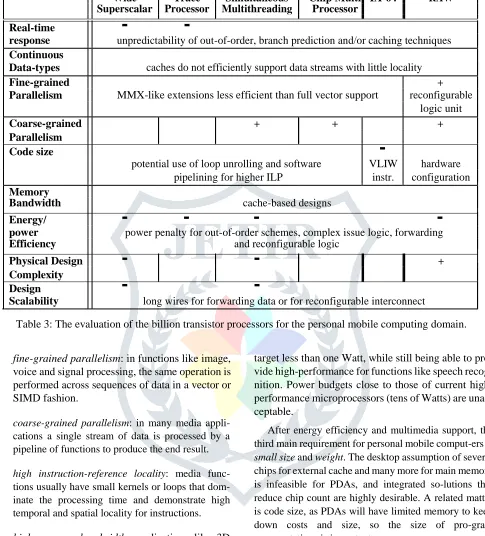
Table 3: The evaluation of the billion transistor processors for the personal mobile computing domain.
fine-grained parallelism: in functions like image,
voice and signal processing, the same operation is performed across sequences of data in a vector or SIMD fashion.
coarse-grained parallelism: in many media
appli-cations a single stream of data is processed by a pipeline of functions to produce the end result.
high instruction-reference locality: media
func-tions usually have small kernels or loops that dom-inate the processing time and demonstrate high temporal and spatial locality for instructions.
high memory bandwidth: applications like 3D
graphics require huge memory bandwidth for large data sets that have limited locality.
high network bandwidth: streaming data like
video or images from external sources requires high network and I/O bandwidth.
With a budget of less than two Watts for the whole device, the processor has to be designed with a power
target less than one Watt, while still being able to pro-vide high-performance for functions like speech recog-nition. Power budgets close to those of current high-performance microprocessors (tens of Watts) are unac-ceptable.
After energy efficiency and multimedia support, the third main requirement for personal mobile comput-ers is
small size and weight. The desktop assumption of several
chips for external cache and many more for main memory is infeasible for PDAs, and integrated so-lutions that reduce chip count are highly desirable. A related matter is code size, as PDAs will have limited memory to keep down costs and size, so the size of pro-gram representations is important.
JETIR1711086 Journal of Emerging Technologies and Innovative Research (JETIR) www.jetir.org 512
5
Processor Evaluation for Mobile
Multimedia Applications
Table 3 summarizes our evaluation of the billion tran-sistor architectures with respect to personal mobile computing.
The support for multimedia applications is limited in most architectures. Out-of-order techniques and caches make the delivered performance quite unpredictable for guaranteed real-time response, while hardware con-trolled caches also complicate support for continuous-media data-types. Fine-grained parallelism is exploited by using MMX-like or reconfigurable execution units. Still, MMX-like extensions expose data alignment is-sues to the software and restrict the number of vector or SIMD elements operations per instruction, limiting this way their usability and scalability. Coarse-grained par-allelism, on the other hand, is best on the Simultaneous Multithreading, Chip Multiprocessor and RAW archi-tectures.
Instruction reference locality has traditionally been exploited through large instruction caches. Yet, design-ers of portable system would prefer reductions in code size as suggested by the 16-bit instruction versions of MIPS and ARM [22]. Code size is a weakness for IA-64 and any other architecture that relies heavily on loop unrolling for performance, as it will surely be larger than that of 32-bit RISC machines. RAW may also have code size problems, as one must “program” the reconfigurable portion of each datapath. The code size penalty of the other designs will likely depend on how much they exploit loop unrolling and in-line procedures to expose enough parallelism for high performance.
Memory bandwidth is another limited resource for cache-based architectures, especially in the presence of multiple data sequences, with little locality, being streamed through the system. The potential use of streaming buffers and cache bypassing would help for sequential bandwidth but would still not address that of scattered or random accesses. In addition, it would be embarrassing to rely on cache bypassing when 50% to 90% of the transistors are dedicated to caches!
The energy/power efficiency issue, despite its im-portance both for portable and desktop domains [23], is not addressed in most designs. Redundant computation for out-of-order models, complex issue and dependence analysis logic, fetching a large number of instructions for a single loop, forwarding across long wires and use of the typically power hungry reconfigurable logic in-
crease the energy consumption of a single task and the power of the processor.
As for physical design scalability, forwarding re-sults across large chips or communication among mul-tiple core or tiles is the main problem of most de-signs. Such communication already requires multiple cycles in high-performance out-of-order designs. Sim-ple pipelining of long interconnects is not a sufficient solution as it exposes the timing of forwarding or com-munication to the scheduling logic or software and in-creases complexity.
The conclusion from Table 3 is that the proposed processors fail to meet many of the requirements of the new computing model. This indicates the need for mod-ifications of the architectures and designs or the pro-posal of different approaches.
6 Vector IRAM
Vector IRAM (VIRAM) [24], the architecture proposed by the research group of the authors, is a first effort for a processor architecture and design that matches the requirements of the mobile personal environment. VIRAM is based on two main ideas, vector processing and the integration of logic and DRAM on a single chip. The former addresses many of the demands of multime-dia processing, and the latter addresses the energy effi-ciency, size, and weight demands of PDAs. We do not believe that VIRAM is the last word on computer ar-chitecture research for mobile multimedia applications, but we hope it proves to be an promising first step.
JETIR1711086 Journal of Emerging Technologies and Innovative Research (JETIR) www.jetir.org 513
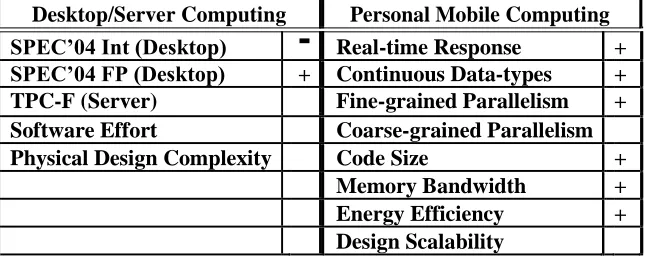
Desktop/Server Computing
-
Personal Mobile ComputingSPEC’04 Int (Desktop) Real-time Response + SPEC’04 FP (Desktop) + Continuous Data-types + TPC-F (Server) Fine-grained Parallelism + Software Effort Coarse-grained Parallelism Physical Design Complexity Code Size +
Memory Bandwidth +
Energy Efficiency +
Design Scalability
Table 4: The evaluation of VIRAM for the two computing environments. The grades presented are the medians of those assigned by reviewers.
Table 4 presents the grades for VIRAM for the two computing environments. We present the median grades given by reviewers of this paper, including the architects of some of the other billion transistor archi-tectures.
Obviously, VIRAM is not competitive within the desktop/server domain; indeed, this weakness for con-ventional computing is probably the main reason some are skeptical of the importance of merged logic-DRAM technology [25]. For the case of integer SPEC’04 no benefit can be expected from vector processing for inte-ger applications. Floating point intensive applications, on the other hand, have been shown to be highly vector-izable. All applications will still benefit from the low memory latency and high memory bandwidth. For the server domain, VIRAM is expected to perform poorly due
to limited on-chip memory3. A potentially differ-ent evaluation for the server domain could arise if we examine decision support (DSS) instead of OLTP work-loads. In this case, small code loops with highly data parallel operations dominate execution time [26], so ar-chitectures like VIRAM and RAW should perform sig-nificantly better than for OLTP workloads.
In terms of software effort, vectorizing compilers have been developed and used in commercial environ-ments for years now. Additional work is required to tune such compilers for multimedia workloads.
As for design complexity, VIRAM is a highly mod-ular design. The necessary building blocks are the in-order scalar core, the vector pipeline, which is repli-cated 8 times, and the basic memory array tile. Due to
3
While the use of VIRAM as the main CPU is not attractive for servers, a more radical approach to servers of the future places a VIRAM in each SIMM module [27] or each disk [28] and have them communicate over high speed serial lines via crossbar switches.
the lack of dependencies and forwarding in the vector model and the in-order paradigm, the verification effort is expected to be low.
The open question in this case is the complications of merging high-speed logic with DRAM to cost, yield and testing. Many DRAM companies are investing in merged logic-DRAM fabrication lines and many com-panies are exploring products in this area. Also, our project is submitting a test chip this summer with sev-eral key circuits of VIRAM in a merged logic-DRAM process. We expect the answer to this open question to be clearer in the next year. Unlike the other proposals, the challenge for VIRAM is the implementation tech-nology and not the microarchitectural design.
As mentioned above, VIRAM is a good match to the personal mobile computing model. The design is in-order and does not rely on caches, making the deliv-ered performance highly predictable. The vector model is superior to MMX-like solutions, as it provides ex-plicit support of the length of SIMD instructions, and it does not expose data packing and alignment to software and is scalable. Since most media processing functions are based on algorithms working on vectors of pixels or samples, its not surprising that highest performance can be delivered by a vector unit. Code size is small com-pared to other architectures as whole loops can specified in a single vector instruction. Memory bandwidth, both sequential and random is available from the on-chip hi-erarchical DRAM.
JETIR1711086 Journal of Emerging Technologies and Innovative Research (JETIR) www.jetir.org 514
ing in parallel on the same vector operation as well as from high-frequency operation, allowing the same per-formance at lower clock rate and thus lower voltage as long as the functional units are expanded. As en-ergy goes up with the square of the voltage in CMOS logic, such tradeoffs can dramatically improve energy efficiency. In addition, the execution model is strictly in order. Hence, the logic can be kept simple and power efficient. DRAM has been traditionally optimized for low-power and the hierarchical structure provides the ability to activate just the sub-banks containing the nec-essary data.
As for physical design scalability, the processor-memory crossbar is the only place were long wires are used. Still, the vector model can tolerate latency if suffi-cient fine-grain parallelism is available, so deep pipelin-ing is a viable solution without any hardware or soft-ware complications in this environment.
7 Conclusions
For almost two decades architecture research has been focussed on desktop or server machines. As a result of that attention, today’s microprocessors are 1000 times faster. Nevertheless, we are designing processors of the future with a heavy bias for the past. For example, the programs in the SPEC’95 suite were originally written many years ago, yet these were the main drivers for most papers in the special issue on billion transistor pro-cessors for 2010. A major point of this article is that we believe it is time for some of us in this very success-ful community to investigate architectures with a heavy bias for the future.
The historic concentration of processor research on stationary computing environments has been matched by a consolidation of the processor industry. Within a few years, this class of machines will likely be based on microprocessors using a single architecture from a single company. Perhaps it is time for some of us to de-clare victory, and explore future computer applications as well as future architectures.
In the last few years, the major use of computing devices has shifted to non-engineering areas. Personal computing is already the mainstream market, portable devices for computation, communication and entertain-ment have become popular, and multimedia functions drive the application market. We expect that the combi-nation of these will lead to the personal mobile comput-
ing domain, where portability, energy efficiency and ef-ficient interfaces through the use of media types (voice and images) will be the key features.
One advantage of this new target for the architec-ture community is its unquestionable need for improve-ments in terms of ”MIPS/Watt”, for either more de-manding applications like speech input or much longer battery life are desired for PDAs. Its less clear that desktop computers really need orders of magnitude more performance to run “MS-Office 2010”.
The question we asked is whether the proposed new architectures can meet the challenges of this new com-puting domain. Unfortunately, the answer is negative for most of them, at least in the form they were pre-sented. Limited and mostly “ad-hoc” support for multi-media or DSP functions is provided, power is not a se-rious issue and unlimited complexity of design and ver-ification is justified by even slightly higher peak perfor-mance.
Providing the necessary support for personal mobile computing requires a significant shift in the way we de-sign processors. The key requirements that processor designers will have to address will be energy efficiency to allow battery operated devices, focus on worst case performance instead of peak for real-time applications, multimedia and DSP support to enable visual comput-ing, and simple scalable designs with reduced develop-ment and verification cycles. New benchmarks suites, representative of the new types of workloads and re-quirements are also necessary.
JETIR1711086 Journal of Emerging Technologies and Innovative Research (JETIR) www.jetir.org 515
References
[1] Semiconductor Industry Association. The
Na-tional Technology Roadmap for Semiconductors.
SEMATECH Inc., 1997.
[2] D. Burger and D. Goodman. Billion-Transistor
Architectures - Guest Editors’ Introduction. IEEE
Computer, 30(9):46–48, September 1997.
[3] J. Crawford and J. Huck. Motivations and Design
Approach for the IA-64 64-Bit Instruction Set
Ar-chitecture. In the Proceedings of the
Microproces-sor Forum, October 1997.
[4] Y.N. Patt, S.J. Patel, M. Evers, D.H. Friendly, and
J. Stark. One Billion Transistors, One
Unipro-cessor, One Chip. IEEE Computer, 30(9):51–57,
September 1997.
[5] M. Lipasti and L.P. Shen. Superspeculative
Mi-croarchitecture for Beyond AD 2000. IEEE
Com-puter, 30(9):59–66, September 1997.
[6] J. Smith and S. Vajapeyam. Trace Processors: Moving to Fourth Generation Microarchitectures.
IEEE Computer, 30(9):68–74, September 1997.
[7] S.J. Eggers, J.S. Emer, H.M. Leby, J.L. Lo, R.L.
Stamm, and D.M. Tullsen. Simultaneous Mul-tithreading: a Platform for Next-Generation
Pro-cessors. IEEE MICRO, 17(5):12–19, October
1997.
[8] L. Hammond, B.A. Nayfeh, and K. Olukotun. A
Single-Chip Multiprocessor. IEEE Computer,
30(9):79–85, September 1997.
[9] E. Waingold, M. Taylor, D. Srikrishna, V. Sarkar,
W. Lee, V. Lee, J. Kim, M. Frank, P. Finch,
R. Barua, J. Babb, S. Amarasinghe, and A. Agar-wal. Baring It All to Software: Raw Machines.
IEEE Computer, 30(9):86–93, September 1997.
[10] J Hennessy and D. Patterson. Computer
Archi-tecture: A Quantitative Approach, second
edition.Morgan Kaufmann, 1996.
[11] K. Keeton, D.A. Patterson, Y.Q. He, and Baker W.E. Performance Characterization of the Quad Pentium Pro SMP Using OLTP Workloads. In the Proceedings of the 1998 International Symposium
on Computer Architecture (to appear), June 1998.
[12] G. Grohoski. Challenges and Trends in Processor
Design: Reining in Complexity. IEEE Computer,
31(1):41–42, January 1998.
[13] P. Rubinfeld. Challenges and Trends in Processor Design: Managing Problems in High Speed. IEEE
Computer, 31(1):47–48, January 1998.
[14] R. Colwell. Challenges and Trends in Processor
Design: Maintaining a Leading Position. IEEE
Computer, 31(1):45–47, January 1998.
[15] E. Killian. Challenges and Trends in Processor
Design: Challenges, Not Roadblocks. IEEE
Com-puter, 31(1):44–45, January 1998.
[16] K. Diefendorff and P. Dubey. How Multimedia
Workloads Will Change Processor Design. IEEE
Computer, 30(9):43–45, September 1997.
[17] W. Dally. Tomorrow’s Computing Engines.
Keynote Speech, Fourth International Sympo-sium on High-Performance Computer Architec-ture, February 1998.
[18] T. Lewis. Information Appliances: Gadget
Ne-topia. IEEE Computer, 31(1):59–68, January
1998.
[19] V. Cerf. The Next 50 Years of Networking. In the
ACM97 Conference Proceedings, March 1997.
[20] G. Bell and J. Gray. Beyond Calculation, The Next
50 Years of Computing, chapter The RevolutionYet
to Happen. Springer-Verlag, February 1997.
[21] D. Matzke. Will Physical Scalability Sabotage
Performance Gains? IEEE Computer, 30(9):37–
JETIR1711086 Journal of Emerging Technologies and Innovative Research (JETIR) www.jetir.org 516
[22] L. Goudge and S. Segars. Thumb: reducing the
cost of 32-bit RISC performance in portable and
consumer applications. In the Digest of Papers,
COMPCON ’96, February 1996.
[23] T. Mudge. Strategic Directions in Computer
Ar-chitecture. ACM Computing Surveys, 28(4):671–
678, December 1996.
[24] C.E. Kozyrakis, S. Perissakis, D. Patterson, T.
An-derson, K. Asanovic, N. Cardwell, R. Fromm, J. Golbus, B. Gribstad, K. Keeton, R. Thomas, N. Treuhaft, and K. Yelick. Scalable Processors in the Billion-Transistor Era: IRAM.
IEEE Com-puter, 30(9):75–78, September 1997.
[25] D. Lammers. Holy grail of embedded dram
chal-lenged. EE Times, 1997.
[26] P. Trancoso, J. Larriba-Pey, Z. Zhang, and J.
Tor-rellas. The Memory Performance of DSS Com-mercial Workloads in Shared-Memory
Multipro-cessors. In the Proceeding of the Third
Inter-national Symposium on High-Performance
Com-puter Architecture, January 1997.
[27] K. Keeton, R. Arpaci-Dusseau, and D.A. Patter-son. IRAM and SmartSIMM: Overcoming the I/O Bus Bottleneck. In the Workshop on ”MixingLogic and DRAM: Chips that Compute and Re-member”, the 24th Annual International Sympo-sium on
Computer Architecture, June 1997.