Finger Vein Recognition with Gray Level Co-Occurrence
Matrix based on Discreet Wavelet Transform
1
Mansur Mohamed Ali,
2Khalifa Nusrat,
3Abdelhafid Ali I. Mohamed,
4Mohamed Ali Hagal,
5
Hend Hadia Ali Almezogi,
6Javad Rahebi,
7Aybaba Hançerlioğullari
1,2,3,4,5,7Science & Arts Faculty, Department of Physics, Kastamono Universty 6University of Turkish Aeronautical Association, Ankara, Turkey
Abstract
In this paper, presented a robust method for finger vein recognition with gray level co- occurrence matrix based on the discrete wavelet transform. In first step for compression of the image we used wavelet Daubechies 4. Also we used local binary pattern for feature extraction.The combination of local binary pattern and gray level co- occurrence matrix with discrete wavelet transform is not used before for finger vein recognition. The simulation results show that this method is robust and fast for feature extraction and classification.
Keywords
GLCM; Discreet Wavelet Transform; Finger Vein Recognition; Classification.
I. Introducation
Biometrics is identifying humans by their physiological, behavioral and biological characteristics. Biometrics can be divided into two categories: physiological biometrics and behavioral biometrics. Physiological biometrics are those which recognize individuals from physiological or biological attributes like face, iris, fingerprint, finger vein, hand geometry, etc. Behavioral biometrics on the other hand, are those which recognize individuals from human attitudes such as hand writing, signature or voice recognition. Fig. 1, illustrate enrollment to and authentication with the biometric system.
Fig. 1: Enrollment to a biometric system: First, the biometric data is captured. Then, extracted information is stored in an enrollment template and the template is stored in the database
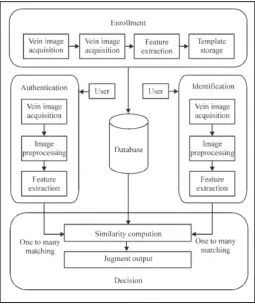
A general framework of vein recognition is shown in fig. 2. For the feature extraction step of the finger-vein recognition, which is the most important step, popular methods such as Line Tracking (LT), Maximum Curvature (MC) and Wide Line Detector (WL) are used in the literature. Among these, the LT method is very slow in the feature extraction phase. Moreover, LT, MC and WL methods are susceptible to rotation, translation and noise.
Fig. 2: A General Framework of Vein Recognition
II. Related work
A. Finger – Vein Recognition
Disadvantages of fingerprint technology made scientists to think about using what is underneath the skin. Under the skin there are blood vessels which are unique to individuals (even in twins) and this uniqueness made a new biometric system based on finger veins. Biometrics based on veins, i.e., vascular biometrics are not limited to the fingers. Retina, face and hands can be identified using vascular properties too, however, the hardware devices used for finger vein identification are more preferred than the others because people are used to using their fingers for identification already. For capturing a vascular network, hemoglobin plays an important role by absorbing infrared light and after absorbing infrared light vein patterns are captured. Distance is very important in absorbing infrared light between skin and vessels: bigger distance leads to more noise in the captured image. Palms, back of the hands and fingers can be used as biometric data, however, people mostly prefer to use their fingers.
B. Devices for Finger-vein Image Acquisition
the quality of the images. Moreover, the image acquisition device should be small and cheap, and it should provide high resolution images. In captured images, the veins appear as gray patterns. As can be seen in Figure 3 finger is placed between the Infrared Light Emitting Diodes (IR-LEDs) and imaging device [1].
Fig. 3: Principle of Personal Identification Using Finger-Vein Patterns [1].
C. Some Advantages and Disadvantages of Finger-Vein Systems
Some of the advantages of the finger vein systems include [2]: Internal nature: Vein patterns are inside the skin and cannot
1.
be seen by naked eye, therefore, damaged skin will not reduce the chance of finding veins behind the skin. Furthermore, dry, wet or dirty hands would not affect the system.
Duplicate protection: Vein patterns are difficult to copy 2.
because blood needs to flow during image capturing. Scientists in Hitachi proved that it is impossible to cut the finger and register it to the system because blood will seep out. Hygienic readers: In contrast to fingerprint and hand geometry 3.
systems, readers are believed to be free of germs because users do not touch the sensor.
Usability: These systems are very easy to use. 4.
No cultural resistance.
5.
Uniqueness: Finger veins are unique even between twins and
6.
do not change by aging.
Finger vein recognition is one of the forefront methods in biometric technology in recent years. Many successful methods such as Line Tracking (LT) [1], Maximum Curvature (MC) [5] and Wide Line Detector (WL) [6] have been proposed for finger vein recognition. Among these methods, LT has a very slow matching and feature extraction phase. Moreover, LT, MC and WL are rotation dependent, and they are affected by image noise. To overcome these drawbacks, using some popular feature descriptors widely used for several Computer Vision or Pattern Recognition (CVPR) are proposed. These descriptors include Fourier Descriptors (FD) [7], Zernike Moments (ZM) [8], Histogram of Oriented Gradients (HOG) [9], Local Binary Patterns (LBP) [10] and Global Binary Patterns (GBP) [11]. Among these, FD, ZM, HOG, LBP and GBP have not been applied to the finger vein recognition before. These descriptors are compared against LT, MC and WL. The novelty of the thesis is in (i) applying new feature extraction methods that have not been used for finger vein recognition before and (ii) evaluating the performance of all these methods under translation, rotation and noise. The focus is on the “feature extraction” step, and the preprocessing step is kept as simple as possible. As for matching, the matching method specific to LT, MC and WL which is called mismatch ratio is used and for all other descriptors, three different distance metrics called Euclidean distance, X2 (Chi-Square distance) and Earth Mover’s Distance (EMD) have been applied and compared to each other. For performance evaluation,
the SDUMLA-HMT finger vein database that is publicly available is used. The contributions of the thesis have been accepted for “the 9th International Joint Conference on Computer Vision, Imaging and Computer Graphics Theory and Applications, VISAPP”.
III. Material and Method
A. Database
The database in this study is carried out from SDUMLA-HMT finger-vein database that is publicly available [4]. This database contains 3; 816 images from both hands and provided images are index finger, middle finger and ring finger and for each finger six different images are captured. Fig. 4 displays small sample
of the database.
Fig. 4: Finger Vein Database [4]
The original images are of size 320*240, however, for the sake of faster analysis, the size is reduced to 160*120 using nearest neighbor interpolation. The images are gray scale images in the intensity range of [0-255]. Using Prewitt edge detector, strong edges are extracted, the boundaries of the finger are found and the mask image is produced. This statues is shown in fig. 5.
Fig. 5: Finding the Mask for the Finger Region in the Image. (a) Original Image, (b) Prewitt Edge Detection, (c) Masked Image.
Masking the image is a very important step since it eliminates the irrelevant areas.
There are unit multiple public finger vein databases, and five typical databases area unit introduced at intervals the Table number one. The first one named MMCBNU_6000 [12] database shown in Table 1.
Table 1: The Most Famous Database
Database Subject number Finger no. per subject
Image number per finger
Image size (pixels) MMCBNU_6000
[12] 100 6 10 640×480
HKPU-FV[13] 156 2 12 513×256
THU-FV[14] 610 1 2 200×100
UTFV[3] [15] 60 6 4 672×380
SDUMLA-AV [16] 106 6 6 320×240
PKU(V2)[14] 5,028 5 3 672×380
It contains finger vein images acquired from different persons and with different skin colors according to the evaluation of average image gray value, image contrast and entropy on the images from the available databases, the acquired images in MMCBNU_6000 have comparable image quality. The second vein finger data base called HKPU-FV [13] which was created by Ajay and Zhou. UTFV FV database was from University of Twente, Recently, 2 finger vein databases were produced, that were from Chonbuk Nation University [14] and Tsinghua University [15]. SDUMLA-HMT[16] is an open finger vein database where every subject who involved was asked to produce images of his/her index finger, middle finger and ring finger of both hands, and the collection for each of the 6 fingers is repeated for 6 times to obtain 6 finger vein images.
The largest scale of finger vein database as reported is PKU Finger Vein Database [14] from Peking University which was established based on the checking attendance system.
B. Preliminaries ans Methodolgy
In this paper we used wavelet transformation based on Daubechies four for image compression. Here the first level of wavelet transformation is take and then from the result of wavelet we take the gray level co-occurrence matrix GLCM. We used 8 global feature for feature extraction. These features are used for every image. For training images we used 1 – 7 image for each person. The result is shown in table 1. The proposed method is arranged below.
C. Discrete Wavelet Transform
Wavelet Transformation (WT) is a specific family of linear time-frequency transformations in mathematics and engineering sciences. The WT consists of the wavelet analysis, which describes the transition of the time representation into the spectral or wavelet representation, and the wavelet synthesis, which describes the back transformation of the wavelet transformed into the time representation. The term wavelet refers to the basic function used for the transformation, with which the signal or image to be analyzed is compared - generally an N-dimensional function. Like all linear time-to-frequency transformations, the wavelet transform is also subject to the uncertainty of the telecommunication technique, that is, an event can not be localized arbitrarily exactly in time and frequency. There is always a compromise between good temporal resolution and good resolution in the frequency range.The wavelet transformation is primarily divided into two camps, namely the continuous wavelet transformation, which has its main application in mathematics and data analysis, and the discrete wavelet transformation, which is more likely to be found in engineering sciences and whose application in the Range of data reduction, data compression, and signal processing.Also in this paper daubechies wavelet is used for implementation.
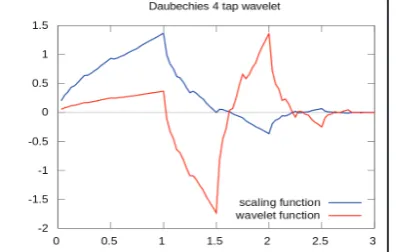
Fig. 6: Example of Daubechies Wavelet Transform
Gray-Level Co-occurrence matrix
Our observation of finger vein image is to be allocated to regions with normal tissues. Using co-occurrence matrices so that in normal tissues need to represent. As in the figure 1, 0°, 45°, 90° and 135° from the co-occurrence matrix is used [1].
In fig. 2 the example of GLCM is illustrated. As shown in this figure the fig. 2(a) shows the result of this algorithm.
Fig. 7: GLCM Construction Based on a (a) Test Image Along Four Possible Directions (b) 0° (c) 45° (d) 90° and (e) 135° with a distance d =1.
E. Feature Extraction
d = 3, θ = 0°, 45°, 90° and 135° constant GLCM is calculated. So there are four co-occurrence matrices. According GLCM in each computer, the successful co-occurrence matrix, which characterizes the behavior of the statistical property is obtained 8. It features: Angular Second Moment, Contrast, Correlations, Dissimilarity, Entropy, Homogeneity, Maximum probability, Average. The equations of these features are below:
1. Contrast
∑∑
−
=
i j
i
j
p
x
y
f
(
)
2(
,
)
1
2. Correlation
3. Entropy
∑∑
=
i j
p
x
y
y
x
p
f
)
,
(
log
)
,
(
3
4. Homogeneity
∑∑
−
+
=
i j
i
j
y
x
p
f
1
)
,
(
4
Where, x and y is coordinate of pixel. p(x,y) is intensity of output gray level co-occurrence matrix. i and j is the length of row and column of image.
F. Euclidean Norm
In Cartesian coordinates, if i = (i1, i2,..., in) and j = (j1, j2,..., jn) are
∑
=
− =
− + + − + − = =
n
k k k
n n
j i
j i j
i j i j i d j i d
1
2
2 2
2 2 2
1 1
)
(
)
( ...
)
(
)
(
)
, (
)
, (
(2)
The position of a point in a Euclidean n-space is a Euclidean vector. So, p and q are Euclidean vectors, starting from the origin of the space, and their tips indicate two points. The Euclidean
norm, or Euclidean length, or magnitude of a vector measures the length of the vector:
I
I
i
i
i
I
=
12+
22+
...
+
n2=
.
(3)Where the last equation involves the dot product.
IV. Result and Discussion
In this paper we used finger vein database. The example of this database for first person is in fig. 3. In this study we have proposed a method for finger vein identification. This ability to extraction the identification algorithm provides better result. In proposed method finger vein identification have been processed by using MATLAB software. Feature extraction is performed using Co-occurrence matrix. Extracted features of the finger veins are then used in the vector and compared with. Many type of features are tested to get the different results.
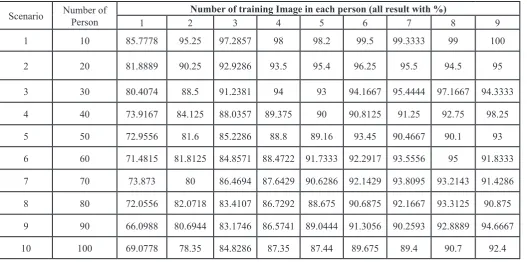
Fig. 8: Comparison Between the Scenarios
As seen in this table the best result is get for 10 person. Also when the 9 image is select as train image the 100 percent for accuracy is get.
Table 2: Average of all Result
Scenario Number of Person Number of training Image in each person (all result with %)
1 2 3 4 5 6 7 8 9
1 10 85.7778 95.25 97.2857 98 98.2 99.5 99.3333 99 100
2 20 81.8889 90.25 92.9286 93.5 95.4 96.25 95.5 94.5 95
3 30 80.4074 88.5 91.2381 94 93 94.1667 95.4444 97.1667 94.3333
4 40 73.9167 84.125 88.0357 89.375 90 90.8125 91.25 92.75 98.25
5 50 72.9556 81.6 85.2286 88.8 89.16 93.45 90.4667 90.1 93
6 60 71.4815 81.8125 84.8571 88.4722 91.7333 92.2917 93.5556 95 91.8333
7 70 73.873 80 86.4694 87.6429 90.6286 92.1429 93.8095 93.2143 91.4286
8 80 72.0556 82.0718 83.4107 86.7292 88.675 90.6875 92.1667 93.3125 90.875
9 90 66.0988 80.6944 83.1746 86.5741 89.0444 91.3056 90.2593 92.8889 94.6667
10 100 69.0778 78.35 84.8286 87.35 87.44 89.675 89.4 90.7 92.4
V. Conclusion
This paper present a survey of human identification with finger vein recognition. In this paper some method anddatabase is investigated. There are different feature description methods in the literature that can be analyzed. For example, there are extensions of LBP, HOG and GBP that provide several invariances, such as rotation invariance, scale invariance. These extensions are worth analyzing as future work. For analyzing resilience to rotation and translation, rotating the finger in different directions and axes will be much realistic, moreover, changing the distance between the finger and camera can be tested instead of artificially rotating, translating and adding noise to the images.
Reference
[1] N. Miura, A. Nagasaka, T. Miyatake,"Feature extraction of finger-vein patterns based on repeated line tracking and its application to personal identification," Machine Vision and Applications, Vol. 15, pp. 194-203, 2004.
[2] H. Vallabh,"Authentication using finger-vein recognition," University of Johannesburg, 2012.
[3] R. M. Haralick, K. Shanmugam, I. H. Dinstein,"Textural features for image classification," Systems, Man and Cybernetics, IEEE Transactions on, pp. 610-621, 1973. [4] [Online] Available: http://mla.sdu.edu.cn/sdumla-hmt.
[5] N. Miura, A. Nagasaka, T. Miyatake,"Extraction of finger-vein patterns using maximum curvature points in image profiles," IEICE TRANSACTIONS on Information and Systems, Vol. 90, pp. 1185-1194, 2007.
[6] B. Huang, Y. Dai, R. Li, D. Tang, W. Li,"Finger-vein authentication based on wide line detector and pattern normalization," In Pattern Recognition (ICPR), 2010 20th International Conference on, 2010, pp. 1269-1272.
[7] R. C. Gonzales, R. E. Woods, S. L. Eddins,"Digital image processing using MATLAB", Pearson Prentice Hall, 2004. [8] M. R. Teague,"Image analysis via the general theory of
moments", JOSA, Vol. 70, pp. 920-930, 1980.
[9] N. Dalal, B. Triggs,"Histograms of oriented gradients for human detection," In Computer Vision and Pattern Recognition, 2005. CVPR 2005. IEEE Computer Society Conference on, 2005, pp. 886-893.
[10] T. Ojala, M. Pietikäinen, D. Harwood,"A comparative study of texture measures with classification based on featured distributions," Pattern recognition, Vol. 29, pp. 51-59, 1996.
[11] E. Sivri,"Shape descriptors based on intersection consistency and global binary patterns," Masters thesis, Middle East Technical University, Ankara, Turkey, 2012.
[12] Yu Lu, Shan Juan Xie, Sook Yoon, Zhihui Wang, Dong Sun Park.: An Available Database for the Research of Finger Vein Recognition", 6th International Congress on Image and Signal Processing (CISP 2013).
[13] Kumar, A., Zhou, Y.B.: Human identification using finger images. IEEE Transactions on Image Process, 21(4), pp. 2228–2244, 2012.
[14] Lu, Y., Xie, S.J., Yoon, S., Wang, Z., Park, D.S.,"An Available Database for the Research of Finger Vein Recognition", In Proceedings of International Congress on Image and Signal Processing, pp. 386-392, Hangzhou, China, 2013.
[15] Yang, W.M., Huang, X.L., Zhou, F., Liao, Q.M., "Comparative competitive coding for personal identification by using finger vein and finger dorsal texture fusion", Information Sciences, 268(6): pp. 20-32, 2013.
![Fig. 3: Principle of Personal Identification Using Finger-Vein Patterns [1].](https://thumb-us.123doks.com/thumbv2/123dok_us/1331167.1641425/2.595.304.557.638.795/fig-principle-personal-identification-using-finger-vein-patterns.webp)