A Comparative Study on Target Detection in Military
Field Using Various Digital Image Processing
Techniques
1
Arya Raj A.K, 2 Radhakrishnan B
1
PG Student, Department of Computer Science & Engineering, Baselios Mathews II College of Engineering Sasthamcotta, Kollam
2
Asst. Professor, , Baselios Mathews II College of Engineering Sasthamcotta, Kollam
Abstract - Automatic aerial image interpretation is one of the new rising high-tech application fields, and it’s proverbially applied in the military domain. This survey paper compares a different approach for target detection and classification of objects by texture clustering and structure features extraction. By clustering the texture feature effective image segmentation is achieved and thus obtain the structure features of target objects. Typical man-made objects including airplanes, tank, ships, mines and vehicles in complex natural background can be detected.
Keywords –Target Detection, DCT, Morphological Enhancing Texture Clustering, Segmentation, Structure Feature Extraction.
1. Introduction
Defending the nation from external aggression and threats, and maintaining peace and security within its borders are the primary missions of the Indian Military and thereby ensuring national security and unity. In the military field digital image processing is used in a wide variety of applications. Object detection is the basis for target tracking and recognition in image processing. The automatic detection and marking of target objects will improve the efficiency of remote sensing image interpretation. It will be beneficial for controlling unmanned aerial vehicles and in situation of a war. In this survey we have made an attempt to explore all the available techniques of image processing, used in military field for target detection. Some of the image processing technique used in the survey includes DCT, Morphological Enhancing, Texture Feature Clustering, Segmentation, and Structure Feature Extraction. The techniques discussed here are unique in its nature. The details of each technique are explained below.
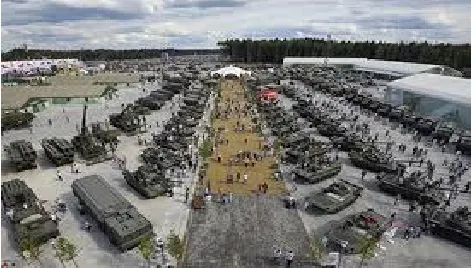
Fig 1. Military Target Detection
2. Techniques
2.1 DCT
The discrete cosine transform (DCT) [5] helps to separate the image into parts with respect to the image's visual quality. It transforms a signal or image from the spatial domain to the frequency domain. DCT is similar to the Fast Fourier Transform (FFT), but it can approximate lines well with fewer coefficients .Object detection by human visual system depends on the ratio between high-frequency and low-high-frequency content. Thus the contrast can be measured as the ratio of high-frequency and low-frequency content in the bands of the DCT matrix. Let the DCT transform of an 8x8 block in the image be {}. First classify the coefficients into 15 different frequency bands. At the nth band the measurement is,
where = ∑,
N = + 1, < 8
14 − + 1, ≥ 8!
2.2 Morphological Enhancement
During preprocessing, we check the contrast measure of the image. If the contrast of the image is poor suitable enhancement methods are used to enhance the contrast. Morphological enhancement [6] is used. Morphological Enhancement is a technique in image processing which is based on the shape and form of objects. The output image is obtained by applying the structuring element to an input image. The value of each pixel in the input image is based on a comparison of the corresponding pixel in the input image with its neighbors. Mathematical morphology is normally used to enhance the contrast of the image. There are many useful operators used in mathematical morphology. They are dilation, erosion, opening and closing. Erosion-dilation method is adopted in this survey. This method is initially applied to grey level images and later extended to color images. Mathematical morphology is a set theoretical approach to enhance the contrast of multidimensional digital signal on the basis of structuring element used. For the analysis and processing of geometrical structures, this technique is used.
2.3Texture Feature Extraction
For the segmentation or classification of image, image textures can be used efficiently. In this survey we verify different primary location approaches based on gray value and texture feature [7-10]. By comparing the clustering results of statistics between histogram-based and Tamura-based texture features, ideal texture feature is selected. The texture feature can be described by using Histogram.
Consider a random variable z, denoting gray levels. The nth moment of z about mean is,
"=∑ #$()*%+, %− &'-#$%' (2)
where L is number of gray levels, m is the mean value of z, and
& =∑/−1.=0$.-#$.'
Brightness is measured using statistics m and contrast is measured using standard deviation 1
1 = 2"3#$'=√12 (3)
Tamura proposed six textural properties and they are coarseness, contrast, directionality, line-likeness, regularity and roughness. Aim of coarseness is to identify the largest size at which a texture exists. The distribution
of gray levels that varies in an image and to what extent its distribution is biased to black or white will be determined by the contrast measures. In order to define the contrast the second order and normalized fourth–order central moments of the gray levels are used. In this survey, Tamura-based texture feature extraction [10] is conducted and the contrast can be derived as,
6789:;<= 1
=41>4 (4)
where =?= "?>1? and "?is the 4th moment and 13 is the variance.
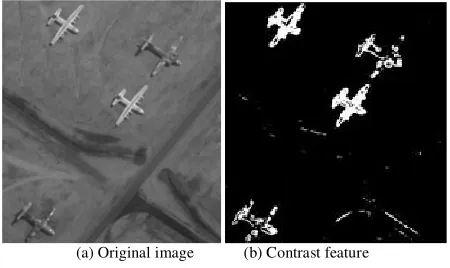
(a) Original image (b) Contrast feature
Fig 2. Comparison of contrast
This figure shows the difference in contrast measure between objects areas and background. Fig. 2(b) shows the FCM clustering to Tamura texture feature contrast.
2.4 Segmentation
Image Segmentation is the process of partitioning a digital image into multiple segments. The result is a set of segments that covers the entire image. Various image segmentation methods are available: Thresholding, Region based, Clustering, Compression-based, Histogram-based etc. Based on image texture there are two types of segmentation. They are,
1. Region based and
2. Boundary based.
levels are selected) is the key of this method. Different thresholding methods are maximum entropy method, Otsu’s method and k-means clustering.
Clustering meansa procedure to determine the grouping of unlabeled data. In this technique, a feature vector for each pixel of the image is extracted and then a similarity metric is used to cluster vectors having similar features. Feature vectors are clustered through Fuzzy C means clustering. Pixels belong to same texture region will have same texture characteristics and should be close to each other in the feature space. Labeling each cluster yields the segmented image.
Unlike previous methods, a reliable framework for incorporating pixel dependencies into segmentation is employed and that is called Markov Random Fields [2]. There is an inter-spacial dependency between pixels and this ensured the use of MRF models for a range of applications. In the domain of image analysis, de-noising and segmentation, it provides global optima even when defined on local features used for novel research. The image segmentation criteria used by MRF to find the labeling schema has the maximum probability for a given set of features. Compared to other models the main advantage of this method is that, accurate segmentation is achieved on seabed types where other models failed. Because of this, in this survey we propose MRF for the segmentation process.
2.5 Structure Feature Extraction
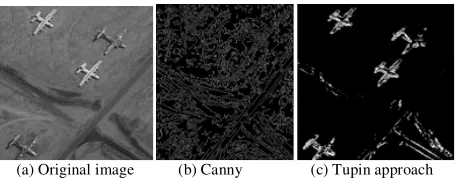
After primary location by clustering the texture feature, target objects are classified as ships, tanks, mine like objects, flight and so on. This classification is based on the geometric structure feature extraction [7][10]. In this method the target objects are marked by additional lines edges and corners. The survey compares different edge detection results using Tupin and Canny.
(a) Original image (b) Canny (c) Tupin approach
Fig 3. Comparison of Canny and Tupin Edge Detection
Fig 3(b) and 3(c). Show the edge detection result of Canny and Tupin approach. From this comparison survey we can see that edge detected by Tupin accord better result than Canny.
3. Literature Survey
Fei Cai et al. [1] propose an approach for target detection by extracting texture and geometry structure features. Here a target detection methodology is designed, by which typical man-made objects in complex natural background, including air planes, tanks and vehicles can be detected. Different primary location approaches based on gray value and texture features are verified. The experiments compares the clustering results of different statistics between histogram-based and Tamura-based texture feature in order to choose ideal texture feature, contrast based on Tamura is adopted. FCM for its low computational consumption and effective segmentation, employed as the clustering algorithm. Finally the objects are marked by additional lines, edges and corner detection. In order to detect the corners Susan operator is used and detect the edges by Tupin approach, Hough line detection is used to extract the lines.
Guo-Jia Hou et al. [2] On the basis of color and shape features they detect and recognize the techniques of underwater man-made objects. First, by applying a color-based algorithm, the objects of interest in an underwater image are extracted. A two-dimensional Otsu’s algorithm is utilized for removing the background color noise. A robust algorithm based on shape signature is employed to recognize the shape type of a regular object. Different process of approach for underwater object detection and recognition includes: non-uniform illumination is corrected using homomorphic filtering and enhance contrast in the image; the color contrast of an image is equalized by a contrast-stretching algorithm; and wavelet domain de-noising based on threshold processing is used to suppress the noise amplified after the previous steps. To extract the object of interest a color-based extraction algorithm (CEA) is applied. For removing the background color noise an improved two-dimensional Otsu algorithm is utilized. After obtaining the object contours using canny edge detector, they utilize a shape signature-based recognition algorithm (SSRA) to discriminate the type of objects.
non ship, unstructured ship, structure 1 (oil tanker appearance), and structure 2 (bulk carrier or container ship appearance)
Esther Dura [4] introduces an image processing technique for the detection and classification of man-made object in side-scan sonar images. Purpose of this work includes
1. Detection of mine like objects,
2. Classification of mine like objects.
In the first stage several segmentation techniques and matched filters are used. The main techniques used for segmentation are: 1) thresholding 2) clustering and 3) Markov Random Fields.. In the second stage classification is used and this procedure normally requires the extraction of mine features. For extracting MLO’s features the main feature used in the literature fall into two categories: 1) shape features 2) gray-level features. Classification is the detection of MLO’s in side-scan images. There various techniques examined can be broadly divided into three groups: supervised, semi-supervised and unsupervised. The classification problem is not widely addressed in the literature. The few approaches that deal with this problem fall into two different groups: mono-view and multi-view classification depending on whether they make use of a single view or several views for determining the shape.
4. Challenges Faced
It will be difficult to perform segmentation accurately in areas where there are a lot of trees.
Images captured during coarse weather conditions like heavy rain or snow fall will contain a lot of noise. Hence we need to perform de-noising techniques and as a result the complexity will increase.
5. Conclusions
This survey paper proposes an approach for detecting targets in the military field. Target objects are detected by clustering the texture feature and then extracting the geometric structure features. During the texture feature extraction process, we compare the segmentation result of histogram-based and Tamura-based texture features. FCM is chosen as the clustering algorithm. From the study of different segmentation methods we prefer Markov Random Field method because accurate segmentation was achieved on seabed types where other models failed. For geometric structure feature extraction edges of the target objects are detected. Canny and Tupin edge detection method is compared and from this survey Tupin is considered better than Canny.
References
[1] Fei Cai, Honghui Chen, Jianwei Ma, “ Man-made Object Detection Based on Texture Clustering and Geometric Structure Feature Extracting”, I.J. Information Technology and Computer Science, 2011, Volume 2, pp.9-16.
[2] Guo-Jia Hou, Xin Luan, Da-Lei Song, Xue-Yan Ma, “Underwater Man-Made Object Recognition on the Basis of Color and Shape Features”, Coastal Education and Research Foundation, September 2015.
[3] Michael Teutsch, “Segmentation and Classification of Man-Made Maritime Objects in Terrasar-X images”, Geoscience and Remote Sensing Symposium (IGARSS), 2011 IEEE International, pp.2657-2660.
[4] Poh Bee Tong, Chin Swee Chia, “Automatic Detection and Classification of Man-made Targets in Side Scan Sonar Images”, Maritime Technology and Research, 2011 IEEE International
[5] Fazal Malik and Baharum Baharudin, “The Statistical Quantized Histogram Texture Features Analysis for Image Retrieval Based on Median and Laplacian Filters in the DCT Domain”, The International Arab Journal of Information Technology, November 2013, Vol. 10, No. 6. [6] K.Sreedhar and B.Panlal, “Enhancement of images using Morphological Transformations”, International Journal of Computer Science & Information Technology (IJCSIT), Feb 2012, Vol.4, pp. 33-50.
[7] Alphonsa Thomas and Sreekumar K, “A Survey on Image Feature Descriptors-Color,Shape and Texture”, International Journal of Computer Science and Information Technologies(IJCSIT), 2014, Vol. 5 (6) , pp.7847-7850.
[8] Andrzej Materka and Michal Strzelecki, “Texture Analysis Methods – A Review”, National Laboratory of Pattern Recognition (NLPR), 2002, Vol 35, 735–747. [9] Fei Cai, Honghui Chen, Jianwei Ma, “Man-made Object
Detection Based on Texture Visual Perception”, I.J. Engineering and Manufacturing, 2012, Vol 3, pp.1-8. [10] Neelima Bagri1 and Punit Kumar Johari, “ A
Comparative Study on Feature Extraction using Texture and Shape for Content Based Image Retrieval”, International Journal of Advanced Science and Technology, 2015, Vol.80, pp.41-52.
[11] Dr.S.N.Geethalakshmi, Dr.P.Subashini, Mrs.P.Geetha, “A study on detecting and classifying underwater mine like objects using image processing techniques”, International Journal on Computer Science and Engineering (IJCSE), October 2011, Vol. 3, No. 10.
[12] Ch.Kavitha, M.Babu Rao, Dr. B.Prabhakara Rao, Dr. A.Govardhan, “Image Retrieval based on Local Histogram and Texture Features”, International Journal of Computer Science and Information Technologies (IJCSIT), 2011, Vol. 2 (2) , pp. 741-746.
Arya Raj A.K received her B.Tech (Computer Science & Engineering) degree from Cochin University of Science & Technology in 2008. She worked at College of Engineering Trivandrum as Lecturer. She is currently pursuing her M.Tech Degree in Computer Science & Engineering from University of Kerala.