Markov Decision Process based Switching for
Wireless Sensor Network
Madhuri U. Choudhari
#1, Prof. Jyoti R. Yemul
*2,#1
Dept. of Information Technology Smt. Kashibai Navale College of Engg. Pune, India
Abstract— Wireless Sensor Networks (WSNs)
consist of sensor nodes and the sensor nodes are capable of collecting, sensing and gathering data from the environment. These networks have extensive application in disaster management, habitat monitoring, security, and military, etc. Wireless sensor nodes are very small in size and very low battery power and have limited processing capability. Tree topology in WSN is used to minimize the energy consumption which is useful technique. Markov Decision Process (MDP) switching algorithm has been designed for sustainable data collection tree to reduce energy consumption in the wireless sensor network. Sensor nodes are arranged with independent energy level inn tree and while performing the operations of WSN nodes energy is harvested. The main aim of this MDP based technique is to reduce energy consumption is tree topology according the energy of levels node. To increase the efficiency of the network the recharging of node technique can be use to low powered nodes so that their energy is reused. Wind energy and solar energy is useful resource for renewable of energy. According to speed of wind the generated energy is stored in to capacitors then by requirement of node, energy is utilized. With wind energy solar energy can also be used for charging nodes of WSN. According to different season solar power can be utilized.
Keywords— Wirreless sensor network, Markov
Decision Process, Wind speed, Solar energy
I. Introduction
Wireless Sensor Network consists of sensor nodes which are capable of sensing information to the base station. In general a sensor network consists of transmission power, reception power in which the sensing nodes sense and collect the data and related information is transmitted to the base station. Sensor nodes are small battery powered devices having very limited resources with wireless communications. Markov Decision Process (MDP) is having applications in transmission policies. Transmission scheduling, transmit power so it is very useful in wireless sensor network [3].
WSN plays a major role in internet application to develop and introduce new technologies in various fields like military, transport, medical, environmental management etc. Because of low
powered sensor nodes of WSN network they cannot transmit the large amount of data through network and this is the main issue of WSN. It also causes the other issues like coverage problem which is most important and widely discussed issue in WSN. The coverage problem can be of area, barrier, and target coverage problems [5]. WSN can‟t support the large networks because of limited resources of sensor nodes.
There are more methods and algorithms are introduced to increase the lifetime and battery power of WSN with the help of new technologies. There are some protocols also present to help in increasing the battery power of WSN. Once a rechargeable sensor node exhausts its energy, it may join the network again after the next recharge schedule. In this paper, a solar-powered Rechargeable Wireless Sensor Network (RWSN) is considered to design a sustainable data sensing paradigm.
Wind is a principal component of our nature. Currently it is being used as a renewable source of energy. So, it is very essential to know the characteristics of wind data [3].
The remainder of this paper is arranged as follows: Section II gives an overview of related work already done on reduction of energy consumption, increase on lifetime of network and wind speed. Section III includes Implementation details, Section IV includes Experimental setup, Section V includes Results and discussions and Section VI includes a conclusion and future scope.
II. RELATED WORK
Unequal sizes of cluster make network load unbalanced and it degrades the performance of clustering algorithms. So far the distributed clustering approaches the concept or the balanced cluster method is introduced. In this balanced cluster method some phases are used: cluster head selection, cluster formation, Rescue phase, TDMA scheduling, Data transmission and re-clustering. By using these phases the network load can be balanced [4].
node and decode it at the sink node so that the amount of information sent has a space to reduce. While traversing the data between nodes, the scheme data aggregation is referred to reduce the size of data in network processing. Apart from above two techniques data prediction maintains model deployed at both sensor and sink node. The model can predict the values sensed by sensor nodes within the certain error bounds. In one hand, if error is acceptable then sensor nodes and sink node can use the prediction values instead of original data so it avoid the communication between them. On the other hand the actual measurements must be delivered to the sink by sensor nodes when the prediction is not accurate enough [5].
Limited energy resources of the sensor nodes are most important constraints in WSN. Therefore, the energy efficient MAC protocols have been developed for WSN. In WSN MAC protocol the large amount of energy is wasted during sleep state or duty cycling mechanism where it is necessary to reduce the energy consumption. Some MAC protocols are introduced here so that the traffic of network can be controlled and wake up sink node can be scheduled [6].
A randomized switching algorithm called Randomized Switching for maximizing lifetime (RaSMaLai) to extend network lifetime based on the concept of bound balanced trees. RaSMaLai applies controlled exploration of data collection trees to find the most balanced ones, thus maximizing the network lifetime [7].
There are many solutions provided in WSN to reduce the consumption of energy and to prolong the network lifetime. For large scale WSN clustering provides another solution for collection of data. The technique is sensor nodes are grouped in to clusters members and their head is called cluster head. In this technique at first the data is collected by cluster members and forwarded to sink through multi-hop routing. To balance the heavy traffic load of CH the cluster based network topology is recognized [9].
Another important technique in energy saving is backbone scheduling in which the turn off and turn on mechanism is used. This mechanism is based on necessity of required applications, so that the sensor nodes turn off or turn on based on their usage this leads to increase the lifetime of network. The Virtual Backbone Scheduling (VBS) technique is the part of backbone scheduling technique to increase the lifetime of network [11].
Existing work has proposed techniques such as data aggregation and sleep states of sensor nodes. The Data aggregation is the technique in which the data is collected from different nodes and aggregate the data so that the redundancy of data can be avoided. Thus the aggregation of data minimizes the consumption of energy and it leads to minimize the network traffic. This technique can be efficiently explained with cluster based network in which the
Cluster Head (CH)receives the all data from different members and aggregate it. In cluster based network is tree like structured in which the sleep state is assigned to Leaf Nodes (LN) to perform operation, where the leaf nodes wake up, sense and transmit the data to cluster head. While in other hand CH keeps awake to gather information. That means the cluster head drain the battery which indirectly affects the network lifetime [12].
Sensing Radius Adaption (SRA) mechanism is introduced to prolong the network. In SRA mechanism the area problem for WSN is considered. In SRA mechanism the area problem for WSN is considered. According to this mechanism each area has variable sensing radius and Weighted Voronoi Diagram (WVD) proposes a tool determine responsible sensing region of each sensor according to its remaining energy in distributed manner. In SRA mechanism each sensor node applies the proposed WVD and REP schemes to adjust the sensing range in distributed manner, achieving the goal of prolonging the network lifetime and full coverage [13].
The related work consists of all the work done on increasing network lifetime of wireless sensor network. There are different techniques used for increasing network lifetime.
The goal of the proposed system is when there is consumption of energy in the network then to maximize the power of node and increase efficiency of network the recharging of node is done. MDP based algorithm uses tree topology to increase network lifetime by levels of energy in network. For reusing of node the recharging of node is done with nature parameter like wind speed.
III. IMPLEMENTATION DETAILS
In this paper, the proposed system is implemented for improving the transmission policies and energy efficiency using recharging capacitors for wireless sensor networks as well as minimizes the energy consumption and calculates the energy consumption, residual energy of the node.
A. Proposed Algorithm
The steps followed are,
Step 1: Calculation of energies of all nodes
Initially, we have to calculate the all energies of node like initial energy, Consumption energy, and residual energy. And check the status of nodes means energy consumption speed of nodes.
Step 2: Finding of potential parent
Step 3: To generate energy using wind power.
The wind energy is renewable resource for generation of energy. So using wind power the energy is stored in to capacitors. These capacitors are used for charging nodes.
Step 4: Charging of node.
The node whose energy is harvested and goes below threshold value of node, then it goes to capacitors for charging.
Step 5: Switching of tree
This process appears many times in system. When residual energy is calculated at that time nodes are arranged according to energy levels in a tree. On the basis of residual energy the potential parents are selected and according to nodes energy harvested in network the switching of parent is done. When nodes energy is harvested that means when nodes energy is below threshold value then it goes to energy capacitors. When these nodes get charged then it will come back to tree for data transmission in to network with their energy levels and according to energy of node switching of tree is done again. Switching of tree will happen multiple times as per the need of system.
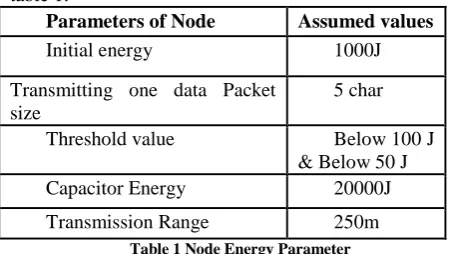
The nodes energy parameters are given below in table 1.
Parameters of Node Assumed values
Initial energy 1000J
Transmitting one data Packet size
5 char
Threshold value Below 100 J & Below 50 J Capacitor Energy 20000J
Transmission Range 250m
Table 1 Node Energy Parameter
B. System Overview
In proposed method decomposed our problem statements into different modules as calculation of energy consumption and residual energy, finding potential parents, MDP() functions, switching function, charging function.
The Fig. 1 shows system architecture diagram for charging of nodes with the help of capacitors.
Fig. 1 : System Architecture
Initially, the node checks the energy consumption speed and residual energy of node for data transferring policy. If nodes residual energy exceeds certain threshold value limit, then that node is called low powered node. Then that node has been sent for charging to the capacitors. Then from capacitors stored energy the node will get recharge and again come in to network for the next WSN operation. When that node came in to network then according to energy of node the tree is get updated.
Following modules are explained for formation of tree and charging of node in Wireless Sensor Networks.
The proposed method design using following modules:
1. Calculation of Energy-The energy of sensor nodes in the sensor network is the very precious resource. In this module the all energies of node are calculated such as total or initial energy of node, residual energy, consumption energy.
2. MDP functions: The Markov Decision Process
having some functions for formation of their process or it means tree and those functions are MDP(), MDP switch (). The MDP function is used for finding the potential parent. The potential parent is going to find out with the help of residual energy of node. The other function is MDP switch(), in this function nodes are arranged in network with potential parent and child nodes for formation of balanced tree. According to residual energy of node the child nodes and parent nodes are arranged in tree.
capacitors store the energy by wind power energy. According to wind speed in different season the energy in capacitors is stored. The day parts are also responsible for wind speed such as day and night. So according to that energy is stored in capacitors. The Solar power is also stored in capacitors. The solar energy is also used to charge the node. The parts are also done to utilize more and more solar energy. The six parts of a day are done like early morning, morning, afternoon, evening, evening to midnight and midnight to early morning.
4. Display result: Results are displayed with energy consumption, residual energy of node.
IV. ASSUMPTIONS AND
MATHEMATICAL MODEL
The result of research and development is nothing but an elegant product name Network Simulator (NS). To build ns system needs a computer and c# net compiler. WSN Localization NS can install on several kinds of operating system (Windows 8, windows 10). NS comes with several packages inbuilt supporting Tcl/Tk files.
If wind speed is under consideration then it is different in different season. So there are three seasons as summer, winter, rainy. But for speed of wind not only season but also the parts of day are also responsible. So to calculate wind speed the factors are to be under consideration. The generation of energy by wind speed is calculated as below :
s
Ʃ
i
[
IIk Wr
]
* SpIn above equation „S‟ is nothing but variable whose value is three seasons and „i‟ is nothing but variable whose value changes according to day parts which are four for one season. The parts are mentioned as morning, afternoon, night and midnight. IIk is the
constant whose value is fixed and Sp is also constant whose value is changed according to season because the speed of wind is different in different season. Wr
is wind power receiving for that season.
V. RESULTS AND ANALYSIS
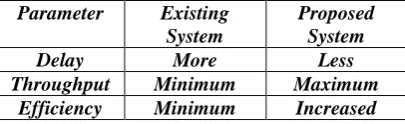
The MDP based switching is nothing but tree based switching using MDP Algorithm. The wind power and solar power are natural resources and by using these energies the lifetime of WSN is get increased. The Table 2 shows the parameters of network which are under consideration which makes proposed system different than existing system.
Parameter Existing
System
Proposed System
Delay More Less
Throughput Minimum Maximum
Efficiency Minimum Increased
Table 2 Comparison of proposed parameters with existing system
The solar power is used to charge the node. The solar energy is stored in to capacitors and from capacitors the energy is get utilized for charging purpose. In graph, it is seen that node3, node10, node14, node17 are the nodes whose residual energy is low and those nodes are under consideration. To increase their residual energy charging of node is done. Then another graph is charged nodes with capacitors who stores energy from wind power and solar power.
Fig 2 Residual energy of node comparison graph before and after charging
VI. CONCLUSION
In this paper, the MDP algorithm is under consideration which is tree based algorithm. In this algorithm the switching of tree is done according to residual energy of nodes. In this work because of these low powered nodes there is delay in packet transmission or fewer packets are sent. In this existing work the wireless sensor network is not that much efficient. To propose this work the switching of tree is done with low power nodes, these nodes get charged from solar power and Wind power which are natural resources. After charging these low powered nodes switching of tree is done and according to nodes of the tree data is transferred in network. So the proposed system is efficient than existing system.
VII. ACKNOWLEDGMENT
REFERENCES
[1] Rashmi Ranjan Rout, Sai Krishna M and Shalinee Gupta, “Markov Decision Process Based Switching Algorithm for Sustainable Rechargeable Wireless Sensor Networks” DOI10.1109/JSEN.2016.2519399, IEEE Sensors Journal.
[2] Sabyasachi Mukhopadhyaya, Debadatta Dashb, Asish Mitrac,Paritosh Bhattacharyad “A comparative study between seasonal wind speed by Fourier and Wavelet analysis” National Institute of Technology Agartala, Agartala-799055, India. [3] Mohammad Abu Alsheikh, Dinh Thai Hoang, Dusit Niyato, Hwee-Pink Tan, Shaowei Lin "Markov Decision Process with Apllications in Wireless Sensor Network : A Survey" IEEE Communications Surveys & Tutorials, 2015.
[4] Vipin Pal, Girdhari Singh, R. P. Yadav " Balanced Cluster Size Solution to Extend Lifetime of Wireless Sensor Networks" IEEE Internet of Things Journal, 2015.
[5] Liansh+++eng Tan and Mou Wu "Data Reduction in Wireless Sensor Network: A heirachical LMS Prediction Approch" DOI 10.1109/JSEN.2015. 2504106, IEEE Sensors Journal.
[6] Zheng Zhang, Zhenbo Li and Jipain chen “Energy Efficient Low delay Strategy for Low power Wireless Sensor Network”, 2013 IEEE International Conference on Green Computing, DOI 10.1109.
[7] Sk Kajal Arefin Imon, Adnan Khan, Mario Di Franscesco, and Sajal k. Das “Energy Efficient Randomized Switching for maximization Lifetime in Tree Based Wireless Sensor Network” 2014 IEEE/ACM Transactions on Networking.
[8] Majidreza Shams Zahraie, Alireza Zareh Farkhady, Abolfazl Toroghi Haghighat “Increasing network Lifetime By optimum Placement od Sensors in Wireless Sensor Networks” 2009:11th International conference on Computer Modelling and Simulation DOI 10.1109/UksIM.2009.43.
[9] Zhezhuang Xu, Liquan Chen, cailian chen, xinping guan “Joint clustering and routing design for reliable and efficient Data Collection in Large-scale Wireless Sensor Networks” DOI 10.1109/IJOT.2015.2482363, IEEE Internet of Things of Jornal. [10] Abhishek Chunawale, Sumedha Sirsikar "Minimization of Average Energy Consumption to Prolong Lifetime of Wireless Sensor Network" 2014IEEE Global Conference on Wireless Computing and Networking(GCWCN).
[11] D.Sharmila, R.Sujitha & G.Rajkumar "On Improving the Lifetime of Wireless Sensor Networks Using Virtual Scheduling Backbone Replacement" 2013 IEEE Conference on International and Communication Technologies.
[12] Kalyan Sasidhar, Sreeresmi R, Rekha P " A WSN Lifetime Improvement Algorithm Repaing benefits of data aggregation and State Transitions" 2014 IEEE Global Humanitarian Technology Conference September 26-27, 2014.