IJSRR, 9(2) April - June, 2020 Page 72
Research Article
Available online www.ijsrr.org ISSN: 2279–0543
International Journal of Scientific Research and Reviews
Studies of Macrocyclic Ni(II) Complexes with Multidentate Schiff base
ligands
Kumar Raman
Department of Chemistry, Prabhu Nath College Parsa, Saran, Jai Prakash University, Chapra. Bihar 841301, India, Email- [email protected]
___________________________________________________________________________________________
ABSTRACT
Studies on coordination chemistry of Nickel (II) is fast gaining importance due to its enormous organometallic and catalytic chemistry. The complexes of NI(II) with multidentate schiff base ligand H2(Mahe1-2) derived from the reaction between Diacetylmonoximeand1,3– Diaminopropane or, 1, 4–
Diaminobutane in dry alcoholic medium have been synthesized and characterized on the basis of elemental analyses, magnetic susceptibility, infrared, electronic spectral and conductivity data. The metal chelate ligand have a general formula [Ni(H2 Mahe1-2)
X
2]
.The IR observations suggest that the ligand have coordinated through two oxime and two amine nitrogen atoms while two axial halogen ions are coordinated in facial mode of one another with Ni (II) but two hydroxyl group of two oximes also combine to one another by intramolecular hydrogen bond and forming six members chelating ring which enhance the extra stability of complexes. During the course of present investigation of magnetic susceptibility along with electronic and IR spectral data Indicates a greenish yellow color distorted paramagnetic Octahedral structure for the Ni(II) complexes. The stability of the macrocyclic complexes have been found to be dependent on the ring size of the cavity of the macrocyclic ligands which can be varied by changing the number of intervening atoms between two amino groups in the terminal and intramolecular hydrogen bonding. Biological activity studies have also been presented.KEYWORDS–
Macrocyclic complexes, Dry alcoholic medium, Axial halogen atoms, Metal chelates ligand. Intramolecular hydrogen bond.___________________________________________________________________________________________
*
CORRESPONDING AUTHOR:
Dr. Raman Kumar
Department of Chemistry, Prabhu Nath College, Parsa, Saran.
IJSRR, 9(2) April - June, 2020 Page 73
INTRODUCTION
Over the world wide attraction has been given to comparative studies on macrocyclic metal Ni
(II) complexes with macrocyclic ligands. Very recently there has been a phenomenal growth in studies
of Ni (II) complexes1-5 consequently in the present communication in continuation of our earlier interest
in the field6-8.In the recent years, it has been the trends to synthesize the ligand molecules having
definite framework of donor atoms and stitch them with different metal ions. Studies of new kind of
Schiff bases and their complexes are now attracting the attention of biochemists. Schiff base metal
complexes have widely studied subject, because of their industrial and biological application. Such
complexes have been further explored for their catalytic and biological activities. For the last few years
much attention has been cast on polyfunctional ligands, which can be encapsulate the metal ions. Schiff
base complexes of later transition metals have been receiving the considerable research attention
because of their use in biological and medicinal application9-12.In recent years there has been growing
interest in preparing the Schiff base complexes which show high activity. Now the chemistry of metal
clusters is also gaining the momentum, the metal complexes have acquired a position of significance in
the area of bioinorganic chemistry. Many enzymes and proteins involving metal systems and Various
spectrochemical methods have been used to elucidate the structure of the complexes and sometimes to
locate the coordination centers in ligand molecules and to know the preponderance of one coordination
site over the other, the molecular orbital calculated have been used.NI(II) macrocyclic complexes
obtained by macrocyclization between Bis-(dimethylglyoximato) and Ni(II). The stoichiometry of the
complexeshavebeen found to be of the type [Ni(H2Mahe1-2) X2]. Where H2 (mahe1) = 3, 9-demethyl – 4,
8-diaza-2, 10-dihydroximino-3, 8-undecadiene.
H2 (Mahe2) = 3, 10- dimethyl- 4-9-diaza-2, 11-dihydroximino-3, 9-dodecadiene. The chelation of
ligands with Ni (II) is expected to form complexes with different structural geometry. It may enhance
their biological activity after chelation also.13-15 which may find their importance in the applied
medicinal chemistry and other area of industries.
EXPERIMENTAL
The Salts of the metal are used for synthetic and analytical workswere of reagent grade solvents,
IJSRR, 9(2) April - June, 2020 Page 74
Ligands synthesis.
(1)Preparation of 3,9-dimethyl-4,8-diaza-2,10-dihydroximino-3,8-undecadiene, H2 (mahe1)
1,3 Diaminopropane (3.7 g, 0.05 mol) of Loba qualities was added to Diacetylmonoxime (10.1 g,
0.1 mol), an Aldrich reagent and the resulting mixture was continuously and vigorously stirred with a
glass rod when it went into a clear solution. Stirring was continued for an hour when the solution start ed
becoming thicker. Stirring was continued and the solution was cooled at about 00C when a light yellow
solid was obtained. The sample was dried under vacuum and was powdered and recrystallised from an
alcoholic solution and kept in a desiccators. It absorbs moisture and turns into a reddish viscous mass
when exposed to atmosphere for a long period. Melting point of the compound was found to be 166
±20C (literature value 1660C). Analysis was in satisfactory agreement with formulation.
(2)Preparation of 3, 10-dimethyl - 4,9-diaza-2,11-dihydroximino-3,9-dodecadiene,H2 (mahe2)
1,4-Diaminobutane (4.4g, 0.05mol) of Loba qualities was added to Diacetylmonoxime (10.1g,
0.1 mol), an Aldrich reagent and the resulting mixture was continuously and vigorously st irred with a
glass rod when it went into a clear solution. Stirring was continued for an hour when the solution started
becoming thicker. Stirring was continued and the solution was cooled at about 00C when a light yellow
solid was obtained. The sample was dried under vacuum and was powdered and recrystallised from an
alcoholic solution and kept in a desiccators. It absorbs moisture and turns into a reddish viscous mass
when exposed to atmosphere for a long period. Melting point of the compound was found to be 170±20C
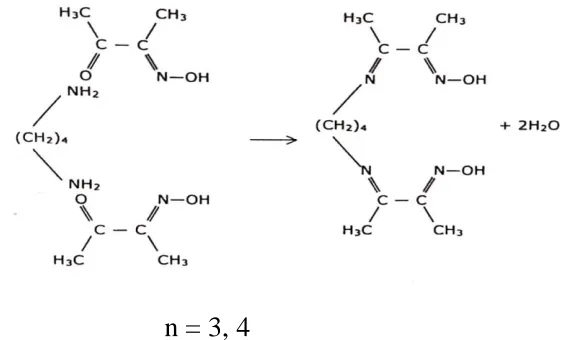
(literature value 1700C).The both synthetic reaction for preparation of ligands can be shown below in the
form of the figure -1.
n = 3, 4
IJSRR, 9(2) April - June, 2020 Page 75
Synthesis and Structure of Ni (II) complexes
1- Preparation of Dichloro-3,9-dimethyl-4, 8-diaza-2, 10-dihydroximino-3, 8-undecadiene, nickel
(II),[Ni (mahe1)Cl2]
The ligand H2(mahe1) (2.40 g, 0.01 mol) was dissolved in minimum amount of absolute alcohol then
an alcoholic solution of Nickel (II) chloride hexahydrate (2.4 g, 0.01 mol) was added. The reaction
mixture was vigorously shaken for a few minutes, then the color of mixture solution immediately
changes to red and fine crystals were obtained. The amount of solid products increased when the
solution was allowed to stand for some time. It was filtered, washed with alcohol and finally with ether
and analyzed after drying.
2. Preparation of Dibromo-3,9-dimethyl-4, 8-diaza-2, 10-dihydroximino-3, 8-undecadiene, nickel
(II),[Ni (mahe1) Br2]
About 1.6 g (0.005mol) of Nickel (II) bromide hexahydrate was dissolved in 50 ml of alcohol. The
solution was treated with an alcoholic solution of the ligand (1.2 g, 0.005 mol) when a dark brown
solution was obtained. After allow the solution was to stand for some time. Dark brown crystals were
obtained. The compound was filtered, washed first with alcohol and then with ether and analyzed after
drying.
3. Preparation of DiIodo-3,9-Dimethyl-4,8-diaza-2,10-dihydroximino-3,8-undecadiene Ni(II), [Ni
(H2 mahe1) I2]
An alcoholic solution of the ligand (2.40 g, 0.01mol) was allowed to react with Nickel (II) iodide
hexahydrate (4.28 g, 0.01mol). The colors of the solution immediately changed to dark red and dark red
crystals were obtained. When the solution was allow to stand for some time. The solid compound was
filtered, washed first with alcohol and then with ether, dried and analyzed.
4. Preparation of Dichloro-3,10-Dimethyl-4,9-diza-2,11-dihydroximino-3,9-dodecadiene Ni(II),
Ni(H2mahe2)Cl2]
The ligand H2(mahe2) (2.5 g, 0.01 mol ) was dissolved in minimum amount of absolute alcohol and
then an alcoholic solution of Ni(II) chloride hexahydrate (2.5 g, 0.01 mol) was added. The mixture was
vigorously shaken. The color of the mixture solution immediately changes to red and fine crystals were
obtained. The amount of solid product increased when the solution was allowed to stand for some time.
IJSRR, 9(2) April - June, 2020 Page 76
5. Preparation of Dibromo-3,10-Dimethyl-4,9-diaza-2,11-dihydroximino-3,9-dodecadiene Ni(II),
[Ni (H2 mahe2) Br2]
About 1.6 g (0.005 mol ) of N(II) bromide hexahydrate was dissolved in 50 ml of alcohol .The
solution was treated with an alcoholic solution of the ligand (1.2 g, 0.005 mol ) when a dark brown
solution was obtained. After allowing the solution to stand for some time, dark brown crystals were
obtained. The compound was filtered, washed first with alcohol and then with ether and analyzed after
drying.
6. Preparation of DiIodo-3,10-Dimethyl-4,9-diaza-2,11-dihydroximino-3,9-dodecadiene
Ni(II),[Ni(H2 mahe2)I2]
An alcoholic solution of the ligand (2.5 g, 0.01mol) was allowed to react with Ni (II) iodide
hexahydrate (4.28 g, 0.01mol).The colors of the solution immediately changed to dark red and dark red
crystals were obtained. When the solution was allow to stand for some time. The solid compound was
filtered, washed first with alcohol and then with ether, dried and analyzed.
RESULT AND DISCUSSION
Very recently oximes and amines have been used for preparation of Schiff base ligands and
macrocyclic Ni(II) complexes by condensing diacetylmonoxime with 1,3–diaminopropane / 1,4-
diaminobutane and to attempt to synthesize and characterize Ni(II ) macrocyclic complexes with these
ligands .The complexes [Ni(H2mahe1-2)X2] have been synthesized and characterized on the basis of
elemental analyses, magnetic susceptibility, infrared. electronic spectral and conductivity data.
Infrared spectra
The complexes [Ni (H2mahe 1-2) X2] have been recorded in the frequency region 4000-600 cm -1
and vibrational bands of structural significance are shown below in Table-1.The complexes show a
strong band centered at 3400 cm-1.The band be assigned to νO-H of the N-O-H group involved in
hydrogen bonding, most probably intramolecular in nature and suggests that the ligand still exists in its
neutral from. Intramolecular hydrogen bonding in oxime complexes where the protons of the N-O-H
groups have not be ionized. The structural features of the complexes involve bonding of amine groups
with the metal center and the macrocyclic ligand exists in a dianionic form. The dianionic form of the
ligands for the group of macrocycles appears to be one of the important factors for electrostatic
IJSRR, 9(2) April - June, 2020 Page 77
cavity forming 5-membered chelate rings with the amine moieties and 6-membered rings involving
oxime groups with intramolecular hydrogen bonding. The spectra of the ligands and complexes show
absorption maximum of medium intensity at 1700cm-1 The four bands in the spectra of the ligand are
found near 1590, 1570, 1500 and 1442 cm-1 respectively. The first and last two bands are having
medium intensity. Where the second band is weak and appears in the form of a shoulder. These bands
are almost unaffected in the metal complexes. The spectra of complexes show yet another band in far
Infrared region in the range 530-510 cm-1 which can be assigned to ν Ni-O or ν Ni-X.
Table-1 Characteristic i.r spectral bands of ligands and complexes
Complex / Ligand ν O-H ν C...H
Azomethine
ν C=N
oxime
ν N-O ν B-O δ B-F2 ˅Ni- x νNi-N
H2(mahe1) 3360
S 1630 S 1440 S 1010 S - - - -
H2(mahe2) 3365
S 1635 S 1445 S 1015 S - - - -
[Ni(H2mahe1)Cl2] 3360
b 1600 S 1460 m 1095 S
- - 510 435
[Ni(H2mahe1)Br2] 3365
b 1595 S 1455 m 1090 S
- - 515 430
[Ni(H2mahe1)I2] 3355
m 1590 S 1465 m 1100 S
520 425
[Ni(H2mahe2)Cl2] 3360
b 1595 S 1455 m 1095 S
520 440
[Ni(H2mahe2)Br2] 3365
b 1590 S 1460 m 1090 S
525 445
[Ni(H2mahe2)I2] 3360
b 1605 S 1465 m 1100 S
520 440
S= Strong m=Medium b= Broad
Magnetic properties and electronic spectra of complexes.
The electronic spectra of these complexes consist of three bands, one in the region 13000-14500
cm-1,the next one in the vicinity of 20000 cm-1 followed by strong intense band near 24000 cm-1. The
band in the lower frequency region can be assigned to the transition,3A 2g←3B1gwhereas the higher
frequency band can be assigned to the transition, 3E g ← 3B1g, 3A2g and 3Eg are the two split
components of 3T1g state in octahedral field upon tetragonal distortion and thus the appearance of two
bands in the region 12000-20000 cm-1 suggests the central Ni(II) ion to be present in an octahedral field
with certain amount of tetragonal distortion. The band at 24000 cm-1 can be assigned to the transition
3
T1g (P) ←3A2g which in some cases overlaps with strong charge transfer bands. During the course of
IJSRR, 9(2) April - June, 2020 Page 78
room temperature which suggests paramagnetic octahedral arrangement of the ligand atoms around the
central Ni (II) ion. The band positions of Ni(II) complexes are recorded in Table-2.
Table-2 Electronic spectra of complexes
Complexes 3B1g → 3A2g 1B1g → 3Eg 3T1g(P) ↔3A2g μeff(B.M)
[Ni(H2mahe1)Cl2] 13,800 17,800 24,000 2.80
[Ni(H2mahe1)Br2] 13,900 18,100 24,300 2.85
[Ni(H2mahe1)I2] 14,000 18,300 24,100 2.95
[Ni(H2mahe2)Cl2] 13,700 17,700 24,100 2.90
[Ni(H2mahe2)Br2] 13,800 18,000 23,200 2.45
[Ni(H2mahe2)I2] 14,100 18,200 24,000 2.95
Conductivity measurement
Conductivity of the complexes in the solvent DMSO. The complexes of [Ni (H2mahe1-2X2] have
been found to possess conductivity in the rang 10–21ohm-1cm2mol-1 and indicate their non-electolytic
nature16-18, which clearly indicates that anions are coordinated with metal ion. The molar conductance
values also supported the structure assigned on the basis of physicochemical and spectroscopic
measurements. The conductivity measurement data have been presented below in Table-3.
Table- 3 Conductivity data of the complexes
Complexes Ʌm ohm-1 cm2 mol-1
Ni(mahe1) 10
Ni(mahe2) 12
[Ni(H2mahe1)Cl2] 14
[Ni(H2mahe1)Br2] 13
[Ni(H2mahe1)I2] 15
[Ni(H2mahe2)Cl2] 18
[Ni(H2mahe2)Br2] 20
IJSRR, 9(2) April - June, 2020 Page 79
Biological activity.
On the basis of experiment the activity of Ni(II) complexes have more effective than free
ligands. The ligands have many donor atoms (N, O) and are analogous to biological environment to
some extent. The complexes are highly active due to the greater lipophilic nature of the complexes.
Which enhance the antimicrobial activity on chelate then the probability of the metal ion will be reduced
to greater extent and increase the lipophilic and absorbing nature of complexes due to the equatorial
overlapping of ligand filled orbital with vacant outer d- orbital of the metal ion. Further it increasing the
delocalization of electrons of metal ion with absorbing power over the whole chelating ring as a result
decreases the growth or increase the ratio of death of bacteria. The results indicated that chelating
improved the antibacterial activity compared to the ligand19-20and known as antibiotic drugs.
CONCLUSION
Thus on the basis of above studies it is concluded that the ligand H2 (mahe1-2) acts in bidentate
manner and coordination is proposed through oxime and amine N atom. The remaining centers of metal
ions in complexes are satisfied by two axial facial modes of negative halogen ions such as Clˉ, Brˉ,Iˉ.But
the macrocyclic ligands exists in a dianionic form. The dianionic form of the ligand for the group of
macrocycles appears to be one of the important factors for electrostatic interaction of the metal ion with
the macrocyclic ligands, enclosing the metal ion in the macrocyclic cavity forming two 5-membered
chelate rings in axial mode of upper and lower direction with the amine moieties. While two hydroxyl
groups of two oximes combine to one another by intramoleculer hydrogen bond and forming
6-membered chelating ring in complexes which enhance the extra stability of the complexes. On the basis
of physicochemical and spectroscopic observation it is proposed that the geometry of the complexes of
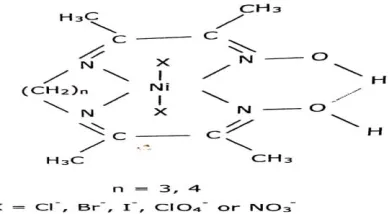
the types [Ni(H2mahe1-2)X2] are monomeric high spin paramagnetic octahedral in geometry. The
following tentative structure may be proposed for these complexes in figure -2.
IJSRR, 9(2) April - June, 2020 Page 80
REFERENCE
1. Eman M. Shoukry, Zinab H.ABD EL.Wahab and Ali, Reda A. Potentiometric studies of binary
and ternary Nickel (II) complexes. Involving ethylenediamine-N,N-Diacetic acid, Amino acids
and peptides. Asian. J. Chemistry. 2003; 15(1): 5-14.
2. LEVER, ABP. Complexes of Cr(III), Mn(III), Fe(III) & Co(III) with Triazolinethiones, Coord.
Chem. Rev.1968; 3: 119.
3. Nelson, S.M. Developments in the synthesis and coordination chemistry of macrocyclic Schiff
base ligands. Pure and applied chemistry. 1980; 529 (11): 2461-2476.
4. Singh Bibhesh k. Complexation Behaviour of Glutathione with metal ions. Asian J. Chem.
2005; 17(1): 1-32.
5. Pragathi. M, Readdy K.H, Synthesis crystal structures, DNA binding and cleavage activity of
water soluble mono and dinuclear copper (II) complexes with tridentate ligands. Inorganica
chimica Acta. 2014; 413: 174-186.
6. Rai. B.K and Sharma K.K, Synthesis, physico-chemical and Antimicrobial structures of
bidentate Schiff base complexes of Co(II), Ni(II) and Cu(II). Oriental. J. Chem. 2011; 27(1):
143-146.
7. Bayat M, Ahmadian N, Theoretical studies on structures stability and nature of C→ E (E= Si,
Sn) bond in some derivatives of bitriazole-base NHC complexes with five membered chelate
rings. Journal of the Iranian chemical Society. 2016; 13(2): 397-402.
8. Evans J.et al. Homogeneous catalyses by transition metal complexes. Chem.Soc. Dalton Trans,
1994; 1337.
9. Bayat M, Ahmadian N, Bis-N-heterocyclic carbine in stabilized [bis-NHC(R) → EBr2H2] (E=
Si to Pb) (R = H, F, Cl, Br, CH3, CF3) complexes. Polyhedron, 2015; 96: 95-101.
10. Singh Devendra kumar and Kumar Raman, Synthesis and spectral studies of Cobalt(II) and
Nickel(II) complexes with 18-membered macrocyclic ligands derived from malonodihydrazide.
Oriental .J. Chem. 2011; 27(1): 277-281.
11. Duta. S, Biswas, P. Structural spectroscopic and magnetic properties of a diphenolate-bridged
Fe(III) and Ni(II) complex showing excellent phosphodiester cleavage activity. Polyhedron,
IJSRR, 9(2) April - June, 2020 Page 81
12. Jha, R.R and Sahu. N. Synthesis and Characterization of Metal(II) Complexes with Macrocyclic,
Ligand 1,4,5,7,8,11,12,14-octaazatetraoxo-6,13-dithio-1,4,5,7,8,11,12,14-
octahydrocyclotetradecane. Asian J.Chem. 2008; 20(8): 6301-6309.
13. Kumar Raman and Singh Santosh Kumar, Synthesis and spectral studies of Nickel(II) with
18-membered exocyclicoctaoxooctaazacyclooctadeca tetradentate saturated macrocyclic ligand.
Indian. J. Research. 2011; 5: 27-30.
14. Kumar Raman, Synthesis and Spectral studies of macrocyclic Ni (II) complexes with
multidentate ligands. Research Journal of Chemistry and Environment.2019; 23 (9): 68-70
15. Maria luisa Ganadu, Nicola Demitri, Ennio Zangrando, Studies
on Ni(II) complexes.VI. The conformational Equilibria of Bis (o-hydroxynaphthaldimine)
complexes. Cryst. Eng. Comm, 2018; 20(40): 6122-6125.
16. Zhao Guoliang, Synthesis, characterization and thermal behavior of manganese (II) Cobalt (II),
Nickel (II), Copper (II) and Zinc (II) Complexes of Vanillin. Asian.J.Chem. 2008; 20(4):
2769-2773.
17. Tiwari Vivek and Singhai Rashmi. Ligational behavior of Vanillin derived Schiff bases towards
Nickel(II) and Copper (II).Asian.J.Chem.2003; 15(1): 435-438.
18. Joseph, J. Nagashri, K. Ayisha Bini Rani. G. Synthesis characterization and antimicrobial
activities of Copper complexes derived from 4-Aminoantipyrine derivatives. Journal of studies
chemical society. 2013; 17(3): 285-294.
19. Sheikh, R.A, Shreaz, S. Sharma,G.S, Khan, L.A, and Hashmi, A.A, Synthesis characterization
and antimicrobial screening of a novel organylborate ligand, potassium
hydro(phthalyl)(salicylyl) borate and its Co(II),Ni(II) and Cu(II) complexes. Journal Saudi
chemical society, 2012; 16(4): 353-361.
20. Bayat, M. Soltani, E. Stabilization of group 14 tetrylene compounds by N-heterocyclic carbine .
Polyhedron, 2017; 123: 39-46.