Psychology Research and Behavior Management 2016:9 277–284
Psychology Research and Behavior Management
Dove
press
submit your manuscript | www.dovepress.com 277
O R I G I N A L R E S E A R C H
open access to scientific and medical research
Open Access Full Text Article
Reliability and validity of the Italian version of the
14-item Resilience Scale
Camilla Callegari1
Lorenza Bertù2
Melissa Lucano1
Marta Ielmini1
Elena Braggio1
Simone Vender1
1Department of Clinical and
Experimental Medicine – Psychiatric Division, 2Department of Clinical and
Experimental Medicine, Centre for Research EPIMED – Epidemiology and Preventive Medicine, University of Insubria, Varese, Italy
Background: In recent years resilience has gained clinical relevance in sociological, psychologi-cal, and medical disciplines, and a lot of scales measuring resilience have been developed and have been utilized in the western countries. The aim of the study was to assess the psychomet-ric properties of the Italian version of the 14-item Resilience Scale (RS-14), by describing its validity and reliability. As agreed with the authors of the original English version of the RS-14, it was translated into Italian. Then the standard procedure for back-translation was followed. Methods: In total, 150 participants among the nursing and professional education students of the University of Insubria of Varese and health workers of the “ASST dei Sette Laghi-Ospedale di Circolo” of Varese were enrolled. The responses to the questionnaires were collected only from the students and the health workers between the ages of 18 and 65 years who gave their consent to participate in the study from April to September 2015. A subsample of 26 students and health workers was retested on the RS-14, 5 weeks after the first assessment. The question-naires were handed out to 214 people, and 150 sets of questionquestion-naires (70%) were returned, of which eight were subsequently removed because >60% of the answers were missing. In order to ensure anonymity, every completed questionnaire was identified only via a code.
Results: No significant differences were found between the mean values of the resilience scores between women (76.1) and men (76.3), with unpaired t-test = –0.08 and P=0.93. Similarly, no difference between resilience scores were found between mean age group of 18–25 years (75.3) and 26–65 years (78.7), with t-test = 1.6. The overall Cronbach’s alpha of the RS-14 is 0.88,
P=0.10. The RS-14 is negatively correlated with the Beck Depression Inventory-Primary Care Version and the 12-item General Health Questionnaire and positively correlated with the World Health Organization Quality of Life-Brief Version. The test-retest reliability, assessed on the 26 subjects 5 weeks after the first evaluation, highlighted an intraclass correlation coefficient value equal to 0.65. Factor analysis retains three factors, and it considers the factor loadings >0.40: RS-14-06 (‘I am determined’) is loaded on all the factors and RS-14-12 (‘In an emergency, I am someone people can generally rely on’) is not loaded on any factor.
Conclusion: This study demonstrates that the Italian RS-14 has psychometric properties with a good level of internal consistency (Cronbach’s alpha = 0.88), an adequate concurrent validity, verified by relationships with the other scales and as it was expected from literature, and an acceptable test-retest reliability.
Keywords: resilience, measuring scales, psychometrics, factor analysis, adolescence, adulthood
Introduction
Resilience is the process of a capacity for or an outcome of successful adaptation despite challenging or threatening circumstances.1 Resilient people are characterized
by interior strength, competence, optimism, flexibility, and coping ability in the face Correspondence: Camilla Callegari
Department of Clinical and Experimental Medicine – Psychiatric Division, University of Insubria, Via O. Rossi 9, 21100 Varese, Italy
Tel +39 332 270 655 Fax +39 332 270 667
Email [email protected]
Journal name: Psychology Research and Behavior Management Article Designation: ORIGINAL RESEARCH
Year: 2016 Volume: 9
Running head verso: Callegari et al
Running head recto: Reliability and validity of the Italian version of the RS-14 DOI: http://dx.doi.org/10.2147/PRBM.S115657
Psychology Research and Behavior Management downloaded from https://www.dovepress.com/ by 118.70.13.36 on 26-Aug-2020
For personal use only.
This article was published in the following Dove Press journal: Psychology Research and Behavior Management
3 October 2016
Dovepress
Callegari et al
of adversity.2 They possess self-esteem, belief in their own
self-efficacy, and a repertoire of problem-solving skills and satisfying interpersonal relationships.3 Resilience is also
defined as the dynamic capacity of an individual to modify his/her modal level of ego-control, in either directions, as a function of the demand characteristics of the environmental context.
In the recent years, resilience has gained clinical relevance in sociological and medical disciplines,4–7 and psychological
resilience has been characterized by the ability to bounce back from negative emotional experiences and by flexible adaptation to the changing demands of stressful experiences.8
Many scales that assess resilience have been developed and have been used in the western countries. These include the Brief Resilience Scale, Connor-Davidson Resilience Scale (CDRISC),9 Baruth Protective Factors Inventory,10
Resilience Scale for Adults (RSA),11 Brief Resilience Coping
Scale (BRCS),12 and Wagnild and Young Resilience Scale
(RS).2 The RS-25 was developed by Wagnild from a
qualita-tive data collected from 24 older women who had successfully recovered from a major life event.13,14
Resilience: relevance in adolescence and
adulthood
A review of some of the aforementioned instruments revealed RS as the best instrument to study resilience in adolescents.15
During adolescence, the development tasks can be faced without serious difficulties, and overcoming these develop-ment tasks (such as autonomy from parents, comparison with peer group, and acquisition of useful tools to experience new roles) could be a significant factor of protection from possible evolutionary breakdown. In fact, the resilient attitudes that are important during adolescence have been highlighted: con-formism, pragmatism, and perseverance (typical of a realistic personality); ambition, optimism, and leadership skills (typi-cal of an enterprising personality); precision, introversion, rationality (typical of an investigative personality),16 because
they are predictive characteristics of the school performance. A high-interest profile has been shown to be indicative of a good level of identity exploration and that the differentiation of interests is indicative of the level of identity commitment.17
RS is the first instrument developed for the study of resil-ience as well as one of the most widely used and accurate scale to measure resilience globally.2,15,18 It has also been
used in several population studies, all across the world, and it has short form made up by 14 items (RS-14) and has been translated into other languages.2,19,20 Other benefits include
ease of use, applicability in different age groups ranging
from adolescent to elderly, and its basic constructs focus on positive psychological qualities rather than deficits.10 The RS
has shown good validity and reliability in several studies.15,21
The Resilience Scale and other scales
measuring resilience that are already
translated into Italian
The scales measuring resilience that are already translated into Italian and validated are as follows: Resiliency Attitudes and Skills Profile,22 Adolescent Resilience Scale,23 RSA,24
BRCS,25,26 25-items Resilience Scale,27 and CDRISC.28,29
The aim of the study is to assess the psychometric proper-ties of the Italian version of the RS-14, currently missing in literature, among the young adults with a higher level of education, by assessing its validity and reliability, with the authorization of the original authors who own the Intellectual Property of the scale.
Materials and methods
Subjects and procedures
The present study consisted of 150 participants enrolled among nursing and professional education students from the University and health workers of the “Ospedale di Circolo” of Varese. The responses to the questionnaires were collected only from the students and the health workers who gave their written consent to participate in the study, from April to Sep-tember 2015. A subsample of 26 students and health workers was retested on the RS-14 5 weeks after the first assessment. In order to ensure anonymity, every completed questionnaire was identified only via a code, which was then used to examine the test-retest reliability. A convenience sample was analyzed, and all the subjects participated in the study for free.
The sample size was calculated by considering a value of Cronbach’s alpha = 0.80, which is expected for the RS, and significantly different from a minimum of Cronbach’s alpha = 0.70. With a power of 90% and an error fixed at 0.05, the total number of subjects needed was 140. The confirma-tory factor analysis was performed to evaluate the construct validity of the RS-14 scale. The following model fit indexes were assessed: root mean error of approximation (RMSEA – good fit for value ≤0.05 and acceptable for value between 0.05 and 0.08), standardized root mean squared residual (SRMR – good fit for value <0.05 and a value between 0.05 and 0.10 is acceptable), goodness-of-fit (GFI), adjusted goodness-of-fit (AGFI), and Comparative Fit Index (CFI). For GFI, AGFI, and CFI scores ≥0.90 are considered adequate.30
Internal consistency, convergent validity, and factor loadings were assessed through the initial assessment, and test-retest
Psychology Research and Behavior Management downloaded from https://www.dovepress.com/ by 118.70.13.36 on 26-Aug-2020
Dovepress Reliability and validity of the Italian version of the RS-14
reliability was assessed through the second assessment. The Provincial Health Ethical Review Board was consulted prior to the beginning of the study, and it determined that the study did not need authorization from the Board as the study involved healthy adults.
Instruments of study
RS-14
Wagnild and Young developed the 25-item Resilience Scale, as a self-report scale.13 Subsequently, they developed a shorter
scale as an offshoot from the 25 items that measures similar psy-chological concepts,2 consisting of 14 items (RS-14). Wagnild
discovered, by means of a principal components factor analysis to examine the factor structure of RS-14, the five characteristics of the resilience core: purpose, perseverance, self-reliance, equanimity, and existential aloneness (authenticity).1,2,31
The respondents to RS-14 were asked to state the degree to which they agree or disagree with each item on a 7-point Likert-type scale from 1 (strongly disagree) to 7 (strongly agree).11,13 All the items are positively scored, and the minimum
score on the 14-item scale is 14 and the maximum score is 98. Wagnild has shown that a score <56 indicates a very low resilience level; a score between 57 and 64 indicates a low resilience level; a score between 65 and 73 indicates that resilience level is on the low end; a score between 74 and 81 indicates a moderate resilience level; a score between 82 and 90 indicates a moderately high resilience level; and a score
>91 indicates a high resilience level.17
The original English version of the RS-14 was translated into Italian (Figure 1). Then the standard procedure was followed for back-translation.32 The Italian translation was
presented to a native English speaker who translated the Ital-ian version back into English. The new English version was
compared with the original English version, and the translator assessed that there were no significant differences between the two English versions (original and back-translated).
Other measures
Other measures of factors linked to resilience and outcome of resilience (such as depression, life satisfaction, and health) were used to verify current validity of RS-14.13
12-Item General Health Questionnaire
The GHQ-12 33,34 is a measure of the common mental health
problems/domains of depression, anxiety, somatic symptoms, and social withdrawal of the past 2 weeks.35 It consists of
12 items, and each one has four possible responses, scor-ing from 0 to 3.36 RS was shown to be negatively correlated
with depression, anxiety, somatic symptoms, and social withdrawal that are all measured with GHQ-12.25
Beck Depression Inventory-Primary Care Version The Beck Depression Inventory-Primary Care Version (BDI-PC) is a seven-item self-report questionnaire,37–39
which assesses depressive symptoms like sadness and loss of pleasure, suicidal thoughts or wishes, pessimism, past failure, self-dislike, and self-criticalness in the last 2 weeks. The BDI-PC is scored by summing up the highest ratings for each of its seven items. Each item is rated on a 4-point scale ranging from 0 to 3.40 RS compared with BDI-PC was shown
to be negatively correlated with depression.13,25
World Health Organization Quality of Life-Brief Version (WHOQOL-Bref)
As RS was shown to be positively correlated with life sat-isfaction,13 in the present study, RS-14 was compared with
Figure 1 The English version of RS-14 alongside the Italian version of RS-14.
Note: 1993 Gail M Wagnild and Heather M Young. Used by permission. All rights reserved. “The Resilience Scale” is an International Trademark of Gail M Wagnild and Heather M Young, 1993.2
Abbreviation: RS-14, 14-item Resilience Scale.
Item 14-item Resilience Scale (English Version) 14-item Resilience Scale (Italian Version)
RS-14-01 I usually manage one way or another. Di solito riesco a cavarmela in un modo o nell’altro.
RS-14-02 I feel proud that I have accomplished things in life. Mi sento orgoglioso/a per le cose che ho realizzato nella mia vita. RS-14-03 I usually take things in stride. Di solito faccio le cose senza il minimo sforzo. Segnendo i miei tempi.
RS-14-04 I am friends with myself. Sono amico/a di me stesso/a.
RS-14-05 I feel that I can handle many things at a time. Sento di poter gestire molte cose allo stesso tempo. RS-14-06 I am determined.
I can get through difficult times because I have experienced difficulty before.
Sono determinato/a.
Posso affrontare momenti difficili perché ne ho già fatto esperienza in precedenza.
RS-14-07
RS-14-08 Self-discipline is important.
I can usually find something to laugh about.
Ho auto-disciplina.
RS-14-09 I keep interested in things. Mantengo interesse nelle cose.
RS-14-10 Di solito trovo qualcosa per cui sorridere.
RS-14-11 My belief in myself gets me through hard times. II credere in me stesso/a mi aiuta a superare i momenti difficili. RS-14-12 In an emergency, I am someone people can generally rely on. In una situazione di emergenza c’è qualcuno su cui posso contare. RS-14-13 My life has meaning.
RS-14-14 When I am in a difficult situation, I can usually find my way out of it. Quando mi trovo in situazioni difficili di solito da solo/a un modo per uscirne. La mia vita è piena di significato.
Psychology Research and Behavior Management downloaded from https://www.dovepress.com/ by 118.70.13.36 on 26-Aug-2020
Dovepress
Callegari et al
WHOQOL-Bref,41,42 an abbreviated version of the
WHO-QOL-100 quality-of-life assessment. It returns the scores on four domains related to the quality of life: physical health, psychological, social relationship, and environment. It also includes one facet on overall quality of life and general health.43
Statistical analysis
The sociodemographic features (age class, sex, education, and marital status) were summed up using absolute and rela-tive frequencies. The scores of the collected scales (RS-14, GHQ-12, BDI-PC, and WHOQOL-Bref) were summarized with mean and standard deviation.
The internal consistency reliability of the RS was evalu-ated using the Cronbach’s alpha coefficient,44 a value of
α≥ 0.70 is usually considered acceptable. An exploratory factor analysis with varimax rotation was applied, in the first test sample, to assess the construct validity. The Cattel’s scree test and the Kaiser criterion were used to define the number of factors to retain.
For the subgroup of 26 subjects who have participated in the second round of testing, the Intraclass Correlation Coefficient (ICC) was calculated to evaluate the test-retest reliability. The commonly cited cutoff for ICC considers good values between 0.60 and 0.74.45
After calculating the total score for the RS (adding up all the scores of the 14 individual items), the concurrent validity among the RS-14 and other scales collected in the study was evaluated using Pearson’s correlation coefficient.
Unparied t-test has been used to compare RS mean scores between men and women and between age groups (18–25 years and 26–65 years).
Following the examples of other studies that have vali-dated a translation of the RS-14,16,17 the statistical analyses
used two-tailed tests. For all statistical evaluations, P<0.05 were considered indicative of significant differences.
All data analyses were performed using SPSS v15 (SPSS Inc., Chicago, IL, USA) and SAS v 9.4 (SAS Institute Inc., Cary, NC, USA) software packages.
Results
The questionnaires were given to 214 people, and 150 sets of questionnaires (70%) were returned back, of which eight were subsequently removed because >60% of the questions were unanswered. Therefore, the final sample consisted of 142 subjects.
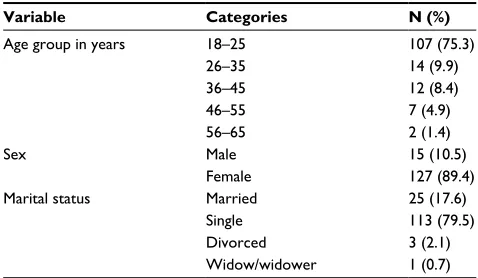
Out of the 142 participants, 127 were women and 15 were men; 107 participants were 18–25 years of age, 14 were
26–35 years, 12 were 36–45 years, seven were 46–55 years, and two were 56–65 years old; 94 participants had high school diploma, 36 were graduated from college, four had lower secondary school diploma, and eight had a master’s degree; 113 were unmarried, 25 married, three separated/divorced, and one widowed (Table 1).
The total mean score on the RS-14 was 76.13. No signifi-cant differences were found between the mean values of the resilience scores between women (76.1) and men (76.3), with t-test = –0.08 and P=0.93. Similarly, no difference between resilience scores was found between mean age group of 18–25 years (75.3) and 26–65 years (78.7), with t-test = 1.65 and P=0.10. The RS-14 items, mean, and standard deviation are presented in Table 2.
The overall Cronbach’s alpha of the RS-14 is 0.88, and in Table 3, the Cronbach coefficient with deleted variables is displayed, and it does not show any significant increase or decrease in the alpha coefficients.
The indicators of concurrent validity of the RS-14 are shown in Table 4. The RS-14 is negatively correlated with the BDI-PC and GHQ-12 and is positively correlated with the WHOQOL-Bref. The test-retest reliability, assessed on the 26 subjects, 5 weeks after the first evaluation, highlighted an ICC value of 0.65 that is considered an adequate level of repeatability.46
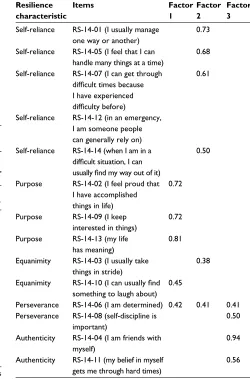
On the basis of Cattel’s scree test and Kaiser criterion, the factor analysis retains three factors (Table 5), and it considers the factor loadings >0.40. It was observed that RS-14-06 was loaded on all the factors, whereas, on the other side of the spectrum, RS-14-12 was not loaded on any factor.
The CFI, RMSEA, and the SRMR are equal to 0.91, 0.08, and 0.07, respectively, which indicate an acceptable fit of the model; however, GFI and AGFI values are under the adequate fit level (0.87 and 0.80, respectively).
Table 1 Distribution of sociodemographic variables, absolute
and relative frequencies
Variable Categories N (%)
Age group in years 18–25 107 (75.3)
26–35 14 (9.9)
36–45 12 (8.4)
46–55 7 (4.9)
56–65 2 (1.4)
Sex Male 15 (10.5)
Female 127 (89.4)
Marital status Married 25 (17.6)
Single 113 (79.5)
Divorced 3 (2.1)
Widow/widower 1 (0.7)
Note: Total sample – men and women aged 18–65 years.
Psychology Research and Behavior Management downloaded from https://www.dovepress.com/ by 118.70.13.36 on 26-Aug-2020
Dovepress Reliability and validity of the Italian version of the RS-14
Table 3 14-item Resilience Scale (RS-14)2: internal consistency –
Cronbach’s coefficient
Item Raw Standardized
Item total correlation If item deleted* Item total correlation If item deleted*
RS-14-01 0.58 0.87 0.57 0.87
RS-14-02 0.57 0.87 0.57 0.87
RS-14-03 0.50 0.87 0.50 0.88
RS-14-04 0.22 0.89 0.22 0.89
RS-14-05 0.36 0.88 0.35 0.88
RS-14-06 0.65 0.87 0.65 0.87
RS-14-07 0.59 0.87 0.60 0.87
RS-14-08 0.67 0.87 0.67 0.87
RS-14-09 0.46 0.88 0.46 0.88
RS-14-10 0.63 0.87 0.63 0.87
RS-14-11 0.70 0.86 0.70 0.87
RS-14-12 0.48 0.87 0.48 0.88
RS-14-13 0.65 0.87 0.64 0.87
RS-14-14 0.69 0.86 0.68 0.87
Notes: Total sample – men and women aged 18–65 years. *Alpha value if item is deleted.
Table 4 Evaluation of concurrent validity: Pearson correlations between the 14-item Resilience Scale (RS-14)2 total score and BDI-PC,37,39 WHOQOL-Bref,41,42 and GHQ-1233,34
RS-14 (14 items)
Mean (SD) Correlation
coefficients
BDI-PC 0.25 (0.4) –0.46*
WHOQOL-Bref 95.4 (8.8) 0.35*
GHQ-12 15.3 (4.4) –0.34*
Notes: Total sample – men and women aged 18–65 years. *P<0.0001.
Abbreviations: BDI-PC, Beck Depression Inventory-Primary Care Version; GHQ-12, 12-Item General Health Questionnaire; SD, standard deviation; WHOQOL-Bref, World Health Organization Quality of Life-Brief Version.
Table 5 14-item Resilience Scale (RS-14)2: exploratory factor analysis and rotated factor pattern
Resilience characteristic Items Factor 1 Factor 2 Factor 3
Self-reliance RS-14-01 (I usually manage one way or another)
0.73
Self-reliance RS-14-05 (I feel that I can handle many things at a time)
0.68
Self-reliance RS-14-07 (I can get through
difficult times because
I have experienced
difficulty before)
0.61
Self-reliance RS-14-12 (in an emergency, I am someone people can generally rely on) Self-reliance RS-14-14 (when I am in a
difficult situation, I can usually find my way out of it)
0.50
Purpose RS-14-02 (I feel proud that I have accomplished things in life)
0.72
Purpose RS-14-09 (I keep interested in things)
0.72
Purpose RS-14-13 (my life has meaning)
0.81
Equanimity RS-14-03 (I usually take things in stride)
0.38
Equanimity RS-14-10 (I can usually find
something to laugh about) 0.45
Perseverance RS-14-06 (I am determined) 0.42 0.41 0.41 Perseverance RS-14-08 (self-discipline is
important)
0.50
Authenticity RS-14-04 (I am friends with myself)
0.94
Authenticity RS-14-11 (my belief in myself gets me through hard times)
0.56
Notes: Total sample – men and women aged 18–65 years. Only factor loadings >0.40 are reported (except for RS-03 item).
Table 2 14-item Resilience Scale (RS-14)2: descriptive statistics, mean, and standard deviation of the single items and the total score of the scale
Items Mean Standard
deviation
RS-14-01 I usually manage one way or another. 5.82 0.97 RS-14-02 I feel proud that I have accomplished
things in life.
5.60 1.17
RS-14-03 I usually take things in stride. 4.26 1.34 RS-14-04 I am friends with myself. 5.43 1.28 RS-14-05 I feel that I can handle many things at a
time.
5.02 1.17
RS-14-06 I am determined. 5.74 1.19
RS-14-07 I can get through difficult times because I have experienced difficulty
before.
5.13 1.36
RS-14-08 I have self-discipline. 5.71 1.18 RS-14-09 I keep interested in things. 5.55 1.08
RS-14-10 I can usually find something to laugh
about.
5.95 1.02
RS-14-11 My belief in myself gets me through hard times.
5.33 1.37
RS-14-12 In an emergency, I am someone people can generally rely on.
6.04 1.15
RS-14-13 My life has meaning. 5.51 1.21
RS-14-14 When I am in a difficult situation, I can usually find my way out of it.
5.08 1.20
Total score 76.13 10.48
Notes: Total sample – men and women aged 18–65 years.
Discussion
The mean RS-14 score found in this study is 76.13; therefore, the sample demonstrated a moderate resilience level, and it is similar to the English RS-14 version which has the mean value 76.17, and it is higher than the Japanese version mean score (63.78).2,18
No statistically significant differences were found while comparing the mean resilience scores of male versus female from different age groups. This evidence agrees with the original studies by Wagnild and Young, who did not find a significant difference in resilience by age or sex.13
Psychology Research and Behavior Management downloaded from https://www.dovepress.com/ by 118.70.13.36 on 26-Aug-2020
Dovepress
Callegari et al
Regarding the split by sex, it is important to acknowl-edge that in our sample population, there is a large share of women (15 males versus 127 females), which is related to an emerging pattern in the health care workforce. As found in other studies, the vast majority of today’s health care workers are women, who have entered traditionally male-dominated professions in large numbers and have made many newer health professions female-dominated.47
The value of Cronbach’s alpha (0.88) is in line with consistency evaluation reported for the original version of RS-14, thus confirming the internal consistency of the RS-14 Italian version.
As expected, resilience (RS-14) was found to be positively correlated with life satisfaction as assessed by WHOQOL-Bref and negatively correlated with depression symptoms as assessed by BDI-PC, and anxiety and general health psychological status as assessed by GHQ-12. Since life satisfaction is a measure of adaptation and adaptation is part of the theoretical definition of resilience, the relation-ship between resilience and life satisfaction was assessed in other studies also which produced positive results.13
Thus, it can be stated that, effectively, resilience promotes adaptation.13
RS-14 was shown to be negatively correlated with depression and anxiety symptoms as assessed by BDI-PC and GHQ-12. The same results were obtained by valida-tion studies of the original English versions of RS-14 and RS-2513 and the Italian version of RS-25.25,48 Resilience
implies inner strength, competence, optimism, flexibility, and the ability to cope effectively when faced with adversity.2
In fact, resilience, in its definition, stands in opposition to depression disorders, defined as a pathological sadness dis-proportionate to a possible reason; it is rigid, independent of the context, accompanied by aggressiveness, irritation, and rejection.49
In this study, test-retest correlation was used, and it is found that inter-reliability is acceptable. The result is dif-ferent from what can be found in the literature, where the studies have found a better reliability in RS.13,14 A low
reli-ability could be linked to the fact that the sample was too homogeneous.50
The factor analysis, run on the whole sample, loads only on three factors, showing a construct validity less than accept-able. For explorative purpose, the factor analysis was applied only to the age group of 26–65 years, which is smaller but more heterogeneous than the other age group (18–25 years); we extracted five factors and the results show a more accept-able construct validity (data not shown).2
One possible explanation can be found in the character-istics of the sample that was analyzed. The participants were all students who were mostly young, single women, without past history of psychiatric illness and not randomly selected.18
These evidences suggest that a more heterogeneous sample could demonstrate a better construct validity for the Italian version of the RS-14.
Furthermore, in the factor analysis, it is found that per-severance loads on the same factor as authenticity while self-reliance loads on equanimity. In other studies, a sig-nificant correlation is found between the common indicators of resilience and self-acceptance, positive relations with others, autonomy, the ability to affect the environment and society, purposefulness in life, personal growth and a sense of belonging, authenticity, and general well-being in the age group of early maturity.51 In a recent study, focused on young
adults (between 17 and 24 years of age) self-reliance has been observed not only as an outcome, but as an identity that may inform the processes by which some youth form relational connections into adulthood.52 The validated Italian version
of RS-14 could be used in clinical and research settings.
Limitations
This study has some limitations. The sample is too homoge-neous and made up by young females, unmarried and with a high-school diploma. We plan to extend the study to a larger and more diverse population engaging outpatients of the “Clinic for anxiety and depressive disorders”, of the “Ospedale di Circolo” in Varese. We are anticipating for the authorization of the Health Ethical Review Board to conduct an extensive study.
Conclusion
This study demonstrates that the Italian version of the 14-item Resilience Scale has psychometric properties with a good level of internal consistency (Cronbach’s alpha = 0.88), and an adequate concurrent validity, verified by relationships with the other scales and as it was expected from literature and adequate level of repeatability (ICC = 0.65). As expected, resilience (RS-14) was positively correlated with life satisfac-tion as assessed by WHOQOL-Bref, negatively correlated with depression symptoms as assessed by BDI-PC, and anxiety and general health psychological status as assessed by GHQ-12. In order to obtain results that are more robust, the study limitations are being addressed with the recruitment of an additional and less homogeneous population.
Disclosure
The authors report no conflicts of interest in this work.
Psychology Research and Behavior Management downloaded from https://www.dovepress.com/ by 118.70.13.36 on 26-Aug-2020
Dovepress Reliability and validity of the Italian version of the RS-14
References
1. Masten A, Best K, Garmezy N. Resilience and development: Con-tributions from the study of children who overcome adversity. Dev Psychopathol. 1990;2:452–444.
2. Wagnild GM. The Resilience Scale User’s Guide for the US English Version of the Resilience Scale and the 14-Item Resilience Scale (RS-14).Montana: The Resilience Center; 2009.
3. Rutter M. Psychosocial resilience and protective mechanisms. Am J Orthopsychiatry.1987;57:361–331.
4. Mahmoud S, Nahla Abd Elaziz A. Impact of stroke on life satisfaction and psychological adjustment among stroke patients during rehabilita-tion. Life Sci J. 2016;13(3);7–17.
5. Rebagliati G, Panella L, Callegari C. The Role of Resilience During Rehabilitation After Orthopedic Surgery in Geriatric Patients with Multiple Co-morbidities”. Funct Neurol. In press 2016.
6. Sarre S, Redlich C, Tinker A, Sadler E, Bhalla A, McKevitt C. A sys-tematic review of qualitative studies on adjusting after stroke: lessons for the study of resilience. Disabil Rehabil. 2014;36(9):716–726. 7. Mealer M, Jones J, Newman J, McFann KK, Rothbaum B, Moss M.
The presence of resilience is associated with a healthier psychological profile in intensive care unit (ICU) nurses: results of a national survey. Int J Nurs Stud. 2012;49:292–299.
8. Tugade MM and Fredrickson BL. Resilient individuals use positive emotions to bounce back from negative emotional experiences. J Pers Soc Psychol. 2004;86(2):320–333.
9. Connor KM, Davidson JR. Development of a new resilience scale: the Connor-Davidson Resilience Scale (CD-RISC). Depress Anxiety. 2003;18(2):76–82.
10. Baruth KE, Carroll JJ. A formal assessment of resilience: The Baruth Protective Factors Inventory. J Indiv Psychol. 2002;58:235–244. 11. Friborg O, Hjemdal O, Rosenvinge JH, Martinussen M. A new rating
scale for adult resilience: what are the central protective resources behind healthy adjustment? Int J Methods Psychiatr Res. 2003;12:65–76. 12. Sinclair VG, Wallston KA. The development and psychometric
evalua-tion of the Brief Resilient Coping Scale.Assessment. 2004;11:94–110. 13. Wagnild GM, Young HM. Development and psychometric evaluation
of the Resilience Scale. J Nurs Meas. 1993;1:165–178.
14. Windle G, Bennett KM, Noyes J. A methodological review of resilience measurement scales. Health Qual Life Outcomes. 2011;9:8.
15. Ahern NR, Kiehl EM, Sole ML, Byers J. A review of instruments measuring resilience. Issues Compr Pediatr Nurs. 2006;2:103–125. 16. Pellerone M, Tolini G, Polopoli C. Parenting, identity development,
inter-nalizing symptoms, and alcohol use: a cross-sectional study in a group of Italian adolescents. Neuropsychiatr Dis Treat. 2016;12:1769–1778. 17. Pellerone M, Spinelloa C, Sidoti A, Miccichè S. Identity, perception
of parent-adolescent relation and adjustment in a group of university students. Procedia Soc Behav Sci. 2015;190:459–464.
18. Abiola T, Udofia O. Psychometric assessment of the Wagnild and Young’s resilience scale in Kano, Nigeria. BMC Res Notes. 2011;4:509. 19. Wagnild G.A review of the Resilience Scale. J Nurs Meas. 2009;17:105–113. 20. Nishi D, Uehara R, Kondo M, Matsouka Y. Reliability and validity of
the Japanese version of the Resilience Scale and its short version. BMC Res Notes. 2010;3:310.
21. Wagnild GM. Resilience and successful aging: comparison among low and high income older adults. J Gerontol Nurs. 2003;29:42–49. 22. De Caroli ME, Sagone E. Generalized self-efficacy and well-being in
adolescents with high vs. low scholastic self-efficacy. Procedia Soc Behav Sci.2001;141:867–874.
23. Stratta P, Riccardi I, Di Cosimo A, et al. A validation study of the Italian version of the Resilience Scale for Adolescents (READ). J Commun Psychol. 2012;40:479–485.
24. Capanna C, Stratta P, Hjemdal O, Collazzoni A, Rossi A. The Italian validation study of the Resilience Scale for Adults (RSA). BPA Appl Psychol Bull. 2015;272:16–24.
25. Cosco TD, Prina AM, Perales J, Stephan BCM, Brayne C. Operational definitions of successful aging: a systematic review. Int Psychogeriatr. 2014;26(3):373–381.
26. Laudadio A, Mazzocchetti L, Pérez FJF. Valutare la resilienza. Teorie, modelli e strumenti. Roma: Carocci Editore; 2011.
27. Girtler N, Casari EF, Brugnolo A, et al. Italian validation of the Wagnild and Young Resilience Scale: a perspective to rheumatic diseases. Clin Exp Rheumatol. 2010;28:669–678.
28. Peveri L. Resilienza e regolazione delle emozioni. Un approccio mul-timodale. Tesi di dottorato, Università degli Studi di Milano-Bicocca; 2010.
29. Di Fabio A, Palazzeschi L. Connor-Davidson Resilience Scale: psycho-metric properties of the Italian version. Counseling. Giornale Italiano di Ricerca e Applicazioni. 2012;5:101–110.
30. McDonald RP, Ho MH. Principles and practice in reporting structural equation analyses. Psychol Methods. 2002;7(1):64–82.
31. Losoi H, Turunena S, Waljasa M, Helminencd M, Ohmana J, Julkunenb J, Otajarvia ER. Psychometric properties of the Finnish version of the resil-ience scale and its short version. Psychol Commun Health. 2013;2:1–10. 32. Van de Vijver F, Hambleton RK. Translating tests: some practical
guidelines. Eur Psychol. 2003;1:89–99.
33. Goldberg DP, Hillier VF. A scaled version of the Geberal Health Ques-tionnaire. Psychol Med. 1997;9:139–145.
34. Fontanesi F, Gobetti C, Zimmermann, Tansella C, Tansella M. Validation of the Italian version of the GHQ in a general practice setting. Psychol Med. 1985;15:411–415.
35. Politi PL, Piccinelli M, Wilkinson G. Reliability, validity and factor structure of the 12-item General Health Questionnaire among young males in Italy. Acta Psychiatr Scand. 1994;90:432–437.
36. Jackson C. The general health questionnaire. Occup Med. 2007;57:79. 37. Beck AT, Beck RW. Screening depressed patients in family practice: a
rapid technique.Postgrad Med. 1972;52:81–85.
38. Beck AT, Steer RA, Brown GK. Manual for the Beck Depression Inventory-ll. San Antonio, TX: Psychological Corporation; 1996. 39. Ghisi M, Flebus GB, Montano A, Sanavio E, Sica C. Beck Depression
Inventory – Second Edition. Manuale. Organizzazioni Speciali, Firenze; 2006.
40. Beck AT, Guth D, Steer RA, Ball R. Screening for major depression disorders in medical inpatients with the Beck Depression Inventory for primary care. Behav Res Ther. 1997;35:785–791.
41. The WHOQOL Group. Development of the WHOQOL: rationale and current status. Int J Ment Health. 1994;23:24–56.
42. De Girolamo G, Rucci P, Scocco P, et al. Quality of life assessment: validation of the Italian version of the WHOQOL-Brief. Epidemiol Psichiatr Soc. 2000;9:45–55.
43. The WHOQOL Group. Development of the World Health Organiza-tion WHOQOL-BREF Quality of Life Assessment. Psychol Med. 1998;28:551–558.
44. Cronbach LJ. Coefficient alpha and the internal structure of tests. Psychometrika. 1951;22(3):297–334.
45. Cicchetti DV. Guidelines, criteria, and rules of thumb for evaluating normed and standardized assessment instruments in psychology. Psy-chol Assess. 1994;6(4):284–290.
46. Leme ACB, Philippi ST. Cultural adaptation and psychometric proper-ties of social cognitive scales related to adolescent dietary behaviors. Cadernos Saúde Coletiva. 2014;22:252–259.
47. Adams TL. Gender and feminization in health care professions. Sociol Compass.2010;4(7):454–465.
48. Heilemann MV, Lee K, Kury FS. Psychometric properties of the Spanish version of the Resilience Scale. J Nurs Meas. 2003;11(1):61–72. 49. Callegari C, Vender S, Poloni N. Fondamenti di Psichiatria. Milano:
Raffaello Cortina Editore; 2013.
50. González V, Sierra M, Martínez B, Martínez-Molina A, Ponce FP. An in-depth psychometric analysis of the Connor-Davidson Resilience Scale: calibration with Rasch-Andrich model. Health Qual Life Outcomes. 2015;13:154–165.
51. Svence G, Majors M. Correlation of well-being with resilience and age. Problems of Psychology in the 21st Century. 2015;9:45–56.
52. Samuels GM, Pryce JM. “What doesn’t kill you makes you stronger”: survivalist self-reliance as resilience and risk among young adults aging out of foster care. Child Youth Serv Rev. 2008;30:1198–1210.
Psychology Research and Behavior Management downloaded from https://www.dovepress.com/ by 118.70.13.36 on 26-Aug-2020
Dovepress
Psychology Research and Behavior Management
Publish your work in this journal
Submit your manuscript here: https://www.dovepress.com/psychology-research-and-behavior-management-journal
Psychology Research and Behavior Management is an international, peer-reviewed, open access journal focusing on the science of psychology and its application in behavior management to develop improved outcomes in the clinical, educational, sports and business arenas. Specific topics covered in the journal include: Neuroscience, memory and decision making; Behavior
modification and management; Clinical applications; Business and sports performance management; Social and developmental studies; Animal studies. The manuscript management system is completely online and includes a very quick and fair peer-review system, which is all easy to use. Visit http://www. dovepress.com/testimonials.php to read real quotes from published authors.
Dove
press
Callegari et al
Psychology Research and Behavior Management downloaded from https://www.dovepress.com/ by 118.70.13.36 on 26-Aug-2020