A QUASI EXPERIMENTAL STUDY TO ASSESS THE
EFFECTIVENESS OF STRUCTUERD TEACHING
PROGRAMME ON THE LEVEL OF KNOWLEDGE
REGARDING DEMENTIA AMONG ELDERLY IN A
SELECTED VILLAGE AT TIRUPUR.
BY
301231852
A DISSERTATION SUBMITTED TO THE TAMILNADU
Dr.M.G.R. MEDICAL UNIVERSITY, CHENNAI, IN PARTIAL
FULFILMENT OF THE REQUIREMENT FOR THE AWARD OF
THE DEGREE OF MASTER OF SCIENCE IN NURSING
A QUASI EXPERIMENTAL STUDY TO ASSESS THE
EFFECTIVENESS OF STRUCTUERD TEACHING
PROGRAMME ON THE LEVEL OF KNOWLEDGE
REGARDING DEMENTIA AMONG ELDERLY IN A
SELECTED VILLAGE AT TIRUPUR.
301231852
Research Guide: ________________________________________________ Prof. Mrs.M.KAVIMANI, R.N, R.M, M.S.N
Clinical Specialty Guide: _________________________________________
Mrs.Jothimani Asst. Prof. Mrs., R.N, R.M, M.S.N
SUBMITTED
IN
PARTIAL
FULFILMENT
OF
THE
REQUIREMENT FOR THE AWARD OF THE DEGREE OF
MASTER OF SCIENCE IN NURSING FROM THE TAMILNADU
Dr.M.G.R. MEDICAL UNIVERSITY, CHENNAI.
DECLARATION
I hereby declare that the present dissertation titled “A quasi experimental study to assess the effectiveness of structured teaching program on the level of knowledge regarding dementia among elderly in a selected village at Thirupur District outcome of the original research work undertaken and carried out by me, under the guidance of Research Guide Prof. Mrs.M.KAVIMANI, R.N,R.M, M.N, Principal, Shivparvathi Mandradiar Institute of Health Sciences, College of Nursing and the Clinical Specialty Guide Asst.Prof.Mrs.JOTHIMANI, R.N,R.M,M.S.N.
I also declare that the material of this has not found in any way, the basis for the award of any degree/ diploma in this University or any other University.
CERTIFIED THAT THIS IS THE BONAFIDE WORK OF
301231852
AT THE SHIVPARVATHI MANDRADIAR INSTITUTE OF
HEALTH SCIENCE, COLLEGE OF NURSING SUBMITTED IN
PARTIAL FULFILMENT OF THE REQUIREMENT FOR THE
AWARD OF THE DEGREE OF MASTER OF NURSING FROM
THE TAMILNADU Dr.M.G.R. MEDICAL UNIVERSITY,
CHENNAI.
Examiners:
1. _________________________
2. __________________________
___________________________________
Prof. Mrs. M. KAVIMANI, R.N, R.M, M.S.N,
THIS STUDY IS DEDICATED TO
MY BELOVED
THIS STUDY IS DEDICATED TO
MY BELOVED FAMILY
ACKNOWLEDGEMENT
“Be strong and take heart, all you who hope in lord”
“God will make a way where there seems to be no way”
I am thankful to “The Supreme Power of God” for giving me the potential opportunities,energy,courage to join in the M.Sc (N) Program and his grace, mercy wisdom and blessing throughout this endeavor without which, it would not have been possible for successful completion of this dissertation.
With gratitude I wish to acknowledge all those who have enabled me to complete this study successfully.
I would like to express my sincere thanks and immense gratitude to our Honorable Chairman Mr.Shivakumar Mandradiar, Shivparvathi Mandradiar Institute of Health Science, Palayakottai for all his blessings, encouragement and dedication for academic excellence and providing us an opportunity to undertake the course in this college of nursing.
Grateful thanks to Mr.Naveen Mandradiar, Secretary, Mrs.Mano Mandradiar Correspondent, Mrs.Pallavi Mandradiar, and Mr.Balasubramanian, Manager, SPM Institute of Health Science College of Nursing, Palayakottai, for their constant encouragement and support to complete this study.
I extent my appreciation and gratefulness to Mrs.Jothimani Asst. Prof., R.N, R.M, M.S.N , HOD, Mental Health Nursing, Shivparvathi Mandradiar Institute of Health Science, for her guidance, support, ever willing help from time to time, untiring and patient correction which helped me to bring this study as successful one.
I take this opportunity to extent my earnest and profound sense of gratitude to all faculty members, Shivparvathi Mandradiar Institute of Health Science, for their motivation during the period of study.
I would like to express my deepest thanks to all the elders, who participated in the study without them it would have been impossible to complete this study.
I pleased to extent my sincere thanks to the Librarian Ms.Vanitha for her helping hands in providing all needed literature to complete this research study.
I express my special thanks to Mr.Dhanapal, Statistician for his commendable support and guidance in statistical analysis and interpretation of the data.
I express my special thanks to Mr.Ragunandhan, Mrs.D.Vijayalakshmi Digital Park, Erode for helping in statistical analysis and careful printing of my dissertation.
Sincere thanks to the Mrs.Thavamani M.A., B.Ed., who translated the tool and structured teaching programme from English to Tamil.
Sincere thanks to the Ms. Saranya, Vincent Nirmala & Mrs.Jayanthi who translated the tool and structured teaching programme from English to Tamil.
I express my special thanks to My Brother Mr.Jegan & Malar for their constant help throughout the study.
I pleased to convey my sincere thanks to dear seniors Miss.Nithyasri, Mr.Tamilselvam, Mrs.Nisha Prasath, Mrs.Pricilla for their kind help for successful completion of this research study.
I express the my special thanks to my classmates& friends.
Finally, yet importantly, thanks are due to many other who have helped me directly and indirectly towards the presentation of this research work.
Above all I bow my head in reverence to God Almighty for guiding me to reach the steps and complete my study. His omnipresence has been my anchor through the fluctuating hard times and making it all possible.
Thanks to all
TABLE OF CONTENTS
CHAPTER
NO. CONTENTS PAGE NO.
I INTRODUCTION
Background of the study Need for the study
Statement of the Problem Objectives of the Study Hypothesis
Operational Definitions Assumptions
Delimitations
Conceptual Frame work
1 3 7 7 7 8 8 9 9
II REVIEW OF LITERATURE
1. Studies related to incidence and prevalence of dementia.
2. Studies related to knowledge and awareness of dementia.
3. Studies related to effectiveness of structured teaching programme.
12 18 21
III METHODOLOGY
Research Approach Research Design Variables
Settings Population Sample Sample Size Sampling Technique Sampling Criteria
Development of the Tool Description of the Tool Validity
Reliability Pilot Study
Data collection procedure Plan for Data Analysis Ethical Consideration 27 27 28 28 28 28 29 29 31 31 31 32 32 33
IV DATA ANALYSIS AND INTERPRETATION
1. Back ground Data obtained from the sample organized and summarized with the help of descriptive statistics like frequency, mean, percentage distribution, standard deviation.
2. Comparing the pre test and post test knowledge scores of experimental group elderly by using paired t’ test.
3. Data on identifying the association between the pre test knowledge with selected socio-demographic variables of experimental group were analyzed using descriptive and chi-square test.
4. Data on effectiveness of structured teaching programme on dementia among control group and experimental group with the use of unpaired’ test.
34
34
35
V SUMMARY,FINDINGS,DISCUSSION,IMPLICATIO NS, CONCLUSION AND RECOMMENDATIONS
Summary Findings Discussion Implications Limitations
Personal Experience Recommendations Conclusion
46 48 50 52 53 54 54 54
REFERANCES
Text Books Journals
Electronic Sources
55 57 58
VI APPENDICES i-liv
LIST OF TABLES
TABLE.
NO. TITLE
PAGE NO.
1.
2.
3.
4.
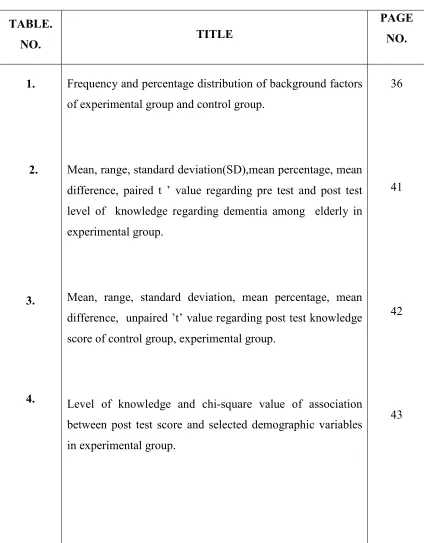
Frequency and percentage distribution of background factors of experimental group and control group.
Mean, range, standard deviation(SD),mean percentage, mean difference, paired t ’ value regarding pre test and post test level of knowledge regarding dementia among elderly in experimental group.
Mean, range, standard deviation, mean percentage, mean difference, unpaired ’t’ value regarding post test knowledge score of control group, experimental group.
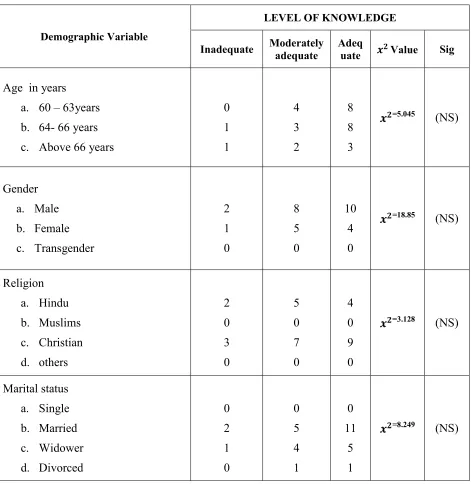
Level of knowledge and chi-square value of association between post test score and selected demographic variables in experimental group.
36
41
42
LIST OF FIGURES
FIGURE.
NO TITLE
PAGE NO.
1. Conceptual Frame work 11
2. Research Design 25
LIST OF APENDICES
S. NO CONTENT PAGE NO.
1. Letter seeking permission to conduct the main study i
2. Letter requesting suggestion for establishing content validity ii-iii
3. Content validity certificate iv
4. Letter granting permission to conduct the main study. v
5. List of experts vi
6. Consent Form Informed written consent form – English & Tamil
vii-viii
7. Structured demographic variables among elderly ix-xxix
8. Structured knowledge questionnaire regarding pelvic
inflammatory disease - English & Tamil xxx-liv
9. Lesson plan video assisted teaching programme-Tamil and English
lv
LIST OF ABBREVIATIONS
SHORT FORMS ABBREVIATION
SPMIHS STP H1
MSC (N) P
F %
2
SD NS MD AD AAFP CT PET EEG
Shivparvathi Mandradiar Institute of Health Sciences Structured teaching programme
Research hypothesis
Master of science in nursing Probability
Frequency Percentage Chi-square test Standard deviation Non Significant Mean Difference Alzheimer’s Disease
American Academy of Family Physicians Computerized Tomography
ABSTRACT
A quasi experimental study to assess the effectiveness of structured teaching program on the level of knowledge regarding dementia among elderly in a selected village at tripur. Tamilnadu was under taken by 301231852 as a partial fulfillment of the requirement for the degree of Master of Science in nursing at Shivparvathi Mandradiar Institute of Health Science, under the Tamilnadu Dr.MGR Medical University during the year 2012-2014.
The objectives of the study were;
1. To assess the pre test and post test level of knowledge regarding dementia among elderly in experimental group and control group.
2. To evaluate the effectiveness of structured teaching program on the level of knowledge regarding dementia among elderly in experimental group. 3. To find the association between the post test level of knowledge on
dementia and the selected demographic variable among elderly in experimental group with their selected demographic variables.
The research hypotheses formulated were;
1. There is a significant difference between the pre test and post test level of knowledge regarding dementia after STP among elderly in experimental group.
2. There is a significant difference in post test level of knowledge regarding dementia among elderly between experimental group and control group. 3. There is a significant association between the post test levels of knowledge
The investigator organized the review of literature under three sections as follows; Studies related to incidence and prevalence of dementia, Studies related to knowledge and awareness of dementia, and Studies related to effectiveness of structured teaching programme.
The conceptual framework for this study was based on Nursing Process model developed by ANA (1991).The research design used was a quasi experimental design. Study was conducted among 60 elderly, 30 elderly in experimental group and 30 in control group who were selected by purposive sampling technique in palayakottai at tirupur (Dt).
The data collection tools were validated by 2 psychiatrists, 3 nursing experts and 1 visual engineer. The tool developed and used for data collection was a structured knowledge questionnaire method. Reliability was established by test retest method r=0. Pilot study was conducted among 10 elderly in archuna nagar at nathakadaiyur.
Main study was conducted in palayakottai at tirupur (dt). After the pretest structured teaching programme was conducted for elderly in experimental group and then post test was conducted. Data obtained were edited, organized, analyzed by using SPSS (Version 13) and interpreted by descriptive and inferential statistics. The findings revealed the effectiveness of structured teaching programme.
The findings of the study showed that there was a significant (p<0.05) improvement on level of knowledge regarding dementia after the structured teaching programme among experimental group. There was no significant association between level of knowledge and selected demographic variables in experimental group. The conclusion of the study was that structured teaching programme was an effective method for improvement of knowledge on dementia among elderly.
1
CHAPTER I
INTRODUCTION
BACKROUND OF THE STUDY
“You have to lose your memory if only in bits and pieces to realize that memory is what makes our lives.
Life with memory is our reason, our feeling, and our action, without it we are nothing.”
Demographic aging is a global phenomenon with differential impact on world regions. It began early in developed countries and progressed over longer period of time and they had more time to develop services. Regions like Asia, Latin America and Africa are now witnessing rapid demographic aging and the developing countries in this region will have comparatively little time to develop geriatric services. It is this unprecedented pace of demographic aging which makes it such a huge public health challenge for the region. Though the biological phenomenon of aging is universal, the daily life of an older person varies considerably according to social, economic, and cultural contexts. Aging and health has many socio-cultural determinants. Social status and available social support for older people vary in different cultures. In many developing countries, older persons are accorded with great respect, both within the families and in society.
2
Dementia is a broad category of brain diseases that cause long term loss of the ability to think and reason clearly that is severe enough to affect a person's daily functioning. It develops when the parts of the brain that are involved with learning, memory, decision-making, and language are affected by one or more of a variety of infections or diseases. The most common form of dementia is Alzheimer's disease (75%). Other forms include Lewy body dementia, vascular dementia, fronto-temporal dementia, progressive supra-nuclear palsy, cortico-basal degeneration, normal pressure hydrocephalus and Creutzfeldt–Jakob disease.
Dementia is the most feared and divesting disorder of late life. Current estimates reveals that there are about 18 million cases of dementia in the world and by 2025, there will be about 34 million suffering from dementia. The overall prevalence of dementia ranges from 5 percent to 7 percent. Alzheimer’s disease is the most common demanding disorder accounting for 80 percent of all cases of dementia
Dementia is not merely a problem of memory. It reduces the ability to learn reason, retain or recall past experience and there is also loss of patterns of thoughts, feelings and activities. Additional mental and behavioral problems often affect people who have dementia, and may influence quality of life and the need for institutionalization. As dementia worsens individuals may neglect themselves and may become disinherited, the individual may become incontinent as their condition worsens. Depression affects (20–30%) of people who have dementia, and about (20%) have anxiety. Psychosis and agitation/aggression also often accompany dementia.
3
There is currently no cure for the disease. Currently available medications offer relatively small symptomatic benefit for some patient but do not show disease progression. It helps a little for the memory. The sun will continue to show its rays on the world. The waves of the vast ocean will continue their rush to reach the shore and the wind will continue to blow the leaves of the tree.
But let us all accept the patient with Dementia and give them a better tomorrow.
NEEDS OF THE STUDY
Dementia is characterized by loss of or decline in memory and other cognitive abilities and reduces the lifespan of affected people. In 2005, it was estimated that 24.3 million worldwide and 1.8 million people in India are affected with dementia. In India the number of people with Alzheimer’s disease and other dementias is increasing every year because of the steady growth in the older population and stable increment in life expectancy and it is expected to increase two-fold by 2030 and three-fold by 2050. Dementia is often associated with physical, mental and financial burden and evidence suggests that elderly people with dementia in developing countries do not often utilize health care services, and when they do, the health care system is often ill prepared to provide quality services for dementia. Around 10-37% of the elderly population with dementia in developing countries is classified as having potentially vulnerable living circumstances with requiring long-term and specialized care. Despite mortality due to communicable diseases, poverty and human conflicts, dementia incidence is destined to increase in the developing world in tandem with the ageing population.
4
(compared with 2.9 million in the USA).This number is likely to increase by 300% in the next four decades. This estimate is based on the premise that the Indian incidence rates are relatively low and will remain stable over time. The relatively high prevalence of smoking and the high and rising prevalence of type 2 diabetes are matters of concern in India. These coupled with anticipated life style changes could affect the incidence rates and lead to a higher than expected prevalence in the near future. The levels of caregiver strain, including that contributed by behavioral disturbances and stress are as high as in developed countries despite extended family networks and home care. Dependency, moreover, is strongly linked to poverty, and imposes additional economic strain on families. People with dementia are cared for at home, by their families. Most families cannot afford institutional care, which in any case is, unavailable in most parts of the developing world.
It is estimated that over 3.7 million people are affected by dementia in our country. This is expected to double by 2030. It is estimated that the cost of taking care of a person with dementia is about 43,000 annually; much of which is met by the families. The financial burden will only increase in the coming years. The challenge posed by dementia as a health and social issue is of a scale we can no longer ignore. Despite the magnitude, there is gross ignorance, neglect and scarce services for people with dementia and their families. We know that dementia is not part of aging and is caused by a variety of diseases. We now have a range of options to treat the symptoms of dementia and offer practical help to those affected.
5
are about 46,000 patients with Alzheimer’s. In Delhi it accounts for about 50,000 Alzheimer’s patient and in Bangalore there are 30,000 elderly patients suffering from Alzheimer’s disease. Today in India 32, 00000 people are affected by dementia. The figure is expected to double every 20 Years.
According to Dr. Harlem (2012) Tomorrow’s elderly people are today’s adult and Yesterday’s children. Adulthood is a unique phase of human development. Adults are the important feature of every society and also a great resource of a nation. Life expectancy has gone up from 20 years at the beginning of the 20th century to 62 years today. India has a large segment of older people in the population. This segment is growing fast with the rapid increase of the grey population in India. Indian aged population is currently the second largest in the world. By 2020, of the countries with the largest elderly population in the world, five will be in developing world, China 230 million, India 142 million, Indonesia 29 million, Brazil 27 million, and Pakistan 18 million. India is home to more than 70 million people older than 60 years as per the 2001 Census. This age group, only 7.5% of the population in 2001, is expected to grow dramatically in the coming decades. With demographic ageing comes the problem of dementia. The numbers of persons with dementia double every 5 years of age and so India will have one of the largest numbers of elders with this problem.
6
In the last 10 years, the evidence on dementia prevalence in India has expanded considerably. More than 42,000 older people have been studied in eight centres across India, and wide variations in estimates exist. Prevalence of dementia using survey diagnosis or clinical diagnosis of DSM IV or ICD 10 reported from Indian studies range from 0.6 % to 3.5% in rural areas and 0.9% to 4.8 % in urban areas. The difference in reported prevalence could be explained by lack of sensitive and specific local measures of assessment, methodological differences in the studies and a host of genetic, sociocultural and environmental factors.
Studies from developing countries have found increased mortality risk for older people with dementia. In two studies from Brazilian and Nigerian on over 6000 individuals aged 65 years and over, a 51.3% death rate for the dementia group compared to non dementia group was found. Persons with dementia from Nigeria died within five years of the diagnosis. The only study from India, conducted in Chennai, investigated predictors of mortality among older people living in the community. The study reported a higher risk of mortality (2.3 times) for older people who received a diagnosis of dementia at the baseline survey and risk of mortality was linearly associated with the severity of cognitive impairment.
Nurses are vital sources in educating the public on various health related issues. Hence the investigator is interested to assess the knowledge of elders regarding Dementia. Furthermore, the study of this kind will serve as guidelines for future elders to provide comprehensive care for Dementia.
7
Keeping above fact in few researcher is keen to assess the knowledge of elders regarding dementia so that knowledge gap can be filled up by educating the elders, caregivers and public and increasing awareness about dementia and accept the individual who is suffering dementia as an important member of society.
STATEMENT OF THE PROBLEM
A quasi experimental study to assess the effectiveness of structured teaching program on the level of knowledge regarding dementia among elderly in a selected village at Tirupur(Dt).
OBJECTIVES OF THE STUDY
1. To assess the pre test and post test level of knowledge regarding dementia among elderly in experimental group and control group.
2. To evaluate the effectiveness of structured teaching program on the level of knowledge regarding dementia among elderly in experimental group.
3. To find the association between the post test level of knowledge on dementia and the selected demographic variables among elderly in experimental group
HYPOTHESES
H1: There is a significant difference between the pre test and post test level of knowledge regarding dementia after STP among elderly in experimental group.
H2: There is a significant difference in post test level of knowledge regarding dementia among elderly between experimental group and control group.
8
OPERATIONAL DEFINITIONS
1. Assess: In this study assess refers to estimate or judge the level of knowledge regarding dementia among elderly by using structured questionnaire.
2. Effectiveness: In this study, effectiveness refers to the extent to which STP has brought about significance difference in the level of knowledge regarding dementia among elderly which was assessed using structured questionnaire. 3. Structured teaching program: It is a Systemic Structured lecture given by the
investigator for 60 minutes with the help of showing pictures regarding dementia.
4. Level of Knowledge: In this study level of knowledge refers to the extent of correct response regarding dementia among elderly and assessed by structured questionnaire.
5. Elderly: In this study elderly refers to those individuals above 50 Years of age who are residing in selected village.
6. Dementia: It refers to a condition in which there is a gradual loss of brain function; it is a decline in cognitive/intellectual functioning The main symptoms are usually loss of memory, confusion, problems with speech and understanding, changes in personality and behavior and an increased reliance on others for the activities of daily living.
ASSUMPTIONS
1. Elderly may have little or inadequate knowledge regarding dementia.
2. Responses of dementia to the questionnaire will reveal their knowledge about dementia.
9
DELIMITATIONS
The study is delimited to;
· The elderly who are living in palayakottai at Tirupur (Dt)
· Sample selected by Non probability purposive sampling technique.
· Data collection period is only four weeks.
CONCEPTUAL FRAME WORK
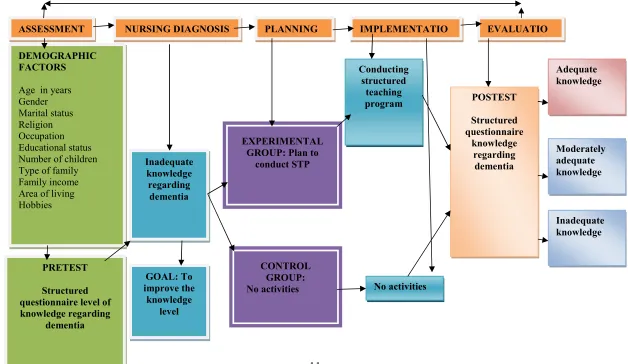
Conceptual frame work is an organized phenomenon which deals with concepts that are assembled by virtue of their relevance to a common theme. The present study was aimed at assessing the effect of structured teaching program on dementia among elderly. The conceptual frame work for the present study was based up on the Nursing Process model (ANA 1991).
1. ASSESSMENT
Assessment is the deliberate and systematic collection of data to determine a client’s current and past health status.
In this study assessment include-
· Pre test knowledge: Knowledge assessment include causes, risk factors, clinical features, management, prevention, prevention of reoccurrence, complication.
10
2. PLANNING
Assessment of data helps in formulating nursing diagnosis, which forms the basis of planning nursing care. Through planning, the nurse determines what needs to be accomplished, in which priority the needs have to be met and how it should be done.
In this study planning includes preparation of structured teaching program for experimental group with the goal to improve the knowledge level and control group no activity.
3. IMPLEMENTATION
During this step individual nursing care is given to client according to the plan. Intervention are continually modified as needed or seemed necessary by an ongoing nursing assessment of the client response.
Screening a structured teaching program on dementia for experimental group and control group no activity.
4. EVALUATION
The nurse determines the client’s progress towards meeting the behavioral outcomes and the success of the nursing intervention.
To evaluate the post test level of knowledge for experimental group and control group based on score key as adequate knowledge, moderate, inadequate.
11
FIGURE - 1
NURSING DIAGNOSIS
DEMOGRAPHIC FACTORS
[image:28.842.95.723.165.529.2]Age in years Gender Marital status Religion Occupation Educational status Number of children Type of family Family income Area of living Hobbies
ASSESSMENT PLANNING IMPLEMENTATIO EVALUATIO
Inadequate knowledge regarding dementia GOAL: To improve the knowledge level PRETEST Structured questionnaire level of knowledge regarding dementia CONTROL GROUP: No activities EXPERIMENTAL
12
CHAPTER-II
REVIEW OF LITERATURE
‘As we grow older, we must discipline ourselves to continue expanding, broadening, learning, keeping our minds active and open’
-Clint Eastwood
A review of literature enables one to get an insight into the various aspects of the problems under the study. This involves the systematic, identification, location, and summary of written materials that contain information on a research problem.
This chapter deals with literature review on effect of structured teaching programme on dementia under the following headings.
1. Studies related to incidence and prevalence of dementia.
2. Studies related to knowledge and awareness of dementia.
3. Studies related to effectiveness of structured teaching programme.
1. STUDIES RELATED TO INCIDENCE AND PREVALENCE OF
DEMENTIA.
Bhardwaj A (1) et.al (2014), conducted a study on the prevalence of dementia
13
refused to participate. The result of the study was a total of 32/2,000 (1.6%) elderly individuals were classified as demented. No case of dementia was reported from tribal population. A look at sex differential reveals that majority (21/32; 66%) of individuals identified as demented were females. As age advanced scores on cognitive screen decreased with elders above 80 years of age showing lowest scores. Out of 32, 18 (56%) of patients classified as demented were more than 80 years of age. The findings of this study are in agreement with previous studies which point towards differential distribution of dementia across populations.
Blom K, et al (2014), conducted a study on influence of vascular risk factors on
cognitive decline in patients with Alzheimer's disease. This study aims to examine the association between VRFs and the rate of cognitive decline in patients with Alzheimer's disease (AD). The results showed that 174 patients (mean age 78.3 years), with a follow-up time follow-up to 5.8 years (mean 1.1 year), in total 447 MMSE scores were obtained. The multivariable analyses showed an association between age as well as systolic blood pressure and a decline in annual rates of change in MMSE scores of -0.05 (95% confidence interval (CI): -0.09 to 0.00) and -0.01 (CI: -0.03 to 0.00), respectively. For all other VRFs, including sex, patients did not show a significant difference. The conclusion of this study did not find an association between preventable vascular risk factors and cognitive decline in patients with AD, except for systolic blood pressure. As the association between systolic blood pressure and decline in MMSE was small, clinical relevance may be limited.
Banerjee Tk et.al (2014), conducted a 7-Year Prospective Study Dementia and
14
group, were diagnosed with dementia. The 7-year prevalence rate for dementia was estimated to be 49.28%. In the Indian population, an early onset of dementia is noted among patients with PD, with the age of onset being less than 55 years. Patients with early-onset PDD showed depression symptoms that differed significantly from the controls of the same age-group. There was a major difference in verbal fluency, word list recall, constructional praxis and recall, word list recognition, abridged Boston Naming Test, word list memory with repetition, and Mini-Mental State Examination between PD-MCI and PDD groups. Hallucinations before baseline (odds ratio [OR] = 4.427, 95% confidence interval [CI] = 2.122-9.373), akinetic/tremor dominancy (OR =0.380, 95%CI = 0.149-0.953), and asymmetrical disease onset (OR = 0.3285, 95%CI =0.1576-0.685) can be considered as risk factors for patients with dementia. Patients with early-onset PD might be more prone to complex depression and dementia.
Landefeld CS et al (2013), conducted a study was done to determine the
incidence of different types of dementia in the very old, and to explore the relation with age and gender. A dementia-free cohort was followed for an average of three years in Stockholm, Sweden. At the end of the follow-up, the subjects were interviewed by nurses, clinically examined by physicians, and cognitively assessed by psychologists. Disease cohort members were studied using death certificates, hospital clinical records and discharge diagnoses. Results showed that during the follow-up, 148 subjects developed dementia. In the age-group 75 to 79, the incidence rates for dementia were 19.6 for women and 12.4 for men per 1,000 person-years.
Hanna M et.al (2013), conducted an exploratory study to assess the
epidemiology of dementia among old age population among urban community, Calcutta. The sample size for the study was 350 old age population. The study results showed that over all prevalence of dementia is between 15-18% after 65yrs of age. And it doubles with every 5yrs increase in age.
15
Fortinsky RH et al (2013) conducted a multicentre cross-sectional,
observational study was conducted to determine the prevalence of dementia in nursing homes in Spain among 852 residents to analyze the associated factors in an elderly population in the institutional setting they performed. Dementia was diagnosed to the DSM-IV-TER clinical criteria. The Hughes Clinical Dementia rating scale was used to measure global impairment or the global severity of dementia. The overall prevalence of dementia was 61.7% and that of Alzheimer’s disease was 16.9%,vascular dementia was found in 7.3% female sex ,was independently associated with a greater frequency of dementia. The prevalence of dementia increased with age. The study concluded that two third of the elderly persons living in nursing home in Spain have dementia.
Etherton-Beer CD. (2013). Conducted an epidemiological study for dementia in
an urban community-resident population in Mumbai, India, wherein the prevalence of all types of dementia was determined. From a potential pool of 30,000 subjects aged 40 years or more, 24,488 (male = 11,875; female = 12,613) persons completed self-report or interviewer-rated protocols based on the Sandoz Clinical Assessment Geriatric Scale, but 5,512 (18.37%) persons refused to participate. The prevalence rate for dementia in those aged 40 years and more was 0.43% and for persons aged 65 and above was 2.44%. Seventy-eight individuals had a CDR of [greater-than-or-equal] 1 yielding an overall prevalence rate of 0.32%, and a prevalence rate of 1.81% for those aged 65 years and older. The overall prevalence rate for Alzheimer's disease (AD) in the population was 0.25%, and 1.5% for those aged 65 years and above. The prevalence of AD and other dementias is less than that reported from developed countries but similar to results of other studies in India. Prevalence of the dementia syndrome increased with age. AD was the most common dementia and the prevalence was higher in women than in men.
Zhang L (4) et.al (2013), conducted a cross-sectional studies to assess the
16
was designed to estimate the prevalence of MCI and explore the possible risk factors including gender disparities among community-dwelling older individuals. A total of 815 individuals, 60 years and older were selected by stratified random cluster sampling. Cognitive function was measured using the mini-mental status examination (MMSE), the Chinese version of the Dementia Rating Scales (CDRS) was used to apply the diagnostic of non-dementia, and activities of daily living (ADL) and instrumental activities of daily living (IADL) systems were used to functional status. The association between socio demographic characteristics, lifestyle, history of chronic diseases and MCI were evaluated separately for men and women using the Pearson χ²-test and binary logistic regression. Of the 815community-dwelling individuals, 145 were found to have MCI. Overall, the prevalence of MCI was 18.5%, with a prevalence of 19.6% in women (105/535), and 15.3% (40/261) in men. The results of the binary logistical regression analysis indicated that age and history of stroke were associated with MCI in men. For women, the risk factors were lower level of educational and lack of religious attendance.
Onishi K. et al (2010), conducted a study to assessed the challenge of estimating
17
increased to 10% after incorporating the results of this study. The prevalence of elderly dementia according to LTCI data should be estimated based on a determination of dementia-equivalence in terms of the level of care required dementia, equivalent to dementia (i.e., requiring daily care similar to that for dementia), and severe squeal of CVD. Furthermore, the capture rate should be carefully considered.
Lichtenberg PA et.al (2011) conducted a descriptive study to assess the
incidence of dementia among old age people in selected rural population, Karnataka. The study sample size was 120 old age people. The study results showed that the incidence of dementia is estimated as 10% 0f old age having dementia over 65 years of age and 35% of old age having dementia over 85years of age.
Blom K, et al (2011), conducted a door-to-door survey was conducted to
investigate the prevalence, psychosocial correlates and risk factors of various dementia disorders in an urban population in Kerala, southern India on 2005. They selected sample from the city of Kochi by using cluster sampling, to identify residents aged ≥65 years. Of 1934 people screened with a vernacular adaptation of the Mini-Mental State Examination, all those scoring at or below the cut-off of 23 were evaluated. The prevalence of dementia was 33.6 per 1000 (95% CI 27.3-40.7). Alzheimer's disease was the most common type (54%) followed by vascular dementia (39%), and 7% of cases were due to causes such as infection, tumour and trauma. According to this survey Dementia (AD) is an important health problem of the elderly population.
Mehta KM et al (2010) conducted a study was done at Rotterdam which country
18
years and over. Alzheimer’s disease was the main sub diagnosis (339 cases) it was also the main cause of the pronounced increase in dementia with age. The relative proportion of vascular dementia (76 cases: 16%), Parkinson’s disease dementia (30.6%) and other dementias (24.5%) decreased with age.
Grover A et al (2010), conducted a descriptive study regarding the awareness of
putative risk factors for Alzheimer’s disease among elderly Koreans. A total of 2767 randomly selected from the Asian Geriatric study were questioned on their knowledge of risk factors for Alzheimer’s disease. The results showed that the most commonly stated risk factor was being older (59.6%), followed by head trauma (33.6%), and Cerebro Vascular Disease (30.4%). The study concluded that AD was more prevalent in older subjects and those with a lower level of education, and so public health education on the basic concepts of AD should be targeted at this population.
Palmer RM et al (2008), conducted a longitudinal Study of Aging was
conducted at Baltimore to estimate age-specific incidence rates of AD. A sample size of 1236 participants (802 men, 434 women) in the BLSA with longitudinal follow –up were taken between January 1985 and May 1998. The average length of follow-up was 7.5 years, with participants evaluated every 2 years by physical, neurological, and neuropsychological examinations. The authors diagnosed 155 cases of dementia, of which 114 (74%) were AD. It was concluded that incidence rates for AD in the BLSA offer a unique opportunity to prospectively investigate the antecedents of AD.
2. STUDIES RELATED TO KNOWLEDGE AND AWARENESS OF
DEMENTIA.
Rullier L et.al (2013) conducted a study was conducted on providing education
19
and after interventions designed to improve knowledge in a sample of 100 undergraduate students. Results showed that education improved Knowledge of Alzheimer's disease by 50% to 85%, as measured by increased scores on a dementia knowledge questionnaire. This study has important implications for public education about dementia and resource allocation for service providers.
Huang HL et.al (2012), conducted a cross sectional study was conducted to
investigate public stigma (stereotype, prejudice, discrimination) relating to Alzheimer’s disease among elders. The data was collected by interview from 500 people aged between 50-65yrs living within the community. The study results showed that the 41.6% of the participants expressed stereotype; 43.4% prejudice, and 35.5% discrimination. The study concluded that dimension of stigma were highly prevalent in relation to Alzheimer’s disease and more interventions are needed to reduce the effect of stigma.
Phelan EA et.al (2012), conducted a study was conducted to examine the
knowledge about Alzheimer’s disease among 794 people by using knowledge questionnaire. The study results showed that the Knowledge about Alzheimer’s disease was lower for dementia care givers, older adults, senior centre staff and undergraduate students. Across groups, respondents don’t know about risk factors and prevention of Alzheimer’s disease. The study concluded that the awareness program is necessary to the public about Alzheimer’s disease.
Simonsick EMet.al (2012), conducted a population-based study was conducted
20
informants did recognize a memory problem, 53% failed to receive a medical evaluation for this problem. The study concluded that unrecognized dementia was common in our population, especially among mild cases. Cognitive screening programs for the elderly and public education policies designed to increase awareness of early signs of dementia are needed if interventions for individuals with potentially treatable dementias are to be implemented.
Rubin SM et.al (2011), conducted a descriptive survey was carried out to
investigate knowledge and fear of developing Alzheimer’s disease in a sample of healthy elders. The sample size was 127 young elders and 118 older elders. The data was collected by using knowledge questionnaire; Younger elders obtained a score of 54 % while older elders obtained 58% on knowledge test. Knowledge and fear scores were not significantly correlated with having a family member or knowing someone with Alzheimer’s disease.
Acosta I et al (2010), conducted a descriptive study was conducted to assess the
knowledge regarding of early identification of dementia among family members in selected families Maharashtra, sample size for the study was 100. The study results showed that 61.3% of the family members are having inadequate knowledge regarding early identification of dementia, and 6.5% of family members having adequate knowledge.
Yang SY et.al (2010), conducted a study was conducted to investigate
21
Meillon C(2) et.al (2009), a study was conducted to assess the racial differences
in knowledge and attitudes about Alzheimer’s dementia among older adults .Data collected from 1176 older adults aged 45 years and over (48.6% White, 25.7%Black, and 25.8% Hispanic) obtained through telephone interview. The result showed that Compared with White and Black respondents, Hispanics were more likely to report feeling well-prepared for handling a diagnosis of Alzheimer’s disease in a family member. The study concluded that misconceptions about Alzheimer’s dementia remain among large segments of the population and continued efforts are needed to educate the public about this disease.
Sosa AL et al (2009), a descriptive study was conducted to assess the knowledge
regarding self care aspects of patients with dementia among primary health care givers on government medical college Pune. Sample size for the study was 100. The study results showed that 42.3% of the primary care givers had adequate knowledge regarding self care while others have inadequate knowledge.
3. STUDIES RELATED TO EFFECTIVENESS OF STRUCTURED
TEACHING PROGRAMME
Zerinet.al (2012), conducted a study with an aim to evaluate the effectiveness of structured teaching program on knowledge and practice regarding management of thrombolytic therapy among 40 staff nurses working in selected hospital, Bangalore revealed that mean post test knowledge score 69.19 was higher than mean pre test knowledge score 34.05 with the‘t’ value of 26.05 and found to be significant at p 0.001. The author concluded that STP was effective method of providing information on knowledge and practice regarding management of thrombolytic therapy.
22
selected with non probability purposive sampling technique and 50 samples were selected. Results showed video assisted teaching practice found to be effective in improving the knowledge of care givers on care of the symptoms, compliance with the treatment, early recognition and prevention of complications.
Zahara Aziz (2011) has done a study on video teaching strategies to increase science subject knowledge to pupils in primary school at Malaysia. Samples were selected randomly 18 pupils in five years from one of the national school in bangsar. Findings of this study were video teaching strategy helped pupils to improve their understanding of basic concepts and knowledge in science. Students showed positive changes in attitude and interest.
Donkor (2010) done a comparative study on instructional effectiveness of print based and video based instructional materials for teaching and practical skills at a distance in U.S.A. Samples were selected randomly34 participants who used print based instructional materials and 35 participants who used video based instructional materials to learn practical skills. Data was collected with use of performance test and achievement test. The results of this study indicate practical skills were significantly higher among users of video based instructional materials students.
Boscardin WJ et al (2009) conducted a pre experimental research study of one
23
CHAPTER-III
METHODOLOGY
According to Polit and Beck (2012) research methods are the techniques used by researchers to structure a study and to gather and analyze information relevant to research question.
Research methodology involves the systematic procedure by which investigator starts from the initial identification of the problem to its final conclusion. Methodology is a significant part of any study which enables the researcher to project the research undertaken.
This chapter deals with research design, setting, population, sample and sample size, sampling technique ,sample selection criteria, description of the tool, scoring, validity of the tool, reliability of the tool, pilot study, data collection procedure, plan of data analysis and ethical consideration.
RESEARCH APPROACH
24
The present study is an evaluative research approach. Evaluative research study is an applied form of research design in which the judgment is made on how well a specific practice or program is working. It is used to determine the effectiveness of processes or equipment used in a particular setting.
The definitive aim of the present study is to evaluate the effectiveness of structured teaching programme regarding dementia among elderly.
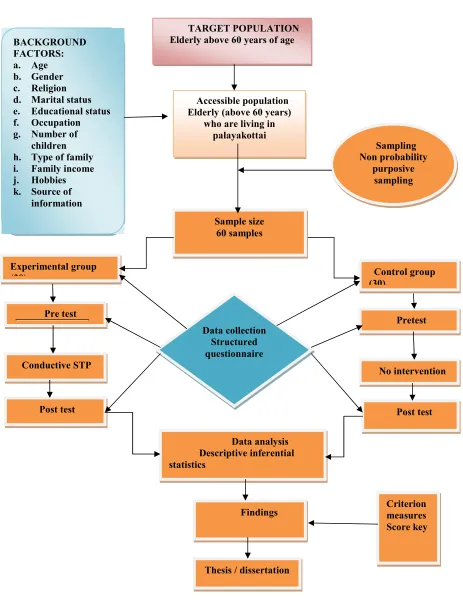
RESEARCH DESIGN
According to Polit and Beck (2012) the research design is the overall plan for obtaining answers to the questions being studied and for handling some of the difficulties encountered during the research process.
25
FIGURE -2
TARGET POPULATION Elderly above 60 years of age
Experimental group
(30) Control group (30)
Accessible population Elderly (above 60 years)
who are living in palayakottai Sample size 60 samples BACKGROUND FACTORS: a. Age b. Gender c. Religion d. Marital status e. Educational status f. Occupation g. Number of
children h. Type of family i. Family income j. Hobbies k. Source of
information Pre test Data collection Structured questionnaire Conductive STP Post test
Thesis / dissertation
Pretest
No intervention
26
NOTATION:
GROUP PRE TEST INTERVENTION POST TEST
Experimental group O1 X O2
Control group O1 - O2
A symbol used in study is;
O1 : Pre test to assess the level of knowledge regarding dementia among elderly in control group and experimental group.
X : Structured teaching program to experimental group.
O2 : Post test to assess the level of knowledge regarding dementia among elderly in control group, experimental group.
VARIABLES
According to Suresh K Sharma (2011) variables are qualities, quantities, properties, or characteristics of people, things, or situations that change or vary.
The categories of variables discussed in the study were;
INDEPENDENT VARIABLE
27
Independent variable: Structured teaching program on dementia. It is a Systemic Structured lecture given by the investigator for 60 minutes with the help of showing pictures regarding dementia.
DEPENDENT VARIABLE
It is the focus of the study and reflects the empirical aspects of the concepts being studied.
Dependent variable: level of Knowledge of elderly regarding dementia.
EXTRANEOUS VARIABLE
:
Age, gender, religion, marital status, educational status, occupation, number of children, type of family, family income, area of living hobbies, previous sources of information regarding dementia.
SETTING
The selection of setting was done on the basis of feasibility of conducting the study, availability of subjects and cooperation of the authorities. The data was collected in palayakottai at tirupur (dt)
POPULATION
28
Target population is the aggregate of cases about whom the investigator would like to make generalization. In this study, elderly were the target population.
Accessible population is the aggregate of cases that confirm to the designed criteria and which is accessible to the investigator as a part of subject for conducting the study. The accessible population selected for this study was elderly who are living in palayakottai at tirupur (dt).
SAMPLE AND SAMPLE SIZE
The sample size was determined arbitrarily by the type of the study, variables being studied, feasibility of time, money, and material. In this study, the sample size was arbitrarily decided to be 60elderly in which 30 were in experimental group and 30 were in control group
SAMPLING TECHNIQUE
Sampling is the process of selecting a portion of the population to represent the entire population. In this study the investigator selected the sample by Non probability purposive sampling technique.
SAMPLE SELECTION CRITERIA
The study samples were selected using the following criteria
Inclusion criteria: elderly
29
· Who are willing to participate
· Who are able to cooperate throughout the period of the data collection
· Who knows to read and write Tamil.
Exclusion criteria
1. Who are sick at the time of data collection.
2. Who have already undergone teaching program regarding dementia.
DEVELOPMENT OF TOOL
The investigator developed a structured knowledge questionnaire as tool for present study after exploring all sources of information like extensive library search, internet sources and consultation with experts. The experts were requested to check for the relevance, sequence and clarity of the tool. Modification was done according to expert’s opinion and the final tool was developed. The tool was translated into Tamil and again it was retranslated into English, thereby, the language validity was ascertained. In the present study the reliability of the structured questionnaire was established by test – retest method, among 10 elderly. Reliability coefficient was r =0.92 and the tools were found to be reliable for the study.
DESCRIPTION OF THE TOOL
The tool used for the research study was structured knowledge questionnaire regarding dementia, tool consists of two parts.
PART I: Back ground data
30
PART I:
Background data of elderly, consists of 11questions seeking information on the background data of students. The items included Age, gender, religion, marital status, educational status, and occupation, number of children, type of family, family income, hobbies, and previous sources of information regarding dementia.
PART 2:
Structured questionnaire for assessing the level of knowledge regarding dementia among elderly.
It contains 25 items, each carries 1 mark. The highest possible score is 25.The lowest score for each question is 0.
SCORING PROCEDURE:
· Maximum score-25
· Minimum score –0
SCORE PERCENTAGE (%) LEVEL OF
KNOWLEDGE
0 -13 0 -50% In adequate knowledge
13 -20 50 - 75 % Moderately adequate knowledge
31
VALIDITY OF THE TOOL
Six experts including two psychiatrists, one visual engineer, and three nursing experts validated the tool for its content. The experts were requested to check for the relevance, sequence and clarity of the tool. Modification was done according to expert’s opinion and the final tool was developed. The tool was translated into Tamil and again it was retranslated into English, thereby, the language validity was ascertained.
RELIABILITY OF THE TOOL
In the present study the reliability of the structured questionnaire for experimental group and control group was established by test –retest method, among 10 elderly. Reliability coefficient was r =0.92 and the tool were found to be reliable for the study.
P
ILOT STUDY
The pilot study was conducted in archuna nagar at nathakadaiyur .It was conducted only after the tool presentation and approval of college of nursing faculty and dissertation committee. Validity and reliability of the instrument were tested during this time. The pilot study was done to obtain information to improve the project or assess its feasibility. The pilot study was conducted among 10 elderly, 5 elderly in control group and 5 elderly in experimental group. Who fulfilled the sample criteria for sample selection and those elderly were excluded from the main study. Pre test, structured teaching programme, and post test was done and feasibility of the study was established. It also helped to select suitable statistical method.
STRUCTURED TEACHING PROGRAMME
32
DATA COLLECTION METHOD
The present study was conducted in palayakottai at tirupur (dt). The data were collected for 4 weeks from 1st of April 2014 to31st April 2013.Permission was sought and obtained from authorities of the village. The study samples were selected by Non probability purposive sampling technique based on sample selection criteria. The study purpose and method were explained to the selected sample. Informed consent was obtained from the study participant’s for participating in the study. The sample size was 60elderly people.
Pre test was conducted for 30 elderly in experimental, 30 elderly in control group. Background data and level of knowledge were collected by using structured knowledge questionnaire (multiple choice questions) to assess the level of knowledge regarding dementia among elderly. After pretest elderly in the experimental group attended the structured teaching programme .Post test score was assessed with same questionnaire 10 days after the structured teaching programme for both control groups, experimental group.
PLAN FOR DATA ANALYSIS
The data collected from subject were edited, compiled, and analyzed by using SPSS version 13. The probability level of 0.05 was used as the level of significance. The data were analyzed as follows;
1. Back ground Data obtained from the sample organized and summarized with the help of descriptive statistics like frequency, mean, percentage distribution, standard deviation.
33
3. Data on identifying the association between the pre test knowledge with selected socio-demographic variables of experimental group were analyzed using descriptive and chi-square test.
4. Data on effectiveness of structured teaching programme on dementia among control group and experimental group with the use of unpaired’ test.
ETHICAL CONSIDERATION
34
CHAPTER-IV
ANALYSIS AND INTERPRETATION
The analysis and interpretation of data of this study were based on the data collected by structure questionnaire method. The results were computed using descriptive and inferential statistics. The data were entered into excel sheet and analyzed using SPSS 13 version. The probability value of less than 0.05 was considered to be significant.
The objectives of the study were,
4. To assess the pre test and post test level of knowledge regarding dementia among elderly in experimental group and control group.
5. To evaluate the effectiveness of structured teaching program on the level of knowledge regarding dementia among elderly in experimental group.
6. To associate the post test level of knowledge regarding dementia and the selected demographic variables among elderly in experimental group.
The data collected were edited, tabulated, analyzed, and interpreted, a findings obtained were presented in the form of tables, and diagrams under the following sections:
5. Back ground Data obtained from the sample organized and summarized with the help of descriptive statistics like frequency, mean, percentage distribution, standard deviation.
35
7. Data on identifying the association between the pre test knowledge with selected socio-demographic variables of experimental group were analyzed using descriptive and chi-square test.
36
SECTION I: DATA ON BACKGROUND FACTORS OF ELDERLY
IN EXPERIMENTAL GROUP AND CONTROL GROUP
[image:53.595.78.540.277.735.2]
TABLE – 1
FREQUENCY, PERCENTAGE OF ELDERLY ACCORDING TO BACKGROUND FACTORS IN EXPERIMENTAL AND CONTROL GROUP N=60
S. NO
DEMOGRAPHIC VARIABLES EXPERIMENTAL
GROUP
CONTROL GROUP
F % F %
1. Age in years a. 60 – 63years b. 64- 66 years c. Above 66 years
12 12 06 40 40 20 15 10 05 50.0 33.3 16.7 2. Gender
d. Male e. Female f. Transgender 20 10 0 66.7 33.3 00.0 18 12 0 60.0 40.0 00.0 3. Religion
a. Hindu b. Muslims c. Christian d. Others 11 0 19 0 36.7 00.0 63.3 00.0 12 0 18 0 40.0 00.0 60.0 00.0 4 Marital status
37 5 Educational status
a. Illiterate
b. Primary education c. High school Education d. Degree and above
23 03 0 04 76.7 10.0 00.0 13.3 19 06 0 05 63.3 20.0 00.0 16.7 6 Occupation
a. Government employee b. Business man
c. Private employee d. Cooley e. Retired/unemployed 00 03 18 05 04 00.0 10.0 60.0 16.7 13.3 00 02 15 06 07 00.0 06.7 50.0 20.0 23.3 7 Number of children
a. No children b. One child c. Two children
d. More than 2 children
00 11 17 02 00.0 36.7 56.6 06.7 03 09 14 04 10.0 30.0 46.7 13.3 8 Type of family
a. Nuclear family
b. Joint family
c. Extended family
19 5 6 63.3 16.7 20.0 17 8 5 56.6 26.6 16.8 9 Family Income
a. < Rs-5000/- b. Rs.5001- 10000 c. Above Rs 10000
6 15 9 20.0 50.0 30.0 4 7 19 13.3 23.4 63.3 10 Hobbies
a. Reading books and news paper b. Watching TV
38 11 Previous sources of information
regarding Dementia a. Yes b. No if yes A. Friends B. Newspaper C. Mass media
3 27 02 01 00 10.0 90.0 6.66 3.33 0.00 4 26 02 02 00 13.3 86.7 6.66 6.66 0.00
Table No 1: Shows the frequency, percentage of elderly according to background factors in experimental and control group.
Regarding age in years in experimental group majority 12(40%) were in 60-63 years and 64 -66 years respectively and the least 6(20%) were above 66 years. Among control group majority 15(50%) were in 60-63 years of age, 10(33.3%) were 64 – 66 years, and the least 5(16.7%) were above 66 years of age.
Regarding gender in experimental group majority 20(66.7%) were males and the least 10(33.3%) were female, and among control group majority 18(60.4%) were males and the least 12(40%) were females.
Regarding religion in experimental group majority 19(63.3%) were Christians and the least 11(36.7%) were Hindus, among control group majority 18(60%) were found to be Christians and the least 12(40%) were in Hindu religion.
[image:55.595.77.542.71.240.2]39
Regarding educational status in experimental group majority 23(76.7%) were illiterates, 4(13.3%) had high school education and the least 3(10%) had primary education. Among control group majority 19(63.3%) were illiterates, 6(20.0%) had primary education, and the least 5(16.7%) had high school education.
Regarding occupation in experimental group majority 18(60%) were working as private employees, 5 (16.7%) were working as coolie, 4 (13`3%) were retired/ unemployed, and the least 3(10%) were business men. Among control group majority 15(50%) were working as private employees, 7(23.3%) were retired/ unemployed, 6(20.0%) were working as coolie and the least 2(06.7%) were business men.
Regarding number of children in experimental group majority 17(56.6%) were having two children, 11(36.7%) were having one children, and the least 2(06.7%) were having more than two children. Among control group majority 14(46.7%) were having two children, 9(30.0%) had one children, 4(13.3%) had more than two children, and the least 3(10%) had no children.
Regarding type of family in experimental group majority 19(63.3%) were living as nuclear family, 6(20.0%) were living in extended family, and the least 5(16.7%) were living as joint family. Among control group majority 17(56.6%) were living as nuclear family, 8(26.6%) were in joint family, and the least 5(16.8%) were living as extended family.
40
Regarding hobbies in experimental group majority 20(66.7%) had the hobby of watching TV, 6(20.0%) had the hobby of chatting with friends and the least 4(13.3%) had the hobby of reading books and news paper. Among control group majority 22(73.3%) had the hobby of watching TV, 5(16.7%) had the hobby of reading books and news paper, 3(10%) had the hobby of chatting with friends.
Regarding previous sources of information regarding dementia in experimental group majority 27(90%) did not have the previous sources of information regarding dementia and the least 3(10%) had the previous sources of information regarding dementia, among control group majority 26(86.7%) did not have the previous sources of information regarding dementia and the least 4(13.3%) had the previous sources of information regarding dementia.
It was inferred that in experimental group majority 12(40%) were from 60-63 years and 64 -66 years respectively, 20(66.7%) were males, 19(63.3%) elders were Christians, 18(60%) were married, 23(76.7%) were illiterates, and 18(60%) were working as a private employee, 17(56.6%) had two children, 19(63.3%) were living in a nuclear family, 15(50%) of their family monthly income was above Rs.5000, 20(66.7%), elders had the hobby of watching TV, 27(90%) elders did not have the previous sources of information regarding dementia.
41
SECTION II: DATA ON PRE TEST, POST TEST LEVEL OF
KNOWLEDGE REGARDING DEMENTIA AMONG ELDERLY IN
EXPERIMENTAL GROUP
TABLE: 2
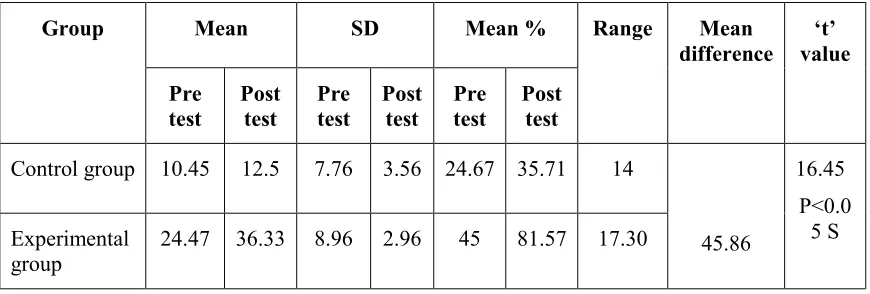
MEAN, RANGE, STANDARD DEVIATION, MEAN PERCENTAGE, MEAN DIFFERENCE, ’T’ VALUE IN PRE TEST AND POST TEST LEVEL OF
KNOWLEDGE SCORE OF CONTROL GROUP AND EXPERIMENTALGROUP.
Group Mean SD Mean % Range Mean
difference ‘t’ value Pre test Post test Pre test Post test Pre test Post test
Control group 10.45 12.5 7.76 3.56 24.67 35.71 14
45.86 16.45 P<0.0 5 S Experimental group
24.47 36.33 8.96 2.96 45 81.57 17.30
Table 3: Shows post test knowledge score mean, S.D, mean percentage, mean difference, ‘t’value of control group and experimental group.
Pre test in experimental group the obtained over all mean score was 24.47, standard deviation was 8.96, mean percentage was 45 and in control group the obtained over all mean score was 10.4, standard deviation was 7.76,mean percentage was 35.71.
Post test in experimental group the obtained over all mean score was 36.33, standard deviation was 2.96, mean percentage was 81.57 and in control group the obtained over all mean score was 12.5, standard deviation was 3.56, mean percentage was 35.71.
[image:58.595.92.527.283.430.2]42
SECTION III: DATA ON EFFECTIVENESS OF STRUCTURED
TEACHING PROGRAMME REGARDING DEMENTIA AMONG
ELDERLY IN CONTROL GROUP AND EXPERIMENTAL GROUP
TABLE:3
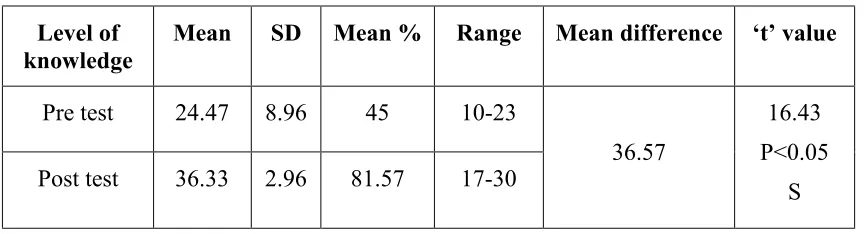
MEAN, RANGE, STANDARD DEVIATION (SD), MEAN PERCENTAGE, MEAN DIFFERENCE, ‘ T ’ VALUE IN PRE TEST AND POST TEST LEVEL OF
KNOWLEDGE REGARDING DEMENTIA AMONG ELDERLY IN EXPERIMENTAL GROUP.
Level of knowledge
Mean SD Mean % Range Mean difference ‘t’ value
Pre test 24.47 8.96 45 10-23
36.57
16.43 P<0.05
S Post test 36.33 2.96 81.57 17-30
Table-3: Shows mean, range, standard deviation (SD), mean percentage, mean difference, ‘ t ’ value of pre test and post test level of knowledge regard