978
A Comprehensive Survey On Soft Computing
Based Optical Character Recognition Techniques
Shrinivas R. Zanwar, Ulhas B. Shinde, Abhilasha S. Narote, Sandipann P. Narote
Abstract: Character recognition has been one of the most interesting and challenging research areas in field of image processing and pattern recognition in the recent years. This paper describes the techniques for better character recognition in document into machine readable form. Several techniques like OCR using Feature extraction and OCR using neural networks are reviewed in this paper. Before going to future research work, analyze and update recognition techniques in detail which are implemented previously. The purpose of this paper is to discuss various algorithms, techniques, processes, and achieve direction towards research work to improve the problems faced by existing systems to get more recognition rate.
Index Terms: Image processing, Pattern recognition, Preprocessing, Feature extraction, Feature selection, Classification, comparison. —————————— ——————————
1
INTRODUCTION
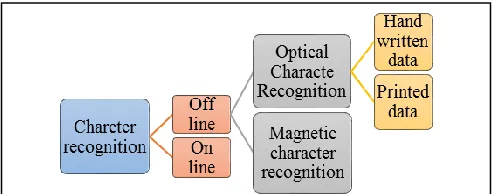
It is always the frontier area of research in the application of image processing as pattern recognition, document analysis, image retrieval, artificial intelligence, machine learning and deep learning approaches. English script is the most widely used script in the world. In the field of OCRs, this script is the most mature as work on English script was started from the 1940s [1]. Here we are presenting the latest literature review on state of art methods. The character recognition is the process in which machine or computer understand the image of handwritten data and convert it into a particular character. There are two ways of character recognition (CR) i.e. online CR or offline CR as observed in Fig 1, which shows the classification of different character recognition systems. In Online character recognition, a data is prepared from a pressure sense of transducer at the time of the user is writing because of the successive movements of the pen are altered into an electronic signal having memory and can be analyzed easily by the computer. Commonly, magnetic character recognition (MCR) or optical character recognition (OCR) is to recognize handwritten as well as printed data. Similarly, offline character recognition includes the conversion of text into an image into letter codes. According to Suman Avdhesh Yadav et. al. [2], the off-line handwriting recognition is more difficult as compared to online recognition because of different people have different handwriting styles, variations inshapes, angles, size, thickness etc. Whereas, on-line handwriting text recognition (HTR) could be used as a more natural way of interaction in many interactive applications. There are many consequences in the improvement in errors rates in HTR, in which the information from the specific task allows to constrain the search and therefore to improve the HTR accuracy [5].
Basically, there are the various steps involved in the character recognition system is explained by Nisha Sharma [3] in 2014, as data acquisition (input image character), preprocessing unit (remove noise, binarization, thinning, resize etc.), segmentation (isolation), feature extraction (extract the essential and differentiable characteristics), classification (decision making), post-processing (output image character) as shown in fig 2.
Fig. 2. The procedural steps for character recognition system
Fig. 1. The classification of different character recognition systems
_____________________________________
• Shrinivas R. Zanwar, Electronics and Telecommunication Engineering department, CSMSS, Chh. Shahu College of Engineering, Aurangabad, India. Email id: [email protected].
• Ulhas B. Shinde, Electronics and Telecommunication Engineering department, CSMSS, Chh. Shahu College of Engineering, Aurangabad, India. Email id: [email protected].
• Abhilasha S. Narote, Electronics and Telecommunication Engineering department, S.K.N. College of Engineering, Pune, India. Email id: [email protected].
979 Here, the paper is organized in various section as first part
types. In section II, dataset is explained in detail.
Preprocessing with various techniques are introduced in section III. Section IV theoretically explicated feature extraction and feature selecting algorithms in section V. Classifiers are explained in section VI. Section VII gives analyzes comparative of various characters, classifiers, and optimizing algorithms with recognition rate. Finally, conclusion and summary are drawn in the last unit.
2
R
ELATEDW
ORKMandal et al. [4] proposed algorithms for the line, words, and character segmentation. The line is segmented into words by using a contour tracing algorithm from the extreme left of the paragraph. Words are segmented by tracing white pixels in between words. Character segmentation algorithm use Baseline Pixel Burst Method for remaining character segmentation. Some noise removal methods are used to increase accuracy up to 95%. Inaccurate line segmentation problem is highlighted as a hurdle in the segmentation of Urdu text [6]. Israr Ud Din et al. [6] proposed a segmentation of lines and ligatures as a necessary step in pre-processing. The 30 documents comprised a total of 310 text lines 306 of which were correctly segmented using the proposed technique reporting a line segmentation accuracy of 98.7%. Naz et al. [7] presented an Urdu Nastalik line recognizer using a multidimensional approach in which it handles diagonal text (Nastalik style). It uses an output layer of the neural network to recognize Nastalik text lines. This approach gives 98% accuracy on printed text. For line segmentation, In addition to some heuristics rules, the projection profile method gives good accuracy. In many Urdu OCR, studies ligature is considered as a basic component to be segmented. Javed and Hussain [8] segmented the thinned strokes in the window and Discrete Cosine Transform (DCT) features are computed for each window. The DCT vectors from the sequence of windows for every segment is being used to teach the HMMs for identification and sequenced to produce the ligature. The system has 92. 73% base form recognition accuracy. Diacritics are rarely handled in Urdu segmentation and cause wrong segmentation [9]. Rana et al. [10] use pre-segmented data and then segmented the Urdu words in two segmented categories of primary ligatures and secondary ligatures (consisting of diacritics). Its difficult task to extract a feature of handwritten text in even English language (in which each character is written separately), when it comes to cursive language like Urdu than its hard to proper segment each ligature. In this section, we review segmentation of handwritten cursive scripts
and different methods that are used to overcome complex segmentation problem in the last few years. Saabni et al. [11] proposed language independent line segmentation techniques. Two different segmentation approaches are proposed for grayscale and binary images of historical Arabic, English and Spanish text. Energy map constructs using Signed Distance Transform for the image to identify text line and upper and lower limit of the text line. Proposed technique tested on four different datasets (ICDAR2009 Contest, Private Collection, ICDAR2009 and Evaluation protocol) and get above 98% accuracy on average. Brodic [12] modifies linear water flow algorithm, by changing its linear function by power function. Water flow deals linearly straight lines, in this modified algorithm bounding boxes, are added to handle angular dimensions of the text. Bounding boxes contain characters or words, each line of a text document is enclosed in bounding boxes. This results in extracted required line regions. Abhishek et al. [13] proposed a segmentation method for handwritten cursive English text. The proposed method uses modified horizontal and vertical projection for line and word segmentation. It even accurately segments multi-skewed lines. The method was tested on IAM dataset giving promising results for line and word (95 and 92% respectively). Horizontal projection approach is used for text line extraction of Handwritten Kannada Historical Script Documents after the pre-processing stage and connected component labelling [14]. Projection profile is used to collect text line information and additionally neighbourhood search is used to assign text to a line. To segment palm leaf manuscripts of Dai, Peng et al. [15] use algorithm based on HMM, to evaluate all segmentation paths. Afterward, optimal segmentation paths are computed by projection properties of the corpus. The system evaluated the historical collection of Dai manuscripts gives an accuracy of 89.9%. Projection profile is the most extensively used technique when there is a sufficient gap between lines. In [16] Pastor Pellicer et al. used the Conventional neural network for text line extraction of historical English documents. Initially, extract line layout analysis and estimates the text area between corpus line and baseline. Further, the Watershed transform is used to extract text lines. This approach is tested on two datasets Saint Gall (98.74%) and Parzival corpora (94.24%). In another study Quang Nhat et al. [17] proposed a multilingual text line segmentation approach. In which trained fully conventional network (FCN) is used to figure out text lines pattern. Through FCN, line map is extracted through which initial segmentation is done and after that line, adjacency graph is used to handle overlapping words between lines. This gives 98.6% accuracy on ICDAR-2013.
3 D
ATASETD
IGITIZATIONA
NDP
REPROCESSINGIn the process of digitization, paper based information is converted in to electronic form. The data from the paper will be captured through optical scanners or cameras. This electronic information is termed as sample dataset, used for training or testing purpose. Generally, the data set of 26 small, 26 capital and 10 numbers of different size, shape, style etc. should be prepared by many writers. Here, the benchmark dataset can be easily available with variety of writers as shown in table 1. Following are the preprocessing steps involved in OCR.
3.1 Remove Noise
The difficulty of the problem lies in the fact that the family of noise patterns that appear in handwritten images could be TABLE1
980 large (or virtually unlimited). Therefore, the author proposed an
unsupervised learning approach that does not rely on the noise patterns belonging to any particular distribution. They formulated the noise removal and recognition as a single optimization problem involving latent variables using the EM algorithm in order to find the values of the latent variables (and therefore the noise patterns) based on an optimization criterion which is defined to be the recognition score for the input image after noise removal. To remove noise elements in the image various techniques are delivered by various researchers. Pepper and salt noise from the scanned images is removed by J. R. Prasad [18], has been used median filter and perform thinning operation to reduce character to minimum one pixel thickness, instead low pass filter has also been used by R. M. Suresh et al. [19].
3.2 Binarization
It is the process for obtaining the image in black (binary 0) and white (binary 1) color only. The captured RGB colored image should be first converted in to gray image and then binary which has been represented with two values for pixel as all the gray levels values of 129 to 255 by binary value ‗0‘ for absence of writing and gray levels values of 0 to 128 by binary ‗1‘ for presence. The Otsu method is used to convert any image into a binary form. In which all the intensity values are representing either in black or white separated by the threshold value. All intensity values below a threshold, are presented by one intensity and above the threshold are by other intensity [3], [20]. Global thresholding technique is also useful for binarization of image. In this technic, dilation of edges is obtained and holes are filled in it [21], [22], it is also called by skeletonization [23].
3.3 Thining
The Thinning is the technique of converting the character images to a single pixel. Zhang Suen Algorithm [24] was used for thinning purpose. This a process of identifying the elements of an image is also called by thinning. This process is required to locate the areas of the document for printing and distinguishing them from figures. Also, with the help of thinning the boundaries and edges of the character image can be possible. Anubhav Jain et al. [25] have applied Prewitt Operator in this step as the color of the image is inverted for black boundaries.
3.4 Normalization
The process of equating the size of all extracted character images is referred by normalization, in which the aspect ratio of the images should be considered and normalize them to different sizes. It should be selected differently by various authors in terms of pixel or inch. Sometimes this process is also useful to reduce noise as mentioned by Suman Avdhesh Yadav et al. [2]. It is also referred by histogram stretching that changes range of intensity values of pixel. Therefore histogram equalization is dominant technique is in image processing for normalization.
3.5 Segmentation (Isolation)
In machine learning, image segmentation is useful for segregating an image into sets of pixels or super pixels. It simplifies the representation of an image into the segmented image for easier analysis. So, by taking lines and curves objects and boundaries are located in the image. Parshuram
M. Kamble et al. has used the bounding box for this process [20]. One another method is projected by J. Pradeep et al. [22] for segmentation. In this system, the isolation of characters is done by allocating a number to each character, provides information about the number of characters in the image. Anubhav Jain et al. [25] has developed the segmentation algorithm as the connected components are labeled based on pixel connectivity. It utilizes the horizontal and vertical projection technique for segmenting the histogram into lines and then to words and individual character. A. Venkata Srinivasa Rao et al. [26] has used drop fall algorithm which is based on the principle of permitting a hypo theatrical marble fall in between two connected characters and making the cut where the marble lands. The main issue in implementation is where to drop the marble from is solved. Jun Tan et al. [27] has addressed one more method for tackling nonlinear segmentation of text lines into characters as a nonlinear clustering method. Two nonlinear clustering methods viz. spectral clustering and kernel clustering based on the Normalized cut (SegNcut) and Conscience On-Line Learning (SegCOLL) respectively. G. Louloudis et al. [28] has articulated a Hough transform and word segmentation algorithm for segmentation. The Hough transform is applicable to minima points in a vertical strip on the left of the image. By grouping cells in an exhaustive search in six directions, the alignments are searched starting from the main direction. After the moving window, assigns the remaining units to alignments associated with a clustering scheme in the image domain. Z Shi et al. [29] has designed the Smearing method. The fuzzy RLSA measures the calculation of standing at a pixel along the horizontal direction. Here, a new grayscale image is created and binarized then the lines of text are extracted from the new image. Bruzzone et al. [30] has introduced projection profiles algorithm, based on the analysis of horizontal run projections are split on a partition of the input image into vertical strips for skewed text. The ascending and descending characters from been corrupted by arbitrary cuts are preserved in it. Itay Bar-Yosef et. al. [31] give model-based segmentation method for highly degraded historical grayscale images. Initially, confidence map is created in two steps as superimpose model on the grayscale image and the small window is placed around every point along the model. Then correlation in between the corresponding portion of the model and that of the image and this value is assigned to contour point. For comparison, the fast image inpainting algorithm is used, proposed by Oliveira et. al. [32].At present, various models of image segmentation are introduced by Kass et al. [33] in which active contour is decimated in two models viz. edge-based and region-based model. The active contour is attracted to the higher gradient of image boundaries in the edge based model, whereas in the region based model, the image is partitioned into several homogeneous regions.
4 F
EATUREE
XTRACTION981 features, the center of the skeleton is calculated for the
normalized image. Topological features are deriving endpoints with respect to the zone, used to reduce jumbles among various features. Chain Code Histogram (CCH) is applied to identify directional features, based on the outline of an image. Since codes are computed for each character should different, there is difficulty in comparison of features. Thus, many times chain code histogram is used as the feature.
4.1 Gabor Texture Feature
Ivan Kitanovski et al. [34] introduced Gabor feature extraction. As edges are detected from the image, the features are selected by a linear filter called as Gabor feature extraction. It gives a bunch of wavelets in which energy is captured by wavelet according to scale and direction so that image can be extracted by the bunch of energy distribution. It can also be used as the classifier which consists of 48 features.
4.2 Principal Component Analysis
Khalil Khan et. al. [35] worked on PCA, which is very much useful in machine learning and pattern recognition. For a huge dataset, the extraction of features is computed in PCA. It reduces dimensions of the image, transform into Eigenvalues and Eigenvectors of an image, and increases speed without any loss of data. Initially, 2-dimensional images are transformed into single dimension by concatenation of rows and columns into a vector and mean is calculated. Then, Eigenvalues and vector are calculated and vectors are stored corresponding to values in descending order, the maximum Eigen value shows the greatest variance in an image.
4.3 Independent Component Analysis
It is the extension of principal component analysis, in which factor analysis is performed. Bruce A. Draper et. al. [36] introduced ICA, based on blind source separation problem, and used for performing large operations on an image to extract its feature. In this method, the new variable can be defined by finding the linear and nonlinear combination of all undefined variables, which are called by an independent component. These independent components as features are computed to extract feature vector, which is selected by performing various optimization algorithms.
4.4 Haralick Texture Feature
The combination of thirteen features i.e. Angular (horizontal and vertical) movement, inverse difference movement, contrast, average, mean square, sum variance, difference variance, entropy, sum entropy, difference entropy, correlation, information measures of correlation, Maximal correlation coefficient [34]. The working principle of haralick texture extraction is based on image co-occurrence matrix, which shows the special dependency of grayscale along with horizontal and vertical direction. Likewise, other parameters can also be calculated by using image co-occurrence matrix.
5 F
EATURES
ELECTIONA
LGORITHMThis section represents the handwritten character recognition based on various soft computing algorithms. The discussion is based on the research methodology used during the last decade.
5.1 Particle swarm optimization (PSO) Algorithm
PSO algorithm is a global algorithm, which has a strong ability
to find the global optimistic result. The Particle Swarm Optimization (PSO) algorithm is designed by Kennedy and Eberhart in 1995. PSO is a population-based searching method which imitates the social behavior of bird flocks or fish schools. The population and the individuals are called a swarm and particles, respectively. Each and every particle will try to subordinate with fittest (best) solution. According to closeness, the terms personal best (pbest) and global best (gbest) are denoted and encountered by all particles of the swarm, communicated with all other particles. The gbest will gives overall best value and its location obtained by any particle in the population. It consists of changing the velocity of each particle as per values of pbest and gbest in each step. It is weighted by separate random numbers being generated for speeding up near pbest and gbest. PSO optimize random solutions particle from the population in D- dimensional space. So that, in PSO neither mutation calculation nor overlapping will have occurred. This method is also discussed by Nai Jen Li et al.[37], in which fuzzy clustering methods are used. It is one of the simple and efficient methods, even though it falls into local minima. This problem is tackled by fuzzy clustering methods, which are based on particle swarm optimization (PSO). Also, it hybridizes with a traditional partitioned clustering method such as FCM. It is demonstrated in the literature that methods that hybridize PSO and FCM for clustering have an improved accuracy over traditional partitioned clustering approaches. Due to it, the results are better than the other methods. Two adaptive particle swarm optimization methods for fuzzy clustering were proposed by the author. The first one is a hybrid method that combines the improved self-adaptive particle swarm optimization (IDPSO) and FCM. The second one (FCM2 IDPSO) also combines IDPSO and FMC but includes the initialization of one of the solutions/particles of FCM IDPSO through a previous execution of FCM. Muhammad Sarfraz et al. [38] has proposed an Arabic character recognition system with particle swarm optimization. Moment invariants have been used as features. PSO has been used to assign an optimal set of weights for these features so as to maximize the recognition rate using the minimum number features.. Satish Lagudu et al.[39] has increased the efficiency of particle swarm optimization as PSO-BP, is an optimization algorithm combining the PSO with the BP, Similar to the GA. The PSO algorithm has a disadvantage in that the search around global optimum is very slow. Therefore BP algorithm, on the contrary, has a strong ability to find a local optimistic result, but its ability to find the global optimistic result is weak.
5.2 k-nearest neighbor algorithm
The k-nearest neighbor algorithm is used for selecting neighborhood characters in the feature. The distance between the test samples and all the stored samples are computed to find the nearest value and obtained distances in ascending order. On the basis of similarity measurement, the classification and recognition are performed. J. Pradeep et al. [40] has used this algorithm and compare it with other methods. A neural network based offline handwritten character recognition system without feature extraction has been introduced in this paper for classifying and recognizing the 26 English alphabets.
5.3 Elastic matching algorithm
982 algorithm which plays important roles in the recognition
methods. The elastic matching between these images are defined as an optimization problem with respect to a 2D–2D mapping, F described as a 2I2-dimensional integer valued vector, i.e., Deformations in handwritten characters have category dependent tendencies used by the author. The Eigen formations are estimated by the principal component analysis of actual deformations automatically collected by the elastic matching. For the better performance of elastic matching based handwritten character recognition; the estimation and the utilization of Eigen-deformations were investigated. The Eigen-deformations are the intrinsic deformations within each character category and can be estimated by the principal component analysis (PCA) of actual deformations automatically collected by the elastic matching. In the present elastic matching based recognition method, the estimated Eigen-deformations are utilized in a posterior process [42].
5.4 Heat Kernel Signature algorithm
Xi Zhang et al. [43] has discussed on Heat Kernel Signature (HKS) which was first proposed for 3D shape recognition. Based on the 3D coordinates of all the points on the shaping surface and their triangular mesh structure, heat kernel can capture the characteristics of the shape with the Laplace Beltrami operator. The heat kernel is an isometric invariant, due to the invariance property of the Laplace Beltrami operator. Therefore, the heat kernel can even match the same human or animal with different poses. Moreover, due to its multi-scale property, it can be captured by the features in its near neighborhoods or on the global shape, so that if two points have similar features in their small neighborhoods, but they may have very different features on the whole shape. Therefore, two points can be matched by the features from their small neighborhoods to large domain. After the key points are detected in the word images, HKS descriptor will be extracted from a local patch centered at each key point. Heat Kernel Signature can capture the local geometry of 3D shapes with short time scales and gradually represent to global characteristics as time becoming larger. The heat kernel has the properties of invariant to isomeric, and stable to non-rigid deformations. Moreover, it can capture both local and global characteristics.
5.5 Discrete wavelet transform
Any image can be processed either in frequency domain analysis. Frequency domain processing of an image includes processing of its pixel values as it is. Whereas the rate of changes of different pixel values of an image is analyzed in the frequency domain. During the analysis different variations of wavelets are used successfully in many image processing applications. The present work is based on DWT (Discrete Wavelet Transform) in which different wavelets are discretely sampled. Wavelet has its advantage over popularly used Fourier transform in terms of temporary resolution, which means it can capture both frequency and location information with respect to time. Sk Md Obaidullah et al. [44] has expended Daubechies wavelets which belong to the family of discrete wavelet techniques and is more advantageous as it includes easy computation with minimal resource and time requirement. These orthogonal wavelets are characterized by the maximum number of vanishing moments for some given support. An image can be decomposed into different frequencies with different resolution using wavelet
decomposition. That is why wavelets are used for multi-resolution analysis. In general, Daubechies wavelet is denoted as ‗dbN‘, where ‗db‘ denotes wavelet family and ‗N‘ represents the number of vanishing moments. In present work, Daubechies wavelets for db1, db2 and db3 are computed on the original numeral word level images generating four coefficients namely approximation coefficients, horizontal coefficients, vertical coefficients, and diagonal coefficients. Then different parameter like entropy, mean, standard deviation etc. are computed on each of these coefficient matrices.
5.6 Levenshtein Distance algorithm
Made Edwin Wira Putra et al. [45] has discussed on Levenshtein distance algorithm which is a string edit distance algorithm and utilize dynamic programming for its operation. Levenshtein distance is the minimum distance required to change one string into another. The change operations are insertion, substitution, and deletion, applied to each string's elements sequentially. The edit distance between two strings is obtained for this method.
6 C
LASSIFIERClassification is nothing but the new learning scheme in which digital computers understand trained input data and classify for approximated output. As feature extraction perform various algorithms and techniques, classifier is used to categorized data or patterns with the help of various machine learning tools to firmness various problems in image processing and computer vision. This is the system in which trained data and its category is mapped.
6.1 Support Vector Machine (SVM)
Parshuram M. Kamble [20] has proposed SVM as a classifier to obtain robust performance to identify characters in the recognition system. The SVM is able to reach error-free recognition on input characters. It is resolved by navigating the input data onto a higher dimensional feature with the maximum margin between the two classes, which are nonlinear to the input. A maximum margin hyperplane is built with kernel function in the gene. Without any computations in the higher dimensional feature with the help of kernel functions, in which optimal separating hyperplane is to be calculated. In character classification, Radial Basis Function kernels is used to transforms the input data to a high dimensional space where the problem is solved.
The multi-model concept for bib number or text recognition in the marathon, athletic or race images/videos using torso detection is introduced by Palaiahnakote Shivakumara ―[46]‖. According to the author, this method is robust and give better results as compared to RBNR data. The Support Vector Machine (SVM) classifier is used for identification of number or text.
6.2 Deep belief network (DBN)
983 learning approach to show the effectiveness of deep learning.
The author is focused to demonstrate the power of unsupervised feature extraction and learning.
6.3 Lexicon reduction system
The lexicon reduction system is based on the shape indexing. Youssouf Chherawala et al. [47] has discussed in detail on this method. First, the descriptor of the query word is computed and compared to the reference database in the descriptor. Then, according to their distance from the query word descriptor, the reference data base entries are sorted in the ascending order. The reduced lexicon is finally obtained by considering the labels of the first entries of the sorted database. The recognition rate is improved by testing all the lexicon word hypotheses, although this is achieved at the expense of a loss of recognition speed. Arabic word descriptor for word indexing and lexicon reduction. It encodes the shape of each connected component of the image through a structural descriptor (SD) based on the bag-of-words model. The sorting and the normalization of the SDs emphasize the symbolic features of Arabic words, such as the sub-words and the diacritics. Experiments on Arabic word databases demonstrate the suitability of the AWD for lexicon reduction and its computation efficiency and high accuracy of reduction. Experimental results occurred 95%.
6.4 MLP classifier
Sk Md Obaidullaha et.al. [44] used MLP classifier for the mapping of an input set to the output set. MLP is multilayer perceptron, a type of feedforward Artificial Neural Network which can be represented by a direct acyclic graph where the direction of the signal flow is specified. In this classifier, each node of an MLP is impersonating of an artificial neuron. MLP classifier is having three layers as input, hidden and output layers, and connected by synaptic connection because synaptic connections are tuned during the training process. The connection of two neurons is associated with weight to show its capacity. According to the number of features selected for pattern recognition, the total number of neurons are used in the input layer and an output layer the number of neurons is the same as the target classes. Purnendu Banerjee et. al. [48] used Scale Invariant Feature Transform (SIFT) descriptors which are located on a regular grid of 5 pixels of size 60*60 pixel. At every grid point, the SIFT descriptor passes the input feature vector to MLP network which shows response from each and every grid point in the form of character. Therefore at every response text regions should be localized in input video frame.
6.5 Hidden Markov Model
Yousri Kessentini et.al. [49] focused on the improvement of the accuracy rate with the help of HMM. The liability of an HMM-based handwriting recognition system, by the use of Dempster Shafer Theory (DST). To finely combine the probabilistic outputs of the HMM classifier, an evidential combination method is proposed and a global post-processing module is developed to improve their liability of the system to a set of acceptance/rejection decision strategies. Finally, an alternative treatment of the rejected samples is proposed using multi-stream HMM to improve the word recognition rate as well as the reliability of the recognition system. The multi-stream HMM is developed by combining various individual feature steam using co-operative Markov model. It improves the recognition rate as compared to mono stream HMM.
6.6 Backpropagation neural network
The backpropagation neural network algorithm is proposed in two phases. In the forward phase, the input pattern is into the network layer. The network banquets pattern from layer to layer until the output pattern is created. In backward phase, the mode of classification is discussed as, if the input pattern is different from the required output, an error is calculated and then propagated backward through the network layer. The weights and bias are updated as the error. This algorithm has been proposed by Nisha Sharma et al. [3], to recognize text from scanned document images, where data can be in machine printed or handwritten format. The author has surveyed on optical character recognition can improve the interaction between man and machine in various applications including data entry, office automation, digital library, banking applications, health insurance, and tax forms etc. Classification is done using the multilayer perceptron neural network (NN) with backpropagation and support vector machine (SVM) classifier. In 2014, J.M. Alonso Weber [50] has defined problems in text recognition when addressing the offline variant, operates on digitized images and lacks information about the strokes, sequencing, and timing of the writing process. He achieved successive improvements in the recognition rate and very low error rates are needed for standalone applications for automated recognition because even error rates of 1% or lower imply the need for human supervision. Extending the training set through pattern deformations is effective but to a certain limit. Reducing the input dimensionality with an interpolation method decreases the size of the parameter space, which in turn helps the gradient descent to be more effective. Here the limit is the need to preserve a minimal image resolution for a correct recognition. The additive noise annealing is hybridized with pattern transformation to improve recognition rate and interpolation method is used to decrease the size of parameter space so that gradient descent is more effective.
6.7 Feedforward neural network
A feedforward neural network algorithm based offline handwritten character recognition system without feature extraction has been introduced by J. Pradeep et al. ―[22]‖ for classification and recognition of alphabets. The more numbers of inputs are obtained from the hybrid feature extraction techniques. All the neurons use log sigmoid transfer functions. The number of hidden layers and neurons are determined through trial and error. For training the neural network, the resized character (segmented image) is used and because of that, the complexity is reduced as compared to offline methods using feature extraction techniques. The highest recognition accuracy of 90.19%.
6.8 Deep Convolutional Neural Network
984 of softmax loss and center loss. Therefore the recognition rate
is improved by 1.5% again. Finally, post-processing of recognition system is done. With this step, the corresponding recognized characters are printed in the particular text form.
7 C
OMPARATIVEA
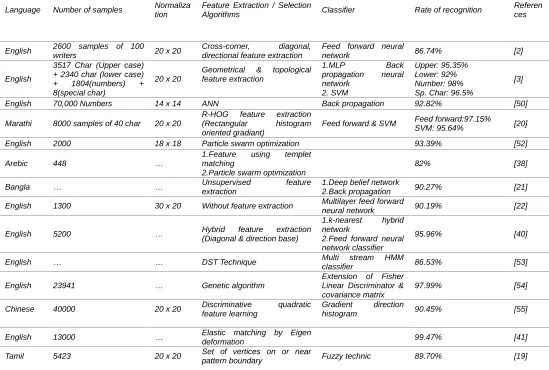
NALYSISHandwritten character recognition has been proposed and presented by many researchers with their work in it, Table 2 represents the comparative analysis of various researchers' work.
8
C
ONCLUSIONThe main approaches used in the field of handwritten character recognition during the last decade have been surveyed in this paper. This article gives complete information about handwritten character recognize with the help of various processes and different performing methods, and useful collection of literature. The recognition rate is improved by following all the steps involved in processing unit as remove noise, binarization, thinning, resize, isolation etc. From various studies it can be discussed as the selection of relevant feature extraction and classification algorithm is an important task is to
improve the performance of the character recognition rate. This review inaugurates a complete system that to convert scanned images of handwritten characters and numbers to text documents. Also, various papers with different segmentation technic, classification algorithms are discussed in detail in this paper. But, still, there are so many untimely problems are faced by many researchers for 100 % recognition rate. So, In the future, there is lots of work to remove drawbacks. This material serves as a guide and update for researchers working in the area of character recognition. In general, traditional hand-crafted feature
extraction based methods consist of several steps, which make the detection system complicated and inefficient, and easily result in error accumulation. Moreover, they need too many manual optimizations of classification rules. Deep learning based methods, however, inherit the merits of machine learning. As long as having sufficient number of training samples, they could outdistance the traditional methods in terms of both accuracy and efficiency. Above short comes can be focused by effective techniques for achieving better recognition rate.
TABLE 2 Comprative Analysis
Language Number of samples Normaliza tion
Feature Extraction / Selection
Algorithms Classifier Rate of recognition
Referen ces
English 2600 samples of 100
writers 20 x 20
Cross-corner, diagonal, directional feature extraction
Feed forward neural
network 86.74% [2]
English
3517 Char (Upper case) + 2340 char (lower case) + 1804(numbers) + 8(special char)
20 x 20
Geometrical & topological feature extraction
1.MLP Back propagation neural network
2. SVM
Upper: 95.35% Lower: 92% Number: 98% Sp. Char: 96.5%
[3]
English 70,000 Numbers 14 x 14 ANN Back propagation 92.82% [50]
Marathi 8000 samples of 40 char 20 x 20
R-HOG feature extraction (Rectangular histogram oriented gradiant)
Feed forward & SVM Feed forward:97.15% SVM: 95.64% [20]
English 2000 18 x 18 Particle swarm optimization 93.39% [52]
Arebic 448 …
1.Feature using templet matching
2.Particle swarm optimization
82% [38]
Bangla … … Unsupervised feature
extraction
1.Deep belief network
2.Back propagation 90.27% [21]
English 1300 30 x 20 Without feature extraction Multilayer feed forward
neural network 90.19% [22]
English 5200 … Hybrid feature extraction (Diagonal & direction base)
1.k-nearest hybrid network
2.Feed forward neural network classifier
95.96% [40]
English … … DST Technique Multi classifier stream HMM 86.53% [53]
English 23941 … Genetic algorithm
Extension of Fisher Linear Discriminator & covariance matrix
97.99% [54]
Chinese 40000 20 x 20 Discriminative quadratic feature learning
Gradient direction
histogram 90.45% [55]
English 13000 … Elastic matching by Eigen
deformation 99.47% [41]
Tamil 5423 20 x 20 Set of vertices on or near
985 Guajarathi 3000 16 x 16 … Multilayer feedforward
neural network 82% [56]
Number 4000 140 x 340
pixel Discrete wavelet transform MPL classifier 82.20% [44]
English 1300 15 x 12
matrix Feature extraction
Multilayer feed forward
ANN 85.62% [57]
Chinese 3214 … Discriminative feature extraction
Modified quadratic
discriminator function 89.55 to 94.85% [58]
English 24045 28 x 28 & 36 x 36
1.Local gradient feature descriptor
2. k-nearest neighborhood algorithm
SVM 97.35% [59]
English 1445 … Curve extraction & string feature representation
Approximate subgraph matching & levenshtein distance
83.56% [60]
Malayala
m … … Haar wavelet transform
SVM machine
classifier 90.25% [61]
A
CKNOWLEDGMENTThe authors would like to express sincere gratitude to Dr.
Ulhas B. Shinde, Principal, CSMSS, Chh. Shahu College of Engineering, Aurangabad, for his continuous support and encouragement to publish this article. They would also like to thank Mr. Devendra L. Bhuyar, Mr. Amit M. Rawate, Mr. Nagesh S. Vaidya, and Mr. Akshay T. Jadhav for their recurrent help in this work.
R
EFERENCES[1] Amin, A.: Segmentation of printed Arabic text. In: International Conference on Advances in Pattern Recognition. Springer (2001)
[2] Suman Avdhesh Yadav, Smita Sharma, Shipra Ravi Kumar, ―A Robust Approach For Offline English Character Recognition‖, IEEE International conference on futuristic trend in computational analysis and knowledge management, vol 1, Issue 1, p.p 121-126, 2015.
[3] Nisha Sharma, Bhupendra Kumar, Vandita Singh "Recognition of Off-line Hand printed English Characters, Numerals, and Special Symbols", IEEE International Conference- Confluence The Next Generation Information Technology Summit, p.p 640-645, 2014.
[4] Mandal, R., Manna, N.: Handwritten english character segmentation by baseline pixel burst method (BPBM). Adv. Model. Anal. B 57(1), 31–46 (2014)
[5] Vicent Alabau, Alberto Sanchis, Francisco Casacuberta, ―Improving on-line handwritten recognition in interactive machine translation‖, Elsevier journal of pattern recognition, p.p. 1217–1228, 2014.
[6] Din, I.U., et al.: Line and ligature segmentation in printed Urdu document images. J. Appl. Environ. Biol. Sci. 6(3S), 114–120 (2016)
[7] Naz, S., et al.: The optical character recognition of Urdu-like cursive scripts. Pattern Recogn. 47(3), 1229–1248 (2014) [8] Javed, S.T., Hussain, S.: Segmentation based urdu
nastalique OCR. In: Iberoamerican Congress on Pattern Recognition. Springer (2013)
[9] Muaz, A.: Urdu optical character recognition system MS thesis. Diss. National University of Computer & Emerging Sciences
[10]Rana, A., Lehal, G.S.: Offline Urdu OCR using ligature based segmentation for Nastaliq Script. Indian J. Sci. Technol. 8(35) (2015)
[11]Saabni, R., Asi, A., El-Sana, J.: Text line extraction for historical document images. Pattern Recogn. Lett. 35, 23– 33 (2014)
[12]Brodić, D.: Text line segmentation with water flow algorithm based on power function. J. Electr. Eng. 66(3), 132–141 (2015)
[13]Bal, A., Saha, R.: An improved method for handwritten document analysis using segmentation, baseline recognition and writing pressure detection. Procedia Comput. Sci. 93, 403–415 (2016)
[14]Vishwas, H., Thomas, B.A., Naveena, C.: Text line segmentation of unconstrained handwritten kannada historical script documents. In: Proceedings of International Conference on Cognition and Recognition. Springer (2018) [15]Peng, G., et al.: Text line segmentation using Viterbi
algorithm for the palm leaf manuscripts of Dai. In: 2016 International Conference on Audio, Language and Image Processing (ICALIP). IEEE (2016)
[16]Pastor-Pellicer, J., et al.: Complete system for text line extraction using convolutional neural networks and watershed transform. In: 2016 12th IAPR Workshop on Document Analysis Systems (DAS). IEEE (2016)
[17]Vo, Q.N., Lee, G.: Dense prediction for text line segmentation in handwritten document images. In: 2016 IEEE International Conference on Image Processing (ICIP). IEEE (2016)
[18]J. R. Prasad, U.V. Kulkarni, ―Offline Handwritten Character Recognition of Gujrati Script using Pattern Matching‖, Journal of Computer Engineering, 2003.
[19]R.M. Suresh, S. Arumugam, ―Fuzzy technique based recognition of handwritten characters‖, Elsevier journal of pattern recognition, p.p. 230-239, 2007.
[20]Parshuram M. Kamble, Ravinda S. Hegadi, ―Handwritten Marathi character recognition using R-HOG Feature‖, Elsevier journal of pattern recognition, p.p. 266–274, 2015. [21]Md. Musfiqur Rahman Sazal, Sujan Kumar Biswas, Md.
Faijul Ami and Kazuyuki Murase, ―Bangla Handwritten Character Recognition Using Deep Belief Network‖, IEEE International Conference on Electrical Information and Communication Technology, 2013.
[22]J.Pradeep, E.Srinivasan, S.Himavathi, ―Neural Network based Handwritten Character Recognition system without feature extraction‖, IEEE International Conference on Computer, Communication and Electrical Technology,p.p 40-44, March 2011.
986 Arora, ―Characterizing Hand Written Devanagari
Characters using Evolved Regular Expressions‖, IEEE transaction, 2006.
[24]Zhang Z, Shen W, Yao C, Bai X (2015) Symmetry-based text line detection in natural scenes. In: IEEE conference on computer vision and pattern recognition, pp 2558–2567 [25]Anubhav Jain, Jaya Sharma, ―Classification and
Interpretation of Characters in Multi-Application OCR System‖, IEEE transaction, 2014.
[26]A.Venkata Srinivasa Rao, Nenkkanti Venkata Rao, Madasu Subbarao, A.S.C.S.Sastry and L.Pratap Reddy, "Segmentation of Touching Handwritten Numerals and Alphabets", IEEE International Conference on Computer and Electrical Engineering, p.p. 304-307, 2009.
[27]Jun Tan, Jian-Huang Lai, Chang-Dong Wang, Wen-Xian Wang, Xiao-Xiong Zuo, ―A new handwritten character segmentation method based on nonlinear clustering‖, Elsevier journal of pattern recognition, p.p. 213-219, 2012. [28]G. Louloudis, B.Gatos, I.Pratikakis, C.Halatsis, ―Text line
and word segmentation of handwritten documents‖, Elsevier journal of Pattern Recognition, p.p. 3169 – 3183, 2009.
[29]Z. Shi, V. Govindaraju, Line separation for complex document images using fuzzy run length, First International Workshop on Document Image Analysis for Libraries, 2004, p.p. 306.
[30]E. Bruzzone, M.C. Coffetti, An algorithm for extracting cursive text lines, Proceedings of the Fifth International Conference on Document Analysis and Recognition, Bangalore, India, 1999, p.p. 749.
[31]Itay Bar-Yosefa, Alik Mokeicheva, Klara Kedema, Itshak Dinsteinb, Uri Ehrlichc , ―Adaptive shape prior for recognition and variational segmentation of degraded historical characters‘‘, Elsevier journal of pattern recognition, pp.3348- 3354, 2009.
[32]Olivier Pauplin, Jianmin Jiang, ―DBN-based structural learning and optimisation for automated handwritten character recognition‖, Elsevier journal of pattern recognition p.p. 685-692, 2012.
a. Kass, M. Witkin, D. Terzopoulos, Snakes, ―Active contour models‖ ,International Journal of Computer Vision,vol.1, p.p.321–332, 1988. [33]Kitanovski, B. Jankulovski, I. Dimitrovski and S. Loskovska,
"Comparison of feature extraction algorithms for mammography images," 2011 4th International Congress on Image and Signal Prcessing, Shanghai, 2011, pp. 888-892. Doi : 10.1109/CISP.2011.6100285.
[34]Khan, Khalil, Rehan Ullah, Nasir Ahmad Khan, and Khwaja Naveed. "Urdu character recognition using principal component analysis." International Journal of Computer Applications 60, no. 11 (2012).
[35]Draper, Bruce A., Kyungim Baek, Marian Stewart Bartlett, and J. Ross Beveridge. "Recognizing faces with PCA and ICA." Computer vision and image understanding 91, no. 1-2 (1-2003): 115-137.
[36]Nai Jen Li, Wen June Wang, Chen Chien James Hsu, ―Hybrid particle swarm optimization incorporating fuzzy reasoning and weighted particle‖, Elsevier journal of pattern recognition, p.p. 488-501, 2015.
[37]Muhammad Sarfraz And Ali Taleb Ali Al-Awami,‖ Arabic character recognition using particle swarm optimization with selected and weighted moment invariants‖, IEEE transaction, 2007.
[38]Satish Lagudu, C. V. Sarma, ―Hand writing recognition using hybrid particle swarm optimization & back propagation algorithm‖, International Journal of Application or Innovation in Engineering & Management, Volume 2, Issue 1, p.p. 75-81, January 2013.
[39]J.Pradeep, E.Srinivasan, S.Himavathi, ―Performance Analysis of Hybrid Feature Extraction Technique for Recognizing English Handwritten Characters‖, IEEE transaction on pattern analysis and machine learning, World Congress on Information and Communication Technologies, p.p. 373-377, 2012.
[40]Seiichi Uchida, Hiroaki Sakoe, ―Eigen-deformations for elastic matching based handwritten character recognition‖, Elsevier journal of pattern recognition, p.p. 2031-2040, 2003.
[41]M. Jyostna Grace, K. Subhashini, ―Image Binarization Based On ICA Approach for Optical Character Recognition‖, International Journal of Advanced Research in Electrical, Electronics and Instrumentation Engineering, Vol. 3, Issue 8, August 2014, pp 11594-11600.
[42]Xi Zhang, Chew Lim Tan, ―Handwritten word image matching based on Heat Kernel Signature‖, Elsevier journal of pattern recognition, p.p. 3346-3356, 2015.
[43]Sk Md Obaidullah, Chayan Halder, Nibaran Das and Kaushik Roy, ―Numeral Script Identification from Handwritten Document Images‖, Elsevier journal of pattern recognition, p.p. 585-594, 2015.
[44]Made Edwin Wira Putra, Iping Supriana Suwardi, ―Structural off-line handwriting character recognition using approximate subgraph matching and levenshtein distance‖, Elsevier journal of Procedia Computer Science 59, p.p. 340 – 349, 2015.
[45]Palaiahnakote Shivakumara, R.Raghavendra, Longfei Qin, Kiran B. Raja, Tong Lu, Umapada Pal, ―A new multi-modal approach to bib number/text detection and recognition in Marathon images‖, Elsevier journal of pattern recognition, pp. 479–491,2017.
[46]Youssouf Chherawala, Mohamed Cheriet, ―Arabic word descriptor for handwritten word indexing and lexicon reduction‖, Elsevier journal of pattern recognition, p.p. 3477-3486, 2014.
[47]Purnendu Banerjee, Ujjwal Bhattacharya and Bidyut B. Chaudhuri, ―Automatic detection of Handwritten Texts from Video Frames of Lectures‖, IEEE International Conference on Frontiers in Handwriting Recognition, p.p. 627-632, 2014.
[48]Yousri Kessentini, Thomas Burger, Thierry Paquet, ―A Dempster–Shafer Theory based combination of handwriting recognition systems with multiple rejection strategies‖, Elsevier journal of pattern recognition, p.p. 534-544, 2015.
[49]J.M. Alonso-Weber, M.P. Sesmero, A. Sanchis, ―Combining additive input noise annealing and pattern transformations for improved handwritten character recognition‖, Elsevier journal of pattern recognition, p.p. 8180-8188, 2014. [50]Shimeng Yang, Fudong Nian, Teng Li, ―A Light and
Discriminative Deep Networks for Off-line Handwritten Chinese Character Recognition‖, IEEE transaction, pp.785-790, 2017.
987 [52]Y.Kessentini, T.Paquet, A.Ben Hamadou, "A multi-lingual
recognition system for an arabic and English hand writing‖, Proceedings of International Conference on Document Analysis and Recognition, pp.1196–1200, 2009.
[53]C. De Stefano, F. Fontanella, C. Marrocco, A. Scotto di Freca, ―A GA-based feature selection approach with an application to handwritten character recognition‖, Elsevier journal of pattern recognition, p.p. 130-141, 2014.
[54]Ming-Ke Zhou, Xu-Yao Zhang, Fei Yin, Cheng-Lin Liu, ―Discriminative quadratic feature learning for handwritten Chinese character recognition‖, Elsevier journal of pattern recognition, 2015.
[55]Apurva A.Desai, ―Gujarati handwritten numeral optical character reorganization through neural network‖, Elsevier journal of pattern recognition, p.p. 2582-2589, 2010. [56]Amit Choudhary, Rahul Rishi, Savita Ahlawat, ―Off-Line
Handwritten Character Recognition using Features Extracted from Binarization Technique‖, Elsevier journal of pattern recognition, p.p. 306-312, 2013.
[57]Qiu-Feng Wang, Fei Yin, Cheng-Lin Liu, ―Unsupervised language model adaptation for handwritten Chinese text recognition‖, Elsevier journal of Pattern Recognition 47, p.p. 1202–1216, 2010.
[58]Olarik Surinta, Mahir F. Karaaba, Lambert R. B. Schomaker, Marco A. Wiering, ―Recognition of handwritten characters using local gradient feature descriptors‖, Elsevier journal of pattern recognition, p.p. 405-414, 2015.
[59]Xu Xiaobing, Wu Xiaoxu, Wang Jianping, Zhu Chenghui, Qiao Yuping, ―Recognition Research of Offline-handwritten Chinese Character Based on Biomimetic Pattern‖, Elsevier journal of pattern recognition, p.p. 5116 – 5120, 2011. [60]Jomy John, Pramod K. V., Kannan Balakrishnan,