By Hidde H. Brongersma
ION-TOF GmbH, Heisenbergstrasse 15, D-48149 Münster, Germany,
Tascon GmbH, Heisenbergstrasse 15, D-48149 Münster, Germany,
and Calipso BV, PO Box 513, 5600 MB Eindhoven, The Netherlands
Thomas Grehl
ION-TOF GmbH, Heisenbergstrasse 15, D-48149 Münster, Germany
Emma R. Schofield and Richard A. P. Smith*
Johnson Matthey Technology Centre, Blounts Court, Sonning Common, Reading RG4 9NH, UK; *E-mmail: [email protected]
and Hendrik R. J. ter Veen
Tascon GmbH, Heisenbergstrasse 15, D-48149 Münster, Germany
Low-energy ion scattering (LEIS) can be used to selec-tively analyse the atomic composition of the outer atomic layer of a catalyst, i.e., precisely the atoms that largely determine its activity and selectivity. It is shown how a new development in LEIS significantly improves its mass resolution. Using this advanced separation and quantification of signals from platinum and gold, the atomic composition of the outer surface of a realis-tic supported platinum-gold bimetallic system can be determined for the first time.
Introduction
Understanding the outermost atomic layer is extreme-ly helpful for understanding heterogeneous cataextreme-lysts. In a mixed metal system such as platinum-gold, the composition of the outer surface, while dependent upon the bulk composition, can differ radically from that composition. The ultimate driving force is ther-modynamics, which means that the metal with the lowest surface energy will tend to segregate to the sur-face. However the attainment of this thermodynamic equilibrium may be limited by kinetic factors deter-mined by the precise history of the sample including temperature and environment.
A commonly used surface analysis technique is X-ray photoelectron spectroscopy (XPS). XPS gives very useful chemical information but the composi-tion is averaged over a dozen or so atomic layers and does not immediately provide information for the outermost atomic layer which, of course, is the place where catalysis occurs.
Low-energy ion scattering (LEIS), also known as ion scattering spectroscopy (ISS), has the unique property that it does give the composition of the outer atomic surface (1, 2), precisely the atoms that largely determine the catalyst’s activity and selectivi-ty. Correlation of this with chemical information from XPS gives a more complete picture of a catalyst
sys-Platinum-Gold Catalysts by Low-Energy
Ion Scattering
Improved resolution allows selective analysis of mixed metal systems
tem, enabling the development of a suitable model of the surface.
In LEIS measurements, ions of known mass and energy are directed at a sample surface where they collide with surface atoms. Such collisions are ‘bil-liard-ball’ in nature, and the resultant energy of the scattered ion can provide information about its colli-sion partner. When the scattering angle is fixed (and narrowly defined) there is a direct relationship between the resultant ion energy and the mass of the surface atom. There is a time-dependent probability of neutralisation by the electrons in the surface which means that only the incident ions scattered from the outer surface contribute to the signal. As a result of these effects, LEIS provides a single-atomic-layer mass spectrum of a material’s surface.
However, in a system such as platinum-gold, there are technical challenges involved in separating the platinum and gold LEIS signals. Due to the high and
overlapping masses of their isotopes (platinum:194Pt, 195Pt,196Pt and 198Pt; gold:197Au), it is impossible to
separate their signals, therefore it has long been sup-posed that LEIS is unsuited for this application (3). Recently a new type of LEIS instrument has been developed: the Qtac100, supplied by ION-TOF GmbH (Figure 1) (4). It is shown in this paper how its unique features enable the analysis of the platinum-gold composition in the outer atomic layer of a bimetallic material, a principle which opens up new perspec-tives for catalyst research. To this end, model catalyst samples were manufactured and studied to show the use of the technique in a technically challenging and realistic situation.
Applications of the Platinum-Gold System A long-established application of the platinum-gold system is as one-half of a fuel cell material for use in the US National Aeronautics and Space
(a)
Fig. 1. (a) The ION-TOF GmbH Qtac100
low-energy ion scattering (LEIS) instrument; (b) Close-up of the analysis chamber, showing the ion optics and sample stage (4)
Administration (NASA) Space Shuttle programme (5). This material is a gold black, stabilised with 10% inum, in which it has been found with XPS that plat-inum is strongly enriched at the surface (6, 7). Recently there has been renewed interest in bimetal-lic catalyst systems containing gold and platinum group metals (8–11). Although fuel cell applications and related technologies are still a focus for this bimetallic system,investigations in other areas include carbon monoxide oxidation, toluene hydrogenation and reduction of nitric oxide by propene (8).As a final example, the company Nanostellar Inc issued an announcement stating that it was developing a palla-dium-platinum-gold catalyst for diesel exhaust oxida-tion (12). In this case, the palladium signal is easily
separated from those of platinum and gold due to the very different atomic masses, but the problem of sepa-rating the platinum and gold signals remains.
LEIS of Platinum and Gold
In LEIS a beam of noble gas ions (typically 4He+or 20Ne+) is directed towards a sample and the energy
distribution of the back-scattered ions is measured (Figure 2). For a given scattering angle (here 145º) and incident ion mass,m1, and energy,Ei (typically 1–5 keV), the energy of the backscattered ions,Ef, allows the mass of the surface atoms,m2, to be calcu-lated. In Figure 3, the ratio of the two energies, ε = Ef/Ei, is given as a function of the mass ratio, µ = m2/m1. When light ions are scattered by heavy
Primary ion: mass m1
energy Ei
Scattered ion: mass m1
energy Ef
Surface atom: mass m2
Fig. 2. Schematic illustrating the low-energy ion scattering (LEIS) principle. Noble gas ions of a few keV energy (Ei)
and mass m1hit the sample at
perpendi-cular incidence. The energy, Ef, of the
backscattered noble gas ion is deter-mined by the laws of conservation of energy and momentum. The mass of the surface atom from which it was scat-tered, m2, can be derived from Ef
Mass ratio, µ
Energy ratio,
ε Derivative, d
ε
/d
µ
0.18 0.16 0.14 0.12 0.10 0.08 0.06 0.04 0.02 0 1
0.9 0.8 0.7 0.6 0.5 0.4 0.3 0.2 0.1 0
0 10 20 30 40 50
Fig. 3. The ratio εof the energies of the ion after (Ef) and before (Ei)
scattering and its derivative are plotted as functions of the ratio µ of the masses of the surface atom (m2) and the ion (m1). The
opti-mum mass resolution in LEIS is obtained for the maximum value of the derivative, which occurs around µ= 2. Therefore, for the analysis of Pt-Au alloys 84Kr+ions
are used (giving µ= 2.3)
ε
surface atoms (µ> 10) the ratio εbecomes less and less sensitive to µ, making it impossible to distinguish between heavy atoms of similar mass.Thus, light ions such as 4He+and 20Ne+are unsuited for separating heavy elements such as Pt and Au. By plotting the derivative of εversus µ, it is even clearer that the opti-mum mass resolution is obtained for values of µ which are below 5 (Figure 3).
For the separation of the Pt and Au LEIS signals, iso-topically-enriched krypton ions of mass 84 (µ= 2.3) would be suitable. However, since εis relatively low at 0.19, this will give only a low backscattered ion ener-gy. For the heavy 84Kr+the velocity will be very low and the interaction time with the sample thus very long. This will lead to effective neutralisation during the scattering process and thus to low scattered ion signals.
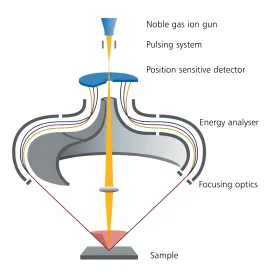
In the Qtac100instrument it is possible to achieve a primary energy up to 8 keV.At this primary energy the final energy,Ef, is 1.5 keV, which gives an acceptable LEIS signal.The Qtac100uses a double toroidal energy analyser (Figure 4) which collects the scattered ions for a given scattering angle (145º) from all azimuth angles.The analyser images the energy distribution of the ions on a position sensitive detector, which
enables parallel energy detection. Its sensitivity is orders of magnitude higher than that of conventional LEIS. As a consequence of this enormous increase in sensitivity, it is possible to reduce the sputter damage by the primary beam to a negligible amount (‘static LEIS’) (2). Since the scattering angle is well defined, this increase in sensitivity does not adversely affect the mass resolution.
The ion impact also gives rise to emission of sput-tered (secondary) ions. This is especially serious for supported catalysts with a low loading of the metallic phase. Although the energy distribution of these ions peaks at very low energies, many sputtered ions are generally still found at energies of more than 30% of the primary energy, leading to a substantial back-ground in the low-energy part of the LEIS spectrum.In the present experiments, the secondary ions are sup-pressed by using a pulsed primary ion beam as well as both energy filtering and time-of-flight filtering of the scattered ions. In this way only the ions with the same mass as the primary ions are detected.
For the analysis of supported catalysts where the supporting material is an insulator, special care has to be taken to avoid surface charging.A low-energy elec-tron shower accurately compensates the charge of
Noble gas ion gun Pulsing system
Position sensitive detector
Energy analyser
Focusing optics
Sample
Fig. 4. Schematic of the double toroidal energy analyser of the Qtac100LEIS instrument which allows
the ion beam. In view of the small energy differences between scattering from Au and Pt, it is important not only that the average charging is compensated but also that local inhomogeneities are avoided.
Preparation of the Test Samples Catalyst A
To prepare the first catalyst test sample, a slurry of γ-alumina (2 g in 25 ml water) was warmed to 60ºC and the pH adjusted to 7.0 with aqueous potassium carbonate solution (0.05 M concentration). A solu-tion of hydrogen tetrachloroaurate(III) tetrahydrate (0.15 g of solid with an assay of 49.9% Au, dissolved in 10 ml water) was added dropwise to the slurry, main-taining the pH at 6–7 with the K2CO3 solution. The slurry was stirred for 1 hour, then 8 ml of a solution of platinum(IV) nitrate (0.49 g of a Pt(IV) nitrate aque-ous solution with an assay of 15.5% Pt, diluted with water to 20 ml) was added. After stirring for 40 min-utes, 5 ml of a 1% formaldehyde solution was added and the slurry heated to >90ºC for 10 minutes. The slurry was filtered, washed and dried then calcined in air for 2 hours at 750ºC. As determined by assay, Catalyst A was 1.15 wt% Pt and 2.73 wt% Au.
Catalyst B
To obtain a very different surface composition, Catalyst B was prepared by physically mixing a cata-lyst impregnated with Pt with one impregnated with Au.The impregnation procedures were similar to that used for Catalyst A. By assay, Catalyst B contained 1.07 wt% Pt and 0.93 wt% Au.
Platinum and Gold Reference Samples
Reference samples of 99.99% Au and 99.9% Pt were used.
Sample Pretreatment
Just before analysis, all samples were treated with atomic oxygen in the prechamber of the Qtac100 instrument. This procedure removes organic contam-ination from the surface.The samples were then trans-ferred under vacuum to the analysis chamber.
Analysis of the LEIS Spectra
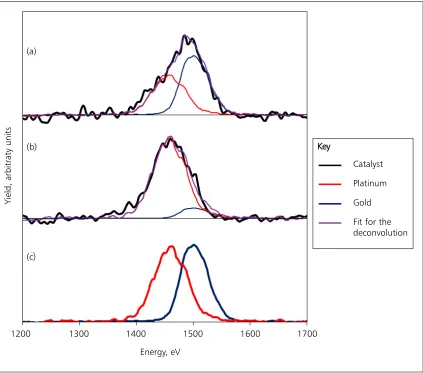
In Figure 5the LEIS spectra are given for 8 keV 84Kr scattered by: (a) Catalyst A, (b) Catalyst B and (c) pure Au and pure Pt.The spectra from the pure Pt and Au samples are normalised to maximum intensity to highlight the energy resolution of the
instrumenta-tion. In all cases, time-of-flight filtering of the scattered Kr+ions has been used to exclude the contribution of secondary ions such as O+or Al+from the signal.This gives the very low background in the spectra.
The spectra for the pure metal reference samples clearly show the energy difference between scatter-ing from Pt (average mass 195) and Au (mass 197). Since Pt has several natural isotopes, its peak is also much wider than that of Au. Due to the overlapping isotopes, it is impossible to fully separate the Pt and Au peaks of an alloy. However, the improved mass res-olution of the Qtac100 instrument makes it easy to deconvolute such a spectrum into the contributions from Pt and Au. It is also clear from this experiment that the time-of-flight filtering is very effective. For all spectra the background is very low, enabling an accu-rate determination of the area and shape of the peaks. This is especially important for the quantifica-tion of the spectra of the catalysts. The low loading leads to low LEIS signals for Pt and Au, while the sup-port contributes to the background by production of secondary ions (such as O+and Al+). Quantification is determined by relating the peak area of the signal from a given element to the signal from a pure sub-strate of that element; in this manner a surface area fraction is determined.
For Au the LEIS signal of Catalyst A is significantly higher than that of Catalyst B, as would be expected on the basis of the bulk compositions. It is interesting to note that for Pt, although Catalysts A and B have about the same loading of Pt, the Pt signal of Catalyst B is much higher. This difference for Pt between bulk loading and surface coverage could be due to sur-face segregation of Au in Pt-Au alloy clusters. Since Catalyst B is a physical mixture of a Pt-loaded and a Au-loaded catalyst, alloy clusters do not exist and sur-face segregation is impossible.An alternative explana-tion would be that the Pt cluster size of Catalyst B is smaller than the cluster size for Catalyst A. More experiments are needed, but Kr+ ion scattering has been shown to be an effective tool to elucidate this.
At present the detection limit for Pt and Au in the outer surface is approximately 0.1 at% for mixed sys-tems and better than 0.01 at% for catalysts containing only Pt or Au. This is significantly more sensitive than conventional techniques such as XPS.
Conclusions
understanding and further improvement of its activi-ty and selectiviactivi-ty. A unique properactivi-ty of the LEIS tech-nique is that it can selectively analyse the atomic composition of the outermost atoms. Using the Qtac100 instrument, the separation of signals from heavy elements such as platinum and gold in mixed metal systems is possible for the first time. In addi-tion, problems with supported catalysts such as low signal strength, surface roughness and, for many, the insulating properties of the support, have been over-come. To demonstrate the technique, the Pt and Au signals from Pt-Au/γ-Al2O3catalysts were successfully resolved. This technique will allow not only Pt and Au but virtually all the elements of the periodic sys-tem to be separated.
Acknowledgements
The authors extend their thanks to Neil Edwards of Technology Forecasting and Information at the Johnson Matthey Technology Centre, Sonning Common, UK, the Platinum Metals Review Editorial Team and the Analytical Department at JMTC, Sonning Common.
References
1 H. H. Brongersma, M. Draxler, M. de Ridder and P. Bauer, Surf. Sci. Rep., 2007, 62, (3), 63
2 H. R. J. ter Veen, T. Kim, I. E. Wachs and H. H. Brongersma, Catal. Today, 2009, 140, (3–4), 197 3 P. Biloen, R. Bouwman, R. A. van Santen and H. H.
Brongersma, Appl. Surf. Sci., 1979, 2, (4), 532
(a)
Energy, eV
Yield, arbitraty units
1200 1300 1400 1500 1600 1700 (b)
(c)
Fig. 5. LEIS spectra for 8 keV 84Kr+scattered over 145º by: (a) Catalyst A (γ-Al
2O3impregnated with 1.15
wt% Pt and 2.73 wt% Au); (b) Catalyst B (γ-Al2O3impregnated with 1.07 wt% Pt and 0.93 wt% Au) and
(c) pure Au and pure Pt
Key
4 ION-TOF: http://www.iontof.com/ (Accessed on 22nd January 2010)
5 K. Kinoshita, “Electrochemical Oxygen Technology”, The Electrochemical Society Series, John Wiley & Sons, New York, USA, 1992, p. 180
6 R. A. P. Smith, Platinum Metals Rev., 2009, 53, (1), 55 7 R. A. P. Smith, Platinum Metals Rev., 2009, 53, (2), 109 8 D. T. Thompson, Platinum Metals Rev., 2004, 48, (4),
169
9 G. C. Bond, Platinum Metals Rev., 2007, 51, (2), 63 10 J. B. Xu, T. S. Zhao and Z. X. Liang, J. Power Sources,
2008, 185, (2), 857
11 “Mixed Metal Nanomaterials”, ed. C. S. S. R. Kumar, Wiley-VCH, Weinheim, Germany, 2009
12 ‘Nanostellar Introduces Gold in Oxidation Catalyst That can Reduce Diesel Hydrocarbon Emissions by as Much as 40 Percent More Than Commercial Catalysts’, Nanostellar press release, SAE 2007, Detroit, 16th April, 2007
The Authors
Dr Thomas Grehl is a Senior Scientist at ION-TOF GmbH. He has been with the company since 1998, after studying Physics at the University of Münster, Germany. He obtained his PhD in 2003. After dealing mainly with TOF-SIMS research, surface analysis and applica-tion development, he is now responsible for product development in the field of LEIS and studies the application of the technique on catalysts and other materials.
After her PhD in Coordination Chemistry in Basel, Switzerland (1999), Dr Emma Schofield spent two years as a post-doctoral researcher in Strasbourg, France, before taking up a Lectureship in Inorganic Chemistry at Trinity College in Dublin, Ireland. In 2004 she moved to Johnson Matthey in the UK where she spe-cialises in developing new synthetic routes to heterogeneous cat-alysts.
Dr Richard Smith is a Senior Scientist, with responsibility for sur-face science tech-niques. He joined the Analytical Department at the Johnson Matthey Technology Centre, Sonning Common, UK, in 2006. He holds a PhD in Surface Physics gained from research carried out at the Surface Science Research Centre of the University of Liverpool, UK. Before and after this he worked in a materials characterisa-tion consultancy and conducted research in surface characterisa-tion at universities in the UK and Austria.
Dr Hendrik (Rik) ter Veen is a LEIS special-ist at Tascon GmbH, a company for consult-ing and analytical serv-ices in surface science. He has been dedicated to LEIS since 2006. Although his focus is on catalysis, he is also active in the applica-tion of LEIS to other fields such as micro-electronics, thin layers and adhesion. After his PhD from