A SURVEY ON QUALITY OF SERVICE
IMPLEMENTATIONS IN CLOUD COMPUTING
Merly Mathew
P G Student, CSE, LBSITW, Kerala (India)
ABSTRACT
Cloud computing is a new terminology achieved by distributed, parallel and grid computing and a design
pattern for large, distributed data centers. Cloud computing offers end customers a pay as go model. Quality of
service plays an important factor in distributed computing. Cloud computing provides different types of
resources like hardware and software as service via internet. Under cloud computing, computing resources are
hosted in the internet and delivered to customers as services. Prior to that, the customers and cloud provider
negotiate and enter into an agreement named service level agreement. The service level agreements clarify the
roles, set charges and expectations and provide mechanisms for resolving service named problems within a
specified and agreed upon time period. Service level agreements also cover performance, reliability conditions
in terms of quality of service guarantees. In this paper, the authors present a comprehensive survey on quality of
service implementations in cloud computing with respect to their implementation details, strengths and
weaknesses.
Keywords: Cloud Computing, QoS, Scheduling, SLA, VMM
I. INTRODUCTION
Cloud computing is the 5th utility after electricity, water, gas and telephony. Nowadays, the market has been
flooded with a large number of cloud service providers. These eservices are hosted on internet and is available
to customer who wants to purchase it. In terms of economy and resource utilization, the cloud computing is
advantageous to both customers and service providers but if optimal resource utilization is not carried out, it
would become a disaster. Prior to commencement of services both service providers and customers enter into an
agreement called Service Level Agreement(SLA), which contain the roles and responsibilities of both parties,
scope of services, quality and performance requirements, charges and rates. Thus Quality of Services (QoS)
plays an important role in making cloud service acceptable to customers. In this paper, a survey on mechanisms
and methods proposed by various researchers with respect to their implementation principles, strengths and
weakness is carried out.
II.CLOUD COMPUTING
The main characteristics of Cloud computing are on-demand self-service, broad network access, resource
pooling, rapid elasticity and measured service. The cloud model is composed of five essential characteristics,
2.1. Essential Characteristics
On-demand self-service: A consumer can unilaterally provision computing capabilities, such as server time
and network storage, as needed automatically without requiring human interaction with each service
provider.
Broad network access: Capabilities are available over the network and accessed through standard
mechanisms that promote use by heterogeneous thin or thick client platforms (e.g., mobile phones, tablets,
laptops, and workstations).
Resource pooling: The provider’s computing resources are pooled to serve multiple consumers using a
multi-tenant model, with different physical and virtual resources dynamically assigned and reassigned
according to consumer demand.
Rapid elasticity: Capabilities can be elastically provisioned and released, in some cases automatically, to
scale rapidly outward and inward commensurate with demand.
Measured service: Cloud systems automatically control and optimize resource use by leveraging a metering
capability at some level of abstraction appropriate to the type of service (e.g., storage, processing,
bandwidth, and active user accounts).
The service of the cloud computing is divided into three main categories: Infrastructure-as-a-Service (IaaS),
Platform-as-a-Service (PaaS), and Software-as-a-Service (SaaS). Fig.1 shows the Cloud computing layers along
with the underlying physical computing infrastructure and virtualized computing infrastructure as two distinct
layers [24]. The physical hardware is the real workhorse that carries out the processing. The physical hardware
is generally provided in the form of computing clusters, grids or individual servers. The virtualized computing
infrastructure is created by installing a Virtual Machine Manager (VMM) on the physical hardware. The VMM
provides the necessary isolation and security between the multiple virtual machines running in parallel on a
single physical computer.
Fig.1: Cloud Computing Layers
III.RELATED WORKS
The different QoS parameters considered in various experiments are CPU time, network bandwidth, storage
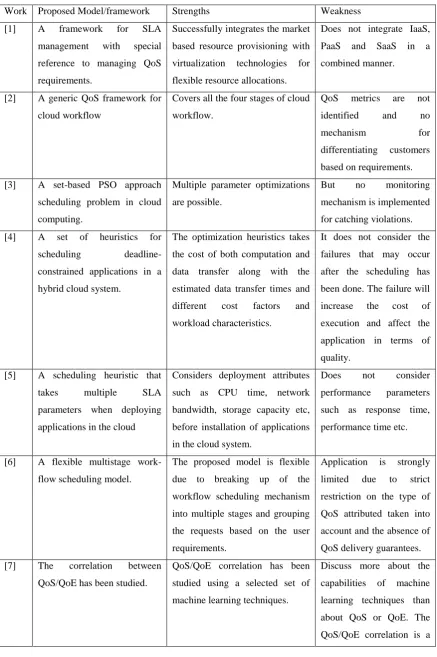
capacity, response time, performance time, processing time. Table 1 summarizes the work done so far with
reference to their strengths and weaknesses along with the proposed model or framework. From Table 1, it can
Table 1: Summary of Strengths and Weakness of Proposed Models and Frameworks
Work Proposed Model/framework Strengths Weakness
[1] A framework for SLA
management with special
reference to managing QoS
requirements.
Successfully integrates the market
based resource provisioning with
virtualization technologies for
flexible resource allocations.
Does not integrate IaaS,
PaaS and SaaS in a
combined manner.
[2] A generic QoS framework for
cloud workflow
Covers all the four stages of cloud
workflow.
QoS metrics are not
identified and no
mechanism for
differentiating customers
based on requirements.
[3] A set-based PSO approach
scheduling problem in cloud
computing.
Multiple parameter optimizations
are possible.
But no monitoring
mechanism is implemented
for catching violations.
[4] A set of heuristics for
scheduling
deadline-constrained applications in a
hybrid cloud system.
The optimization heuristics takes
the cost of both computation and
data transfer along with the
estimated data transfer times and
different cost factors and
workload characteristics.
It does not consider the
failures that may occur
after the scheduling has
been done. The failure will
increase the cost of
execution and affect the
application in terms of
quality.
[5] A scheduling heuristic that
takes multiple SLA
parameters when deploying
applications in the cloud
Considers deployment attributes
such as CPU time, network
bandwidth, storage capacity etc,
before installation of applications
in the cloud system.
Does not consider
performance parameters
such as response time,
performance time etc.
[6] A flexible multistage
work-flow scheduling model.
The proposed model is flexible
due to breaking up of the
workflow scheduling mechanism
into multiple stages and grouping
the requests based on the user
requirements.
Application is strongly
limited due to strict
restriction on the type of
QoS attributed taken into
account and the absence of
QoS delivery guarantees.
[7] The correlation between
QoS/QoE has been studied.
QoS/QoE correlation has been
studied using a selected set of
machine learning techniques.
Discuss more about the
capabilities of machine
learning techniques than
about QoS or QoE. The
case for evaluating the
machine learning
techniques.
[8] Proposal for monitoring the
cloud system for QoS
performance
Only the concept and idea based
work in progress have been
described.
No concrete proposal or
evaluation is presented.
[9] Profit-Based Analysis of
Resource Allocation on QoS
An innovative method for
analyzing the impact of resource
provisioning.
No discussion on how to
optimally allocate
resources.
[10] A distributed resource
allocation algorithm for cloud
and grid systems.
Capable of handling multiple
resource requirements.
Too simple, as it assumes
perfect conditions for
execution. Failures after
allocation of resources are
not taken into account.
[11] Extensible dynamic
provisioning framework for
multitenant cloud system.
The proposed framework is
dynamic and allocates resources
depending on the tenant
requirements.
May not be capable of
handling bursty
requirements with short
duration and large resource
requirements. The new
tenants arriving late may
suffer from resource
starvation.
[12] Lightweight framework for
monitoring public clouds.
Less resource intensive Does not monitor the real
QoS parameters such as
response time, processing
time etc.
[13] A framework for handling
adaptive applications in cloud
systems.
Based on multi-input multi-output
feedback control model for
resource provisioning
Limited only to CPU and
memory provisioning.
Hence application
performance may be
affected by other resource
constraints such as
network, storage etc.
[14] A resource pricing model for
QoS and profit balancing.
Uses realistic values using age as
a parameter.
Utilization is not
considered in computing
cost. Hence may produce
inaccurate costs.
QoS parameters in iO55. the performance of service
providers.
due to focusing only on
available transfer rate and
one-way delay as QoS
parameters.
[16] A QoS based trust
management model.
Multiple QoS parameters can be
used.
No clear explanation on
how to use the parameters
is given nor is there any
possibility to prioritize the
parameters.
[17] Resource allocation in a
Compute Cloud through
bargaining approach.
The proposed strategy handles the
dynamic nature of cloud very well
during run time.
May lead to sub optimal
solutions from a
customer’s perspective, if
a single provider cannot
meet all the requirements.
[18] Investigation of the capability
of MAP based queuing
models for predicting
workload of cloud systems.
Markov arrival processes have the
capability fir heavy trial
distributions that are common in
web applications.
Only numerical
experiments have been
used to validate the model,
hence needs further
validation with real data
traces.
[19] An optimization framework
for cross layer cloud services.
Suitable for vendors selling
products across multiple layers.
Dynamic nature of cloud has been
considered.
Lacks the run time
management of QoS
performance.
[20] Algorithms for resource
allocation for SaaS providers
for balancing cost and QoS.
It helps reduce the cost of SaaS
providers without compromising
the QoS of customers.
Due to reuse of already
open VMs, it can create
security problems for
customers.
[21] Results of an initial
investigation of using Dwarf
bench-marks to measure the
performance of virtualizes]d
hardware.
General labeling of cloud service
providers for size or the number
of units used is not sufficient to
predict the real capabilities
through real experiments.
A set of experiments by
experts in laboratory may
not help the general set of
customers who are not that
tech sawy.
[22] A process for matching
providers’ capability with customers’ requirements based
on SLA parameters.
Automates the matching process
that was hitherto done manually
by customers.
Match capabilities
published by service
providers with customer
requirements. It cannot
performance due to
dynamic nature of clouds.
[23] Optimal resource allocation
model for revenue
maximization.
Mathematically derived and
performs better than heuristics.
Only mean performance
time is considered, hence
not suitable for QoS
sensitive applications
requiring guaranteed
performance.
IV. CONCLUSION
Cloud computing has been the paradigm shift in distributed computing due to the way the resource is
provisioned and charged. Managing QoS is a critical task in making such an innovative technology to a larger
audience. Several researchers have put forward their ideas for new and innovative solutions for handling this
vital area. In this paper, a critical review of the most recent work carried out in this area is done. The findings in
terms of the strengths and weaknesses of the pro-posed work have been presented in a table for easy reference.
REFERENCES
[1] R. Buyya, S.K. Garg, and R.N. Calheiros. ―SLA-Oriented Resource Provisioning for Cloud Computing:
Challenges, Architecture, and Solutions,‖ Proc. Int. Conf. Cloud and Service Computing, pp. 1-10, 2011.
[2] X.Liu, Y. Yang, D. Yuan, G. Zhang, W. Li, and D. Cao, ―A Generic QoS Framework for Cloud
Workflow Systems,‖ Proc. Ninth IEEE Int. Conf. Dependable, Autonomic and Secure Computing, pp.
713-720, 2011.
[3] W.N. Chen, and J. Zhang, ―A Set-Based Discrete PSO for Cloud Workflow Scheduling with
User-+Defined QoS Constraints,‖ Proc. IEEE Int. Conf. Systems, Man and Cybernetics, pp. 773-778, 2012.
[4] R.V. den Bossche, K. Vanmechelen, and J. Broeckhove, ―Cost Efficient Scheduling Heuristics for
Deadline Constrained Workloads on Hybrid Clouds,‖ Proc. 3rdIEEE Int. Conf. Cloud Comp. Tech. and
Sc., (CloudCom), pp. 320-327, 2011.
[5] V.C.Emeakaroha, I.Brandic, M. Maurer, and I. Breskovic, ―SLA-Aware Application Deployment and
Resource Allocation in Clouds,‖ Proc. 35th IEEE Annual Computer Software and Applications
Conference Workshops (COMPSACW),pp. 298-303, 2011.
[6] W. Li, Q. Zhang, J. Wu, J. Li, and H. Zhao, ―Trust-based and QoS Demand Clustering Analysis
Customizable Cloud Workflow Scheduling Strategies,‖ Proc. IEEE Int. Conf. Cluster Comp. Workshops,
pp. 111—119, 2012.
[7] M.S.Mushtaq, B.Augustin, and A.Mellouk, ―Empirical Study based on Machine Learning Approach to
Assess the QoS/QoE Correlation‖, Proc. 17th European Conf. Networks and Optical Comm., pp. 1-7,
2012.
[8] K. Alhamazani, R. Ranjan, F. Rabhi, L. Wang,and K. Mitra, ―CloudMonitoring for Optimizing the QoS
[9] J. Li, Q. Wang, D. Jayasinghe, S. Malkowski, P. Xiong, C. Pu, Y. Kanemasa, and M. Kawaba,
―Profit-Based Experimental Analysis of IaaS Cloud Performance: Impact of Software Resource Allocation,‖
Proc. Ninth IEEE Int. Conf. Services Computing, pp. 344-351, 2012.
[10] D.Adami, C.Callegari, S.Giordano, and M.Pagano, ―A Hybrid Multidimensional Algorithm for
Network-aware Resource Scheduling in Clouds and Grids,‖ Proc. IEEE Int. Conf. Comm., pp. 1297-1301, 2012.
[11] A. Gohad, K. Ponnalagu,and N.C.Narendra, ―Model Driven Provisioning in Multi-tenant Clouds.‖ Proc.
Annual SRRI Global Conference, pp. 11-20, 2012.
[12] J. Ma, R. Sun, and A.Abraham, ―Toward a Lightweight Framework for Monitoring Public Clouds,‖
Proc. Fourth Int. Conf. Computational Aspects of Social Networks, pp. 361-365, 2012.
[13] Q. Zhu and G. Agrawal, ―Resource Provisioning with Budget Constraints for Adaptive Applications in
Cloud Environments,‖ IEEE Trans. Services Computing, vol. 5, no. 4, pp. 497-511.
[14] B. Sharma, R.K. Thulasiram, P. Thulasiraman, S.K. Garg, and R. Buyya, ―Pricing Cloud Compute
Commodities: A Novel Financial Economic Model,‖ Proc. 12th IEEE/ACM Int. Symp. Cluster, Cloud
and Grid Computing, pp. 451-457, 2012.
[15] F. Stoicuta, I. Ivanciu, E. Minzat, A.B. Rus, and V. Dobrota, ―An OpenNetInf-Based Cloud Computing
Solution for Cross-Layer QoS: Monitoring Part Using iOS Terminals,‖ Proc. 10th Int. Symp. Electronics
and Telecomm., pp. 167—170, 2012.
[16] M.K. Goyal, A. Aggarwal, P. Gupta, and P. Kumar, ―QoS based Trust Management Model for Cloud
IaaS,‖ Proc. 2nd IEEE Int. Conf. Parallel, Distributed and Grid Computing, pp. 843-847, 2012.
[17] G.N. Iyer and B, Veeravalli, ―On the Resource Allocation and Pricing Strategies in Compute Clouds
using Bargaining Approaches,‖ 17th IEEE Int. Conf. Networks, pp. 147-152, 2011.
[18] S.P. Sanchez, G. Casale, B. Scotney, S. McClean, G. Parr,and S. Daw-son, ―Markovian Workload
Characterization for {QoS} Prediction in the Cloud,‖ Proc. IEEE Int. Conf. Cloud Computing, pp.
147-154, 2011.
[19] Y. Kouki, T. Ledoux, and R. Sharrock, ―Cross-Layer SLA Selection for Cloud Services,‖ Proc. First Int.
Symp. Network Cloud Computing and Applications, pp. 143-147, 2011.
[20] L. Wu, S.K. Garg, and R. Buyya, ―SLA-based Resource Allocation for Software as a ServiceProvider
(SaaS) in Cloud Computing Environments,‖ Proc. 11th IEEE/ACM Int.Symp. Cluster, Cloud and Grid
Com-puting,pp. 195-204, 2011.
[21] S.C.Phillips, V.Engen, and J. Papay, ―Snow White Clouds and the Seven Dwarfs,‖ Proc. Third IEEE Int.
Conf. Cloud Comp. Tech. and Sc.,pp. 738-745, 2011.
[22] T. Chauhan, S. Chaudhary, V. Kumar,and M. Bhise, ―Service Level Agreement Parameter Matching in
Cloud Computing,‖ World Cong. ICT, pp. 564-570, 2011.
[23] G. Feng, S. Garg, R. Buyya, and W. Li, ―Revenue Maximization using Adaptive Resource Provisioning
in Cloud Computing Environments,‖ Proc. 13thACM/IEEE Int. Conf. Grid Computing, pp. 192–200,
2012.
[24] Mohamed Firdhous, Suhaidi Hassan, Osman Ghazali, ―A Comprehensive Survey on Quality of Service