INTERNET VOTING SYSTEM BASED ON
MODIFIED ELLIPTIC CURVE CRYPTOGRAPHY
Kaustubh Pimparkar
Information Technology Department,
Vishwakarma Institute of Information Technology, Kondhwa, Pune
ABSTRACT
The election system is necessitating of every democracy and the administration formed is dependent on the
results of the election. The election process paves the path for every voter to select a representative among
themselves who can guide the democratic system towards the welfare of the society. The voting system has
observed many effective changes over the past few decades, right from the traditional paper ballot voting to
electronic voting and now towards the Internet Voting. However, the voter choice is a reliable and verifiable
Voting where in manual system he used to stamp on the symbol of his choice. This requires a security algorithm
that could resist the attacks and keep the data confidentiality and also authenticate Voter in online. Modified
Elliptic Curve Cryptography is used for both confidentiality and authentication.
Keywords: Internet Voting (I-Voting), electronic voting, authenticate Voter, Modified Elliptic
Curve Cryptography (MECC), Parallel Multicore Particle Swarm Optimization (PMPSO)
I. INTRODUCTION
Voting is the mechanism used by any eligible voter to option his choice from a list of candidates. Elections are conducted everywhere from small union election in order to select a leader to huge general elections to select the prime minister or president. This is used everywhere such as school representatives, college representatives, union leader, national or state leader. Voting is required to be conducted in various situations [1, 2].
Where ever election systems are conducted, the election system must be robust and secure which should resist a variety of fraudulent actions. This is required to be transparent and comprehensible that voters and candidates should accept the results of the election without any issue. However, when we refer to previous contexts, some cases have immense effect on conducting the election smoothly and had influence on the result that is unacceptable. A secured voting system has to meet the following criteria [3].
1. There are some attacks from manipulated persons which include ballot stuffing and incorrect counting by few persons inside counting center.
2. Secrecy of ballot is important and it should guarantee the voter safety which has no evidence showing to which candidate vote is casted by the voter.
3. The system should be flexible and understandable by all kinds of voters. Every voter should be able to cast his vote either aged or disabled.
6. Speed and Accuracy are also important in achieving secure voting.
As the role of Internet voting system is crucial, it is difficult to come up with a system which is highly secure & accurate in all senses. If these factors of security are satisfied, then Internet voting could be a great option over paper systems and EVMs.
II. MODIFIED ELLIPTIC CURVE CRYPTOGRAPHY
Parallel Multicore Particle Swarm Optimization (PMPS0):
The particle swarm optimization based on the evolutionary technique of computation that optimizes an objective function by performing population-based search. The particles in population that are potential solutions are similar to birds in a flock. The particles are first initialized randomly and then fly across the multi-dimensional search space. Every particle updates its velocity and position based on its own best experience and that of the entire population. The updating policy will cause the particle swarm to move toward a region with a higher object value [5].
Parallel Multicore processing aims to produce the same results by using multiple processors that ultimately increases the CPU utilization [6]. In this study, the spirit of the data parallelism method was utilized to create a parallel particle swarm optimization (PPSO) algorithm. The purpose of applying parallel processing to particle swarm optimization goes further than merely being a hardware accelerator. Rather, a distributed formulation is developed which gives better solutions with reduced overall computation. It is difficult to find an algorithm which is efficient and effective for all types of problems. Our research has indicated that the performance of PPSO can be highly dependent on the level of correlation between parameters and the nature of the communication strategy. In PMPSO the particles update its velocity and position by using the following equation which denotes kth iteration with n cores. The mathematical form of the parallel particle swarm
optimization algorithm can be expressed as shown in equation (1) and (2) [7].
Here V1, nk represents the Velocity of agent at kth iteration at nth core and V1, nk+1 at next iteration. U1, nk is the
current position of the agent at kth iteration at nth core and U1, nk+1 at next iteration. Gbest is the best position among
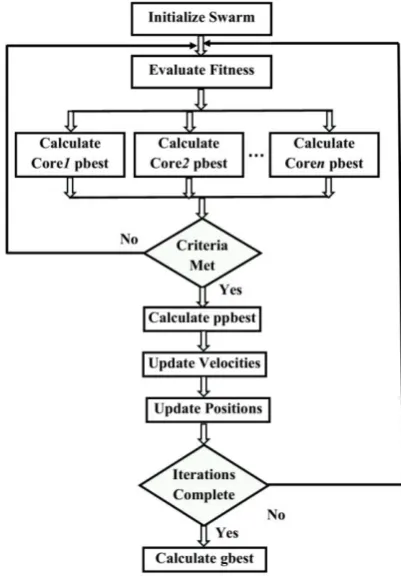
all particles from the first to last iteration basing on the number of cores which are dependent upon system being executed. The complete algorithm for PMPSO is given below and the figure 1 depicts the flowchart.
Step 1 : Initialize each particle
Step 2 : Repeat step 1 until all particles are initialized Step 3: Calculate Fitness value for each particle applying multicore parallel processing.
Step 4 : Check if fitness value is better than particles personal best value in each core Step 5 : Set particles best value as current pbest.
Step 6 : Calculate parallel personal best ppbest. [End of Step4 if statement]
Step 7 : Repeat Step 3 thru 6 until all particles are calculated.
Step 9 : Update velocity of each particle by using equation 7. Step 10 : Update position of each particle by using equation 8. Step 11 : Repeat Step 6 and 7 until all particles are updated.
Step 12 : Repeat Step 2 thru 8 until minimum error or maximum iterations
Advantages of PMPSO:
1. Easy to Implement and simple 2. Attains solution faster.
3. Applied to Engineering and also Scientific Problems as this is based on intelligence.
4. Compared to GA this has no overlapping and mutation calculation. Search is based on calculating the velocity of particle.
5. Uses real number code and the number of dimensions are equal to constant of solution. 6. Effectively utilizes processor capabilities.
Figure 1: Muticore Parallel PSO Flowchart
Modified ECC:
Here ECC and PMPSO are combined where the parameters in ECC are chosen by using PMPSO. This uses the concepts of public key cryptography that involves both private and public keys and elliptic curve. The private keys are chosen by optimization algorithm PMPSO.
MECC Discrete Logarithm problem:
ECC the discrete logarithm problem for elliptic curves seems to be harder if compared to other similar problems used in cryptography. This implies that we need fewer bits for the integer k in order to achieve the same level of security as with other cryptosystems [9, 10]. International Journal of Applied Engineering Research ISSN 0973-4562 Volume 11, Number 3 (2016) pp 1874-1878 © Research India Publications. http://www.ripublication.com 1876
Authentication with MECC:
The authentication using MECC is as shown in below procedure. 1. Two users A and B select the elliptic curve parameters.
2. Admin B takes a random point Message Point, MP on the selected elliptic curve which is transmitted to Voter.
3. Voter A selects his private key PrA using PMPSO algorithm which is kept securely with him.
4. Voter computes his public key point by using his private key and applying scalar multiplication on elliptic curve point MP basing on equation 3 and sends to Admin
PuA = PrA x MP …(3)
5. Similarly, Admin selects his private key using PMPSO algorithm PrB that is kept securely with user B.
6. User B computes his public key point using his private key and based on equation 4 and sends to User A PuB = PrB x MP …(4)
7. Admin computes final point basing on equation 5 Pa = PrA x PuB …(5)
8. Voter computes final point basing on equation 6 Pb = PrB x PuA …(6)
9. This implements the concept of shared secret key as shown in equation 7 Pa = kaR = kakbP = kbkaP = kbQ = Pb …(7)
Encryption with MECC:
1. Voter selects his private key his private key using PMPSO algorithm which is any random number Pra.
2. Then he computes his public key from private key and sends that to Admin basing on equation 8 and which is another point on elliptic curve.
Q = nPb …(8)
3. Voter signs with private key
4. Admin checks if he is valid voter and he sends his public key PuA to voter.
5. Voter encrypts his vote using the admin’s public key PuA.
6. Admin decrypts the voter’s choice using his private key PrA. MECC Advantages:
Compared to traditional systems, MECC algorithms have following advantages [12, 13] 1. Short Keys
2. Quick Processing
3. Same curve can be used for several distinct key pairs. 4. Used to factor integers
Reliable and Verified Internet Voting System using MECC
The Reliable Internet voting is possible by applying the following procedure. 1. Authenticate Voter by using ECC
2. Encrypt Vote by using MECC
3. Verify Vote by applying the procedure given below.
Voter may like to verify the vote whether it is transmitted correctly and his choice is correctly counted. This requires a mechanism where the voter is authenticated and encrypted vote is send to voter which is decrypted by using his private key [14, 15].
Voter chooses his private key which is any random number nv. Then he computes his public key from private
key and sends that to Admin elliptic curve. Voter signs with private key and Admin checks if he is valid voter and he sends public key to voter. Voter requests to verify his vote. Admin encrypts vote using the voter’s public
key. Voter decrypts vote using his private key to verify that his vote is counted to the candidate of his choice [16, 17].
III. RESULTS
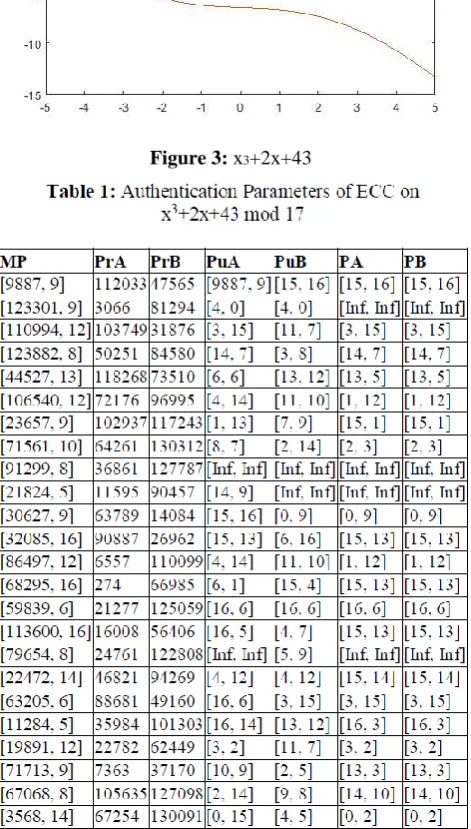
To maintain the security of the system, the voter has to take the responsibility in keeping his private key secure. The channel also should be secure while transmitting the keys, so many times hashing and encryption algorithms is applied to the private key to ensure non-repudiation and integrity. The proposed algorithm is developed and is tested on a case scenario. In this case the chosen elliptic curve is plotted in Fig 3.
Then authentication is applied and the table 1 shows the ECC results. Here MP is the Message Point and
P
rA theprivate key of A and
P
rB the private key of B.P
uA andP
uB are public keys of A and B computed from privateauthentication which always same. However, it can be observed that PA and PB are sometimes reaching infinite values in ECC operations as they are going beyond the range.
Figure 3: x3+2x+43
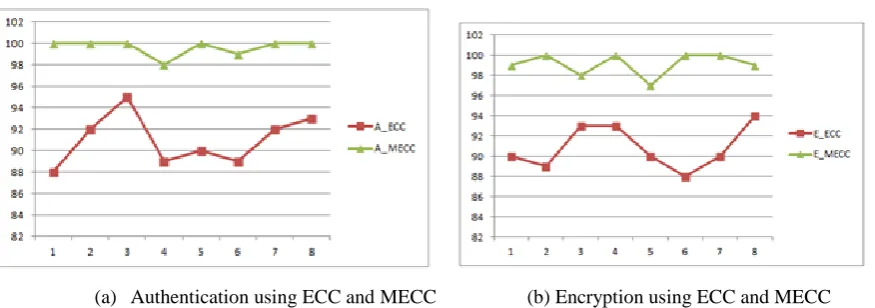
This is similar in case of algorithm applied in authentication and encryption success rate is always high in MECC compared to ECC. The figure 4 shows the test results on both algorithms. The observations depict that both algorithms related to authentication and encryption using MECC are always highly accurate compared to those using ECC.
(a) Authentication using ECC and MECC (b) Encryption using ECC and MECC Figure 4: Authentication and Encryption and Success Rate on test sets
IV. CONCLUSION
REFERENCES
[1] Daniel Barbara and Hector Garcia-Molina, “The Reliability of Voting Mechanisms”, IEEE, vol. c-36, pp. 1197-1208, (1987).
[2] Behrooz Parhami, “Voting Algorithms”, IEEE, vol 43, No 4, pp. 617-629, (1994).
[3] Orhan Centinkoya, “Analysis of Security Requirement of Cryptographic Voting Protocols(Extended Abstract)”, IEEE, pp. 1451-1456, ( 2008).
[4] K. Sujatha, P. V. Nageswara Rao, A. Arjuna Rao, L. V. Rajesh, V. Vivek Raja; “Secured Internet Voting System based on Combined DSA and Multiple DES Algorithms”, ICT and Critical Infrastructure:
Proceedings of the 48th Annual Convention of Computer Society of India- Vol II Advances in Intelligent Systems and Computing Volume 249, 2014, pp 643-650.
[5] J. Kennedy and R. Eberhart, “Particle swarm optimization, ” Proceedings of: IEEE International Conference on Neural Networks, Perth, WA, Australia, 1995, pp. 1942-1948.