* Corresponding author, E-mail: [email protected]
CHANGES IN ELECTROLYTE EFFLUX PATTERN IN DETACHED AND
ATTACHED TOMATO FRUITS IN SLOW AND FAST RIPENING VARIETIES
VIJAY PAUL*, G.C. SRIVASTAVA AND V.P. SINGH
Division of Plant Physiology, Indian Agricultural Research Institute, New Delhi-110012 Received on 12 Oct., 2004, Revised on 21 April, 2005
SUMMARY
Comparative study was carried out to examine the differences in electrolyte efflux, which indirectly assess the membrane stability, for detached and attached fruits of tomato undergoing ripening in slow and fast ripening varieties. Slow ripening behaviour for fruits of Pusa Gaurav was not characterized by better membrane stability with age of the fruits during storage in comparison with fast ripening fruits of Pusa Ruby. Ripening of fruits attached on the plant also yielded similar results. Further, rate of electrolyte efflux was not influenced by slow or fast ripening behaviour of tomato varieties. Already proposed role of hypothetical “ripening inhibitor substance” from vegetative parts to fruits could not be proved in terms of its role in providing stability to the membrane. Detached fruits (at 8 days after harvest) and attached fruits (at pink stage) of both the varieties showed drastic increase in electrolyte efflux that might be associated with climacteric behaviour. Thus, indicating climacteric pattern of ripening for detached as well as attached fruits in tomato.
Key words: Electrolyte efflux, membrane stability, ripening, tomato
INTRODUCTION
Many fruits, belong to climacteric group, enter the climacteric phase soon after harvest, whereas, they might not ripen for weeks if left on the tree (Gerhardt 1947). The best example for such a differential behaviour is avocado fruit, which do not undergo a climacteric change or ripen while attached to the plant. To explain this, it was proposed that a substance of unknown nature entering the fruit from the tree inhibits ripening (Burg and Burg 1965, Gazit and Blumenfield 1970). Burg and Burg (1965) hypothesized that ethylene is rendered ineffective by a ripening inhibitor supplied by the parent plant, and that harvesting the fruit removes it from the source of this
Based on comparative study on attached and detached tomatoes, it was concluded by Saltveit (1993) that a respiratory climacteric per se (which has been considered an intrinsic part of the ripening of certain fruits) may not be necessary for the ripening of “climacteric” fruit on the plant but instead be an artifact of using harvested fruit. In muskmelon also detached fruit produced climacteric pattern of CO2 and ethylene but fruits on plant did not exhibit the climacteric increase in respiration in spite of climacteric increase in the plant hormone ethylene (Shellie and Saltveit 1993). Andrews (1995) on the other hand, challenged the above findings in tomato and reported climacteric rise in respiration rate whether, the fruits were detached or attached to the vine. The physiological differences in ripening of attached and detached fruits therefore, are not clear.
Among post harvest physiological events, membrane damage is the key event leading to a cascade of biochemical reactions (Marangoni et al. 1996). Increased free radical mediated damage and loss of membrane integrity are characteristics of senescing plant tissue and fruit ripening (Stanley 1991, Ferrie et al. 1994). Ripening tomato fruit exhibited increase in ion leakage (Palma et al. 1995). Electrolyte efflux when expressed as per cent of total is generally considered as an indirect measure of plant cell membrane damage or membranal stability (King and Ludford 1983, Assi et al. 1997). In the present study, therefore, the membrane stability was examined for detached and attached tomato fruits in slow ripening (Pusa Ruby) and fast ripening (Pusa Gaurav) varieties.
MATERIALS AND METHODS
Seeds of two tomato varieties, viz. Pusa Ruby and Pusa Gaurav, fast and slow ripening types respectively were obtained from Horticulture Division, Indian Agricultural Research Institute, New Delhi. Seeds were treated with fungicide (0.5 % mercuric chloride solution for 5 minutes and rinsed with distilled water thoroughly) and sown on raised soil bed during October end. Grown up seedlings at five leaves stage (height 10±2 cm) were transplanted in experimental field well supplied with organic manure (farm yard manure) at spacing of 75 x 45 cm. Fertilizers @ 100 kg N, 80 kg P and 80 kg K ha-1 were
applied. Half dose of N (urea) along with full dose of P
and K were applied to soil at the time of transplanting and rest of the N was applied as top dressing after 5th week
of transplanting. Uniform irrigation was given whenever required. Other recommended cultural practices as required were also followed. Healthy tomato fruits (60-80 g) at required stages were manually harvested in the second week of March. Fruits were treated with bavistin [0.3 g (a.i.) l-1] for 10 minutes at about 30 0C. Fruits were
then air dried and used for two separate experiments.
Experiments were repeated in two tomato crop seasons (2002-03 and 2003-04). Dates for both the experiments were kept same so that the conditions during storage should almost be uniform for the experiments. This has allowed us to compare the data of two separate experiments.
Experiment I (Ripening during storage): Tomato fruits of two varieties at green mature stage as described by United Fresh Fruit and Vegetable Association (UFFVA) (1975) were harvested. Fruits were then stored in ventilated plastic baskets at room condition in four replications (40 tomatoes in each replication). For each replication, 15 fruits were marked for their respective sampling at 0, 5, 8, 10, and 14 days after harvest (DAH) and rest of 25 fruits were used to assess the ripening index (RI %) and red ripe status (RR %). RI (%), which measures the extent of ripening, was estimated as described by Wang and Morris (1993). RR (%), which also indicates ripening status, was calculated by counting the tomato fruits reached to red ripe stage [whole fruit became red in colour as per UFFVA (1975)]. Marked fruits for respective sampling at fixed DAH were used for determination of electrolyte efflux. Mean of two readings from two separately marked tomato fruits per replication made one observation. In total four observations were recorded.
Initial conductivity (IC) and final conductivity (FC) values on the basis of per gram fresh weight of pericarp tissue and in turn electrolyte efflux as percentage of total (EE %) were determined by following the procedure of Najib et al. (1997) with minor modifications. The pericarp pieces (about 1 cm2) from equatorial region of fruits
20 ml of DD water. Tubes were placed on to and fro shaker (150 cycles min-1). IC was recorded after 3 hours
of incubation at room temperature by using conductivity bridge (Century Instruments, India). Samples were then boiled for 90 minutes and allowed to reach the room temperature, while placed on shaker to facilitate total electrolyte leakage from the tissues. Volume was then made to 20 ml with DD water and shaked for another 5 minutes. FC was then recorded. IC and FC were recorded for per gram of fresh weight of pericarp tissue. EE (%) was then arrived at by using formula: (IC/FC) x 100
Experiment II (Ripening on the plant): Tomato fruits were harvested for each of the seven defined stages of tomato fruit ripening i.e. green mature, breaker, turning, pink, light red, red and red ripe as described by Saltveit (1989) based on illustrations adopted by the UFFVA (1975). Fruits at each of the above ripening stages, having fixed RI (%) were evaluated for EE (%) as described above. EE (%) for plant harvested fruits at green mature and turning stages was also determined by incubating same pericarp tissue sample for 1, 2, 3, 4, 5, 7 and 8 hours and taking IC at these intervals. In an another, sub-experiment, harvested green mature fruits were stored and during storage as and when different ripening stages were
reached, EE (%) was determined to compare with directly plant harvested fruits for each variety. Two varieties were also compared when fruits were harvested at green mature stage and allowed to reach at each of the ripening stages during storage.
Data were statistically analysed using two factor complete randomized design (CRD) and correlation coefficients (r) were also determined wherever required. Mean values were then ranked using Duncan’s Multiple Range Test (DMRT). Statistical procedures as described by Gomez and Gomez (1984) were followed. As each experiment was repeated in two subsequent seasons and similar trends in results were obtained so, the data obtained during 2003-04 season are being presented here.
RESULTS
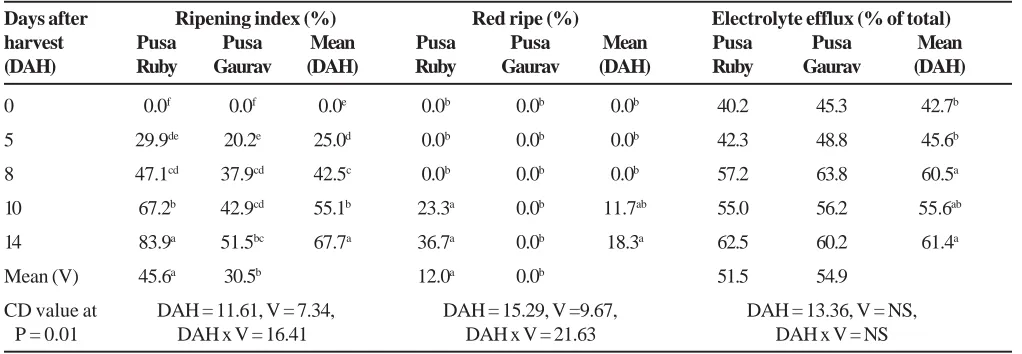
Ripening during storage: During storage, RI (%) increased gradually and values at 10th (67.2 %) and 14th
(88.9 %) DAH were significantly higher for Pusa Ruby in comparison with values of 42.9 % and 51.5 % for Pusa Gaurav at respective DAH (Table 1). Low RI (%) value for Pusa Gaurav along with no red ripe tomato even upto 14 DAH in contrast with 36.7 % red ripe tomatoes for Pusa Ruby indicated slow rate of ripening in Pusa Gaurav
Table 1. Effect of duration of storage of tomato fruits harvested at green mature stage for varieties Pusa Ruby and Pusa Gaurav on ripening and electrolyte efflux (%).
Days after Ripening index (%) Red ripe (%) Electrolyte efflux (% of total)
harvest Pusa Pusa Mean Pusa Pusa Mean Pusa Pusa Mean
(DAH) Ruby Gaurav (DAH) Ruby Gaurav (DAH) Ruby Gaurav (DAH)
0 0.0f 0.0f 0.0e 0.0b 0.0b 0.0b 40.2 45.3 42.7b
5 29.9de 20.2e 25.0d 0.0b 0.0b 0.0b 42.3 48.8 45.6b
8 47.1cd 37.9cd 42.5c 0.0b 0.0b 0.0b 57.2 63.8 60.5a
10 67.2b 42.9cd 55.1b 23.3a 0.0b 11.7ab 55.0 56.2 55.6ab
14 83.9a 51.5bc 67.7a 36.7a 0.0b 18.3a 62.5 60.2 61.4a
Mean (V) 45.6a 30.5b 12.0a 0.0b 51.5 54.9
CD value at DAH = 11.61, V = 7.34, DAH = 15.29, V =9.67, DAH = 13.36, V = NS,
P = 0.01 DAH x V = 16.41 DAH x V = 21.63 DAH x V = NS
(Table 1). Values for EE (%) showed significant decrease in membrane stability at 8 DAH and beyond. No varietal differencein terms of membrane stability was recorded (Table 1). Thus, slow ripening behaviour of Pusa Gaurav could not be attributed to low EE (%) or better membrane stability during storage or with ageing of tomato fruits.
Ripening on the plant: Comparison of two varieties for EE (%) and RI (%) at different ripening stages of tomato fruits harvested from the plant on the same day showed no varietal difference (Table 2). EE (%), however, showed increasing trend with stages of ripening (Table 2). These results are similar to those obtained during storage (Table 1). Significant decrease in membrane stability was noticed at turning stage (corresponds to RI of 33.3 %) and afterward stages of ripening (Table 2). In contrast, 8 DAH (corresponds to RI of 47.1 and 37.9 % for Pusa Ruby and Pusa Gaurav, respectively) and beyond was the time for significant decrease in membrane stability during storage (Table 1). At par values of EE (%) for both the varieties indicated that the ripening of fruits either on the plant (Table 2) or during the storage (Table 1) was not associated with low or higher EE (%) in slow and fast ripening varieties of tomato respectively. This was in spite of the fact that ripening stages of tomato fruit on plant was highly correlated with EE (%) in
Pusa Ruby (r = 0.910**) as well as in Pusa Gaurav (r = 0.904**).
Data on the EE (%) of pericarp tissue from plant harvested fruits at green mature and turning stages when incubated for different durations also showed that the ion leakage was not affected by the slow or fast ripening behaviour of tomato varieties (Table 3). Thus, in spite of strong correlation between electrolyte efflux (or membrane leakiness) with the progress of ripening for fruit attached with plant, rate of electrolyte efflux could not predict the rate of ripening in slow and fast ripening varieties.
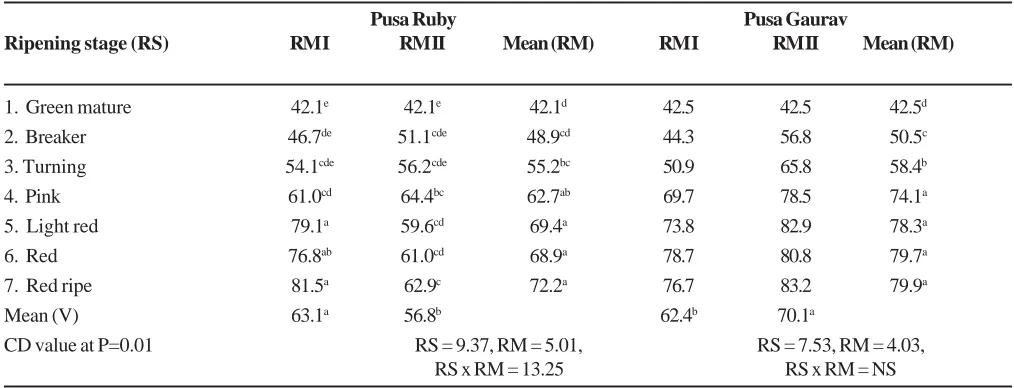
Ripening of fruits attached to plants was also compared with attainment of specific ripening stages during storage in fast and slow ripening varieties (Table 4). EE (%) showed significantly higher values for fruits where ripening was taking place on plant especially at light red stage and beyond for Pusa Ruby, in comparison with similar ripening stages attained by fruits during storage. So, in spite of ageing effect during storage the EE (%) was more for fruits undergoing ripening on plants. Thus, plant attached fruits of Pusa Ruby showed less membrane stability over stored fruits at light red stage and beyond. In contrast, EE (%) in Pusa Gaurav showed reverse trend where membrane were less stable for stored
Table 2.Ripening index (RI %) and electrolyte efflux at different ripening stages of tomato fruits in Pusa Ruby and Pusa Gaurav. Tomatoes at different ripening stages were directly harvested (8-3-2004) from the plants.
Ripening stage (RS) RI (%) Electrolyte efflux (% of total)
Pusa Ruby and Pusa Gaurav Pusa Ruby Pusa Gaurav Mean (RS)
1. Green mature 0.0 42.1 42.5 42.3d
2. Breaker 16.6 46.7 44.3 45.5cd
3. Turning 33.3 54.1 50.9 52.5c
4. Pink 50.0 61.0 69.7 65.3b
5. Light red 66.6 79.1 73.8 76.5a
6. Red 83.3 76.8 78.7 77.8a
7. Red ripe 100.0 81.5 76.7 79.1a
Mean (V) - 63.0 62.4
CD value at P=0.01 - RS = 7.75, V = NS, RS x V = NS
Table 3. Comparison of electrolyte efflux (%) of pericarp tissue from plant harvested tomato fruits at two ripening stages when incubated for different durations for Pusa Ruby and Pusa Gaurav.
Green mature stage Turning stage
Duration of incubation (DOI) in h Pusa Pusa Mean Pusa Pusa Mean
Ruby Gaurav (DOI) Ruby Gaurav (DOI)
1 29.3 30.6 29.9c 52.3 56.8 54.6d
2 38.9 42.5 40.7de 69.8 73.3 71.6c
3 47.9 51.5 49.7cd 80.2 83.6 81.9bc
4 54.6 58.2 56.4bc 86.3 89.1 87.7ab
5 61.4 64.2 62.8b 90.7 91.9 91.3ab
7 76.8 74.9 75.9a 95.6 96.4 96.0a
8 78.8 79.9 79.0a 94.9 97.1 96.0a
Mean (V) 55.4 57.3 81.4 84.0
CD value at P = 0.01 V = NS, DOI = 11.57, V x DOI = NS V = NS, DOI = 11.35, V x DOI = NS
- Values followed by different alphabetic letter/s are significant over one another.
Table 4. Electrolyte efflux (%) at different ripening stages of tomato fruits in Pusa Ruby and Pusa Gaurav. Tomatoes were either directly harvested from the plant (ripening method I) or harvested at green mature stage and allowed to mature up to specific stage by storing (ripening method II) at room conditionsa.
Pusa Ruby Pusa Gaurav
Ripening stage (RS) RM I RM II Mean (RM) RM I RM II Mean (RM)
1. Green mature 42.1e 42.1e 42.1d 42.5 42.5 42.5d
2. Breaker 46.7de 51.1cde 48.9cd 44.3 56.8 50.5c
3. Turning 54.1cde 56.2cde 55.2bc 50.9 65.8 58.4b
4. Pink 61.0cd 64.4bc 62.7ab 69.7 78.5 74.1a
5. Light red 79.1a 59.6cd 69.4a 73.8 82.9 78.3a
6. Red 76.8ab 61.0cd 68.9a 78.7 80.8 79.7a
7. Red ripe 81.5a 62.9c 72.2a 76.7 83.2 79.9a
Mean (V) 63.1a 56.8b 62.4b 70.1a
CD value at P=0.01 RS = 9.37, RM = 5.01, RS = 7.53, RM = 4.03,
RS x RM = 13.25 RS x RM = NS
- Values followed by different alphabetic letter/s are significant over one another.
a Average temperature of 31.7 ±1 0C and RH 33.2 ±7 % prevailed during storage.
fruits rather than for fruits picked up directly from the plant at specified ripening stage. Further, comparison of r values (between ripening stages and EE (%), Table 4) for fruits of Pusa Ruby and Pusa Gaurav
DISCUSSION
Progress of ripening for detached (Table 1) and attached fruits (Table 2, 4) was associated with the gradual decrease in membrane stability. Palma et al.
(1995) also observed progressive increase in ion leakage during storage. When fruits of two varieties were compared either for detached (Table 1) or attached (Table 2), no differences were observed for EE (%) at any of the storage duration or ripening stages. The above results were obtained in spite of fast and slow ripening behaviour of Pusa Ruby and Pusa Gaurav, respectively as indicated by RI (%) values (Table 1). The data for EE (%) of pericarp tissue from plant harvested fruits at two ripening stages when incubated for different durations (Table 3) further confirmed the above finding. In contrast to our findings, varietal variation in ion leakage (%) in apple during storage was reported by Meresz et al.
(1992). They attributed the decay of the middle lamella, regular structure of cell wall and separation of cell membrane from cell wall for the increase in ion leakage during ripening (Meresz et al. 1994). While, Palma et al.
(1995) correlated the extent of ion leakage with loss in ATPase activity and percentage of linolenic acid present in the microsomal membranes. Lipoxygenase mediated oxidation of linolenic acid was the cause attributed for the observed correlations.
This study showed that slow and fast ripening behaviour of fruits could not be distinguished on the basis of EE (%) or membrane stability at least for these two contrasting varieties. Further, hypothesis that slow ripening variety would receive more of hypothetical “ripening inhibitor substance” from the plant and consequently providing membrane stability which might cause delay the process of ripening could not be proved. Significant increase in EE (%) during storage of harvested fruits at 8 DAH (Table 1) and for the plant-attached fruits up to pink stage (Table 2) indicated either the beginning of climacteric phase or its effect on the membranes of tomato fruit. Thus, 8th DAH and pink
stage of fruits attached to plant are the important stages during fruit ripening with respect to decrease in stability of membrane and progress of ripening. As this shift was recorded whether the fruits were detached or remain
attached with the plant so our study supported the view proposed by Andrews (1995), which states that tomato behaves like climacteric fruit whether fruits were detached or attached to the plant. Saltveit (1993), however, was of the view that ripening of tomato fruit was climacteric only if it is harvested and stored and not when fruit is undergoing ripening while attached to the parent plant.
The comparison of electrolyte efflux data for different stages of ripening in detached and attached fruits for two varieties (Table 4) suggested more deterioration of membrane integrity in Pusa Ruby when fruits were remained attached to plant in contract to stored fruits. Slow ripening variety (Pusa Gaurav) on the other hand, showed better membrane stability, at any given ripening stage, when fruits were attached to plant. These results indicated more stable membrane system when fruits were harvested and stored for Pusa Ruby and left attached to plant for Pusa Gaurav. The primary reason for this difference might be due to their fast and slow ripening nature as such. Colour change during storage for Pusa Ruby was faster in comparison with relative change in ion leakage between two ripening stages being a fast ripening variety. While, slower change in colour in spite of more age of fruit could have resulted in relatively more EE (%) between two ripening stages might be the case for Pusa Gaurav as it is slow ripening variety. This also explained the low values of r for stored fruits over plant-matured fruits.
The study indicated that the EE (%) could not be a suitable criterion to assess the slow and fast ripening behaviour of tomato varieties either for detached or attached fruits. The study also ruled out the slow and fast ripening behaviour of varieties in view of differences in the quantity of hypothetical “ripening inhibitor substance” being translocated to the fruit undergoing ripening while attached to the plant. The study therefore, supported the view that tomato is a climacteric fruit whether the ripening takes place in attached or detached fruits.
REFERENCES
Assi, N.E., Huber, D.J. and Brecht, J.K. (1997). Irradiation-induced changes in tomato fruit and pericarp firmness, electrolyte efflux and cell wall enzyme activity as influenced by ripening stage. J. Amer. Soc. Hort. Sci. 122: 100-106.
Burg, S.P. and Burg, E.A. (1965). Ethylene action and the ripening of fruits. Science 48: 1190-1196.
Ferrie, B.J., Beaudoin, N., Burkhart, W., Bowsher, C.G. and Rothstein, S.J. (1994). The cloning of two tomato lipoxygenase genes and their differential expression during fruit ripening. Plant Physiol. 106: 109-118.
Gazit, S. and Blumenfield, A. (1970). Response of mature avocado fruits to ethylene treatments before and after harvest. J. Amer. Soc. Hort. Sci. 95: 229-231.
Gerhardt, F. (1947). A comparison of the ripening of attached apple and pear fruits. Wash State Hort. Assoc. Proc. 43: 57-59.
Gomez, K.A. and Gomez, A.A. (1984). Statistical Procedures for Agricultural Research (2nd edition). John Wiley, Singapore.
King, M.M. and Ludford, P.M. (1983). Chilling injury and electrolyte leakage in fruit of different tomato cultivars. J. Amer. Soc. Hort. Sci. 108: 74-77.
Mapson, W. and Hulme, A.C. (1970). The biosynthesis, physiological effects and mode of action of ethylene. In: L. Reinhold and Y. Liwschitz (eds.), Progress in Phytochemistry, Vol. 2, pp. 343-384. Interscience Publishers, London.
Marangoni, A.G., Palma, T. and Stanley, D.W. (1996). Membrane effects in post harvest physiology. Postharvest Biol. Technol. 7: 193-217.
Meresz, P., Lovasz, T. and Berezvai, Z. (1994). Post harvest membrane permeability of apple. Acta Hort. 368: 285-290.
Meresz, P., Lovasz, T., Sass, P. Laszlo,P. and Molnar-Perl, I. (1992). Functional changes of apple cell membranes during storage. Acta Hort.343: 34-40.
Najib, E.A., Donald, J.H. and Jeffery, K,B. (1997). Irradiation-induced changes in tomato fruit and pericarp firmness, electrolyte efflux and cell wall enzyme activity influenced by ripening stage. J. Amer. Soc. Hort. Sci. 122: 100-106.
Palma, T., Marangoni, A.G. and Stanley, D.W. (1995). Environmental stresses affect tomato microsomal membrane function differently than natural ripening and senescence. Postharvest Biol. Technol.6: 257-273.
Saltveit, M.E. Jr. (1989). Effect of alcohols and their interaction with ethylene on the ripening of epidermal pericarp discs of tomato fruit. Plant Physiol. 90: 167-174.
Saltveit, M.E. Jr. (1993). Internal carbon dioxide and ethylene levels in ripening tomato fruit attached to or detached from plant. Physiol. Plant. 89: 204-210.
Sfakiotakis, E. M. and Dilley, D. P. (1973) Internal ethylene concentrations in apple fruits attached to or detached from the tree. J. Amer. Soc. Hort. Sci. 98: 501-503.
Sawamura, M., Knegt, E. and Bruinsma, J. (1978). Levels of endogenous ethylene, carbon dioxide, and soluble pectin, and activities of pectin methylesterase and polygalacturonase in ripening tomato fruits. Plant Cell Physiol. 19: 1061-1069.
Shellie, K.C. and Saltveit, M.E. Jr. (1993). The lack of a respiratory rise in muskmelon fruit ripening on the plant challenges the definition of climacteric behaviour. J. Exp. Bot. 44: 1403-1406.
Stanley, D.W. (1991). Biological membrane deterioration and associated quality losses in food tissues. Crit. Rev. Food Sci. Nutr. 30: 487-553.
United Fresh Fruit and Vegetable Association (UFFVA) (1975). Colour classification requirements in tomatoes. USDA Visual Aid TM-L-1. The John Henry Co., Lansing, Minch