University of Pennsylvania
ScholarlyCommons
Publicly Accessible Penn Dissertations
Fall 12-21-2011
The Costs of Shareholder Activism: Evidence from
a Sequential Decision Model
Nickolay M. Gantchev
University of Pennsylvania, [email protected]
Follow this and additional works at:
http://repository.upenn.edu/edissertations
Part of the
Corporate Finance Commons
,
Econometrics Commons
, and the
Finance Commons
Recommended Citation
Gantchev, Nickolay M., "The Costs of Shareholder Activism: Evidence from a Sequential Decision Model" (2011).Publicly Accessible Penn Dissertations. 442.
The Costs of Shareholder Activism: Evidence from a Sequential Decision
Model
Abstract
Recent work on hedge fund activism documents substantial abnormal returns but fails to answer the question whether these returns cover the large costs of activist campaigns. This paper provides benchmarks for
monitoring costs and evaluates the net returns to activism. I model activism as a sequential decision process consisting of demand negotiations, board representation and proxy contest and estimate the costs of each distinct stage. A campaign ending in a proxy fight has average costs of $10.71 million. The proxy contest is the most expensive stage, followed by demand negotiations. The estimated monitoring costs consume more than two-thirds of gross activist returns implying that the net returns to activism are significantly lower than previously thought. Even though the mean net return is close to zero, the top quartile of activists earn higher returns on their activist holdings than on their non-activist investments.
Degree Type
Dissertation
Degree Name
Doctor of Philosophy (PhD)
Graduate Group
Finance
First Advisor
Lucian Taylor
Second Advisor
Franklin Allen
Third Advisor
Itay Goldstein
Keywords
Shareholder Activism, Hedge Funds, Monitoring, Corporate Governance
Subject Categories
THE COSTS OF SHAREHOLDER ACTIVISM:
EVIDENCE FROM A SEQUENTIAL DECISION MODEL
Nickolay M. Gantchev
A DISSERTATION
in
Finance
For the Graduate Group in Managerial Science and Applied Economics
Presented to the Faculties of the University of Pennsylvania
in Partial Ful…llment of the Requirements for the Degree of Doctor of Philosophy
2011
Supervisor of Dissertation
____________________
Lucian Taylor, Assistant Professor of Finance
Graduate Group Chairperson
____________________
Eric T. Bradlow, Professor of Marketing, Statistics, and Education
Dissertation Committee
Lucian Taylor, Assistant Professor of Finance
Franklin Allen, Nippon Life Professor of Finance and Economics
The Costs of Shareholder Activism:
Evidence from a Sequential Decision Model
COPYRIGHT
Nickolay M. Gantchev
Acknowledgements
I am grateful to Franklin Allen, Itay Goldstein, and Lucian Taylor for their invaluable
guid-ance. I thank an anonymous referee, Ashwini Agrawal and David Denis for helpful comments
and discussion. I also thank Carlos Bellon, Philip Bond, Indraneel Chakraborty, Paolo
Ful-ghieri, Anil Shivdasani, Toni Whited, and seminar and conference participants at University of
British Columbia, Carnegie Mellon University, University of Houston, London Business School,
Ohio State University, Oxford University, University of Rochester, University of Toronto,
Uni-versity of North Carolina at Chapel Hill, UniUni-versity of Pennsylvania, Vanderbilt UniUni-versity,
Washington University in St. Louis, University of Wisconsin at Madison, the SFS Finance
Cavalcade at the University of Michigan and the 2011 Western Finance Association. I am
Abstract
THE COSTS OF SHAREHOLDER ACTIVISM:
EVIDENCE FROM A SEQUENTIAL DECISION MODEL
Nickolay M. Gantchev
Lucian Taylor
Recent work on hedge fund activism documents substantial abnormal returns but fails to
answer the question whether these returns cover the large costs of activist campaigns. This
paper provides benchmarks for monitoring costs and evaluates the net returns to activism.
I model activism as a sequential decision process consisting of demand negotiations, board
representation and proxy contest and estimate the costs of each distinct stage. A campaign
ending in a proxy …ght has average costs of $10.71 million. The proxy contest is the most
expensive stage, followed by demand negotiations. The estimated monitoring costs consume
more than two-thirds of gross activist returns implying that the net returns to activism are
signi…cantly lower than previously thought. Even though the mean net return is close to
zero, the top quartile of activists earn higher returns on their activist holdings than on their
Contents
Contents vi
List of Tables viii
List of Figures ix
0.1 Introduction . . . 1
0.2 Literature Review . . . 7
0.3 Model Framework . . . 10
0.3.1 Activism as a Sequential Process . . . 10
0.3.2 The Activist’s Decision Problem . . . 13
0.4 Econometric Design . . . 17
0.4.1 Random Utility Speci…cation . . . 17
0.4.2 Identi…cation . . . 20
0.4.3 Target Valuation and Campaign Return . . . 22
0.5.1 Sample Construction . . . 25
0.5.2 Summary of Activist Events . . . 27
0.6 Empirical Results . . . 35
0.6.1 Costs of Activist Campaigns . . . 35
0.6.2 Returns to Hedge Fund Activism . . . 40
0.7 Robustness . . . 42
0.7.1 Expected Activist Reward . . . 42
0.7.2 Activist Heterogeneity . . . 44
0.7.3 Ownership, Takeover Activity and Learning . . . 45
0.8 Concluding Remarks . . . 47
0.9 Appendices . . . 48
0.9.1 Appendix A: SEC Schedule 13D . . . 48
0.9.2 Appendix B: Carl Icahn & Time Warner Inc. . . 50
List of Tables
1 Distribution of Activist Campaigns by Year and Activist Stage . . . 58
2 List of Activist Hedge Funds: 2000-2007 . . . 59
3 Most Common Activist Demands . . . 60
4 Duration of Activist Campaign . . . 61
5 Activist Ownership Analysis . . . 62
6 Characteristics of Target Companies . . . 63
7 Costs of Commonly Used Activist Tactics . . . 64
8 Activist Abnormal Return Analysis . . . 65
9 Stage-Speci…c Logistic Regressions: Alternative Estimation Methods . . . 66
10 Expected Activist Reward by Outcome . . . 67
11 Stage-Speci…c Logistic Regressions with Activist Fixed E¤ects . . . 68
List of Figures
The Costs of Shareholder Activism:
Evidence from a Sequential Decision Model
0.1
Introduction
Does activist investing generate positivenet returns for the activist? Answering this question
will help us evaluate the potential for activism to mitigate agency costs resulting from the
sep-aration of ownership and control. Activist shareholders occupy an important ‘middle ground’
between internal governance by blockholders and board of directors and external governance
by the market for corporate control. As a result, the presence of an activist shareholder can
be crucial for the proper functioning of a …rm’s corporate governance system.
A shareholder’s incentives to actively monitor are determined by a trade-o¤ between the
private costs of monitoring, which are fully internalized by the activist, and thepublic bene…ts
of monitoring, which are shared among all …rm shareholders (Grossman and Hart (1980),
Shleifer and Vishny (1986)). In order to understand this incentive trade-o¤, we need to assess
both the bene…ts and the costs of active monitoring.
Recent work on hedge fund activism has documented that activists generate signi…cant
abnormal returns both in absolute terms and in comparison to non-activist investing. Brav
et al. (2008) report that the average hedge fund activist in 2001-2006 earned 14.30% higher
return than the size-adjusted value weighted portfolio of stocks. Cli¤ord (2008) demonstrates
that activist hedge funds in 1998-2005 generated 21.75% higher annualized returns that the
Do these substantial returns cover the large costs of activist engagements? These costs
consist of disclosure, legal and other fees of hiring proxy advisors and solicitors, corporate
governance experts, investment banks, public relations and advertising …rms in addition to
unobservable costs such as the time and e¤ort of the activist to negotiate with a target. The
existing literature on shareholder activism lacks a proper measure for these costs and does
not take them into account in the estimation of activist returns. This leads to an incomplete
assessment of the activist’s incentive trade-o¤.
Most evidence about monitoring costs is anecdotal and limited to proxy solicitations - the
most public activist approach. Stephen M. Bainbridge estimates the costs of a proxy contest
at $1.8 million based on a survey conducted in the late 1980s (see Thomas et al. (1998)) but
points out that “costs almost certainly are much higher today”. Hedge fund activists estimate
proxy costs at "upwards of $10,000,000”.1 However, the majority of activist campaigns do not reach a proxy contest but rely on less confrontational activist approaches such as informal
demand negotiations and board representation, whose costs are unobservable and cannot be
estimated from public data.
This paper complements recent work on hedge fund activism by providing cost benchmarks
for evaluating the net returns to activism. In order to account for the large heterogeneity of
activist events, I estimate the costs associated with three common activist approaches - demand
negotiations, board representation and proxy contest. I …nd that the average campaign ending
in a proxy …ght costs $10.71 million. Subtracting costs reduces the mean abnormal activist
return by two-thirds suggesting that costs play a major role in the activist’s decision-making
1
See Stephen M. Bainbridge (http://www.sec.gov/rules/proposed/s71903/bainbridge121903.htm);
Ralph V. Whitworth (http://www.sec.gov/comments/s7-10-09/s71009-185.pdf); and Carl Icahn
behavior.
The approach taken in this paper consists of two interrelated parts. First, I model activism
as a sequential decision process consisting of demand negotiations, board representation and
proxy contest, and de…ne the activist’s break-even constraint for monitoring. Then, I transform
this break-even condition into a discrete-choice framework and estimate the costs of activism
implied by the observed decision-making behavior of activists between 2000 and 2007.
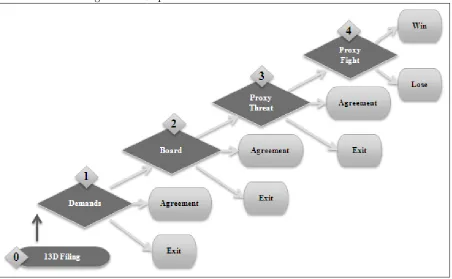
The starting point of this paper is a novel de…nition of activism as a sequence of escalating
decision steps, in which an activist chooses a more hostile tactic only after less confrontational
approaches have failed. A typical campaign starts with an announcement of activist intentions
(usually reported in a regulatory …ling), followed by communication of speci…c demands to
the target. Initial negotiations between the activist and the target are rarely successful. The
activist may choose to terminate his campaign after failed negotiations, or pursue a more
direct approach by requesting a board seat. In most instances, the activist is denied board
representation, in which case he has the option to solicit input from other shareholders, and
eventually wage a proxy …ght.
The activist’s decision problem involves a basic trade-o¤ between the expected bene…t from
campaign continuation with a speci…c approach and the expected cost of activist involvement.
This decision can be described by the activist’s break-even pro…t constraint for monitoring
and consists of two steps. First, the activist estimates a net continuation bene…t by comparing
his expected reward from the campaign to the cost of intervening with a particular tactic.
Then, he compares this net bene…t to the selling value of his ownership stake. The observed
continuation decision de…nes a minimum cost threshold at which the activist is indi¤erent
The activist’s break-even condition is transformed into a discrete-choice problem under the
assumptions of random utility theory. The activist’s decision is summarized by the expected
gross return in a successful campaign, which relies on an estimate of its bene…t, and the
ac-tivist’s marked-to-market investment in the target, which captures the opportunity cost of the
campaign. The expected reward in a successful intervention equals a target’s potential value if
the activist’s demands are successfully implemented. Empirically, I estimate a target’s
poten-tial value as the valuation of a matched peer with similar fundamentals. This valuation metric
re‡ects the potential for value improvement due to an activist engagement and is calibrated
to the actual valuation improvement in successful activist campaigns.
The estimation procedure consists of two simultaneous parts - a system of conditional
logistic regressions, which separately derives the costs of each activist stage, and statistical
backward induction, which uses the estimated costs of later stages in the calculation of the
costs of the earlier stages of activism. I solve the underidenti…cation problem of the logistic
model by using an exogenous identi…cation restriction derived from the activist’s break-even
pro…t constraint. This identifying restriction …xes the scale of utility of each stage allowing me
to derive the absolute magnitude of stage costs.
The main contribution of this paper is providing cost benchmarks to assess thenet returns
to activism. I estimate the costs of three common activist approaches - demand negotiations,
board representation and proxy contest. The proxy contest stage has the highest cost equal to
$5.94 million for the average activist campaign. The demand negotiations stage is the second
most expensive stage of the activist process, with average costs of $2.94 million. The least
expensive tactic is board representation, which adds $1.83 million to the cost of the average
these common activist approaches.
I calculate net abnormal activist returns in excess of the value-weighted portfolio of stocks
(VW returns) and in excess of characteristic portfolios based on size, market-to-book and stock
return momentum (DGTW returns).2 The mean annualized VW abnormal return is 4.02%
while the mean DGTW abnormal return is 7.61%. Costs consume more than two-thirds of
gross activist returns. The mean VW abnormal return drops to 0.23% while the mean DGTW
abnormal return becomes 2.38% after subtracting costs. Even though the mean net return is
close to zero, the top quartile of activists earn higher returns on their activist holdings than
on their non-activist portfolios.
This paper introduces a large hand-collected dataset of hedge fund activist campaigns
be-tween 2000 and 2007, which contains detailed information about the evolution of each campaign
and the negotiation tactics employed by activists. The …nal sample consists of 1164 unique
campaigns summarized in 5645 individual …lings by 171 hedge funds and 1023 unique targets.
In addition to data from regulatory …lings, the sample includes activist events reported in the
press as described in Brav et al. (2008).3
The comprehensive dataset used in this paper provides new large-sample evidence, which
aids in understanding the nature and evolution of activist engagements. I document that more
than two-thirds of activists quit before making formal demands to their targets. From the
sample of activists who announce speci…c demands, less than 20 percent proceed to request
a board seat and only 10-12% threaten a proxy contest. Surprisingly, only 7% of activist
2The calculation of characteristic based returns follows the approach in Daniel, Grinblatt, Titman and
Wermers (1997).
3Schedule 13D and proxy statements are the main data sources in this study. Schedule 13D is …led by any
campaigns end up in a proxy …ght.
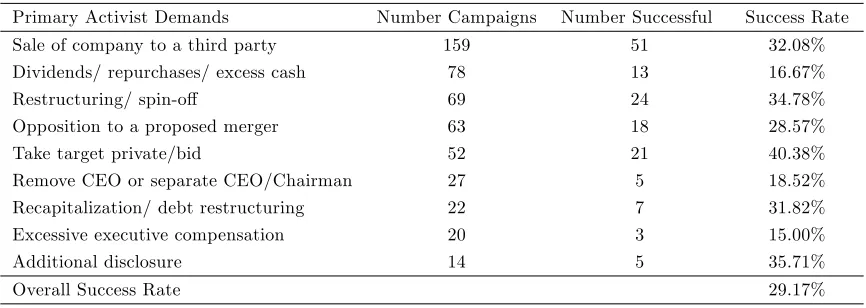
Activists are most successful when demanding a sale (or privatization) of a target,
restruc-turing of ine¢ cient operations and additional disclosure but less successful when asking for
higher dividends (or repurchases), CEO removal or executive compensation changes. In terms
of their demands, 29.17% of activists achieve their objectives. As an alternative measure of
success, I estimate holding period returns and show that only the highest quartile of activist
campaigns earn positive returns.
I also document that more confrontational activist tactics have higher success rates. The
most successful activist stage is the proxy contest, in which 57.38% of activists achieve their
objectives. Board representation is e¤ective in 39.33% of the cases while demand negotiations
are successful in only 6.76% of the campaigns. Even though proxy contests are successful in
the majority of activist events, only 7% of campaigns reach the proxy stage suggesting that the
high costs of proxy solicitations deter some activists from pursuing their investment objectives.
The rest of the paper proceeds as follows. Section 2 reviews the related academic
liter-ature. Section 3 presents a new de…nition of activism as a sequential decision process and
de…nes the activist’s break-even pro…t constraint. Section 4 discusses the empirical design,
identi…cation and estimation of target valuations. Section 5 describes the activist sample.
Section 6 reports the main empirical results and Section 7 presents robustness analysis.
0.2
Literature Review
One of the classic questions in …nance is whether shareholders have adequate incentives to
e¤ectively monitor …rm management. Active monitoring aligns the interests of managers and
shareholders, and reduces the agency costs resulting from the separation of ownership and
control. Shareholder activists - minority shareholders intent on changing major …rm policies
- have often acted as the interface between internal governance by blockholders and board of
directors and external governance by the market for corporate control.
The theoretical literature has studied the importance of monitoring costs (in terms of
liquidity, risk aversion, or information acquisition) in determining the activist’s incentive
trade-o¤. Grossman and Hart (1980) were the …rst to point out that small shareholders may lack the
proper incentives to discipline managers. Shleifer and Vishny (1986) consider the role of large
shareholders (blockholders) in providing e¤ective governance. They argue that a blockholder
will actively monitor as long as the return on his stake is su¢ cient to cover the costs of
monitoring.
Admati, P‡eiderer and Zechner (1994) consider a blockholder’s trade-o¤ in terms of the
loss in risk-sharing bene…ts resulting from concentrated ownership. They show that market
ine¢ ciencies (e.g., free-riding) may induce a blockholder to reduce his ownership rather than
incur the cost of monitoring. Kahn and Winton (1998) demonstrate that the precision of a
blockholder’s private information increases his motive to speculate in the target’s shares rather
than intervene to improve performance. Maug (1998) studies the e¤ects of market liquidity on
a shareholder’s incentives to monitor and shows that liquid markets help shareholders overcome
More recently, Edmans and Manso (2011) argue that a multiple blockholder structure
exacerbates the free-rider problem and reduces the e¤ectiveness of direct intervention (“voice”)
but increases the usefulness of governance through trading (“exit”). Cohn and Rajan (2011)
consider the interplay between internal and external governance in a model, in which the
activist incurs a …xed cost as a function of his information about the …rm.
Despite the theoretical emphasis on monitoring costs, the empirical literature has largely
ignored costs in analyzing the activist’s incentive trade-o¤. This most likely results from
challenges in measuring the costs of activism.
The …rst challenge has been …nding the right institutional setting to study the trade-o¤
facing an activist shareholder. Most empirical work has focused on pension or mutual funds
and labor unions even though their monitoring abilities are severely limited by regulatory (or
self-imposed) restrictions. For example, pension and mutual funds are subject to the ‘prudent
man’ rule which curbs investment in some troubled companies while mutual funds have to
comply by diversi…cation requirements that limit their ability to accumulate a concentrated
position in a target. In addition, pension and mutual funds may be unwilling to become
confrontational with …rms whose business they covet while unions may pursue self-interested
agendas con‡icting with shareholder maximization.
Consequently, most recent surveys of shareholder activism (Karpo¤ (2001), Romano (2001),
Gillan and Starks (2007), Holderness (2003), Yermack (2010)) have concluded that institutional
activism (by pension funds, mutual funds and unions) has had limited impact on …rm
gover-nance and performance. Kahan and Rock (2006) di¤erentiate hedge funds from other activists.
They argue that hedge funds su¤er from fewer con‡icts of interest, face fewer regulatory
as active monitors.4
The second challenge in measuring the costs of activism has been the lack of empirical
data. Most evidence about monitoring costs is limited and anecdotal, and pertains to contested
proxy solicitations. For example, Stephen M. Bainbridge estimates the costs of a proxy contest
at $1.8 million based on data from the late 1980s while statements by hedge fund managers
suggest that proxy costs exceed $10 million.5 However, the costs of less confrontational activist campaigns are unobservable and cannot be estimated from publicly-available information.
This paper is the …rst attempt in the literature to quantify the costs of monitoring. It
complements recent work on hedge fund activism by providing cost benchmarks to evaluate
the net returns to activism. For example, Brav et al. (2008) report that the average hedge
fund activist in their sample between 2001-2006 earned 14.30% higher return than the
size-adjusted value-weighted portfolio of stocks. Klein and Zur (2009) compare the hostile activist
campaigns of hedge funds to those of other activists, and …nd that hedge funds earn higher
overall returns. Cli¤ord (2008) demonstrates that activist investing is a pro…table investment
strategy even when compared to non-activist investing.
The existing literature on shareholder activism does not account for the costs of activist
monitoring due to the lack of proper measures for these costs. This leads to an incomplete
assessment of the activist’s incentive trade-o¤. This paper estimates that costs consume about
two-thirds of gross activist returns implying that the net returns to activism are signi…cantly
lower than previously thought.
4Hedge funds have initiated the large majority of activist campaigns since 2000.
5
0.3
Model Framework
0.3.1 Activism as a Sequential Process
Gillan and Starks (2007) de…ne shareholder activists as “investors who, dissatis…ed with some
aspect of a company’s management or operations, try to bring about change within the
com-pany without a change in control.”(p. 55) Tirole (2006) provides the following de…nition:
“Active monitoring consists in interfering with management in order to increase the value of
the investors’ claims.”(p. 27) Both de…nitions comprise “a continuum of possible responses
to corporate performance and activities” but do not consider activism as a decision process
consisting of a sequential set of tactics.
Contrast these broad de…nitions to the way in which activists describe the monitoring
process as a sequence of escalating decision steps.6 Appaloosa Management writes to Beverly Enterprises: “Although we continue to preferpursuing a negotiated transaction with the
Com-pany, your actions have left us no choice but to nominate a slate of directors for election at
your upcoming annual meeting. [...] Our nominees, if elected, will, subject to their …duciary
duties, be committed to going forward with a process that would give due consideration to our
o¤er as well as any other proposals the Company may receive.”7
Another example comes from a letter by Seymour Holtzman of Jewelcor Management to the
Chairman of Thistle Group, “My reason forproposing a slate of Directors is for the purpose of
hiring an investment banker to seek out an attractive merger partner who would be willing to
pay a signi…cant premium for our stock. [...] Moreover, if you were to assure the shareholders
6See also Appendix B describing Carl Icahn’s campaign at Time Warner Inc.
7
of your willingness to do this, I would give serious consideration to withdrawing my proposed
slate of Directors. I know that you and your family are larger shareholders and I hope you will
act in the best interest of all of the shareholders, so the Company will not have to waste time
and money in a proxy contest.”8
The above anecdotal statements underscore two common patterns in the data. First,
activists consider a range of tactics in their discussions with a target - demand negotiations,
board representation, and proxy threat/…ght. Second, these tactics form an escalating sequence
from less hostile to more confrontational. An activist chooses a more hostile tactic only after
less confrontational approaches have failed to produce results.
A typical campaign starts with the announcement of activist intentions, usually reported
in Schedule 13D. This regulatory form (also know as a “bene…cial ownership report”) needs to
be …led with the SEC by anyone who acquires more than 5% of the voting stock of a public
company with the intention of in‡uencing its operations or management.9 The majority of initial 13D …lers terminate their campaigns without announcing demands. These hedge funds
may have …led Schedule 13D for legal reasons or in anticipation of an activist engagement but
decided against it. This sample of activists is instrumental in estimating the costs of the …rst
stage of the activist process.
Insert Figure 1
Shortly after the initial …ling of Schedule 13D, the activist formally communicates a set of
8
Full letter available at http://www.sec.gov/Archives/edgar/data/1056590/000105659002000009/exhibitc.txt. 9
speci…c demands (such as a sale of the company, restructuring of ine¢ cient operations,
addi-tional share repurchases, etc.) to the management of the target. The formal announcement
of activist demands marks the beginning of the …rst stage of the activist process - demand
negotiations. This …rst stage is rarely successful despite its high costs in terms of the activist’s
time and e¤ort. Upon failure of initial demand negotiations, the activist may choose to
termi-nate the campaign, or request board representation, which allows for a more direct interaction
with the target’s management. This second stage of the activist process starts with an o¢ cial
request for board representation, most often accomplished by a nomination notice, a
share-holder proposal, or a publicly …led letter. Board representation has a higher success rate than
demand negotiations but increases the overall costs of a campaign. As a result, only one-…fth
of initial 13D …lers request a board seat.
If the activist does not obtain board representation, he may start soliciting input from other
shareholders by …ling a preliminary proxy statement (stage 3), and eventually wage a proxy
…ght (stage 4). The proxy contest stage has the highest success rate in terms of implementing
the activist’s demands but is also the most costly. As a result, less than one-tenth of the
original 13D …lers initiate proxy contests.
De…ned in this way, the activist process evolves from private to more public forms of
engage-ment. There is some anecdotal evidence describing the legal and disclosure costs of the proxy
contest stage. However, most of the costs of the demand negotiations and board representation
0.3.2 The Activist’s Decision Problem
Ralph V. Whitworth of Relational Investors describes their decision whether to initiate a proxy
contest as follows: “Although the credible ability to initiate a proxy contest under the existing
rules has been e¤ective for Relational in many cases, in others, costs and procedural burdens
resulted in our electing not to use the process even though we were convinced that improved
board composition would create value for all shareholders. In the latter set of cases, the
projects are often abandoned or not taken in the …rst instance.”10
The above statement describes the decision problem of an activist as a basic trade-o¤
between the expected bene…t from an activist intervention (with a speci…c tactic) and the
expected cost of the engagement. The activist’s choice set - denoted below by n2 f0;1;2;3g
- corresponds to commonly observed activist tactics as described in the sequential de…nition
of activism. Speci…cally, 0 = activist intentions but no speci…c demands, 1 = demand
nego-tiations, 2 = board representation, 3 = (threatened) proxy contest. The activist selects more
confrontational tactics only if less hostile approaches fail to convince the target to implement
the proposed demands. Intuitively, more aggressive tactics have a higher probability of success
but increase the overall cost of a campaign.
The activist’s break-even pro…t constraint for monitoring compares the expected bene…t
from campaign continuation against its costs. The expected bene…t in a successful campaign
is based on an estimate of the target’s maximum potential value, which equals its valuation
if the activist’s demands are successfully executed. This continuation value corresponds to
the di¤erence between the target’s fundamental value, Vi, and its current market price, Mi,
1 0Letter of from Ralph V. Whitworth, Principal, Relational Investors LLC to the SEC, Aug. 14, 2009
and is a su¢ cient statistic for the pro…tability of the campaign. In the empirical analysis, the
continuation bene…t is measured by the valuation gap between the target …rm and its matched
peers, and is robust to a variety of de…nitions and estimation procedures.
The costs of an activist campaign include disclosure, legal and other fees of hiring proxy
advisors and solicitors, corporate governance experts, investment banks, public relations and
advertising …rms in addition to unobservable costs such as the time and e¤ort of the activist.
This study assumes that costs vary with the choice of tactic but are independent of campaign
characteristics, i.e. the costs of each stage are …xed across activists. The empirical analysis
relaxes this assumption by including activist …xed e¤ects such as experience, preference for
confrontation and ‘busyness’in the estimation of costs.
The activist’s decision involves two steps. First, he estimates a net continuation bene…t by
comparing his expected return from campaign continuation to the cost of intervening with a
particular tactic. Then, he compares this net bene…t to the selling value of his ownership stake.
A binding break-even pro…t constraint de…nes a minimum cost threshold associated with the
stage, at which the activist terminates the campaign. Using the exit decisions of activists in
the sample period, I am able to derive a sequence of (minimum) cost thresholds implied by
the observed decision-making behavior.
Consider the activist’s decision at stage n. Upon failure of this stage, he has to decide
whether to sell at the current market price, Min, or continue with a more confrontational
tactic (n+ 1), which has a higher probability of success but will increase the cost of the
campaign. At stage (n+ 1), the activist eliminates the target’s discount with some probability,
choice between continuation and exit.11
The activist’s problem can be summarized by the expected utility of each alternative. The
activist compares his utility from continuation, Ui;ncont, to the utility of selling at the current
price, Uexit i;n :
Ui;ncont = cn+pi;n+1E( i;n+1Vi;n+1) + (1 pi;n+1)E max i;n+1Mi;n+1; Ui;ncont+1 (1)
Ui;nexit = inMin
Here, in denotes the current activist ownership, and cn is the cost of stage n.12 Ui;ncont+1 is the utility from continuation to the next stage, if applicable. The activist’s break-even
constraint can be written as:
Ui;ncont=Ui;nexit <=> U~i;n=Ui;ncont Ui;nexit= 0 (2)
For example, consider the activist’s choice at the last decision stage - the decision node
before the proxy contest stage. The activist compares the utility from the two available
al-ternatives - continue to a proxy …ght, Ui;cont3 , or sell at the current market price, Uiexit3 , as
follows:
Uicont3 = c3+pi3 iVi3+ (1 pi3) iMi3 (3)
Uiexit3 = iMi2
1 1
The model assumes that each stage of the activist process has a …xed duration, which allows me to replace
the time subscripttwith the stage subscriptnin the rest of this section. See the empirical analysis for evidence
supporting this assumption.
1 2The empirical evidence in Section 5 supports the modelling assumption that the activist would not use
The activist continues to the proxy stage if
~
Ui3 = c3+pi3 iVi+ (1 pi3) iMi iMi 0 (4)
~
Ui3 =
c3 pi3
1
iMi
+ Vi
Mi
1 0
The above transformation summarizes the activist’s decision by two explanatory variables
- the expected gross return from a successful campaign, MiVi (continuation decision), and
the current value of the investment in the target, iMi1 (exit decision). The transformation
assumes that the activist’s best estimate of his continuation reward equals the target’s current
gap from potential …rm value, i.e. the activist does not time the market. This assumption is
reasonable if we believe that any attempt by the activist to manipulate the market’s perception
of his success will result in an immediate negative correction of the target’s price to its current
value, Mi. This reasoning is supported by …ndings in Brav et al. (2008) who show that the
market reacts very negatively to hedge fund exits in failed campaigns resulting in negative
abnormal returns of -4% in the (-20, +20) window of exit.
More generally, the activist’s stage-speci…c break-even constraint is
~
Uin = n
1
iMi
+ Vi
Mi
where
3 = c3 pi3
(6)
2 = max
c2 (1 pi2)c3 pi2+pi3 pi2pi3
; c2 pi2
1 = max
c1 (1 pi1)c2 (1 pi1)(1 pi2)c3 pi1+pi2+pi3 pi1pi2 pi1pi3 pi2pi3+pi1pi2pi3
; c1 (1 pi1)c2 pi1+pi2 pi1pi2
; c1 pi1
The next section converts the activist’s stage-speci…c break-even condition into a
discrete-choice model by adding an error structure, which captures the econometrician’s imperfect
knowledge of the utility from each decision alternative. This allows estimation of activist costs
without imposing additional assumptions about the parameter distributions.
0.4
Econometric Design
0.4.1 Random Utility Speci…cation
The activist’s break-even constraint for monitoring can be rewritten into a regression framework
under the general assumptions of random utility theory. This step transforms the activist’s
decision into a discrete-choice problem, in which his choice between continuation and exit at
each stage is summarized by the utility of each alternative.13
The activist knows the utility of campaign continuation (denoted by Uin) as well as the
utility of exit (Uin0). The econometrician estimates the activist’s representative utility, Uin
and Uin0 respectively, based on some observable characteristics of each alternative such as the
1 3
expected gross return of a successful campaign and the present value of the investment in
the target. These estimates di¤er from the activist’s actual utility by an error term, which
captures unobservable factors that vary among activists with the same representative utility
such as preference for (or experience with) a speci…c tactic.
Uin = Uin+"in (7)
Uin0 = Uin0 +"in0
Assuming an exogenous sample of activists whose decisions are independent, we write the
probability of activistichoosing alternative nas the following expression:
PrfUin> Uin0g = PrfUin+"in> Uin0+"in0g= Prf"in0 "in< Uin Uin0g (8)
=
Z
"
If"in0 < "in+Uin Uin0gf(")d"
where I is an indicator function equal to one when the expression in the parentheses is
correct.
Assuming iid type I extreme value errors results in the logit formulation, which simpli…es
the above expression further.
PrfUin> Uin0j"ingi6=j =
Y
i6=j
exp( exp( ("in+Uin Uin0))) (9)
PrfUin> Uin0gi6=j =
Z 0 @Y
i6=j
exp( exp( ("in+Uin Uin0)))
1
Using the fact that the di¤erence between two extreme values is distributed logistically, the
above expression takes the following closed form for a binary choice:
PrfUin> Uin0g=
exp(Uin)
1 + exp(Uin)
(10)
We derive the standard logistic regression model assuming a linear probability speci…cation:
PrfUin > Uin0g =
exp(x0 )
1 + exp(x0 ) (11)
Pr Uin> Uin0
Pr Uin Uin0
= exp(x0 )
log Pr Uin > Uin0
Pr Uin Uin0
!
= x0
As a result, the activist’s stage-speci…c break-even constraint can be rewritten into a
re-gression equation, which takes an analogous form for each stage:
log continue
exit = ^1
1
inMin
+ ^2 Vin
Min
(12)
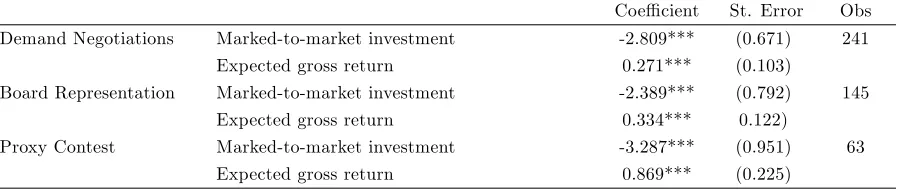
Activist costs are estimated using the above regression equation for each stage of activism.
The …rst coe¢ cient in each regression estimates relative stage costs. The second coe¢ cient
identi…es a stage-speci…c scale parameter, which is required to …nd the absolute magnitude of
0.4.2 Identi…cation
Monitoring costs are estimated using the activist’s break-even pro…t condition (as de…ned
in equation 12). The empirical procedure consists of two simultaneous parts - a system of
conditional logistic regressions, which separately derives the costs of each stage, and statistical
backward induction, which uses the estimated costs of later stages in the calculation of the
costs of the earlier stages of activism.14 That is, the activist’s decision problem is estimated equation by equation following a recursive system of substitutions.
Each stage logistic regression uses the conditional sample of activists who have reached the
current decision step and are choosing whether to continue to the next stage.15 The starting point of the estimation is the last decision stage, where the activist chooses whether to initiate
a proxy contest.16 The activist’s break-even pro…t constraint (Equation 4) de…nes a minimum
cost threshold associated with the continuation to a proxy. Then, the estimated costs of the
proxy stage are used as inputs in the calculation of the costs of board representation and
demand negotiations.
A signi…cant advantage of the chosen empirical design versus other structural methods is
that costs can be estimated without imposing any additional assumptions on the parameter
distributions. The …rst coe¢ cient estimate, ^1n, in each logistic regression determines (up to
scale) stage-speci…c costs. ^1ncan be given the following general interpretation:
^
1n= ^n=
stage cost function
stage continuation probability (13)
1 4See Bas, Signorino and Walker (2008) for a discussion of statistical backward induction.
1 5
This technique is qualitatively similar to using a sequential response model, a limiting case of the nested
logit model, in which the probability of making a transition from stagenof the activist process to stagen+ 1
is conditional on having reachedn.
The …rst regression coe¢ cient determines relative stage costs but does not identify the
absolute magnitudes of these costs. This is due to the underidenti…cation of the logistic
re-gression model. In brief, estimation of the logistic model requires imposing a restriction on the
variance of the random error term. Typically, it is assumed that the random utility component
is distributed type I extreme value with variance 2 = 2=6. This is equivalent to normalizing
the scale of utility, or scaling each regression coe¢ cient by 1= (see Train 2003). Most
empiri-cal studies using logistic estimation are interested in the relative magnitudes of the regression
coe¢ cients and are not a¤ected by this underidenti…cation problem.
However, we cannot determine the net returns to activism without knowing the absolute
magnitudes of monitoring costs. Absolute costs can be estimated by using an exogenous
identi…cation restriction derived from the activist’s break-even pro…t constraint:
"in=
1 ^
2n
(14)
This identifying restriction …xes the scale of utility of each stage and provides an additional
degree of freedom to pin down the magnitude of stage costs. The stage-speci…c scale parameters
control for unobserved heterogeneity in the activist sample and lead to more precise cost
estimates. Intuitively, we expect the scale parameters to become smaller with every consecutive
stage because the activists employing more confrontational tactics are more homogeneous. The
results in Table 7 con…rm that the proxy contest has the lowest scale parameter while the
0.4.3 Target Valuation and Campaign Return
The activist’s choice between campaign continuation and exit is described by two explanatory
variables - the expected gross return from a successful intervention, MiVi , and the current
value of the activist’s investment in the target …rm, iMi1 . A crucial step of the empirical
design is …ndingVi - a target’s maximum (or ‘frontier’) valuation. The modelling setup in this
paper assumes that a target will achieve its maximum potential value if the activist’s demands
are successfully implemented.
The maximum potential value of a …rm is unobservable and has to be estimated. The right
measure needs to re‡ect the potential for value improvement due to an activist intervention.
Generally, a …rm’s valuation may diverge from its fundamental value due to both operational
ine¢ ciencies (such as an outdated plant) and agency issues (for example, poor management).
Both of these problems can be alleviated by e¤ective active monitoring.
Valuation metrics based on a target’s current market value are inappropriate because they
may be confounded by market expectations and/or fail to fully re‡ect the potential value
improvement from activism. Using market price reactions as a measure of activist reward will
generally underestimate the expected bene…ts from successful activism (see Brav et al. (2008)
for a discussion). Consequently, I estimate a target’s maximum value as the valuation of a
matched peer with similar fundamentals. To produce a valid measure of a target’s valuation
improvement due to activism, the chosen valuation metric needs to satisfy three important
conditions.
First, any suitable estimate of ‘frontier’value needs to measure a target’s fundamental
use of …rm-level characteristics, which are likely to remain una¤ected by the activist’s demands.
Following Edmans, Goldstein and Jiang (2011), I match targets to other CRSP/Compustat
…rms based on size (de…ned as the log of sales), asset turnover (sales over total assets), market
share (sales divided by total industry sales), growth (average sales growth during the past two
years), and R&D ratio (R&D expense divided by sales).
Second, the estimation of maximum value needs to allow for ‘noise’due to luck, misvaluation
or idiosyncratic factors. In the presence of noise, a target and its matched peer(s) are unlikely
to achieve identical market valuations even if an activist successfully corrects the former’s
operational and agency problems. Consequently, the calculation of maximum value assumes
that an activist can improve a target’s valuation to that of the best performing peer company
in the same value tercile as the target. This conservative approach limits a target’s potential
value improvement and biases the estimated costs of activism downward.
Third, the de…nition of maximum value needs to properly re‡ect the potential for value
improvement when a campaign is successful. This is achieved by calibrating expected rewards
to the actual valuation improvement in successful activist campaigns. Speci…cally, a
parame-ter in the censored quantile regression used to estimate ‘frontier’ values is set to equal the
median value improvement achieved by successful activists (calculated at 35.38%).17 Table 10 compares expected activist rewards between successful and failed campaigns and demonstrates
that the di¤erence in average rewards between the two samples is not statistically signi…cant at
conventional levels. This evidence con…rms that the chosen valuation metric accurately re‡ects
the potential for value improvement from a successful campaign.
The estimation of frontier values starts by dividing all CRSP/Compustat …rms in a given
1 7
year into terciles based on sales, asset turnover, market share, growth and R&D ratio. Then,
I calculate a target’s maximum potential value by using a censored quantile regression of the
target’s Q ratio on the tercile ranks of each of the …ve characteristics.18 A …rm’s Q ratio is de…ned as market equity plus total debt plus preferred stock plus deferred taxes and investment
credit divided by total assets (as in Lemmon, Roberts and Zender (2008)).19 The Q ratio is a suitable measure for the activist’s reward from a successful campaign because it re‡ects both the
probability of being targeted and the potential for improvement in undervalued companies.20
In an alternative speci…cation, I use a target’s industry a¢ liation as the only determinant of
its ‘frontier’value. This approach borrows from the takeover literature, which frequently uses
industry analysis to evaluate potential takeover targets (known as the “comparable company”
method). I assume that an activist can improve a target’s value to that of the best performing
industry peer in the same value tercile as the target.
In particular, I divide all CRSP/Compustat …rms in the sample period into terciles based
on their Q ratios. Then, I assume that a target’s maximum potential value equals the value of
the best performing 3-digit SIC industry peer within the same value tercile. Both explanatory
variables retain their statistical and economic signi…cance under this alternative speci…cation
(as reported in Table 9).
1 8The censored least absolute deviations estimator of Powell (1984) is a variation of the original approach of
Koenker and Bassett (1984) and is robust to heteroskedasticity.
1 9The estimation of maximum value is robust to alternative Q de…nitions such as the one in Hennessy, Levy
and Whited (2007) who de…ne Q as total assets plus market equity less book equity less balance sheet deferred taxes divided by total assets.
2 0Brav et al. (2009) demonstrate that “a one standard deviation decrease in Q is associated with a 0.49
0.5
Campaign Data
0.5.1 Sample Construction
I use data from SEC Schedule 13D, preliminary and de…nitive proxy statements, and
SharkRe-pellent.net to construct a comprehensive dataset of hedge fund activist campaigns between
2000 and 2007. My focus is on the negotiation tactics used during each campaign. I also
collect information about the activist’s investment intent and demands, the speci…cs of his
communication with the target, the …rm’s response and the outcome of each demand.
Schedule 13D needs to be …led by any person or group that acquires more than 5% of the
voting stock of a public company with the intention of in‡uencing its operations or
manage-ment. More importantly, the SEC requires an amended …ling within 10 days of any material
change in the amount or intent of ownership, which allows me to track the evolution of each
campaign through the stages of activism. Appendix A provides a detailed description of SEC
Schedule 13D.
A major challenge in the data collection is consistently identifying activist hedge funds. I
follow a four-step procedure. First, I start with a list of important 13D …lings reported by
Dow Jones Newswires in the period between 2000 and 2007. The list contains approximately
5000 …lings but about 15% of them were not by hedge funds. The next step is to verify the
identity of the …lers. I use at least two of the following sources: FT.com’s 100 Hedge Funds
to Watch (April 27, 2007), Institutional Investor’s Alpha Magazine Hedge Fund 100
(2002-2008), Infovest21’s714 Hedge Fund Managers Register (Feb. 1, 2006), and a list of hedge fund
activists provided by Robin Greenwood. I supplement the sample by searching Factiva for the
activism”. I also use Internet searches for web sites and articles about the 13D …lers. This
step yields approximately 200 hedge funds and managers, which I group into 129 hedge fund
families.
Then, I download from SEC.gov all 13D …lings and their amendments for the …nal list of
hedge funds. I collect the following data points - the …ling and event dates; the identity and
CIK number of the fund; whether the activist …les a 13F report with the SEC; the identity,
CIK number, CUSIP and SIC code of the target; the percentage owned by the activist; the
formal list of demands; the target’s reaction and the outcome of each demand.
Item 4 of Schedule 13D provides detailed information about the purpose of each transaction.
This section requires disclosure of any speci…c plans or proposals with respect to the company
such as an acquisition, a reorganization, a change in capital structure, dividend policy, board
of directors, bylaws, etc. I group activist demands in …ve categories - corporate governance,
strategic alternatives, corporate structure, opposition to a proposed transaction and general
undervaluation. Activists who choose the last category without making subsequent demands
could be considered passive investors.
In the last step, I supplement the sample with data from two additional sources. It is
common for an activist to threaten a proxy …ght without actually …ling proxy materials with
the SEC. For example, an activist may …le a so-called preliminary proxy statement soliciting
materials from shareholders as a “scare tactic” to induce cooperation by the target. In order
to di¤erentiate between a proxy threat and a proxy …ght, I collect all preliminary (PREC 14A
and PREN 14A) and de…nitive (DFAN 14A and DEFN 14A) proxy …lings from SEC.gov. I also
use additional outcome data from SharkRepellent.net for the campaigns whose …nal outcome
To account for activist engagements with no Schedule 13D …lings (i.e., events below the 5%
…ling threshold), I incorporate the non-public activist campaigns used in Brav et al. (2008).
Data on these campaigns were collected “through news searches . . . plus a general search using
various combinations of ‘hedge fund’and ‘activism’as key words”. (p. 1738) Of the 25 events,
one was already included in the original sample, two had insu¢ cient press coverage and one
involved preferred shares and non-activist intentions.
For the remaining 21 campaigns, I performed Factiva searches in order to collect
informa-tion necessary to …t these events in the sequential de…niinforma-tion of activism - tactics and their
announcement dates, demands and outcomes. Of the 21 events, 9 exited after demand
nego-tiations (3 successes), 4 exited after board representation (all successful), and 8 after proxy
contest (3 successes).21 The inclusion of these non-public activist events does not a¤ect the cost estimates reported in this paper.
After excluding REITS (SIC 6798), bankrupt companies, blank check entities (SIC 6770),
trusts (6792), ADRs, and left-censored observations (events whose start is before 2000), my
…nal sample consists of 1164 unique campaigns summarized in 5645 individual …lings involving
171 hedge funds and 1023 unique targets.
0.5.2 Summary of Activist Events
De…ning activism as a sequential process allows for a more detailed description of its evolution
than previous academic studies. Hedge fund activists achieve di¤erent levels of success with the
various tactics they employ and do not seem to use ownership strategically to a¤ect campaign
2 1
outcomes. Common demands consist of major operational or capital structure changes and
frequently involve consideration of strategic alternatives. Activists are becoming more
con-frontational and are not afraid to go to a proxy …ght or even bid for a target if its management
refuses to listen to their demands. These observations add to the empirical evidence on what
makes hedge funds more successful monitors than other types of institutional activists.
Table 1, Panel A, presents the distribution of hedge fund activist campaigns by year.22 The number of activist events increased more than three times from 135 in 2001 to 565 in 2007,
signi…cantly outpacing the growth of hedge fund assets under management during the same
period. More importantly, there was a substantial shift in the activists’preferred tactics from
informal negotiations to more confrontational (and public) approaches. Hedge fund activists
requested board representation in 16.81% of the campaigns in 2007 versus only 11.85% in 2001
(a 42% increase). The use of the proxy process showed a 50% increase - 12.21% in 2007 versus
8.15% in 2001. Both trends suggest that activist hedge funds are increasingly following a more
hostile (and public) approach.
Insert Table 1
Panel B of Table 1 describes the progression of a typical campaign across the stages of the
activist process as de…ned in this paper. The …rst two columns summarize the data for the
original activist sample, which includes 5645 individual …lings involving 129 hedge fund groups
and 1164 unique targets. The last two columns of the table present the CRSP-Compustat
merged sample, which includes 4610 individual …lings and 953 unique targets.23
2 2
The analysis in Panel A of Table 1 excludes the …rst year of the sample period to correct for left censoring (i.e. campaigns initiated before the beginning of the sample period).
2 3
As seen in Table 1, more than two-thirds of activists quit before making formal demands to
the target. These hedge funds may have …led Schedule 13D for legal reasons or in anticipation
of an activist engagement but decided against it. From the sample of activists who formally
communicate speci…c demands to their targets, less than 20 percent proceed to request a board
seat and only 10-12% threaten a proxy contest. Surprisingly, only 7% of activist campaigns
end up in a proxy …ght.
The most active hedge funds during 2000 to 2007 are Loeb Partners Corp/Third Point
Management, Millennium Management, Steel Partners II LP, Farallon Capital and ValueAct
Capital Management. The top 25 hedge funds listed in Table 2 account for more than half of
all campaigns in the sample period. The most confrontational hedge fund activists are Carl
Icahn, Steel Partners II LP, Financial Edge Fund LP, Bulldog Investors GP, Barington Capital
Group LP/Clinton Group and Ramius LLC. The evidence suggests that both experience and
preference for a speci…c tactic may be important in explaining the activist’s behavior. In the
main empirical analysis, I show that both …xed e¤ects are statistically signi…cant.
Insert Table 2
Activist Demands and Success Rates
Table 3, Panel A, presents the most common activist demands in the sample period.24 As previously documented in the literature, the most frequent demand is for a sale of the company
to a third party (one third of all events), followed by demands for higher dividends (share
2 4The total number of demands listed in the table exceeds the number of campaigns with formal demands as
repurchases), and restructuring of ine¢ cient operations. Greenwood and Schor (2009) argue
that “activism targets earn high returns primarily when they are eventually taken over.” (p.
363) In the robustness section, I evaluate the impact of takeover activity on campaign outcomes
and …nd that the average return di¤erence between the M&A and non-M&A samples is not
statistically signi…cant after propensity-score matching on demand success.
Insert Table 3
The impact of takeover activity on event outcomes warrants further discussion. As Carl
Icahn points out, it would be simplistic to suggest that activists “simply bang on the boardroom
table and demand a sale”: “While sometimes selling the company is the right approach because
of the synergies that come from a takeover, my overall strategy is more complex: it is to
force lackluster managements to sustainably improve their performance. This is frequently
an arduous and complex process. Simple solutions are rarely obvious. In numerous cases, we
have taken board seats to work with existing managements to help build value. ... As board
members, we don’t simply bang on the boardroom table and demand a sale, but work hard
with existing managements to create lasting value. This bene…ts all shareholders, not just us.
It is hard to reconcile these facts with the [...] statement that my strategy is simply to “sell
the company.””25
Another interesting observation from Table 3 is that in more than 10% of the events the
activist himself bids for a target (o¤ers to take it private). In the majority of cases, the
activist’s bid follows a hostile response by the target’s management to a previous demand
2 5
for a sale. A hedge fund bid galvanizes the takeover process and sets a reasonable lower
bound on future takeover o¤ers. This is one way in which activist shareholders occupy an
important ‘middle ground’between internal governance by blockholders and board of directors
and external governance by the market for corporate control. The activist’s motivation - to
attract high bids from third parties - is distinctly di¤erent from the motivation for a toehold
acquisition (to help a future takeover by the toehold buyer). Consequently, this type of activist
bid is typically considered as another activist demand (see for example, Brav et al. (2008)).
Table 3 also reports the average success rate of each demand. As in previous studies of
hedge fund activism (see Brav et al. (2008) and Klein and Zur (2009)), an activist campaign
is classi…ed as successful if the activist achieves his main investment objective(s) or reaches a
partial agreement with the target. Activists are most successful when demanding a sale (or
privatization) of the target, restructuring of ine¢ cient operations and additional disclosure but
less successful when asking for higher dividends (or repurchases), CEO removal or executive
compensation changes. In terms of their demands, 29.17% of activists achieve their objectives.
Note that classifying board representation as an activist tactic rather than a campaign demand
lowers the estimated success rate of activism compared to previous studies.26 Using holding period activist returns as an alternative measure of success, I …nd that only the highest quartile
of campaigns earn positive returns (see the return analysis presented in Table 8).
Panel B of Table 3 reports the success rate of activism by stage. I …nd that more
con-frontational activist tactics have higher success rates. The most successful activist stage is the
proxy contest, in which 57.38% of activists achieve their objectives. Board representation is
e¤ective in 39.33% of the cases while demand negotiations are successful in only 6.76% of the
2 6Including board representation demands raises the success rate in my sample to 46%, which is in line with
campaigns. These results need to be interpreted with caution as the decision to continue an
activist engagement is endogenous to each campaign.
The Activist’s Investment Horizon and Capital Commitment
Are hedge fund activists short-term investors who make a quick pro…t at the expense of
long-term shareholders? The data do not support this criticism. Panel A of Table 4 reveals that the
average duration of an activist campaign is 15 months. Excluding events in which no formal
demands were announced raises the average campaign horizon to 19 months.27
Insert Table 4
Panel B of Table 4 reports that the mean (median) duration of an activist stage is seven
(three) months. There is a virtually no variability in the mean (median) duration among the
di¤erent stages of the process. This empirical observation serves as the basis for the convenient
modelling assumption that each stage of the activist process has a …xed duration.
What is the activist’s capital commitment during a campaign? Panel A of Table 5 reports
that the mean (median) initial ownership stake at the start of a campaign is 8.27% (8.00%)
of the target’s outstanding shares. In terms of the average target valuation of $868.52 million,
the mean (median) initial dollar stake is $71.83 million ($69.48 million). The mean (median)
maximum ownership stake over the duration of the campaign is 9.11% (9.00%).
Insert Table 5
2 7Brav et al. (2008) report a similar median duration for the campaigns in their sample - 12 months based
Another interesting question is whether activists vary their ownership with the tactics they
employ. Panel A of Table 5 reports that the median percentage change in ownership between
two activism stages is only 2.94%, which corresponds to a 0.24% ownership increase based on
the median activist stake of 8%. The mean change in ownership is 1.63%. The small magnitude
of these changes suggests that activists do not use high ownership to exert pressure in their
negotiations with the target.
Panel B of Table 5 further evaluates the role of activist ownership on campaign outcomes by
comparing ownership and maximum ownership between successful and unsuccessful campaigns
(de…ned in terms of demand outcomes). The di¤erence in ownership and maximum ownership
between the two samples is not statistically signi…cant after propensity-score matching on
predicted probability of success.28
Characteristics of Target Companies
What are some important characteristics of activist targets that di¤erentiate them from other
…rms? Table 6 compares the typical target to the average CRSP/Compustat …rm in terms of
several valuation, capital structure, performance and information asymmetry variables. The
last two columns of Table 6 report di¤erences between activist targets and other CRSP/Compustat
…rms after propensity-score matching in terms of industry, size and book-to-market.
Insert Table 6
2 8
Table 6 reveals that activist targets are signi…cantly smaller than matched …rms, with a
mean market value of $868.52 million and Q ratio of 1.30. However, activist targets are not
statistically di¤erent from the average CRSP/Compustat …rm in terms of growth opportunities
(proxied by market-to-book ratio) or book leverage. Target …rms have lower sales growth
compared to their matched counterparts but do not show statistically signi…cant di¤erences
in terms of pro…tability (ROA), asset turnover, market share or research and development
costs (R&D expense/assets). More importantly, targets have signi…cantly higher institutional
ownership, which is a critical determinant of campaign success in the more confrontational
stages of activism. Overall, hedge fund activists seem to target small …rms with no signi…cant
operational problems but serious market underperformance which most likely results from
agency problems.
In terms of their industry a¢ liation, most activist targets are in manufacturing and services.
The individual two-digit SIC codes with the highest concentration of activism are business
services (17% of all targets), retail (11%), chemicals (9%), electronic equipment (7%), and
instruments (7%). The …xed e¤ects for each of the above groups are not statistically signi…cant.
There is also no evidence of industry concentration by hedge fund activist, except for highly
specialized industries such as medical instruments and depository institutions. Intuitively,
focusing on underperformance issues general to most …rms (such as agency problems) reduces
0.6
Empirical Results
0.6.1 Costs of Activist Campaigns
The main goal of this study is to estimate the costs of activist engagements implied by the
observed investment decisions of hedge fund activists. At each stage of the process, an activist
must choose whether to continue or exit his campaign based on a cost-bene…t analysis of
the intervention. In order to account for the heterogeneity of activist events in terms of
their duration and exit stage, I estimate the costs of three common activist tactics - demand
negotiations, board representation and proxy contest.29 The cost of an activist campaign equals the sum of the costs of its component stages.
The estimation methodology uses the activist’s break-even pro…t constraint for monitoring
(as de…ned in equation 12) to determine the cost thresholds of the three activism stages
-demand negotiations, board representation and proxy contest. Each cost cuto¤ represents a
lower bound on the costs of employing a speci…c engagement tactic. The empirical design
consists of two parts - a system of conditional binary logistic regressions, which separately
derives the costs of each stage, and statistical backward induction, which uses the estimated
costs of the later stages of activism in the calculation of the costs of its earlier stages.
The starting point of the estimation procedure is the last decision step - the decision node
before the proxy contest stage. The conditional sample of activists who reach that node are
divided into two sub-groups - those who choose to exit after board representation (coded as
0) and those who continue to a proxy contest (coded as 1). I regress an activist’s continuation
2 9In order to provide more robust estimates, I combine proxy threat and proxy …ght into ‘proxy contest’