University of Huddersfield Repository
Sharif, ZakiyahIntention Towards Whistle-Blowing Among Internal Auditors in the U.K.
Original Citation
Sharif, Zakiyah (2015) Intention Towards Whistle-Blowing Among Internal Auditors in the U.K. Doctoral thesis, University of Huddersfield.
This version is available at http://eprints.hud.ac.uk/28421/
The University Repository is a digital collection of the research output of the University, available on Open Access. Copyright and Moral Rights for the items on this site are retained by the individual author and/or other copyright owners. Users may access full items free of charge; copies of full text items generally can be reproduced, displayed or performed and given to third parties in any format or medium for personal research or study, educational or not-for-profit purposes without prior permission or charge, provided:
• The authors, title and full bibliographic details is credited in any copy; • A hyperlink and/or URL is included for the original metadata page; and • The content is not changed in any way.
For more information, including our policy and submission procedure, please contact the Repository Team at: [email protected].
1
Intention Towards Whistle-Blowing Among Internal
Auditors in the U.K.
Zakiyah Sharif
A Thesis Submitted to the University of Huddersfield in Partial
Fulfilment of the Requirements for the Degree of Doctor of
Philosophy
The University of Huddersfield
Business School
2
Copyright statement
i. The author of this thesis (including any appendices and/or schedules to this thesis) owns any copyright in it (the “Copyright”) and she has given The University of Huddersfield the right to use such copyright for any administrative, promotional, educational and/or teaching purposes. ii. Copies of this thesis, either in full or in extracts, may be made only in
accordance with the regulations of the University Library. Details of these regulations may be obtained from the Librarian. This page must form part of any such copies made.
iii. The ownership of any patents, designs, trademarks and any and all other intellectual property rights except for the Copyright (the “Intellectual Property Rights”) and any reproductions of copyright works, for example graphs and tables (“Reproductions”), which may be described in this thesis, may not be owned by the author and may be owned by third parties. Such Intellectual Property Rights and Reproductions cannot and must not be made available for use without the prior written permission of the owner(s) of the relevant Intellectual Property Rights and/or
3
Acknowledgements
In the name of Allah, the Beneficent, the Merciful
All praises and thanks to Allah (S.W.T) the Almighty for His love, His assistance and His blessings that have led to the success of producing this thesis. I am deeply grateful to Allah (S.W.T) for giving me good health and a strong spirit to complete this study.
A PhD is completely different from a taught degree programme and has its own set of challenges. Completing my PhD has required me to have a lot of courage, perseverance, encouragement and support from others. I am so indebted to a number of people who were always with me at every step of the PhD journey. I would like to sincerely express my gratitude and appreciation to my main supervisor, Professor
Christopher Cowton (the Dean of Business School), who has been gracious and
patient all the way and has provided me with valuable guidance, support and encouragement during my doctoral study. His constant support and his constructive comments and suggestions have contributed to the success of this research. Not forgotten, my appreciation and thanks are extended to my co-supervisor, Dr. Julie
Drake for her endless encouragement. I am also thankful to the staff within the
University of Huddersfield Business School for the cooperation they have given me. My gratitude also goes to the University of Huddersfield for providing training and courses which have helped me with my study.
4 I am also thankful to the Universiti Utara Malaysia (UUM), in general, and the
School of Accountancy Universiti Utara Malaysia (SOA UUM) for all the support
they have given to me. I give special thanks to the UUM and the Malaysian
Ministry of Higher Education for sponsoring me to do my PhD at the University of
Huddersfield Business School.
My warmest appreciation and thanks also go to my family. There are no words that can describe my gratitude to my late father, Haji Sharif Sukar, my mother, Maznah
Abdul Raoh, my husband, Muhammad Khairul Ezad Sulaiman, my siblings Farhanah, Ifadah, Zamilah and Faisal and my in-laws for all of their prayers. I am
thankful to my husband for his great love, understanding and all the sacrifices that he made just to make sure I finished my PhD with success. Your prayers and endless support for me are what have kept me going thus far. I am also thankful to Allah for giving me such lovely children, Aedam Syahmy and Arissa Eryna who always cheer me up and are really the backbone to my success.
I would also like to thank my friends, Dr. Ram Al Jaffri Saad, who helped me a lot in the early stage of my PhD, and Rita Rahayu, who has always been at my side throughout the years. Many thanks also go to all my friends in the School of Accountancy UUM and to other PhD students in the University of Bradford, Nur
Baini, who helped me with statistics, and Adilah Othman, for introducing me to one
of the best statistic books. May Allah bless you all.
5
Abstract
Whistle-blowing has garnered widespread attention in many countries, including the U.K. Whistle-blowing has been seen as one of the most effective ways to cater with illegal and unethical practices in organisations. Whistle-blowing describes the action of a worker disclosing (internally or externally) questionable practices, from within an organisation, to the parties that can take remedial actions. Nevertheless, whistle-blowing is a risky action where the worker might lose his/her job for making the disclosure. In the early years of whistle-blowing practice, not much whistle-blowing protection legislation has been introduced. In the U.K. whistle-blowing protection legislation, known as the Public Interest Disclosure Act, was only enacted in 1998. Since then, various amendments to the Act have been made to give better protection to whistle-blowers. Many other policies have been introduced by policy makers in an effort to encourage whistle-blowing practice. Nevertheless, it is still an action that an individual might be disinclined to undertake.
The purpose of this study is to identify factors that influence internal auditors in the U.K. to blow the whistle. Seven individual-level, independent variables (attitude, injunctive norm, descriptive norm, perceived behavioural control, self-efficacy, organisational professional conflict and awareness of the whistle-blowing protection legislation) are examined for their relationship with the dependent variable (intention to blow the whistle). Moral intensity is examined for its moderating effect on the relationships that exist between the seven independent variables and the dependent variable.
Multiple regression analysis found positive and significant relationships involving six independent variables and the dependent variable. The six independent variables are attitude, injunctive norm, perceived behavioural control, self-efficacy, organisational-professional conflict and awareness of whistle-blowing protection legislation. The moderated multiple regressions found significant moderating effects of moral intensity in a relationship between injunctive norm and whistle-blowing intention, and descriptive norm and whistle-blowing intention.
Overall, the findings suggest that, individual-level variables also play significant role in determining internal auditors’ intention to blow the whistle. Relative to individual -level variables, organizational--level and situational -level variables have received much attention among researchers in the past. Therefore, the findings suggest that future researches should also put emphasis and consideration on individual-level variables along with organizational and situational level variables in their future work. Also, intention to whistle-blow among internal auditors in the U.K. is high especially in a scenario involving a wrongdoing that may harm public safety than in scenario involving falsified invoices and collusion and tiers of hierarchy. The spirit of whistle-blowing can be infused if more efforts were taken by government, media and many other parties. The efforts include promoting the encouragement for whistle-blowing and institutionalise effective whistle-blowing policies and procedures in organizations.
6
Table of Contents
Copyright Statement………... 2 Acknowledgements………. 3 Abstract………... 5 Table of Contents………... 6 List of Tables………... 14 List of Figures………. 17 List of Abbreviations ………. 19Chapter One: Introduction and Background………... 20
1.0 Introduction……… 20
1.1 Background to the Study……… 22
1.1.1 Whistle-blowing in internal auditing context: a debated issue…………... 27
1.1.2 Whistle-blowers and the loyalty issue………. 32
1.1.3 The relevance of internal auditors to blow the whistle………... 34
1.2 Motivations of the study………... 36
1.3 Research objectives………... 40
1.4 A brief review of proposed research conceptual framework………... 41
1.5 Boundaries of the research………... 42
1.6 Whistle-Blowing in the U.K. context………... 44
1.7 Thesis structure………. 48
Chapter Two: Literature Review and Hypothesis Development ………... 49
2.0 Introduction……… 49
7
2.2 Whistle-blowing as prosocial behaviour………... 54
2.3 The U.K. whistle-blowing legal framework………... 55
2.4 Empirical literature on whistle-blowing ………... 57
2.4.1 Empirical research on whistle-blowing in accounting and auditing context……... 62
2.5 Theoretical approaches to whistle-blowing studies………. 70
2.5.1 Theory of planned behaviour………... 71
2.5.1.1 Recent debate on the theory of planned behaviour………... 77
2.5.2 Bandura’s self-efficacy element in social cognitive theory………... 84
2.5.3 Jones’s moral intensity element of ethical decision making……… 87
2.6 Variables affecting whistle-blowing intention and hypothesis development……. 90
2.6.1 Independent variables ………. 90
2.6.1.1 Attitudes toward whistle-blowing……….. 90
2.6.1.2 Social norm (injunctive norm and descriptive norm)……….. 92
2.6.1.3 Perceived behavioural control ……… 93
2.6.1.4 Self-efficacy……… 95
2.6.1.5 Organisational-professional conflict……….. 96
2.6.1.6 Awareness of the whistle-blowing protection legislation……….. 97
2.6.2 Moderating variable……….. 99
2.6.2.1 Moral intensity………... 99
2.6.3 Dependent variable……… 102
2.6.3.1 Whistle-blowing intention……….. 102
2.6.4 Control variables……… 102
8
2.6.4.1.1 Gender ……….. 103
2.6.4.1.2. Age……….. 103
2.6.4.1.3 Internal auditing work experience……… 104
2.6.4.1.4 Client categories ……….. 105
2.6.4.1.5 Employment position……… 106
2.7 Research conceptual framework……….. 110
2.7.1 Variables definition………. 110
2.8 Conclusion………. 112
Chapter Three: Research Methodology and Method ………... 113
3.0 Introduction ……….. 113
3.1 Research aim and objectives ……….. 113
3.2 Research methodology and research method ………. 114
3.3 Research philosophies ……….. 115
3.3.1 Ontological position: objectivism versus constructivism ………. 117
3.3.2 Epistemological position: positivism versus interpretivism……….. 119
3.3.3 Research strategy: quantitative versus qualitative versus mixed-methods research……… 121
3.3.4 Method of reasoning: deductive versus inductive ……….. 125
3.3.5 Interrelationship between each building block of the research……… 126
3.4 Research approach adopted by current study……… 127
3.5 Research populations and samples ……… 127
3.6 Data collection Method ………. 128
9
3.7.1 Scenarios development ……….. 132
3.7.2 Controlling measurement error ……….. 138
3.7.2.1 Social desirability bias……….. 138
3.7.2.2 Order of scenarios effect on bias ………. 140
3.7.2.3 Acquiescence and dis-acquiescence bias ………. 140
3.7.2.4 Common method variance (CMV) bias ………... 141
3.7.3 Types of questions and scales of measurement ………. 142
3.7.3.1 Measurement of dependent variable – whistle-blowing intention……… 144
3.7.3.2 Measurement of independent variables ……… 145
3.7.3.2.1 Attitude towards whistle-blowing ………. 145
3.7.3.2.2 Injunctive norm ………. 146
3.7.3.2.3 Descriptive norm……… 147
3.7.3.2.4 Perceived behavioural control ……….. 148
3.7.3.2.5 Self-efficacy ………. 149
3.7.3.2.6 Organisational-professional conflict ……… 150
3.7.3.2.7 Awareness of the whistle-blowing protection legislation ………. 151
3.7.3.3 Measurement of moderating variable –moral intensity……….. 152
3.7.3.4 Measurement of control variables –demographic variables ……….. 153
3.7.4 Survey design ………. 153
3.7.5 Survey administration ………. 156
3.7.6 Pre-testing ………... 161
3.8 Analysis plan ………. 162
10
Chapter Four: Analysis of Results ……….. 164
4.0 Introduction ……… 164
4.1 Descriptive statistic results for demographic profiles ………. 164
4.1.1 Non-response bias ………... 169
4.1.2 Social desirability response bias ………. 170
4.2 Descriptive statistics of variables ………. 176
4.3 Statistical results for comparing group differences in relation to independent variables ……… 177
4.3.1 Gender ………. 178
4.3.2 Age ……….. 182
4.3.3 Internal auditing work experience……… 189
4.3.4 Client categories ……….. 195
4.3.5 Employment position ……….. 199
4.3.6 Results summary……….………. 208
4.4 Results on the intention to blow the whistle………..……… 208
4.5 Statistical results for exploring relationship between variables ………. 209
4.5.1 Assumptions of standard multiple regressions ………..………. 210
4.5.1.1 Minimum sample size ……….. 210
4.5.1.2 Multicollinearity and correlation……….. 211
4.5.1.3 Normality, linearity, homoscedasticity and outliers ……… 216
4.5.2 Standard multiple regression results ………... 218
4.5.2.1 Attitude ………..………... 221
11
4.5.2.3 Descriptive norm ……….. 223
4.5.2.4 Perceived behavioural control …..……… 223
4.5.2.5 Self-efficacy ………...…….. 224
4.5.2.6 Organisational-professional conflict ….………... 224
4.5.2.7 Awareness of whistle-blowing protection legislation ……….. 225
4.5.2.8 Regression results for control variables ………... 226
4.6 Statistical results for moderating effects of moral intensity ………... 229
4.7 Hypothesis results summary ……… 243
4.8 Conclusion ………. 244
Chapter Five: Discussion of Findings ….……….. 246
5.0 Introduction ……….. 246
5.1 Statistical results for comparing groups differences in relation to the independent variables ……… 247
5.1.1 Gender ……… 247
5.1.2 Age ………. 249
5.1.3 Internal auditing work experience ………. 250
5.1.4 Client categories ………. 252
5.1.5 Employment position ………. 254
5.2 Statistical results for exploring relationship between variables ……… 255
5.2.1 The influence of attitude towards whistle-blowing on the intention to blow the whistle ………. 256
5.2.2 The significant influence of injunctive norm and insignificant influence of descriptive norm on the intention to blow the whistle ……… 258
12 5.2.3 The influence of perceived behavioural control and self-efficacy on
the intention to blow the whistle ……… 261
5.2.4 The influence of awareness of the whistle-blowing legislation on the intention to blow the whistle ………. 263
5.2.5 The influence of organisational-professional conflict on the intention to blow the whistle ……… 266
5.2.6 The intention to blow the whistle among internal auditors in the U.K. …………. 268
5.3 The influence of moral intensity as moderator ………. 271
5.4 Conclusion ………. 272
Chapter Six: Conclusion ……… 275
6.0 Introduction ……… 275
6.1 Summary of the study ……… 276
6.2 Contributions of the study ………. 278
6.3 Recommendations ……….………. 280
6.4 Limitations of the study ………. 283
6.5 Suggestions for future research ……….. 285
6.6 Conclusion of the study ………. 286
References ……….. 287
Appendix A: Q-Q plot graphs for Scenario 1 ……… 311
Appendix B: P-P plot and scatterplot for Scenario 2 and Scenario 3 ………... 314
Appendix C: Means, standard deviations and correlations among control, independent and dependent variables (Scenario 2)……… 316
13
independent and dependent variables (Scenario 3)……… 317
Appendix E: Multiple regression results for tolerance (VIF) and Durbin Watson values among the independent variables ... 318
Appendix F: P-P plot for moderated multiple regressions ……… 319
Appendix G: Questionnaire ………. 321
Appendix H: Cover letter ……… 332
Appendix I: Cover letter (Reminder) ……….... 333
Appendix J: Details of samples ……….. 334
14
List of Tables
Table 2.1: Recent empirical whistle-blowing studies………. 60
Table 2.2: Whistle-blowing studies involving accountants and auditors…… 65
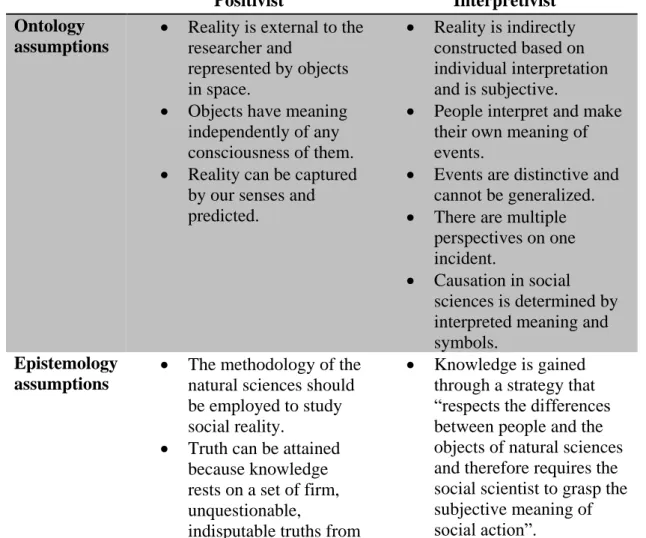
Table 3.1: Distinctions between ontology and epistemology ……… 117
Table 3.2: Assumptions inherent in objectivism and constructivism ……… 118
Table 3.3: Ontological and epistemological positions of a positivist and interpretivist... 120
Table 3.4: Situations appropriate to use mixed-methods ……….. 123
Table 3.5: The forms of quantitative, qualitative and mixed-methods research………. 124
Table 3.6: Scenario(s) used in previous whistle-blowing studies (accounting and auditing context) ……… 133
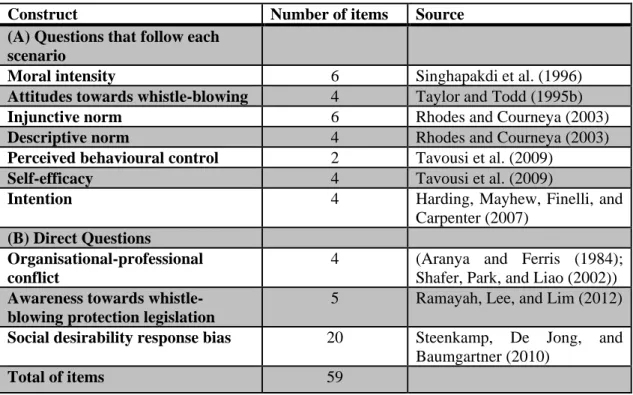
Table 3.7: Number of items and sources for each variable ……… 138
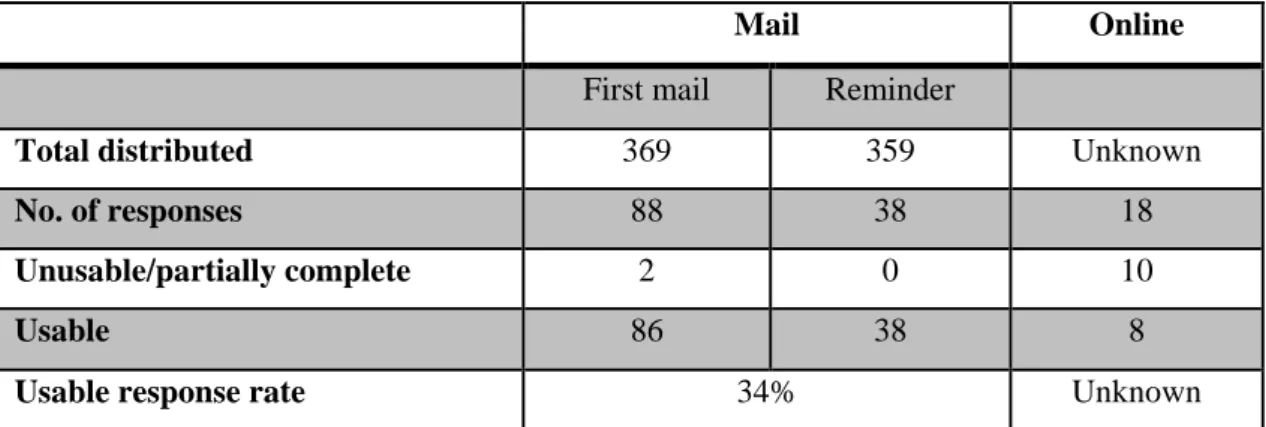
Table 3.8: Survey response rate ………. 161
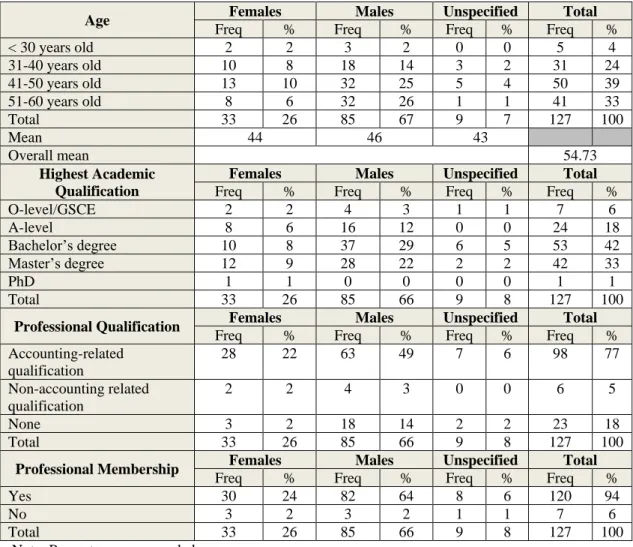
Table 4.1a: Educational background of participants….. ……… 165
Table 4.1b: Participants’ work experience and awareness of whistle- blowing protection legislation ……… 166 Table 4.2: Frequency analysis for social desirability bias items….………… 171
Table 4.3: Association between the SDRB scales and the tested variables………..……….. 173 Table 4.4: Summary of the association results between variables and SDRB scales ... 174
15
Table 4.5: Descriptive statistics of all variables……….. 176
Table 4.6: Mann-Whitney U Test result for gender groups……… 179
Table 4.7: Exploratory data analysis on gender groups in relation to independent variables ……… 181
Table 4.8: One-way ANOVA results for age groups ………. 184
Table 4.9: Exploratory data analysis on age groups in relation to independent variables ……….. 187
Table 4.10: One-way ANOVA results for internal auditing work experience groups………... 190
Table 4.11: Exploratory data analysis on internal auditing working experience groups in relation to independent variables……….. 193
Table 4.12: T-test results for client categories groups……… 196
Table 4.13: Exploratory data analysis on client categories groups in relation to independent variables….………. 198
Table 4.14: Cross-tabulation for organizational-professional conflict (OPC)……… 200
Table 4.15: Cross-tabulation for awareness of whistle-blowing protection legislation……….. 201
Table 4.16: Cross-tabulation for attitude towards whistle-blowing ………. 202
Table 4.17: Cross-tabulation for injunctive norm ………. 203
Table 4.18: Cross-tabulation for descriptive norm……… 204
Table 4.19: Cross-tabulation for perceived behavioural control……… 206
16
Table 4.21: Summary of group differences results………. 208
Table 4.22: Means, standard deviations and correlations among control, independent and dependent variables (Scenario 1) ……… 214
Table 4.23: Summary of the correlation between each independent variable and dependent variable ………... 215
Table 4.24: Standard multiple regression results of whistle-blowing intention……….. 218
Table 4.25: Summary of the influence of the control variables to whistle-blowing intention……….…... 227
Table 4.26: Moderated regression analysis results of the main effects and moderating effects of internal auditors’ whistle-blowing intentions (Scenario 1) ………... 232
Table 4.27: Moderated regression analysis results of the main effects and moderating effects of internal auditors’ whistle-blowing intentions (Scenario 2)……... 233
Table 4.28: Moderated regression analysis results of the main effects and moderating effects of internal auditors’ whistle-blowing intentions (Scenario 3) ….………... 234
Table 4.29: Summary of moderating effect results…...……….. 237
Table 4.30: Hypothesis results summary ……….. 243
17
List of Figures
Figure 1.1: Reporting channel options ……….. 31
Figure 2.1: The extant literature of whistle-blowing ……… 58
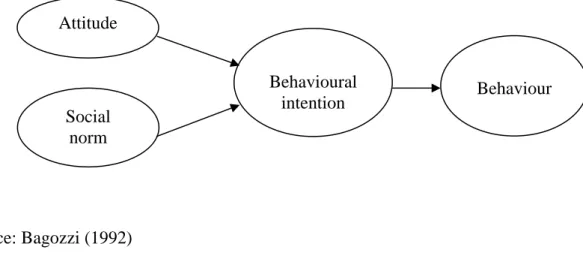
Figure 2.2: Theory of reasoned action ………. 72
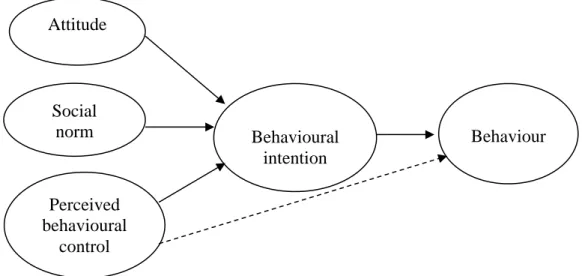
Figure 2.3: Theory of planned behaviour ……… 74
Figure 2.4: An issue-contingent model of ethical decision making in organisations……… 89
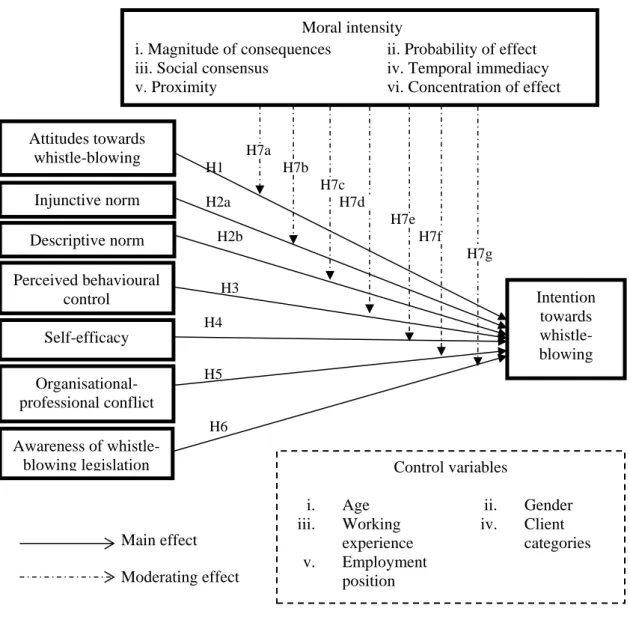
Figure 2.5: Research conceptual framework of whistle-blowing intentions among internal auditors ……….. 110
Figure 3.1: Interrelationship between building blocks of research …………... 126
Figure 4.1: Normal P-P plot for regression standardised residual graph for intention (Scenario 1) ………. 216
Figure 4.2: Scatterplot graph for intention (Scenario 1) ……….. 217
Figure 4.3: Plot of moderating effect of moral intensity and attitude towards whistle-blowing on whistle-blowing intention ………... 239
Figure 4.4: Plot of moderating effect of moral intensity and injunctive norm on whistle-blowing intention ……… 239
Figure 4.5: Plot of moderating effect of moral intensity and descriptive norm on whistle-blowing intention ………. 240
Figure 4.6: Plot of moderating effect of moral intensity and perceived behavioural control on whistle-blowing intention ……… 240 Figure 4.7: Plot of moderating effect of moral intensity and self-efficacy on
18 whistle-blowing intention ………... 241 Figure 4.8: Plot of moderating effect of moral intensity and organizational-
professional conflict on whistle-blowing intention ……… 241 Figure 4.9: Plot of moderating effect of moral intensity and awareness of
whistle-blowing protection legislation on whistle-blowing
intention ……….. 242
19
List of Abbreviations
BIDR Balanced Inventory of Desirable Responding CIIA Chartered Institute of Internal Auditors CMV Common Method Variance
ERA Employment Rights Act
ICAEW Institute of Chartered Accountants in England and Wales IIA Institute of Internal Auditors
NHS National Health Service PCaW Public Concern at Work PIDA Public Interest Disclosure Act SDRB Social Desirability Response Bias TRA Theory of Reasoned Action TPB Theory of Planned Behaviour
20
Chapter One
Introduction and Background
1.0 Introduction
Organisational wrongdoings are frequently reported across the world in the media and have caught public attention. The reported organisational wrongdoings involve severe and serious cases such as; financial reporting fraud (Enron and WorldCom); negligence in performing tasks that may affect the safety of the public (Liverpool’s Alder Hey Hospital and Bristol Royal Infirmary); fraudulent trading and money laundering (HBOS); producing hazardous products (Food and Drug Administration, AstraZeneca, GlaxoSmithKline), among others, that could affect public interest. In the abovementioned cases, the wrongdoings were detected through whistle-blowing.
Whistle-blowing has been identified as a source of information on wrongdoings or questionable practices that have occurred in the organisation. Through whistle-blowing it is hoped that management teams or any parties who have power and authority can take remedial action. According to Hooks, Kaplan, and Schultz (1994) whistle-blowing is generally known as a management tool to deter and detect any wrongdoings in organisations. In the U.K., the Chartered Institute of Auditors describes whistle-blowing as a situation when an employee, contractor or supplier goes outside the normal management channels to report suspected wrongdoing at work (Chartered Institute of Auditors, 2014). Whistle-blowing reporting can be done via internal processes, set up by an organisation (internal whistle-blowing), or to an external party such as a regulator (external whistle-blowing).
21 From the above whistle-blowing cases, there are two lessons that can be learnt. First, despite the heroic action of whistle-blowers to stop organisational wrongdoings, the whistle-blowing action may bring harm to whistle-blowers. For example, they may face reprisals from their peers and superiors. Second, it needs the whistle-blower to make a critical decision for blowing the whistle. This has attracted the interest of researchers to examine factors that may influence organisational staff members to blow the whistle.
The objective of this study is to examine factors (individual level) that may influence whistle-blowing intentions among internal auditors in the U.K. This study tests a conceptual model of factors that are likely to influence whistle-blowing intentions using a quantitative approach.
In the first section of this chapter the background to the study is presented. In the second and third sections the motivations of the study and research objectives are put forward respectively. In the fourth section the conceptual framework for the research is explained. In the fifth section the boundaries of the present study are considered. In the sixth section, whistle-blowing practice in the U.K. context is discussed. Finally, the organisation of this thesis is presented in the last section.
22
1.1 Background to the study
In the early 2000s the world was shocked by the U.S.A. whistle-blowing cases of Enron and WorldCom. In these two cases, the accounting scandals and fraud practices led to the collapse of both companies. The whistle-blowers in both Enron and WorldCom were positively rewarded in the media for their brave actions in revealing the dirty work of their co-workers. Although their actions have been rewarded and recognised in the media, they were not exempt from paying a price for their actions, which included receiving retaliations from their work colleagues and superiors.
In the U.K., the accounting scandal in Tesco and the financial scandal in West London Mental Health NHS Trust are among two recent whistle-blowing cases. To date, both cases are still under investigation. Although the outcomes of these cases are not readily known, the capacity of the whistle-blowers to blow the whistle is more important and attracts attention.
Whistle-blowing cases reported in the media have shown how whistle-blowers were put under stressful situations in confronting those who were against their whistle-blowing actions. In most cases, challenges are received from their own superiors and peers. For example, Mr. Jesudason and Dr. Stephen Bolsin, the whistle-blowers in Liverpool’s Alder Hey Hospital and Bristol Royal Infirmary respectively, lost their jobs and have never been employed in the NHS since the scandal. Not only that, ramifications, such as being harassed and facing hostility and resentment from peers and superiors, are always the price that whistle-blowers need to pay for their actions.
23 At the end of the journey there is no guarantee that their life will be back to normal. The impact on the whistle-blower’s life, and that of their loved ones, is huge. There is always a possibility that they will find difficulties in getting a new job and a destroyed career and financial ruin are some of the worst experiences whistle-blowers may face. The above descriptions give a wide picture on the complexity of the whistle-blowing phenomenon.
Illegal and/or unethical cases (also called wrongdoing cases) in organisations exist in various forms. Frauds, corruptions, accounting or auditing irregularities, abuse of power, waste and mismanagement and producing or selling unsafe products to the public are among the most common wrongdoings in organisations. Over the years organisation wrongdoing cases across the world have increased (Bowen, Call, & Rajgopal, 2010) and these are expected to continue to occur in the future. Therefore whistle-blowing reporting is increasingly important in many societies and encouraging whistle-blowing practice is one of the ways organisations portray good governance (Eaton & Akers, 2007).
In most situations, having information on any wrongdoings in organisations might not necessarily put individuals in a good and easy situation, especially those who have serious concern on the consequences of the wrongdoings and those who have responsibilities to report the wrongdoings, such as internal auditors. An awareness of the risks or ramifications they might encounter if they blow the whistle puts them into a dilemma of what action they should take. ‘Should I keep silent or voice my
24 concerns?’ and ‘Which welfare or interests should I consider most?’ are among the questions that may cross their minds.
Although the basic idea of whistle-blowing has, in some ways, been accepted, the decision whether or not to blow the whistle involves a very complex decision process for the individual. Various factors may play their role in driving potential whistle-blowers to the decision whether to blow or not to blow the whistle. This provides opportunities for researchers to investigate factors that influence whistle-blowing intention.
A review of the literature shows that the subject of whistle-blowing has been progressively developed. This is partly caused by the increasing awareness, amongst scholars, of the importance of whistle-blowing, in addition to the advantages it brings to a wide range of entities such as organisations, investors, consumers and the public. Many scholars discuss various aspects of whistle-blowing such as; organisational whistle-blowing policy (Barnett, Cochran, & Taylor, 1993; Hassink, De Vries, & Bollen, 2007; Near & Dworkin, 1998; Tsahuridu & Vandekerckhove, 2008); national and international whistle-blowing protection legislation (Devine, 1999; Estlund, 1992; Gobert & Punch, 2000; Kaplan, 2001; Lewis, 2001, 2008; Lewis & Uys, 2007; Vandekerckhove & Lewis, 2012; Vandekerckhove & Tsahuridu, 2010; Vickers, 2000); and determinants of whistle-blowing intention (Chiu, 2003; Hwang, Staley, Te Chen, & Lan, 2008; Keil, Tiwana, Sainsbury, & Sneha, 2010; Mesmer-Magnus & Viswesvaran, 2005; Park & Blenkinsopp, 2009; Park, Rehg, & Lee, 2005). These
25 papers discussed blowing in a manner that helps put the practice of whistle-blowing at a higher place.
Past research on whistle-blowing has been conducted in various lines of professions such as; police officers (Park & Blenkinsopp, 2009; Rothwell & Baldwin, 2007); managers and executives (Keenan, 1990, 2000, 2002); nurses (Jackson et al., 2011; Mansbach & Bachner, 2010); external auditors (Kaplan & Whitecotton, 2001; Maroun & Atkins, 2014; Taylor & Curtis, 2010); accountants (Hwang et al., 2008; Liyanarachchi & Adler, 2011; Patel, 2003); and internal auditors (Arnold & Ponemon, 1991; Xu & Ziegenfuss, 2008). As reported in the literature, whistle-blowing reporting is a very risky action to be taken by any staff member, including internal auditors, due to the various possible incoming challenges and risks they may face, including reprisals (Arnold & Ponemon, 1991; Miceli, Near, & Schwenk, 1991; Xu & Ziegenfuss, 2008).
Unlike external auditors, internal auditors have a wider scope of work in organisations. Through their work internal auditors are faced with broader opportunities to detect organisational wrongdoings. Internal auditors play important roles in organisational governance. Their roles include examining, evaluating and monitoring the adequacy and effectiveness of an organisation’s internal control structure.
In performing their audit work, internal auditors may encounter situations or information involving suspicious and serious matters. As a consequence of having that information internal auditors have a responsibility or obligation to report the
26 matter to the organisation’s management. This responsibility, known as informing duty, is embedded in the role prescription of internal auditors (Near & Miceli, 1985). If the informing does not lead to remedial action from the person who has power and authority another option available for reporting the matter is via whistle-blowing. However, the whistle-blowing reporting is not included in the scope of responsibility of internal auditors. The decision to blow or not to blow the whistle depends greatly on the judgement of internal auditors as the whistle-blowing may impose risks. Informing and whistle-blowing should be seen as a series of reporting actions. Informing is a prescribed role of internal auditors and therefore is the first option on which internal auditors should embark in reporting suspicious matters. Whistle-blowing, on the other hand, is not a prescribed role of internal auditors and should be regarded as an alternative option that internal auditors may take if the informing failed it purposes.
Although literature regarding whistle-blowing in the past decades has started to consider internal auditors as the most qualified and reliable staff members to blow the whistle (Miceli et al., 1991), at present there are a limited number of whistle-blowing studies that have been conducted in an internal auditing context. In addition, no empirical whistle-blowing studies in the internal audit profession have been conducted in the U.K.
Previous studies on whistle-blowing, in an internal auditing context, have focused on organisational and situational level factors and the influences of individual-level factors have not been greatly investigated. The individual-level variables that are
27 frequently examined include the level of cognitive development (moral reasoning) and demographic characteristics. A considerable amount of the past research has used Kohlberg’s and Rest’s theory to investigate the association between levels of cognitive development of the individual and his/her whistle-blowing behaviour. In this study, drawing on the extended theory of planned behaviour (TPB), the influences of seven individual-level factors on the whistle-blowing intention are investigated. The seven independent variables are: attitudes towards whistle-blowing; injunctive norm; descriptive norm; perceived behavioural control; self-efficacy; organisational-professional conflict; and awareness of whistle-blowing protection legislation. In addition, the moderating effect of moral intensity is examined. TPB is used because it helps explain intentions of behaviour. The theory has been widely used in behavioural research.
1.1.1 Whistle-blowing in internal auditing context: a debated issue
The relevance of internal auditors to blow the whistle has been debated by some scholars. Courtemanche (1988) denied the relevance of internal auditors to whistle-blow. His opinion was expressed in Vinten (1992a):
internal auditors should not act as self-appointed watchdogs over the behaviour of their employers...internal auditors are not independent of management but independent because of management...[they]should bend with their management, even if the bending includes a figurative interpretation of laws, rules and regulations...(p. 8)
28 The author1 disagrees with the above arguments as the points contradict the functions of internal auditing. According to the IIA, internal auditing is:
An independent and objective assurance and consulting activity that is guided by a philosophy of adding value to improve the operations of the organizations. It assists an organization in accomplishing its objective by bringing a systematic and disciplined approach to evaluate and improve the effectiveness of the organization’s risk management, control and governing process (IIA, 2013).
The definition illustrates internal auditing as a profession that is entrusted to safeguard the interests of various parties. As a professional, internal auditors should always be independence and objective. In performing the tasks as internal auditors, all the trusts are run by ensuring that the organization are operating properly and looking for additional values for the organization. In addition, internal auditors should ensure there are no persecutions of any party to satisfy the personal needs of a person or a group of people within the organization. In other words, in performing its duties in an organization, not only the internal auditors have a responsibility towards the organization but also to the profession and other parties such as society in general. The above definition demonstrates that internal auditors have no obligations or responsibility for fulfilling the will of certain individuals, including management team members, but should bear their obligations and responsibilities to the organisation as an entity. The internal auditing function is established to help organisations to achieve objectives and sustain excellent performance. In other words, the functions of internal audit are more to adding value to organisations, such
1
29 as identifying rooms for operational improvements, and assessing organisational risks. An internal auditing function also helps organisations to mitigate such organisational risks and maintain high performance in the long run. In addition, internal auditing is a profession that emphasizes independent, objective and professional judgment (Umar & Anandarajan, 2004). Indeed, the nature of the auditing profession requires internal auditors to perform their work on professionalism and ethical grounds (Thorne, 1998). Therefore, having information about suspicious matters occurring in their workplace, internal auditors are responsible to inform the matters to the management team. If the informing brings to no remedial actions, internal auditors may proceed with whistle-blowing.
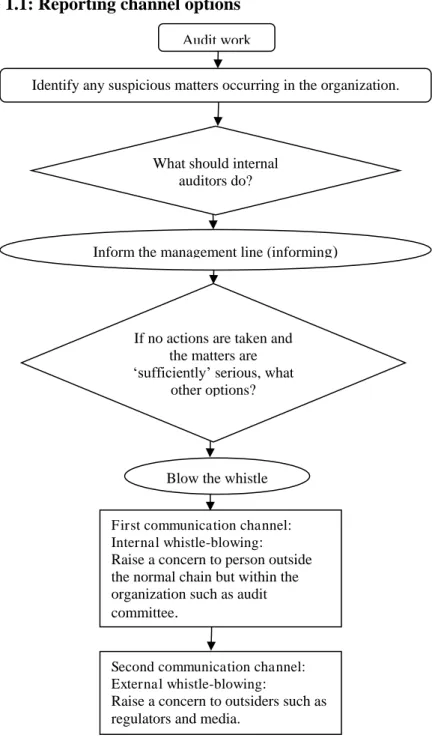
The relevance of internal auditors to whistle-blow is also argued by Jubb (1999). Jubb insists that the duty to report matters which internal auditors encounter during their audit works is already within the role-prescription of internal auditors and is also within the internal auditors’ profession territory (Jubb, 1999). The duty to report, as claimed by Jubb in his article, refers to the ‘informing’ duty of internal auditors. The informing role basically involves reporting any suspicious matters found during their audit work to those in the normal chain of command in the organisation. The party in the chain of command here refers to those in the management team who can take appropriate action on the suspicious matters. If the informing results in no action, internal auditors may consider further communication of the information to persons outside the normal chain of command, and this action is referred to as “whistle-blowing”. Whistle-blowing normally occurs if the suspicious matters are generally serious, for example, matters involving illegal and/or unethical practices.
30 Furthermore, being in a group of honourable professions2 requires internal auditors to execute their duties with independence and objectivity. Their roles as internal auditors require them to take care of a group of stakeholders’ interests.
There are two channels for whistle-blowing: internal and external. Regardless of which channel(s) is being used, the main reason to blow the whistle is to inform those with authority to remedy the illegal and/or unethical behaviour in their workplace. Internal whistle-blowing occurs when internal auditors report to the parties outside the normal chain of command within the organisations, for example, to the audit committee of the board. Alternatively, internal auditors can disclose the information to parties outside of the organisation and this is called external whistle-blowing. As reported in the literature, potential whistle-blowers who trust their organisations’ whistle-blowing policies and investigation mechanism will first opt for internal channels of whistle-blowing (Barnett, 1992). Additionally, blowing the whistle externally might be viewed as a violation of business etiquette, employee loyalty, code of conduct and professional standards. The IIA requires internal auditors to avoid, if possible, disclosing sensitive information to the individuals outside of their organisation. As such, internal auditors should consider external whistle-blowing as their last resort. The above explanation is briefly illustrated in
2
Internal auditing is recognized as an honourable profession due to the high entry qualification requirements; both academic and professional qualifications. They are also bounded with Professional Standards which summon them with Independence and Objectivity obligation. Independence guides
them with ‘freedom’ which is vital for their unbiased judgement while Objectivity is to assist them not
to be in any situation which may expose them with conflict of interest. Thirdly, they are required to continuously update their skills, knowledge and other competencies which may help them with their competence and due professional care. Lastly, the profession makes it compulsory for internal auditors to undergo continuing professional development (IIA, 2009).
31 Figure 1.1. There is a debate of whether or not internal channel should be included in whistle-blowing reporting. In this study, whistle-blowing reporting includes both internal and external channels and discussion on this matter is discussed in section 2.1.
Figure 1.1: Reporting channel options
Source: Author
Audit work
Identify any suspicious matters occurring in the organization.
Inform the management line (informing)
Blow the whistle
First communication channel: Internal whistle-blowing: Raise a concern to person outside the normal chain but within the organization such as audit committee.
Second communication channel: External whistle-blowing:
Raise a concern to outsiders such as regulators and media.
What should internal auditors do?
If no actions are taken and the matters are
‘sufficiently’ serious, what other options?
32
1.1.2 Whistle-blowers and the loyalty issue
According to Near and Miceli (1985), whistle-blowers are members of organisations. This has subsequently raised the issue of loyalty between whistle-blowers and organisations. The loyalty issue has been discussed by various scholars (see Jubb, 1999; Lewis, 2011). For the purpose of this study, considering there are two main employment positions of internal auditor, in-house and outsourced, the term ‘organisational members’ is used rather than ‘employees’.
According to Larmer, Duska asserts that loyalty arises in a reciprocal relationship where there is a mutual surrendering of self-interest (Larmer, 1992). Duska also argued that organisational members have no prima facie duty to be loyal to the organisation where they are working (Larmer, 1992). This is based on his justification that an organisation is only an object and its primary aim is profit maximisation (this applies to private sector). This implies that, from the organisation’s side, it is quite impossible for organisations to surrender their self-interests for the benefit of their members. Duska then concludes that there is no loyalty involvement in the relationship between organisational members and their organisations, thus whistle-blowing behaviour by organisational members does not have any moral justification on which to be argued (Larmer, 1992; Vandekerckhove & Commers, 2004).
In his counter argument to Duska’s view, Larmer (1992) claimed that loyalty does not necessarily involve reciprocal relationship. According to Larmer (1992), organisations deserve loyalty from their organisational members. In his paper,
33 Larmer points out three key points to explain the context in which loyalty applies. First, loyalty to organisations does not necessarily mean organisational members are refrained from reporting any immoral actions that took place in their workplace. Larmer added that organisational members who blow the whistle are not disloyal to the organisation. In fact, the action is regarded as more loyal. This is because by blowing the whistle, the organisational members prevent their employers from engaging in self-destructive behaviour. The second point is that loyal organisational members should try to resolve the problem internally without interventions from outsiders. In other words, staff should whistle internally first before bringing the matters to external parties. By this way, opportunities are given to the organisation to resolve the problem. Lastly, loyalty is more than a consideration of justice. In his paper, Larmer put forward his opinion that punishment is not the right way to punish disloyalty. Larmer (1992) also added that the loyalty spirit should supposedly encourage staff to continuously ensure the organisation is free from any problems. Continuous efforts should also be taken by organisational members to ensure problems in organisations do not escalate. In a situation when whistle-blowing becomes necessary, the action should be regarded as a positive action. The whistle-blowing action is taken with an aim to help the organisation (Larmer, 1992).
In their article, Vandekerckhove and Commers (2004) introduce the concept of ‘rational loyalty’ in the whistle-blowing context. This refers to the loyalty to the organisation’s explicit set of mission statements, goals, value statement and code of conduct, which are judged as legitimate, which organisational members advocate (Lewis, 2011; Vandekerckhove & Commers, 2004). In this sense, loyalty does not
34 apply to the physical aspects of the organisation, such as the executives, board of directors and colleagues (Lewis, 2011; Vandekerckhove & Commers, 2004). According to Lewis (2011), a loyal person is a person who is ‘true to obligations’ (p. 77) and in a situation when an organisation departs from its explicit mission, goals and values, the ‘rational loyalty’ would justify the necessities of whistle-blowing and organisational members do not have any loyalty concerns towards their organisation that involve any questionable practices or wrongdoings.
1.1.3 The relevance of internal auditors to blow the whistle
The literature in this field reveals that there has been an increase in attention on the internal auditing function (Subramaniam, Carey, Soh, & Martinov-Bennie, 2011). This is also the current scenario in the U.K. (Allegrini, D'Onza, Paape, Melville, & Sarens, 2006). The internal auditing function has been given a new recognition and the internal auditor is one of the four pillars of an organisation’s good governance (Karagiorgos, Drogalas, Gotzamanis, & Tampakoudis, 2010) alongside non-executive directors, non-executive management and external auditor. Davies (2009) asserts that an effective internal auditing function is one of the elements that enables organisations to survive. Overall, internal auditors are in a position that may affect others’ decisions and it is essential that internal auditors blow the whistle in a situation that requires them to do so.
Internal auditing is a profession that comes with prestige and trustworthiness. The profession requires auditors to pursue their responsibilities as stated in the professional standards and codes of ethics. The IIA’s Code of Ethics requires its
35 members to keep up to date with law and regulations and make disclosures as guided by the law and the profession. They are also required to disclose all material facts which, if not disclosed, may distort their report (IIA, 2009) and may consequently tarnish the image and credibility of the professional. On the website of the IIA, whistle-blowing is described as an event that occurs when:
an employee, contractor or supplier goes outside the normal management channels to report suspected wrongdoing at work, i.e. speaking out in a confidential manner. This can be done via internal processes set up by the organization (internal whistle-blowing) or to an external body such as a regulator (external whistle-blowing). Public disclosure to the media is also perceived by some as whistle-blowing and is of interest to internal audit as a possible indicator on the control environment and in the context of an internal auditor needing to go outside his/her organization to get concerns dealt with (IIA’s website).
This statement should be seen as a form of encouragement given by the professional body to internal auditors to blow the whistle in situations that require them to do so. Internal auditors are obligated to act in accordance with the IIA’s Standards and Code of Ethics which requires them to use the internal channels (internally whistle) before opting for external channels. The support given by the IIA adds another point on the relevance of internal auditors to blow the whistle.
According to Schmidt (2005), Kaplan, Pope, and Samuels (2010) and Trevino and Victor (1992), staff members are usually the first to know any wrongdoings or questionable practices in their organisations. Chadwick (2000) and Hillison, Pacini, and Sinason (1999) assert that no other staff members, either from within or outside the organisation, understand the organisation’s policies and procedures as well as internal auditors. Vinten (2003) asserts that internal auditors are in the key position
36 to have a sound knowledge of the internal activities in their workplaces. The relevance of internal auditors to blow the whistle can also be seen from their unique position in an organisation. The position and the job specifications of internal auditors provide them with wide access to their organisation’s documents and files. Moreover, the internal auditor role permits rigorous involvement and subsequently makes the internal auditor a person who clearly understands the internal matters in the workplace. The privileged access is one of the important criteria for whistle-blowing as highlighted by Tsahuridu and Vandekerckhove (2008). Therefore, internal auditors are the utmost reliable members to identify any illegal and unethical practices occurring in their workplace and should make a report accordingly. Having such significant and sensitive information on the organisation they audit, on one hand, and denying their responsibility to blow the whistle, on the other hand, is not in line with the objective of establishing internal auditing functions in organisations in the first place.
The above explanation sufficiently highlights the relevance of internal auditors as one of the most eligible organisational members to blow the whistle.
1.2 Motivations of the study
The first motivation for conducting this research concerns the unique position of internal auditors in organisations. The unique position here refers to the dual allegiance which internal auditors hold: first, to the internal audit profession and second, to the organisation. On one hand, internal auditors are paid for their work by the organisation, i.e. they are paid to do what the management teams ask them to do,
37 on the other hand, internal auditors are obligated to uphold standards of professional practice which include independence and objectivity. Conflicts arise when internal auditors are asked to keep the interest of management teams, or those who are in power, over the interests of the organisation itself or other stakeholders. These conflicts place their independence and objectivity values at risk. The possible tension between management demands and professional responsibilities, which the literature refers to as organisational-professional conflict, creates a critical point for internal auditors in deciding either to blow the whistle or not to blow and encouraged the researcher to conduct this research.
The second motivation for conducting this research concerns the limited number of whistle-blowing cases researched in an internal auditing context. Slovin (2006) states that internal audit is the second most common method of fraud detection, which shows that research on whistle-blowing in the internal auditing context should not be underemphasised. Read and Rama (2003) suggest that the role of internal auditors in whistle-blowing needs to be further reviewed. Within the literature there has been considerable discussion of the significance of the role of internal auditors. However, there is limited research that investigates internal auditors in the whistle-blowing context. As shown in Table 2.2 (see Chapter Two), whistle-whistle-blowing research in an internal auditing context is limited; limited variables have been investigated. Previous research has mainly focused on organisational-level factors, for instance codes of conduct in organisation (Read & Rama, 2003), organisational justice (Seifert, Sweeney, Joireman, & Thornton, 2010), situational-level factors, for instance, rewards (Xu & Ziegenfuss, 2008), and value congruence, perceived
38 victimization and retaliation (Miceli & Near, 1994). Many other variables, discussed in whistle-blowing literature and in ethical decision making literature more generally, have not been thoroughly studied and consequently create a wide and significant knowledge gap. Therefore a need for this study is to examine factors that influence internal auditors to blow the whistle. Arnold and Ponemon (1991) claim that there is limited information on the internal auditors’ whistle-blowing decisions, as evidenced by the limited number of studies on internal auditing whistle-blowing since then.
As demonstrated in Table 2.2, from the limited number of whistle-blowing studies in an internal auditing context, most of the research has been conducted in the U.S.A. The research on whistle-blowing involving internal auditors is not even extensive in the U.S.A. In the U.K., whistle-blowing research is still modest (Vinten & Gavin, 2005). The findings from the U.S.A. whistle-blowing literature might not be generalized to the U.K. context for various reasons; for example, both countries differ in their whistle-blowing protection legislation, culture and society norms. Further discussion on the differences in whistle-blowing practice between the U.S.A. and the U.K. is provided in Section 1.6. Vogel (1992) claims culture differences among countries leads to a variation in perception of ethics, morals, justice, loyalty, right and wrong. These, in turn, influence their acceptance or rejection towards the whistle-blowing practices. The U.K. whistle-blowing literature is generally discussion and conceptual papers (e.g. Chambers, 1995; Lewis, 2006, 2008; Saha, 2008; Vandekerckhove & Lewis, 2012; Vinten, 2003, 2004; Vinten & Gavin, 2005). From these limited whistle-blowing papers, few of the research papers discuss the
39 whistle-blowing issue in an internal auditing context, for instance papers written by Chambers (1995) and Vinten (2003).
Discussions and arguments raised in their papers have motivated the author to conduct this present study empirically.3 This point leads to the third motivational factor for conducting this research.
Finally, previous whistle-blowing studies put much attention on organisational and situational level factors (see Table 2.1 and Table 2.2 in Chapter Two). Several factors, from organisational and situational-level, have been examined, for example; job position; retaliation; rewards; codes of conduct; and job performance. However, antecedents or factors of whistle-blowing intention from individual-level have not received equal interest among previous researchers. MacNab and Worthley (2008) claim that there is little whistle-blowing research that examines individual level factors available in the literature (e.g. Sims & Keenan, 1998), and more empirical research on the influence of individual-level factors, on whistle-blowing reporting action, is needed (MacNab & Worthley, 2008; Sims & Keenan, 1998). Moral reasoning and demographic characteristics are the most frequent individual level factors which have been examined so far. The calls for more studies on individual-level factors have motivated this research to investigate other individual-individual-level factors that may influence whistle-blowing intention.
3
Empirical papers refer to articles which report research based on actual observations or experiments where the research applies certain methods – qualitatively or quantitatively – which seek to establish causal relationship or critically analyse behaviour, values or beliefs from the data gained in the observations or experiments.
40 In bringing together these four motivational factors, this research identified that a wide and significant knowledge gap exists. Thus, this present study was conducted to examine factors that influence an internal auditor’s intention to blow the whistle. Specifically, this study was conducted in the U.K., a context which has previously been under-researched. This study is specifically related to the UK social democratic and based on the Public Interest Disclocure Act (1998). PIDA is the whistle-blowing protection legislation in the U.K. that provides protection to whistle-blowers.
1.3 Research objectives
The principal aim of this research is to identify factors that influence an internal auditor’s intention to blow the whistle. Several individual-level factors were investigated. The objectives of the research are listed below:
1) To determine whether there are significant differences between respondents from various demographic backgrounds (gender, age, work experience, client categories and employment position) in all independent variables examined in this study.
2) To investigate the individual-level factors (attitudes towards whistle-blowing, injunctive norm, descriptive norm, perceived behavioural control, self-efficacy, organisational-professional conflict and awareness of the whistle-blowing protection legislation) that influence an internal auditor’s intention to blow the whistle upon discovering unethical and/or illegal behaviour.
41 3) To identify the moderating effect of moral intensity on the relationship
between the individual-level factors and whistle-blowing intention.
1.4 A brief review of proposed research conceptual framework
The research conceptual framework of this study is based on the extended4 version of the TPB. The original TPB was introduced by Ajzen in 1985 (Ajzen, 1991). The TPB is a social-psychological model which was developed to investigate intention and behaviour of a person under a specified situation where the person might have lack of control on his/her own behaviour. The original TPB model has three core variables: attitudes towards (specific) behaviour, social norms and perceived behavioural control.
Previous literature on TPB reveals that there are inconsistent empirical findings on the contribution of the social norm and perceived behavioural control in predicting intention. Based on those findings, and the suggestions by previous research in this study, the social norm is decomposed into multidimensional belief variables. The decomposition allows researchers to investigate the influence of norm beliefs variables in greater detail. As suggested in the literature, the social norm variable is decomposed into injunctive norm and descriptive norm. This is purposely to investigate the influence of injunctive norm and descriptive norm, rather than general social norm influence. The decomposition TPB has been proved to have better
4
42 explanatory power than the original TPB model (Hsu & Chiu, 2004; Lin, 2008; Taylor & Todd, 1995a).
This study also investigates the influence of the perceived behavioural control and self-efficacy on the intention to blow the whistle. These two variables have been argued as similar, by some scholars; however, empirical findings have proved that these two variables are measuring two different things (Tavousi et al., 2009; Terry & O'Leary, 1995; Trafimow, Sheeran, Conner, & Finlay, 2002).
In addition to the three core variables of the TPB, several other variables that have been discussed in ethical decision making literature are also included in the research framework. The variables are organisational-professional conflict and awareness of the whistle-blowing legislation. A few demographic variables were also included in the framework as control variables. Moral intensity was tested for its moderating effect on each of the individual relationships between the independent variables (seven individual-level variables) and the dependent variable (intention to blow the whistle). Details of these variables are explained in greater detail in Chapter Two. Figure 2.5 illustrates the research conceptual framework.
1.5 Boundaries of the research
There are boundaries to this research. First, this study was only interested in examining the internal auditors’ intention to blow the whistle. Internal auditors are chosen as subjects because they have privilege in relation to any other staff members. They are given greater access to the organisation’s documents and files. The position
43 as internal auditors presents them with opportunities to encounter any illegal and unethical practices in the organisation.
Second, data was collected in the U.K. Thus, the findings of this study may not be suitable for generalization to other countries.
Third, only variables from individual-level factors were examined in this study. Although there are three general factors; organizational, situational and individual, that help explain reporting behavior among employees within organizations (Miceli, Near, & Dworkin, 2008), no variables from organizational-level and situational-level factors are examined in this study. Past research has largely focused on organizational-level factors and situational-level factors; however, there is limited research on the individual-level factors. The inconsistent findings of the influence of individual-level variables compared to the consistent findings of organizational and situational variables on whistle-blowing intention or behavior as reported by Vadera, Aguilera, and Caza (2009) suggests that more research on individual-level variables are warranted. Investigating individual-level factors has been the main focus in this study and it is anticipated that this study will contribute valuable findings to the literature. Investigating individual-level factors allows the researcher to better understand how internal auditors perceive whistle-blowing, the role of significant others in influencing their intention to blow the whistle and their self-ability to blow the whistle, among others. Individual-level factors are factors that are much closer and personal to the individual compared to the organisational and situational factors.
44
1.6 Whistle-blowing in the U.K. context
According to David (1986), the U.K. is one of the democratic countries that practices secrecy. It has also been reported in the literature that people in the U.K. live in a culture that emphasizes secrecy which Vinten (1994) refers as “over secretive U.K” (p.14). The secrecy culture is said to have deeply inflicted the British way of life. Apart from the secrecy culture, historically, no constitutional right to freedom of speech was applied in the U.K. until the Human Rights Act 1998 which incorporated Article 10 of the European Convention on Human Rights (Lewis & Trygstad, 2009). The integration of Article 10 facilitated a new phase where each individual was given freedom of expression. However, Article 10(2) has restricted freedom of expression where the disclosure of confidential information is prohibited. This has, in fact, given little value to whistle-blowing practices (Lewis & Trygstad, 2009).
Whistle-blowing has received prominence in various developed countries. The U.S.A. and the U.K. are two developed countries that have long established their whistle-blowing protection legislation. Vinten (1994), in his book “Whistleblowing: Subversion or Corporate Citizenship”, potrayed the attitudes toward whistle-blowing practices in the U.K. as less positive and there is relatively lighter progressive movement on the whistle-blowing practices, compared to the U.S.A. This is the situation that describes the whistle-blowing practices in the U.K. prior to the establishment of the Public Interest Disclosure Act (PIDA) in 1998. PIDA is the blowing protection legislation in the U.K. that provides protection to