Semantics-based automated essay evaluation
A dissertation presented by
Kaja Zupanc
to
The Faculty of Computer and Information Science in partial fulfilment of the requirements for the degree of
Doctor of Philosophy in the subject of
Computer and Information Science
APPROVAL
I hereby declare that this submission is my own work and that, to the best of my knowledge and belief, it contains no material previously published or written by another person nor material which to a substantial extent has been accepted for the award of any other degree or diploma of the university or other institute of higher learning, except where
due acknowledgement has been made in the text. — Kaja Zupanc —
May
The submission has been approved by
dr. Janez Demšar
Professor of Computer and Information Science examiner
dr. Matjaž Kukar
Associate Professor of Computer and Information Science examiner
dr. Richard Johansson
Associate professor of Computer and Information Science external examiner
University of Gothenburg, Sweden
dr. Zoran Bosnić
Associate Professor of Computer and Information Science advisor
PREVIOUS PUBLICATION
I hereby declare that the research reported herein was previously published/submitted for publication in peer reviewed journals or publicly presented at the following occa-sions:
[] K. Zupanc, and Z. Bosnić. Automated essay evaluation augmented with semantic
coherence measures. In R. Kumar, editor,Proc. of ICDM , pages -, Los
Alamitos (CA), . IEEE. doi:./ICDM..
[] K. Zupanc, and Z. Bosnić. Advances in the field of automated essay evaluation.
Informatica, ():–, .
[] K. Zupanc, and Z. Bosnić. Automated essay evaluation with semantic analysis.
Knowledge-based systems, :-, . doi:./j.knosys...
[] K. Zupanc, M. Savić, Z. Bosnić, and M. Ivanović. Evaluating coherence of essays using
sentence-similarity networks. In B. Rachev, and A. Smrikarov, editors,Proc. of
CompSysTech , volume ofACM International Conference Proceeding Series,
pages -, New York (NY), . ACM. doi:./.
[] K. Zupanc, and Z. Bosnić. Improvement of automated essay grading by grouping similar graders. Under review, .
I certify that I have obtained a written permission from the copyright owner(s) to include the above published material(s) in my thesis. I certify that the above material describes work completed during my registration as graduate student at the University of Ljubljana.
This dissertation is a result of doctoral research, in part financed by the European Union, European Social Fund and the Republic of Slovenia, Ministry for Education,
Science and Sport in the framework of the Operational programme for human resources development.
ABSTRACT
Universityof LjubljanaFacultyof Computer and Information Science
Kaja Zupanc
Semantics-based automated essay evaluation
Automated essay evaluation (AEE) is a widely used practical solution for replacing time-consuming manual grading of student essays. Automated systems are used in combination with human graders in different high-stake assessments, as well as in classrooms. During the last years, since the beginning of the development of the field, many challenges have arisen in the field, including seeking ways to evaluate the semantic content, providing automated feedback, determining reliability of grades, making the field more “exposed”, and others. In this dissertation we address several of these challenges and propose novel solutions for semantic based essay evaluation.
Most of the AEE research has been conducted by commercial organizations that protect their investments by releasing proprietary systems where details are not pub-licly available. We provide comparison (as detailed as possible) of state-of-the-art approaches for automated essay evaluation and we propose a new automated essay evaluation system named SAGE (Semantic Automated Grader for Essays) with all the technological details revealed to the scientific community.
Lack of consideration of text semantics is one of the main weaknesses of the exist-ing state-of-the-art systems. We address the evaluation of essay semantics from per-spectives of essay coherence and semantic error detection. Coherence describes the flow of information in an essay and allows us to evaluate the connections between the discourse. We propose two groups of coherence attributes: coherence attributes ob-tained in a highly dimensional semantic space and coherence attributes obob-tained from a sentence-similarity networks. Furthermore, we propose the Automated Error De-tection (AED) system and evaluate the essay semantics from the perspective of essay consistency. The system detects semantic errors using information extraction and logic reasoning and is able to provide semantic feedback for the writer. The proposed system SAGE achieves significantly higher grading accuracy compared with other
ii Abstract K. Zupanc
art automated essay evaluation systems.
In the last part of the dissertation we address the question of reliability of grades. Despite the unified grading rules, human graders introduce bias into scores. Conse-quently, a grading model has to implement a grading logic that may be a mixture of grading logics from various graders. We propose an approach for separating a set of essays into subsets that represent different graders, which uses an explanation method-ology and clustering. The results show that learning from the ensemble of separated models significantly improves the average prediction accuracy on artificial and real-world datasets.
Keywords:automated scoring, essay evaluation, natural language processing, semantic attributes, coherence, semantic feedback
POVZETEK
Univerzav LjubljaniFakultetaza računalništvo in informatiko
Kaja Zupanc
Semantično usmerjeno avtomatsko ocenjevanje esejev
Avtomatsko ocenjevanje esejev predstavlja praktično rešitev za številne težave, poveza-ne s časovno zahtevnim ročnim ocenjevanjem. Avtomatizirani sistemi se uporabljajo v kombinaciji s človeškimi ocenjevalci pri številnih standardiziranih testih, vse več pa tudi v učilnicah. V zadnjih letih, od začetka razvoja področja, so se pojavili šte-vilni izzivi, vključno z iskanjem pristopov za ocenjevanje semantične vsebine, zagota-vljanjem avtomatskih povratnih informacij, določanjem zanesljivosti ocen, težnjo po dostopnosti podrobnosti delovanja sistemov in s tem odprtosti področja, in drugi. V pričujoči disertaciji obravnavamo te izzive in predlagamo nove rešitve za semantično usmerjeno avtomatsko ocenjevanje esejev.
Eden od glavnih problemov sistemov za avtomatsko ocenjevanje esejev je problem ocenjevanja semantične pravilnosti besedila. V disertaciji obravnavamo ocenjevanje semantike besedila z različnimi pristopi: ocenjevanje koherence esejev in zaznavanje semantičnih napak. Koherenca opisuje pretok informacij v eseju in nam omogoča, da ocenimo povezanost besedila. Predlagamo dve skupini atributov za ocenjevanje koherence: atributi, pridobljeni v visoko dimenzionalnem semantičnem prostoru, in atributi, pridobljeni iz omrežij stavčne podobnosti. Poleg tega predlagamo sistem za avtomatsko odkrivanje napak, ki nam pomaga oceniti semantiko eseja z vidika dosle-dnosti. Sistem zaznava semantične napake z uporabo ekstrakcije informacij in logične-ga sklepanja ter zagotavlja povratno semantično informacijo. Predlalogične-gani sistem SAGE (Semantic Automated Grader for Essays) dosega višjo napovedno točnost v primerjavi z drugimi sodobnimi sistemi za avtomatsko ocenjevanje esejev.
V zadnjem delu disertacije se posvečamo vprašanju zanesljivosti ocen. Kljub poeno-tenim kriterijem za človeške ocenjevalce, ocenjevalci vnašajo pristranskost v rezultate. Zato mora napovedni model uporabiti napovedno logiko, ki je lahko mešanica ocenje-valne logike različnih ocenjevalcev. Predlagamo pristop za ločevanje množice esejev v
iv Povzetek K. Zupanc
podmnožice, ki predstavljajo različne ocejevalce, kjer uporabimo metodologijo razlage napovedi in gručenje. Rezultati kažejo, da učenje na ansamblu ločenih modelov bistve-no izboljša povprečbistve-no točbistve-nost napovedi na umetnih in realnih podatkovnih mbistve-nožicah.
Ključne besede: avtomatsko ocenjevanje, evalvacija esejev, procesiranje naravnega jezi-ka, semantični atributi, skladnost, semantična povratna informacija
ACKNOWLEDGEMENTS
First and foremost, I would like to thank my advisor Zoran Bosnić. You have a remarkable gift of patience! I am thankful for all the remarks you had on my work and I am even thankful for your never-ending tendency to improve my writing skills. You believed in me from the beginning of my PhD and I will always be grateful for that!
I would like to thank my thesis committee: prof. Janez Demšar, assoc. prof. Matjaž Kukar, and assoc. prof. Richard Johansson, for their insightful comments and suggestions that certainly improved my thesis. I would especially like to thank assoc. prof. Johansson for agreeing to serve as an external examiner of my dissertation.
My special thanks goes to prof. Jesse Davis for being my advisor during my research stay at KU Leuven, and for all the discussions we had even after my time in Leuven. I would also like to thank prof. Mirjana Ivanović for hosting me at the University of Novi Sad.
My lab has not only been a source of good advice, but also a source of friendship. You helped me survive the PhD journey! Erik, thank you for all the on and off-topic conversa-tions, funny moments, and bad jokes that put a smile on my face!
This journey would not have been possible without the support of my family. Thank you for supporting me throughout writing this thesis and through my life in general. I am especially grateful to my mum for all the emotional support: Mami, hvala!
Thanks to all my friends for sharing my happiness when starting my PhD and following with encouragement and entertainment when it seemed too difficult to be completed.
Last but not least, I would like to thank Ben, for staying loving, positive, and supporting even at the hardest times. Dankjewel!
— Kaja Zupanc, Ljubljana, May .
CONTENTS
Abstract i Povzetek iii Acknowledgements v Introduction . Motivation . . . . Problem description . . . . Scientific contributions . . . . Dissertation overview . . . Automated essay evaluation
. Automated essay evaluation systems . . . . Measuring coherence of the text . . . . Detection of semantic errors in an essay . . .
.. Open information extraction . . .
.. Ontology consistency . . . . Grader effects . . .
Semantic Automated Grader for Essays (SAGE)
. Automated Grader for Essays (AGE) . . .
.. Syntax attributes . . . .. Presentation of the syntax attributes . . .
. Automated Grader for Essays+ (AGE+) . . .
.. Coherence attributes obtained from a semantic space . . . .
viii Contents K. Zupanc
.. Presentation of the spatial coherence attributes . . . .. Coherence attributes obtained from sentence-similarity
net-works . . . .. Presentation of the network coherence attributes . . .
. Semantic Automated Grader for Essays (SAGE) . . .
.. Automatic error detection system . . . .. Construction of the base ontology . . . .. Processing of the ungraded essay . . . .. Logic reasoner . . . .. Presentation of the consistency attributes . . . .. Providing automated feedback . . .
. Semantic Automated Grader for Essays- (SAGE-) . . .
Comparison of AGE, AGE+, SAGE-, and SAGE against the state-of-the-art
. Evaluation . . . .. Essay datasets . . . .. Evaluation measures . . . .. Prediction model . . . . Results . . . .. Evaluation of the implemented attributes . . .
.. Accuracy of the semantic-based AEE system . . .
.. Comparison with the state-of-the-art AEE systems . . .
Automated grouping of similar graders
. Explanation methodology . . .
. Detection of similar graders . . .
. Experimental environment and evaluation . . .
.. Datasets . . . .. Evaluation metrics . . . .. Evaluation protocol and libraries . . . . Results . . . .. Experiments on artificial datasets . . . .. Experiments on real-world datasets . . .
Semantics-based automated essay evaluation ix
Conclusion
. Main contributions to science . . . . Future research directions . . . . Final thoughts . . .
A Razširjeni povzetek
A. Uvod . . . A.. Prispevki k znanosti . . .
A. Sistem za avtomatsko ocenjevanje esejev SAGE . . .
A.. Avtomatski ocenjevalec esejev (AGE) . . . A.. Avtomatski ocenjevalec esejev+ (AGE+) . . . A.. Semantični avtomatski ocenjevalec esejev (SAGE) . . . A. Primerjava sistemov AGE, AGE+, SAGE- in SAGE s sodobnimi
sis-temi za avtomatsko ocenjevanje esejev . . . A. Avtomatsko ločevanje različnih ocenjevalcev . . . A. Zaključek . . .
Introduction
Introduction K. Zupanc
.
Motivation
Essays are short literary compositions on a particular subject (also referred to as prompt-specific essays), usually in prose, and generally analytic, speculative, or interpretative in nature. Essays are considered to be the most useful tool to assess learning outcomes, giving students an opportunity to demonstrate their range of skills and knowledge, including higher-order thinking skills, such as synthesis and analysis [Valenti et al., ]. However, grading students’ essays is a time-consuming, labor-intensive, and expensive activity for educational institutions. Since teachers are burdened with hours of grading of written assignments, they assign less essay writing tasks, thereby limit-ing the needed experience to reach the writlimit-ing excellency. This contradicts the aim to make students better writers, for which they need to rehearse their skill by writing as much as possible [Page,].
A practical solution to many problems associated with manual grading is to have an automated system for essay evaluation. Automated essay evaluation (AEE) is the process of evaluating and scoring written essays via computer programs [Shermis and Burstein,]. For teachers and educational institutions, AEE represents not only a tool to assess learning outcomes, but also helps save time, effort, and money without lowering the quality of evaluation.
AEE is a multi-disciplinary field that incorporates research from computer science, cognitive psychology, educational measurement, linguistics, and writing research [ Sher-mis et al.,]. Computer scientists are developing attributes and are implementing AEE systems, writing scientists and teachers are providing constructive criticisms to the development, and cognitive psychologists expert opinion is considered when mod-elling the attributes. Psychometric evaluations provide crucial information about the reliability and validity of the systems, as well.
The field has been developing since the s when Ellis Batten Page and his col-leagues proposed the first automated essay scoring (AES) system [Page,]. The system was using basic measures to approximate features of interest and thus describe the quality of an essay. By the s, the progress in the natural language processing (NLP) field encouraged researchers to apply new computational techniques to auto-matically extract essay writing quality measures. In the last decade, this automated process became the preferred way of grading in many low-stake assessment in class-rooms as well as in high-stake assessment as standardized tests. AEE systems can also
Semantics-based automated essay evaluation
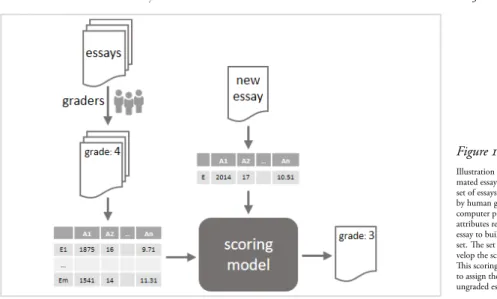
Figure . Illustration of an auto-mated essay evaluation: A set of essays is pre-scored by human graders and a computer program extracts attributes representing each essay to build a training set. The set is used to de-velop the scoring model. This scoring model is used to assign the scores to new, ungraded essays.
be used in all other application areas of text mining, where the content of the text needs to be graded or prioritized, such as: written applications, cover letters, scientific papers, e-mail classification etc.
Framework of operation (shown in Figure.) is a common property of majority of the AEE systems: Systems use a substantially large set of prompt-specific essays (i.e. set of essays on the same topic) assessed by expert human graders. A computer program extracts a set of attributes for each of these essays to construct the learning set. This set is used to build the scoring model of the AEE system. Using this model, the AEE system assigns scores to new, ungraded essays. The performance of the scoring model is typically validated by calculating how well the scoring model replicated the scores assigned by the human expert graders using metrics such as quadratic weighted Kappa and exact agreement [Fazal et al.,].
Throughout the development of the field, several different names have been used for the field interchangeably. The terms automated essay scoring (AES) and automated essay grading (AEG) slowly became replaced with the term automated writing eval-uation (AWE) or automated essay evaleval-uation (AEE). The termevaluationwithin the name (AWE, AEE) surfaced to use because the automated process enables students to receive constructive feedback about their writing.
Introduction K. Zupanc
.
Problem description
The field of automated essay evaluation is currently (as of ) focusing on three main open challenges:
. Weak consideration of text semantics.
The main weakness of existing AEE systems is that they consider text semantics very weakly and focus mostly on its syntax. Although the details of the majority of the systems have never been announced publicly, we can still deduce from the literature that they mostly perform syntax and shallow content measurements (calculating similarity between texts) and neglect the semantics. To analyse se-mantics, the state-of-the-art systems use latent semantic analysis (LSA) [ Lan-dauer et al.,], latent Dirichlet allocation (LDA) [Kakkonen et al.,], and content vector analysis (CVA) [Attali,]. To measure the coherence of essays’ content, LSA [Foltz et al.,;Foltz,], random indexing [Higgins et al.,], an entity-based approach [Burstein et al.,], and complex net-work representation [Antiqueira et al.,;Ke et al.,] have been used. However, only two existing systems [Gutierrez et al.,;Brent et al.,] use approaches that partially check for consistency of the statements in the es-says. Despite the efforts, the latter systems are not automatic, as they require manual interventions from the user.
. Reproduction of biased human grades.
In the last years, many researchers [Bejar,;Attali,;Williamson et al., ] have debated that accurately reproducing the human graders is no longer the main goal of AEE systems. Researchers in the field of Automated Essay Evaluation (AEE) often consider expert human graders as unmistakeable and objective, but scoring essays relies heavily on human judgement. In reality, hu-man graders are inconsistent and unreliable. Biased scoring is thought to be due to various aspects of reader characteristics (e.g., rating experiences), reader psychology (factors that occur internally to the reader), and rating environment (including pressure) [Bridgeman,]. Scores are therefore subjective and in-fluenced bygrader effects. That is, scores can be affected by factors, such as bias (strictness, leniency) and (un)reliability (non-systematic error) of the grader. Systematic and non-systematic human errors introduce subjective variance into
Semantics-based automated essay evaluation scores and therefore impact their validity [Lottridge et al.,].
It is desirable that the AEE systems can recognize certain types of errors in-dependently of human raters, including syntactic errors, and offer automated feedback on correcting these errors. In addition, the systems shall also provide global feedback on content and development. The current limitation of the feedback is that its content is limited to the syntactic aspect of the essay while neglecting the semantic aspects. Exceptions are systems [Gutierrez et al.,; Brent et al.,] that include semantic evaluation of the content, but are not automatic.
. Lack of standards and good practice (due to predominance of proprietary systems). In the past, one of the main obstacles to achieve progress in this area was the lack of open-source AEE systems, which would provide insight into their grad-ing methodology. Namely, most of the AEE research and development has been conducted by commercial or non-profit organisations that have protected their investments by restricting access to the technological details. The first scoring engine to be made available publicly was Rudner’s Bayesian Essay Test Scoring sYstem (BETSY) [Rudner and Liang,]. This was a preliminary investi-gation and authors never continued with their work. More recently, Mayfield and Rosé released LightSIDE [Mayfield and Penstein-Rosé,], an easy-to-use automated evaluation engine with both compiled and source code publicly available. LightSIDE made a very important contribution to the field of AEE by publicly providing the source code. However, the used methodology to predict the final grade is very basic. Aside from these two systems, there were several other attempts in the last couple of years to make the field more transparent, including publishing the Handbook of Automated Essay Evaluation [Shermis and Burstein,].
.
Scientific contributions
In the light of the preceding discussion about the existing models’ weaknesses, the following scientific contributions are presented in this dissertation:
. New semantic attributes for evaluating semantic coherence of the text.We propose two groups of coherence attributes: spatial attributes and network attributes. We develop the first group of attributes by observing semantic changes within
Introduction K. Zupanc
the flow of the text. To achieve this contribution, we complete the following sub-tasks: optimally choosing sequential parts of the essay to be observed, build-ing the semantic space by transformbuild-ing essay parts usbuild-ing a variation of TF-IDF vectors, and defining several metrics for describing variability of the essay parts in that space. We obtain the second group of the attributes using sentence-similarity networks. Within the network we represent each sentence as a node and use weights to represent similarity between sentences. We derive different structural metrics from such networks to propose novel coherence attributes. Furthermore, we develop a new automated essay grading system that uses the novel coherence attributes and perform systematic analysis of its performance compared with all available state-of-the-art systems. On average the system sig-nificantly improves the classification accuracy due to the novel attributes.
. Methodology for cross-referencing facts in text with external fact sources.This con-tribution yields additional semantic attributes that monitor the content of the essay and detect the sentences that contradict the truth. We developautomated error detection system(AED), a novel methodology that discovers semantic errors and provides a comprehensive feedback. We define an approach to automati-cally transform essay text into independent representation (ontology) and com-pare it to a representation of common sense knowledge from the external sources in a form of ontology. We enhance the developed automated essay evaluation system with new attributes and the output of the AED system, i.e., automated semantic feedback. We also published all the technological details of the system.
. Methodology for detection of different graders.We propose a novel methodology for separation of the original dataset that contains scores given by several differ-ent graders into smaller subsets. We aim these smaller subsets to contain only essays that were graded by the same grader. To differentiate between differ-ent graders we use the explanation methodology and clustering, which enables us to detect different dependencies (grading logics) between essays’ attributes and its score. In our experiments we show that the single model learned on resolved scores performs worse on the average than the ensemble of models that represents individual different graders. Our results show that the approach is able to detect different graders using unsupervised learning and obtain better predictive performance on the ensemble of models. We augment the proposed
Semantics-based automated essay evaluation AEE system with the methodology and we significantly improve the prediction accuracy.
. Dissertation overview
The main aim of this dissertation is to build a semantic automated essay evaluator that would not only improve the grading accuracy but would be capable of providing understandable feedback about essay’s semantics. Thus, we first build a basic system and then upgrade it through the subsequent chapters and sections.
In Chapterwe first describe several subfields of the related work that are relevant to our research. Most importantly, we compare the existing state-of-the-art systems that represent a basis for our research. Through the Chapterwe build a new auto-mated essay evaluation system and upgrade it with novel coherence and consistency attributes. We conclude the chapter with the proposal of the automated error detection system as part of the SAGE (Semantic Automated Grader for Essays) that provides se-mantic feedback for students. In Chapterwe describe the methodological aspects of the proposed system SAGE. We perform several experiments to demonstrate the per-formance of the system. Among others, we compare the system with nineteen other state-of-the art AEE approaches. Chapterproposes a new methodology for grouping similar graders into subsets which reflects in an improved grading prediction accuracy and can be used on any AEE system. Chapterdraws conclusions.
Automated essay evaluation
Automated essay evaluation K. Zupanc
We approached the open challenges of the Automated Essay Evaluation (AEE) field from different problem areas that we highlight in the following subsections. We start with the overview and comparison of the existing AEE systems and continue with the description of the state-of-the-art approaches for measuring coherence of an essay. Next, we review the relevant fields for detection of semantic errors in an essay and we conclude with the description of the research on biased scoring.
.
Automated essay evaluation systems
In , the high school English teacher E. Page proposed the first automated system for grading student essays [Page,]. He saw the system as a solution to reducing hours of manually grading student essays. In[Ajay et al.] he and his colleagues had enough hardware and software at their disposal to implement the first AEE system under the name Project Essay Grade. The first results were characterized as remarkable as the system’s performance had more steady correlation with human graders than the performance of two trained human graders. Despite its impressive success at predicting teachers’ essay ratings, the early version of the system received only limited acceptance in writing and education community. The availability of necessary tools (home com-puters, Internet, computational techniques for automatically extracting measures of writing quality, ...) was poor and the society criticised the idea of displacing human graders [Shermis et al.,].
By the s, with the widespread of the Internet, natural language processing tools, e-learning systems, and statistical methods, the AEE became a support technology in education. Nowadays, the AEE systems are used in combination with human graders in different high-stake assessments such as the Graduate Record Examination (GRE), Test of English as a Foreign Language (TOEFL), Graduate Management Admissions Test (GMAT), Scholastic Aptitude Test (SAT), American College Testing (ACT), Test of English for International Communication (TOEIC), Analytic Writing Assessment (AWA), No Child Left Behind (NCLB) and Pearson Test of English (PTE). Further-more, some of them also act as a sole grader.
In the past, one of the main obstacles to achieve progress in this area was lack of open-source AEE systems, which would allow insight into their grading methodology. In the following we present the known characteristics of the majority of proprietary AEE systems developed by commercial organizations as well as two publicly-available systems and approaches proposed by the academic community. We conclude this
sec-Semantics-based automated essay evaluation tion with a comparison of described systems and their known characteristics.
Project Essay Grade (PEG)
PEG is a proprietary AES system developed at Measurement Inc. [Page,]. It was first proposed in , and in a web interface was added [Shermis et al.,]. The system scores essays through measuringtrinsandproxes. A trinis defined as an intrinsic higher-level variable, such as punctuation, fluency, diction, grammar, etc., which as such cannot be measured directly and has to be approximated by means of other measures, calledproxes. For example, the trinpunctuationis measured through the proxesnumber of punctuation errors andnumber of different punctuations used. The system uses regression analysis to score new essays based on a training set of to essays [Page,].
e-rater
E-rater is a proprietary automated essay evaluation and scoring system devel-oped at the Educational Testing Service (ETS) in [Burstein et al.,]. E-rater identifies and extracts several attribute classes [Attali and Burstein,; Burstein et al.,]: () grammatical errors (e.g. subject-verb agreement er-rors), () word usage errors (e.g. their versus there), () errors in writing me-chanics (e.g. spelling), () presence of essay-based discourse elements (e.g. thesis statement, main points, supporting details, and conclusions), () development of essay-based discourse elements, () style weaknesses (e.g. overly repetitious words), () two content vector analysis (CVA)-based attributes to evaluate top-ical word usage, () an alternative, differential word use content measure, based on the relative frequency of a word in high scoring versus low-scoring essays, () two attributes to assess the relative sophistication and register of essay words, and () an attribute that considers correct usage of prepositions and collocations (e.g. powerful computer vs. strong computer), and variety in terms of sentence structure formation. The system uses regression modelling to assign a final score to the essay [Burstein et al.,a]. E-rater also includes detection of essay sim-ilarity and advisories that point out if an essay is off topic, has problems with discourse structure, or includes large number of grammatical errors [Higgins et al.,].
Automated essay evaluation K. Zupanc
Intelligent Essay Assessor (IEA)
In the Pearson Knowledge Technologies (PKT) developed Intelligent Es-say Assessor (IEA). The system is based on the Latent Semantic Analysis (LSA), a machine-learning method that acquires and represents knowledge about mean-ing of words and documents by analysmean-ing large bodies of natural text [Landauer et al.,]. IEA uses LSA to derive attributes describing content, organiza-tion, and development-based attributes of writing. Along with LSA, IEA also uses NLP-based measures to extract attributes measuring lexical sophistication, grammatical, mechanical, stylistic, and organizational aspects of essays. The system uses approximately attributes to measure the above aspects within essays: content (e.g. LSA essay semantic similarity, vector length), lexical so-phistication (e.g. word maturity, word variety, and confusable words), grammar (e.g. n-gram attributes, grammatical errors, and grammar error types), mechan-ics (e.g. spelling, capitalization, and punctuation), style, organization, and de-velopment (e.g. sentence-sentence coherence, overall essay coherence, and topic development). IEA requires a training with a representative sample (between and ) of human-scored essays.
IntelliMetric
IntelliMetric was designed and first released in by Vantage Learning as a proprietary system for scoring essay-type, constructed response questions [Schultz,]. The system analyses more than semantic-, syntactic-, and discourse-level attributes to form a composite sense ofmeaning. These attributes can be divided into two major categories: content (discourse/rhetorical and con-tent/concept attributes) and structure (syntactic/structural and mechanics at-tributes). The content attributes evaluate the covered topic, the breadth of con-tent, support for advanced concepts, logic of discourse, as well as cohesiveness and consistency in purpose and main idea; whereas structure attributes evaluate grammar, spelling, capitalization, sentence completeness, punctuation, syntac-tic variety, sentence complexity, usage, readability, and subject-verb agreement [Schultz,]. The system uses multiple predictions (called judgements) based on multiple mathematical models, including linear analysis, Bayesian approach, and LSA to predict the final score and combines the models into a single final essay score [Rudner et al.,]. Training Intellimetric requires a sample of
Semantics-based automated essay evaluation at least human-scored essays. IntelliMetric uses Legitimatch technology to identify responses that appear off topic, are too short, do not conform to the ex-pectations for edited American English, or are otherwise inappropriate [Schultz, ].
Bookette
Bookette [Rich et al.,] was designed by California Testing Bureau (CTB) and became operational in classroom settings in and in large-scale testing settings in . Bookette uses NLP to derive about attributes describing student-produced text. Combinations of these attributes describe traits of ef-fective writing: organization, development, sentence structure, word choice/grammar usage, and mechanics. The system uses neural networks to model expert human grader scores. Bookette can build prompt-specific models as well as generic models that can be very useful in classrooms for formative purposes. Training Bookette requires a set (from to ) of human-scored essays. The system provides feedback on students writing performance that in-cludes both holistic feedback and feedback at the trait level including comments on the grammar, spelling, and writing conventions at the sentence level [Rich et al.,].
CRASE
Pacific Metrics proprietary automated scoring engine, CRASE [Lottridge et al., ], moves through three phases of the scoring process: identifying inappro-priate attempts, attribute extraction, and scoring. The attribute extraction step is organized around six traits of writing: ideas, sentence fluency, organization, voice, word choice, conventions, and written presentation. The system analyses a sample of already-scored student responses to produce a model of the graders’ scoring behaviour. CRASE is a Java-based application that runs as a web ser-vice. The system is customizable with respect to the configurations used to build machine learning models as well as the blending of human and machine scoring (i.e. deriving hybrid models) [Lottridge et al.,]. Application also produces text-based and numeric-based feedback that can be used to improve the essays.
AutoScore
Automated essay evaluation K. Zupanc
Research (AIR). The system analyses measures based on concepts that discrimi-nate between high- and low- scored papers, measures that indicate the coherence of concepts within and across paragraphs, and a range of word-use and syntactic measures. Details about the system were never published, however, the system was evaluated in [Shermis and Hamner,].
Lexile Writing Analyzer
The Lexile Writing Analyzer is a part of The Lexile Framework for Writing [Smith,] developed by MetaMetrics. The system is score-, genre-, prompt-, and punctuation-independent and utilizes the Lexile writer measure, which is an estimate of student’s ability to express language in writing, based on factors related to semantic complexity (the level of words used) and syntactic sophis-tication (how the words are written into sentences). The system uses a small number of attributes that represent approximations for writing ability. Lexile perceives writing ability as an underlying individual trait. Training phase is not needed since a vertical scale is employed to measure student essays [Smith et al., ].
SAGrader
SAGrader is an online proprietary AEE system developed by IdeaWorks, Inc. [Brent and Townsend, ]. The system was first known under the name Qualrus. SAGrader blends a number of linguistic, statistical, and artificial in-telligence approaches to automatically score the essay. The operation of the SAGrader is as follows: The instructor first specifies a task in a prompt. Then the instructor creates a rubric identifying the “desired features” – key elements of knowledge (set of facts) that should be included in a good response, along with relationships among those elements – using a semantic network (SN). Fuzzy logic (FL) permits the program to detect the features in the students’ essays and compare them to desired ones. Finally, an expert system scores student essays based on the similarities between the desired and observed features [Brent et al., ]. Students receive immediate feedback indicating their scores along with the detailed comments indicating what they did well and what needs further work.
Semantics-based automated essay evaluation OBIE based AEE System
The AEE system proposed byGutierrez et al.[,,] provides both, scores and meaningful feedback, using ontology-based information extraction (OBIE). The system uses logic reasoning to detect errors in a statement from an essay. The system first transforms text into a set of logic clauses using open information extraction (OIE) methodology and incorporates them into domain ontology using manually selected vocabulary mapping. The system determines if these statements contradict the ontology and consequently the domain knowl-edge. This method considers incorrectness as inconsistency with respect to the domain. Logic reasoning is based on the description logic (DL) and ontology debugging [Gutierrez et al.,].
Bayesian Essay Test Scoring sYstem (BETSY)
The first scoring engine to be made available publicly was Rudner’s Bayesian Essay Test Scoring sYstem (BETSY) [Rudner and Liang,]. BETSY uses multinomial or Bernoulli Naïve Bayes models to classify texts into different classes (e.g. pass/fail, scores A-F) based on content (e.g. word uni-grams and bi-grams) and style attributes (e.g. sentence length). Classification is based on assumption that each attribute is independent of another. BETSY worked well only as a demonstration tool for a Bayesian approach to scoring essays. It re-mained a preliminary investigation as the authors never continued with their work.
LightSIDE
In , Mayfield and Rosé released LightSIDE [Mayfield and Penstein-Rosé, ], an automated evaluation engine with both compiled and source code publicly available. LightSIDE is designed as a tool for non-experts to effectively use text mining technology for a variety of purposes, including essay assessment. It allows choosing the set of attributes and algorithm to build prediction model (e.g. linear regression, Naïve Bayes, linear support vector machines) [Mayfield and Rosé,]. The set of attributes is mainly focused on n-grams, POS tags, and “counting” attributes. However, the system allows users to manually input the code for new attributes.
Automated essay evaluation K. Zupanc
Use of Syntactic and Shallow Semantic Tree Kernels for AEE
Chali and Hasan[] exposed the major limitation of LSA - it only retains the frequency of words by disregarding the word sequence and the syntactic and semantic structure of texts. They proposed the use of syntactic and shal-low semantic tree kernels for grading essays as a substitute to LSA. The system calculates the syntactic similarity between two sentences by parsing the corre-sponding sentences into syntactic trees and measuring the similarity between the trees. Shallow Semantic Tree Kernel (SSTK) method allows to match por-tions of a semantic trees. The SSTK function yields the similarity score between a pair of sentences based on their semantic structures.
A Ranked-based Approach to AEE
Chen et al.[] consider the problem of AEE as a ranking problem instead of classification or regression problem. Ranking algorithms are a family of super-vised learning algorithms that automatically construct a ranking model of the retrieved essays. They consider the following three groups of attributes: term usage, sentence quality, and content fluency and richness. Authors showed that their approach outperforms other classical machine learning techniques.
Neural Essay Assessor
Taghipour and Ng[] developed an approach based on recurrent neural net-works. The system learns the relations between an essay and its assigned score automatically, without any feature engineering. It encodes the information re-quired for essay grading and learns the complex patterns in the data through non-linear neural layers. The neural network is based on long-term memory networks.
AES using neural networks
Alikaniotis et al.[] introduced a model that forms word representations (embeddings) by learning the local linguistic environment of each word as well as the extent to which a specific word contributes to an essay’s score. The system uses the long short-term memory recurrent neural networks [Hochreiter and Schmidhuber,] to represent the meaning of essays.
AEG using Memory Networks
Semantics-based automated essay evaluation by a network’s capability to store rich representations of data and reason over that data in memory. Their model is based on the idea that with enough graded samples for each score in the rubric, such samples can be used to grade future work that is found to be similar. For each possible score in the rubric, a student response graded with the same score is collected. These selected responses rep-resent the grading criteria specified in the rubric and are stored in the memory component. The model is trained on these data with the rest of the student re-sponses in a supervised learning manner to compute the relevance between the representation of an ungraded response and that of each sample.
OzEgrader
OzEgrader is an Australian AES system proposed byFazal et al.[]. Grading process considers different aspects of content and style: audience, text structure, character and setting, paragraphing, vocabulary, sentence structure, punctua-tion, spelling, cohesion and ideas. Techniques such as POS tagging, named entity recognition, artificial neural networks, and fuzzy regression are employed in order to model linear or non-linear relationships between attributes and the final score. The system also includes the methodology for noise reduction in the essay dataset.
AEE using Generalized LSA
Islam and Hoque[] developed an AEE system using Generalized Latent Semantic Analysis (GLSA) which makesn-gram by documentmatrix instead of word by documentmatrix as used in LSA. The system uses the following steps in grading procedure: preprocessing of the training essays, stopword removal, word stemming, selecting the n-gram index terms,n-gram by documentmatrix creation, computation of the singular value decomposition (SVD) ofn-gram by documentmatrix, dimensionality reduction of the SVD matrices, and computa-tion of the similarity score. The main advantage of GLSA is observance of word order in sentences.
AEE using Multi-classifier Fusion
Bin and Jian-Min[] proposed an approach to AEE using multi-classifier Fusion. The system first represents each essay by the vector space model and removes stopwords. Then it extracts the attributes describing content and
lin- Automated essay evaluation K. Zupanc
guistic from the essays in the form of attribute vector. Three approaches includ-ing document frequency (DF), information gain (IG) and chi-square statistic (CHI) are used to select attributes by some predetermined thresholds. The sys-tem classifies an essay to an appropriate category using different classifiers, such as naïve Bayes, k-nearest neighbours and support vector machine. Finally, the ensemble classifier is combined by those component classifiers.
Markit
Markit [Williams and Dreher,] is a proprietary AEE system developed by Blue Wren Software Pty Ltd. The system is capable of running on typi-cal desktop PC platforms. It requires comprehensive knowledge in a form of one model (exemplary) answer against which the student essays are compared. A student essay is processed using a combination of NLP techniques to build the corresponding propriety knowledge representation. Pattern matching tech-niques (PMT) are then employed to ascertain the proportion of the model an-swer knowledge that is present in the student’s anan-swer, and a score assigned accordingly.
PS-ME
The Paperless School proprietary AEE system was designed primarily for day-to-day, low-stake testing of essays. The student essay is compared against each relevant master text to derive a number of parameters which reflect knowledge and understanding as exhibited by the student. When multiple master texts are involved in the comparison, each result from an individual comparison gets a weight that could be negative in the case of a master text containing common mistakes. The individual parameters computed during the analysis phase are then combined in a numerical expression to yield the assignments’ score and used to select relevant feedback comments from a comment bank [Mason and Grove-Stephenson,].
Schema Extract Analyse and Report (SEAR)
Christie[] proposed a software system Schema Extract Analyse and Report (SEAR), which provides the assessment both of style and content. The method-ology adopted to assess style is based on a set of common metrics as used by other AES systems. For content assessment the system uses two measures:
us-Semantics-based automated essay evaluation age and coverage. Using content schema system measures how much of each essay is included in schema (usage) and how much of schema is used by the essay (coverage).
Comparison of the state-of-the-art systems
In order to compare technical, methodological, and structural characteristics of the state-of-the-art systems, we present their comparison in Table.using the following main criteria:
Type of attributes: The attributes describing the quality of an essay can roughly be divided into three groups:style,contentandsemanticattributes. Style attributes focus on lexical sophistication, grammar and mechanics (spelling, capitalization, and punctuation). Content attributes shallowly describe semantics of an essay and are based on comparing an essay with source text and other already graded essays. Semantic attributes are based on verifying the correctness of content meaning.
Methodology: Different systems use various approaches to extract attributes from essays. The most widely used methodology is based on NLP. Systems focusing on content mostly use Latent Semantic Analysis (LSA) - a machine learning method that analyses related concepts between a set of documents and the con-tained terms. LSA assumes that words with similar meaning occur in similar parts of text. To evaluate content, systems also use pattern matching tech-niques (PMT) and extensions to LSA such as Generalized Latent Semantic Analysis (GLSA) (which uses ann-gram-by-documentmatrix instead of a
word-by-document matrix) and improvement that considers semantics by means of
the syntactic and shallow semantic tree kernels. For verifying the correctness and consistency of content, approaches such as (Open) Information Extraction ((O)IE), Semantic Networks (SN), Ontologies, Fuzzy Logic (FL), and Descrip-tion Logic (DL) are used.
Prediction model: The majority of the systems use machine learning algorithms (usually regression modelling) to predict the final grade. An alternative is to use: the Lexile measure - an estimate of student’s ability to express language in writing based on semantic complexity (level of expressing) and syntactic sophistication
Automated essay evaluation K. Zupanc
(how the words are combined into sentences); cosine similarity; and rule-based expert systems.
Table.provides a comparison of characteristics for the majority of AEE systems and approaches, including proprietary (non-public) systems, two publicly available systems, approaches proposed by the academic community, and our proposed system
namedSAGE.
.
Measuring coherence of the text
Coherence is a concept that describes the flow of information from one part of dis-course to another and ranges from lower level cohesive elements such as coreference, causal relationship, and connectives, up to higher level elements that evaluate connec-tions between the discourse and reader’s mental representation of it [Foltz,].
Existing systems measure coherence in noisy text with different supervised and un-supervised approaches. The unun-supervised approaches usually measure lexical cohesion, i.e. repetition of words and phrases in an essay. Foltz, Kintsch, and Landauer [Foltz et al.,;Foltz,] assume that coherent texts contain a high number of seman-tically related words and measure coherence as a function of semantic relatedness be-tween adjacent sentences. Relatedness can be computed using LSA without employing syntactic or other annotations. Hearst[] subdivides texts into multi-paragraph units that represent subtopics and identifies patterns of lexical co-occurrence and dis-tribution, i.e. identifying repetition of vocabulary across adjacent sentences.
The supervised learning approaches require annotated data (graded essays). They focus on occurrences of discourse elements (e.g. thesis statement, main idea, conclu-sion), entity sentence roles, grammar errors, and word usage. Miltsakaki and Kukich [] have explored the role ofcentering theory[Grosz et al.,] in locating topic shifts in student essays. Centering theory argues that the discourse in a text contains a set of textual segments, each containing discourse entities, which are then ranked by their importance. Topic shifts are generated by short-lived topics and are indicative of poor topic development.Higgins et al.[] have developed a system that computes similarity across text segments based on their type of discourse element and seman-tic similarity (LSA). A support vector machine (SVD) uses these features to capture breakdowns in coherence due to relatedness to the essay question and relatedness be-tween discourse elements. More recently,Burstein et al.[,a] showed how
Semantics-based automated essay evaluation
Table .
A comparison of the key features of the state-of-the art AEE systems.
AEE System Attr. Types Methodology Prediction Model PEG [Page]
Style
Statistical multiple linear regression PS-ME
[Mason and Grove-Stephenson] NLP linear regression e-rater [Burstein et al.]
Style & Content
NLP
linear regression
IntelliMetric [Schultz] multiple
mathematical models Bookette [Rich et al.]
neural networks OzEgrader [Fazal et al.]
CRASE [Lottridge et al.] machine learning
AutoScore [Shermis and Hamner] statistical model
Lexile [Smith et al.] Lexile measure
Ranked-based AEE [Chen et al.] learning to rank Multi-classifier Fusion
AEE [Bin and Jian-Min]
ensemble classifiers BETSY [Rudner and Liang]
Statistical Bayesian networks
SEAR [Christie] linear regression
Neural Essay Assessor [Taghipour and Ng]
Deep learning
recurrent neural networks AES using NN [Alikaniotis et al.]
AEG using MN [Zhao et al.] memory networks
LightSIDE [Mayfield and Rosé]
Content
Statistical
machine learning
IEA [Foltz et al.] LSA, NLP
Semantic-tree-based AEE [Chali and Hasan]
LSA, tree kernel functions
cosine similarity GLSA based AEE
[Islam and Hoque] GLSA
Markit [Williams and Dreher] NLP, PMT linear regression SAGrader [Brent et al.]
Semantic
FL, SN rule-based expert systems OBIE-based AEE [Gutierrez et al.] OIE, DL /
Automated essay evaluation K. Zupanc
theBarzilay and Lapata[] algorithm can be applied to the domain of student essays. InBarzilay and Lapata[] approach, entities (nouns and pronouns) are represented by their sentence roles and the algorithm counts all possible entity transi-tions between adjacent sentences in the text. By combining those entity-based features with features related to grammar errors and word usage,Burstein et al.[b] im-prove the performance of automated coherence prediction for student essays.
To best of our knowledge there are only two prior studies exploring the idea of using complex network representations for automated essay grading [Antiqueira et al.,; Ke et al.,]. In both approaches the authors used word adjacency networks to derive network-based features for essay coherence evaluation.Antiqueira et al.[] showed that there are strong correlations between basic structural network metrics (e.g. the average node degree, the clustering coefficient and the characteristic path length) and text quality scores assigned by human judges on a corpus of Portuguese essays written by high-school students. Ke et al.[] obtained similar results for a corpus of Chinese essays written by college students in a recently published study.
The above approaches mainly focus on the local coherence, while our system SAGE measures coherence as a function of semantic relatedness not only between adjacent sentences, but through the entire essay. Our proposed system measures changes be-tween sequential essay parts from three different perspectives: semantic distance (e.g. dis-tance between consecutive parts of an essay, maximum disdis-tance between any two parts, etc.), central spatial tendency/dispersion, and spatial autocorrelation in semantic space. Moreover, we evaluate coherence with another, i.e. network based approach. In con-trast to the previous two network-based studies, our approach is based on complex networks capturing similarities between sentences.
.
Detection of semantic errors in an essay
Only two mentioned systems [Brent et al.,;Gutierrez et al.,] partially check if the statements in an essay are correct. SAGrader, developed byBrent et al.[], was the first AEE system that detected semantic information in an essay and upon which we based the architecture of our system. For SAGrader, the teacher first speci-fies the assignment prompt and desired features along with relationships among them. Using fuzzy logic, the system recognizes word combinations that can be used by stu-dents to detect desired features and relationships. Desired knowledge in the form of a semantic network is then compared with the knowledge detected in a student’s essay.
Semantics-based automated essay evaluation The system scores the student’s essay based on the similarities between observed and desired knowledge using procedural rules. Detailed feedback indicates what student did right and wrong [Brent et al.,].
Gutierrez et al.[,,] later proposed a system that not only detects the desired (correct) knowledge but also detects incorrect knowledge using logic reason-ing [Gutierrez et al.,]. The system extracts statements using Open Information Extraction (OIE) and adds them to the domain ontology. The extracted tuples are in a form that is compatible with the OWL ontology. In the final step, the system deter-mines the correctness of a statement through an ontology-based consistency checking. If the domain ontology becomes inconsistent after the extracted sentence is added into it, then the sentence is incorrect with the respect to the domain [Gutierrez et al., ]. Despite many efforts, this system is still not fully automated, as it requires man-ual inputs from the user to build a vocabulary mapping mechanism between extracted entities and vocabulary of the ontology.
In contrast to other systems, our proposed system focuses on completely automated semantic evaluation and provides semantic feedback to students. SAGE analyses text consistency by detecting entities in an essay, considering coreferences of entities, and extracting relations between entities. SAGE exploits common sense knowledge on-tologies, taxonomies, and can therefore work on different domains.
In the following we overview the related work concerning the methodology we used for detecting the semantic errors in an essay.
.. Open information extraction
Information extraction (IE) is the task of automatically acquiring knowledge by trans-forming natural language text into structured information, such as a knowledge base [Wimalasuriya and Dou,]. The main tasks of information extraction areentity recognition(ER),relation extraction(RE), andcoreference resolution(CR). We focused on a tool for relation extraction called Open Information Extraction (OIE).Wu and Weld[] define the OIE system as a function that maps an unstructured document text𝑑, to a set of triples,{<arg1,rel,arg2>}, where theargs are noun phrases and relis a textual fragment indicating an implicit, semantic relation between the two noun phrases. Unlike other relation extraction methods focused on a predefined set of target relations, the open information extraction paradigm is not limited to a small set of target relations known in advance, but extracts new types of relations found in
Automated essay evaluation K. Zupanc
the text. The main properties of OIE systems are domain independency, reliance on unsupervised extraction methods, and scalability to large amounts of text [Gamallo, ].
Gamallo[] categorized the existing OIE systems in four groups. First he di-vided them into two broad categories: systems that require training data to learn a classifier and systems based on hand-crafted rules or heuristics. In addition, each for-mer category can be divided in two subsequent types: systems that use the shallow syntactic analysis (e.g. part-of-speech tagging and/or chunking), and systems that use dependency parsing (transforming sentences into dependency trees).
For implementing semantic consistency checking in our system, we used four dif-ferent OIE systems. One of the systems, Open IE [Etzioni et al.,], belongs to the group that needs training data and uses shallow syntax. The other three sys-tems, ClausIE [Corro and Gemulla,], CSD-IE [Bast and Haussmann,], and DepOE [Gamallo et al.,] belong to the group that relies on rules and uses dependency parsing. We describe their use in detail in Section..
We also used a system for entity recognition (Illinois Shallow Parser [Punyakanok and Roth,]) and two coreference resolution systems (Illinois Coreference Reso-lution [Bengtson and Roth,] and Stanford Parser [Chen and Manning,]) in our system for automated semantic error detection. We will further explain their application in Section..
.. Ontology consistency
An ontology defines a set of representational primitives with which one can model a knowledge or discourse. The representational primitives are typically classes (or sets), attributes (or properties), and relationships (or relations among class members). The definitions of the representational primitives include information about their meaning and constraints on their logically consistent application [Gruber,]. A semantic network is a graphical notation for representing knowledge in patterns of intercon-nected nodes and arcs. To formally represent knowledge and use it in our system we use the Web Ontology Language (OWL) [Bechhofer et al.,]. Description logic (DL) models concepts (e.g.Person), roles (e.g.isMarriedTo) and individuals (e.g.alice, bob), and their relationships (e.g.alice:Person,(alice,bob):isMarriedTo). The fundamental modelling concept of a DL is an axiom - a logical statement that relates roles and/or concepts using conjunction, disjunction, existential and value restrictions.
Semantics-based automated essay evaluation Several reasoners exist for DL, one of them is HermiT [Motik et al.,]. The main function of a reasoner is to determine if a given knowledge base (given as an ontology) is consistent. Reasoners detect classes that are unsatisfiable, i.e. when there is a con-tradiction in the ontology that implies that the class cannot have any instances (OWL individuals). While OWL ontologies with unsatisfiable classes can be used, inconsis-tency is a severe error: most OWL reasoners cannot infer any information from an inconsistent ontology. When faced with an inconsistent ontology, they will report this and abort the classification process.
.
Grader effects
Due to graders’ inconsistency and unreliability, it is very difficult to score essays objec-tively. Scores are therefore subjective and influenced bygrader(orrater)effectswhich describe the influence of human factors on an assessment score.Grader biasandgrader reliabilityare the most frequently examined grader effects when it comes to assessing essays. There is a strong empirical evidence of some graders being biased, meaning being noticeably more severe or lenient. Researchers usually use a multifaceted Rasch model to show the graders’ unreliability [Congdon and McQueen,;Elder et al., ;Myford and Wolfe,].
The second most common studied grader effect iscentral tendency. Researchers pro-vide epro-vidence in favour of graders being biased away from the extreme scores (e.g. [ En-gelhard,;Myford and Wolfe,;Leckie and Baird,]).Leckie and Baird [] also found no significant differences in bias or reliability between more and less experienced graders (grader experience).
An interesting and commonly observed grader effects are alsocategory/rubric pref-erences.Eckes[] reported that graders differed significantly in their views on the importance of the various scoring criteria, resulting in several distinct types of graders. Rezaei and Lovorn[] report that graders were significantly influenced by mechan-ical characteristics of students’ writing rather than the content, even when they used a scoring rubric.
The authors of the above related work verified their results using various statistical analyses. In our work we propose a novel approach for detecting different grading log-ics that is based on explanation methodology [Štrumbelj et al.,]. In the proposed approach we aim at separating the original dataset into subsets representing different graders. By modelling each grader (subset) independently, we assume that we will be
Automated essay evaluation K. Zupanc
able to improve the grading accuracy, compared to modeling the entire dataset that contains mixed graders.
Semantic Automated Grader
for Essays (SAGE)
Semantic Automated Grader for Essays (SAGE) K. Zupanc
Our aim is to develop a semantic AEE system with the motivation that the system shall (.) improve the grading accuracy and (.) provide an automatic feedback about the essay’s semantic. Improving an existing AEE system is not an option since the majority of the systems are proprietary and LightSIDE, the only publicly available system, uses only a limited amount of mostly syntax attributes. Thus, we decided to build a new AEE system. We developed a new automated essay grading system in four phases:
. Automated Grader for Essays (AGE): The system with only linguistic and content attributes (described in Section.),
. Automated Grader for Essays+ (AGE+): system AGE, augmented with additional
coherence attributes (described in Section.),
. Semantic Automated Grader for Essays (SAGE): system AGE+, augmented with
additional consistency attributes and automatic semantic feedback (described in Section.),
. Semantic Automated Grader for Essays- (SAGE-): system AGE, augmented with
additional consistency attributes (but not also with the coherence attributes) and automatic semantic feedback (described in Section.).
We illustrate the hierarchy of the used and newly proposed attributes in the above four AEE systems in Figure.and describe them in detail in the following sections.
.
Automated Grader for Essays (AGE)
We first developed a basic AEE system based on the attributes described in the liter-ature. We named the systemAutomated Grader for Essays (AGE). In this section, we present the used common syntax (linguistic and content) attributes that are illustrated as the right branch in Figure..
.. Syntax attributes
To implement the baseline AEE system we used different attributes that were men-tioned in Section.. A high number of attributes measures different aspects of each essay, e.g. it has been shown that essay length significantly influences the human rater’s score and we also know that the length of an essay has the highest influence on the
Semantics-based automated essay evaluation
Figure . Groups of attributes used in the propsed AEE systems.
final computer score [Perelman,]. Different readability measures and variations of the used words also impact the final score.
To group similar syntax attributes, we divide them into two groups:
Linguistic attributes. The linguistic attributes describelexical sophisticationand
gram-maticalandmechanicalaspects of the essay. These attributes are measured by count-ing all words, long words, different words, and number of words with different part of speech (PoS) tags. More complex attributes measure the readability level [Dubay, ; Smith and Jönsson,], lexical diversity [Mellor, ], and spellcheck-ing/capitalization/punctuation errors.
Content attributes. The second group contains the content attributes, which are based
on comparing the lexical content of unseen essays with the lexical content of the graded ones using cosine similarity. To extract these attributes, we perform several compar-isons of the new, ungraded essay; e.g. with the source text, with all already graded essays, with the groups of essays graded with the same grade.