Education Doctoral Dissertations in Leadership School of Education
2018
Learning to Teach without a Script: A
Phenomenological Study of Artists as Teachers at a
Performing Arts High School
Callie L. Jacobs
University of St. Thomas, Minnesota, [email protected]
Follow this and additional works at:https://ir.stthomas.edu/caps_ed_lead_docdiss Part of theEducation Commons
This Dissertation is brought to you for free and open access by the School of Education at UST Research Online. It has been accepted for inclusion in Education Doctoral Dissertations in Leadership by an authorized administrator of UST Research Online. For more information, please contact [email protected].
Recommended Citation
Jacobs, Callie L., "Learning to Teach without a Script: A Phenomenological Study of Artists as Teachers at a Performing Arts High School" (2018).Education Doctoral Dissertations in Leadership. 132.
A Phenomenological Study of Artists as Teachers at a Performing Arts High School
A DISSERATION SUBMITTED TO THE FACULTY OF THE
COLLEGE OF EDUCATION, LEADERSHIP AND COUNSELING OF THE UNIVERSITY OF ST. THOMAS
ST. PAUL, MINNESOTA
By
Callie L. Jacobs
IN PARTIAL FULFILLMENT OF THE REQUIREMENTS FOR THE DEGREE OF
DOCTOR OF EDUCATION 2018
ABSTRACT
This qualitative phenomenological study investigated how professional artists, working as classroom teachers without partaking in a formal teacher preparation program learned to teach. Interviews of thirteen professional artists, termed community experts, contributed to an understanding of how they learned to teach and how their experiences compared to those of traditional teachers. The interviews revealed the following four findings: (a) the artists achieved purpose in their work through a mindset formed by an identity that integrates values centered on performance and continuous learning; (b) the teacher did not exist absent the artist, but over time the artist and teacher became one and the same, the artist-teacher; (c) the artists employed a distinctive pedagogy as classroom teachers that authentically and naturally used their
disciplinary and professional skills, performance abilities, and the values that comprise their identity as artists when learning to teach; and (d) learning to teach for community experts was a process that progressed through foundational stages of teacher development similar to
traditionally prepared teachers.
Analysis of the findings compared community experts to traditionally prepared teachers using Fuller’s (1969) developmental conceptualization of teacher concerns and Berliner’s (1988) development theory of skill learning in teachers. The experiences of community experts as they learned to teach revealed an inability to separate their previously acquired artist identity, values, knowledge, skills, and performance abilities from the process of learning to teach when in the role of high school classroom teacher. As a result, their experiences allowed for the discovery of a distinctive pedagogy used by the community experts that incorporated their disciplinary and
professional knowledge as artists. This unique pedagogy represented the life and work of the artists. It is “the artist way of teaching.”
The recommendations that emerged from this study align with valuing non-traditional teachers, such as artists, in the field of K-12 education. This begins with school districts deliberately hiring and developing community experts to increase educational opportunities for students. Teacher preparation programs should consider supporting such a shift in the field’s current practices by creating alternative pathways for individuals interested in becoming K-12 teachers but not necessarily leaving behind their current professions. School leaders need professional development that authentically supports and grows non-traditional teachers, such as artist-teachers and their distinctive pedagogy. This study contributes new knowledge to the field of K-12 education and informs prospective teachers without traditional preparation seeking to understand what to expect through the experiences of the artists that participated in this study and learned to teach without a script.
Keywords: learning to teach, non-traditional teachers, community experts, artist as teacher, teaching artist, artist-teacher, artist-teacher pedagogy
ACKNOWLEDGEMENTS
The contributions of many people resulted in the completion of this dissertation. This accomplishment cannot be recognized without shining a light on these important individuals for who they are and for all they did to support me on this incredible journey, which at times I honestly didn’t know if I could see through to the end. They gave me a smile and words of encouragement when I needed it most. They picked me up each time I fell and reminded me of my goals. They helped me find the light when I felt surrounded by darkness. And most of all, they never, never let me give up!
I give special thanks to my dissertation committee for their long-term guidance and encouragement. My Committee Chair, Dr. Sarah Noonan made this study a reality with her confidence, generosity, patience, and steadfast belief that my study was an important
contribution to the field. The continued balance of kindness and tough love was more than I deserved over the many, many years. I also extend my sincere gratitude to Dr. Candace Chou and Dr. Stephen Pohlen for your time, insights, and suggestions throughout the process. Your willingness to share your thoughts and experiences always proved immensely helpful. I will forever hold a special place in my heart for the three of you.
To my friends, family, colleagues, and fellow scholars, you represent the human spirit at its finest. This path of discovery was never without collaboration.
Lastly, I thank my husband for constantly pushing me to finish what I started. Your subtle and not so subtle hints were always appreciated, albeit irritating at times. I’m looking forward to taking that extended vacation we said we’d take when we both finished.
TABLE OF CONTENTS
ABSTRACT ... iii
ACKNOWLEDGEMENTS ... v
TABLE OF CONTENTS ... vi
TABLE OF TABLES AND FIGURES ... viii
CHAPTER ONE: INTRODUCTION ... 1
Introduction to the Study ... 1
Reflective Statement ... 2
Problem Statement, Purpose, and Significance ... 5
Research Question ... 9
Definition of Terms ... 9
Overview of the Chapters ... 11
CHAPTER TWO: TOPICAL AND THEORETICAL LITERATURE ... 13
Professional Standards for Teachers ... 13
Non-Traditional Art Teachers ... 17
Learning to Teach... 19
Role of Preexisting Images and Beliefs ... 20
The Identity of a Novice Teacher ... 21
The Student Teaching Experience ... 23
The First Year of Teaching ... 26
Analytical Theory ... 30
Fuller’s (1969) Developmental Conceptualization of Teacher Concerns ... 31
Pre-teaching phase: Non-concern. ... 31
Early teaching phase: Concern with self. ... 32
Covert concerns: Where do I stand? ... 32
Overt concerns: How adequate am I?... 33
Late concerns: Concern with students. ... 34
Berliner’s (1988) Developmental Theory of Skill Learning in Teachers ... 34
Stage 1: Novice. ... 35
Stage 2: Advanced beginner. ... 35
Stage 4: Proficient. ... 36
Stage 5: Expert. ... 36
Key differences between novice and expert teachers. ... 37
Interpreting classroom occurrences... 37
Distinguishing critical events. ... 38
Implementing routines. ... 38
Anticipating classroom phenomena. ... 39
Judging predictable and uncommon events. ... 39
Evaluating performance: responsibility and emotions. ... 39
Summary of Analytical Theory ... 40
Summary of Gaps and Tensions in the Literature ... 41
CHAPTER THREE: METHODOLOGY ... 43
Qualitative Research Design ... 43
Phenomenology as a Research Method ... 44
Institutional Review Board (IRB) ... 46
Participants ... 46
Selection and Recruitment of Participants ... 47
Prior and Relevant Experiences of Participants ... 48
Education. ... 49
Professional. ... 50
Teaching. ... 51
Data Collection ... 52
Data Analysis ... 54
Reliability and Validity ... 56
Ethical Considerations... 58
Summary of Methodology ... 60
CHAPTER FOUR: FINDINGS – THE ARTIST WAY OF LEARNING TO TEACH ... 62
The Artist Shapes the Teacher ... 62
The Artist is a Performer ... 65
Passion. ... 65
Discovering a passion for the arts. ... 66
Communicating presence in the classroom. ... 68
Collaboration... 70
Creating opportunities for collaboration. ... 70
Relationships. ... 73
Establishing relationships with others. ... 73
The Artist is a Continuous Learner... 76
Relevance. ... 76
Meaningful work is relevant work. ... 77
Reflection. ... 78
Finding time to reflect on experiences. ... 78
Adaptation. ... 79
Navigating obstacles and embracing change. ... 80
Growth. ... 82
Personalizing the evolution of an artist. ... 82
Networking. ... 83
Cultivating productive relationships. ... 84
Summary of How the Artist Shapes the Teacher ... 84
Sink or Swim: The Experiences of Artists as Classroom Teachers ... 84
Introduction to Teaching ... 90
Assumptions and beliefs about the school, teaching, and high school students. ... 91
The value of being a part-time teacher. ... 95
Navigating the elements of public-school systems. ... 97
Participating in teacher workshops. ... 97
Learning procedures for attendance and grades. ... 98
Implementing accommodations for individual students. ... 98
The Role of the Classroom Teacher ... 100
On the job training: One day at a time. ... 100
Adapting expectations of the profession to support student learning. ... 102
Developing a “teaching style.” ... 105
Define: The first year. ... 106
Develop: The third year and beyond. ... 109
Understanding, Developing, and Implementing Curriculum ... 111
Understanding curriculum requires knowledge and time. ... 111
Developing curriculum requires resources. ... 112
Implementing curriculum requires the ability to communicate, assess, and adapt. ... 113
Working with High School Students ... 116
Meeting students where they were at when they entered the classroom ... 116
Building a bridge between the classroom and real life. ... 119
Building rapport with students over time... 122
Establishing boundaries. ... 124
Professional Development ... 126
Observations, evaluations, and feedback. ... 126
Professional development interests. ... 128
Thoughts about obtaining a traditional teaching license... 131
Advice to New Community Experts ... 132
Believe in yourself and what you know. ... 132
Recognize the importance of planning and timing. ... 133
Be patient. ... 134
Summary of the Experiences of Artists as Classroom Teachers ... 134
Summary of Findings ... 135
CHAPTER FIVE: ANALYSIS – THE ARTIST WAY OF TEACHING ... 136
Interpreting the Artists’ Experiences of Learning to Teach ... 136
The Concerns of Artists Learning to Teach ... 137
Pre-Teaching Phase ... 138
Early Teaching Phase ... 140
Late Concerns ... 143
Skill Development in Artists Learning to Teach ... 145
Stage 1: Novice ... 147
Stage 2: Advanced Beginner ... 149
Stage 3: Competent ... 151
Stage 4: Proficient ... 153
Summary of Analysis ... 155
CHAPTER SIX: SUMMARY, IMPLICATIONS, AND RECOMMENDATIONS... 158
Becoming an Artist-Teacher ... 159
Artist-Teacher... 159
The Artist Identity ... 161
Artist-Teacher Pedagogy ... 162
The Artist and Teacher Become the Artist-Teacher ... 163
Models of Teacher Development for Community Experts ... 164
Recommendations to Support Community Experts as K-12 Teachers ... 167
Support Community Experts in the Field of K-12 Education ... 168
Expand Teacher Preparation Programs ... 169
Develop School Leadership ... 170
Inform Potential and Practicing Community Experts ... 170
Future Research Opportunities ... 171
Summary ... 172
Closing Reflections ... 173
REFERENCES ... 175
APPENDICES ... 180
Appendix A: Recruitment Email to Participants ... 181
Appendix B: Consent Form... 182
Background Information ... 182
Procedures ... 182
Risks and Benefits of Being in the Study ... 183
Privacy ... 183
Confidentiality ... 183
Voluntary Nature of the Study ... 184
Contacts and Questions ... 184
Statement of Consent ... 184
Appendix C: Interview Questions ... 185
TABLE OF TABLES AND FIGURES
Table 1. Participant demographic information. ... 49
Table 2. Textural themes for participants. ... 63
Table 3. Structural themes for participants. ... 86
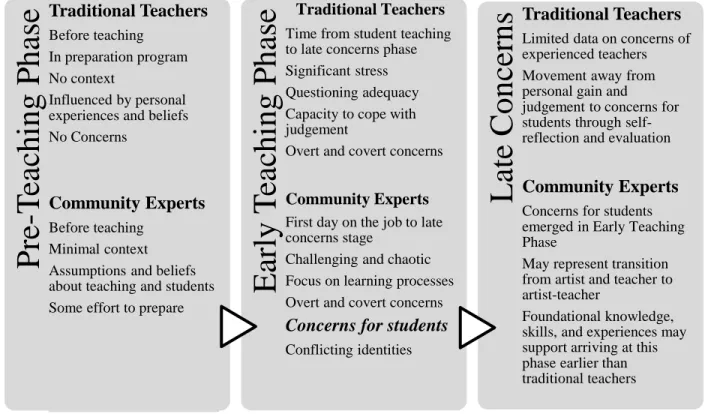
Figure 1. A comparison of Fuller's (1969) development conceptualization of traditional teacher
concerns to the development of community experts when learning to teach. ... 138
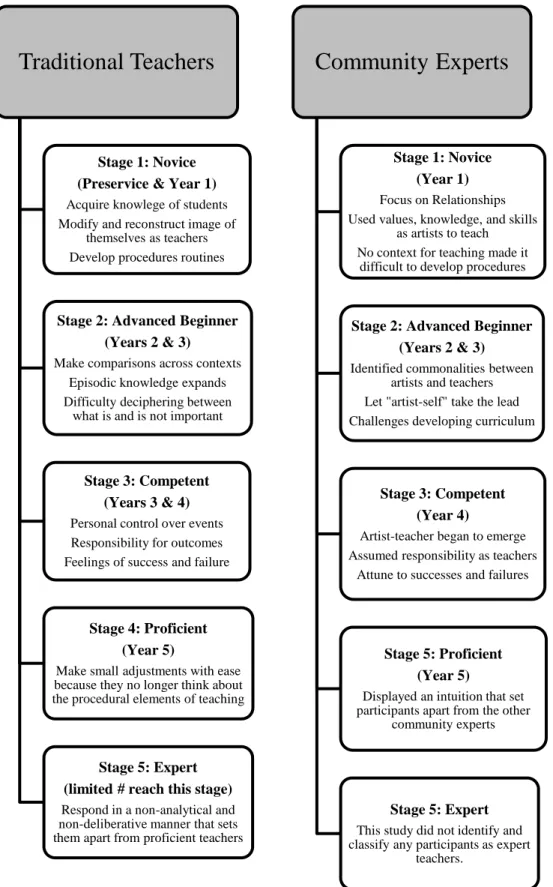
Figure 2. A comparison of Berliner's (1988) developmental theory of skill learning in teachers to the development of community experts when learning to teach... 146
CHAPTER ONE: INTRODUCTION
Non-traditional models of staffing, such as the use of community experts in the
classroom, continues to grow as the demand for niche schools with innovative practices increases to meet demands in the field of K-12 education. Working at these schools is inspiring yet
challenging as research in K-12 education, particularly in learning to teach, fell behind current practices. Without a body of current research, educational leaders blindly navigate the realm of teacher development as they attempt to understand and support the experiences of, and
subsequent stages of development associated with learning to teach for the non-traditional teachers they employ. I know this because I am an educational leader in this position.
Understanding the experiences and needs of community experts as they learn to teach is vital to supporting their development, ensuring student learning, and the overall success of a school.
This led me to conduct a study to explore how professional artists learned to teach when they assumed the role of classroom teacher at a performing arts high school without partaking in a teacher preparation program. Through a study examining the experiences of these community experts as they learned to teach, I hoped to gain an appreciation for their individual and
collective journeys, understand how to best support them in their day-to-day practices, and foster their continued development as artists and teachers.
Introduction to the Study
In this study I share my personal reflections as a teacher and administrator. I state the problem and explain its significance as a research subject. I follow this with a summary of the existing literature that includes two fundamental theories of teacher development that withstood the test of time. I next describe these two theories as an analytical framework for interpreting my findings. I then describe my methodology, findings, and analysis of the data through the two
theoretical lenses I selected for this study. Finally, I put forth conclusions, implications,
recommendations, and opportunities for future research supported by my findings and analysis.
Reflective Statement
I started my career in education as a high school biology teacher. Thinking back to my first few years in the profession, I remember the challenges I faced as a new teacher despite the knowledge I acquired during my teacher preparation program at a local university. I lacked the knowledge and skills of an experienced teacher. My first few years represented a significant time of development for me as a teacher. I needed to put what I learned in my teacher preparation program into practice and experienced considerable growth.
Most K-12 teachers follow a pathway similar mine when pursuing a career in teaching. I took the “traditional route,” and entered the profession after completing a teacher preparation program. This option is appealing to those interested in K-12 teaching because it is the most common way to fulfill state requirements to obtain a license to work in the profession. However, it is possible in some states for aspiring teachers who did not complete a teacher preparation program and do not hold traditional teaching licenses to obtain permission to work as K-12 teachers for a limited time. For example, professional artists may teach within their artistic disciplines in K-12 schools with special permission. A state’s Department of Education or Board of Teaching typically grants permission to “community experts,” such as professional artists, allowing them to accept teaching positions and bring their authentic, “real-world” experiences and training into K-12 classrooms.
I focused my study on how professional artists employed as teachers at a performing arts high school learned to become teachers without doing so by means of a teacher preparation program. These individuals are the opposite of most teachers, like me, who started their
professional journey by enrolling in a teacher preparation program. Preparation programs provide aspiring teachers with foundational knowledge of students, classroom management strategies, and educational theory and practices. Pre-service teachers observe school and classroom environments and the work of experienced teachers. Learning how to become a teacher also involves “field work” and “student teaching” experiences. During an intense
semester of student teaching, aspiring teachers experiment with teaching under the supervision of mentor teachers. These experiences along with coursework, all elements of a preparation
program, help future teachers learn about their upcoming roles and responsibilities. A
preparation program introduces aspiring teachers to the profession. It also helps them understand what to expect before signing their first contract and accepting a teaching position as a licensed professional.
Becoming a teacher, also known as “learning to teach,” is an important topic in my profession. The school I work at holds a unique mission. This mission is to provide the highest caliber of academic and artistic education for aspiring pre-professional performing artists in the areas of instrumental and vocal music, theatre, and dance and to fully prepare students for college and conservatory. The school believes exclusively employing professional artists to teach in the arts program aligns with this mission. The professional artists employed to provide conservatory-style training to students in dance, theatre, musical theatre, instrumental music, and vocal arts learned to teach without the support of a traditional teacher preparation program. Since these teachers do not hold licenses to teach, the state’s Board of Teaching designates them community experts and grants them permission to teach courses aligned with their professional expertise in a given performing arts discipline. My study explored the way professional artists
working as community experts learned to teach high school without participating in a formal teacher preparation program.
This topic interested me because I serve as the superintendent of a performing arts high school where teachers with traditional licenses teach students in academic classes and
professional artists with special permission from the state deliver conservatory-style training in arts classes. As the superintendent, my role is broad with responsibilities in the areas of
leadership, board relations, financial management, student achievement, oversight of daily operations, and promotion of the school within the broader community. K-12 arts education is typically classified as “elective” programming in most school districts. Education in the arts is typically led by traditionally licensed teachers assigned to teach a wide array of classes. Common offerings include visual arts, music programs, extracurricular activities, and community education programming.
Despite my background in K-12 education, which includes multiple and varied teaching and administrative experiences, I did not know how the professional artists working at my school entered and navigated the world of K-12 education, learned through their experiences, and became and evolved as high school classroom teachers. Conducting this study to understand how professional artists learned to become high school teachers without completing a formal teacher preparation program assists me in growing as a leader and better meeting the needs of my school and unique teaching staff.
My study investigated how professional artists, without completing a teacher preparation program, learned to become high school teachers. Arts focused schools have unique missions and strive to be innovative, offer educational opportunities in competitive markets of school choice beyond that of other schools, and present course options aligned with students’ interests.
I believe my school does this by utilizing a unique model of arts education. This unique model requires employing professional artists to teach conservatory-style arts classes. Exploring this model of arts education expands the knowledge of community experts, specifically professional artists, working as classroom teachers in the field of K-12 education. It also helps me learn how to better lead, support, and develop the professional artists working in my school and benefits the field of education and its practitioners. I describe this next.
Problem Statement, Purpose, and Significance
Arts programs, in one form or another, currently exist in many K-12 schools. However, arts schools have a uniquely specific focus compared to most K-12 schools. My school’s mission is to provide authentic conservatory-style training to aspiring professional artists in grades nine through twelve. The school utilizes community experts, specifically professional artists, to provide this exclusive type of training to students. My service as an administrator at the school allows me to experience first-hand a rare paradigm in K-12 arts education. Valuing and employing professional artists to teach students rather than traditionally prepared teachers is a rare, non-traditional model of staffing. As a result, my school experienced rapid growth due to this approach to education and training in the performing arts.
Although the use of community experts in K-12 schools is a non-traditional model of staffing, it is not entirely unheard of and in some districts and schools, such as mine, the
preferred method of instruction in technical and training programs. Since it is not uncommon for schools to employ community experts as teachers, my study regarding how professional artists learned to become teachers in a K-12 setting contributes to an understanding of how individuals learn to teach without participating in a teacher preparation program. It is a benefit for
the experiences of others to expand their knowledge of teaching and learning, build confidence, and develop their overall capacity as teachers. In addition, my findings assist administrators in supervising and developing community experts. It is the responsibility of administrators to use data to effectively lead, manage, support, and develop those we employ, especially the teachers as they serve an integral role in student learning.
My study benefits leaders in the field by allowing them to see how people can develop their own capacity and tap into their own set of resources through the process of learning to teach. It also helps administrators understand how to develop teachers that went through traditional teacher preparation programs and are not prepared to teach or unsuccessful in the classroom. If administrators gain additional insights to better develop their teachers, whether traditionally prepared or not, it is of value to the field, their districts and schools, themselves, and most of all, their students. This value relates to the overarching responsibility of both
administrators and teachers to ensure students are well educated. My study also informs districts and schools with no choice but to hire community experts for hard to fill teaching positions. They must invest in these teachers, as they do traditional teachers, to support them in learning how to teach and becoming better teachers over time.
Innovative educational practices emerged to meet demand in areas of art education and redefined teaching and learning (Daichendt, 2009). Daichendt’s concept of artists as teachers defied traditional teaching and learning methodology. A narrow body of literature represented research relative to this concept. Like Daichendt’s exploration of artists as teachers, the limited body of literature on this topic represented investigations of the term “artist-teacher”, artists in residence, conventional art programs, traditionally certified PK-12 art educators that span two
professions, teacher and artist, and those that teach in extra-curricular or community education programs within school districts.
Lackey, Chou, and Hsu’s (2010) article examined the question, “How can art educators embrace non-certified individuals who teach art in a variety of settings such as craft stores, after-school programs, and community centers?” They found strong opinions existed regarding “how” and “who” is qualified to teach art in K-12 schools in the United States. The general population of the United States maintained schools as separate and distinct entities with rigid boundaries that kept them sacred and inseparable from all other art education programs. Teaching within a school setting yielded a perception of content authority compared to those working outside of the core of everyday school life (Lackey, Chou, & Hsu, 2010).
Smilan and Miraglia’s (2009) model for art education supported the belief held by the general population. Only licensed teachers, deemed highly qualified professionals, should direct all art-based learning occurring within the nation’s schools. The researchers cited witnessing problematic situations, such as classroom teachers with little or no art education and community artists untrained in the art of teaching replacing or circumventing art teachers and misapplying well-intended curricula to foster art-integration. Stankiewicz (2007) explained to an audience of university art educators and students that artists without professional degrees of education received permission to teach art in various schools across the country under the classification “teaching artist.” This statement, according to the presenter, contradicted the efforts of those studying, practicing and earning a K-12 teaching license.
A survey of the nation’s K-12 schools just prior to the 21st century illustrated a lack of
continuity and consistency in art education (Longley, 1999). A unique, yet common, aspect of many of the schools with an arts focus involved the use of professional artists to promote
students’ interests in the arts and deliver training to prepare them to further their education and training in specific disciplines. The autonomy school districts maintained over art education resulted in some eliminating the arts while others used these initiatives to explore and implement innovative missions, offer specific and unique opportunities for students in the arts, and employ community experts such as professional artists.
Despite traditional views in the field, it became increasingly popular for schools to implement non-traditional models, such as employing community experts, to attract students seeking innovative educational programming and opportunities (Longley, 1999). Regardless of who is in the classroom, a traditionally educated and prepared K-12 educator or a community expert, each teacher moves through a series of experiences when learning to teach. For community experts, this begins with their first unaccompanied K-12 teaching assignment. Schools striving to maintain enrollment through innovative and real-world programing in an era of school choice need to understand how non-traditional teachers, such as community experts, learn to become teachers without completing a traditional teacher preparation program. This is particularly important as schools must always attempt to meet the needs and promote success of both students and teachers. The success of students and teachers is necessary to sustain these unique schools and models of education long term. What a school offers and how well it is done can be what attracts and keeps students and teachers.
The challenge in this whole situation is helping community experts develop as teachers. Becoming a teacher requires moving through a sequence of stages characterized as complex, stressful, intimate, and largely covert (Fuller & Brown, 1975). This makes it even more challenging to study how non-traditional teachers learn to teach. My study regarding how professional artists learned to teach contributes to the current body of research in education
because of the growing popularity of non-traditional models of staffing and programming. A door is also opened for teacher preparation programs to support the development of teachers entering the profession through non-traditional pathways. My findings offer insights for K-12 schools and administrators seeking to understand how to most appropriately approach the development of the community experts they employ. More broadly, I share the experiences of how 13 artists learned to teach with other potential or practicing community experts.
Research Question
The purpose of my study was to explore the phenomenon of learning to teach for
professional artists working as classroom teachers within their first five years in the field of K-12 education. To study the phenomenon of learning to teach I needed to collect and analyze the experiences of community experts as they learned to teach. Therefore, I adopted one central research question to study how working professionals, termed community experts, specifically artists, learned to teach: How do professional artists, working as community experts without partaking in a formal teacher preparation program, describe and make meaning of their experiences of becoming classroom teachers at a performing arts high school?
Definition of Terms
Professional artist: Merriam-Webster (n.d.) defines professional as “participating for gain or livelihood in an activity or field of endeavor often engaged in by amateurs.” Merriam-Webster (n.d.) defines artist as “someone who makes art.” I used the term professional artist or working artist to define one who can use talent or skill to create works of aesthetic value to earn a living.
Conservatory-style: Merriam-Webster (n.d.) defines conservatory as “a place of instruction in some special study” and style as “a particular manner or technique by which
something is done, created, or performed.” My study used the term conservatory-style to depict programming that places substantial emphasis on practical performance, training, and experience in the performing arts.
Community expert: Merriam-Webster’s (n.d.) definition of community is “society at
large.” Expert, according to Merriam-Webster (n.d.)is “having, involving, or displaying special skill or knowledge derived from training or experience.” I used the term community expert to represent an individual without a teaching license but hired by a district or school because they have a specific area of expertise related to a teaching assignment.
Teacher preparation program: The US Legal Dictionary indicates a teacher preparation
program is “a state-approved course of study, the completion of which signifies that an enrollee has met all of the state’s educational or training requirements for initial certification or licensure to teach in the state’s elementary or secondary schools.” This definition aligned with my use of the term in this study.
Learning to teach: The field of psychology refers to learning, as referenced in Merriam-Webster’s online dictionary (n.d.), as “the modification of behavior through practice, training, or experience.” According to Merriam-Webster (n.d.), teach, is “to give instruction in” or “to
instruct regularly in.” My use of the phrase learning to teach in this study is the process of becoming a teacher that requires one to acquire the knowledge and skills necessary in the profession through initial and on-going education, training, practice, and experience, which results in the continual modification of behavior as one instructs students regularly.
Phenomenon: My research used Merriam-Webster’s (n.d.) definition of the term
phenomenon, which states it is “something (such as an interesting fact or event) that can be
The event in my study is the experience of becoming a teacher, also referred to as learning to teach.
Overview of the Chapters
Chapter one explains my interest in conducting this study, what I hoped to learn and contribute to the field of education by conducting this study, the significance of learning to teach as a subject for research, and background information pertaining to prior research on the subject. Previously conducted studies explored the process of learning to teach for traditionally
developed teachers and revealed a complicated process often concealed by multiple variables. This makes studying the process of learning to teach for non-traditional teachers an even more adventurous endeavor in the field. Chapter one concludes by stating the central research question for this study: How do professional artists, working as community experts without partaking in a formal teacher preparation program, describe and make meaning of their
experiences of becoming classroom teachers at a performing arts high school? This is followed by the definitions of the terms used in my research.
Chapter two summarizes the existing research to identify what is known about learning to teach and reveal the gaps that exist in the literature. The following three themes, the first and the third studied more by researchers, emerged when conducting a review of the literature: (a) professional standards for teachers, (b) non-traditional teachers, and (c) learning to teach. The literature revealed gaps pertaining to the need for current research on learning to teach in K-12 education and more specifically, a need for studies focused on understanding the phenomenon for non-traditional teachers who enter the field of education without completing a preparation program.
Chapter three begins with descriptions of qualitative and phenomenological research and why I selected these traditions for my study. I explain the involvement of the University of St. Thomas’ Institutional Review Board (IRB) in conducting my study and how I selected and recruited participants, collected data through semi-structured interviews, and analyzed data. The chapter concludes with a discussion of reliability, validity, and the ethical considerations that emerge when conducting qualitative research.
Chapters four through six encompass the findings, analysis, conclusions, implications, and recommendations of my study. Chapter four organizes the findings according to the two overarching themes that emerged: (a) how the artist identity shaped teachers working as community experts in a high school setting and (b) how the artists innately used their
disciplinary and professional knowledge, skills, and performance abilities along with their values to form an identity as an artist-teacher over time.
I analyzed my findings in chapter five, using two fundamental theories of teacher development: (a) Fuller’s (1969) developmental conceptualization of teacher concerns and (b) Berliner’s (1988) developmental theory of skill learning in teachers. Use of these stage-based models allowed the similarities and differences between community experts and traditional teachers to emerge from the findings.
A summary of my study appears in chapter six. I identify the main conclusions of my study and discuss the implications for changes in educational practice. This chapter also suggests opportunities for future research, as this study only cracks open the door to
understanding how professionals from one field learn to teach in K-12 classrooms without being prepared in the same ways as traditional teachers. My study continues with a review of the literature and use of analytical theory to interpret my findings.
CHAPTER TWO: TOPICAL AND THEORETICAL LITERATURE
I conducted a review of literature to determine what scholarly literature existed regarding my topic. I used the following search engines: Academic Search Premier, Education Full Text, ERIC, Scopus, and PsycINFO. I found a narrow pool of scholarly and peer-reviewed literature specific to artists working in K-12 education and none depicting how professional artists learn to teach. I expanded my search by using the following keywords: “K-12 art education,” “teaching art,” “art teacher preparation,” “artist-teacher,” and “artists in K-12 schools.” With results still limited, I expanded my review of articles to include topics more broadly related, such as “teacher education,” “teacher preparation,” “becoming a teacher,” “learning to teach,” “novice teachers,” “novice teacher experiences,” “new teacher development,” and “professional development for new teachers.” I organized my literature review into the following three themes: (1) professional standards for teachers, (2) non-traditional teachers, and (3) learning to teach. These areas related to my investigation of how professional artists learned to teach without completing a teacher preparation program. Traditional means for preparing aspiring teachers began with professional standards that inform key programmatic elements candidates experience in teacher preparation programs.
Professional Standards for Teachers
Educational organizations and leaders long argued that traditionally prepared teachers drive educational reform (Longley, 1999). Teacher preparation programs and standards involve not only a description of effective teachers and teaching but also set goals for raising student achievement to expected state and national levels.
The National Board for Professional Teaching Standards (NBPTS) first developed voluntary national standards in 1994 with the title What Teachers Should Know and Be Able to
Do. NBPTS intended for these standards to improve K-12 education and define accomplished teachers and effective teaching. The standards, still represented by their initial title, most recently underwent revision in 2016. The following five broad statements continue to classify these standards and define the actions of accomplished teachers and effective teaching:
1. Accomplished teachers commit to students and their learning;
2. Accomplished teachers know the subjects taught and how to teach those subjects to students;
3. Accomplished teachers take responsibility for managing and monitoring student learning;
4. Accomplished teachers think systematically about their practice and learn from experience; and
5. Accomplished teachers become members of learning communities (p. 1). These professional standards apply to all teachers, including those who teach in the arts. Professional organizations, such as the National Art Education Association (NAEA) adopted these basic principles to develop standards regarding art teacher preparation.
In 1999, the National Art Education Association’s Standards for Art Teacher Preparation
underwent revision to address what a graduate in art education should know and be able to do. The National Art Education Association (1999) organized these standards into three sections: (a) the content for art teacher preparation programs, (b) the competencies for faculty preparing teacher candidates, and (c) the standards and skills adapted from the National Board for Professional Teacher Standards that teacher candidates should possess upon program completion.
In addition, the Interstate New Teacher Assessment and Support Consortium (INTASC) Arts Education Committee (2002), a program of the Council of Chief State School Officers (CCSSO), drafted a document entitled the Model Standards for Licensing Classroom Teachers and Specialists in the Arts for state dialogue. These voluntary state-licensing standards
addressed the competencies and skills required of arts specialists and classroom teachers in the areas of dance, theatre, visual art, and music. The INTASC intended for these standards to serve as a guide for individual states, professional organizations, and teacher education programs when developing and refining standards and practices. Following the release of the draft, it received endorsement from over 30 states, with additional endorsement by the National Council for Accreditation of Teacher Education (NCATE) (Henry, 2002).
A review of Minnesota’s system for teacher licensing and certification revealed four requirements: (1) graduation from a school of education, (2) a passing score on an assessment of pedagogical and professional knowledge, (3) satisfactory completion of a yearlong internship encompassing student teaching, and (4) successful completion of a practical examination assessing the complex intellectual skills of teaching (Becoming a Minnesota Educator, 2017).
The public generally believed effective teachers and teaching coincided with graduation from teacher preparation programs, although little knowledge of teacher preparation programs existed among those surveyed (Lackey et al., 2010). Lackey et al. (2010) concluded the general population held a universal view that teachers receive formal training that prepares them to be teachers and teach. The formal training prepared teacher candidates to work in school systems containing academic environments with certified instructors, implement pre-established and hierarchical curriculum, and evaluate student achievement using standardized assessments.
However, the process of becoming a teacher and learning to teach is complex and unique to each teacher candidate (Kagan 1992).
The complex nature of training teacher candidates resulted from variation and gaps in preparation programs, the tendencies of novice teachers to defer to mentor teachers rather than follow disciplinary standards, and the individualized and diverse experiences of candidates as individuals and teachers (Bain, Newton, Kuster, & Milbrandt, 2010; Carroll, 2011; Stockrocki, 1986). Consequently, teacher preparation programs graduated candidates with varied levels of professional knowledge and ability (Kagan, 1992). The following studies demonstrate the complexity and effectiveness of teacher preparation across contexts.
Carroll (2011) analyzed state-approved baccalaureate and masters’ programs that
prepared K-12 art teachers and found broad, rather than deep, content expertise. Programs failed to include the following four components: (1) opportunities to create individual work, (2)
reference to contemporary theory or practice in art, (3) global art history or contemporary art studies as curricular components, and (4) too few courses in methods (Carroll, 2011).
Bain et al. (2010) examined 11 first-year novice art teachers’ awareness and
implementation of meaningful curriculum through four structured interviews. They found many novice teachers defaulted to their mentor teachers’ strategies for teaching and learning. They followed their mentors instead of disciplinary standards, which resulted in gaps in practice.
States relying primarily on examination scores to license teachers learned of gaps in teacher preparation. Carroll (2011) cited Maryland’s deficiencies regarding the preparation of art educators. Maryland relied heavily on exams, which only required teachers to meet minimum professional, pedagogical, and content standards, all of which lacked correlation to student achievement. Teachers felt unprepared to teach such a broad range of classes because the
curricula contained minimal references to national and state K-12 art education standards (Carroll, 2011). Previous conversations at the national level about making direct connections between K-12 student achievement and the institutions where teachers obtained their preparation had yet to materialize (Cibulka, 2009; Duncum, 2009).
A study by Stockrocki (1986) described and analyzed the characteristics of an elementary art teacher identified as effective. The art teacher displayed an understanding of teaching and learning by defining educational philosophy and its application within the classroom. For example, the teacher made intentional instructional arrangements with student needs and interests in mind. Environmental factors, such as school culture, support of the school’s art program, the community’s work ethic, and logistical considerations that furthered the
development of the teacher’s personal and professional priorities, artistically and educationally, cultivated the teacher’s ability to be effective.
Studies of teacher preparation programs and art teachers revealed differing perspectives and standards regarding teacher preparation and what constitutes an effective teacher. These findings provided background information on the issues in the field of K-12 art education. The issues represented discrepancies in art education, teacher preparation, and the criteria for effective teaching. My review of art education found varied perspectives related to the
importance of art education offered either informally or formally within K-12 schools, as well as the qualifications required of teachers in the arts.
Non-Traditional Art Teachers
A summary of data by Lackey et al. (2010) revealed a tradition of undervaluing the arts in K-12 schools. Many people indicated not being surprised to find programs in the arts among the first to go through a transformation. The definition of an “art teacher” evolved into a blended
definition including non-certified teachers, such as professional artists, assuming responsibility for educating the nation’s students across artistic disciplines (Lackey et al., 2010). Researchers classified professionals or “community experts,” such as artists, working in K-12 schools as non-traditional teachers because they did not possess the credentials required of non-traditional teachers (Daichendt, 2010). Non-traditional teachers working in K-12 classrooms displayed alternative philosophies and instructional methodology not governed by the professional standards, required qualifications, or preparation associated with traditional art teachers.
The term “artist-teacher” described an alternative philosophy of teaching based upon artistic practice and spanning educational backgrounds and professional roles (Daichendt, 2009). Artist-teachers taught what they did as artists and emphasis on the word “artist” suggested a process of creation, not necessarily an ability to teach across a spectrum of established standards. Daichendt expressed a belief that the term “artist” conveyed elitism because it implied a greater value when compared to the field of education and those classified as traditional art teachers. This resulted in advocacy for the concept of “artist-teacher” as a term to celebrate when it suggested the use of artistic practices and bringing artistic ways of thinking into the classroom. The term itself encompassed the qualities of a traditional art educator and the unique aspects of a professional artist, essentially an individual positioned between two fields where traditional educational processes and the making of art blend (Daichendt, 2009).
A study declared ten professional musicians “good-enough” teachers and able to engage students in musical activity (Swanwick, 2008). The study evaluated the teaching musicians for the following three qualities: (1) care for music as human discourse, (2) care for the musical input of students and their musical autonomy, and (3) the promotion of musical fluency. The musicians viewed additional training in non-musical aspects of teaching and learning to be a
lower priority. The musicians displayed little awareness of the broader educational framework. They rarely acknowledged issues such as health and safety, equal opportunities and diversity, child protection, data protection, and disability services. They classified such items as nothing more than legislative instruments with little application to their actual work with students. Overall, the musicians displayed a general lack of awareness of their possible vulnerability by not understanding their position within the framework of K-12 education (Swanwick, 2008). This study supports the complex process of learning to teach, a process often concealed due to its personalized nature.
Learning to Teach
Despite decades of empirical and practical research, remarkably little is known about the evolution of the teaching skill (Kagan, 1992), even more so for those who do not follow the traditional path of enrolling in a teacher preparation program. During the 1960s and 1970s, quantitative research of relatively large sample sizes focused on teacher change, which documented the structured attempts to influence the professional growth of teachers through workshops and training programs with little attempt to follow the long-term effects of these programs (Cruickshank & Metcalf, 1990, McLaughlin, 1990; Richardson, 1990). Literature in the 1980s represented a group of studies termed “learning-to-teach” because of the exploration of qualitative cognitions, beliefs, and mental processes that underlie teachers’ classroom behaviors rather than the quantitative assessment of behaviors in earlier years (Kagan, 1992). Throughout the 1990s and into the 21st century learning to teach research continued, but many aspects remained broad, unclear, and in some cases, contradictory.
Learning to teach studies in the literature yielded a wide array of data and incorporated a range of internal and external factors impacting participants internally and externally (Kagan,
1992). These factors illustrated the complexity in understanding preservice and first year teachers’ experiences. Despite its complex nature and sometimes conflicting data, I found common themes in the research on learning to teach. These themes supported stage-based theories of development, such as those of Fuller (1969) and Berliner (1988) and highlighted the following four aspects of learning to teach: (1) the role of preexisting images and beliefs, (2) the important role played by the novice’s identity as a teacher, (3) the student teaching experience, and (4) the first year of teaching.
Role of Preexisting Images and Beliefs
Teachers just starting out in the profession brought their personal experiences and beliefs with them into teacher preparation programs (Clandinin & Connelly, 1996; He & Levin, 2008; Levin & He, 2008; Richardson, 2003). These images and beliefs impacted how they perceived what they encountered in teacher preparation programs and influenced their classroom practices (Chant, 2002; Chant, Hefner, & Bennett, 2004). A study of six preservice elementary teachers who observed and analyzed how children learned to write resulted in the novices acknowledging their inaccurate or incomplete beliefs and as a result, reconstructed their beliefs (Florio-Ruane & Lensmire, 1990).
It was not always the case that preservice and beginning teachers’ images, beliefs, perceptions, and behaviors changed so easily. Calderhead and Robson (1991) followed and interviewed 12 teacher candidates through their first year of course work in an elementary
teacher education program at a British university. They studied the candidates’ anxieties, images of self as a teacher, and understanding of how students learn. Data revealed each participant entered the preparation program with clear images of good teaching. These images coincided with their own experiences as students, represented one or two role models, and remained
inflexible across classroom contexts. When reflecting, statements focused exclusively on actions of the teacher rather than the students.
Additional studies evidenced the significant role beginning teachers’ preexisting images and beliefs have in their work. A study of 22 preservice teachers, mostly secondary, revealed a tendency to relate the content of the courses to their own beliefs and prior experiences in the classroom (McDaniel, 1991). Another study examined changes in preservice teachers’ beliefs about teaching (Weinstein, 1990). The researcher explored candidates’ conceptions of good teaching related to affective traits, such as the capacity to care for children. Despite course work and field experiences, the candidates’ viewpoints about teaching and themselves as teachers remained unaltered throughout the semester.
The Identity of a Novice Teacher
An awareness of professional identity contributed to teachers’ self-efficacy, motivation, dedication, and job satisfaction. Research found awareness to be a critical element in becoming and being an effective teacher (Day, Stobart, Kington, Sammons, & Last, 2003). During their teacher preparation programs and early in the profession, teachers developed their professional identities by uniting aspects of their past with pieces of their present to give purpose to their work and the field of education (Feiman-Nemser, 2001). Prior experiences determined a
teacher’s success during the first four months of teaching. Those who entered teacher education programs with a dysfunctional image of themselves as teachers retained them and those that entered with self-images aligned with the realities of the classroom adjusted and learned when they encountered problems (Aitken & Mildon, 1991).
Identity, particularly its formation within the context of the profession, was important in the process of becoming a teacher (Flores & Day 2006). A study of 14, mostly elementary,
teachers examined how professional identity formed during the first two years of teaching (Flores & Day 2006). Identity formation transpired through the interaction between personal, professional, and contextual factors in two different school settings. Three main elements influenced the construction, deconstruction, and reconstruction of a teacher’s professional identity: (1) prior influences, (2) initial teacher training and student teaching, and (3) contexts of teaching. The prior influences of each participant included feedback from supervisors’
observations of the participants as students and during practicum experiences in a teacher preparation program. This feedback played an important role in identity formation. It guided how the new teachers approached classroom situations and practices and the way they thought about themselves as teachers.
The experiences of initial teacher training and student teaching provided insight into what motivated participants to become teachers and an overall assessment of what everyone learned relevant to the profession during these experiences (Flores, 2001; Flores & Day, 2006). A teacher’s motivation to teach and knowledge of the profession played a critical role in identity formation. Participants commonly cited the gap between theory and practice throughout their accounts of initial teacher training and student teaching. Many teachers in the study referenced inadequate preparation and an overall feeling of “being lost” in their ability to deal with the complex and demanding nature of the day-to-day realities of being in a classroom and school (Flores & Day 2006).
The processes of learning, socialization, and professional development occurred within the contexts of teaching (Flores & Day, 2006). Researchers viewed these processes through classroom practice, school culture, and the role of school leadership. These contexts continually
evolved and resulted in the reconstruction of teachers’ identities through new learning, expanded understanding of social expectations, and professional growth (Flores & Day, 2006).
Participants cited classroom management as one of the most challenging areas of classroom practice (Flores & Day, 2006). They realized a shift in their teaching from a more student-centered approach to a more “traditional” and teacher-centered approach because of the struggle to manage and control student behavior. The shift occurred despite their beliefs about what constituted a good teacher and good teaching being contradictory to the adjustment. Teachers identified the roles of school culture and leadership in moving them from creativity to compliance. Participants expressed learning “while doing” and by “performing the tasks” required of them. Socialization happened when they adopted the school’s established norms and values. Conversely, teachers who student taught and taught in schools with an informative, supportive, and encouraging school culture and leadership reported more positive attitudes toward teaching and themselves as teachers.
The Student Teaching Experience
A survey of 259 mentor teachers yielded data that designated student teaching as the capstone experience of a teacher preparation program (Kwan & Lopez-Real, 2005). Student teaching provided an opportunity to teach before undertaking a classroom teacher’s full range of responsibilities. These experiences primarily occurred under the guidance of assigned mentor teachers who taught at schools where teacher preparation programs placed student teachers. Mentor teachers supervised student teachers as they practiced putting the theories they learned through coursework into practice. Mentors assisted student teachers in understanding the role and responsibilities of a teacher and directed the process of learning to teach during the student teaching experience (Kwan & Lopez-Real, 2005).
A survey of 37 of the 40 members comprised of veteran mentors and new teacher program directors in the Leadership Network for Teacher Induction (LNTI) in Northern California found a common perception that mentor teachers were the key source of support for student teachers and critical to quality student teaching experiences because they assumed a wide array of responsibilities (Achinstein & Athanases, 2006). These duties ranged from ongoing observation, dialogue, evaluation of practice, assisting in standards-based goal-setting in areas of teaching and subject-based knowledge, modeling lessons, coaching, and advocacy, to technical and emotional support. The participants surveyed believed the lack of a mentor during student teaching impacted the development of aspiring teachers during a critical time of induction into the profession. Active engagement by student teachers with others in their profession,
particularly mentors, resulted in greater learning and development (Achinstein & Athanases, 2006).
An ethnographic case study of student teachers found learning occurred through social participation and a “community of practice,” a key concept of Wenger’s (1998) social learning theory (Xiuli, 2011). The study examined the professional learning of student teachers without mentor teacher support during their four-month student teaching assignments. The student teachers displayed a heavy reliance on previous learning, including experiences teaching in other settings (Xiuli, 2011). Bi-weekly reflective journal writings and monthly interviews disclosed how the student teachers promoted their own professional learning through their personal communities and defaulted to their original beliefs about teaching in the absence of a mentor to provide them with opportunities to participate socially or engage in communities of practice within the profession (Xiuli, 2011).
A study following 14 elementary and secondary student teachers found four factors influenced the attainment of professional knowledge in beginning teachers: (a) their images of themselves as students, (b) a mindfulness they needed to moderate their initial beliefs in order to resolve classroom management issues, (c) the presence of a cooperating teacher to serve as a role model and enable development, and (d) placement with a cooperating teacher whose ideas and practices represented beliefs different from those of the student teacher (Hollingsworth, 1989). Student teachers needed to first establish general rules and routines before they could focus on pedagogy and content knowledge. Only five of the participants mastered the necessary
managerial and instructional strategies that opened the door to understanding markers of student learning (Hollingsworth, 1989). In addition to the factors influencing the development of student teachers, the study referenced the evolutionary pattern that emerged as the student teachers moved through their preparation programs as a potential focus for a future study (Hollingsworth, 1989).
An assessment of four middle school mathematics teachers as they completed the final two years of their teacher education program suggested a standard evolutionary pattern amongst inexperienced teachers (Strahan, 1990). They first needed validation of themselves as teachers. They then looked to students to confirm their status as teachers. Lastly, they pursued affirmation of their achievements as teachers through student success (Strahan, 1990).
Data obtained through structured interviews with student teachers, journals, final written self-evaluations, and tapes from post-teaching interviews established a profile of each student teacher’s process and perceptions of self-evaluation (McLaughlin, 1991). The methods these 26 social studies student teachers used to evaluate themselves over the course of their student teaching experiences varied in many ways. The absence of a process with established criteria
explained why this variation occurred in the data. Three common themes emerged from the methods student teachers used to evaluate themselves: (a) student teachers analyzed their behaviors in comparison to the objectives of the lesson, (b) student teachers based their evaluations on external criteria or feedback from observers, and (c) student teachers assessed themselves based on responses from students (McLaughlin, 1991). Despite the varying approaches to self-evaluation, each student teacher demonstrated increased focus on student needs as the semester progressed. However, the attention to student needs was short-term and described as a personal benefit rather than advantageous for the students (McLaughlin, 1991). Student teachers experienced a steep learning curve. This only grew as they entered the first year of teaching.
The First Year of Teaching
Several studies of novice teachers highlighted the sudden and sometimes dramatic shift teachers experience as they move into the profession. Some new teachers experienced a shock of reality as they assumed the role of classroom teacher and the responsibilities allocated to the position (Huberman, 1989). In certain instances, this resulted in feelings of isolation, conflict between idealistic expectations and actual events, and a lack of support and mentorship from colleagues and administration. Other novice teachers reported less negative and less upsetting experiences. The degree to which first-year teachers described their experiences as positive or negative appeared related to their ability to cope with challenging situations in certain school cultures and experiencing feelings of professional fulfillment (Flores & Day, 2006). A narrative report of a first-year success story revealed three influential factors: (a) alignment between expectations, personality, and workplace realities; (b) evidence of influence; and (c) use of
successful strategies to control student behavior and become inserted into the political and social culture of the school (Hebert & Worthy, 2001).
Another study followed five secondary preservice teachers for two years during their preparation program and first year of teaching (He & Cooper, 2011). Researchers described the major concerns preservice teachers conveyed as they transitioned from student teachers to first-year teachers. Data indicated the preservice teachers used an array of strategies to address their concerns and some struggled to maintain their passion for teaching. The concerns emerged through participant autobiographies, individual interviews, and a focus group discussion after student teaching. The concerns coincided with the following three themes: (a) classroom management, (b) student motivation, and (c) parent involvement through knowledge of their children’s academic progress or lack thereof and behavioral issues. The preservice teachers’ responses varied in classroom management. Their responses included the following concerns: feeling weak despite training, wishing for more confidence, being trusted by the students, and establishing themselves as someone students respected and expected respect from. Participants expressed continuing to work to develop strategies to address these concerns (He & Cooper, 2011).
Novice teachers employed strategies to address the challenges they encountered in the classroom. The three strategies identified included: (a) using what they learned from students to motivate students to engage with the content; (b) using assignments, observations, and class discussions to improve their knowledge of students and families; (c) focusing on positive experiences, such as student successes and statements of gratitude from parents, to sustain their passion for teaching; and (d) assuming individual methods of managing stress and aggravation (He & Cooper, 2011). Teachers continued to utilize these strategies as they faced additional
challenges transitioning into and during their first year of teaching. These new obstacles and challenging experiences encompassed pressures related to standardized assessments, a lack of administrative support, a shortage of resources, and preserving a balance between teaching and their personal lives. The concerns (e.g. self, task, and students) implied preservice and first-year teachers moved through developmental stages with each subsequent experience.
A longitudinal study of one teacher, Kerrie, described her development during her first year of teaching (Bullough, 1987, 1989). Kerrie initially focused on issues pertaining to classroom management. Once resolved, she focused on improving instruction and student learning. Finally, Kerrie used her expansive knowledge of the students to refine her practices. Kerrie expressed her teacher preparation program insufficiently prepared her because little of what she attained applied directly to her work in the classroom (Bullough, 1987).
Bullough (1987) analyzed Kerrie’s experiences using the first two stages of Ryan’s (1986) theory of teacher development (as cited in Bullough, 1987). According to Ryan’s theory, teachers moved through four developmental stages: fantasy, survival, mastery, and impact (on students). Kerrie experienced the second and third stages of Ryan’s theory during her first year of teaching. Her initial focus on issues pertaining to classroom knowledge placed her in the second or survival stage. This conflicted with the fantasy stage that occurred prior to or during student teaching and forced Kerrie to move forward to the next stage of development. As Kerrie progressed through her first year of teaching, she shifted from the survival stage into the mastery stage. In the mastery stage she attempted to refine her practices. Kerrie’s movement through these stages represented the process of learning to teach (Bullough, 1987).
Two case studies followed teachers learning to teach during their preservice and first years of teaching (Hollingsworth, 1992; Hollingsworth, Dybdahl, & Minarek, 1993). The
studies suggested teachers learn to teach after entering the classroom. Researchers found teachers displayed the most significant growth during the first year. The first, a study of seven teachers in their first year concluded conversation was a crucial element in the process of learning to teach (Hollingsworth, 1992). The second study found construction of individual knowledge of teaching developed and evolved through sustained dialogue, particularly with colleagues, mentors, and leadership (Hollingsworth, Dybdahl, & Minarek, 1993). The dialogue had little value until the teachers were in their classrooms.
A qualitative study examined how 11 first-year novice teachers working in public rural, urban, and suburban school districts defined, designed, and implemented curriculum (Bain et al., 2010). The researchers sought to gain perspective regarding the teachers’ understanding and implementation of meaningful curriculum. They findings revealed the teachers’ definitions and implementation of meaningful curriculum coincided with overall abilities to connect art lessons to students’ lives and cultures (Bain et al., 2010). The novice teachers expressed greatest
concern around the attributes of the students’ products and establishing trust with their students. Teachers only identified curriculum as meaningful when evidence existed of the teachers’ relationships with the students and their art-making experiences (Bain et al., 2010).
A study of a novice teacher revealed he survived his first year with the help of Twitter, online math blogs, television clips, and skilled teachers in his school (Blankinship, 2010). When asked about his teacher preparation program, he stated he wished he learned about “motivating kids to do their homework, dealing with parents, reading a teacher contract, using classroom technology . . . , and whether it’s ok to accept friend requests from students on Facebook” (p. 1). A cohort of 14 new teachers, primarily elementary, expressed heavy workload, bureaucratic tasks, minimal support, the range of tasks to be accomplished, performance assessments, and the