DigitalCommons@USU
DigitalCommons@USU
All Graduate Theses and Dissertations Graduate Studies
5-2019
Standards-Based Grading: A Correlational Study Between Grades
Standards-Based Grading: A Correlational Study Between Grades
and End-of-Level Test Scores
and End-of-Level Test Scores
Tyler R. PollUtah State University
Follow this and additional works at: https://digitalcommons.usu.edu/etd Part of the Teacher Education and Professional Development Commons
Recommended Citation Recommended Citation
Poll, Tyler R., "Standards-Based Grading: A Correlational Study Between Grades and End-of-Level Test Scores" (2019). All Graduate Theses and Dissertations. 7435.
https://digitalcommons.usu.edu/etd/7435
This Dissertation is brought to you for free and open access by the Graduate Studies at
DigitalCommons@USU. It has been accepted for inclusion in All Graduate Theses and Dissertations by an authorized administrator of DigitalCommons@USU. For more information, please contact
STANDARDS-BASED GRADING: A CORRELATIONAL STUDY BETWEEN GRADES AND END-OF-LEVEL TEST SCORES
by Tyler R. Poll
A dissertation submitted in partial fulfillment of the requirements for the degree
of
DOCTOR OF PHILOSOPHY in
Educational Leadership Approved:
Courtney D. Stewart, Ph.D. Max L. Longhurst, Ph.D.
Major Professor Committee Member
Susan A. Turner, Ph.D. Michael Freeman, Ph.D.
Committee Member Committee Member
Robert W. Wagner, Ph.D. Laurens H. Smith, Ph.D.
Committee Member Interim Vice President for Research and
Interim Dean of the School of Graduate Studies
UTAH STATE UNIVERSITY Logan, Utah
Copyright © Tyler R. Poll 2019 All Rights Reserved
ABSTRACT
Standards-Based Grading: A Correlational Study Between Grades and End-of-Level Test Scores
by
Tyler R. Poll, Doctor of Philosophy Utah State University, 2019
Major Professor: Courtney D. Stewart, Ph.D. Department: Teacher Education and Leadership
The purpose of this research study was to investigate the relationship between standards-based grades and end-of-level SAGE test scores. By using end of term grades, the researcher evaluated the correlation between grades and end-of-level SAGE test scores, the impact on student learning through the student growth percentile, and the differences in grades and test score data dependent on curriculum content area and years of teaching experience. Grade and SAGE data from the 2016-17 school year were obtained from the school district assessment department. The researcher analyzed the data using frequency histograms, multiple independent samples t tests, bivariate scatter plots, and linear regression models. In general, the independent samples t tests showed standards-based grades and traditional grades are both moderately correlated with student performance on the end-of-level SAGE tests. However, an examination of specific areas showed students who participated in standards-based classrooms earned higher grades,
scored higher on the end-of-level SAGE tests, and showed higher learning growth when compared to their peers who participated in traditional graded classrooms. Overall, the results suggested standards-based grading as a positive option for educators to consider for their grading practices. Therefore, educational leaders should consider providing standards-based grading professional development for their teachers to help benefit student learning and promote accurate grading practices.
PUBLIC ABSTRACT
Standards-Based Grading: A Correlational Study Between Grades and End-of-Level Test Scores
Tyler R. Poll
As students move from grade level to grade level and onto college, their grades have an impact on the number of opportunities available to students. The competition for entering college and earning a scholarship are at an all-time high and the grades students earn have a direct impact on future opportunities. Grading practices vary by teacher causing students’ grades to mean different things.
Standards-based grading practices focus on removing teacher bias and puts emphasis on the learning students can demonstrate. Students are given assessments to determine learning and are given multiple opportunities to show what they have learned. Emphasis is placed a student’s most current knowledge rather than an average of scores during the grading period.
This study focused on how student learning was impacted when secondary math, science, and language arts teachers use standards-based grading practices in their
classrooms. Student learning was measured by term grades and end-of-level SAGE test scores. Results show students who attended a classroom with standards-based grades earned higher GPAs, performed better on the end-of-level test, and had more learning growth over the course of the school year, than their peers who participated in traditional grading classrooms.
ACKNOWLEDGMENTS
The opportunity to further my education and participate in this learning process would not be possible without the many positive influences I have had in my life. First, I would like to thank Dr. Joe Matthews for encouraging me to pursue my doctoral degree. Although he retired early in my doctoral program, he left me in the excellent hands of Dr. Courtney Stewart. Dr. Stewart is an amazing educator, advocate, and friend. I hold him in the highest esteem possible. I would like to thank my teachers for dedicating their lives to teaching and Drs. Susan Turner, Robert Wagner, Max Longhurst, and Michael Freeman for serving on my doctoral committee. They have each influenced me positively in different ways.
I express appreciation to Dr. Logan Toone and Bryce Barth for their help with data. I am grateful for my classmates, especially Jennifer Throndsen, for the positivity and motivation. A big thanks to my colleagues and district leaders for the support and interest in my project. Thank you to my parents for teaching me the importance of education and for their support. I am grateful to my children who have sacrificed more than I ever would want them to. Most of all, I am grateful for my wife Lindsey, who has been supportive since day one and has carried more than her share of the load.
CONTENTS Page ABSTRACT ... iii PUBLIC ABSTRACT ... v ACKNOWLEDGMENTS ... vi LIST OF TABLES ... ix LIST OF FIGURES ... x CHAPTER I. INTRODUCTION ... 1
Statement of the Problem ... 7
Purpose ... 8
Research Questions ... 9
Assumptions ... 10
Scope and Limitations ... 10
Definition of Terms ... 10
Significance of the Study ... 11
Conclusion ... 12
II. REVIEW OF THE LITERATURE ... 13
Student Learning ... 14
1965 Elementary and Secondary Education Act ... 15
A Nation at Risk ... 16
No Child Left Behind Act ... 16
Common Core ... 17
Race to the Top ... 18
Assessment Overview ... 19
Grading ... 24
Standards-Based Grading ... 34
Grades Versus High-Stakes Testing Scores ... 46
Conclusion ... 47
III. METHODS ... 48
Page
Research Design ... 50
Setting ... 50
Participants ... 50
Data Sources ... 53
Data Collection Procedures ... 53
Data Analysis Procedures ... 56
Conclusion ... 59
IV. RESULTS ... 60
Correlation Between Grades and End-of-Level SAGE Test Scores ... 61
Effect on Student Learning ... 66
Difference by Core Subject ... 67
Difference by Years of Teaching Experience ... 69
Conclusion ... 71
V. DISCUSSION ... 73
Overview ... 77
Review of the Research and Research Questions ... 78
Fidelity of Implementation ... 79
Discussion of Results ... 81
Practical Implications of the Study ... 94
Theoretical Implications of the Study ... 95
Limitations of the Research ... 96
Recommendations for Future Research ... 98
Conclusion ... 99
REFERENCES ... 104
APPENDICES ... 112
Appendix A: Standards-Based Grading in the Classroom ... 113
Appendix B: GPA and SAGE Error Bar Charts ... 118
Appendix C: SAGE z Score Regression Residual ... 120
Appendix D: Error Bar Chart Showing Confidency Level for Residuals ... 122
Appendix E: Bar Graph Showing SGP Score Analysis ... 124
Appendix F: Error Bar Charts by Content ... 126
Appendix G: Error Bar Charts by Experience ... 129
LIST OF TABLES
Table Page
1. Common Differences Between Traditional Grading and Standards-Based
Grading ... 34 2. Standards-Based Grading Cohort and Traditional Grading Group
Demographics ... 51 3. Grade Point Average (GPA) Scale ... 57 4. Standards-Based and Traditional Grading Groups Descriptive Statistics
for GPA and SAGE z Scores ... 61 5. Regression Model: Descriptive Statistics for GPA and SAGE z Scores ... 63 6. Regression ANOVA Model: GPA and SAGE z Scores ... 63 7. Descriptive Statistics for GPA and SAGE z Scores Based on Level of
Implementation (Self-Identified) ... 65 8. Descriptive Statistics of Student Growth Percentiles for Both Group ... 66 9. Descriptive Statistics for SGP Based on Level of Implementation
(Self-Identified)... 67 10. Content Area Statistics Regression Residuals-SAGE z Score with GPA ... 68 11. Teaching Experience Group Statistics Regression Residuals-SAGE
LIST OF FIGURES
Figure Page
1. Standards-based grading mindset ... 81
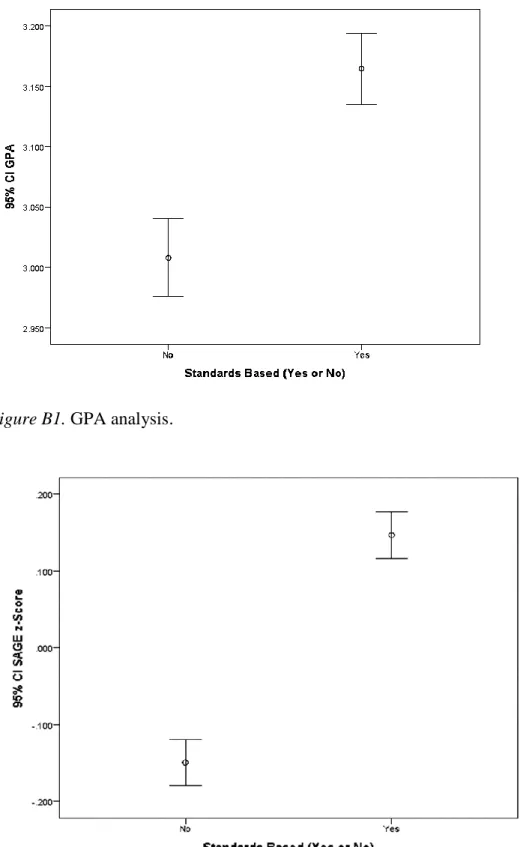
B1. GPA analysis ... 119
B2. SAGE z score analysis ... 119
C1. SAGE z score regression residual ... 121
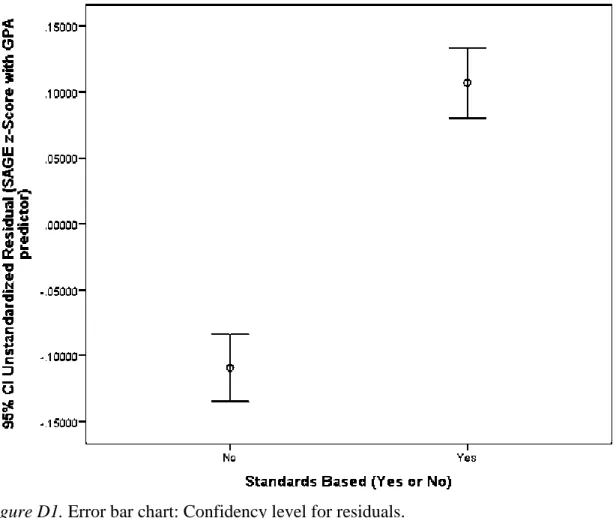
D1. Confidency Level for Residuals ... 123
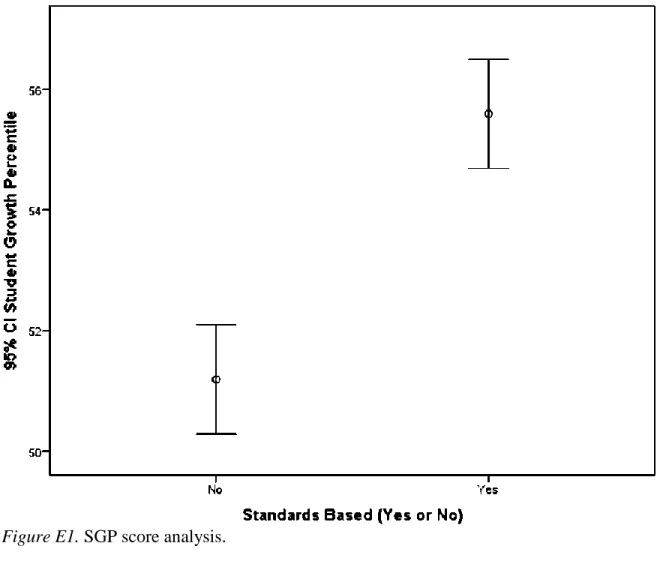
E1. SGP sore analysis ... 125
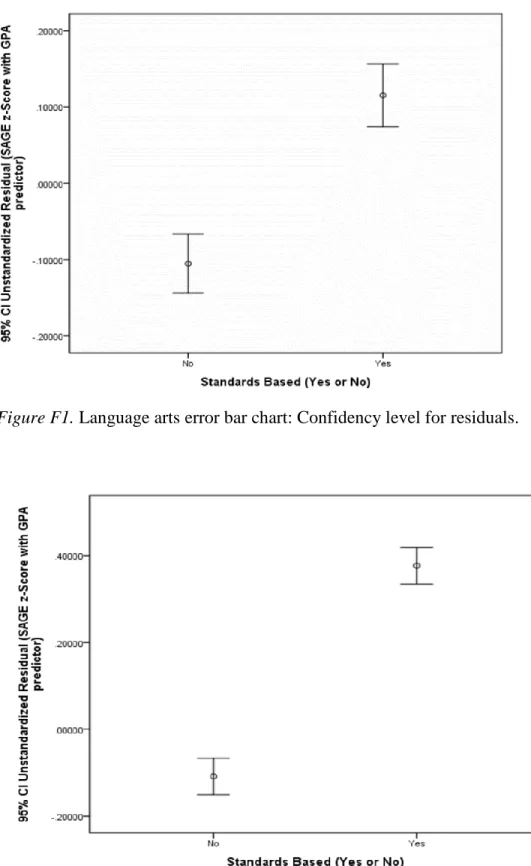
F1. Language artserror bar chart: Confidency level for residuals ... 127
F2. Matherror bar chart: Confidency level for residuals ... 127
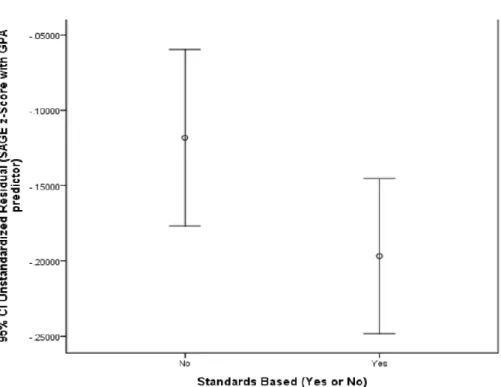
F3. Science error bar chart: Confidency level for residuals ... 128
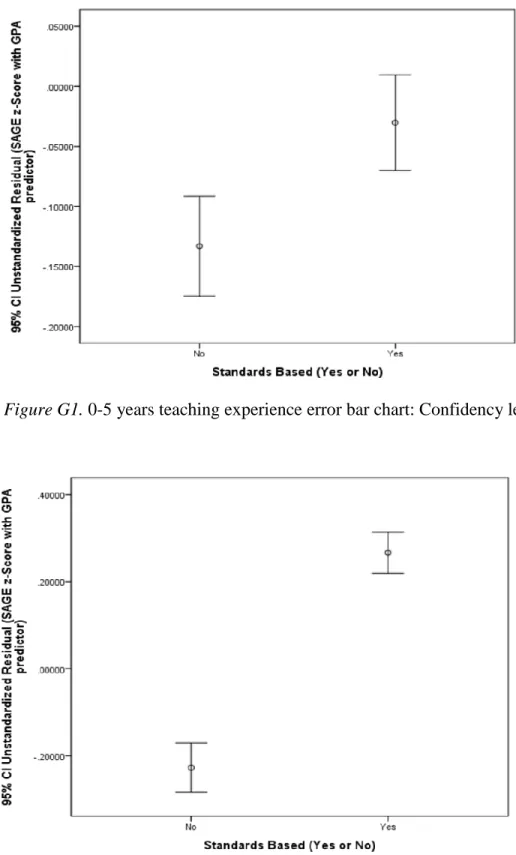
G1. 0-5 years teaching experienceerror bar chart: Confidency level for residuals ... 130
G2. 6-10 years teaching experienceerror bar chart: Confidency level for residuals ... 130
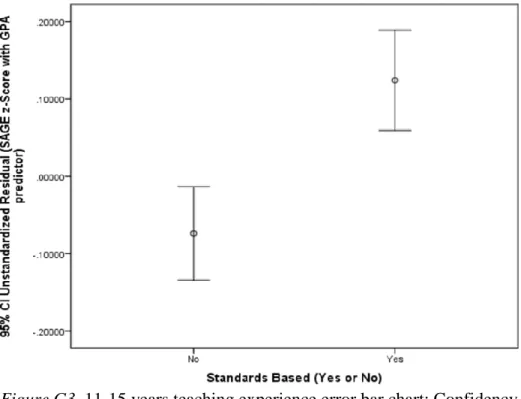
G3. 11-15 years teaching experienceerror bar chart: Confidency level for residuals ... 131
G4. 16+ years teaching experienceerror bar chart: Confidency level for residuals ... 131
CHAPTER I INTRODUCTION
The tardy bell rings, and a smattering of students lazily walk toward their class. Teachers are beginning to take attendance as I, along with two other school
administrators, clear the hallways and ensure each student arrives in their appropriate classroom. After scouring the halls for 5 minutes, I walk back to my office to respond to emails. Before I can sit down, the secretary enters and informs me a parent is waiting in the office and wants to talk to the principal immediately.
Curious as to the nature of this arrival, I respond, “Do you know who their child is and what they are here for?” Parents come to school to speak with a principal for a gamut of reasons and having an idea of what they want a few minutes before meeting with them can save a great deal of time.
The secretary gives me the student’s name and comments, “I don’t know what they want for sure, but they seem mad.” Despite this vagueness, I let her know I am ready to see the parent. As the secretary walks away, I quickly load our student information system on the computer and begin looking at the student’s records. I scour attendance, grades, and behavior, hoping to locate a clue as to why the parent is here and upset.
The student’s attendance looks sufficient, other than a few days missed due to illness and a trip to Disneyland. The student does not have any major disciplinary issues. He was reported for bullying a few weeks ago, but he and his parents denied any
knowledge of him doing anything wrong. As I observe his grades, he has mostly A’s, a B+, and one F in math. Why does it always have to be math? I assume the failing grade in
math is the reason the parent is here and angry.
The culmination of this research occurs in the 45 seconds it takes the secretary to leave my office, retrieve the parent, and bring the parent back to my office to meet. As the parent enters, I introduce myself as the assistant principal and indicate I am pleased to meet her. It becomes clear my pleasantries are not welcome and she wants to get straight to business.
The mother begins by telling me her son has always been a straight-A student. Although he competes on multiple athletic competition teams and is extremely busy, he always turns in his homework. She lays the groundwork to let me know her son is nearly perfect and whatever her complaint is, it cannot possibly be her son’s fault.
I smile politely and ask how I can help. She continues to explain how all his teachers love him and how well behaved he is—in and out of school. She explains that if he does not get an athletic scholarship, he will most definitely get an academic
scholarship. The way she describes her son’s achievement encourages me to believe he will receive both. She continues expressing how proud she is of her son. I can relate to that. I begin thinking about my own children and how much I love them. I cease thinking about my own children as she questions, “…and what are you going to do about it?”
I bring my focus back to reality and realize I had become distracted during her monologue. I ask a follow-up question to ensure I know what her concern is regarding. Thankfully, during my quick, 45-second research, I am confident she is here to discuss his math grade.
His math scores for the most part look okay. I see the teacher has marked some assignments “late,” which I assume means he was docked credit for handing the
assignments in after the deadline. I also see he is missing a few homework assignments; however, he has done reasonably well on the tests. I also observe he was given some zeros on a few quizzes. Being familiar with the teacher, I know she has a strict policy that quizzes cannot be made up if the student is absent. Attending class and participating is very important to her. The missing work is titled, “Homework 3/27, Homework 4/5, Quiz #4” and so on.
The mother inquires why her son is failing math and quite honestly, I do not know. I want to be able to give the mother an answer that would indicate he is failing because he has not met a standard or he is not proficient in a certain area. I want to be able to tell her that it is okay because the teacher is working with him until he learns the concepts. But I am unable to provide her with these reassurances. All I can do is look at the mother and say, “Your son is failing math because of some missing assignments. He also missed some quizzes while you and your family were out of town. According to the math teacher, those quizzes cannot be made up unless he has a doctor’s note.”
I know this is not a sufficient response to her question, but to be honest, I do not have the information to let this mother know what can be done for her son to earn a grade that demonstrates learning. The titles of the assignments, quizzes, and tests are labeled by date and in sequential order. They are not labeled by the math standard or what the child is actually learning. The mother looks at me in disgust and responds, “Well, how can he raise his grade?” I open my mouth to ask a question to which I already know the answer.
I have asked this question many times and usually get the same answer.
I ask, “What did the teacher say when you talked to her?” The mother tells me she has not talked to the teacher because the teacher “does not care” and “will not budge.” The mother wants me to march into the classroom and let the teacher know this child is an angel and he deserves an A. Essentially, she wants me to tell the teacher he needs an A because he is a good student, not because he has demonstrated proficiency in math skills and standards.
As the assistant principal, I do not have the answers, and I do not have the power to change a math grade. I therefore inform the mother we will need to schedule a meeting with the teacher, myself, parents, and the child to discuss this matter further. The purpose of the meeting will be to find a way for her son to demonstrate learning in the classroom and earn a better grade.
At the meeting a few days later, both parents are in attendance. Their sole purpose is to ensure their son has an A in math at the end of the term. The teacher is there to defend herself and her grading practices. I am there as a mediator to make sure everybody leaves in agreement. The teacher focuses on the student’s lack of attending class and the one time he was disruptive in class. The parents do not believe he was ever disruptive and they defend their trip to Disneyland as much needed family time. They only want to know what their son can do to raise his grade. Eventually the teacher budges and provides some extra credit opportunities, many of which will have nothing to do with the math skills and standards actually studied while he was on vacation.
focus of the meeting is on a letter grade, not what the student has learned. It is not the parents’ fault; they went through the same school system. They know how the system works and they know how to get what they want. The fault is mine, the teacher’s, and the school’s. We are still relying on a system of assessing and grading that is outdated and ineffective. Something must change.
As the frequency of assessments increases and the results of high-stakes testing affects students and schools, it is important school leaders identify methods to help ensure students are being assessed appropriately. If assessments are provided effectively and feedback is given to students, more learning can take place (Phelps, 2012). The way teachers assess students has not changed for more than a century. Educators and
educational leaders must look for new and innovative ways to assess student learning at their schools and help students prepare for college and their future career.
The duties of school leaders continue to grow as education adapts and reforms. While the responsibilities may seem overwhelming, ensuring student success is of the utmost importance. With standardized testing taking a bigger role in education, school leaders need to look at other measures of student learning. Administrative support is needed to help teachers develop effective classroom grading practices that are compatible with newer assessment methods and communicate the changes with educational
stakeholders (Suurtamm, 2004). Aligning assessments and having continuity in grading and testing practices helps ensure valid and reliable data. Keeping grading and testing data consistent allow teachers and school leaders to identify students who did not meet the standards and allows educators to pinpoint what interventions a student needs to be
successful.
With the recent focus on common standards through Common Core, some educators have begun to look at changing how to assign grades and assess learning. For the majority, however, traditional grading continues to be a mainstay in educational practice. Traditionally, grades have been used to sort students into higher and lower achieving classes. Grades have been used to determine honor rolls and right of
membership in honor societies, student government, and athletic teams (Guskey, 2015). Having high grades can provide many opportunities; having low grades limits students from pursuing the same opportunities. Grades can have an immense impact on a student’s life. The education system believes that grades should reflect a student’s growth and progress, yet it continues to use an outdated grading system that does not reflect the ability to effectively determine student learning.
Standards-based grading enables educators to evaluate student learning based on how well the student masters specific content and skills. Instead of averaging scores for a set amount of time, students are graded based on how they demonstrate knowledge in each respective standard (Hooper & Cowell, 2014). Clearly describing the expected standards of performance is important, that way students know what they are expected to learn (Buckles, Schug, & Watts, 2001). Using standards-based grading methods provides the opportunity for educators, students, and parents to know the specific standards and identify where students need more support and learning interventions. By using data from secondary teachers who are currently implementing standards-based grading procedures in their classroom and the correlation of grades with end-of-level test scores, this study
will provide educational leaders with data in an area that lacks research.
Statement of the Problem
The traditional way of determining student learning and assigning grades is unreliable and commonly based off of each individual teacher’s preferences. Determining what a student has learned and assigning a grade to that student can be complex. The grades students receive can literally mean the difference between graduating from high school and not graduating, attending college and not attending college. Because grades have an impact on students’ futures, it would be logical to assume educators are trained in assessment and assigning grades. However, undergraduate and graduate courses rarely teach curriculum on effective student grading. As a result, educators seldom know about different grading practices, the pros and cons of each, or the effect grading practices have on students (Brookhart, 2011; Stiggins & Chappuis, 2011). Because of the lack of
training and knowledge regarding grading practices, teachers most often grade their students using the same grading and reporting methods they remember their teachers using in elementary and secondary schools (Frary, Cross, & Weber, 1993; Guskey & Bailey, 2001).
The way grades are determined, valued, and even collected has been around for a long time, yet research does not show the traditional way of assigning grades to be an accurate reflection of student learning. In fact, as early as 1912, Starch and Elliot indicated 147 English teachers assigned widely varied grades to two identical papers from students. They found the focus of what should count on the grade varied based on
teacher expectations. Educators at the time argued good writing is subjective, so Starch and Elliot (1913) did a similar study with math assignments. One geometry paper was scored by 128 teachers and scores ranged from 28% to 95%. As with their previous study, Starch and Elliot found teachers gave points dependent of the learning indicators they were assigned to look for on the assessment.
Recent research has shown evidence used in grading practices varies considerably from teacher to teacher and is even inconsistent within a teacher’s own practice
(Brookhart, 1993; Howley, Kusimo, & Parrot, 2000). Duncan and Noonan (2007) found secondary teachers’ grading practices varied by subject area and non-achievement factors were regularly calculated into students’ grades. In 2011, Brimi replicated Starch and Elliot’s 1912 study and found similar results. Brimi had 73 high school teachers, who had received twenty hours of training in a writing program, grade a paper on a 100-point grading scale. Scores ranged from 50% to 96%. The results were nearly identical to the study completed a century earlier. The traditional way of determining student learning through the use of grades is outdated, inconsistent, and unreliable (Brookhart, 2004; Marzano, 2000).
Purpose
The purpose of this study is to evaluate the effectiveness of determining student learning through the use of standards-based grading in secondary classrooms and the correlation those grades have with end-of-level test scores. While grading practices vary across the world, most educators use the same grading practices that have been used for
over 100 years. With the recent emphasis on content standards, educators are looking for more effective ways to determine student learning. Little research has been done to determine if standards-based grading is an effective way to assess student learning. By looking at teachers from a large, suburban school district in the western U.S. who are beginning to implement standards-based grading in the classroom and comparing student grades with student test scores, results will add to the existing research for standards-based grading.
Research Questions
There are four areas of focus in this study: (1) determine if standards-based
grading is an effective way to assess student learning in comparison with end-of-level test scores, (2) determine if the use of standards-based grading increases student learning as measured by the standard growth percentage on end-of-level tests, (3) understand what relationships exist between math, language arts, and science classes implementing standards-based grading, and (4) determine if teachers’ years of experience affects the correlation between grades and end-of-level test scores. In order to address the areas of focus identified by this study, the following four research questions guided this study.
1. Is there a positive correlation between standards-based grading term grades, and end-of-level SAGE test scores?
2. To what extent does the standards-based grading environment increase or decrease student learning in comparison with traditional grading, as measured by the student growth percentage on end-of-level SAGE test scores?
3. Is there a difference in the correlation of standards-based grades and end-of-level SAGE test scores between math, language arts, and science?
scores vary based on teachers’ years of teaching experience?
Assumptions
The major assumption in this proposed study is the cohort of teachers implementing standards-based grading procedures represents the larger population. Another assumption is that survey respondents will answer the survey questions
truthfully. Last, the researcher is assuming students will do their best on the end-of-level SAGE tests.
Scope and Limitations
The proposed research is limited by a few factors. The first limitation is time. Ideally, it would be beneficial to look at data for several years to compile more reliable results. Although the sample size is large, having only one year of data is a limitation. Second, the study is limited by the researcher’s knowledge of the teachers in the
traditional grading group. Some of these teachers could be in the process of attempting to use different grading techniques instead of the traditional grading practices often seen in schools. This is a limitation because it combines a segment of the population with a group into which they may not fit.
Definition of Terms
The following terms are used throughout this study.
error (American Educational Research Association [AERA], American Psychological Association [APA], & National Council on Measurement in Education [NCME], 1999).
Student Assessment for Growth and Excellence (SAGE). The Utah end-of-level computer adaptive assessment aligned to the State’s language arts, mathematics, and science standards.
Student Growth Percentile (SGP). Measures the amount of academic growth a student has made, as a result of one year of instruction, compared to similarly performing peers across the State. Average SGP is 50%
Standards. Learning goals for what students should know and be able to do at each grade level.
Traditional Grading Group. Set of math, science, and language arts teachers who did not participate in the standards-based grading cohort.
Validity. A measure of the degree to which a survey has evidence that supports the inferences made from the scores (AERA et al., 1999).
Significance of the Study
Educators are frequently looking for ways to determine if students have learned concepts and standards taught within the classroom. Term grades and test scores are the indicators used most often to reflect student learning. The current method of grading used by most educators has been shown to be an unreliable way to determine if a student has learned and in which standards a student is deficient (Brimhi, 2011; Guskey, 2015; O'Connor & Wormeli, 2011; Starch & Elliot, 1913). The potential evidence from this
study would provide research showing standards-based grades are more accurately correlated with end-of-level tests and are more conducive to support student learning. The research on standards-based grading will continue to grow and will provide
educators with data to inform their decisions about standards-based grading and its value in the classroom.
Conclusion
Educators have been having the same conversation about student grades with parents and students for far too long. Educational stakeholders know how important grades are, but the letter grade has become the focus of education, rather than what a student has learned and can do. Focus must be put back on the skills and knowledge students have learned and can demonstrate. If research on grading continues to examine traditional grading methods rather than newer grading methods, grading in education will continue along the same cycle we have seen for the past 100 years. Developing
meaningful and equitable grading practices is a challenge for educators at all levels. The challenge will be more overwhelming if educators continue to use the same methods. “We’ve always done it that way is insufficient justification for continuing practices that have no strong evidence” (Guskey, 2015, p. 112).
CHAPTER II
REVIEW OF THE LITERATURE
For centuries, the purpose of education has been debated, and this debate
continues today. Politicians, educators, researchers, and the general public cannot seem to find common ground on public education. Educational reforms come and go as new elections begin and end. One topic with which most agree, is the necessity of doing what is best for students.
Finding the most effective curriculum for student success has been an ever-changing process. Past philosophers and educators have debated which form of
curriculum is best for students. Small (1896) believed education should be based off “the evolution of the whole person, not merely of intelligence” (p. 175). Bobbit (1912)
believed that educational curriculum should:
Work up the raw material into that finished product for which it is best adapted. Applied to education this means: Educate the individual according to his
capabilities. This requires that the materials of the curriculum be sufficiently various to meet the needs of every class of individuals in the community; and that the course of training and study be sufficiently flexible that the individual can be given just the things that he needs. (p. 269)
Bobbit (1924) later pointed out that education is to prepare for an adult life, not a child’s life. It is a preparation for the years after childhood. Other researchers, such as Dewey (1916), felt it was a disservice to put children on a “waiting list,” or a “probation for another life” (p. 63). Dewey, felt it was important for knowledge to become part of the child, and that the experiences a child encounters continue to evolve and grow (Kliebard, 2004). Currently, education looks somewhat different.
Student Learning
Determining what a student has learned can be complicated. The educational world has many terms to describe student learning: student achievement, student learning outcomes, student success, etc. For the purpose of this paper, all of these terms will collectively be called student learning.
The executive summary from the U.S. Department of Education (USDE) Race to the Top (2009) program provided the following definition for student learning.
(a) For tested grades and subjects: (1) a student’s score on the State’s assessments under the Elementary and Secondary Education Act (ESEA); and, as appropriate, (2) other measures of student learning, such as those described in paragraph (b) of this definition, provided they are rigorous and comparable across classrooms (b). For non-tested grades and subjects: alternative measures of student learning and performance such as student scores on pre-tests and end-of-course tests; student performance on English language proficiency assessments; and other measures of student achievement that are rigorous and comparable across classrooms. (p. 14) According to this definition, considerable focus on student learning stems from how well students do on state and classroom assessments. Teachers are responsible for ensuring student learning. USDE (2009) defines a highly effective teacher as:
A teacher whose students achieve high rates (e.g., one and one-half grade levels in an academic year) of student growth (as defined in this notice). States, LEAs, or schools must include multiple measures, provided that teacher effectiveness is evaluated, in significant part, by student growth (as defined in this notice). Supplemental measures may include, for example, multiple observation-based assessments of teacher performance or evidence of leadership roles (which may include mentoring or leading professional learning communities) that increase the effectiveness of other teachers in the school. (p. 12)
Part of an educational leader’s job is to help provide best practices in education and ensure student learning. In fact, most of the responsibility of
student success is put on educational leaders to create a culture of learning. USDE (2009) defines a highly effective principal as:
…a principal whose students, overall and for each subgroup, achieve high student growth…other measures may include, for example, high school graduation rates; college enrollment rates; evidence of providing supportive teaching and learning conditions, strong instructional leadership, and positive family and community engagement; or evidence of attracting, developing, and retaining high numbers of effective teachers. (p. 12)
While this may appear a large task, it is important to remember a school leader’s job is to do what is most appropriate for students and help them realize their potential. While the role of an educator includes teaching course content and life skills, because much of the definition of the role of an effective teacher and principal with respect to student learning revolves around assessment, it is
imperative all educators become proficient in assessment practices and principals provide professional development and training so their staff can learn the
necessary skills to help promote student learning (Schneider, Egan, & Julian, 2012).
1965 Elementary and Secondary Education Act
Over the last 50 years, education has changed and new reforms have been introduced. In 1965, President Lyndon B. Johnson signed into law the Elementary and Secondary Education Act (ESEA) hoping to strengthen and improve educational quality and opportunities in elementary and secondary schools. A goal of the ESEA was to provide equal and appropriate learning opportunities to the nation’s disadvantaged youth. Following ESEA, the federal government began providing millions of dollars to the
educational system and schools in the U.S. Between 1965 and 1980, ESEA was amended four times due to demands for higher academic standards and improved teacher
preparation (Thomas & Brady, 2005).
A Nation at Risk
Less than 20 years after the ESEA of 1965, the U.S. released a dissimilar report called “A Nation at Risk” in response to the accusation that the education system was broken and students in the U.S. were falling behind on international achievement tests. The publication resulted in many states increasing the academic requirements for graduation and teacher certification requirements (Thomas & Brady, 2005). The early 1990s began to shape what is known as the Standards-Based Education Reform movement. In the late 1990s, with an increased awareness of international learning, increased emphasis began to be placed on learning standards and standards-based assessments.
No Child Left Behind Act
In 2001, a new reform was announced called the No Child Left Behind Act (NCLB). The NCLB Act, which reauthorizes the ESEA, puts emphasis into raising academic standards and holding state and local educational agencies accountable for student achievement. Included in NCLB was the goal for all students in the U.S. to be proficient in reading and math by 2013-2014 (NCLB, 2002).
accountability systems covering all public schools. This accountability included annual testing and annual progress objectives ensuring all students would reach proficiency within 12 years of implementation. Data were to be broken down by poverty, ethnicity, disability, and limited English proficiency; no group is to be left behind. If schools or districts failed to make adequate yearly progress toward statewide goals, they are subject to improvement, corrective action, and restructuring to get them back on course to meet the state standards (NCLB, 2002).
Although progress is occurring from these changes in education, a review of standards-based reform confirms there are still opportunities to improve (Hamilton, Stecher, & Yuan, 2008). NCLB led educators to increase focus on student performance against the standards being taught.
Common Core
In 2009, governors and education state commissioners from across the U.S. formed the Common Core State Standards (CCSS) with the goal that all U.S. children graduate from high school with the necessary skills to succeed in college career pathways and an ability to contribute to success in the economy. CCSS include learning goals identifying what students should know and be able to do at each grade level. These standards help educators focus on what students are to learn. Standards also help parents understand what is expected of their children in each grade level (National Governors Association Center for Best Practices & Council of Chief State School Officers, 2010). Currently, 42 States are using CCSS to educate their children.
While the majority of the States participated in creating the CCSS, the actual implementation of the standards and how they are taught and implemented is being led at the state and local levels. Although the standards are the same, educators interpret the standards differently, leading to different ideas on what is important and what is not.
The overarching goal in Common Core is to help prepare children for their future. While this is a broad goal, educators and policy makers have tried to break the goal down into more manageable steps. These steps are commonly known as grade levels. In each grade level, students are expected to learn specific items called standards. “According to Taylor, precise specifications and standards had to be established in advance in order to achieve the desired product with maximum efficiency” (as cited in Kliebard, 2004, p. 103) Standards are described as what we want students to know, and be able to do because of the education they receive in school (Guskey, 2008). These standards have been identified by policy makers as items necessary for students to learn, and put in place to prepare children for the future.
Race to the Top
On February 19, 2009, President Barack Obama signed a new law called the American Recovery and Reinvestment Act (ARRA). This law is designed to stimulate the economy, support job creation, and invest in critical sectors, such as education. The ARRA helps fund educational reform by supporting and investing in innovative strategies that are most likely to lead to improved student results, long-term improvements in school system capacity, and increased productivity and effectiveness.
The money provided in the Race to the Top Fund is designed to encourage and reward States that are moving toward education innovation and reform, showing
significant improvement in student outcomes, closing achievement gaps, improving high school graduation rates, and preparing students for college and career success. In
addition, funds are given for implementing motivated plans in four core education reforms: (1) adopting standards and assessments that prepare students for college, the workplace, and to compete in the global economy; (2) building data systems that measure student growth and success, and inform educators how they can improve instruction; (3) recruiting, developing, rewarding, and retaining effective teachers and principals, especially in areas of high need; and (4) turning around the lowest-achieving schools.
Race to the Top rewards states that have the top plans to accelerate learning reforms in the future and demonstrate success in raising student achievement. Effective states are identified using a points-based system, in which each area is worth a specific amount of points. Rewarded states will offer models for other states to follow so effective reforms spread across the country (U.S. Department of Education, 2009).
Ultimately, the purpose of each of these reforms is to increase student success. Each reform has adapted the way educators assess students and measure student growth and learning. While reforms implemented by elected officials have a wide impact on education, student learning is measured in the classroom through the use of assessments.
Assessment Overview
assortment of assessments. The most common and frequent types of assessments are formative and happen on a daily basis. Many students are administered common or interim assessments typically measured using state standards and objectives. Last, students are administered end-of-year exams, or summative assessments, designed to measure student learning on state-mandated standards over the course of a school year. While it is ideal the formative, interim, and summative assessments all be aligned with the same standards and expectations, it is common for other factors to be measured, such as attendance, behavior, and work completion, causing confusion among educational stakeholders as to how each child is really performing.
Classroom assessment
Classroom assessment is a tool educators use to gather data regarding what students know and understand (Shavelson & Towne, 2002). Classroom assessments include formative and interim assessments. These types of assessments are locally controlled and consist of informal assessment and structured techniques. These could include: student observation, questioning, tests, portfolios, reports, student
self-assessment, and coursework. It allows teachers to judge student competence and learning by providing evidence gathered through different assessments (McMillan, 2012).
For most of the 20th century, the research on educational assessment focused primarily on standardized testing (Shephard, 2006). Until recently, very little research was done on classroom assessment. Through the work of Wiggins (1993) and Shephard, experts began to pay more attention to classroom assessment as a factor in effective instruction. Their research also examines learning as a process that connects existing
knowledge with new information.
While classroom teachers use data from end-of-unit summative assessments to administer grades and record student progress, formative assessment data are used in classrooms as practice to monitor students' understanding and adjust instruction to increase student learning (Cornelius, 2013). An essential part of decision making in education comes from monitoring student progress and collecting data (Hojnoski, Gischlar, & Missall, 2009). The most important reasons for schools to administer assessments are to collect data for planning instruction, evaluate the curricular program, and decide whether students are making progress toward their goals (Shapiro et al., 2012).
Today, educators have more data easily available than ever before. The push for gathering data is a result of recent research, which has shown gathering student progress data during instruction can lead to improved student achievement (Hattie, 2009).
Acquiring data and making data-based decisions have become more common with the increase in accountability policies targeting student performance (Bancroft, 2010). Formative assessments occur during instruction to inform teachers of students’
understanding and to guide additional instructional strategy decisions. Educational policy makers continue pushing data-informed instruction to ensure effective teaching in each classroom, ensuring assessment and accountability are at an all-time high.
End-of-Level or Standardized Tests
Summative assessment occurs after instruction with the purpose of evaluating student mastery levels or demonstrating the sum of knowledge (Cornelius, 2013). The
U.S. Congress Office of Technology Assessment defined standardized tests as assessments that use uniform procedures for administration and scoring to ensure the scores from different students are comparable (as cited in Bond, 1996). As a result of federal policies, many states have created reforms to upgrade curriculum, instruction, and assessment. The federal policies have encouraged educators to implement more
challenging standards, align assessments to the standards, and hold schools,
administrators, and teachers responsible for helping all students become proficient in the standards (Ravitch, 1995). Some states have even gone as far to create a system of
rewards and sanctions for schools and educators who do not meet the achievement targets in student performance on high-stakes tests. Because of this change, accountability policies have created incentives for schools to improve student learning (Elmore, Abelman, & Furhman, 1996). For many years, education has focused on standards in education and what students need to know to be successful. As part of the goal to ensure students are receiving the necessary skills to succeed, an increased push to identify standards every student should know has occurred. In order to ensure students are learning CCSS, policy makers instituted end-of-level high-stakes testing.
In Utah, these end-of-level high-stakes SAGE tests began during the 2013-14 school year. Each year, students take four SAGE tests: math, writing, language arts, and science. All of these tests, except the writing test, are adaptive and questions become harder as students perform better, or easier if students perform poorly. Possible scores students can receive are: below proficient, approaching proficient, proficient, and highly proficient. In addition to proficiency scores, students are given a student growth
percentile. The student growth percentile measures the amount of academic growth a student has made as a result of one year of instruction, when compared to equally performing peers. The growth calculation identifies an academic peer group of students who performed at the same level in the prior year, and produces a growth score
depending on how the peer group performed on SAGE in the current year. A 50-student growth percentile means that a student made more growth than 50% of the students who had the same score the previous year.
While students’ grades are not affected by the scores they receive, schools are given grades based on how well their students do on these tests. According to information compiled by the Utah State Senate (2013), “The School Grading System gives all public schools in the state of Utah a grade of A, B, C, D, or F, similar to grades given to
students.” The school grades are compiled using three indicators from the SAGE tests: overall student proficiency, overall student growth, and growth of nonproficient students. A fourth indicator used for high schools is high school graduation rates. As a result of the implementation of assigning school grades, politicians and the general public can look at school grades and compare the testing results for all public schools in the state of Utah.
Utah is not the only state that has made changes; an increasing number of standards-based tests are administered to students across the country. For several decades, U.S. students’ standardized test scores have been compared with other
countries’ test scores. In a push to be the best, an emphasis on ensuring students know the learning standards, and are being tested on those standards, has occurred.
positive effect on student achievement and student learning. Politicians have used high-stakes tests as a way to leverage the problem of low student achievement and under performing schools (Smith, Heinecke, & Noble, 1999). Educational leaders have the important task of ensuring students receive the best and most appropriate education possible. It is important teachers are trained on proper assessment techniques to ensure student learning. Educational leaders also have the task of working with legislators and school boards to ensure standardized testing is accomplishing the task it is set out to do.
School districts use data from summative, high-stakes state assessments to report student learning. Much of the focus and reasoning behind high-stakes testing is for teacher and school accountability. While very little pressure is put on students for high-stakes tests—ecause they do not affect student grades or graduation—teachers, schools, and districts feel pressure as they are held accountable. Naturally, this leads to an increased focus on learning standards to prepare students for the tests.
Grading
Teachers’ decisions on grades and student achievement can have a long-lasting impact for students. “Grading is the process of summing up student achievement with marks or symbols. Teachers grade individual assessments and assignments, and they also combine those grades into one summary mark or symbol for a report period” (Brookhart, 2012, p. 257). There are many different purposes for grading. Researchers have
categorized teacher and school leader responses into six major categories (Airasian, 2001; Feldmesser, 1971; Frisbie & Waltman, 1992; Guskey & Bailey, 2001; Linn, 1983).
1. Communicate information about student achievement to parents and others. 2. Provide information and feedback to students for self-evaluation.
3. Select, identify, or group students for specific educational paths and programs. This could include higher level AP and honors classes or possibly remedial and special education classes.
4. Provide incentive and motivation for students to learn.
5. Evaluate the effectiveness of instructional programs. Are students learning and is the content valuable?
6. Provide evidence of students’ lack of effort or inappropriate responsibility. Educators generally agree each of the six purposes is important and legitimate, but they seldom agree which one is most important. The fact that educators cannot agree on which purpose is the most important helps illustrate why there are so many different grading practices in education.
History of Grading
Student grades have long been in use to gauge student ability. In the 1800s, a method was needed to determine which students were doing well in school. Educators began using percentage grading to assess learning and determine the percent of points earned on assignments and tests. In the early 1900s, the letter grade became popular as a method to categorize percentages. The A-F scale was implemented using plusses and minuses as a way to differentiate even further. End-of-term grades were then calculated and students were given a grade point average (GPA). This is the grading scale most commonly used in schools today. Typically, letter grades are factored using percentage grading from 0% to 100% based on the total number of points earned on assessments.
The reliability of the school’s estimate of the accomplishment and progress of pupils is of large practical importance. For, after all, the marks or grades attached to a pupil’s work are the tangible measure of the result of his attainments, and constitute the chief basis for the determination of essential administrative
problems of the school, such as transfer, promotion, retardation, elimination, and admission to higher institutions, to say nothing of the problem of the influence of these marks upon the moral attitude of the pupil toward the school, education, and even life. The recent studies of grades have emphatically directed our attention to the wide variation and utter absence of standards in the assignment of values. (p. 442)
While this grading system has been around for many years, it does have some flaws. Depending on each teacher, this grading system can serve a variety of purposes. Teachers have been known to use behavior, responsibility, and attitude to help determine a child’s grade. When specific and common measures are not used in grading, it is up to the teacher’s discretion to assign grades, and almost anything can be assessed and counted toward a grade (O'Connor & Wormeli, 2011). In an effort to separate what a student has learned and can demonstrate and a student’s behavior, many schools have created a secondary, or citizenship grade to assess a student’s behavior in each specific class. While the citizenship grade is in place, many educators still fail to separate the behavior and citizenship of the student from the letter grade, designed to measure what standards and content students have learned.
Norm-Referenced Grading
Concerns with the traditional methods of assigning student grades led to a different type of grading called norm-referenced grading or “bell curve” grading. This grading method is used to compare students to each other, allowing a small percentage of students to score well, most to score average, and small percentage to score poorly. A
concern with norm-referenced grading is it limits the number of students who can earn a top grade (Raymond, 2013).
Norm-referenced grading assumes the average student is going to earn a C and the majority of students fall into average range, causing a negative reaction since one of the purposes of teaching is to improve the knowledge base of all students. Once teaching has taken place, it is natural to assume all students should rank above the average in
knowledge. Norm-referenced grading curves scores and ensures students are competing against each other, rather than competing against themselves and the standard (Raymond, 2013). Teachers who have implemented norm-referenced grading set scales so only a percentage of students will be ranked in the top tier of the grading scale. Even though the lowest students may have achieved at high levels, they will be lumped into the lowest grade level (Guskey, 2001). This leads students to compete against each other and creates a reluctance to help each other and collaborate in learning. Instead of helping one another and learning together, learning can become a game of winners and losers (Haladyna, 1999). One of the main reasons educators use norm-referenced grading is for
convenience; however, there is no educational justification for grading on a curve (Biggs, 1999). Norm-referenced grading has been criticized because the focus is on competition, rather than assessing skills and content (Bond, 1996). Educators who grew concerned with norm-referenced grading began to look for a more effective way to assess student learning.
Mastery-Based Grading
rather than against learning targets. Mastery-based grading allows students to pass or move on once they have reached a pre-specified level. Different amounts of time are allotted to students based on needs and the time they require to reach mastery. Mastery learning requires each student to achieve established standards of performance. The focus is on how well students are doing against the standards and objective, not against each other. Students are required to learn, and if necessary relearn, until mastery is
demonstrated. Because students learn at different levels and times, enrichment activities are needed for students who demonstrate mastery earlier than others. In mastery learning, clear standards and objectives must be identified, assessments must be created to
determine mastery, and grading incentives must be established to encourage students to learn beyond initial mastery (Lalley, & Gentile, 2009).
Mastery-based grading led into an experiment to eliminate the traditional letter grading scale and create two levels of grades: pass/fail. These two indicators were used to determine if a student met mastery or not. Some educators felt mastery-based learning was effective to help individualize education, but it was difficult for the teachers to track student progress and prepare what students needed next. Several areas of the U.S. have recently re-introduced mastery-based grading because improved technology and computer based learning programs have made it easier on educators to track students.
Criterion-Based Grading
A criterion is “a distinguishing property or characteristic of anything by which its quality can be judged or estimated, or by which a decision or classification can be made.” Its purpose is “to describe, clarify, and communicate requirements, to contextualize and
fine-tune expectations; to facilitate the substantiation of judgments; to safeguard against subjectivity and bias; to ensure fairness; and to provide a defensible framework for assessing” (Scarino, 2005, p. 9). In a criterion-referenced grading system, student performance is measured against a fixed set of learning criteria. Students are scored and evaluated against a set number of points or the percentage system. The focus is on how well a student has learned a specific body of knowledge rather than a comparison of students. One of the goals of criterion-referenced grading is to help all students learn enough to meet the standards and pass each assessment. Because comparison to other students is not used, everybody works toward the same goal of meeting and exceeding the predetermined performance levels. Criterion-based assessments may include
multiple-choice, true-false, or open-ended questions. Many assessments include a variety of these types of questions to determine if the students have adequately learned the required content. Criterion-referenced tests are the most widely used type of test in the U.S. public school setting. Through this grading method, results are obtained to determine to what extent the learner has achieved the course objectives and help
educators know if the learner is ready to move on to the next level of instruction (Smith, 1973). Standards-based grading measures how well a student knows the predetermined standard and can demonstrate learning on levels rated as advanced or proficient.
With criterion-referenced tests, educators are able to determine how well students are doing compared to pre-determined performance levels in the curriculum (Bond, 1996). Seat time and age are not factors in advancing to the next level. Students are able to work at their own pace and are evaluated on their performance and how they apply
their knowledge of the subject matter. Students are evaluated on performance and application of what they are learning, irrespective of how their peers are doing. Through criterion-based learning, educators are able to differentiate learning for individual students and assess skills in a myriad of ways (Sturgis, Patrick, & Pittenger, 2011). Though educators have experimented with different types of grading practices over the years, most educators continue to resort back to the most common grading methods and traditional grading practices.
Problems with Traditional Grading Practices
Traditional grading practices are those practices most used by educators and have been around for over a century. This method of grading provides minimal information about what a student has learned (Marzano & Heflebower, 2011). In some cases, teachers have been known to inflate grades to improve teacher feedback from students (Griffin, Hilton, Plummer, & Barret, 2014). According to Welsh, D'Agostino, and Kaniskan (2013), “The grading practices teachers use may jeopardize the reliability of grades and therefore weaken the link between grades and academic achievement” (p. 27).
Teachers’ grading practices are not only different from the recommendations of specialists; they also vary considerably from teacher to teacher and are occasionally inconsistent within a teacher’s own classroom (Brookhart, 1993; Friedman & Troug, 1998). In some classrooms, certain assignments, assessments, and behaviors have been known to carry different weights toward a child’s grade (Resh, 2009). This thorough examination of classroom grading practices is revealing as it provides an example of how various policies and principles are translated into practice. It also provides awareness into
understanding the various focal points, personal views, and administrative restrictions that may promote or oppose the ideas executed within a standards-based context.
Through their studies, Starch and Elliot (1912) found when different teachers are given the same assignment to grade, student scores differ from teacher to teacher. There is unreliability in the standards teachers look at and the weight by which assessments are scored. If each teacher is using different techniques in grading, determining what a grade means and if a student has obtained the desired academic achievement and learned the standards of each course can become more difficult.
Brookhart (2004) reviewed a set of 19 studies regarding grading practices and found four main findings. First, most teachers try hard to be fair to students by informing them up front what the components of their grade will be. Next, tests and other
achievement measures make up the majority of the grade, but ability and effort are
commonly considered. Third, grading practices differ by grade level. Elementary teachers tend to use more informal evidence and observation to grade their students while
secondary teachers use tests, quizzes, and other written activities to comprise the majority of a student’s grade. Last, there is wide variation from teacher to teacher in grading practices. Each teacher perceives the meaning and purpose of grades differently. The variation in grading practices is alarming because it raises concerns about the validity of grading and what those grades are supposed to measure.
The meaning of grades varies based on the teacher, department, school, and state a student receives their education. “Validity is in question when the construct to be measured is not purely achievement but rather some mix of achievement and
non-achievement factors…it is also in question when grades mean different things in different schools or subjects, in different teachers’ classes, and for different types of students” (Brookhart, 2012, p. 260). Many teachers seem to resist the idea of grading on achievement alone because they do not understand the negative effects of mixing methods when grading. In order for teachers to change this mindset, Cross and Frary (1999) recommend a solution of providing teachers with professional development about the effects of their grading practices and continued research on grading practices,
including training in standards-based grading.
The meaning of grades and grading practices have been shown to be perceived differently by parents compared to teachers (Waltman & Frisbie, 1994). Inconsistencies in the way teachers grade can be found in many circumstances. In a study by Feldman, Kropf, and Allibrandi (1998) results showed most teachers believed grades should reflect learning and achievement, yet many of those same teachers included points for
completing assignments, doing extra credit, and studying as part of a student’s grade. While teachers reported interest in grading on learning, they were in fact grading behavior unrelated to student learning. In a study by Randall and Engelhard (2010), survey results show student grades increase as behavior improves, regardless of academic ability.
Grades are open to multiple interpretations and do not have a comprehensive meaning for all stakeholders. Because of this, it is suggested conventional grading practices should change to better support student autonomy and improved student learning (Thomas & Oldfather, 1997).
Standards-focused programs like the Common Core typically have a centrally developed curriculum, common reporting mechanisms, and large-scale assessment programs. Evaluation of the impact of standards-based movements has shown some gains in student achievement (Hanushek & Raymond, 2004), but currently there is very little evidence in which standards-based systems have actually improved the quality or consistency of grading practices in the classroom.
Grading practices tend to focus specifically on students’ end of term grades as determined by the teacher for report cards. Effective grading should be based on varied and multiple sources of evidence. While the use of these sources of evidence make it more likely to understand what a child can do, it also makes the grading process more difficult and less straightforward for teachers (National Council of Teachers of
Mathematics, 2000). Many of the concerns raised in the past about grading, such as the misinterpretations of report cards, including nonacademic factors in grades, and the unreliability of percentage systems, continue to resurface (Brookhart, 2004).
In education, much of assessing whether or not students have learned the required standards is shown through students’ grades and test scores. While both grades and test scores can show what students know, they are compiled differently and show dissimilar data in regards to student learning. Best practice encourages educators to look at their current grading practices and make the adjustments needed to maximize student learning.
Although focus on standards has increased, grading practices have mostly remained the same. One issue of using averages is students and parents are not able to determine which standards have been met and which standards need to be re-emphasized
and retaught. As a result, many educators have begun implementing a grading system called standards-based grading.
Standards-Based Grading
Standards-based grading is described as a grading system in which students are evaluated based on their proficiency in meeting clearly articulated standards (Tomlinson & McTighe, 2006). The idea behind standards-based grading is to focus on the larger outcome of learning, rather than attendance, work completion, and how many points a student has accumulated from any number of assignments (Table 1). Standards-based
Table 1
Common Differences Between Traditional Grading and Standards-Based Grading
Traditional grading Standards-based grading Penalties for late work No penalties for late work
Including nonacademic factors into the grade Only factoring academic factors into grades Everything goes in the grade book, regardless of
purpose
Selected assessments are used for grading purposes
Includes every score regardless of when it was collected.
Emphasize the most recent evidence of learning
Based on the percentage system Criterion or proficiency-based.
Grade deductions for retaking assessments Students are allowed multiple opportunities to retake assessments without penalty
Homework counts heavily towards the grade Homework is for learning practice. Learning standards are combined to show one
grade
Learning standards are separated to show proficiency levels on each standard
Zeroes are counted in a grade Zeroes are removed and counted as incomplete Students are unsure of learning targets Learning targets are made available to students
before the assessment is given Guskey, 2015; O’Connor, 2002; Schimmer, 2016.
grading encourages teachers to implement more measurable methods when evaluating student learning and progress. It also encourages students to meet learning standards and become proficient in each respective standard (Iamarino, 2014). Some grading practices compare students against other students. Using standards-based grading, students are evaluated by the standard which can be differentiated by levels of quality (Guskey, 2001).
Research on standards-based grading is still in its infancy (Brookhart, 2012). Currently, there is more professional literature (e.g., Brookhart, 2012; Guskey & Bailey, 2010; McTighe & O’Connor, 2005) related to standards-based grading than research literature. Most of the current evidence regarding standards-based grading is anecdotal (Brookhart, 2012).
Standards-based grading enables educators to grade students based on how well they perform at each standard. Instead of averaging scores for a set amount of time, students are graded based on how they demonstrate knowledge in each respective standard (Hooper & Cowell, 2014). Clearly describing the expected standards of performance is important so students know what they are expected to learn (Buckles et al., 2001). Using this method provides the opportunity for educators, students, and parents to know the standards and identify where students need more support and
learning interventions. Since standards are used to guide the curriculum, it makes sense to assess on the mastery of those same standards.
Standards-based grading has been developed and implemented in many
has been slow because of the wide variety of classes and the many standards taught in each subject. In addition, letter grades are still the norm when applying for post high school education.
McMunn, Schenck, and McColskey (2003) studied the professional development in standards-based grading practices in a Florida school district. Results indicated
teachers felt the provided professional development allowed them to be more focused on an achievement-based form of grading. However, observations and classroom artifacts showed this was only true for a portion of the teachers. It was determined educators need more intensive support and professional development before undertaking a change in grading practices. While standards-based grading research is still in its infancy, many educators are implementing it within their classrooms and schools because they feel it is most appropriate for student learning and growth.
Standards-based grading does not measure student learning the same way
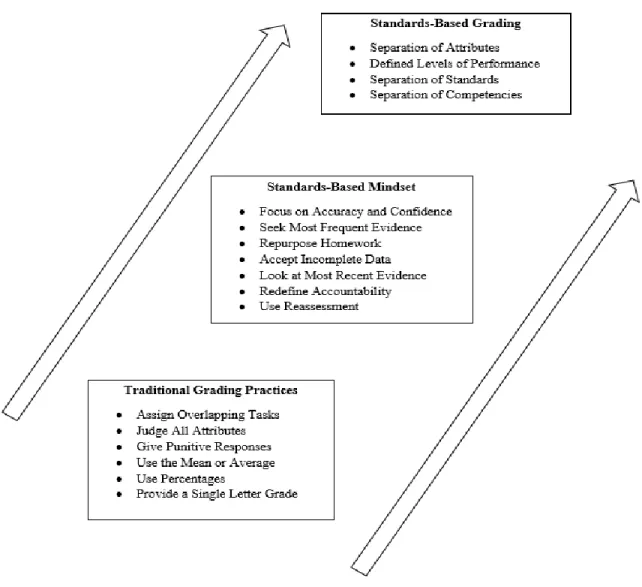
traditional grading does. Grading experts argue standards-based grading provides a more accurate description of what a student knows and can do (Guskey, 2015; Marzano, 2006; O’Conner, 2011; Schimmer, 2016). In order for educators to truly implement standards-based grading effectively, a change from traditional grading mindset must take place.
Changing the way educators teach and having a standards-based mindset means educators redefine accountability, repurpose the role of homework, and give students full credit for what they know (Schimmer, 2016). CCSS provide an opportunity for schools to move toward standards-based grading. Educators can base grades on common reference points, or standards, making it possible to develop common grading policies. Creating