How Effective are Food
for Education Programs?
A Critical Assessment of the
Evidence from Developing Countries
Sarah W. Adelman, Daniel O. Gilligan, and Kim Lehrer
International Food Policy Research Institute 2033 K Street, N.W. Washington, D.C.
Food Policy
Review
9
IFPRI
INTERNATIONAL FOOD POLICY RESEARCH INSTITUTE sustainable solutions for ending hunger and poverty ®Copyright © 2008 International Food Policy Research Institute.
All rights reserved. Sections of this material may be reproduced for personal and not-for-profit use without the express written permission of but with acknowledgment to IFPRI. To reproduce material contained herein for profit or commercial use requires express written permission. To obtain permission, contact the Communications Division <[email protected]>.
International Food Policy Research Institute 2033 K Street, NW
Washington, D.C. 20006-1002, U.S.A. Telephone +1-202-862-5600
www.ifpri.org
DOI: 10.2499/0896295095FPRev9
Library of Congress Cataloging-in-Publication Data
Adelman, Sarah.
How effective are food for education programs? : a critical assessment of the evidence from developing countries / Sarah W. Adelman, Daniel O. Gilligan, and Kim Lehrer.
p. cm.—(Food policy review ; 9) Includes bibliographical references. ISBN 978-0-89629-509-4 (alk. paper)
1. School children—Food—Developing countries. I. Gilligan, Daniel. II. Lehrer, Kim. III. Title. IV. Series.
LB3479.D443A34 2008
Contents
List of Tables v List of Figures v Foreword vii Acknowledgments ix Summary xiChapter 1 Introduction and Motivation 1
Chapter 2 The Structure and Scope of FFE Programs 5 Chapter 3 Economic Rationale for FFE Programs 9
Chapter 4 Method for Reviewing the Empirical Literature 19 Chapter 5 Empirical Evidence of the Impacts on Education 23 Chapter 6 Empirical Evidence of the Impacts on Food
Consumption and Nutrition 35
Chapter 7 Other Programs Providing Schooling Inputs 49 Chapter 8 Conclusion 53
Appendix: How an Impact Evaluation Measures Casual Effects of the Program 57
References 61
About the Authors 69
Table
Table 6.1 Study design for Murphy et al. (2003) experiment in
Kenyan primary schools 39
v
Figure
Foreword
F
ood for education (FFE) programs, including meals served in school and take-home rations conditional on school attendance, have recently received renewed attention as a policy instrument for achieving the Millennium De-velopment Goals of universal primary education and the reduction of hunger in developing countries. FFE programs attract children to school by providing nutri-tious meals in exchange for school participation. If children are undernourished, the programs may also boost learning and cognitive development by improving attention spans and nutrition. The attraction of these programs is their potential to improve both school participation and learning and cognitive outcomes by increas-ing the consumption of nutritious food by undernourished children. However, FFE programs also have their critics. They are often more expensive than other pro-grams that provide school inputs to increase school participation, and the nutrition benefits are small compared to those from nutrition programs targeting younger children. As a result, governments and donors are in the midst of a debate about the future of FFE programs.This food policy review presents a rationale for FFE programs and undertakes a critical review of the causal evidence on the impact of FFE programs on education participation and attainment, learning, cognitive development, and nutrition.
Results from the most careful studies show that in-school meals programs im-prove primary school attendance of enrolled students where initial attendance was low. Potential impacts on school participation by children not previously enrolled in school are not well known. There is mixed evidence that school meals can improve performance on math and literacy tests, and they may improve cognitive develop-ment, depending on the type of food provided, the size of the food rations, and program duration. Several well-designed controlled trials have shown that school
viii foreword
meals have a positive impact on nutrition outcomes, including anthropometry and iron status, though these results have received less support from field trials in more typical settings. There are few studies of scaled-up take-home ration programs, but one study from Bangladesh shows a significant impact on school participation. In general, FFE programs have larger impacts in areas with low school participation and on children with greater initial malnutrition. The impacts of the programs may also be higher when combined with complementary programs to improve schools or child health.
Despite a large literature on the impact of FFE programs, the authors found that many studies suffer from methodological shortcomings that limit the quality of their contributions. They argue for more carefully designed field trials to bolster the evidence. New research should directly compare alternative FFE programs and other programs with similar objectives to identify the program components that are most effective. Within FFE programs, more information is needed on how impacts on school attainment, learning, and cognitive development could be im-proved through more effective targeting, changes to the size and composition of food transfers, or provision of complementary schooling and health inputs. Side-by-side comparisons to other popular programs, such as conditional cash transfers and deworming, should also focus on the relative cost-effectiveness of achieving the broad set of education and nutrition objectives.
Joachim von Braun Director General, IFPRI
Acknowledgments
W
e gratefully acknowledge funding for this review from the Danish Min-istry of Foreign Affairs. We also thank Akhter Ahmed, Harold Alder-man, Mary Arimond, Kristian Højersholt, Marie Ruel, three anonymous reviewers, and colleagues in the Danish government for very useful comments. All remaining errors or omissions are ours.Summary
T
he economic motivations for investing in the education and nutritional status of primary-school-aged children are well established. Moreover, in-vestments in both of these forms of human capital are likely to benefit from substantial complementarities. However, in developing countries, poor and credit- constrained households routinely invest less in education and nutrition than is pri-vately or socially optimal. Food for education (FFE) programs, including meals served in school and take-home rations conditional on school attendance, attempt to improve these investments by subsidizing the cost of school participation through providing food that could improve nutrition and learning. This study examines the economic motivation for the use of FFE programs to increase investments in education and nutrition. The study then presents a critical review of the empirical evidence of the impact of FFE programs on education and nutrition outcomes for primary-school-aged children in developing countries. The main contribution of this study is to judge and summarize the strength of the evidence based on the extent to which existing studies have identified a causal effect of an FFE program, as opposed to finding an association between the program and key outcomes that may have been affected by other contextual factors.The economic rationale for FFE programs is to offer free food conditional on school attendance to increase the net benefits of schooling enough to change some households’ decisions about their children’s school participation. Although school-aged children are past the critical window of opportunity during early childhood for the greatest gains from good nutrition, increasing food and nutrient consump-tion among school-aged children with low baseline food energy or micronutrient intake can improve weight, reduce susceptibility to infection, and increase cognitive function in the short run. Because school meals are usually fortified, a child’s micro- nutrient intake can improve even if her total calorie consumption does not. These
short-run gains may improve a child’s educational attainment and academic achieve-ment, which can improve future welfare.
For logistical and political reasons, school meal programs are commonly pro-vided to all children in a targeted school. This practice raises the cost of achieving program objectives, such as increased attendance rates, because it provides transfers to many children who would have attended school anyway. Take-home rations programs are less subject to this criticism, because they are more easily targeted to groups, such as poor or female children, who are in greater need or who may be more likely to change their human capital investment decisions as a result of the program.
Even when provided at school, food transfers can be diverted to other house-hold members by taking food away from the beneficiary child at other meals. This practice could diminish the size of the transfer received by the beneficiary child, resulting in only a small net gain in the child’s daily consumption. However, empiri-cal evidence suggests that a substantial share of the food provided through in-school meal programs is not redistributed away from the beneficiary child.
The critical review examines the empirical literature on the impacts of FFE programs on education and nutrition outcomes. The education outcomes consid- ered include school participation measured by enrollment and attendance, age at entry, drop-out status, learning achievement, and cognitive development. The nutri- tion outcomes reviewed include food energy consumption, anthropometry, and micronutrient status. The review focuses on the empirical literature with the strongest methodology for identifying causal impacts. This literature includes experimental studies, such as randomized controlled trials; experimental field trials; studies using quasi-experimental methods, such as natural or administrative experiments; and nonexperimental studies using careful evaluation designs. Although the literature on the impacts of FFE programs is vast, high-quality studies with evaluation designs that provide causal impact estimates are relatively few. The nutrition literature offers many more experimental studies on nutrition outcomes than is yet available in the economics literature on education outcomes, yet many of the nutrition studies are controlled trials in which many components of the intervention typically affected by behavior, such as amount of food available at a meal, are closely managed. The external validity of these studies for programs implemented in the field is often dif-ficult to ascertain. The number of experimental field studies for any outcome is few, but growing. From the existing literature, it is possible to draw conclusions about the likely impact of FFE programs on some outcomes, whereas for other outcomes, the literature is inconclusive.
The empirical evidence suggests that in-school feeding has a positive impact on school participation in areas where initial indicators of school participation are low. In-school meal programs have been shown to have small impacts on school
attendance rates for children already enrolled in school. However, there is no causal evidence for an impact on net primary-school attendance rates for all school-aged children in the service area of a school because of limitations in study design. The only study we found with attendance data for a representative sample of primary-school–aged children, including those enrolled in school at baseline and those not enrolled, found a strong association between participation in a school meal program and school attendance, but estimated impacts cannot be reliably attributed to causal effects of the program. For similar reasons, there is also scant evidence on the effects of school meals on primary-school enrollment rates.
Two empirical studies find that school meal programs cause a significant in-crease in learning achievement, as measured by improvements in test scores. How-ever, in each study, scores were significantly higher for school meal recipients on only one of three tests taken. The impact of in-school meals on learning appears to operate both through improvements in school attendance and through better learn-ing efficiency while in school, though no study has separately identified the relative contribution of these effects.
FFE programs may also have an impact on cognitive development, though the size and nature of the effect vary greatly by program, micronutrient content of the food, and the measure of cognitive development used. Empirical evidence on the effects of school meals on cognitive function is mixed and depends on the tests used, the content of the meals, and the initial nutritional status of the children. Most of the studies are conducted in a laboratory setting and look at the short-term impact of feeding on cognitive function. The aspects of cognitive ability tested differ by study, making it difficult to compare results. Nonetheless, there is evidence that school meals rich in animal-source foods improved cognitive function in Kenyan children. Another study demonstrates an effect of school breakfasts on cognitive function. Given the controlled setting that formed the basis for these experiments, it would be useful now to expand the external validity of the evidence through field experiments.
On other outcomes, the evidence of the impact of in-school feeding on primary-school drop-out rates is inconclusive. We also found no study that examines the impact of school meals on age at school entry, probably because of the expense of collecting data on a representative sample of children around this age. Also, there is little conclusive evidence on the impact of take-home rations on education outcomes.
For nutrition outcomes, most of the evidence comes from randomized trials in the nutrition literature. For food-energy (calorie) consumption, the evidence shows that in-school feeding programs show greater potential to improve children’s total daily energy consumption when children’s baseline consumption is well below their age- or weight-recommended consumption level. Differences in empirical strategy
may account for differences in findings across studies, as randomized experiments found a lower impact than did quasi-experimental studies.
The diversity of program components and target populations in anthropo- metric studies, as well as the complexity of biological growth mechanisms, make it difficult to assess the effectiveness of FFE on anthropometric indicators. Overall, sev-eral studies showed gains in body size (for example, height, weight, body mass index) or composition (for example, mean upper-arm circumference) due to participation in FFE programs, with weight or body mass index appearing to respond most often. Improvements were typically small, though the effects of increased consumption may have been mitigated by increased activity levels in some cases. The micronutri-ent contmicronutri-ent of foods provided may contribute to gains in height (iron fortification) and mean upper-arm circumference (providing meat-based snacks). Deworming ap-pears to have an interactive effect with FFE on height in one study.
Turning to micronutrient status, iron fortification of FFE meals appears to improve iron status in nearly all studies reviewed. Evidence for other micronutrients is more sparse. One study found that meat-based meals improve plasma vitamin B12 concentrations but found no impact on other micronutrients. Two studies re- viewed the impact of FFE on vitamin A status: one found a positive effect on plasma vitamin A status, whereas the other found no impact. Finally, one study found that iodine fortification reduced the prevalence of iodine deficiencies. The presence of malaria or other infections may impede detection of these benefits, particularly with respect to iron status. Combining the treatment with deworming can improve the effectiveness of iron supplementation, particularly in children with low baseline iron stores.
Summarizing this evidence, FFE programs appear to have considerable impacts on primary-school participation, but the quality of this evidence is weak. Higher quality studies indicate some impacts on learning and cognitive development. There is evidence of effects on food consumption and micronutrient status, provided that initial consumption and nutrient deficiencies are identified and that programs are tailored to address these deficiencies. In many cases, the FFE programs appear to have little impact, because the levels of key outcome variables, such as school at-tendance or micronutrient status, are already high.
Despite this evidence, significant research gaps remain. A surprising gap in this literature is the lack of convincing evidence of these programs’ effect on school enrollment and attendance for a representative sample of school-aged children from the school’s service area. There is also no conclusive empirical evidence on the im-pact of FFE programs on age at entry and grade repetition, and little on drop-out rates. In general, the impacts of take-home ration programs are poorly understood. Also, few studies identify the differential impacts of FFE on children by age or
gender. Finally, the impact of FFE programs on learning achievement has not been carefully analyzed by schooling inputs and class size.
Perhaps the greatest omission in current research on FFE programs is the ab-sence of well-designed cost-effectiveness studies. The policy decision on whether to undertake an FFE program or an alternative education or nutrition inter- vention should be based on relative differences in cost-effectiveness. However, most studies that measure program impact do not collect the additional data needed to obtain a measure of cost-effectiveness. Such studies would identify the cost from various interventions of achieving a certain percentage increase in primary-school attendance, for example. The most convincing approach would be to conduct side-by-side randomized field experiments of alternative programs. To our knowledge, only one study has done so, comparing in-school meals to programs that provide teachers with school supplies or foster parent–teacher communication. However, even these comparisons are complicated by the scarcity of programs likely to have the same kind of combined impacts on both education and nutrition outcomes.
The most immediate policy implication of this review study is that more care-ful and systematic research is needed to find the most cost-effective combination of programs available. Without rigorous estimates of the impact of FFE programs on school participation, it is not possible to determine whether important secondary effects on learning achievement or cognitive development come primarily through school attendance or through joint effects of schooling and improved nutrition. It is these joint effects that are uniquely available through FFE programs. If the learn-ing and cognitive benefits to school-aged children of simultaneous improvements in nutrition and schooling from FFE programs are small, cash-based programs may be more effective at increasing school participation. If there are no joint education and nutrition effects from FFE programs, it may be more cost-effective to replace these programs with specialized education and nutrition programs that are more narrowly targeted at specific objectives. More comprehensive and rigorous evalua-tion studies of FFE programs are needed to determine the full scope of the impacts of these programs and their relative cost-effectiveness.
Our interpretation of the empirical evidence reviewed here leads to several recommendations on the design and use of FFE programs. Effects tend to be larger where schooling participation is low or where there are significant nutritional de-ficiencies. This fact argues for doing an assessment of school needs in target areas before starting an FFE program. Such an evaluation would improve targeting and allow FFE program components, such as the nutrient composition and quantity of food, to be tailored to local needs. Also, program administrators should be willing to consider complementary programs to improve school quality. Learning effects cannot be achieved if the instruction is of little value. Poor school quality lowers
the benefits of participation and discourages attendance. Though much more evi-dence is needed, results from field experiments in the Philippines suggest that the cost of alternative programs to improve school quality may be only a fraction of the per child cost of an FFE program. Coordinated programs that combine FFE with improvements in school quality may be much more effective.
C h a p t e r 1
Introduction and Motivation
F
ood for education (FFE) programs, including meals served in school and take-home rations conditional on school attendance, are a common tool used to attract children to school and to reduce short-term hunger to help students concentrate and learn. FFE programs operated by the World Food Pro-gramme (WFP) reached 21.6 million children in 2005 (WFP 2004), and many governments operate publicly funded FFE programs. For example, Brazil’s national school feeding program covers 36 million children aged 0–14 (WFP 2006). These programs are also advocated as important interventions for improving the human capital of school-aged children. The Millennium Development Goal (MDG) Task Force Report (Birdsall, Levine, and Ibrahin 2005) on achieving the Educa-tion MDG cites FFE programs as one important approach to attract children to school and improve learning. The MDG Task Force Report on Hunger (Sanchez et al. 2005) acknowledges FFE programs as an indirect nutrition intervention that can contribute to the reduction of malnutrition among school-aged children. Although some policymakers and donors push for expanding FFE programs, many question their cost-effectiveness. A recent report by the World Bank (2006) criticizes FFE programs because they are not targeted at the vital first two years of life and they divert resources away from less costly nutrition interventions.To inform this ongoing debate, this study examines the rationale for FFE pro-grams and conducts a critical review of the empirical evidence of their impacts on education and nutrition outcomes. Several recent studies have addressed the rationale for FFE programs or the empirical evidence of their impacts, including results of a recent experts seminar (WFP 2006), as well as Rogers and Coates (2002), Caldes and Ahmed (2004), and Kristjansson et al. (2007). The research behind this review has benefited greatly from these earlier studies. Although there is an extensive literature on the potential impacts of FFE programs, the strength of the evidence
varies greatly, depending on study design and methods of analysis. The main con-tribution of this study is to provide a critique of the literature on FFE program impacts, judging the strength of the evidence based on the extent to which existing studies have identified a causal effect of an FFE program as opposed to finding an association between the program and key outcomes that may have been affected by other contextual factors.
Often the primary objective of FFE programs is to increase school participation; these programs have been a common tool in developing countries seeking to establish universal primary education. However, the use of food rather than cash as the form of transfer acknowledges that hunger plagues many poor students at school, which may discourage school attendance and also impede learning. Many developing-country governments and international organizations implementing FFE programs have rec-ognized that, by fortifying the food with protein and key micronutrients, they may also be able to improve child nutritional status and reduce morbidity, and so have an additional positive effect on regular school attendance and learning.
Despite these advantages, FFE programs are often criticized as an expensive method for producing the stated education and nutrition objectives. For specific education or nutrition outcomes, other, more cost-effective interventions may exist. Other criticisms include that school meal programs may divert class and teacher time away from learning. In addition, logistical and political considerations often make it difficult to effectively target the program to children who are in greatest need or who are most likely to change their behavior (and begin attending school, for example) as a result of the program. Consequently, many programs choose to supply meals to all students. Although this practice prevents claims of inequity, it raises the cost of achieving program objectives, such as increased attendance rates, because it provides transfers to many children who would have attended school anyway. Also, food transfers, even when provided at school, can be diverted at home by taking food away from the beneficiary child at other meals. This practice may be a rational household decision, but it decreases the potential impact of an FFE program on the target child’s outcomes.
Developing a consensus on the desirability and cost-effectiveness of FFE pro-grams in developing countries has been most difficult with regard to the nutrition objectives. The recent World Bank (2006) report on nutrition refocuses attention on the importance of nutrition interventions that reach children during pregnancy (fetal life) and the first 2 years of life. This period has been referred to as the window of opportunity, because it is a period of accelerated physical growth in which nutri-tion intervennutri-tions are most needed and have the greatest impact on child survival, health, and development. Nutritional deficits during this period result in largely irreversible damage. In considering the nutritional impacts, the report criticizes FFE
programs not only because they arrive too late in the life cycle, but also because they divert resources away from interventions targeting this most critical period of life for nutrition investments.
However, this critique fails to adequately account for the education objectives of school feeding and the potential joint benefits of feeding hungry children dur-ing school. Although the lifetime net nutritional benefits of nutrition investments before age 2 outweigh those made later, educating children is also critical to hu-man capital formation and can have substantial returns later in life (Schultz 1988; Glewwe and Kremer 2006). There is substantial empirical evidence that the eco-nomic returns to education are high in developing countries (Psacharopoulos 1985, 1994; Duflo 2001). Education also changes behavior in ways that reduce fertility and improve the health and nutritional status of current and future generations (Strauss and Thomas 1995; Schultz 1997, 2002a,b).1
An assessment of the desirability of funding FFE programs should consider all potential effects of the programs across education, nutrition, and other objectives. Moreover, policy decisions should ultimately be made on the cost-effectiveness of FFE programs relative to alternative education and nutrition programs. Two shortcomings of the existing literature on FFE program impacts are that many studies focus on a limited set of education or nutrition outcomes and that a heavy emphasis is placed on identifying the benefits or impacts of FFE programs without much con-sideration of the costs. With this caveat in mind, the review examines the strength of the evidence on the impacts of FFE programs, to better inform the policy debate and identify important gaps to be addressed in future research.
The scope of this review includes the empirical literature in economics and nu-trition on the impact of programs that provide food transfers conditional on school participation, such as subsidized school meals and take-home rations, on outcomes in primary school where these programs are most common. In addition, the review emphasizes that part of the empirical literature with the strongest methodology for identifying causal impacts. This literature includes experimental studies, including randomized controlled trials; experimental field trials, which have higher external validity; and studies using quasi-experimental methods, such as natural or admin-istrative experiments that identify impacts by exploiting a quasi-random compo-nent of program eligibility. The review does not address several related outcomes, including class size and local agricultural production. We also exclude nutrition supplementation or fortification trials conducted in developing-country primary schools that do not include schooling improvements as outcomes.
introduction and motivation 3
1See Behrman (1999), Huffman (2001), and Glewwe (2002) for reviews of the impacts of education
This study is organized as follows. Chapter 2 describes the structure and scope of FFE programs. Chapter 3 describes the economic rationale for these programs and explores the mechanisms by which school feeding may affect economic and nu-trition outcomes. Chapter 4 describes the methods used to select candidate studies for the review of the empirical literature. Chapter 5 reviews the empirical evidence on impacts of FFE programs on education outcomes. The education outcomes con-sidered include school participation measured by enrollment and attendance, age at entry, drop-out status, learning achievement, and cognitive development. Chapter 6 reviews the empirical evidence for effects on nutrition outcomes, including food-energy consumption, anthropometry, and micronutrient status. We compare the relative impacts of FFE programs to those of alternative programs that provide schooling inputs and discuss the limited evidence on relative cost-effectiveness, where it exists, in Chapter 7. Chapter 8 concludes.
C h a p t e r 2
The Structure and Scope
of FFE Programs
FFE Modalities
F
FE programs generally take two forms: in-school meals and take-home ra-tions. The major objectives of both modalities are the same: to improve edu-cation outcomes and increase food consumption, and possibly nutritional status, of children. However, differences between these two modalities suggest that they may not be equally effective or may affect different aspects of education and nutrition. Among the differences between the programs are the likely timing of food consumption during the school day; who controls and distributes the food; the ability of recipient households to divert the food to other family members; and the quality of food stemming from differences in storage, sanitation, and preparation practices. The composition of the food provided is also often different. Take-home rations are more likely to be single, nonperishable food items, such as cereals or oil. Moreover, in the FFE modality, individual programs can be implemented very dif-ferently to achieve specific desired results.In-School Feeding Programs
In-school feeding programs provide food to children while they are attending school. This food can take the form of breakfast, snack(s), and/or lunch. School meals vary in the quantity of food provided and in their nutritional content, and so their expected impacts also vary. In some cases, the food may be fortified, for example, with vitamin A or iron. School meals are often prepared on site, requiring kitchen facilities, cooking staff, eating and serving utensils, and a space at the school for consuming the meal, making these programs relatively costly to operate. Schools serving meals must set aside time to serve the food, which could disrupt learning,
if time for meals would not otherwise be provided. Some programs also offer other health, nutrition, or education programs jointly with in-school feeding. These pro-grams have included deworming, improving school quality and infrastructure, and providing health education. Unlike in the United States, for example, where school meals are targeted to selected students through exclusive breakfast before school or a targeted subsidy of lunch already available for sale, in developing countries, it is often infeasible or undesirable to target individual students for school meals. As a result, all students in program schools receive the food, substantially raising costs.
By providing food at school during the school day, in-school feeding has two advantages over take-home rations. First, it provides an incentive for school at-tendance directly to the child, rather than through the parents, as with take-home rations. Second, well-timed school meals alleviate short-term hunger, possibly im-proving students’ ability to concentrate and learn (Caldes and Ahmed 2004). Al-though it is also possible that take-home rations can achieve this goal, this outcome is not explicit in the take-home rations design.
Take-Home Rations
Take-home rations are food rations given to the household conditional on a child’s enrollment in school and a minimum level of attendance. Usually the ration is given monthly. A common requirement, though often weakly enforced, is that children attend at least 80–85 percent of school days to maintain eligibility for the program. Because the transfer is directed to the household and not the child, the welfare gains may be more dispersed.1 The household can redirect the food ration to whomever
it desires or sell it for other goods or cash. In this sense, the ration is comparable to an income transfer. Take-home ration programs place less emphasis on alleviat-ing short-term hunger for children at school, focusalleviat-ing instead on improvalleviat-ing food security at the household level (Pollitt 1995). It is often much less costly than in-school feeding and does not take time away from learning. In practice, take-home ration programs are often cheaper to operate, because they are more easily targeted, for example, toward poor households. Although it is often infeasible in developing countries to restrict in-school meals to specific children, either for logistical or politi-cal reasons, take-home rations are routinely provided to a select set of children. For example, the WFP sometimes targets take-home rations exclusively to girls, who often lag behind boys in school attendance. In some cases, these take-home rations are provided as a top-up transfer to girls: an additional incentive in areas where all primary-school children receive in-school meals (WFP 2005).
6 chapter 2
1As described below, this effect depends on whether the transfer is inframarginal with respect to the
The Scope of Today’s FFE Programs
It is difficult to know the full scope of FFE programs in developing countries, but a summary of the programs currently operated by the WFP, likely the world’s largest provider of in-school meals and take-home rations outside of a single country, gives a good indication of the typology and popularity of FFE programs. According to Gelli (2006), WFP’s FFE programs reached approximately 21.6 million children in 72 countries in 2005. In addition to in-school meals and take-home rations, WFP sometimes provides fortified biscuits for distribution at school. Nearly half of WFP FFE programs combine these modalities for linking food to school participa-tion. In 24 percent of FFE schools, only fortified biscuits are provided, whereas 22 percent of program schools use only on-site meals and 6 percent use take-home rations exclusively. On average, in-school meals provide 876 kcal of food energy per child per day; biscuits provide 313 kcal of energy.2
The average cost of running FFE programs at WFP in 2005 was US$15.79 per child per year. The cost of on-site meals alone was slightly higher, whereas that of biscuits averaged US$9 per child. For take-home rations, the annual average cost was much higher (US$30) because of transport costs and differences in food bundles. In addition to the food, WFP also supports complementary activities to improve child health. For example, deworming is provided in 56 percent of WFP-assisted schools; micronutrient supplements are provided in 40 percent of schools; hand-washing facilities are provided in 51 percent of FFE beneficiary schools. In some cases, WFP partners with nongovernmental organizations (NGOs), the country government, or other United Nations agencies to provide complementary school facilities and services.
Many countries operate their own FFE programs without support from WFP. One such program is the national school-feeding program in Brazil, a universal school meal program covering public and religious schools operating since 1955 (WFP 2006). In 2006, the program reached 36 million children aged 0–14. Many other countries operate similar programs, but it is beyond the scope of this study to summarize their incidence and operation.
the structure and scope of ffe programs 7
C h a p t e r 3
Economic Rationale for FFE Programs
Conceptual Framework
F
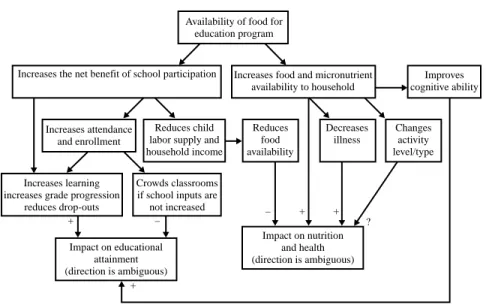
igure 3.1 shows the pathways through which FFE programs may affect par-ticipants’ education and nutrition outcomes. FFE programs increase the benefits of school participation, which leads to increases in enrollment and attendance. These increases may improve learning and educational achievement, which may be bolstered by improved nutrition and associated gains in cognitive function.FFE programs improve nutrition and health by directly increasing household food availability, but the net effect on current nutritional status could be negative because of income loss resulting from increased school participation. If an FFE pro-gram is not accompanied by increased school capacity, classrooms may be crowded, leading to negative effects on learning. Thus, well-run programs that provide rea-sonably nutritious meals should have positive impacts on school participation, learning, and child dietary intake. However, the size of these effects depends on various programmatic and contextual factors. In some cases, they may be small or even negative.
The next two sections discuss these mechanisms in detail for both in-school feeding and take-home ration programs. The first section looks at the impacts of both programs on education outcomes, and the next one looks at the theoretical impacts on nutrition.
Theoretical Impacts on Education
The primary rationale for FFE programs is to promote households’ investments in the human capital of their children, particularly investments in education but also
in nutrition. Levels of education attainment remain extremely low in many develop-ing countries, despite substantial evidence that both the private and social returns to education are high (Hanushek 1986; Schultz 1988). To understand how FFE programs redress this underinvestment, it is necessary to consider how households decide on schooling investments.
Parents decide how much to invest in the education of each of their children by comparing the potential future benefits of this education to current costs.1 The
cur-rent value of these benefits is affected by the household’s discount rate—how much it values improvements in its current being over future improvements in well-being. The costs of education include both direct and indirect costs. Direct costs can include those of school fees, supplies, books, uniforms, and travel to school. Indirect costs include the opportunity cost of a child’s time. These opportunity costs include the value to the household of the activities the child foregoes by attending school, such as caring for other family members, working on a family farm or business, or working outside the household to provide additional income. Households will not send their children to school if the costs of schooling exceed the expected benefits, or if the household is unable to finance the schooling investment, either directly or through credit.
10 chapter 3
Figure 3.1 Potential benefits of food for education programs
1The future returns to education can include higher earnings in adulthood, improved marriage
out-comes, and better health for current and future generations.
Increases the net benefit of school participation Increases food and micronutrient availability to household Reduces food availability – + – + + + ? Impact on nutrition and health (direction is ambiguous) Impact on educational attainment (direction is ambiguous) Increases attendance and enrollment Increases learning increases grade progression
reduces drop-outs
Crowds classrooms if school inputs are
not increased Reduces child labor supply and household income Decreases illness Changes activity level/type Improves cognitive ability Availability of food for
FFE programs lead to greater investment in education primarily by subsidizing these schooling costs. Moreover, the food provided in the program can also help the child learn more effectively, thereby increasing the returns to education in the future. Below we consider the mechanisms by which FFE programs impact various schooling outcomes, including school participation, age at entry, grade repetition, drop-out rates, classroom behavior, learning achievement, and cognitive develop-ment. We focus first on in-school meals and then consider how these impacts differ for take-home rations.
In-School Meals
The availability of subsidized in-school meals will increase school enrollment rates if the program changes the household’s schooling decision for some children who would not have been enrolled in school otherwise. Changing the school enrollment decision to a positive one for these households requires that the net benefits of participating in the program exceed the gap between direct and opportunity costs of schooling and the expected benefits of schooling. The magnitude of the increase in enrollment rates depends in part on the size of the transfers relative to the size of this cost–benefit gap for these households. Because many children would have enrolled in school without the program or with a less-generous program, the in-ability to target in-school meals only to those children whose enrollment decision would be changed by the program raises the cost of the program per additional student enrolled.
In-school meals can also be effective at increasing school attendance rates be-cause children receive the meal only on days when they attend. Bebe-cause the oppor-tunity cost of a child attending school can vary across school days—according to seasonal demand for agricultural labor, for example—the effectiveness of in-school meals at changing school attendance rates depends on the value of the meal relative to the difference between the cost and expected benefit of school attendance on a given day.
Furthermore, school attendance may be affected through improved nutri-tional status. Three aspects of nutrition may influence school attendance through in-school feeding. The first is the short-term impact of in-school feeding. In-school feeding alleviates a child’s short-term hunger during the school day, by providing more nutrients to the child, providing the child with a meal when he or she would have not otherwise have had one, or replacing a meal that would have been received after school with one during school hours. A child who is not hungry during school hours is able to concentrate better and learn more (Grantham-McGregor, Chang, and Walker 1998). Such a child may benefit more in terms of learning from a day of school than would a hungry child, which may impact households’ school-ing choices. Additionally, the child may prefer to attend school when he or she is
not hungry. The second nutrition-related influence of school feeding on school attendance is through the longer run benefits of program-induced improvements in nutrition. Sustained nutrition improvements through school feeding could im-prove a child’s physiological capacity for learning, which has a direct effect on the benefits of schooling and an indirect effect by increasing the child’s desire to attend school. Finally, in-school meals may improve attendance through nutrition by reduc-ing morbidity. In many developreduc-ing countries, morbidity is a leadreduc-ing cause of missed school days. Improved nutrition, especially adequate intake of micronutrients, can strengthen the immune system and reduce the incidence and severity of infectious diseases among children (Scrimshaw and SanGiovanni 1997). Therefore, if in-school meals improve children’s nutritional status, they may reduce morbidity and decrease the number of school days missed from illness, thus increasing attendance.
Children may begin primary school at a different age than the country’s sug-gested starting age for many reasons. These include lack of funds, lack of childcare, and a perception of limited benefits of attending school at the recommended age. Delayed schooling is very common in developing countries, with many children starting school much later than the recommended age (regarding Sub-Saharan Af-rica, see UNESCO Institute for Statistics 2001). In-school meals are most likely to affect age at entry through an income effect. That is, the food provided effectively increases household income and directly raises the benefits of attending school. This income effect will be large enough to cause some households to start their child in school at a younger age. Thus, average age at entry should decrease. Age at entry may also be influenced by neighborhood effects that result from the school feed-ing program. If, in a given neighborhood, households tend to send their children to school earlier with the introduction of school feeding, then there may be social pressure on those who have not yet enrolled their children to do the same.
The effect of in-school feeding on grade repetition, drop-out rates, learning achievement, and school performance are all interrelated. This effect works through two mechanisms: attendance and nutrition. The attendance channel can be de-scribed as follows. In-school feeding improves children’s attendance, so they spend more hours learning in school. This attendance impact should allow them to learn more and, as a result, improve their school performance, decreasing their likelihood of repeating a grade or dropping out. This mechanism is dependent on the level of school quality, including teacher/student ratios; the availability of schooling inputs, such as textbooks and pencils; and teacher quality. If school meals increase enroll-ment rates and attendance, as expected, classrooms may become overcrowded, and teaching quality may decrease. Similarly, if school feeding represents a significant burden on the teachers’ time, learning time may be reduced. Thus, unless additional financial and human resources are available, school feeding programs have the poten-tial to worsen school performance and increase drop-out rates and grade repetition.
As with school participation, the effect of in-school feeding on other measures of school retention and performance may be enhanced through improved nutri-tion. This mechanism operates through two channels. The short-term impacts of providing children with a meal during the school day may alleviate hunger and help them to concentrate and learn better, thereby improving school performance and retention. The longer run effects are conditional on in-school meals improving the nutritional status of children and on nutritional status affecting the ability to learn. Furthermore, the impact of in-school feeding on education will vary, depending on the initial nutritional status of the child.
Pollitt (1995) discusses two biological mechanisms through which breakfast can affect cognition. By extension, these mechanisms are present in an in-school meal setting, be it breakfast, snack, or lunch. The first is the short-term metabolic and neurohormonal changes that are associated with the immediate supply of en-ergy and nutrients to the brain. Brain function is sensitive to these changes. If an overnight fast is extended because a child does not eat breakfast, insulin and glucose levels gradually decline, resulting in a stress response that interferes with different aspects of cognitive function. If this stress occurs frequently, it is likely to have a cumulative effect. This sequence is the second biological mechanism discussed by Pollitt, which pertains to the long-term impacts of the sustained contributions of breakfast to a person’s health status, which in turn affects cognitive development. To the extent that the in-school meal is, at least in part, an addition to the child’s usual nutritional intake, then this second mechanism should also occur with other in-school meals. It should then improve the nutritional status of a child in the long run. In addition, when the school meal is nutrient fortified, it may prevent or reduce nutritional deficiencies that affect cognition, such as iron deficiency.
Take-Home Rations
Many of the mechanisms through which in-school meals can affect education out-comes also exist for take-home rations. This commonality is particularly true for impacts that derive primarily from the income effects of the transfer. However, differences in education effects between the two modalities arise for three reasons: (1) differences in how households redistribute food among their members under the two modalities, (2) constraints on the timing of meals with take-home rations, and (3) differences in the type of food provided. To consider the first two effects, assume that both programs would provide the same quantity and composition of food to the household over the course of a month.
The first effect represents a dilution of food transfers to the targeted child. With take-home rations, the entire household is targeted by the food transfers, as opposed to just the school-going child. When the rations are received at home rather than at school, it easier for the household to redistribute the food to other household
members. In theory, if the quantity of food provided to a child through school meals is inframarginal, meaning that it is less than the child would consume that day in the absence of the program, the household could redistribute food at other meals to other household members and achieve the same daily allocation of food to all members as it would with take-home rations. If the school meal is extramarginal—if it is more than the child would consume otherwise—it is not even theoretically pos-sible for the household to achieve the same intrahousehold allocation of food as with take-home rations. In practice, even inframarginal food transfers through in-school meals may be difficult for a household to redistribute through substitution at other meals, if social norms make it unacceptable to sharply reduce a child’s consump-tion at other meals. This discussion assumes that the timing of food consumpconsump-tion during the day is inconsequential and that only total daily intake matters. If timing of consumption matters, the second effect becomes operative.
The second effect arises because of differences in the likely timing of food consumption under the two modalities. In-school meals benefit from timely provi-sion of food to students during school hours, which can increase concentration and the ability to learn. These effects can only be replicated under a take-home rations program if children are able to carry a meal of equivalent quantity and quality with them to school or are able to consume a meal at home at the same time of day. The relative effectiveness of the two modalities depends on the optimal time of day to provide food to maximize the learning benefits. Also, it is harder to approximate the timing of some meals through take-home rations than others, particularly if these are “wet” rations, or those that must be prepared at the time they are consumed. If the school meal is provided at breakfast, the benefits of this meal are fairly eas-ily replicated at home with breakfast before school under the take-home rations program. This parity holds unless the child has to travel a great distance to school, and so must eat breakfast at home using take-home rations well before she would receive the food at a school breakfast. If a school meal of wet rations is provided as a mid-morning snack or school lunch, achieving the same effects through take-home rations would require that the child go home for the meal, disrupting the school day. Alternatively, if the learning benefits of consuming breakfast outweigh those of lunch, and the school meal is suboptimally timed for later in the day, the meal could be better targeted at breakfast through take-home rations.
The third effect arises if the composition of the take-home ration differs from that of the in-school meals. In-school meals often include milk products or other nutrient-dense foods, whereas take-home rations primarily include cereals and oils, which may or may not be fortified. If foods provided through the program are more nutritious than foods eaten at home, then the impact of the program on the quality of the child’s diet is dependent on the share of the child’s daily consump-tion that comes from the program food. In this case, in-school meals would likely
provide a better quality diet for the child than take-home rations. This difference in diet quality may lead to better educational performance. However, these dif-ferences in impacts arise from the application of take-home rations and in-school meals in practice and do not derive directly from differences in the two modalities of food delivery.
Theoretical Impacts on Nutrition
FFE programs have come under scrutiny recently for targeting children who are too old to reap lasting morbidity and anthropometric benefits of improved calorie and micronutrient consumption.2 However, FFE programs can reduce short-term hunger
and micronutrient deficiencies, which can increase cognitive function and resistance to intestinal and respiratory infections (Jamison et al. 1993, 2006).3 FFE programs
may also provide an important nutritional intervention during an often overlooked critical growth period. With delayed starts to schooling and repeated grades, many children in primary schools in developing countries have already reached adoles-cence. As adolescents can gain as much as 15 percent of adult height and 50 percent of adult weight, their energy requirements are very high during this period. Adoles-cent girls, in particular, have high nutrient and micronutrient demands. Although malnourished adolescent girls do catch up to well-nourished girls during puberty, their growth is delayed. This delay can mean that a malnourished girl is not finished growing at the time of her first pregnancy (Gillespie and Flores 2000), which can increase the risk of complications and of maternal and infant death.
FFE as an Intrahousehold Resource Allocation Issue
While providing a direct transfer to nutritionally vulnerable children would seem like a reasonable approach to offset intrahousehold nutritional inequalities, tradi-tional intrahousehold resource allocation models (Samuelson 1956; Becker 1973) predict that households will treat these targeted transfers in the same way that they treat income transfers to the household as a whole. In these highly criticized models, household members pool their income, including transfers to children, and make consumption decisions according to a single household preference structure. As such, the models predict that regardless of which household member receives a transfer, household consumption will be affected in the same way. With respect to
economic rationale for ffe programs 15
2A counterexample to this claim is provided by a study from the Philippines (Adair 1999) that shows
that children aged 2–12 who were previously stunted can experience catch-up growth.
3A considerable body of literature suggests that both educational attainment and cognitive ability
improve adult productivity and earnings. For a review of literature linking educational attainment and wages, see Psacharopoulos (1994) and Psacharopoulos and Patrinos (2004); see, for example, Cawley, Heckman, and Vytlacil (2001) for evidence of cognitive ability’s effect on wages.
school feeding, these models predict that when children receive food at school, they receive less food at home. Assuming that the school-feeding transfer is inframarginal (less than the child’s usual consumption), the transfer is equivalent to a change in household income equal to the value of the transfer and is distributed accordingly. These models suggest the same outcome regardless of whether FFE programs are administered as in-school feeding programs or take-home rations.
More recent household models, which fall under the umbrella of “collective models” (see Chiappori 1988, 1992; Browning et al. 1994; Browning and Chiappori 1998), suggest that household income is treated differently depending on which household member receives the income. As such, these models predict that targeted transfers, including school-based feeding programs, can be more effective at improv-ing specific household members’ outcomes than transfers given to households as a whole. Household bargaining models (Manser and Brown 1980; McElroy and Horney 1981) are a form of collective model in which specific assumptions on the origins of the sharing rule are made.
Several recent empirical studies, although not providing direct support for these collective models, have shown that intrahousehold allocation, hence the transfer beneficiary, depends on which member brings income into the house and whether the income is conditional or unconditional (Thomas 1990; Duflo 2003; Quisumbing 2003; Quisumbing and Maluccio 2003; among others). In particular, these studies show that child anthropometric outcomes improve when mothers control more household income. For example, Duflo showed that girls living with a grandmother who received a government pension gained more weight than did girls living with grandfathers who received this pension. Quisumbing (2003) found that intrahousehold beneficiaries also change, depending on whether the transfer is conditional or unconditional.
As children are not typically involved in household resource-allocation deci-sions, it is unclear, theoretically, how providing children with a transfer will affect how the transfer is used. However, as care of children and allocation of food is typically under women’s control, school feeding transfers are likely similar to pro-viding a transfer to the mother, and are therefore more likely to be targeted toward improving children’s health and nutrition (Rogers and Coates 2002). Additionally, Kooreman (2000) argued that child transfers generate a “labeling” effect in which child transfers actually change parental preferences in favor of child goods, increas-ing the percentage of the transfer benefitincreas-ing the targeted child. Thus, school feedincreas-ing may be an effective method of improving school-aged children’s consumption.
Differences in Outcomes Based on FFE Modality
The resource allocation models described above predict that FFE programs that provide inframarginal transfers will have the same impact on consumption whether
they are provided in school or as take-home rations. However, these models ignore the potential differences in effects of school meals and take-home rations on educa-tion outcomes meneduca-tioned earlier in the chapter. That is, outcomes may differ be-tween modalities depending on the importance of the timing of food consumption and the potential for differences in the composition of food transfers in practice between the two types of programs. Overall, the timeliness of food consumption may be less important for nutritional status than for learning performance. Differ-ences in micronutrient content of foods between the two modalities are likely to have more direct effects on nutritional status than on school participation, but they may have important effects on cognitive development.
C h a p t e r 4
Method for Reviewing
the Empirical Literature
Criteria for Selecting Studies for Review
T
he objective of the literature review is to summarize and critique the evi-dence from studies using rigorous methods to identify the impact and cost-effectiveness of programs for subsidized school meals or take-home rations in developing countries on outcomes in primary school, where these programs are most common. To identify candidate studies for the review, we used searchable electronic bibliographical databases with broad coverage of mostly peer-reviewed research in economics and nutrition, including ECONLIT and MEDLINE.1 Wealso consulted with several colleagues who are familiar with this literature to identify relevant unpublished or very recent studies.
To be selected for the review, a study must: (1) address the impacts or cost- effectiveness of free or subsidized FFE programs (in-school meals or take-home rations conditional on school attendance), (2) use as primary subjects primary-school-aged children in developing countries, (3) focus on selected education outcomes (school participation measured by enrollment and attendance, age at entry, drop-out status, learning achievement, and cognitive development) and/or nutrition outcomes (food-energy consumption, anthropometry, and micronutrient intake or status), and (4) utilize statistical techniques to attempt to identify causal impacts of the programs (including, but not limited to, experimental designs, such as randomized controlled trials or field trials, and quasi-experimental designs using natural, administrative, or policy experiments that determine program access). Also,
19 1Keywords used include “school feeding” or “food for education” and “Asia or Africa,” in combination
most, but not all, of the studies cited had already been subjected to peer review, for publication in a journal or elsewhere.
To keep the review focused and manageable, we excluded studies that esti-mated impacts of FFE programs on several related outcomes, including class size and improvements in local agricultural markets or agricultural production. We also avoided consideration of a number of complementary programs, including nutrition education or school gardens. The review also excludes studies of nutrition supplementation trials in which schools were used as a venue for the experiment, but the primary goal of the intervention did not include improvements in school participation or performance.
Assessing the Strength of the Evidence: Methods for Identifying Causal Impacts
The studies reviewed here seek to address the question, “What is the impact of this FFE program on education or nutrition outcomes?” In answering this question, researchers hope to measure the difference in the outcomes that can be attributed to the presence of the FFE program, or the causal impact. This measurement requires comparing outcomes for beneficiaries of a program to the counterfactual—what those outcomes would have been had these beneficiaries not participated in the program. All evaluation strategies are designed to find a method for constructing a proxy for these counterfactual outcomes from information on nonbeneficiaries. In this section, we introduce the intuition behind the need for these evaluation strate-gies. For a more detailed explanation, see the Appendix.
How should the comparison group for constructing counterfactual outcomes be formed? Average outcomes of all nonbeneficiaries may not make a very good counterfactual, because program beneficiaries may be systematically different from nonbeneficiaries even before the program. For example, most FFE programs target poor communities or areas where school enrollment is low. Also, the factors affect-ing household decisions to send children to school can vary. It may be that those who send their children to school in response to the FFE program have lower food consumption at home or have less need for the children to work on the farm. These distinguishing characteristics cause selection effects, leading some households and not others to participate in the FFE program. The most common form of selection effects arises from program targeting or household characteristics that affect self- selection from among eligible households. If these characteristics are not accounted for when constructing a comparison group, they lead to a form of bias in the impact estimates known as selection bias.
The most convincing way to form a comparison group for an impact evaluation is to randomly assign the program to a subset of communities among a group of
similarly eligible communities. Households in communities not randomly selected for the program form an experimental comparison group or control group. Ran-domization of the program is an effective way to form a comparison group because, in a program provided by chance, we expect that beneficiaries and nonbenficiaries would have had similar outcomes in the absence of the program. Impact estimates from a randomized evaluation will have low bias, because outcomes cannot be cor-related with access to the program. This approach can be justified in a program that is phased in over time because of budgetary limitations. Communities randomly assigned to the control group at first can be brought into the program in later years, when more funding is available.
Often, random assignment of the program for the purpose of an evaluation is not possible for logistical, ethical, or political reasons. In these cases, it may still be possible to conduct a rigorous evaluation by constructing a statistical comparison group from among nonbeneficiary households. There are many of these non- experimental approaches to impact evaluation, including matching methods, regres- sion discontinuity, or instrumental variables. The appropriate choice of technique depends on the design of the program, the method of targeting used, and the data available. Matching evaluation methods involve finding a subsample of nonbenefi-ciaries who are statistically similar to benefinonbenefi-ciaries in terms of a large set of observ-able preprogram characteristics. Regression discontinuity constructs a comparison group of nonbeneficiaries who are most similar to beneficiaries near the threshold of program targeting criteria for a carefully and systematically targeted program. Instrumental variables techniques require proxy variables for access to the program that are uncorrelated with unobserved characteristics affecting program partici- pation and the outcome variables. In most cases, an evaluation is stronger if out- comes can be measured before and after the program begins, so that impact estimates can be constructed as the difference in the average change in household or child outcomes between the treatment and comparison groups, or the difference-in- differences (DID) in outcomes. DID estimates remove bias caused by unobserved fixed characteristics that are systematically different between the treatment and comparison groups.
Our critical review of the literature presented in the following chapters consid-ers the strength of the evaluation design and the methods used to reduce selection bias in the impact estimates. We emphasize the evidence from studies in the litera-ture with the strongest evaluation designs.
C h a p t e r 5
Empirical Evidence of the
Impacts on Education
School Participation (Enrollment and Attendance)