African Journal of Business Management Vol. 5(15), pp. 6569-6578, 4 August, 2011 Available online at http://www.academicjournals.org/AJBM
DOI: 10.5897/AJBM11.205
ISSN 1993-8233 ©2011 Academic Journals
Full Length Research Paper
The impact of globalisation on higher education:
Achieving a balance between local and global needs
and realities
Marius Meyer
1, Melanie Bushney
2and Wilfred I. Ukpere
1*
1Department of Industrial Psychology and People Management, University of Johannesburg, Republic of South Africa. 2
Department of Human Resources Management, University of South Africa, Republic of South Africa.
Accepted 8 April, 2011
The business world has changed dramatically over the last decade to address the reality of globalisation in the sphere of business. However, most universities have remained intact as local universities servicing local needs of citizens studying at their closest universities. For instance, a small number of universities have managed to attract students from other provinces, countries and regions. The question arises: to what extent have universities in South Africa embraced to the reality of globalisation? Are higher education institutions preparing students to work globally, or do they still function as institutions operating with a local mindset for a local market? Although South African universities have been widely criticised for not producing graduates meeting the needs of the local economy, these institutions are now challenged to prepare students for global markets. Only one local university achieved a ranking in the top hundred universities in the world according to the latest international ranking of universities. This reality poses several challenges for universities, for example, globalising curriculum to meet global needs and realities, as well as sourcing more academics from different parts of the world to infuse a global focus in the development and delivery of a global curriculum. Similarly, local universities are expected to play a key role in the socio-economic transformation of South Africa, while being challenged to meet international standards. This dichotomy places severe strain on the resources of universities, of which many may not be ready to compete globally, especially in the light of the rapid growth of private higher education, and big business, resorting to corporate universities to meet their needs. This paper seeks to determine the impact of globalisation on higher education with specific recommendations for achieving a balance between global and local higher education needs and realities.
Key words: Tertiary education, global curriculum, corporate universities, international standards, local.
INTRODUCTION
While the business world has changed dramatically over the last decade to address the reality of globalisation in the sphere of business, most universities have remained intact as local universities servicing local needs of citizens studying at their closest universities (Alam, 2009; Alam and Khalifa, 2009). However, a small number of universities have managed to attract students from other provinces, countries and regions. Critical questions arise:
*Corresponding author. Email: [email protected].
to what extent have universities in South Africa adapted to the reality of globalisation? Are higher education insti-tutions preparing students to work globally, or do they still function as institutions operating with a local mindset for a local market? These questions need to be addressed if we consider the results of a recent study that showed that only 38% of Chinese students feel that they have been adequately prepared for global citizenship (IT Online, 2010).
Although, South African universities have been widely criticised for not producing graduates meeting the needs of the local economy, these institutions are now challenged
to prepare students for global markets. Only one local university (University of Cape Town) achieved a ranking in the top hundred universities in the world according to the latest international ranking of universities (Stanz, 2010). This reality poses several challenges for univer-sities, for example, globalising curriculum to meet global needs and realities, as well as sourcing more academics from different parts of the world to infuse a global focus in the development and delivery of a global curriculum. Similarly, local universities are expected to play a key role in the socio-economic transformation of South Africa, while being challenged to meet international standards (Alam et al., 2010). This dichotomy places severe strain on the resources of universities, of which many may not be ready to compete globally, especially in the light of the rapid growth of private higher education, and big business resorting to corporate universities to meet their needs. This paper seeks to determine the impact of globalisation on higher education with specific recommendations for achieving a balance between global and local higher education needs and realities.
Today’s competitive business context has radically altered the structural features of the corporations which, in many universities, students are being insufficiently trained to operate globally (Barnett, 1992; IT Online, 2010). Thus, the need to reassess traditional models for institutional administration, research, and teaching, has never been more urgent. Yet, universities have demonstrated a reluctance to stimulate major transformation in how they educate students for a global workplace.
BACKGROUND
Although there are many different definitions of globalisation, the modern perspective of Evans et al. (2011) will be used for the purpose of this paper. Evans et al. (2011) define globalisation as a “widening, deepening, and speeding up of interconnectedness in all aspects of contemporary life, from the cultural, to the criminal, the financial to the spiritual.” Hence, in the context of higher education and drawing in the definition of Evans et al. (2011), we can refer to global higher education as the widening, deepening and speeding up of interconnectedness of universities within the global world. This implies that universities are no longer isolated institutions of society operating in particular towns or cities, but rather as global higher education institutions that are connected to the global world, irrespective of their country of origin.
Several studies indicate the need for universities to respond to globalisation (De Vijlder, 2001; Fourie, 2010; Salmi, 2009; Williams and Van Dyke, 2007; Young, 2004). Different universities have responded differently to the challenges imposed by globalisation. For instance, Edenburgh University has students from all over the
world in tutorial groups round a camp fire on a virtual beach (Moynach and Worsley, 2008). Globalisation, and especially global management education, and in particular, the MBA, have made differences in nationality and business practices less evident than in the past (Powell and Ghauri, 2008).
Even most developed countries are struggling with the structure of their higher education systems (Moodie, 2007). The situation in South Africa is not different. South African universities are challenged to adapt to the reality of globalisation (Jansen, 2010; Price, 2010; Rozyn, 2011). Historically, South African universities operated from a geographic approach in terms of attracting students, or due to reasons of convenience or cost-effectiveness, students would opt for the closest university, or the cheapest option. Exceptions to the rule are when parents could afford sending students to universities that are in different provinces, for example, residents in Gauteng would sometimes decide to study at the universities of Cape Town, Stellenbosch, or at North-West University. In most cases, however, the choice of institution depends on convenience, this resulted in a provincial mindset among prospective students. For instance, scholars in Bloemfontein are likely to study at the University of Freestate or Central University of Technology, Free state. Now with the reality of globalisation, the provincial mindset extends to a global mindset, and therefore, constitutes a fundamental shift in thinking. Most South Africans will never be able to study at international universities, thus, they will only be able to benefit from a true global study environment if local universities can make the paradigm shift and become global themselves.
The new global reality is that success can only be achieved through a highly-skilled, motivated and globally competitive workforce (Price, 2010; Rasool, 2006). The boundaryless knowledge economy exemplifies the need for collaboration across borders (Veldsman, 2011). It is no longer good enough to prepare students for the local marketplace, given the reality that current and future students find themselves in an increasingly global market and workplace. As a result of the fact that most of the leading South African companies are globalising by spreading their footprint across the globe, universities should refocus higher education to prepare students for work in global operations. It is essential that graduates must be internationally mobile (Price, 2010).
Different modes of academic functioning will be needed in a global higher education environment. Only interdisciplinary faculty collaboration, blending functional concentrations into the total business process, can produce students who are problem-driven, team-oriented, and appropriately sensitised to the realities of managing global businesses (Pucik et al., 1992; Salmi, 2009).
Students should emerge from programmes with a global mindset (Barnett, 1992). Ramoupi (2010) puts it stronger when she asserts that universities must play a role in
“decolonisation”, when she challenges universities in South Africa to move away from its traditional western mindset to reflect a stronger African focus in curriculum. Part of the curriculum should be significant exposure to other cultures (Barnett, 1992).
While the majority of universities in South Africa have focused primarily on western approaches to management, the need for a dramatic shift to new and different approaches is critical. For instance, comparing management theory in the East, Eastern Europe, South America and Africa in addition to the traditional western theories may provide a more objective comparison between nations and regions of the entire world (Ukpere, 2010).
An inclination toward forming partnerships with individuals from other countries and ethnic groups would result from the pedagogical structure of the programme so that, whereas national patriotism would not diminish, a global citizen mind-set would be fostered (Barnett, 1992; Evans et al., 2011; IT Online, 2010; Price, 2010).
Against the backdrop of the need for a more global approach to higher education, Birkin (2006) poses a thought provoking question: why have we failed to learn from South East Asia, from China and Japan in particular, from international management, and from the US? Thus, a true global mindset is needed. We have used a western oriented system while our problems are drastically different (Birkin, 2006; Ramoupi, 2010; Yang, 2004). Stanz (2010) goes further and states that it is almost impossible for South African universities to compete with the leading universities globally, given our comparatively low research outputs.
More visiting academics from overseas universities appeared to be part of the solution (Yang, 2004). In addition, several international higher education institutions such as the Australian university, Monash University, have used an international multi-campus model with campuses in different countries such as South Africa and Malaysia. Students have the option of studying on the campuses in different countries before finally exiting with their degrees. Moreover, in many courses offered, the majority of students are from other countries.
METHODOLOGY
Drawing on Yang’s (2003) work, this paper adopts critical theory as a theoretical framework based on an extensive literature review. Critical theory offers “valuable analytical insights to delineate a bigger and clearer picture of the globalisation discourse at local, national and global level” (Yang, 2003). As suggested by Alam (2008, 2011), this paper deals with the relationship between globalisation and higher education, with a focus on determining the impact of globalisation on higher education. In order to ensure that a balanced perspective about the impact of globalisation on higher education is presented, articles by leading higher education scholars and commentators covering the globalisation of higher education systems in twenty different countries over the last twenty years have been studied. These countries include a mix of Western, Eastern, African, and other developing nations.
Meyer et al. 6571
THE GLOBALISATION-HIGHER EDUCATION LINK
Building on our background discussion, we will now provide a consolidated summary of the implications of globalisation for higher education by outlining the positive impact, in Tables 1 and 2.
While Table 1 does provide an outline of the positive consequences of globalisation for higher education, Yang (2003) challenges the current uncritical acceptance of globalisation as a positive force for higher education and society as a whole. Thus, in Table 2, we counter this criticism by exposing the negative side of globalisation and its effects on universities.
From Table 2, it is evident that globalisation does not only have positive implications for higher education, but indeed, present several challenges and problems for universities to consider. Careful strategies need to be planned to mitigate the risks outlined in Table 2. Nevertheless, some of South Africa’s leading universities have started to respond to globalisation as indicated further.
EXAMPLES OF SOUTH AFRICAN EFFORTS TO GLOBALISE
Despite the challenges outlined earlier, some examples of moving towards a more global approach to higher education have emerged at several higher education institutions in South Africa. For example, the University of Cape Town has been well established as the top university in Africa, mainly because of the fact that it is the leading research university in the country (Stanz, 2010). In addition, many universities often invite international lecturers to present classes in South Africa, and some of these efforts have developed into full exchange programmes of students and staff. Also, some business schools like Wits and Gibs have taken students on study tours to different countries where they visited leading international business schools and companies. These and other business schools have also developed programmes on international business in order to prepare South African managers for working in an increased global business environment. In general, while not all of our business schools have embraced globalisation, many of our academics at business schools have been recognised globally, and some even appointed in senior positions overseas (Rozyn, 2011). In 2010, the University of Freestate, against the background of diversity problems experienced on campus in recent years, and the expressed need to instil a global mindset among students, sent a large group of first year students on a study tour to the USA, probably the largest group of undergraduates visiting overseas universities. It is also the vision of the University of Freestate to be one of the leading universities in Africa (Jansen, 2010). Leveraging its distance learning model with the capacity to reach students in different countries, the University of South
Table 1. Positive impact of globalisation on higher education.
Possible positive factor Source
A better understanding of globalisation and global trends can enrich higher education curriculum.
Lloyd (1996); Moodie (2007); Salmi (2009); Teichler (2003); Yang (2004)
Globalisation changes how universities operate, and create more effective, efficient and accountable institutions.
Moodie (2007); Price (2010); Salmi (2009); Waghid (2002); Yang (2004)
World-class standards and quality assurance systems at certain universities can be transferred through-out the world.
Lieven and Martin (2006); Lloyd (1996); Salmi (2009); Teichler (2003); Yang (2004)
Universities can play a positive role to educate global citizens who can create a better world for all.
Frey (2000); IT Online (2010); Nath (2003); Price (2010)
A larger number of people throughout the world can be empowered with higher education qualifications.
Brock-Utne (1999); De Vijlder (2001); Lieven and Martin (2006); Moodie (2007)
Positive global relationships among academics may assist in advancing research, science and innovation.
Cloete, Bunting and Sheppard (2010); Frey (2000); Fourie (2010); Lieven and Martin (2006); Moodie (2007); Price (2010); Teichler (2003); Yang (2004)
Professionalization in higher education and the realisation for sound support systems and structures are likely to intensify.
Teichler (2003); Moodie (2007); Williams and Van Dyke (2007); Yang (2004)
Innovative higher education programmes, such as
recognition of prior learning can be spread across the globe to benefit more students.
De Vijlder (2001); Lieven and Martin (2006); Nel (2010); Teichler (2003)
More opportunities are created for students to gain internationally recognised qualifications.
De Vijlder (2001); Lieven and Martin (2006); Price (2010)
Sharing resources globally can play a great role to address national and global problems and to address future economic needs.
Cloete et al. (2010); Nath (2003); Teichler (2003); Yang (2004)
Globalisation creates an environment conducive to electronic learning.
Fee (2009); Killen (2010); Yang (2003)
Hosting or participating in international conferences enhances the global reputation of universities.
Williams and Van Dyke (2007); Yang (2004)
An increase in international students yield more funds to universities.
Moodie (2007); Yang (2003)
Staff in non-western universities, become more confident in international communication.
Yang (2004)
Universities are ranked globally and this affects the international reputation of the institution.
Cloete et al. (2010); Fourie (2010); Stanz (2010); Williams and Van Dyke (2007)
Africa (Unisa) is one of the largest universities in the world, with more than 400 examination centres in several countries, a regional office in Ethiopia, and students
spread across the globe. Likewise, the Unisa School of Business Leadership is Africa’s largest business school by reach and looking to expand into Asia (Thompson,
Meyer et al. 6573
Table 2. Negative impact of globalisation on higher education.
Possible negative factor Source
The commercialisation of higher education and the profit motive in certain cases supersedes the need for quality provision, and erodes the traditional values, intellectual character and critical thinking of university life.
Brock-Utne (1999); De Vijlder (2001); Lieven and Martin (2006); Yang (2003); Wangenge-Ouma (2007); Yang (2004)
In certain countries the quality of higher education is considered to be of a low quality.
Horsthemke and Enslin (2008); Lieven and Martin (2006); Stanz (2010); Wangene-Ouma (2007); Yang (2003) Higher education operates in strong national systems of
education and is generally subject to local needs and strong local regulation.
De Vijlder (2001); Elmgren et al. (1999); Fourie (1999); Lieven and Martin (2006); Phillipson (2001); Teichler (2003); Tomlinson (2003); Yang (2003)
There is a poor understanding of the higher education systems of the developing world.
Horsthemke and Enslin (2008); Lieven and Martin (2006); Wangene-Ouma (2007); Yang (2003)
Rigid social structures and strong national cultures in certain countries impede or resist globalisation.
De Vijlder (2001); Eisenhart (2008); Horsthemke and Enslin (2008); Lloyd (1996); Phillipson (2001); Yang (2003) Global imperialism or colonialism is created when the
“strongest” universities (mostly from the UK and USA) are strengthened and “weaker” universities weakened because they do not have the resources to globalise.
Horsthemke and Enslin (2008); Lloyd (1996); Phillipson (2001);
Tomlinson (2003); Wangene-Ouma (2007); Yang (2003)
While national qualifications frameworks exist in many countries, the absence of regional and global qualifications frameworks stifle student mobility.
De Vijlder (2001); Eisenhart (2008); Lieven and Martin (2006)
The most advantaged people in developing nations are empowered, while the poor remains disadvantaged, thus the “elitist” nature of higher education is perpetuated.
De Vijlder (2001); Horsthemke and Enslin (2008); Lieven and Martin (2006); Tomlinson (2003); Wangenge-Ouma (2007); Yang (2003)
There are currently many obstacles to the effective exercise of free international movement for both students and staff in higher education.
De Vijlder (2001); Eisenhart (2008); Tomlinson (2003)
Dominant cultural values and systems are spread throughout the world, and may threaten the survival of local cultures and customs.
Phillipson (2001); Tomlinson (2003); Wangenge-Ouma (2007); Yang (2003)
The emphasis on research rather than teaching is more suitable to the needs of richer countries, than poorer countries where the need for skills development is more profound.
Lieven and Martin (2006); Yang (2003); North-West University (2010); Wangenge-Ouma (2007); Williams and Van Dyke (2007)
Uncertainty caused by globalisation and ambivalence is likely to lead to increased managerialism in higher education, and could be resisted by academics and administrators.
Teichler (2003); Yang (2004)
Most journal reviewers are from western countries, and they are the “gatekeepers” of science and are likely to reject different approaches and perspectives from other regions.
Fourie (2010); Yang (2003)
There has been a lot of criticism relating to validity of international university ranking systems.
Cloete et al. (2010); Fourie (2010); Moodie (2007); Williams and Van Dyke (2007)
Table 2. Contd.
The need to operate profit-making enterprises distracts academic staff from their legitimate academic functions.
Wangenge-Ouma (2007); Yang (2003)
Globalisation has widened the digital divide between richer and poorer countries.
Yang (2003)
Given high level academic skills shortages, universities will increasingly focus on attracting staff from all over the world; and retention of staff will be a challenge.
Fourie (2010); Jansen (2010); Price (2010)
2010). Another example is that in 2009, the University of Johannesburg developed a strategy to enhance the international profile of the university. Even some univer-sities have affiliated to the Association of Commonwealth Universities, a consortium of 500 universities under the chairmanship of Theuns Eloff, the vice-chancellor of North-West University (North-West University, 2010). More than that, most South African universities now have established international offices and appointed directors to manage these offices, despite the fact that current efforts in this regard is at most a piece-meal approach and not integrated into a strategic global strategy for the university.
A FRAMEWORK FOR CREATING A GLOBAL APPROACH TO HIGHER EDUCATION
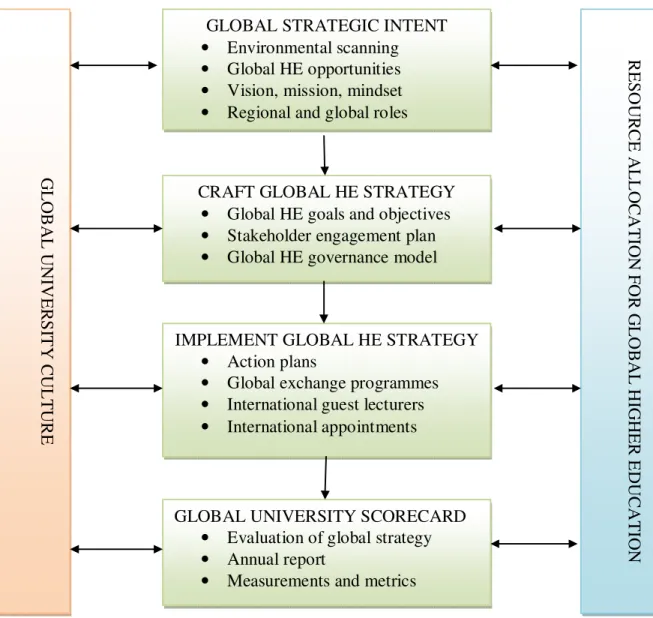
In the light of earlier discussion, it is clear that current short-term and under-resourced efforts to engender a more international focus at South African universities are not sustainable. Isolated approaches to globalising higher education will not work. A more concerted and integrated focus on establishing a fully-fledged strategic globali-sation strategy for a university is needed (Figure 1).
The success of the global higher education strategy depends on two key factors informing the process phases and interfacing in a reciprocal relationship with the four phases of the framework, that is, the creation and growth of a true global university culture which is required, and involves transcending the current city, provincial or national model used in South Africa. This implies a global mindset among all staff in reaching out to the global world, beginning with the rest of Africa, and then, expanding into the rest of the world. In addition, a significant resource allocation is needed to ensure that the university transforms its current city, provincial and national focus to become global. A fully integrated global university requires substantial investment in the creating and maintenance of global infrastructure, curriculum, staff exchange programmes, bursaries, appointing of international staff, accommodation and travelling, and many other cost items. Should the mentioned two prerequisites be put in place, an enabling environment is
creased for the four phases of the framework to be implemented thus:
Phase 1: Global strategic intent
In the first phase, the university will register its intent to become more global in its thinking, approach to teaching, curriculum and research. Typically, the university will generate or refine a more global vision and mission, and will set some goals in terms of a regional focus (for example, the strong African regional intent expressed by UJ and Unisa). This phase also includes a proper global and regional environmental scanning of the higher education landscape and typically concludes with an outline of global challenges and opportunities.
Phase 2: Craft global higher education strategy
Secondly, the university will craft its global higher education strategy. Clear goals and objectives will be set during this stage, in other words, what the university wants to achieve with its globalisation strategy. During this phase, it is critical to clearly show the difference between the status quo and future goals. For example, in Table 3, UJ has clear goals in terms of increasing international student numbers.
However, although the goals set in Table 3 is indeed a good point of departure, clear strategies are needed to realise these goals, and to ensure that an enabling environment is created for international students, as well as other related goals for globalising higher education. For example, while the international student numbers may increase, it does not necessarily mean that the approach to higher education, or curriculum for that matter, will be more global. Thus, clear supporting strategies are needed. In essence, a global stakeholder engagement plan is needed to support these and other goals. Key stakehol-ders in global higher education are global professional associations, research and funding institutions, global companies, international universities, alumni, government agencies, schools, and prospective students. Moreover, the globalisation of higher education
Meyer et al. 6575
GLOBAL STRATEGIC INTENT
•
Environmental scanning
•
Global HE opportunities
•
Vision, mission, mindset
•
Regional and global roles
CRAFT GLOBAL HE STRATEGY
•
Global HE goals and objectives
•
Stakeholder engagement plan
•
Global HE governance model
IMPLEMENT GLOBAL HE STRATEGY
•
Action plans
•
Global exchange programmes
•
International guest lecturers
•
International appointments
GLOBAL UNIVERSITY SCORECARD
•
Evaluation of global strategy
•
Annual report
•
Measurements and metrics
G
L
O
B
A
L
U
N
IV
E
R
S
IT
Y
C
U
L
T
U
R
E
R
E
S
O
U
R
C
E
A
L
L
O
C
A
T
IO
N
F
O
R
G
L
O
B
A
L
H
IG
H
E
R
E
D
U
C
A
T
IO
N
Figure 1. An integrated strategy for globalising higher education.
at any university requires a sound global governance model that extends beyond the current limited “interna-tional office” model. Clear responsibilities and roles need to be established for different role-players, for example, academics, management, research office, marketing, bursaries sections, etc.
Phase 3: Implement global higher education strategy
The third phase consists of the implementation phase. Specific action plans should be developed and implemented to give effect to the global strategic intent and the explicit higher education strategy. Clear controls need to be put in place to ensure the effective execution of the global higher education strategy at institutional level. Typical actions include international staff exchange
programmes, international appointments and guest lecturers. While some of these initiatives are already in place in certain faculties, the shift in focus is to ensure that all these activities are aligned into an integrated strategy for globalising higher education.
Phase 4: Global university scorecard
During the last phase of the framework, it is essential to evaluate and measure the impact of the global higher education strategy. This can be done continuously, as well as during times when key mile-stones are achieved. For example, in 2015, UJ will be able to see whether they have attained the targets set for this year, and then, adjust their planning accordingly. Over and above a
Table 3. Goals for increasing international student numbers at UJ.
Goal 2009 (%) Target for 2015 (%)
International undergraduate students 3.4 10
International post-graduate students 22 33
Table 4. Typical measures for evaluating higher education globally.
Measure of university globalisation Source
Number and percentage of international staff Williams and Van Dyke (2007) Quality of staff
Price (2010); Rozyn (2011); Salmi (2009); Williams and Van Dyke (2007)
Number of staff recognised as experts globally Williams and Van Dyke (2007) Percentage of academic staff with doctoral qualification Cloete et al. (2010)
Number and percentage of international publications Williams and Van Dyke (2007); Yang (2004) Number of international collaborative agreements Fourie (2010); Yang (2004)
Number of courses accredited internationally Price (2010)
Satisfaction level of international students Williams and Van Dyke (2007)
Number and percentage of international students Moodie (2007); Price (2010); Williams and Van Dyke (2007) Throughput rate of international students Cloete et al. (2010)
Ranking of the university on global ranking systems Cloete et al. (2010); Fourie (2010); Moodie (2007) Percentage of international students in university residences Jansen (2010)
Post graduate qualification outputs Cloete et al. (2010); Fourie (2010); Williams and Van Dyke (2007)
Post graduate progression rates Williams and Van Dyke (2007)
Results of industry surveys Salmi (2009); Williams and Van Dyke (2007)
Salaries of academics Salmi (2009)
CEO surveys Salmi (2009); IT Online (2010); Williams and Van Dyke (2007)
Peer opinion Salmi (2009); Williams and Van Dyke (2007)
Private income generated Cloete et al. (2010)
general evaluation of the effectiveness of the strategy, and international awards received, other typical measures are illustrated in Table 4.
Collecting the typical data at institutional level as illustrated in Table 4 would be the first step towards developing a framework for measuring the extent of
globalisation and global excellence. Once the data is available, the next step would be to generate specific action plans to improve on the different benchmarks. However, the challenge remains to apply the four phases for globalising higher education in an integrated and coherent manner to create and maintain a global university.
Conclusion
During the past century, we lived in an era in which higher education and universities have become key institutions of nation-states. The role of universities revolved around economic, socio-political and labour market needs in these nation states. However, the fall of communism in Eastern Europe, the establishment of democracies throughout Africa, Asia, and South America and the eradication of apartheid in South Africa, all contributed to an increased realisation of the importance and impact of globalisation on higher education. Trends such as the commercialisation of higher education, rapid technological and scientific advancement, and the internet revolution in particular are also reflected in the global development of higher education. In line with de Vijlder’s (2001) analysis, national responses to these developments in Europe constitute a mix of defensive and offensive approaches, and it appears as if a similar dichotomy is prevalent in South Africa. While some universities have attempted to respond to globalisation, the majority of higher education institutions in South Africa have not yet embraced the need for globalisation.
As indicated in this paper, globalisation presents both positive and negative implications for higher education. Be that as it may, and despite the growth of a national response to the challenges facing higher education in South Africa, the growth and intensification of globalisation is inevitable, and a clear strategy is needed to mitigate the possible negative consequences, and to leverage opportunities for South African students and staff. South African universities cannot immune themselves against the global context. An integrated strategy for globalising South African universities will not only contribute to the development of global citizens ready to play a role in the global economy, but also contribute to capacity-building efforts in improving the global competitiveness of South Africa’s economy. Essentially, the best universities worldwide have, for several decades, consistently embraced globalisation, and this commitment to excellence, globally positioned them as global leaders in higher education. Notwithstanding the huge gap between the top universities globally and South African higher education institutions, our local universities have no choice but to actively pursue an aggressive approach to globalising higher education in South Africa in a concerted attempt to grow our economy and become more globally competitive.
Meyer et al. 6577
RECOMMENDATIONS
The key question to address is: what exactly can South African universities do to reposition themselves to adapt to globalisation? Further mentioned recommendations can be implemented to start addressing the challenge of globalisation in higher education. First and foremost, there is a need to scan global trends and realities and make them an explicit part of institutional planning and curriculum in all fields of study. In addition, there is a need to form alliances with international universities and other bodies such as professional associations or research institutions. Moreover, South African universities need dynamic leadership who are committed to the sound governance of universities in a global world. Hence, a purposeful strategy for globalising the university, including mitigating all risks and challenges associated with this decision should be created. Likewise, significant investment is required in managing, optimising and retaining academic talent in an increasing competitive academic market. More than that, research projects should be launched to further research the impact of globalisation on higher education, within countries and across countries and regions. There is also a need to build stronger regional alliances in Africa and Asia to ensure a stronger emerging market focus in higher education, and thereby reducing the reliance on Western approaches in curriculums. This will encourage more international staff and student exchange programmmes. Furthermore, there is a need to utilise global social networking forums to infuse a stronger international platform in forming and building relationships, in order to establish an appropriate balance between global and local curriculum content in all aspects of learning programmes, for example, articles, textbooks, case studies and other means of teaching. In similar vein, more international guest lecturers to instil a global culture in teaching and research should be encouraged. There should be purposeful focus on joint publications with international authors. Hence, there is a need to develop the global mindset of local students to be able to become real global citizens, in order to create global academic cultures within South African universities. Moreover, there should be alliances with leading South African global companies such as SABMiller, Standard Bank, Massmart and Shoprite to open up opportunities for collaboration in other countries. Finally, South Africa’s higher education sector should develop a measurement system to evaluate progress towards increased levels of globalisation at university level.
REFERENCES
Alam GM (2009) Can governance and regulatory control ensure private higher education as business or public goods in Bangladesh? Afr. J. Bus. Manage., 3(12): 890-906.
Alam GM, Khalifa MTB (2009). The impact of introducing a business marketing approach to education: a study on private HE in
Bangladesh. Afr. J. Bus. Manage., 3(9): 463-474
Alam GM, Hoque KE, Ismail L, Mishra PK (2010) Do developing countries need education laws to manage its system or are ethics and a market-driven approach sufficient? Afr. J. Bus. Manage., 4(15): 3406-3416,
Alam GM (2008). Impact of Private Higher Education on Bangladeshi Education System: An Investigation of Education Policy. VDM Verlag, Germany,
Alam GM (2011). A further editorial guideline for writing manuscript in the field of social science: A special perspective for African Journal of Business Management (AJBM). Afr. J. Bus. Manage., 5(1): PP editorial
Barnett CK (1992). The Global Agenda for Research and Teaching in the 1990s. In Pucik V, Ticky NM, Barnett CK(Eds). Globalizing Management: Creating and Leading the Competitive Organization. New York: John Wiley.
Birkin M (2006). HR Myopia: It’s time for us to question our 30 year old “people” model. HR Future, April, p. 35.
Brock-Utne B (1999). African universities and the African heritage. Int. Rev. Educ., 45(1): 87-104.
Cloete N, Bunting I, Sheppard C (2010). Diversity in higher education in South Africa: From inequality to differentiation. Paper presented at the SANTED conference, Aucklandpark, 22 November.
De Vijlder FJ (2001). Globalisation of higher education. What roles for nation states? Eur. J. Educ. Law Pol. Sci. Educ., 5: 159-2001. Eisenhart M (2008). Globalization and science education in a
community-based after-school program. Cultural Stud., 3: 73-95. Elmgren C, Roman O, Sjolund M, Wahlen S, Ostling M (1999). Support
or control – or both? The Role of a national agency? Tertiary Educ. Manage., 5: 245-259.
Evans P, Pucik V, Bjorkman I (2011). The Global Challenge: International Human Resource Management, 2nd ed. New York: McGraw-Hill.
Fee K (2009). Delivering E-learning: A complete strategy for design, application and assessment. London: Kogan Page.
Fourie CM (2010). Ranking of universities. Paper presented at SANTED Conference. Johannesburg, 22 November.
Fourie M (1999). Institutional transformation at South African universities: Implications for academic staff. Higher Educ., 38: 275-290.
Frey BS (2000). Citizenship in a globalised world. Unpublished paper. Zurich: University of Zurich.
Horsthemke K, Enslin P (2008). African Philosophy of Education: The Price of Unchallengeability. Studies on the Philosophy of Education. IT Online (2010). Universities fail students in globalisation,
sustainability. IT Online, 18 June.
Jansen J (2010). Praat saam. Onderhoud met Lynette Francis. Johannesburg: Radio Sonder Grense.
Killen R (2010). Teaching Strategies for Quality Teaching and Learning. Claremont: Juta.
Lieven M, Martin G (2006). Higher education in a global market: The case of British overseas provision in Israel. Higher Educ., 52, 41-68. Lloyd B (1996). The outlook for globalization. Leadership Org. Dev. J.,
17(5): 18-23.
Moodie G (2007). Changing higher education. Minerva, 45: 73-84. Moynach M, Worsley R (2008). Going Global: Key questions for the 21st
century. London: A and C Black.
Nath B (2003). Education for sustainable development: The Johannesburg Summit and Beyond. Environ. Dev. Sustainability, 5: 231-254.
Nel JP (2010). Establishing a positive quality culture in education, training and development. Pretoria: Mentornet.
North-West University (2010). Viskansellier hou internasionaal die leisels vas. Noordwes-Universiteit Aliumni Tydskrif, 2(2), 8-9. Phillipson R (2001). English for globalisation or for the world’s people?
International Review of Education, 47(3-4), 185-200.
Powell S, Ghauri P (2008). Globalisation. Essential Managers. London: Dorling Kindersley.
Prahalad (1992). Globalization: The Intellectual and Managerial Challenges. In: Pucik V, Ticky NM, Barnett CK (Eds). Globalizing Management: Creating and Leading the Competitive Organization. New York: John Wiley.
Price M (2010). Crucial time for SA universities as higher education goes global. Sunday Times, 14 October, 7.
Ramoupi NL (2010). Universities must play role in decolonisation. Sunday Times, 5 December, p. 4.
Rasool H (2006). Rag trade needs a fine fit of complex skills. The Star, 7 June, p. 2.
Rozyn S (2011). Business Schools in South Africa and their contributions to national competitiveness: impact on people and organisations. In Boninelli I, Meyer T (Eds). Human Capital Trends: Building a Sustainable Organisation. Randburg: Knowres.
Salmi J (2009). The Challenge of Establishing World-Class Universities. Directions in Development: Human Development. Washington: World Bank.
Stanz K (2010). Educating and developing the professional HR practitioner of the future. SABPP Professional Review, Midrand, 3 June.
Teichler U (2003). The Future of Higher Education and the Future of Higher Education Research. Tertiary Educ. Manage., 9: 171-185. Thompson K (2010). Renewal – UNISA SBL: Financial Mail. Corporate
Report. 22 October, 92-94
Tomlinson S (2003). Globalization, race and education: Continuity and change. J. Educ. Change, 4, 213-230.
Ukpere WI (2010). Globalisation, Internationalisation, H. Resources, Industrial Democracy: A critical exploration of economic prodigies. Germany: Lambert Academic Publishing.
University of Johannesburg (2009). Strategy to enhance the international profile of the University of Johannesburg. Aucklandpark: University of Johannesburg.
Veldsman TH (2011). Strategic talent partnering between higher educational institutions and organisations. In Boninelli I, Meyer T (Eds). Human Capital Trends: Building a Sustainable Organisation. Randburg: Knowres.
Waghid Y (2002). Knowledge production and higher education transformation in South Africa: Towards reflexivity in university teaching, research and community service. Higher Educ., 43: 457-488.
Wangenge-Ouma G (2007). Higher education marketisation and its discontents: the case of quality in Kenya. Higher Educ., 1-23. Williams R, Van Dyke N (2007). Measuring the international standing of
universities with an application to Australian universities. Higher Educ., 53: 819-841.
Yang R (2003). Globalisation and higher education development: A critical analysis. Int. Rev. Educ., 49(3-4): 269-291.
Yang R (2004). Openness and reform as dynamics for development: A case study of internationalisation at South China University of Technology. Higher Educ., 47: 473-500.