ContentslistsavailableatSciVerseScienceDirect
Thinking
Skills
and
Creativity
jo u r n al h om epa ge : h t tp : / / w w w . e l s e v i e r . c o m / l o c a t e / t s c
Creativity:
The
role
of
unconscious
processes
in
idea
generation
and
idea
selection
Simone
M.
Ritter
∗,
Rick
B.
van
Baaren,
Ap
Dijksterhuis
RadboudUniversityNijmegen,BehaviouralScienceInstitute,Montessorilaan3,6500HENijmegen,TheNetherlands
a
r
t
i
c
l
e
i
n
f
o
Articlehistory:Received17October2011 Receivedinrevisedform 16November2011 Accepted5December2011
Available online 15 December 2011 Keywords: Creativity Unconsciousprocesses Fosteringcreativity Ideageneration Ideaselection
a
b
s
t
r
a
c
t
Today’sworldofcontinuouschangethrivesoncreativeindividuals.Anecdotalreports sug-gestthatcreativeperformancebenefitsfromunconsciousprocesses.Empiricalresearchon theroleoftheunconsciousincreativity,though,isinconsistentandthusfarhasfocused mainlyononeaspectofthecreativeprocess–ideageneration.Thisisthefirststudyto assesstheroleoftheunconsciousmindforbothideagenerationandideaselection. Partic-ipantsgeneratedcreativeideasimmediately,afterconsciousthought,orafteraperiodof distractionduringwhichunconsciousthoughtwashypothesizedtotakeplace.After hav-inglistedtheirideas,participantsselectedtheirmostcreativeidea.Performanceinidea generationwassimilarbetweenconsciousandunconsciousthought;however,individuals whohadunconsciouslythoughtaboutideaswerebetterinselectingtheirmostcreative idea.Thesefindingsshedmorelightontheroleofunconsciousprocessesincreativity,and provideameanstoenhancecreativeperformance.
© 2011 Elsevier Ltd. All rights reserved.
1. Introduction
Ineverydaylife,creativevisionishighlyappreciated.Forexample,arecentsurveyamong1500chiefexecutivesaround theworldrankedcreativityasthemostcrucialleadershipquality(IBMCorporation,2010),andcreativitywasratedasan importantdeterminantofmakingapsychologyarticleinfluential(Sternberg&Gordeeva,1996).Inthescientificliterature, ‘creativity’isdefinedastheprocessofbringingintobeingsomethingthatisbothnewanduseful(e.g.,Amabile,1996; Sawyer,2006;Sternberg&O’Hara,1999).Giventhateffort,hardwork,andtrainingplayanimportantroleinthecreative process(Amabile,1996;Csikszentmihalyi,1996;Sawyer,2006),onemayexpectthatcreativityisachievedthroughextensive consciousthought;however,severalstudieshavepointedoutthattheunconsciousmindisalsoindispensableincreative performance(e.g.,Simon,1996;Smith,1995).Moreover,theimportanceoftheunconsciousincreativityisemphasizedby manyanecdotesaboutindividualshailedasgeniuses(Ghiselin,1952;Wallas,1926;Woodworth&Schlosberg,1954).For example,themathematicianPoincaréwasconvincedthathiscreativeideasemergedfromtheunconscious,andEinstein reportedthathefirst‘saw’thesolutiontoaproblemwithoutbeingabletoexpressit(Ghiselin,1952).Inarts,experiencesof creativityseemtobesimilar.AccordingtoSchopenhauer(1970,p.41),“everythingprimary,andconsequentlyeverything genuine,worksastheforcesofnaturedo,unconsciously.”
Theseandmanysimilaranecdotalreportsstronglysuggestthatcreativitycannotbeexplainedbyconsciousprocesses alone.Accordingtodualprocesstheories,wehaveaconscious,rule-based,controlledsystem,andanunconscious, associa-tive,automaticsystem(Evansetal.,2009).Increativity,theperiodduringwhichtheunconsciousisatworkisoftencalled ‘incubation’.Oneoftheearliestwell-developedconceptsofincubationwaspostulatedbyWallas(1926),whoassumedthat
∗ Correspondingauthor.Tel.:+310243612144;fax:+310243612677. E-mailaddresses:[email protected],[email protected](S.M.Ritter). 1871-1871/$–seefrontmatter© 2011 Elsevier Ltd. All rights reserved.
duringincubationonedoesnotconsciouslythinkaboutthetaskbutratherthemindcontinuestoworkonitbelowthelevel ofconsciousness.Thereissomecontroversy,though,astowhyincubationishelpful.Oneoftheexplanationsforthepositive effectsofincubationoncreativeproblemsolvingisthereductionofmentalfatigue(Posner,1973).Accordingtothemental set-shiftingorforgetting-fixationhypothesis,puttingaproblemasideforawhilehelpstofindcreativesolutions,asitallows forafresh,unbiasedandnewlookataproblemandreducesassociationswithincorrectanswers,allowingcorrectones tosurface(Schooler&Melcher,1995;Smith&Blankship,1989).Theseexplanationsascribetotheunconsciousamerely passiverole,whereastheterm‘incubation’itselfsuggeststhattheunconsciousalsoactivelycontributestosolvingaproblem (e.g.,Claxton,1997;Koestler,1964).Therefore,theseexplanationsmaynotbetheonlybenefitofanincubationperiod,and thequestionrisesastowhethertheunconsciousalsoactivelycontributestocreativeproblemsolving.
TheideaofanactiveunconsciouswassupportedbyapioneeringexperimentfromBowers,Regehr,Balthazard,&Parker (1990).Participantshadtoguessatargetwordwhiletheyweregivensuccessivehints.Whereasindividualsfeltclueless forquitesometimeandthensuddenlycameupwiththecorrectanswer,participants’priorguessesshowthattheywere slowlygettingclosertotherightsolutionbeforethesolutionreachedtheirconsciousness.Furtherevidenceforanactive unconsciouswasprovidedbyZhong,Dijksterhuis,&Galinsky(2008),whoexaminedtheeffectof‘unconsciousthought’(i.e., task-relatedthoughtprocessesthatoccurwhileconsciousattentionisdirectedelsewhere;Dijksterhuis&Nordgren,2006)on twooutcomesofaremoteassociationtest(RAT):implicitaccessibilityandconsciousreportingofanswers.Theaccessibility ofRATanswers,butnotthenumberofcorrectanswers,washigherafterunconsciousthoughtthanafteranequalduration ofconsciousthought.Interestingly,thelevelofactivationofRATanswerswasalsohigherthaninthemere-distraction condition,whichsuggeststhattheincreasedaccessibilityafterunconsciousthoughtwasnotduetorelaxationortherelease ofincorrectassociations,assuggestedbytheforgetting-fixationormentalset-shiftinghypothesis.Unconsciousthought seemstothinkactivelyand,thereby,facilitatesthediscoveryofremoteassociations.Besidesthescientificevidenceforan activeunconscious,though,andthetremendousanecdotalevidencefortheimportanceoftheunconsciousincreativity, researchhasyieldednosoundempiricalsupportforthebeneficialeffectofunconsciousprocessesoncreativeperformance (Sio&Ormerod,2009).Howcanthis discrepancybeexplained?Isitpossiblethatthebeneficialeffectofunconscious processesoncreativeperformanceisespeciallyvisibleduringtheideaselectionphase?
Variouscreativitytheorieshavesuggestedarolefortheevaluationandselectionofideas,asbeingcreativeincludesboth generatingmanynoveloptionsandsubsequentlyidentifyingthesinglebestoption.Incognitivetheories,creatingideasis distinguishedfromevaluatingideas(Cropley,2006).Moreover,socioculturaltheoriessuggestthathavinganideaiseasy, whereasitisdifficulttodevelopanideasothatthedomain’saudienceacceptsit(Sawyer,2006;Sternberg,2006).Also, inDarwiniantheories,adistinctionismadebetweenprocessesthatgenerateideasandprocessesthatselectivelypreserve themostcreativeidea(Simonton,1999).Severalgoodeffortshavebeenmadetogainmoreinsightintohowindividuals (Rietzschel,Nijstad,&Stroebe,2010;Runco&Smith,1992),groups(Faure,2004),andeminentcreators(Kozbelt,2007)select ideas;however,researchonideagenerationhasovershadowedthequestionofideaevaluation.Tothebestofourknowledge, nopreviousresearchhasinvestigatedwhetherunconsciousprocessesmayhelppeopletobemorediscerning.Isitpossible thataperiodofunconsciousthoughtenablesindividualstoconvergemoretowardtheselectionmadebytrainedraters?
Frompreviousresearchweknowthatafteraperiodofunconsciousthoughtpeoplearebetteratselectingthemost attractivealternativeamongseveraloptions(e.g.,Dijksterhuis,2004;Dijksterhuisetal.,2006;Ham,VandenBos,&Van Doorn,2009;Lerouge,2009).Inatypicalunconsciousthoughtexperiment,participantshavetochoosethemostattractive alternativeamongseveraloptions.Theyeitherdosoimmediatelyafterhavingreceivedtheinformation,orafteraperiod duringwhichtheywereallowedtoconsciouslythinkabouttheoptions,orafteraperiodofdistraction,duringwhich ‘uncon-sciousthought’wasassumedtotakeplace.Thebestdecision,asjudgedfromanormativeperspective,isusuallymadebythe unconsciousthinkers.Itisassumedthatunconsciousthoughthelpstomakecomplexdecisions,asitisgoodatevaluating, weighting,andintegratingattributeinformationconcerningvariousalternatives(Dijksterhuis&Nordgren,2006).Giventhat selectingone’smostcreativeideacanbeconsideredadecisionmakingprocess,thesefindingssuggestthatthinkingabout one’sideasunconsciouslymayalsohaveabeneficialeffectontheideaselectionpartofthecreativeprocess.Ifitis,indeed,the casethattheroleoftheunconsciousisespeciallyvisibleduringideaselection,thiswouldexplainwhyanecdotesofcreative people,whichrelyonreallifecreativityand,therefore,onideagenerationaswellasonideaselection,supporttheroleofthe unconsciousincreativity,whereasscientificstudies,whichmainlyfocusonideageneration,provideonlyweakevidence.
Inthecurrentstudies,wedonotusetheterm‘creativity’torefertoachievementsofgeniusessuchasEinstein,Poincaré andSchopenhauer.Rather,wefocusontwoaspectsofcreativity:thegenerationofcreativethoughtsandtheabilitytoselect one’smostcreativeidea.Theaimofthecurrentexperimentsistoinvestigatetheroleoftheunconsciousmindintheidea generationandtheideaselectionpartofthecreativeprocess.Basedonpreviousfindings,wehypothesizethatthinkingabout ideasunconsciouslyespeciallyfacilitatestheideaselectionphaseofthecreativeprocess.Thefindingsofthecurrentstudies mayshedmorelightontheroleofunconsciousprocessesincreativity,andmayprovideameanstoenhanceindividuals’ creativeperformance.
2. Experiment1
Participantswereaskedtothinkofasmanyideasaspossibletosolveaproblem.Afterhavinglistedtheirideas,they wereaskedtoselecttheirmostcreativeidea.Thistaskallowedustountangletheroleofunconsciousprocessesintheidea generation,aswellastheideaselectionpartofthecreativeprocess.
2.1. Method
2.1.1. Participantsanddesign
OnehundredandtwelvestudentsfromRadboudUniversityNijmegenreceivedcoursecreditsormoney(4Euros)for participation.Theiraverageagewas20.8years(rangingfrom16to29,SD=2.23),and21weremale.Participantswere randomlyassignedtooneofthreeconditions–animmediatecondition(n=37),aconsciousthoughtcondition(n=37),or anunconsciousthoughtcondition(n=38).
2.1.2. Procedure
Participantswererandomlyallocatedtooneofthesethreeconditions.Intheimmediatecondition,participantswere instantlyaskedtogenerateandlistideasonhowtosolvethecreativitytask.Intheconsciousthoughtcondition,participants wereaskedtofirstcarefullythinkaboutpossiblesolutionsfor2minbeforelistingtheirideas.Intheunconsciousthought condition,participantswereinformedthattheywouldfirsthavetoperformanunrelatedtaskfor2minand,thereafter, wouldhavetimetolisttheirideas.Tominimizetask-relevantconsciousthoughtduringthedistractionperiod,theyhadto clickasquicklyaspossibleoncirclesofdifferentsizesthatappearedrapidlyatrandomlocationsonthecomputerscreen.
Afterthemanipulation, participantshad 2mintolisttheirideasin anemptybox presentedonthescreen.Finally, participantswereaskedtochoosetheirmostcreativeideafromalltheideastheyhadgenerated.
2.1.3. Creativitytask
Participantshadtogenerateandlistideasonhowtomakethewaitingtimeatthecashdeskmorebearable.Unlikeletter fluencytasksandsemanticfluencytasks,thecurrenttaskintendstocapturethecreativequalityoftheresponses,notmerely thenumberofresponses.Furthermore,thistaskenabledustoaskparticipantstoselecttheirmostcreativeideafromallthe ideastheygenerated.
2.1.4. Creativitymeasures
For theideagenerationphase, themeasuresofinterestwerethenumberof ideasthata participantlistedand the participant’saveragecreativityscore.Concerningtheideaselectionphase,wewereinterestedinwhetheraparticipant’s selectionofthemostcreativeideawasinaccordancewithjudgmentoftrainedraters.Creativeideas,asallcreativeproducts, do nothaveadistinct,inherentlevel ofcreativeness;thecreativeworthofanideaisusually determinedbycomplex socioculturalandhistoricalprocesses(Sawyer,2006;Simonton,1998),whichmakesitdifficultinanexperimentalsettingto determineanindividual’screativeperformance.Thereisalongtraditionincreativityresearch,however,ofscoringcreative performancebyhavingtrainedratersevaluateparticipants’responses.Goodagreementhasbeenfoundinthejudgmentsof independentraters(Baer,Kaufman,&Gentile,2004;Kaufmanetal.,2005).Hence,inthecurrentexperiment,threetrained raterswereaskedtoexaminethecreativityofeachidea,andtoidentifythemostcreativeideaofeachparticipant.
2.1.4.1. Trainingofobjectiveraters. Trainingconsistedofanelaborateexplanationoftheconceptofcreativity(i.e.,thata creativeideahastobebothusefulandnovel;Hennessey&Amabile,2010;Sawyer,2006;Sternberg&O’Hara,1999),and theraterswereprovidedinformationaboutthescoringsystem.Hereafter,theratersweregivena10-minexerciseinwhich theyhadtoexaminethecreativityofvariousideas.
2.1.4.2. Scoringprocedure. Toreceiveareliableaveragecreativityscore,allratershadtoscoreeachideaintermsofcreativity onafive-pointscale(1=‘notatallcreative’,to5=‘extremelycreative’).Foreachidea,ameanofthethreescoreswascalculated (inter-raterreliability˛=77),andperparticipantthesemeanscoreswereadded.Thissumscorewasdividedbythenumber ofideasaparticipantlistedtomakesurethataparticipant’screativityscorewasindependentfromfluency,i.e.,thenumber ofideasgenerated.1
Fortheimplementationofcreativeideas,itiscrucialthatonesucceedsinrecognizingandselectingone’smostcreative idea.Previousresearchusuallyinstructedparticipantstoratetheirresponses(Grohman,Wodniecka,&Kłusak,2006;Runco& Smith,1992);however,real-lifecreativeperformancetypicallyrequiresmakingaselectioninsteadofjudgmentsorrankings. Therefore,participantsaswellasthreetrainedraterswereinstructedtoselectoneideaonly–theonetheyconsideredmost creative.Toreceiveanobjectiveexternaljudgment,itwasrequiredthatatleasttwoofthethreeratersagreedabouta participant’smostcreativeidea.Thisrequirementwasfulfilledinalmostallcases(94%);however,twoparticipantshadto beexcludedfromtheanalysisastheydidnotcomplywiththetaskinstructionofselectingonlyoneidea,andtwoparticipants couldnotselecttheirmostcreativeideaastheyhadonlylistedoneidea.
Table1
Numberofideasandtheaveragecreativitybythoughtcondition.Resultsareexpressedasmeans,standarddeviations(SD),and95%confidenceintervals (CI).
Experiment Thoughtcondition Mean SD 95%CI
LowerBound UpperBound
Numberofideas 1 Immediate 3.89 1.73 3.31 4.47 Conscious 5.24 2.06 4.67 5.82 Unconscious 4.68 1.49 4.11 5.25 2 Immediate 6.39 2.36 5.36 7.42 Conscious 7.91 3.00 6.90 8.92 Unconscious 7.59 1.75 6.58 8.60 Averagecreativity 1 Immediate 2.11 .61 1.91 2.32 Conscious 2.20 .64 1.99 2.41 Unconscious 2.10 .64 1.90 2.30 2 Immediate 1.90 .40 1.70 2.09 Conscious 2.29 .54 2.10 2.48 Unconscious 2.05 .43 1.86 2.25 2.2. Results 2.2.1. Ideageneration
Inordertoinvestigatewhetherthethoughtmanipulationinfluenced thenumber ofideasgeneratedandthemean creativityoftheseideas,twoANOVAswereconducted.AnANOVAonthenumberofideasrevealedamaineffectofthought condition,F(2,109)=5.43,p<.01,2=.09.AsshowninTable1,participantsintheimmediateconditiongeneratedfewer
ideasthanparticipantsintheconsciousthoughtandunconsciousthoughtconditions,t(72)=3.06,p<.01,t(73)=2.13,p<.05, respectively.However,consciousandunconsciousthinkersdidnotdifferinthenumberofideastheygenerated,t(73)=1.35, ns.AnANOVAontheaveragecreativityrevealedthattheeffectofthoughtconditionwasnotsignificant,F<1.
2.2.2. Ideaselection
Inordertoinvestigatewhetheraparticipant’sselectionofthemostcreativeideawasinaccordancewiththejudgmentof trainedraters,aChi-Squaretestwasconductedandrevealedamaineffectofcondition,2(2)=11.15,p<.01.Aspresentedin Fig.1,unconsciousthinkersoutperformedconsciousthinkers,2(1)=5.67,p<.05,andthosewhoimmediatelylistedtheir
ideas,2(1)=10.46,p<.01,inselectingtheirmostcreativeidea.Consciousthinkersdidnotdifferfromparticipantswho
immediatelylistedtheirideas,2(1)=.74,ns.
Tosummarize,consciousandunconsciousthinkersdidneitherdifferinthenumberofideaslistednorintheaverage creativityoftheirideas;however,participantsintheunconsciousthoughtconditionhadanimportantadvantage:they performedbetterthanparticipantsintheconsciousthoughtconditionandtheimmediateconditioninselectingthemost creativeideafromallself-generatedideas.Thesefindingssupporttheideathattheroleoftheunconsciousisespeciallyvital duringideaselection.Sincetheabilitytoselectone’smostcreativeideaisimportantfortheimplementationofcreative
ideas,thecurrentexperimentprovidesinsightintotheroleofunconsciousprocessesincreativity,andoffersameansto facilitatecreativeperformance.
3. Experiment2
Experiment1hasshownthatthinkingaboutideasunconsciouslydoesnotleadtomorecreativeideasbutenhances individuals’abilitytoselecttheirmostcreativeidea.Theaimofthecurrentexperimentwastoreplicatethefindingsof Experiment1and,furthermore,togainmoreinsightintothebeneficialeffectsofunconsciousthoughtonideaselection. Doesthinkingaboutideasunconsciouslyspecificallyhelpintheselectionofthemostcreativeidea?Ordoesitenhance participants’generalselectioncapacity;anddoesitenableparticipants,therefore,toalsobetterselecttheirleastcreative idea?Toinvestigatethesequestions,weaskedparticipantstoselecttheirmostcreative,aswellastheirleastcreative idea.
3.1. Method
3.1.1. Participantsanddesign
Sixty-eightstudentsfromRadboudUniversityNijmegenreceivedcoursecreditsormoney(4Euros)forparticipation. Theiraverageagewas22years(rangingfrom17to65,SD=5.78),and18weremale.Participantswererandomlyassignedto oneofthreeconditions– animmediatecondition(n=22),aconsciousthoughtcondition(n=23),oranunconsciousthought condition(n=23).
3.1.2. Procedureandmaterials
TheprocedurewassimilartothatinExperiment1;however,inthecurrentexperiment,creativesolutionsforadifferent self-relevantproblemhadtobefound.Participantshadtocomeupwithasmanyideasaspossibleonhowstudentscanearn someextramoney.Furthermore,afterhavinglistedtheirideas,participantsnotonlyhadtochoosetheirmostcreativeidea butalsotheirleastcreativeone.
3.1.2.1. Measuresofinterest. TheexperimentemployedthesamedependentvariablesasinExperiment1:numberofideas listed,averagecreativity,andmostcreativeidea.Inaddition,weaddedafourthvariable–leastcreativeidea.Inthecurrent experiment,notrainingwasprovidedastheideaswerescoredbythesameratersasinExperiment1(inter-raterreliability
˛=.88).
3.2. Results
3.2.1. Ideageneration2
AnANOVArevealedthatthenumberofideasparticipantsgenerateddidmarginallydifferbetweenthethreeconditions,
F(2,65)=2.46,p=.09,2=.07.AsshowninTable1,participantsintheimmediateconditionlistedmarginallylessideas
thanparticipantswhohadfirstthoughtconsciouslyorunconsciously,t(43)=1.89,p=.07;t(43)=1.95,p=.06,respectively. However,consciousandunconsciousthinkersdidnotdifferinthenumberofideastheylisted,t<1.AnANOVAontheaverage creativityrevealedasignificantmaineffectofcondition,F(2,65)=4.10p<.05,2=.11.AsshowninTable1,unconscious
thinkersdidnotdifferfromconsciousthinkers,t(44)=1.64,pns.However,comparedtoparticipantswhoimmediately listedtheirideas,consciousthinkersweremorecreative,t(43)=2.75,p<.05.
3.2.2. Ideaselection3
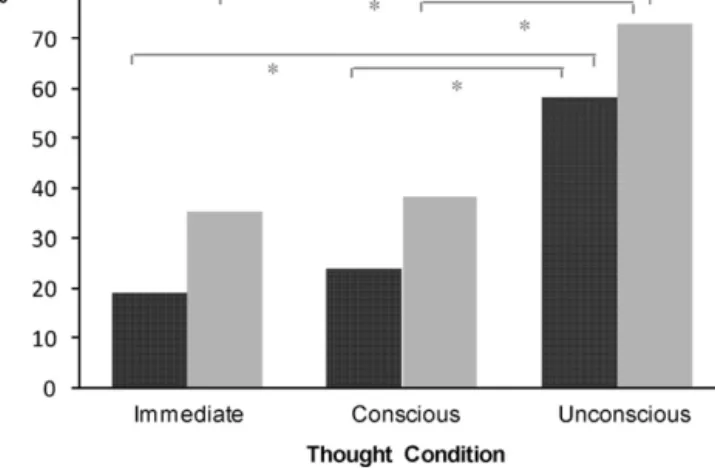
TwoChi-Squaretestswereconductedtoinvestigatewhetherthethoughtmanipulationhadaneffectonindividuals’ abilitytoselecttheirmostcreativeandtheirleastcreativeidea.Theeffectofconditionwassignificantfortheselectionof themostcreativeidea,2(2)=8.00,p<.05,aswellasfortheleastcreativeidea,2(2)=7.20,p<.05.AspresentedinFig.2,
unconsciousthinkerssignificantlyoutperformedconsciousthinkersandparticipantswhoimmediatelylistedtheirideasin choosingtheirmostcreativeidea,2(1)=4.83,p<.05,2(1)=6.42,p<.05,andtheirleastcreativeidea,2(1)=5.11,p<.05, 2(1)=5.87,p<.05,respectively.Consciousthinkersdidnotdifferfromparticipantswhoimmediatelylistedtheirideas,all 2<1.
InlinewithExperiment1,unconsciousthinkersandconsciousthinkersneitherdifferedinthenumberofideaslistednor intheaveragecreativityoftheirideas.However,asinExperiment1,unconsciousthinkersoutperformedconsciousthinkers inselectingtheirmostcreativeidea.Inaddition,unconsciousthinkerswerebetterthanconsciousthinkersinselectingtheir
2Thecorrelationbetweenfluencyandcreativitysumscorewasr(68)=.90,p<.01.
3Theagreementbetweenthethreeratersaboutthemostcreativeidea,F(3,86)=1.19,p>.10,andtheleastcreativeidea,F(3,86)=1.11,p>.10,was
equallydistributedacrossthethreeconditions.Thissuggeststhatfortrainedraters’selectionperformanceitdoesnotmatterwhethertheyhavetoselect themostorleastcreativeideafromanideapoolthatwasgeneratedbyparticipantswhoimmediatelylistedtheirideas,orbyparticipantswhofirstthought consciouslyorunconsciouslyabouttheirideas.
Fig.2.Percentageparticipantswhosucceededinselectingtheirmostandleastcreativeideafromseveralself-generatedideas.*p<0.05.
leastcreativeideafromallself-generatedideas.Thesefindingsprovidefurthersupportfortheideathattheroleofthe unconsciousisvitalfortheideaselectionpartofthecreativeprocess.
4. Discussion
Despitevariousanecdotesabouttheimportanceoftheunconsciousincreativity,researchhasprovidednosound empir-icalsupport.Theaimofthecurrentstudieswastoinvestigatetheroleofunconsciousprocessesintheideagenerationand ideaselectionpartofthecreativeprocess.Basedontheextantevidenceconcerningselectionadvantagesachievedafter unconsciousthought,wehypothesizedthatthinkingaboutideasunconsciouslyfacilitatestheselectionpartofthecreative process.
Ourresultsshowthatindividualsdidnotgeneratemorecreativeideasafterunconsciousthoughtthanafterconscious thought;however,individualswhothoughtabouttheirideasunconsciouslyhadanimportantadvantage–theyperformed betterthanconsciousthinkersinrecognizingtheirmostandleastcreativeidea.Thismay,atleastpartially,explainwhy anecdotesofcreativepeople,whichrelyonreal-lifecreativityand,therefore,onideagenerationaswellasideaselection, supporttheroleoftheunconsciousincreativity,whereasscientificstudies,whichmainlyfocusonideageneration,provide weakevidence.Giventhattheabilitytorecognizeone’smostcreativeideaiscrucialfortheimplementationofcreative ideas,wecanconcludethattheunconsciousmindplaysavitalroleincreativeperformance.
Whyareindividualswhounconsciouslythoughtabouttheirideasbetterabletoselecttheirmostcreativeidea?Itis possiblethatduringunconsciousthoughtideasareassociatedwiththeirappropriateevaluativeconnotation,forexample withpositiveornegativeaffect.Thisspontaneoustaggingprocessmay,inturn,unconsciouslyinfluenceindividuals’selection ofthemostandleastcreativeidealateron.However,weconcedethisexplanationisspeculativeandwarrantsfurther study.
Inadditiontotheirscientificcontribution,thecurrentfindingsalsohaveapracticalimplication.Formanyyears, cre-ativityresearchhasfocusedmainlyonideageneration,andithasbeenassumed thatpeoplewouldbehighlycapable ofidentifyingtheirmostcreativeidea.Peopleindeedseemtopossesstheabilitytodiscriminatebetweentheirideas, especiallywhentheyscorehighonopennesstoexperience(Silviaetal.,2008);however,researchhasalsoshownthat peopledo not perform optimallyat idea selection (Faure, 2004; Putman& Paulus,2009; Rietzschelet al.,2010). In linewiththesefindings,individualsintheimmediateandconsciousthoughtconditionsperformedpoorlyinselecting theirmost creativeidea.Participantswho had unconsciouslythoughtabout theirideas,however, wereabletoselect theirmostcreativeandleastcreativeidea fromseveralself-generatedideas.Therefore,thecurrentfindings providea meanstoincreaseindividuals’ performanceintheideaselection partofthecreativeprocess.Thisisvitallyimportant for everyday creativity, as even after thesuccessful generationof ideas, suboptimalresults canbe gained when the wrongidea is chosenfor furtherelaboration. For future researchit maybe interestingto examinewhethera longer unconsciousprocessesnotonly facilitatestheideaselection butalsotheideagenerationpartofthecreativeprocess. Moreover,thecurrentresearchfocusedonindividualcreativity. For thedevelopmentofinnovationsinorganizations, itis alsoimportant tostimulategroupcreativity (Paulus&Nijstad,2003).Therefore, future researchmayinvestigate whetheraperiod of unconsciousthoughtalsoincreasestheidea selectionperformance of groups,e.g., inbrainstorm sessions.
Inthecurrentexperiment,we combinedcreativity researchwithresearchonunconsciouscognitiveprocesses.The presentfindingsincreaseourscientificunderstandingoftheroleofunconsciousprocessesincreativityand,furthermore, provideameanstoenhanceindividuals’creativeperformance.Thisisimportant,astoday’sworldofcontinuouschange thrivesoncreativeindividualsandinventiveorganizations.
References
Amabile,T.M.(1996).Creativityincontext:Updatetothesocialpsychologyofcreativity.Boulder,CO,USA:WestviewPress.
Baer,J.,Kaufman,J.C.,&Gentile,C.A.(2004).Extensionoftheconsensualassessmenttechniquetononparallelcreativeproducts.CreativityResearchJournal,
16,113–117.doi:10.1207/s15326934crj160111
Bowers,K.S.,Regehr,G.,Balthazard,C.,&Parker,K.(1990).Intuitioninthecontextofdiscovery.CognitivePsychology,22,72–110.doi: 10.1016/0010-0285(90)90004-N
Csikszentmihalyi,M.(1996).Creativity:Flowandthepsychologyofdiscoveryandinvention.NewYork:HarperPerennial. Claxton,G.(1997).Harebrain,tortoisemind:Howintelligenceincreaseswhenyouthinkless.NewYork:HarperCollins.
Cropley,A.(2006).Inpraiseofconvergentthinking.CreativityResearchJournal,18,391–404.doi:10.1207/s15326934crj1803 13
Dijksterhuis,A.(2004).Thinkdifferent:Themeritsofunconsciousthoughtinpreferencedevelopmentanddecisionmaking.JournalofPersonalityandSocial Psychology,87,586–598.doi:10.1037/0022-3514.87.5.586
Dijksterhuis,A.,Bos,M.W.,Nordgren,L.F.,&vanBaaren,R.B.(2006).Onmakingtherightchoice:Thedeliberation-without-attentioneffect.Science,311, 1005–1007.doi:10.1126/science.1121629
Dijksterhuis,A.,&Nordgren,L. F.(2006).Atheoryofunconsciousthought.Perspectives onPsychologicalScience, 1, 95–109.doi:10.1111/j. 1745-6916.2006.00007
Evans,J.St.B.T.,&Frankish,K.(2009).Intwominds:Dualprocessesandbeyond.Oxford:OxfordUniversityPress.
Faure,C.(2004).Beyondbrainstorming:Effectsofdifferentgroupproceduresonselectionofideasandsatisfactionwiththeprocess.TheJournalofCreative Behavior,38,13–34.
Ghiselin,B.(1952).Thecreativeprocess.NewYork:NewAmericanLibrary.
Grohman,M.,Wodniecka,Z.,&Kłusak,M.(2006).Divergentthinkingandevaluationskills:Dotheyalwaysgotogether?JournalofCreativeBehavior,40, 125–145.
Ham,J.,VandenBos,K.,&VanDoorn,E.A.(2009).Ladyjusticethinksunconsciously:Unconsciousthoughtcanleadtomoreaccuratejusticejudgments.
SocialCognition,27,510–522.doi:10.1521/soco.2009.27.4.509
Hennessey,B.A.,&Amabile,T.M.(2010).Creativity.AnnualReviewofPsychology,61,569–598.doi:10.1146/annurev.psych.093008.100416
IBM Corporation. Capitalizing oncomplexity (.pdf edition) (2010). Retrieved from http://public.dhe.ibm.com/common/ssi/ecm/en/gbe03297usen/ GBE03297USEN.PDF.
Kaufman,J.C.,Gentile,C.A.,&Baer,J.(2005).Dogiftedstudentwritersandcreativewritingexpertsratecreativitythesameway?GiftedChildQuarterly,
49,260–265.doi:10.1177/001698620504900307
Koestler,A.(1964).Theactofcreation.NewYork:PenguinBooks.
Kozbelt,A.(2007).AquantitativeanalysisofBeethovenasself-critic:Implicationsforpsychologicaltheoriesofmusicalcreativity.PsychologyofMusic,35, 144–168.doi:10.1177/0305735607068892
Lerouge,D.(2009).Evaluatingthebenefitsofdistraction onproductevaluations:Themindseteffect.JournalofConsumerResearch, 36,367–379. doi:10.1086/599047
Paulus,P.B.,&Nijstad,B.A.(2003).Groupcreativity:Innovationthroughcollaboration.NewYork:OxfordUniversityPress. Posner,M.I.(1973).Cognition:Anintroduction.Glenview,IL:Scott,Foresman.
Putman,V.L.,&Paulus,P.B.(2009).Brainstorming,brainstormingrulesanddecisionmaking.TheJournalofCreativeBehavior,43,23–39.
Rietzschel,E.F.,Nijstad,B.A.,&Stroebe,W.(2010).Theselectionofcreativeideasafterindividualideageneration:Choosingbetweencreativityandimpact.
BritishJournalofPsychology,101,47–68.doi:10.1348/000712609X414204
Runco,M.A.,&Smith,W.R.(1992).Interpersonalandintrapersonalevaluationsofcreativeideas.PersonalityandIndividualDifferences,13,295–302. doi:10.1016/0191-8869%2892%2990105-X
Sawyer,R.K.(2006).Explainingcreativity:Thescienceofhumaninnovation.NewYork:OxfordUniversityPress. Schopenhauer,A.(1970).Essaysandaphorisms(R.J.Hollingdale,Trans.).London:Penguin.
Schooler,J.W.,&Melcher,J.(1995).Theineffabilityofinsight.InS.M.Smith,T.B.Ward,&R.A.Fink(Eds.),Thecreativecognitionapproach(pp.97–134). Cambridge,MA:MITPress.
Silvia,P.J.,Winterstein,B.P.,Willse,J.T.,Barona,C.M.,Cram,J.T.,Hess,K.I.,etal.(2008).Assessingcreativitywithdivergentthinkingtasks:Exploringthe reliabilityandvalidityofnewsubjectivescoringmethods.PsychologyofAesthetics,Creativity,andtheArts,2,68–85.doi:10.1037/1931-3896.2.2.68
Simon,H.A.(1996).Scientificdiscoveryandthepsychologyofproblemsolving.InR.G.Colodny(Ed.),Mindandcosmos:Essaysincontemporaryscienceand philosophy(pp.22–40).Pittsburgh,PA:UniversityofPittsburgPress.
Simonton,D.K.(1998).Achievedeminenceinminorityandmajoritycultures:Convergenceversusdivergenceintheassessmentsof294AfricanAmericans.
JournalofPersonalityandSocialPsychology,74,804–817.doi:10.1037/0022-3514.74.3.804
Simonton,D.K.(1999).Originsofgenius:Darwinianperspectivesoncreativity.NewYork:OxfordUniversityPress.
Sio, U. N., & Ormerod, T. C. (2009). Does incubation enhance problem solving? A meta-analytic review. Psychological Bulletin, 135, 94–120. doi:10.1037/a0014212
Smith,S.M.(1995).Fixation,incubation,andinsightinmemoryandcreativethinking.InS.M.Smith,T.B.Ward,&R.A.Finke(Eds.),Thecreativecognition approach(pp.135–146).Cambridge,MA:MITPress.
Smith,S.M.,&Blankship,S.E.(1989).Incubationeffects.BulletinofthePsychonomicSociety,27,311–314.
Sternberg,R.J.,&Gordeeva,T.(1996).Theanatomyofimpact:Whatmakesanarticleinfluential?PsychologicalScience,8,69–75.doi: 10.1111/j.1467-9280.1996.tb00332.x
Sternberg,R.J.(2006).Thenatureofcreativity.CreativityResearchJournal,18,87–98.
Sternberg,R.J.,&O’Hara,L.A.(1999).CreativityandIntelligence.InR.J.Sternberg(Ed.),Handbookofcreativity(pp.251–272).NewYork:Cambridge. Wallas,G.(1926).Theartofthought.London:Cape.
Woodworth,R.S.,&Schlosberg,H.(1954).Experimentalpsychology(Rev.ed.).Oxford,England:Holt.
Zhong,C.B.,Dijksterhuis,A.J.,&Galinsky,A.D.(2008).Themeritsofunconsciousthoughtincreativity.PsychologicalScience,19,912–918.doi: 10.1111/j.1467-9280.2008.02176.x