Bryn Mawr College
Scholarship, Research, and Creative Work at Bryn Mawr
College
Computer Science Faculty Research and
Scholarship
Computer Science
2012
Dependently typed programming with singletons
Richard A. Eisenberg
Bryn Mawr College
, [email protected]
Stephanie Weirich
Let us know how access to this document benefits you.
Follow this and additional works at:
http://repository.brynmawr.edu/compsci_pubs
Part of the
Programming Languages and Compilers Commons
This paper is posted at Scholarship, Research, and Creative Work at Bryn Mawr College.http://repository.brynmawr.edu/compsci_pubs/10 For more information, please [email protected].
Custom Citation
Richard A Eisenberg, Stephanie Weirich, "Dependently typed programming with singletons," ACM SIGPLAN Notices - Haskell '12 47.12 (December 2012): 117-130.
Draft for submission to Haskell 2012
Dependently Typed Programming with Singletons
Richard A. Eisenberg
University of Pennsylvania Philadelphia, PA, USA
Stephanie Weirich
University of PennsylvaniaPhiladelphia, PA, USA [email protected]
Abstract
Haskell programmers have been experimenting with dependent types for at least a decade, using clever encodings that push the limits of the Haskell type system. However, the cleverness of these encodings is also their main drawback. Although the ideas are in-spired by dependently typed programs, the code looks significantly different. As a result, GHC implementors have responded with ex-tensions to Haskell’s type system, such as GADTs, type families, and datatype promotion. However, there remains a significant dif-ference between programming in Haskell and in full-spectrum de-pendently typed languages. Haskell enforces a phase separation be-tween runtime values and compile-time types. Therefore, singleton types are necessary to express the dependency between values and types. These singleton types introduce overhead and redundancy for the programmer.
This paper presents thesingletonslibrary, which generates the boilerplate code necessary for dependently typed programming using GHC. To compare with full-spectrum languages, we present an extended example based on an Agda interface for safe database access. The paper concludes with a detailed discussion on the current capabilities of GHC for dependently typed programming and suggestions for future extensions to better support this style of programming.
Categories and Subject Descriptors D.3.3 [Programming Lan-guages]: Language Constructs and Features—Data types and struc-tures; D.3.2 [Programming Languages]: Language Classifications— Haskell; F.3.3 [Logics and Meanings of Programs]: Studies of Pro-gram Constructs—Type structure
Keywords Haskell; dependently typed programming; singletons; GADTs
1.
Introduction
Haskell programmers have been experimenting with rich inter-faces inspired by dependently typed programming for more than a decade. The goal of these rich interfaces is both to extend the reach of Hindley-Milner type inference (e.g., for generic programming, type-safeprintf, n-ary zips, heterogeneous lists) and to enhance the lightweight verification capabilities of the Haskell type checker (e.g., for length-indexed lists, well-typed abstract syntax). The techniques used in these examples are astoundingly diverse: from
[Copyright notice will appear here once ’preprint’ option is removed.]
phantom types [Leijen and Meijer 1999], to nested datatypes [Bird and Paterson 1999; Okasaki 1999], to a higher-order polymorphism encoding of Leibniz equality [Baars and Swierstra 2002; Cheney and Hinze 2002; Weirich 2004], to overlapping type classes [Kise-lyov et al. 2004], to a tagless algebra [Carette et al. 2009], to func-tional dependencies [Guillemette and Monnier 2008a; McBride 2002]. The flexibility of the Haskell type system and the ingenu-ity of Haskell programmers have been demonstrated beyond doubt. However, the cleverness of these encodings is also their draw-back. Although the ideas behind the encodings are inspired by dependently typed programs, the code does not look like code in any full-spectrum dependently typed language, such as Cayenne [Augustsson 1998], Coq [Coq development team 2004], Epigram [McBride 2004], or Agda [Norell 2007]. As a result, several authors [Guillemette and Monnier 2008b; McBride 2002; Neubauer and Thiemann 2002] have pushed for more direct mech-anisms, and GHC implementors have responded with General-ized Algebraic Datatypes (GADTs) [Cheney and Hinze 2002; Pey-ton Jones et al. 2006; Schrijvers et al. 2009; Xi et al. 2003], type-level functions [Chakravarty et al. 2005], and type-type-level datatypes with kind polymorphism [Yorgey et al. 2012]. These additions provide native support for constrained data (replacing the use of phantom types, nested datatypes, and type equality encodings) and type-level computation (replacing the use of logic programming with type classes and functional dependencies).
1.1 An example of singletons A natural number datatype
dataNatwhere
Zero::Nat Succ::Nat→Nat
can now automatically be used at the type level to indicate the length of a vector represented by a GADT.
dataVec::∗ →Nat→ ∗where
VNil::Vec a’Zero
VCons::a→Vec a n→Vec a(’Succ n)
(The single quotes in front of the data constructor names indicate that they werepromotedfrom the expression language.)
Furthermore,type familiescan express functions on this type-level data, such as one that computes whether one natural number is less than another.
type family (m::Nat):<(n::Nat)::Bool
type instancem :<’Zero =’False
type instance’Zero :<(’Succ n) =’True
type instance(’Succ m):<(’Succ n) =m:<n
However, there is still at least one significant difference between programming in Haskell and in full-spectrum dependently typed languages. Haskell enforces a phase separation between runtime
Figure 1. Singleton generation ofSucc Zero
values and compile-time types. Consequently, to express the depen-dency between the value of one runtime argument and the compile-time type of another requires the definition and use ofsingleton types—types with only one non-⊥value.
For example, consider the safe indexing operation for vectors below, callednth. This operation ensures that the indexmis less than the length of the vectornwith the constraint(m:<n)∼True. However, becausenth requires the index at runtime, this index cannotonlybe a type. We must also include a runtime witness for this index, called a singleton, that can be used for computation. The type of singleton values for natural numbers isSNat, a GADT indexed by atypeofkindNat.
dataSNat::Nat→ ∗where
SZero::SNat’Zero
SSucc::∀(n::Nat).SNat n→SNat(’Succ n)
A graphical schematic of the relationship between the original datatype, the promoted kind, and the derived singleton type can be seen in Figure 1. Because the constructors ofSNatmirror those of the kindNat, only one non-⊥term exists in each fully-applied type in theSNatfamily. Hence, these types are called singleton types. In such types, the type variable indexing the type and the one non-⊥ term of that type are always isomorphic. Thus, singleton types can be used to force term-level computation and type-level computation to proceed in lock-step.
This singleton is the first runtime argument of thenthfunction and determines the element of the vector that should be returned.
nth::(m:<n)∼ ’True⇒SNat m→Vec a n→a nth SZero (VCons a ) =a
nth(SSucc sm’) (VCons as) =nth sm’ as
Thenthcode type checks in the second case because pattern matching refines the type variablesmandnto be headed bySucc. Therefore, the constraintm:<nreduces to the simpler constraint required by the recursive call tonth. Furthermore, GHC observes that indexing must succeed. An attempt to add the following case to the pattern match results in a compile-time error.
nth m VNil=error"index out of bounds"
1.2 Thesingletonslibrary
Programming with singletons incurs programming overhead in code when compared with programming in a full-spectrum lan-guage. As in Figure 1, there are now three sorts ofNats, not just one. Datatype promotion [Yorgey et al. 2012] automatically pro-vides the kind level version, but not the corresponding singleton
SNat. This datatype must be declared separately, even though its definition is straightforward. Furthermore, this overhead exists not just for datatype definitions, but also for function definitions. For example, the :<type family only applies to types. Two more defi-nitions of<are required to compare term-levelNats and singleton
SNats.
Fortunately, this overhead is boilerplate. As previous work has demonstrated, there is a mechanical derivation of singleton types
and functions (most notably by Monnier and Haguenauer [2010], but also foreshadowed in earlier work [Bernardy et al. 2010; Crary and Weirich 2000]).
This paper presents thesingletonslibrary1that supports depen-dently typed Haskell programming using the singletons design pat-tern. All of the boilerplate code needed to marry values with types is produced by the Template Haskell primitives provided by the library. These primitives produce singleton types from datatypes, along with type families and singleton functions from function def-initions. Thesingletonslibrary removes the tedium and possibil-ity of errors from this duplication process. Any suitable (see Sec-tion 3.2) funcSec-tion over original datatypes can be promoted to the type level and translated to work with singletons.
While thesingletonslibrary automates the promotion and re-finement of datatypes and functions, it does not hide the nature of the encoding from the programmer. The plumbing remains visible, so to speak. In our experience programming with using the single-tonslibrary, we have had to remain aware of the definitions made in the library and how they interact with GHC’s type inference en-gine in order for our code to compile. Nevertheless, the automation provided by the library allowed us to focus our efforts on the harder parts of a project instead of on the boilerplate necessary to declare singleton types.
To focus the discussion of this paper, we present an extended example of the use of the singletons library. In The Power of Pi, Oury and Swierstra [2008] describe a dependently typed safe database interface. They claim that the interface, written in Agda, would not be possible in Haskell. However, using a translation involving singletons, along with extensions to Haskell added after Oury and Swierstra’s paper, this interface can indeed be written in Haskell.
1.3 Contributions
The contributions of this paper include:
• A discussion and analysis of the current state of dependently typed programming in Haskell, demonstrating how well recent (and not so recent) extensions to GHC can be used for this purpose.
• A library,singletons, to better support dependently typed pro-gramming in Haskell. This library uses Template Haskell to automatically generate singleton types, automatically lift func-tions to the type level, and automatically refine funcfunc-tions with rich types. The generated code is tied together using a uni-form, kind-directed interface. In the context of the sophisticated Haskell type system, there are a number of design variations in this generation: we present the library in Section 2, explain its implementation in Section 3, and discuss trade-offs in its the design in Section 4.
• An extended example of a type-safe database interface, written using thesingletonslibrary, based on an Agda implementation by Oury and Swierstra [2008] (Section 5).
• Proposals for future additions to GHC to better support depen-dently typed programming (Section 7).
Colors Three colors will be used throughout this paper to distin-guish the origin of Haskell source code: code written as part of the
singletonslibrary isblue; code generated through the use of the
library isred; and other code is black.
2.
Programming with
singletons
We begin by describing the important language features and ele-ments of thesingletonslibrary that support dependently typed
data familySing(a::κ) classSingI(a::κ)where
sing::Sing a
classSingE(a::κ)where typeDemote a::∗
fromSing::Sing a→Demote(Any::κ)
class(SingI a,SingE a)⇒SingRep a
instance(SingI a,SingE a)⇒SingRep a
dataSingInstance(a::κ)where
SingInstance::SingRep a⇒SingInstance a
class(t∼Any)⇒SingKind(t::κ)where
singInstance::∀(a::κ).Sing a→SingInstance a
Figure 2. The definitions of thesingletonslibrary
gramming in GHC. As in the introduction, to maintain overall fa-miliarity, we base our examples in this section on length-indexed vectors. We have already seen that working with length-indexed vectors requiresindexed datatypes,type-level computation, and sin-gleton types. Below, we briefly review how GHC (andsingletons) supports these features in more detail, before discussing additional ingredients for dependently typed programming. A summary of the singletonslibrary definitions is in Figure 2.
2.1 Indexed datatypes
The definition of the datatypeVec requires GADTs because its two data constructors VNil and VCons do not treat the second type argument (of kindNat) uniformly. In the first case, we know that empty vectors have zero length, so this constructor produces a vector of typeVec a ’Zero. Likewise, the VCons constructor increments the statically-tracked length.
This non-uniform treatment means that pattern matching in-creases the knowledge of the type system. For example, a safehead
function can require that it only be called on non-empty lists.
head::Vec a(’Succ n)→a head(VCons h ) =h
Because the type index toVec is the successor of some number, it is impossible for theheadfunction to be called withVNil. Fur-thermore, GHC can detect that theVNil case could never occur. When checking such a pattern, the compiler would derive an equal-ityVec a(’Succ n)∼Vec a’Zero, because the type of the pattern must match the type of the argument. Such an equality can never hold, so the case must be impossible. GHC issues a compile-time error if this case were to be added.
2.2 Type-level computation
The :<type operator is an example of a type-level function. In the
nthexample, we use this function in a constraint—indexing a vec-tor is valid only when the index is in range. We can represent such propositions equally as well using a multiparamter type class. How-ever, there are situations where type-level computation is essential. For example, to append two length-indexed vectors, we need to compute the length of the result, and to do that we need to be able to add.
Thesingletonslibrary supports the automatic reuse of runtime
functions at the type-level, through function promotion. The fol-lowing Template Haskell [Sheard and Peyton Jones 2002] splice not only definesplusas a normal function,
$(promote[d|
plus::Nat→Nat→Nat
plus Zero m=m
plus(Succ n)m=Succ(plus n m)|])
but alsogenerates the following new definition (note that GHC requires the type family name to be capitalized):
type family Plus(n::Nat) (m::Nat)::Nat type instancePlus’Zero m=m
type instancePlus(’Succ n)m=’Succ(Plus n m)
Above, the $(...)syntax is a Template Haskell splice—the contents of the splice are evaluated at compile time. The result is a list of Template Haskell declarations that is inserted into Haskell’s abstract syntax tree at the splice point. This code also demonstrates Template Haskell’s quoting syntax for declarations,[d|...|]. Any top-level declarations can appear in such a quote.
We can usePlusto describe the type of append:
append::Vec a n→Vec a m→Vec a(Plus n m)
append VNil v2=v2
append(VCons h t)v2=VCons h(append t v2)
The length of the combined vector is simply the sum of the lengths of the component vectors.
2.3 Singleton datatypes
The singletons library also automates the definition of singleton types. ThegenSingletonsfunction generates the singleton defini-tions from datatypes already defined. For example, the following line generates singleton types forBoolandNat:
$(genSingletons[’’Bool,’’Nat])
The double-quote syntax tells Template Haskell that what follows is the name of a type. (A single quote followed by a capitalized identifier would indicate a data constructor.)
Thesingletonslibrary uses a kind-indexed data family, named
Sing, to provide a common name for all singleton types. data familySing(a::κ)
Adata familyis a family of datatype definitions. Each instance in the family has its own set of data constructors, but the family shares one type constructor. The applicable data constructors for a particular datatype are determined by the parameters to the data family.Kind-indexedtype and data families are a new addition to GHC, introduced with datatype promotion [Yorgey et al. 2012]. A kind-indexed type family can branch on the kind of its argument, not just the type, and the constructors of a kind-indexed data family are determined by the kind arguments as well as the type arguments to the data constructor.
The call togenSingletonsabove generates the following decla-rations (see below for a description of the classSingRep):
data instanceSing(a::Bool)where STrue::Sing’True
SFalse::Sing ’False
data instanceSing(a::Nat)where SZero::Sing’Zero
SSucc::SingRep n⇒Sing n→Sing(’Succ n)
Each constructor in an unrefined datatype produces a construc-tor in the singleton type. The new construcconstruc-tor’s name is the original constructor’s name, prepended withS.2
Thesingletonslibrary also produces synonyms toSingto
en-force the kind of a type argument. These synonyms are just the original datatype names prepended with anS:
2Symbolic names (operators) are prepended with:%. It is possible that the
new names introduced here and elsewhere will clash with other names. At present, it is the library user’s responsibility to avoid such name clashes.
typeSNat (a::Nat) =Sing a typeSBool(a::Bool) =Sing a
These synonyms can be used in type signatures when the kind of the type parameter is known. Using the synonym instead ofSing
adds documentation and kind-checking at little cost. 2.4 Singleton functions
Functions can also have singleton types. In order to generate sin-gleton versions of functions, they must be defined within a splice.
$(singletons[d|
isEven::Nat→Bool
isEven Zero =True isEven(Succ Zero) =False isEven(Succ(Succ n)) =isEven n nextEven::Nat→Nat
nextEven n=ifisEven nthennelseSucc n|])
This code generates not just the promoted version of the func-tion (as a type family) but also a runtime version of the funcfunc-tion that works with singleton types. The name of the new function is the original function’s name, prepended with ansand with the next letter capitalized.3Note the use ofsTrueinstead ofSTruein the code below. These are smart constructors for the singleton types, described in Section 3.1. ThesIf construct, provided by the single-tonslibrary, branches onSBools.
sIsEven::Sing n→Sing(IsEven n) sIsEven SZero =sTrue sIsEven(SSucc SZero) =sFalse sIsEven(SSucc(SSucc n)) =sIsEven n sNextEven::Sing n→Sing(NextEven n) sNextEven n=sIf (sIsEven n)n(sSucc n)
With these definitions, we can write a function to extend a vector until it has an even length, duplicating the first element if necessary:
makeEven::SNat n→Vec a n→Vec a(NextEven n)
makeEven n vec=casesIsEven nof
STrue →vec SFalse→casevecof
VCons h t→VCons h(VCons h t)
To make this code type check, we must use the functionsIsEven. Pattern matching on the result ofsIsEvenbrings information about
ninto the context so that the cases in the pattern match have the expected type.
Along withgenSingletons and singletons, the singletons li-brary providesgenPromotionsandpromote, which convert term-level declarations into type-term-level declarations only. Generating sin-gletons requires promoting first, so most users will use only the
genSingletonsandsingletonsfunctions. See Section 3.3 for more details on singleton conversion for functions.
2.5 Forgetting static information
The overloaded operation fromSing eliminates a singleton term and gives back a term of the unrefined datatype. It witnesses one direction of the isomorphism between the members of a singleton type family and the unrefined version of the type. For example, suppose we have a function with the following type signature that takes some number of elements from a vector and forms a list with those elements:
vtake::Nat→Vec a n→[a]
3Symbolic function names are prepended with%:
To callvtakewith a value of typeSNat n, we need to convert to a plain oldNat. The functionfromSingdoes that.
vtake’::(m:6:n)∼ ’True⇒SNat m→Vec a n→[a]
vtake’ m vec=vtake(fromSing m)vec
ThefromSing function is defined in the classSingE, repeated here for convenience:
classSingE(a::κ)where typeDemote a::∗
fromSing::Sing a→Demote(Any::κ)
TheDemoteassociated kind-indexed type family returns the type from which a kind was promoted. The most interesting aspect of the instances is the definition ofDemote, which is a little subtle in the case of a parameterized type. As examples, here are the instances forNatandMaybe:
instanceSingE(a::Nat)where typeDemote a=Nat fromSing SZero =Zero
fromSing(SSucc n) =Succ(fromSing n)
instanceSingE(a::Maybeκ)where
typeDemote a=Maybe(Demote(Any::κ)) fromSing SNothing =Nothing
fromSing(SJust a) =Just(fromSing a)
Ideally, we would writeDemotewith only an explicit kind param-eter. However, this feature is not yet supported in GHC. Instead,
Demotetakes a type parameteraand its kindκ, and it branches only on its kind parameterκ. To write the instance for Maybe, we need to supply the recursive call toDemote with some type of kindκ. We use theAnytype, which is a primitive provided by GHC that is an inhabitant of every kind.4In the case ofDemote, it provides an exact solution to our problem: we simply useAny
with an explicit kind signature to get the recursiveDemote call to work as desired. Because recursive calls toDemote must use
Any, it is also necessary to useAny in the type signature for
fromSing; otherwise the type checker tries to unifyDemote(a::κ) withDemote(Any::κ). Using the knowledge that the type param-eter is irrelevant, we can see that these two types clearly unify, but the compiler does not have that specialized knowledge and issues an error.
2.6 Implicit arguments
Sometimes, runtime singleton arguments can be determined by compile-time type inference. For example, here is a function that creates a vector containing some repeated value:
replicate1::SNat n→a→Vec a n replicate1SZero =VNil
replicate1(SSucc n)a=VCons a(replicate1n a)
However, the compiler can often use type inference to calculate the value ofSNat nthat is required in a call to this function. For example, when we know (from unification) that a vector of length two is required, then the only possible argument to this function is
SSucc(SSucc SZero). Therefore, the compiler should be able to infer this argument and supply it automatically.
Thesingletonslibrary supports such implicit arguments using
theSingItype class.
classSingI(a::κ)where
sing::Sing a
This class merely contains the singleton value in its dictionary, which is available at runtime. (Because of theSing data family,
note that we need only have one class that contains many different types of singleton values.)
To enable GHC to implicitly provide the singleton argument to
replicate, we rewrite it as follows:
replicate2::∀n a.SingI n⇒a→Vec a n
replicate2a=case(sing::Sing n)of
SZero →VNil
SSucc →VCons a(replicate2a)
In the first version, theSNatparameter is passed explicitly and is used in a straightforward pattern match. In the second version, the SNat parameter is passed implicitly via a dictionary for the
SingI type class. Because a pattern match is still necessary, we have to produce the singleton term using the method sing. In the recursive call toreplicate2, we need an implicit SNat, not
an explicit one. This implicit parameter is satisfied by the class constraint on theSSuccconstructor.
Instances of theSingI class are automatically generated along with the singleton type definitions. For example,
$(genSingletons[’’Nat])
generates the following instance declarations: instanceSingI ’Zerowhere
sing=SZero
instanceSingRep n⇒SingI(’Succ n)where sing=SSucc sing
TheSingRepclass TheSingI andSingE classes are kept sepa-rate because while it is possible to define instances forSingE on a datatype-by-datatype basis, the instances forSingImust be defined per constructor. However, it is often convenient to combine these two classes. TheSingRepclass is a essentially a synonym for the combination ofSingI andSingE.5As such, it is unnecessary for thesingletonslibrary to generate instances for it. All parameters to singleton type constructors have aSingRepconstraint, allowing a programmer to usesingandfromSingafter pattern matching with these constructors.
class(SingI a,SingE a)⇒SingRep a
instance(SingI a,SingE a)⇒SingRep a
2.7 Explicitly providing implicit arguments
What if we are in a context where we have avalueof typeSNat n
but nodictionaryforSingI n? Nevertheless, we would still like to call thereplicate2function. What can we do?
On the surface, it might seem that we could simply call
replicate2without fuss; after all, the compiler can ascertain thatn
is of kindNatand any type of kindNathas an associated instance of the classSingI. There are two fallacies in this line of reason-ing. First, the dictionary forSingI nmust be available at runtime, and the value ofn—a type—is erased at compile time. Second, the compiler does not perform the induction necessary to be sure that every type of kindNat has an instance ofSingI. If Haskell per-mitted programmers to supply dictionaries explicitly, that construct could solve this problem. This idea is explored further in Section 7. The solution in the current version of Haskell is theSingKind
class, which is defined over a kind and can provide the necessary in-stance ofSingI. The intuition is thatSingKindis the class of kinds that have singletons associated with them. Ideally, the definition of
SingKindwould start with
5With the newConstraintKindsextension, it is possible to make a true
synonym, usingtype, for a pair of class constraints. However, pairs of constraints are not yet compatible with Template Haskell, so we are unable to use this simplification.
classSingKind(κ::)where...
whereis the sort of kinds and informs the compiler thatκ is a kind variable, not a type variable. At present, such a definition is not valid Haskell. Instead, we use this definition as a workaround:
class(t∼Any)⇒SingKind(t::κ)where
singInstance::∀(a::κ).Sing a→SingInstance a
In this definition,Anyis once again used to pin down the value of thettype variable, indicating that onlyκmatters. ThesingInstance
method returns a term of type SingInstance, which stores the dictionaries forSingIandSingE.
dataSingInstance(a::κ)where
SingInstance::SingRep a⇒SingInstance a
Here is the generated instance ofSingKindforNat: instanceSingKind(Any::Nat)where
singInstance SZero =SingInstance singInstance(SSucc ) =SingInstance
For example, usingSingKind, the programmer can satisfy the
SingI nconstraint forreplicate2as follows:
mkTrueList::SNat n→Vec Bool n mkTrueList n=casesingInstance nof
SingInstance→replicate2True
3.
Implementing the
singletons
library
In this section we go into more detail about the automatic genera-tion of singleton types and funcgenera-tions, as well as the promogenera-tion of term-level functions to the type level.
3.1 Generating singleton types
Given a promotable6datatype definition of the form
dataT a1...an=K t1...tm
the Template Haskell splice $(genSingletons[’’T])produces the the following instance ofSing:
data instanceSing(x::T a1...an)where
SK::∀(b1::t1)...(bm::tm).
(SingKind(Any::ai1), ...,SingKind(Any::aip), SingRep b1, ...,SingRep bm)⇒
Sing b1→...→Sing bm→Sing(’K b1...bm)
wherei1, ...,ipare the indices of the kind variablesathat appear outside of any kind constructor in any of thet1, ...,tm.
The type of the singleton data constructor SK is created by translating each parameter of the original data constructorK. Any such parameterti that is not an arrow type is converted to an application of theSing data family to a fresh type variablebiof kindti, having been promoted. (We discuss the special treatment for arrow types below, in Section 3.3.) The result type of the data constructor is theSing data family applied to the promoted data constructor applied to all of the generated type variables.
To allow for the use of functions with implicit parameters, the the type also includes aSingRep constraint generated for each parameterbi. (Section 4.3 discusses this design decision.) If the original datatype T is a parameterized datatype, then it is also necessary to add aSingKind constraint for any parameters used in the arguments of the data constructor. Those that do not occur do not require such a constraint, as explained shortly.
For example, the declaration generated for theMaybetype is:
data instanceSing(b::Maybeκ)where SNothing::Sing ’Nothing
SJust ::∀(a::κ).(SingKind(Any::κ),SingRep a)⇒
Sing a→Sing(’Just a)
Note that this definition includes two class constraints forSJust. The first constraintSingKind(Any::κ)is necessary forMaybe’s instance forSingKind. In theSJustcase below, we need to know that the kindκhas an associated singleton.
instanceSingKind(Any::Maybeκ)where
singInstance SNothing=SingInstance singInstance(SJust ) =SingInstance
Kind parameters mentioned only within the context of a kind constructor need not have the explicitSingKind constraint. Con-sider a kind parameterκ that appears only in the kindMaybeκ. There will be a type parameter (b::Maybe κ) and a term pa-rameterSing b. Any code that eventually extracts a value of type
Sing(t::κ)for some typet of kindκ would have to do so by pattern-matching on a constructor ofSing (b::Maybeκ)— in other words, theSJustconstructor. This pattern match would in-clude theSingKindconstraint written as part of theSJust construc-tor, so we can be sure that the kindκ has an associated singleton type, as desired. Thus, including theSingKind constraint onκ in the translation above would be redundant.
The second constraint, SingRep a, ensures that the singleton type fora is available implicitly and that this singleton can be demoted to a raw type usingfromSing.
Smart constructors The definition of the SJust constructor above requires a caller to satisfy two constraints: one forSingKind
and one forSingRep. However, a dictionary forSingKind can al-ways produce one forSingRep, so this is redundant. Listing both constraints improves usability when pattern-matching, as both in-stances are brought into the context—a programmer does not have to use thesingInstance method to get to theSingRep instance. To ease the constraint burden when using a singleton constructor, smart constructors are generated without theSingRepconstraints:
sSucc::Sing n→Sing(’Succ n)
sSucc n=casesingInstance nofSingInstance→SSucc n 3.2 Promoting functions to the type level
The current version of GHC automatically promotes suitable datatypes to become data kinds. However, there is no promotion for functions. Instead, the promote and singletons functions of thesingletonslibrary generate type families from function defini-tions with explicit type signatures. The explicit type signatures are necessary because the GHC does not currently infer the parameter kinds or result kind of a type family (they default to∗) and because Template Haskell splices are processed before type inference.
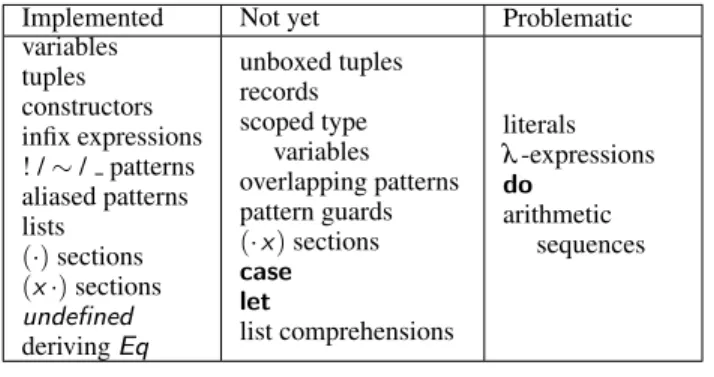
Although the syntax of term-level functions and type-level func-tions is quite different, these differences are not substantial. Term-level constructs, such as conditionals and case statements, can be accurately simulated by defining extra type-level functions to per-form pattern matching. Figure 3 summarizes the current state of the implementation, showing what Haskell constructs are supported and what are not. The constructs in the second column are those that we believe are relatively straightforward to add.7
The constructs in the last column are those that would require a change in Haskell to implement fully. First, Iavor Diatchki is cur-rently working to promote certain literals (curcur-rently, strings and
7Promotingletandcasewould require generating a new type family to
perform the pattern match. A user would then need to specify the argument type and return type of these statements for them to be promoted.
Implemented Not yet Problematic
variables tuples constructors infix expressions ! /∼/ patterns aliased patterns lists (·)sections (x·)sections undefined derivingEq unboxed tuples records scoped type variables overlapping patterns pattern guards (·x)sections case let list comprehensions literals λ-expressions do arithmetic sequences
Figure 3. The current state of function promotion
natural numbers) to the type level and produce singleton types for them.8The interface to this extension will agree with thesingletons interface. Next, all uses of a type family must be fully saturated. While it is conceivable to simulate a closure at the type level with the current features of Haskell, the closure would have to be im-mediately applied to arguments to satisfy the saturation constraint. Such a restriction makes programming withλ-expressions imprac-tical, so they are not supported. See Section 7 for more discussion of this topic. Finally,doexpressions and arithmetic sequences both rely on type classes, which are currently not promotable.
3.3 Converting functions to work with singletons
As discussed in Section 2.4, any term function defined in the con-text of a call to thesingletons function is not only promoted to the type level, but also redefined to work with singleton-typed arguments. For example, theisEvenfunction generates both the type familyIsEven and the term function sIsEven::Sing b → Sing(IsEven b). As discussed above, the function definition must be explicitly annotated with its type for this translation to succeed. The translation algorithm uses the explicit type of the function to derive the desired kind of the generated type family declaration and the type of the singleton version of the function. For exam-ple, consider the functionfmap, specialized toMaybe. The splice (ignoring the body of thefmapfunction)
$(singletons[d|
fmap::(a→b)→Maybe a→Maybe b|]) produces the declarations:
type familyFmap(f::κ1→κ2) (m::Maybeκ1) ::Maybeκ2
sFmap::∀(f::κ1→κ2) (m::Maybeκ1).
SingKind(Any::κ2)⇒
(∀(b::κ1).Sing b→Sing(f b))→
Sing m→Sing(Fmap f m)
The kind of the type family is the promoted type of the function. Because thefmapis polymorphic in two type variables,Fmapis polymorphic in two kind variablesκ1andκ2.
However, the type ofsFmapis both kind- and type-polymorphic. The original function takes two arguments, of type(a→b)and
Maybe a, so the refined version also takes two arguments. All non-arrow types, such asMaybe a, are converted to an application of
Sing to a fresh type variable, such as Sing m. Arrows, such as
a→b, on the other hand, are converted to polymorphic function types over singletons.
This type translation is actually a well-known extension of sin-gleton types to arrow kinds [Crary and Weirich 2000; Guillemette
and Monnier 2008a]. In general, forf of kindκ1→κ2, the
single-ton type can be expressed by the following kind-indexed function (writing the kind indices explicitly).
Singleton[[κ1→κ2]]f=
∀(α:κ1).Singleton[[κ1]]α→Singleton[[κ2]](fα) Singleton[[κ]]τ=Singτ whenκis a base kind, likeNat
The intuition is that a higher-order function on singletons can take only functions that operate on singletons as parameters. Any such function must necessarily be polymorphic in its singleton type pa-rameters. Thus, arrow types get translated to higher-rank polymor-phic functions as above. However, because type-level functions must be fully saturated in Haskell (see Section 7), there is currently a limited use for such parameters. The typef can be instantiated with only type and promoted data constructors.
In the type ofsFmap, theSingKindconstraint is necessary be-cause this function must process a singleton value whose type index is of kindκ2. In other words, the singleton type associated withκ2
appears in a negative context in the type ofsFmap. Every singleton type that appears in a negative context must have a kind that has an associated singleton because terms of these types are passed to the smart constructors defined for other singleton types. This fact is trivially true whenever the outer-most kind constructor is fixed (such as inNat or Maybeκ), but it must be explicitly declared when the kind is fully polymorphic, as here. Thesingletonslibrary detects polymorphic kinds whose singleton types are in a negative context and adds the necessarySingKindconstraints.
The translation of the bodies of the functions is straightforward. Locally bound variables are translated to the variables generated during translating variable patterns, other variables are translated into the singleton versions of the variables of the same name (fmap
to sFmap, for example), conditional statements are translated to use ansIf function defined to work with singletonBool values, and constructors are translated to the associated smart constructor. For example, here is the body of the translatedfmapfunction:
sFmap SNothing=SNothing sFmap f (SJust a) =sJust(f a)
4.
Design decisions
In designing the conversion algorithms, support classes and defini-tions, there were a number of design choices. This section presents some of those alternatives.
4.1 Singletons for parameterized types
Thesingletonslibrary uses a novel translation for parameterized
datatypes, diverging from prior work. A more standard translation would include an extra parameter for each parameter of the original datatype. For example, under this scheme we would generate the following singleton type forMaybe:
dataSMaybe(s::κ→ ∗) (m::Maybeκ)where
SNothing::SMaybe s ’Nothing
SJust ::∀(a::κ).(SingKind(Any::κ),SingRep a)⇒
s a→SMaybe s(’Just a)
This type definition is polymorphic over κ, the kind parame-ter to Maybe. Therefore, to construct the singleton type for a, of kind κ, thisSMaybe type is also parameterized by s. With this definition, we might create a singleton value for the type (’Just(’Succ ’Zero))of kindMaybe Nat, as below:
sJustOne::SMaybe SNat(’Just(’Succ’Zero))
sJustOne=SJust(SSucc SZero)
This parameters is awkward. The definitionSMaybeis not as flexible as it appears. For every kind, there is only one singleton
type associated with that kind, so onceκ has been instantiated, there is only one possibility fors.
Fortunately, the presence of type and data families in GHC improves the translation. Compare this definition to that in Sec-tion 3.1. The key difference is the use ofSing to select the sin-gleton type for the parametera, using its kindκ, even though the kind is abstract. That both simplifies and unifies the definition of singletons for parameterized datatypes.
4.2 TheSingkind-indexed data family
The implementation presented in this paper uses a kind-indexed data family forSing. One may ask why it is better to makeSing
a data family instead of a type family. The problem with aSing
type family involves type inference. Consider the following type signature, using theSingTF type family instead of theSing data family:
sPlus::SingTF n→SingTF m→SingTF(Plus n m) If a programmer tries to writesPlus(SSucc SZero)SZero, the compiler has no way to infer the values ofnandm, as those type variables are used only in the context of type family applications. On the other hand, because all data families are necessarily injec-tive, theSingdata family does not hinder type inference.
The drawback of using a data family is that we cannot de-fine an instance for arrow kinds. As described previously, the sin-gleton type for a type of kindκ1→κ2 should be the
polymor-phic function type∀(b::κ1).Sing b→Sing (a b), not a new
datatype. Therefore, there is no data instance ofSing for types of these kinds. As a result, we cannot create a singleton for the type
Maybe(Nat→Nat), for example. However, given the saturation requirement for type functions, such types would be of limited util-ity. Alternatively, using a type family forSingalmost allows this definition, but currently fails because the result of a type family currently cannot be a quantified type. Type families also suffer the limitations of type inference discussed above.
4.3 Implicit vs. explicit parameters
When defining a function in Haskell, a programmer has a choice of making a singleton parameter implicit (using a class constraint
SingI) or explicit (usingSingdirectly).9This choice makes a
dif-ference. An explicit parameter aids in type indif-ference. A functionf
of type(SingI a)⇒If a Nat Bool→Boolcannot be called be-cause there is no way to determineathrough unification and thus derive the implicit argument. In general, ifaappears only as the ar-guments to type functions, then an explicitSing aparameter should be used. Alternatively, when arguments can be inferred, it is spler to make them implicit. Furthermore, it is easy to convert an im-plicit parameter to an exim-plicit one (simply by usingsing), whereas the converse is not possible, in general.10ThesingInstancemethod provides access to aSingIconstraint, but itself requires aSingKind
constraint.
In thesingletonslibrary, we have made sure that implicit param-eters are always available. Each singleton data constructor includes aSingRepconstraint for each of its arguments. This creates some redundancy, as a data constructor such asSSuccincludes both im-plicit and exim-plicit arguments. Alternatively, we could have defined SNatso thatSSuccincludesonlythe implicit arguments:
9Lewis et al. have described an extensionImplicitParamsto Haskell that
enables implicit parameters [Lewis et al. 2000]. The discussion here is about class constraints considered as implicit parameters, and is not directly related.
10One way this symmetry could be remedied is by introducing the notion of
data instanceSing(a::Nat)where
SZero::Sing ’Zero
SSucc::SingRep n⇒Sing(’Succ n)
Because it is easy to convert implicit parameters to explicit ones, storing only the implicit parameters would work for all applica-tions. However, extracting an explicit form of an implicit argu-ment would require an explicit type signature (as seen above in
replicate2) and would then require heavy use of
ScopedTypeVari-ables. Though this system is free from implicit/explicit redundancy, the ease of use is impacted.
5.
Example: A safe database interface
Oury and Swierstra [2008] present a dependently typed database interface supporting an expressive and strongly typed relational al-gebra, written in Agda. In their discussion of the system, the au-thors note various constructs that Agda supports that are not present in Haskell. Here, we present a translation of Oury and Swierstra’s example usingsingletons. Notwithstanding the caveat that Haskell admits⊥, this translation preserves the typing guarantees of the original and retains its simplicity. The complete code for the exam-ple is online.11
The goal is to write a strongly typed interface to a database, similar to HaskellDB [Bringert et al. 2004; Leijen and Meijer 1999]. That work uses phantom types provided in the client code to control the types of values returned from database queries. The interface is responsible for making sure that the data in the database is compatible with the types provided.
The use ofsingletonsin our version of the library removes a significant amount of boilerplate code present in the HaskellDB version. However, note that this section is not a proposal for a new, production-ready database interface. Instead, this example is included to contrast with dependently typed code written in Agda. 5.1 Universe of types
The interface must define a set of types used in the database. Following Oury and Swierstra, we define the universe typeUand type-level functionElas follows:
$(singletons[d|
dataU=BOOL|STRING|NAT|VEC U Nat
deriving(Eq,Read,Show)|]) type family El(u::U)::∗ type instanceEl BOOL=Bool
-- other instances
type instanceEl(VEC u n) =Vec(El u)n
The El type-level function connects a constructor for the U
datatype to the Haskell type of the database element.
Magalh˜aes [2012] also treats the topic of universes in the con-text of GHC’s recent capabilities; we refer the reader to his paper for a more complete consideration of this encoding using promoted datatypes.
5.2 Attributes, schemas, and tables
A database is composed of a set of tables, where each table is a set of rows of a particular format. The format of a row (the columns of a table) is called that row’s schema. In this interface, a schema is an ordered list of attributes, where each attribute has an associated name and type. The type of an attribute is denoted with an element ofU. Ideally, the name of an attribute would be aString; however,
11
http://www.cis.upenn.edu/~eir/papers/2012/singletons/ code.tar.gz, requires GHC version>7.5.20120529.
type-levelStrings are not yet available.12 Nevertheless, the code in this paper uses strings at the type level; please refer to the version online to see the desugared version. Here are the relevant definitions:
$(singletons[d|
dataAttribute=Attr String U
dataSchema =Sch[Attribute]|])
Note that we define the schema using thesingletons function to generate its associated singleton type.
We next define rows in our database: dataRow::Schema→ ∗where
EmptyRow::[Int]→Row(Sch’[ ])
ConsRow ::El u→Row(Sch s)→
Row(Sch((Attr name u) ’:s))
TheRow datatype has two constructors.EmptyRow takes a list ofInts to be used as the unique identifier for the row. (A list is necessary because of the possibility of Cartesian products among rows.)ConsRow takes two parameters: the first element and the rest of the row. The types ensure that the schema indexing the row has the right attribute for the added element.
A table is just a list of rows, all sharing a schema: typeTable s= [Row s]
For a very simple database containing student information, we could define the following schema
$(singletons[d|
gradingSchema=
Sch[Attr"last" STRING,
Attr"first"STRING,
Attr"year" NAT,
Attr"grade"NAT,
Attr"major"BOOL]|]) and table (using(B)forConsRow)
["Weirich" B"S"B12B3BFalseBEmptyRow[0],
"Eisenberg"B"R"B10B4BTrueBEmptyRow[1]] ::Table GradingSchema
The explicit type signature is necessary because it is impossible to infer the full details of the schema from this definition. 5.3 Interacting with the database
Client code interacts with the database through an element of the typeHandle:
dataHandle::Schema→ ∗where...
We have elided the constructors forHandle here, as we are not interested in the concrete implementation of the database access.
Client code connects to the database through theconnect func-tion, with the following type signature:
connect::String→SSchema s→IO(Handle s)
This is the first use in this example of a singleton type. Recall that the nameSSchemais a synonym for theSing kind-indexed data family, where the kind of its argument isSchema. The first argu-ment toconnectis the database name, the second is the expected schema, and the return value (in theIOmonad) is the handle to the database. Theconnectfunction accesses the database, checks that the provided schema matches the expected schema, and, on suc-cess, returns the handle to the database. Internally, the check against
12Type-level Symbols (essentially, atomicStrings) are forthcoming in
the database’s schema is performed using thefromSingfunction— the schema loaded from the database will not be a singleton, so it is necessary to convert the singletonSSchema s to aSchemato perform the comparison.
In our strongly typed interface, this function is the one place where a runtime type error can error, which happens when the expected schema and actual schema do not match. In this case, this function throws an error in theIOmonad. Outside of this one function, a client is guaranteed not to encounter type errors as it reads from the database.
5.4 Relational algebra
Following Oury and Swierstra, we define the typeRA(short for relational algebra) as follows:
dataRA::Schema→ ∗where
Read ::Handle s→RA s Union ::RA s→RA s→RA s Diff ::RA s→RA s→RA s
Product::(Disjoint s s’∼ ’True,SingI s,SingI s’)⇒
RA s→RA s’→RA(Append s s’)
Project ::(SubsetC s’ s,SingI s)⇒
SSchema s’→RA s→RA s’ Select ::Expr s BOOL→RA s→RA s
The RA type is itself indexed by the schema over which it is valid. The constructors represent different algebraic operations a client might wish to perform. The first three allow a client to consider all rows associated with a table, take the union of two sets of rows, and take the difference between two sets of rows. TheProductconstructor represents a Cartesian product, requiring that the two schemas being combined are disjoint. TheProject
constructor projects a set of columns (possibly reordered) from a larger set; it requires the resulting schema to be a subset of the original schema. TheSelectconstructor uses a Boolean expression to select certain rows. The Expr GADT (elided) uses its type parameter to constrain of the result value of an expression.
The Product and Project constructors deserve attention, as they each exhibit special features of our use of singleton types.
TheProductconstructor The constraint on theProduct con-structor uses the Disjoint type family to ensure that the two schemas do not share attributes. The code below is written at the term level and defined over the simple datatypes described above. It uses common features, such as wildcard patterns and infix oper-ators. These functions are promoted to the type familiesAppend, AttrNotInandDisjointbysingletons.
$(singletons[d|
-- append two schemas
append::Schema→Schema→Schema append(Sch s1) (Sch s2) =Sch(s1++s2)
-- check that a schema is free of a certain attribute
attrNotIn::Attribute→Schema→Bool attrNotIn (Sch[ ]) =True
attrNotIn(Attr name u) (Sch((Attr name’ ):t)) = (name6≡name’)∧(attrNotIn(Attr name u) (Sch t)) -- check that two schemas are disjoint
disjoint::Schema→Schema→Bool disjoint(Sch[ ]) =True
disjoint(Sch(h:t))s=
(attrNotIn h s)∧(disjoint(Sch t)s)|])
TheProjectconstructor TheProject constructor encodes the type constraints using type classes and GADTs instead of a type
family. (We compare the two approaches in Section 6.) It uses the GADT SubsetProof, shown below, to encode the relation that one schema is contained within another. This relation relies onInProof, which holds when an attribute occurs in a schema. The classes InC and SubsetC make these proofs inferrable by the Haskell type-checker, so they need not be provided with each use ofProject. Note that there is one instance of each class per constructor of the associated datatype.
dataInProof::Attribute→Schema→ ∗where
InElt ::InProof attr(Sch(attr ’:schTail))
InTail::InC name u(Sch attrs)⇒
InProof (Attr name u) (Sch(a ’:attrs))
classInC(name::String) (u::U) (sch::Schema)where
inProof ::InProof (Attr name u)sch
instanceInC name u(Sch((Attr name u) ’:
schTail))where
inProof =InElt
instanceInC name u(Sch attrs)⇒
InC name u(Sch(a ’:attrs))where
inProof =InTail
dataSubsetProof::Schema→Schema→ ∗where
SubsetEmpty::SubsetProof (Sch’[ ])s’ SubsetCons ::
(InC name u s’,SubsetC(Sch attrs)s’)⇒
SubsetProof (Sch((Attr name u) ’:attrs))s’
classSubsetC(s::Schema) (s’::Schema)where
subset::SubsetProof s s’
instanceSubsetC(Sch’[ ])s’where
subset=SubsetEmpty
instance(InC name u s’,SubsetC(Sch attrs)s’)⇒
SubsetC(Sch((Attr name u) ’:attrs))s’where
subset=SubsetCons
Automatic inference of these classes requires the Overlapping-Instancesextension. In general, both instances ofInCare applica-ble for matching attributes, keeping in mind that GHC’s search for an instance examines only the instance head, not the constraints. However, the first instance above is always more specific than the second, meaning it would take precedence. This preference for the first instance gives the expected behavior—matching at the first occurrence—in the event that two attributes in a schema share a name. The alternative toOverlappingInstancesis to require client code to build the proof terms of typeInProof andSubsetProof
explicitly. 5.5 Queries
Client code can retrieve rows from the database using thequery
function with the following signature:
query::∀s.SingI s⇒RA s→IO[Row s]
For example, the following code lists the names of all students earning a grade less than 90, by first selecting the students matching the criteria (using constructors of theExprGADT) and projecting their first and last names.
$(singletons[d|
names=Sch[Attr"first"STRING,
Attr"last" STRING]|])
main::IO()
main=do
h←connect"data/grades"sGradingSchema notAStudents←
Select(LessThan(Element(sing::Sing"grade")) (LiteralNat90)) (Read h)
putStrLn(show notAStudents)
Note that this code usessGradingSchema, the singleton value that corresponds togradingSchema, defined above. To construct the singleton string value we assume thatStringis in theSingIclass.13 The most illustrative part of the implementation ofqueryis the handling of theProject constructor. We highlight a function that extracts an element from a row:
extractElt::∀nm u sch.InC nm u sch⇒
Sing(Attr nm u)→Row sch→El u extractElt attr r=
caseinProof::InProof (Attr nm u)schof
InElt→caserof
ConsRow h t→h
--EmptyRow →impossible →bugInGHC
InTail→caserof
ConsRow h t→extractElt attr t
--EmptyRow →impossible →bugInGHC
To extract the value of a certain element from a row, we must know where that element appears. We could do a straightforward search for the element, but in general, that search may fail. Instead, we pattern-match on the proof, produced fromInC, that the desired element is in the schema that indexes the row. (To extract this proof, usinginProof, we need an explicit type signature.)
If the proof that an attribute with namenameis in the schemas
is witnessed byInElt, we return the first element in the row. (The
InEltconstructor indicates that the first element in the row is the one that matches the desired name.) Thus, we pattern-match onrow
to extract its head element. This head element must be present—the case thatrowisEmptyRowcan be statically shown impossible by
InElt.14If theInProof is witnessed byInTail, we recur on the tail ofrow, which also must exist.
5.6 Comparison with Agda
The translation of this example from Agda into Haskell shows the expressiveness of dependently typed programming in Haskell with singletons. In particular, compare the following Agda definitions, taken verbatim from Oury and Swierstra’s work (the curly braces { }in the code below indicate implicit arguments and the ! notation declares an infix operator):
dataRA:Schema→Setwhere
Read :∀ {s} →Handle s→RA s Union :∀ {s} →RA s→RA s→RA s Diff :∀ {s} →RA s→RA s→RA s Product:∀ {s s’} → {So(disjoint s s’)} →RA s→RA s’→RA(append s s’) Project :∀ {s} →(s’:Schema) → {So(sub s’ s)} →RA s→RA s’
13This is another instance of our simplified treatment of strings. The
desug-ared version can be with our posted code found online.
14If we include the case forEmptyRowin the case statement, GHC rightly
issues an error that we have written inaccessible code. However, if we omit this case and compile with warnings for incomplete patterns, GHC wrongly warns us that the pattern match is incomplete. This infelicity is in the GHC Trac database, ticket #3927. Until that bug is fixed, programmers should try all alternatives and manually remove those ones that the compiler labels as inaccessible code, as we have done in the code presented here. To suppress the warning, we include the wildcard case seen above. ThebugInGHC
function simply callserrorwith an appropriate message.
Select :∀ {s} →Expr s BOOL
→RA s→RA s
Oury and Swierstra’sSoproposition matches up with the com-parison against ’True used in the Haskell code. Note that the Haskell definitions are very similar to these definitions, gaining no extra annotations or syntactic infelicities other than the use of
singletons. The Haskell version even preserves whether individual parameters are implicit or explicit. This direct comparison shows that writing Haskell code using singleton types can be a good ap-proximation of Agda.
5.6.1 Constraining the schema
There is a weakness lurking beneath the surface in this example compared to the Agda version. Oury and Swierstra also propose an improvement to their definition of theSchematype, introducing a constraint that each attribute in a schema is distinct from all those that come after it. This improvement cannot be made to the Haskell version because, no matter whether the constraint is given implicitly (through a class constraint) or explicitly (through a GADT parameter), the constrainedSchematype would no longer be promotable to the type level [Yorgey et al. 2012]. A more complete discussion of this restriction appears in Section 7. 5.6.2 Functional vs. relational reasoning
A careful comparison will pick up one key change between the two versions in the types of theProject constructors. In Agda, the validity of the projection is guaranteed bySo(sub s’ s); in Haskell, it is guaranteed bySubsetC s’ s. This subtle change makes a large difference in the implementation of thequeryfunction, as we describe below.
Using thesubfunction The AgdaProjectconstructor uses the functionsub to guarantee that the schema s’ is a subset of the schemas. (TheSoprimitive asserts that the result of this function is ’True.) To understand how this works, we consider a Haskell defi-nition ofsub, promoted to the type functionSub(which requires a standardlookupfunction, elided):
$(singletons[d|
sub::Schema→Schema→Bool sub(Sch[ ]) =True
sub(Sch((Attr name u):attrs))s’=
lookup name s’≡u∧sub(Sch attrs)s’|])
Recall that theextractEltfunction, which retrieves an element from a row, is an important component of projection. In this ver-sion, this function usesLookupto compute the correct return type.
extractElt::Lookup name s ∼u⇒
Sing name→Row s→El u
The context where we call this function has the constraint
Sub s’ s∼ ’True. Pattern matching gives us the case wheres’is not empty. It is equal to some ’Sch((’Attr name u)’:attrs). In that case, corresponding to the second clause ofsub, above, the con-straint reduces to(Lookup name s:≡:u:∧Sub(’Sch attrs)s)∼ ’True, from the definition ofSub, where:≡:and :∧are Boolean equality and conjunction at the type level.15 To callextractElt, we must satisfy the constraintLookup name s ∼u, which GHC cannot immediately derive from the above.
We can use clever pattern matching on results that we already know to manipulate this constraint so that(Lookup name s’:≡:u)∼ ’Trueis in the context. However, this constraint is distinct from the
15As part of promoting and refining datatypes that derive the type classEq,
thesingletonslibrary generates instances for:≡:and an instance for the type classSEq, the singleton counterpart ofEq.
desired one,Lookup name s’∼u. Getting to our goal requires the following function, which reflects an equality function call :≡:to an equality constraint.
dataEql::κ→κ→ ∗where
Refl::Eql x x
boolToProp::∀(u1::U) (u2::U).(u1:≡:u2)∼ ’True⇒
Sing u1→Sing u2→Eql u1u2
TheboolToPropfunction can be defined by an exhaustive pattern-match on all possibilities foru1andu2, using recursion in theVEC
case. Of course, those matches that giveu1andu2different values
are rejected as impossible by the(u1:≡:u2)∼ ’Trueconstraint.
Using the SubsetCrelation In this case, we must derive the
InC name u s’constraint from the constraintSubsetC s s’, again whens equals ’Sch(’Attr name u’:attrs). In that case, there is only one way to derive the associatedSubsetProof extracted from this constraint. Therefore we can pattern match this term against theSubsetConsconstructor, of type:
SubsetCons::(InC name u s’,SubsetC(Sch attrs)s’)⇒
SubsetProof (Sch((Attr name u)’:attrs))s’
This match directly brings the necessary constraint into scope. In this example, working with relations instead of functions simplifies static reasoning. We discuss this trade-off in more detail below.
6.
Expressing type-level constraints
When we wish to express a compile-time constraint, we have at least three options: we can use a Boolean-valued type-level func-tion, a GADT, or a class constraint. All three of these techniques are used above.
Using type families When using the singletons library, it is straightforward to write a function at the term level returning a
Bool, promote that function to the type level (using thepromoteor
singletons function) and then use the promoted version to satisfy some constraint. This ability, demonstrated withDisjointabove, is the chief advantage of the type families—it corresponds with the way Haskellers already know how to solve problems.
The chief disadvantage of this technique is that it can be diffi-cult to use a constraint defined via a function, as we saw in Sec-tion 5.6.2. The type checker may know that the result of the func-tion call is ’True, but sometimes it is surprising that the compiler cannot use this fact to infer additional information. For example, even if the function has a closed domain, the compiler cannot rea-son by case analysis (without additional runtime cost). Further-more, there is no formal connection between Boolean-valued func-tions (such as:∧and:≡:) and their corresponding constraints.
Using a relation encoded by a GADT Using indexed types, like GADTs, to encoderelationsis standard practice in dependently-typed programming. A GADT provides explicit evidence that the constraint holds—pattern matching the data constructors of a GADT allows programmers to explicitly invert this relation to bring new constraints into the context.
There are two main drawbacks to this approach. All GADT terms must be explicitly built—the compiler does none of the work for us here. Furthermore, GADT-encoded constraints can be trivially satisfied by⊥, meaning that the programmer cannot absolutely rely on the constraint.
Using type classes As we saw in the example, multiparameter type classes can also express constraints on the relations between the arguments to a function. In fact, they can work in conjunction with GADTs to allow the compiler to implicitly provide proofs.
A big advantage to using this technique is that the instance cannot be instantiated by⊥. Because the compiler produces the
instance, a programmer can be sure that an instance exists and is valid. There is no way to spoof the type checker into producing a bogus instance.16
Sometimes, when using class constraints, it is necessary to enable either the OverlappingInstances extension or the more ominous-sounding IncoherentInstances extension. The use of these extensions do not reduce the veracity of the proof. Both of these extensions give the compiler the latitude to choose a satisfy-ing instance among a set of choices, perhaps ussatisfy-ing heuristics such as specificity; without the extensions enabled, the compiler insists on the uniqueness of the available option. The use of
IncoherentIn-stancesis similar to the nondeterminism of the use ofauto in
a proof in Coq. In both cases, the programmer lets the compiler choose among a set of options, but she can always be sure that the compiler will choose a valid option if one is chosen at all.
A noted disadvantage to class constraints is that all inference mustbe done by the compiler. It is impossible to provide an explicit instance even when desired.
Conclusion All three techniques have advantages and disadvan-tages. Many have exploited the power of Haskell’s type class mech-anism to express rich constraints on types. As GADTs and type families have been introduced, there has been movement away from the logic programming capabilities of type classes and toward a more functional style of programming at the type level. However, as the example above shows, the logic programming facility of type classes still has its place and may offer more direct reasoning.
7.
GHC extensions
In this section we discuss a number of extensions to GHC that would better support dependently typed programming.
Unsaturated and injective type families Current versions of Haskell do not allow for unsaturated type families. For example, take thePlustype-level function overNats discussed earlier, and consider a type-level implementation ofMap.
Map(Plus(’Succ ’Zero))’[’Zero,’Zero]
Unfortunately, this is not valid Haskell code. It is not possible to use Pluswithout supplying both of its parameters. The reason for this restriction is that allowing unsaturated type families interferes with type inference. Consider the case when the type inference engine knows that the typesa bandc dunify. Currently, it is sound to then unifyawithcandbwithd. If Haskell allowed unsaturated type-level functions, however, this decomposition would not be sound. In the current implementation, all type-level functions must be fully applied, so we know thataandccould never be instantiated by type functions. In the case where the typesF bandF dare unified, for some one-parameter type-level functionF, the compiler is aware thatFis a type-level function and will not unifybandd. (In this case, the ability to mark certain type families as injective, would allowbanddto unify when it is safe to do so.)
Kind-level equality When rich kinds were introduced into GHC [Yorgey et al. 2012], kind-level equality constraints were explicitly disallowed. That restriction simplified the extension, minimizing the number of changes to GHC necessary to support datatype promotion and kind polymorphism. However, this lack of kind-level equality imposes two restrictions for dependently typed programming: it is impossible to write kind-level functions and to promote GADTs.
16It is always possible to write bogus instances and then have the compiler
find them. Whenever we refer to the consistency of the constraint language, we mean consistency with respect to the axiom system inferred by the class and family instances declared.