Universitat Politècnica de Catalunya (UPC)
Castelldefels School of Telecommunications and Aerospace Engineering
Department of Network Engineering
Energy-Aware Routing Techniques
for Software-Defined Networks
Author: Adriana Fernández-Fernández
Ph.D. Advisor: Cristina Cervelló-Pastor
Thesis submitted in partial fulfillment of the requirements for the degree of Doctor of Philosophy in Network Engineering
Focus on doing the 20% of work that will yield you 80% of the results.
Pareto Principle
This work is licensed under theCreative Commons Attribution-NonCommercial 4.0 Interna-tional License. To view a copy of this license, visithttp://creativecommons.org/licenses/ by-nc/4.0/
A digital copy of this document can be downloaded from TDX (Theses and Dissertations Online, http://www.tdx.cat/), the repository of theses managed by the Consorci de Serveis Universitaris de Catalunya (CSUC) and sponsored by the Government of Catalonia.
Abstract
Achieving energy efficiency has recently become a key topic of networking research due to the ever-increasing power consumption and CO2 emissions generated by large data networks. This problem is becoming even more concerning and challenging given the drastic traffic increase expected over the next few years. However, the use of efficient energy-aware strategies could overturn this situation reducing the electricity consumption of Internet data transmission net-works, as well as contributing to mitigate the environmental impact of other sectors.
The existence of redundant network elements with high capacities is a common design prac-tice in current network infrastructures in order to face suddenly failures or peak traffic flows. However, these additional resources remain either unused or barely used most of the time leading to an undesired energy waste. Therefore, putting into sleep mode (i.e. a low-power state) un-used elements is an effective and widely-accepted strategy to decrease the consumption of data networks. In this context, Software-Defined Networking (SDN) can be seen as an attractive solution to achieve the long-awaited energy efficiency in current communications systems, since they allow a flexible programmability suitable for this problem.
This doctoral thesis tackles the problem of optimizing the power consumption in SDN through the design of energy-aware routing techniques that minimize the number of network elements required to satisfy an incoming traffic load. Different from existing related works, we focus on optimizing energy consumption in SDN with in-band control traffic in order to close this important gap in the literature and provide solutions compatible with operational backbone networks. Complementing the general aim of improving the energy efficiency in SDN, this re-search is also intended to cover important related features such as network performance, Quality of Service (QoS) requirements and real-time operation. Accordingly, this study gives a general
perspective about the use of energy efficient routing techniques, which cover integrated routing considerations for the data and control plane traffic in SDN.
By using realistic input data, significant values of switched-off links and nodes are reached, which demonstrates the great opportunity for saving energy given by our proposals. The ob-tained results have also validated the intrinsic trade-off between environmental and performance concerns, considering several performance indicators. These findings confirm that energy-aware routing schemes should be designed considering specific traffic requirements and performance metric bounds. Moreover, it is shown that jointly considering QoS requirements and energy awareness is an effective approach to improve, not only the power consumption, but the per-formance on critical parameters such as control traffic delay and blocking rate. Similarly, the proposed dynamic traffic allocation with congestion-aware rerouting is able to handle demanding traffic arrival without degrading the performance of higher priority traffic.
In general, our proposals are fine-grained, easy to implement and quite balanced and effec-tive in their results looking for a suitable and readily deployment in real-world SDN scenarios. Therefore, the conducted research and contributions reported through this document not only add to what is known about the potential of energy-aware routing techniques, but also stand as a valuable solution on the road to a sustainable networking.
Acknowledgements
First and foremost, I want to thank my advisor Dr. Cristina Cervelló-Pastor. This work would not have been possible without her immense support, guidance and knowledge. But a bigger thanks for being much more than just my thesis director and for taking care of all the difficulties that we have come through along these three years. I could not have imagined having a better advisor and mentor for my PhD.
Besides my advisor, I would like to express my special appreciation and thanks to Prof. Sebastià Sallent. I will always be grateful for the words of trust and the encouragement on both my research as well as on my career. Thanks for bringing expertise and sense of humor, even in the more tedious moments.
I would also like to express my sincere gratitude to the rest of my thesis committee: Dr. Joan Triay Marques and Dr. Xavier Costa Perez, for the time and effort they have put in reviewing and assessing my work. Their ideas, feedback and questions have been invaluable.
My most sincere thanks also goes to Dr. Paola Grosso from University of Amsterdam, who provided me an opportunity to join their team as a visiting researcher. Her insightful comments and stimulating discussions about my work motivated me to widen my research from various perspectives. A special thanks to the rest of the SNE group, for all the time we spent together as coworkers as well as friends. Thank you all for making these three months one of the best experiences I have had during my PhD.
I thank my fellow lab-mates for the long hours we were working together before deadlines, for the nice and relaxed working atmosphere and for all the fun we have had along the way. It was great sharing laboratory with all of you. Also I thank the friends and colleagues I have met during my PhD, for the exchanges of knowledge and skills and for those unforgettable moments
we have enjoyed and shared along these years.
I recognize that this research would not have been possible without the financial support from the Ministerio de Economía y Competitividad of the Spanish Government, from which I got a PhD scholarship.
Last but by no means least, I would like to thank my family. Words cannot express how grateful I am to them. They are the most important people in my world and I dedicate this thesis to them.
To my life-coaches, my parents, who are the biggest inspiration in every aspect of my life both personal and professional. Although we have been physically separated most of the time during these last three years, they have been more than aware of every step I have done along this path. Thanks for your endless love and for making me feel that you are and will always be there for me. Because I owe it all to you. Many Thanks!
To my brother, for being the best big brother anyone could ever hope for. Thanks for making me so proud and for always setting the bar higher. My deepest gratitude goes to my grandparents, who have always supported me and encouraged me to pursue all my goals.
Finally, a special thanks to Leo, for sharing with me every moment of this adventure that we have lived together. It would not have been the same without you by my side. This work and achievement are also yours.
Contents
Abstract v
Acknowledgements vii
List of Figures xv
List of Tables xvii
List of Abbreviations xix
1 Introduction 1
1.1 Software Defined Networks: An Overview . . . 3
1.2 Research Problems and Objectives . . . 6
1.3 Contributions . . . 8
1.4 Thesis Organization . . . 9
2 Background and Literature Review 11 2.1 Principles of Energy-Aware Routing . . . 11
2.1.1 Traffic-Based Solutions . . . 14
2.1.2 Topology-Based Solutions . . . 17
2.2 Energy Efficiency and Performance Concerns . . . 19
2.3 Multi-Objective Traffic Engineering . . . 22
2.4 Dynamic Green Traffic Allocation . . . 24
3 Tailored Solutions to the Energy-Aware Routing Problem in SDN 29
3.1 Introduction . . . 29
3.2 Exact Algorithms . . . 30
3.2.1 One Single Controller . . . 30
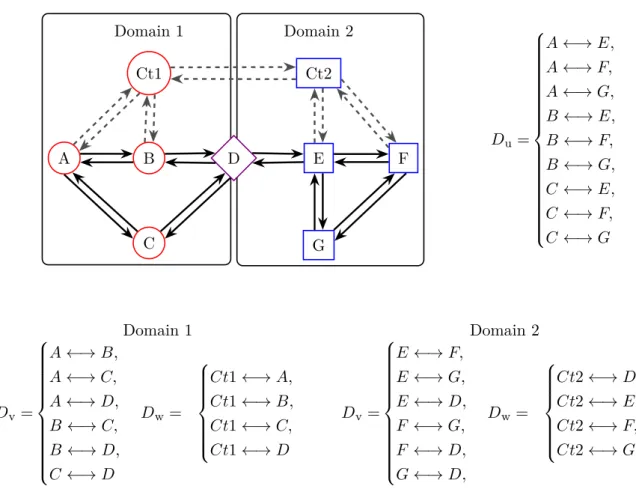
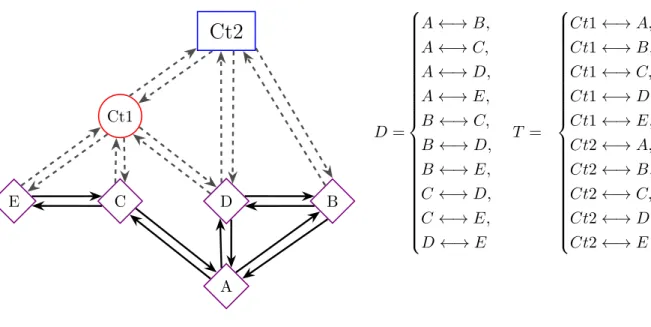
3.2.2 Multiple Controllers . . . 32
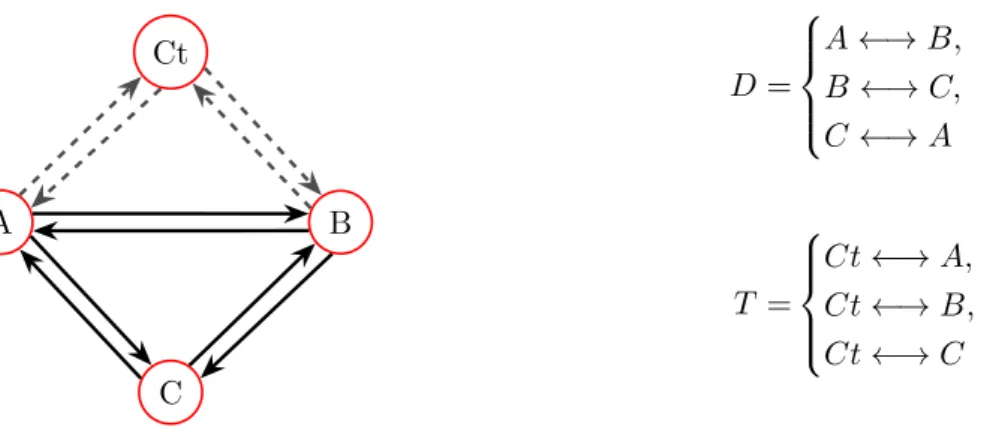
3.2.3 Model Operation Example . . . 39
3.3 Heuristic Algorithms . . . 41
3.3.1 Energy-Aware Routing . . . 41
3.3.2 Energy-Aware Location of a Single SDN Controller . . . 44
3.3.3 Complexity Analysis . . . 46
3.4 Simulations and Results . . . 47
3.4.1 DEAR Performance . . . 49
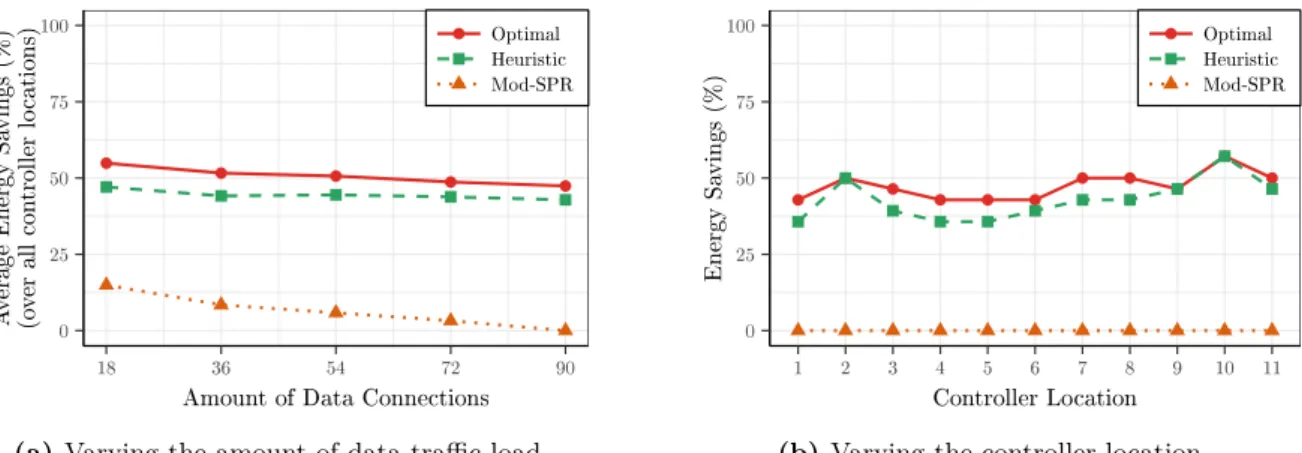
3.4.2 Optimal vs. Heuristic Solutions . . . 50
3.4.3 Performance in Large-Scale Topologies . . . 54
3.4.4 Impact of Control Paths Delay Bound . . . 55
3.4.5 Impact of Controllers Placement . . . 56
3.5 Conclusion . . . 58
4 Impact of Energy-Aware Routing on SDN Performance 59 4.1 Introduction . . . 59
4.2 Problem Statement . . . 60
4.2.1 Network Model . . . 60
4.2.2 Formulation . . . 61
4.3 Heuristic Algorithms . . . 63
4.3.1 Static Network Configuration Algorithm (SNetCA) . . . 64
4.3.2 Dynamic Energy Saving Routing Algorithm (DESRA) . . . 70
4.3.3 Complexity Analysis . . . 71
4.4 Simulations and Results . . . 72
4.4.1 Optimal vs. Heuristic Solutions . . . 74
4.4.2 SNetCA Performance . . . 77
Contents
4.4.4 Impact on Network Performance . . . 81
4.4.5 Resilience Considerations . . . 91
4.5 Conclusion . . . 94
5 Multi-Objective Routing Combining QoS and Energy Awareness 97 5.1 Introduction . . . 97
5.2 Problem Statement . . . 98
5.2.1 Network Model . . . 98
5.2.2 Formulation . . . 99
5.3 Multi-Objective Evolutionary Algorithm . . . 101
5.3.1 Design Issues . . . 103
5.3.2 Complexity Analysis . . . 106
5.4 Simulations and Results . . . 106
5.4.1 Simulation Setup . . . 106
5.4.2 Energy Efficiency and Control Path Delay Trade-off . . . 108
5.4.3 Blocking Rate . . . 110
5.5 Conclusion . . . 111
6 Dynamic Performance and Congestion Aware Energy Efficient Routing 113 6.1 Introduction . . . 113
6.2 Problem Statement . . . 114
6.2.1 Network Model . . . 115
6.2.2 Formulation . . . 115
6.3 Heuristic Algorithms . . . 118
6.3.1 Green Initial Setup (GrIS) . . . 118
6.3.2 Dynamic Power-Aware Routing (DyPAR) . . . 122
6.3.3 Complexity Analysis . . . 125
6.4 Simulations and Results . . . 126
6.4.1 Simulation Scenario . . . 126
6.4.2 Optimal vs. Heuristic Solutions . . . 128
6.4.3 Assessment of Power Saving Potential . . . 129
6.5 Conclusion . . . 132
7 Conclusion and Perspectives 135
7.1 Research Outcomes . . . 136 7.2 Room for Improvement . . . 137 7.3 Road Ahead . . . 138
Publications 141
List of Figures
1.1 SDN architecture . . . 4 1.2 Signaling modes in SDN . . . 5 1.3 Thesis outline . . . 9 2.1 Power model . . . 12 3.1 Example topology . . . 31 3.2 Example topology . . . 33 3.3 Example topology . . . 373.4 Models operation example . . . 40
3.5 Real-world network topologies . . . 48
3.6 DEAR performance in the Abilene topology with two domains . . . 49
3.7 Energy saving for one network controller in the Abilene topology . . . 51
3.8 Energy saving for one network controller in the Nobel-US topology . . . 51
3.9 Average energy saving for different numbers of controllers . . . 52
3.10 Average energy saving varying the number of controllers . . . 54
3.11 Average energy saving varying the control paths delay bound . . . 55
3.12 Average energy saving and average control paths delay . . . 56
4.1 Illustrative diagram of the proposed approach . . . 64
4.2 Example of SNetCA operation . . . 69
4.3 Real-world network topologies . . . 72
4.5 Performance of SNetCA on the Norway topology . . . 78
4.6 Average number of pruned links varying the number of controllers . . . 79
4.7 Average energy saving for different numbers of controllers . . . 80
4.8 Maximum control traffic over-length in the New York topology . . . 83
4.9 Maximum control traffic over-length in the Geant topology . . . 83
4.10 Maximum control traffic over-length in the Norway topology . . . 83
4.11 CDF of data paths latency varying the amount of controllers . . . 84
4.12 Maximum control traffic over-length under delay constraints . . . 86
4.13 CDF of data paths latency under delay constraints . . . 87
4.14 CDF of link utilization varying the amount of controllers . . . 89
4.15 Average TCAM occupation with |C|= 2 . . . 90
4.16 Average energy saving with |C|= 1 . . . 92
5.1 SPEA2 general procedure . . . 103
5.2 Average energy saving with the reported traffic matrices . . . 108
5.3 Control traffic over-length with the reported traffic matrices . . . 109
5.4 Average energy saving with generated traffic demands. . . 110
5.5 Average blocking rate with generated traffic demands. . . 111
6.1 Network topology of Cost266 . . . 126
6.2 Power saving vs. number of controllers and percentage of transit nodes . . . 129
6.3 Power consumption vs. traffic arrival rate and over-provisioning factor . . . 131
List of Tables
3.1 Average execution time on real topologies . . . 53
3.2 Energy savings for different placement strategies . . . 57
4.1 Main characteristics of considered topologies . . . 73
4.2 Average execution time on real topologies . . . 76
4.3 Energy savings with paths delay constrained . . . 88
List of Abbreviations
AC-OFER Ant Colony Online Flow-based Energy-efficient Routing.
ADI ADequacy Index.
CDF Cumulative Distribution Function.
CERC Centralized Energy-efficient Routing Control.
DEAR Distributed Energy-Aware Routing.
DESRA Dynamic Energy Saving Routing Algorithm.
DyPAR Dynamic Power-Aware Routing.
ECMP Equal Cost Multiple Path.
EMMA Energy Monitoring and Management Application.
ESACON Energy Saving based on Algebraic CONnectivity.
ESIR Energy Saving IP Routing.
ESOL Energy Saving based on Occurrence of Links.
FRR Fast Rerouting.
GrIS Green Initial Setup.
IEA International Energy Agency.
IGP-WO Interior Gateway Protocol Weight Optimization.
ILP Integer Linear Programming.
KPI Key Performance Indicator.
LB Load Balancing.
LC Least Cost.
LSP Label Switching Path.
MCMF Multi-Commodity Minimum Cost Flow.
MCP Maximum Clique Problem.
MILP Mixed-Integer Linear Programming.
MILP-EWO MILP-based algorithm for Energy-aware Weights Optimization.
MLU Maximum Link Utilization.
Mod-SPR Modified Shortest Path Routing.
MOEA Multi-Objective Evolutionary Algorithm.
MPLS Multi-Protocol Label Switching.
MSPF Multiple Paths by Shortest Path First.
NFV Network Functions Virtualization.
NMU Next Maximum Utility.
NSGA2 Non Sorting Genetic Algorithm 2.
NSP Next Shortest Path.
List of Abbreviations
OSPF Open Shortest Path First.
QoS Quality of Service.
R-EAR Reliable Energy-Aware Routing.
ROD Routing On Demand.
SDN Software-Defined Networking.
SGH Strategic Greedy Heuristic.
SLA Service Level Agreement.
SNetCA Static Network Configuration Algorithm.
SP Shortest Path.
SPEA2 Strength Pareto Evolutionary Algorithm 2.
SPR Shortest Path Routing.
SPT Shortest Path Tree.
TCAM Ternary Content Addressable Memory.
TE Traffic Engineering.
Chapter
1
Introduction
Over the last decade, Information and Communication Technologies (ICT) have been forced to face an exponential demand growth from an ever-increasing number of connected devices. For instance, global Internet traffic in 2021 will be equivalent to 127 times the corresponding volume observed in 2005, reaching 30 GB per capita, up from 10 GB per capita in 2016, while the number of devices connected to IP networks will triple the global population [1]. Such steady rise has implied an increasing energy usage contributing to a non-negligible and concerning impact on the environment as well as associated operational costs. Consequently, the need for energy efficient networking has become a major goal involving government and industry efforts and attracting a great deal of attention from research community.
According to [2], between 2007 and 2012 the global energy use of ICT grew at an annual rate of nearly 7% representing a higher value than the 3% yearly growth of the overall worldwide electricity consumption in the same time frame. These figures correspond with an increase of ICT’s relative share in worldwide electricity consumption from about 4% in 2007 to 4.7% in 2012 [3].
Currently, this sector is responsible for about 2.4-3% of global electricity consumption and it is expected an annual increase of 20% [4]. Accordingly, the global carbon dioxide footprint of ICT equipments accounts for 2-2.5% of worldwide emissions [5], which equals the amount generated by the aviation industry [6]. Moreover, it is projected that the ICT-related CO2 emissions will increase to 4% by 2020 [7]. Similarly, it has been forecasted that, compared to the level in 2010, the total electricity consumption of ICT will be doubled by 2022 and tripled by 2030 [8].
Among the main ICT areas, data transmission networks account for more than a third part of the total energy consumption in this sector [9]. Moreover, they presented the strongest electricity consumption growth (10.1% per year) with respect to end-user equipment (5.2% per year) and data centers (4.3% per year) [10].
A recent estimation from the International Energy Agency (IEA) [11] states that global electricity used by internet data transmission networks in 2015 amounted to around 185 TWh (i.e. 1% of total worldwide electricity demand). Moreover, considering the increasing global use of Internet (with an estimated growth rate between 30 and 40% per year), the electricity demand of data networks in 2021 can rise by over 70% to about 320 TWh. However, the use of efficient energy-aware strategies could overturn this estimation reducing the electricity consumption of Internet data transmission networks by 15% to about 160 TWh.
As a result, the reduction of power consumption in telecommunication networks is a crucial step to accomplish significant energy savings in this sector. The future direction of ICT impact on energy consumption and carbon emissions will depend on the adoption of power efficient solutions in data networks. At the same time, being ICT a support technology for many industries, increasing the energy efficiency in data networks can also substantially reduce the environmental impact of other sectors.
Given that in practice, the energy consumption of network equipment is not in proportion with their traffic load [12], the reduction of the number of active elements is an effective and widely-accepted strategy to decrease the consumption of data networks [13]. This feature can be implemented by putting into sleep mode (i.e. a low-power state) unused networks elements such as interconnection devices, line cards or port interfaces [14].
Although turning off entire interconnection devices enables greater energy savings, this pos-sibility should be carefully considered, since it leads to resiliency concerns in case of network failures. Nevertheless, due to the link over-provisioning typically considered in the design and operation of backbone networks, substantial energy can still be saved by changing the status of network interfaces to sleep mode whenever a link is not transferring data.
Within this context, SDN, which is further described in this section, is a very well-suited architecture to perform an energy-aware routing and to manage the state of unused switch interfaces in a coordinated and centralized way. Therefore, the implementation of an energy-aware solution in the control plane is a valuable opportunity to solve the power consumption
1.1. Software Defined Networks: An Overview
problem in data networks.
1.1
Software Defined Networks: An Overview
The optimization of power consumption could be considered as one promising field of appli-cation for SDN [15, 16]. In this networking architecture, control functions (routing decisions) are decoupled from the data plane (forwarding nodes) and delegated to a new entity called the controller.
The standardization work behind SDN concepts and technicalities is led by the Open Net-working Foundation (ONF) in collaboration with major standards organizations such as ETSI, IETF, 3GPP, and IEEE. SDN provides four essential features [17]:
• Control and data planes separation;
• Logically centralized control and network view;
• Control plane and data plane connected through open interfaces;
• Use of external applications providing network programmability.
In essence, the basic idea of SDN –moving control functions from hardware into software– makes network environments more manageable. Unlike traditional networks, requiring manual and individual configuration of network devices to change the network behavior, network-wide routing and forwarding decisions can be taken in the decoupled and logically centralized (or even possibly distributed) control plane.
The logically centralized controller in SDN provides global knowledge of the network state and topology information. Moreover, it can manage network tasks and perform device program-ming without additional software or hardware-based intelligence in each one of the switching elements. In particular, an SDN controller can collect traffic patterns, perform path computa-tion using its knowledge of the existing topology and push such routing decisions down to the data plane devices for execution.
On the other hand, forwarding nodes in the data plane are merely required to follow the instructions set by the controller to forward the traffic, being no longer involved in network control. Routing strategies are sent by the controller in the form of flow table rules and installed
in the Ternary Content Addressable Memory (TCAM) of the forwarding elements. Additionally, flow entries can be modified or removed by the controller in order to manage the switches behavior with respect to traffic forwarding.
Consequently, the use of an underlying SDN architecture will facilitate the introduction and deployment of new applications and services, making it easier than with classical hardware-dependent implementations. Another advantage of exploiting SDN is the possibility to dynami-cally adapt control decisions to comply with diverse QoS requirements to handle heterogeneous application-driven networks.
The different planes and interfaces conforming the SDN architecture can be appreciated in the diagram shown in Fig. 1.1.
Fig. 1.1: SDN architecture.
Control plane implementations can be categorized into centralized and distributed architec-tures, according to the number of physical controllers deployed in the network [18]. Obviously, the use of a physically-centralized control plane consisting of a single server is a recurrent con-cern, since it brings scalability and reliability issues. As an alternative, the logically centralized control in SDN can be implemented with multiple physically-distributed servers in order to mit-igate such issues. In this regard, two main categories of distributed SDN control architectures
1.1. Software Defined Networks: An Overview
have been discerned based on the physical organization of SDN controllers, namely flat and hierarchical [19]. In the first approach, the network is partitioned into multiple areas, where each is handled by a single controller [20], while in the second, multiple vertical control layers are defined depending on the required services [21].
The exchange of traffic flows between switches and controllers is possible through an open southbound interface. OpenFlow [22, 23] is the first and most commonly used protocol for the southbound interface of SDN. It is already supported by commercial products of different vendors [24] and has been applied in a wide range of network environments [25]. Other examples of protocols defined for the southbound interface in SDN are ForCES [26] and OpFlex [27].
(a)Out-of-band control (b)In-band control Fig. 1.2: Signaling modes in SDN.
Regarding the traffic flows between control elements and forwarding nodes on the data plane, two operational modes can be identified, namely out-of-band and in-band control [18]. Out-of-band control, depicted in Fig. 1.2(a), is based on the deployment of a separate control network in addition to the one used for the data traffic. This is a common approach in data centers limited in geographical size, where CAPEX and OPEX associated with an additional control network are usually acceptable.
With in-band control, the same links are used by both data and control plane traffic, as illustrated in Fig. 1.2(b). Hence, control messages are exchanged without the need for addi-tional infrastructure [28, 29]. Evidently, in wide-ranging carrier networks, this is a more realistic scenario since additional links dedicated to directly connect controllers and forwarding nodes are impractical and cost-inefficient.
By allowing innovation and flexibility, SDN can dramatically simplify network control pro-cedures [30]. Specifically, the use of these programmable networks can have a significant role in
reducing the energy consumption [31]. The centralized decision-making mechanism can be lever-aged to perform an energy-aware routing that determines, in a coordinated way, the network elements that should be put into sleep mode and to accordingly program the forwarding nodes. Therefore, an energy-aware solution could be easily implemented in the SDN control plane.
Based on the aforementioned reasons, throughout this work we exploit the benefits of SDN to solve the problem of power consumption in data networks. Complementing the general aim of an energy-aware routing that minimizes the number of active network elements needed to route the required traffic in SDN, this research also seeks to propose several novel methods to address the following research problems with energy efficiency at its focus.
1.2
Research Problems and Objectives
As stated before, this research aims to tackle the energy consumption problem in SDN. For such purpose, we have identified four key related challenges which have naturally guided and motivated the investigation.
• How to route, in an energy efficient way, connection requests in an SDN
envi-ronment with multiple controllers. To address this question we aim at achieving the optimal energy-aware routing in the network by selecting the number of physical resources that lead to minimum power consumption and meet a given traffic demand. We pursue to optimize energy consumption in OpenFlow networks with in-band control traffic to ad-vance the state of the art that considers only the data plane traffic in SDN. We also seek to optimize the distribution of switches between controllers and the controllers location in terms of energy efficiency.
• How to increase the energy saving and quantify its impact on network
perfor-mance. Considering that executing an energy efficient routing technique is only reasonable if the impact on other network performance parameters is tolerable, we need to determine the intrinsic inter-relation between both essential features. We endeavour to provide a broader analysis about the existing trade-off between power consumption and network performance, considering several performance indicators, in order to shed light on this crucial issue for communication systems nowadays.
1.2. Research Problems and Objectives
• How to jointly optimize QoS requirements and energy efficiency while still
meeting control traffic requirements. The conflicting nature between QoS and energy-related objectives calls for an integrated networking solution. In this context, optimization refers to a more complex joint criterion combining the traditional Traffic Engineering (TE) goals with the new energy-related ones in a common multi-objective framework in order to achieve the best compromise solution between the aforementioned goals. In this regard, control traffic requirements in terms of latency should also be included in the integrated model.
• How to provide online energy efficient traffic allocation to real-time demands
without performance degradation. For current networking environments, which are
facing less predictable traffic patterns, incoming demands need to be strategically allocated in real-time along energy efficient paths. In this way, dynamic awaking/sleeping decisions can be taken based on the arrival/departure of network traffic. In addition to minimizing the number of active elements, the routing framework should also reduce the network congestion in order to avoid associated performance degradation.
To achieve the aim of this thesis, a set of main objectives, closely related to the aforemen-tioned research problems, have been defined:
1. Develop an energy-aware routing approach in SDN beyond the current state of the art by taking into account integrated routing considerations for data and control plane traffic, often neglected in the past.
2. Evaluate the impact of energy-aware routing on SDN performance considering crucial network parameters such as control traffic delay, data path latency, link utilization and TCAM occupation.
3. Compose amultiple objective optimization solution, jointly considering QoS require-ments and energy awareness to avoid performance degradation while reducing the power consumption.
4. Design an online energy-aware routing to support time-variable traffic demands that dynamically employs traffic reallocation to ensure energy efficiency and congestion avoid-ance.
In addition, we specify a set of secondary objectives to provide support in attaining the main goals.
1. Identify theexisting solutionsalready proposed about energy consumption in SDN, the granularity of which they are applied and the remaining limitations in this subject. 2. Formulate exact mathematical programming models and heuristic optimization algorithmssufficiently generic, in line with different system requirements and constraints. 3. Generalize the proposed algorithms by focusing on in-band control traffic to ensure
compatibility with current physical topologies without a dedicated control network. 4. Compare proposed algorithms with existing related approaches in order to validate the
effectiveness and benefits of the proposed solutions.
1.3
Contributions
For the sake of convenience, the contributions of the thesis in accordance with the proposed research problems and objectives can be summarized as follows:
I. To overcome current energy-related limitations and move to a more flexible, effective and environmentally friendly TE approach, this thesis presents as a first contribution, a set
of energy-aware routing approaches tailored to fit SDN requirements [32–35].
To this end, exact optimization models, considering routing requirements for control and data plane communications, are formulated. In order to reduce the associated complexity of these models in large-scale topologies, heuristic algorithms are developed as well. In addition, we derive a simple and efficient algorithm to find the best controllers placement in terms of energy saving.
II. To stress the importance of energy efficiency, we propose a novel strategy aiming to reduce the number of active links. By jointly considering specific network topological properties and the use of TE techniques, a low-complexity and energy efficient strategy is achieved. This combined approach isused to evaluate its impact on crucial perfor-mance metrics [36, 37]. Being the proposal energy efficiency oriented, notable
improve-1.4. Thesis Organization
ments in terms of energy saving can be achieved while disclosing the intrinsic trade-off between environmental and performance concerns.
III. Performance constraints, such as bounded delay for the control plane traffic and QoS requirements for data plane traffic, are crucial in the correct operation of SDN. In this context, an algorithm is proposed, which is able to tackle a multi-objective routing
scenario combining QoS requirements and energy awareness[38]. This novel
solu-tion is implemented using a Multi-Objective Evolusolu-tionary Algorithm (MOEA) customized to our particular routing problem. In this way, data and control paths are established according to the changing traffic scenario and a significant performance improvement on critical network parameters is attained.
IV. Considering the unpredictable nature of incoming traffic in current networking environ-ments, performing a dynamic energy-aware routing is one of the main technical challenges. For such purpose, a strategic traffic allocation is designed through anonline energy ef-ficient and congestion aware routing[39]. This proposal is conceived to dynamically reduce the number of active nodes and links required to manage load demanding real-time traffic patterns while avoiding the performance degradation of higher priority traffic.
1.4
Thesis Organization
In line with the thesis scope, this document is structured as shown in Fig. 1.3:
Fig. 1.3: Thesis outline.
Chapter 2 discusses the principles of the energy-aware routing problem addressed by the thesis. The chapter also presents a literature review with the relevant research work and assesses their main contributions and drawbacks. The aim of this chapter is to provide an updated and thorough perspective of the state of the art scope in this research area, identifying the networking challenges that are covered by the present thesis.
Chapter 3 introduces novel energy-aware routing solutions for SDN with in-band control traffic. Starting from the initial case of having a single controller, the model is extended to support multiple controllers, either allocated in distributed domains or logically centralized. Exact mathematical formulations as well as heuristic algorithms are derived in this chapter. The problem of energy-aware controllers location is also addressed.
Chapter 4 develops a novel low-complexity heuristic algorithm relying on topology knowledge combined with TE techniques to reduce the overall power consumption. Using a link-based mathematical formulation the problem is formulated. Two heuristic algorithms are designed: a static network configuration and a dynamic energy-aware routing improving convergence times by several orders of magnitude and finding results very close to the optimal ones. Moreover, an insightful analysis is performed to evaluate the impact on several network performance metrics. Chapter 5 describes the design of a multi-objective routing approach jointly considering QoS requirements and energy awareness, suitable for SDN environments with in-band control traffic. To achieve this, we present an optimization problem that integrates the routing requirements for data and control traffic and implement this approach using a MOEA. Performance simulations confirm the flexibility of the proposal to provide different solutions according to the specific traffic needs and validate the performance improvement on critical network parameters.
Chapter 6 proposes an online solution minimizing the number of active nodes and links required in an SDN architecture with multiple controllers and in-band control traffic. This proposal comprises of two modules: a green initial setup and a dynamic power-aware routing. Besides being compatible with SDN environments without a dedicated control network, the proposed strategy is able to handle demanding traffic arrival without degrading the performance of higher priority traffic. Simulation results show that our heuristic approach allows to obtain close-to-optimal power savings. Moreover, they validate the improvements achieved by our solution in terms of power efficiency and performance degradation avoidance.
Chapter 7 summarizes the thesis contributions and presents future research directions and perspectives.
Chapter
2
Background and Literature Review
This chapter is divided into four main parts, according to the research problems covered by this study. In each part, relevant research works in the literature dealing with the energy-aware routing problem related to this thesis are introduced. Finally, we extract the main open issues regarding the energy awareness property in routing strategies for SDN and propose some guidelines to overcome these existing challenges.
Energy-aware routing mechanisms were initially considered for traditional IP networks. How-ever, the disadvantages of implementing these approaches in traditional networks have brought the attention of the networking research community to the use of SDN for minimizing power consumption. Therefore, works concerning to both networking environments are covered along this chapter.
2.1
Principles of Energy-Aware Routing
The basic idea of energy-aware routing is to manage the incoming traffic reducing the number of unused network resources, or equivalently, adjusting the offered capacity to the actual net-work utilization [40–42]. However, this long-awaited proportional behaviour seems incompatible with current design criteria. Typically, network infrastructures are designed with more network elements than needed to ensure redundancy in case of failures. Likewise, network links are equipped with high capacity in order to handle sudden peak traffic flows. Therefore, under light traffic loads, these additional resources are either not used or less frequently used, which leads to an undesired energy waste.
PB
PT
0 L
Switch Load (Gbps or number of active ports)
P ow er C onsumption (W) Ideal Real
Fig. 2.1: Power model (redrawn from [12]).
To solve the problem of power consumption in data networks two well-known power man-agement approaches have been proposed [43–45]. The first approach, also known as link rate adaptation, adjusts the speed (and capacity) of individual device’s interfaces, to meet actual traffic loads and requirements. The second approach, also known as sleeping mode, attempts to concentrate the incoming traffic over the fewest amount of nodes and links in order to put the remaining unused network elements to sleep (i.e. a low-power state).
To better understand the motivations behind the two aforementioned energy management approaches, the power characterization of network equipments should be considered. In general, power consumption of networking devices is composed by a static component (due to power consumed by chassis, fans, line-cards, etc.) and a dynamic one, related to the rate of traffic flowing through their port interfaces.
Ideally, the static part –also known as the idle component– that represents the power required by an unused device, should be null. Then, in presence of an increasing traffic load, the power consumption should behave proportionally and linearly grow along with the traffic increase as shown by the line marked as Ideal in Fig. 2.1.
However, this model differs considerably from the real behaviour. In practice, whenever a device is active it consumes a fixed amount of power (Pn), irrespective of the load conditions. Additionally, this baseline power is increased by the number of active ports and the utilization of each port, which is depicted in Fig. 2.1 with the line indicated as Real.
2.1. Principles of Energy-Aware Routing
Precisely, the link rate adaptation technique is based on the relation between the power consumed by a device and the data rate at which its interfaces operate. Instead of running networking devices at full capacity, which implies that they remain under-utilized most of the time, the reasoning behind this method is to vary the capacities of network interfaces as a function of the current link load. Therefore, the energy consumption of the equipment is reduced minimizing the required network link data rates in accordance with the link utilization.
In this regard, several measurement studies [12, 13] have previously proved that energy con-sumption of networking devices is largely independent of the amount of traffic handled by its port interfaces. In addition, reducing link data rates has a less significant effect on power con-sumption than putting unused network elements into energy saving modes. Explicitly, while most of the power is consumed only by turning the device on, increasing the port capacities from zero to full load represents less than 8% of total power consumption [46]. Therefore, an active port, even without carrying traffic, consumes almost full power but nearly zero power consumption is measured when it is set to the sleep mode.
Given that power consumption of network equipment is only slightly influenced by their data rate configuration and current traffic load, the sleeping mode approach is able to obtain higher energy savings than solutions based on adapting the link data rates [43, 47].
Consequently, the sleeping mode is used in this work as the power saving strategy. This means that the problem of energy consumption is tackled reducing the number of required active elements in proportion to the network load. Accordingly, we consider that the power consumed by a network node depends on the baseline power and the number of active ports, both of which represent a fixed contribution.
In the model considered in this thesis, each network element (i.e. nodes and links) can have one of two possible states: the active state at which it operates at full rate and the sleep state with zero rates. In active state, we assume that the same amount of energy is consumed by elements of the same type, thus the overall network consumption is in proportion with the number and kind of active elements. Inversely, network elements do not consume energy being in the sleep state.
Another aspect that may emerge concerning the use of the sleeping mode strategy is related to the reconfiguration times. Although turning off entire networking devices yields the major power conservation, a non-negligible amount of time is required to switch them on. According
to reported measures, booting up a switch may take between 30 seconds and 5 minutes [12, 46]. Meanwhile, individual ports can be rapidly reactivated from the sleeping state in about 1-3 seconds [46, 48]. Therefore, the implementation of sleeping mode solutions is conditioned by the use of technologies allowing a quick response and low reconfiguration times. This constraint should be carefully considered by energy-aware approaches based on the sleeping mode strategy. In this regard, it should be noted that when a node is in sleep mode it is essentially removed from the network topology, which means that it is not able to receive, process and forward traffic. Therefore, a node can only be put into sleep mode if it is not the source or destination of any incoming demand. This is the reason why our first routing strategies exclusively concentrate on minimizing only the number of active links.
Identifying the most suitable links and switches that should remain active to route incoming flows introduces an additional level of complexity in the network. In fact, the difficulty of the classical energy-aware routing problem is known to be NP-Hard, which has been proved in several research works [49–51] by reduction from different well known network optimization problems such as the fixed point-to-point connection problem [52]. This means that the consumption of resources and time complexity of optimal solutions grow exponentially with the network size, until become impractical for real-world networks. For this reason, multiple heuristic algorithms have been developed in the literature to find approximate solutions to the considered problem. Existing energy-aware techniques based on the reduction of active network elements can be divided into two categories, namely traffic-based and topology-based solutions, according to the elements considered in the model. In this section, we analyze in more detail works that deal with each one of these two approaches.
2.1.1 Traffic-Based Solutions
Under the assumption of dealing with expected (i.e., known in advance) traffic, traffic-based solutions are routing mechanisms that aggregate traffic over a network subset in over-provisioned systems. By adopting this strategy, the number of turned on network components handling the incoming traffic is minimized. Over the last decade, traffic-based solutions have been widely studied in order to tackle the problem of power consumption.
One of the most significant works in this area is [53], in which authors propose GreenTE, an intra-domain, centralized TE mechanism that finds a set of links that can be turned off under
2.1. Principles of Energy-Aware Routing
a given traffic load or matrix. The approach is based on a Mixed-Integer Linear Programming (MILP) formulation where the traffic demands are routed through a set of previously computed k-shortest paths. Performance requirements such as Maximum Link Utilization (MLU) and network delay are considered as constraints in the problem.
In a similar way, Bianzino et al. [54] aim to find the network configuration that minimizes the network energy consumption, modeled as the sum of the energy spent by all nodes and links carrying traffic. To achieve this, they formulated an optimization problem for finding minimum-power network subsets assuming the existence of traffic level with known daily be-haviour. Therefore, an accurate prediction of incoming traffic is required.
In [55] the problem of switching off network elements is formulated as a variant of the Multi-Commodity Minimum Cost Flow (MCMF) problem [56]. A greedy heuristic that iterates first over all the network nodes and then through the links (both sets sorted according to rules such as random, least-link, least-flow and most-power) is proposed. The authors studied all possible node/link sorting combinations.
More recently, in [57], the authors introduce a state-of-the-art study of energy efficiency strategies in SDN. This paper addresses the importance of implementing green routing methods in SDN, taking advantage of the flexibility given by dynamic configuration and centralized network view capabilities. A summary of some existing energy-aware techniques in SDN with their key properties (benefits and drawbacks) is presented, based on a four category classification namely: traffic aware, compacting TCAM, rule placement, and end host aware.
Regarding the use of partially deployed SDN, the authors of [58] face the problem of saving energy in these hybrid scenarios. For this, they formulate an optimization model which aims to find minimum power network subsets. After proving the problem is NP-hard, they propose a heuristic solution to approach the exact solution, based on the use of several groups of spanning trees to satisfy the traffic loads.
The energy efficiency in hybrid IP/SDN networks is also addressed in [59]. In particular, this paper introduces the energy-aware SDN nodes replacement problem aiming to improve the energy efficiency during the transition from traditional IP networks to fully deployed SDN. To solve this problem an Integer Linear Programming (ILP) formulation and a genetic algorithm are proposed. The most appropriate set of traditional IP nodes to be upgraded to SDN-enabled switches are selected according to six different replacement methods.
Taking into account the rule space limitations of the TCAM in SDN forwarding nodes, Giroire et al. [60] propose an energy-aware routing method for a backbone network. An ILP optimization model is presented as well as an efficient heuristic, respecting capacity constraints on links and rule space constraints on routers. Performed simulations show that important savings (similar to the classical TCAM-agnostic approach) can be achieved using the proposed smart rule space allocation.
Markiewicz et al. [61] formulated an MILP model that aims to switch on a minimum amount of routers and links to carry the traffic. To solve the problem for large networks, they present a heuristic method, called Strategic Greedy Heuristic (SGH), that iteratively selects a pre-computed shortest path for each request, according to four different strategies of processing order of requests.
Similarly, two heuristic algorithms, namely Next Shortest Path (NSP) and Next Maximum Utility (NMU), are proposed in [62] to deal with the energy aware routing problem in SDN. Considering an initial Shortest Path Routing (SPR), both models seek to minimize the energy consumption of links and switches redirecting selected flows from under-utilized links to a more utilized replacement path in order to turn off the under-utilized links if all flows are redirected. The new selected path corresponds, respectively, to the next shortest path or the most-loaded path calculated after excluding the under-utilized links. Results show that, although NSP and NMU are more efficient in minimizing the average path length, more energy can be saved initializing the network with the outputs of [61] instead of using the SPR approach.
The authors of [63] provide two greedy algorithms for minimizing the power of integrated chassis and line-cards used under constraints of link utilization and packet delay. One attempts to adjust as few requests as possible while the other reroutes all requests sorted by priority in order to get better energy savings. To achieve this they considered an expanded network topology according to the connections between forwarding nodes. Specifically, routers are symbolized as star graphs, where the center represents the integrated chassis and the leaves are the line-cards. Although the proposed scheme saves an important amount of energy, it results in a highly-loaded network environment, making the network vulnerable to link failures and sudden traffic bursts. Focusing on the use of pre-established multi-paths, an SDN-based green routing and resource management model for Multi-Protocol Label Switching (MPLS) networks is presented in [64]. In this approach, the controller, considering several pre-established Label Switching Paths (LSPs)
2.1. Principles of Energy-Aware Routing
between each ingress and egress pair, performs three main operations: path selection, load balancing and path resizing. In the first case, paths are activated or deactivated in order to reduce energy consumption. The two other functions are intended to manage resource utilization. Instead of assuming dedicated links between the controller and SDN nodes, in [65] the authors propose a model for controller-switch associations that aims to maximize the energy efficiency of the network. Although the routing of control traffic is considered in this work, they assume that controllers act as well as forwarding nodes, i.e. data plane traffic demands are routed through network controllers. Therefore, only links that belong to control paths are activated and data traffic demands are routed using these links until an MLU threshold is reached. We argue that data plane traffic should not pass through network controllers, since this will represent an additional load in these devices.
2.1.2 Topology-Based Solutions
The lack of awareness of traffic conditions in typical operative networks has led to several research works that, in order to reduce the number of active links, are oriented to control the network topology. Basically, these approaches modify the existing topology considering different requirements such as the resulting connectivity. Consequently, during the selection of the sleeping components, topology-based solutions are only concerned about keeping reachable network endpoints.
In [66] the authors present an Open Shortest Path First (OSPF)-based routing mechanism that considers the topological information exchanged among routers. The proposed energy-aware routing algorithm is based on the definition of the “exportation” mechanism where a Shortest Path Tree (SPT) is shared between neighbor nodes. The routers with the highest node-degree, called “exporters”, calculate the SPTs that are used to route the traffic and force the use of these paths to all their neighbors, so that the overall set of active links can be reduced.
The exportation mechanism is enhanced in [67], where the concept of “move” was introduced turning the energy saving routing problem into a formulation of the well-known Maximum Clique Problem (MCP) in an undirected weighted graph. Given that the MCP is NP-hard, a Max-Compatibility heuristic is proposed to select the maximum number of compatible moves. In this way, the selection of exporter routers is optimized leading to further energy savings.
CON-nectivity (ESACON), using the algebraic conCON-nectivity [69] as a metric to control the resulting network topology. Based on this metric, ESACON is able to identify and switch off the network links that less affect the network connectivity, keeping this value over a given threshold. Con-sequently, significant energy saving is achieved while still preserving network connectivity and performance to efficiently support the incoming traffic.
Similarly, the topology-based solution reported in [70] also takes into account the algebraic connectivity as a requirement to preserve the overall network connectivity. This work also considers the edge betweenness [71] as a metric to measure the links role in the network, placing the links least frequently used as the first candidates to be pruned. However, this approach is conceived to be implemented in a distribute way into each IP router.
The work in [72] also aims to improve the energy efficiency reducing the number of active links. For this purpose, the authors propose four different versions of the Energy Saving based on Occurrence of Links (ESOL) algorithm that show the trade-off between complexity and efficiency in powering off a great number of links. The parameters used in this approach to select the network interfaces to be switched off are the occurrences of nodes and links in shortest paths, extracted from the network topology by using the classical Dijkstra algorithm.
The analysis of including QoS requirements in an energy-aware topology-based solution is discussed by the authors of [73]. Their approach, called Energy Saving IP Routing (ESIR), is also based on the concepts of SPT exportation and move but constrained to a maximum load boundary on network links in the traffic-aware scenario. However, such requirements in their study are considered of fixed values which is not practical (given the heterogeneity of flows in networks) and limits the suitability of their work for network services of varying patterns.
In order to switch off entire networking devices, the Steiner-tree-based algorithm proposed in [74] models the network topology as a graph composed of edge and core routers and their respective links. Specifically, this approach relies on the computation of a Steiner tree [75] to obtain the minimum subgraph connecting all the edge nodes. Then, the links and core nodes not involved on this subgraph are switched off to save energy. In case of routes with hop-counts above a given threshold, the original shortest path is added to the Steiner tree in order to minimize the path length along with energy savings.
The idea of using the algebraic connectivity concept to measure the importance of a link has been proposed in the literature by different works, such as [68, 70, 76]. More in detail, the
2.2. Energy Efficiency and Performance Concerns
authors of [76] introduce the ADequacy Index (ADI), a traffic-agnostic metric, which depends on the algebraic connectivity, for quantifying the quality of a frugal topology. Two heuristic algorithms are proposed to create pruned topologies by removing links in some order until a given ADI threshold is reached. They differ on the order followed to remove the links. The first one relies on the algebraic connectivity, while the second on the betweenness centrality.
All the previously described works mainly tend to minimize the number of active network elements in the current topology restricting the path selection to meet some specific metric bound or connectivity rate according to the energy-aware routing, without properly address-ing the performance or traffic quality indicators. Moreover, their lack of awareness about the requirements of incoming connection requests can lead to performance degradations, which is highly undesired.
2.2
Energy Efficiency and Performance Concerns
While energy-aware routing solutions optimize the power efficiency finding the minimum number of active elements needed to support the concentrated traffic for all source-to-terminal requests, the performance of this remaining subnetwork in crucial parameters such as traffic delay and link utilization is more likely to be affected.
Precisely, the existing trade-off between energy saving and network performance is illustrated in the approach presented in [77]. This work presents Routing On Demand (ROD), an OSPF-based routing mechanism that considers energy saving and performance in terms of MLU. Using non-linear optimization approaches, authors formulate a problem that aims to minimize both the MLU and energy consumption of a network subject to capacity and flow conservation con-straints. After considering different scenarios, two stages are identified, namely power-sensitive
and performance-sensitive each of them with a particular compromise between both metrics. They prove mathematically that, for each scenario, a set of link weights exist, under which routes derived from ROD can be converted into shortest paths and realized through OSPF. These link weights are the solution of their approach.
In this regard, there are several works that, in order to address performance concerns in the energy-aware routing problem, restrict the path selection to the ones that meet specific network metrics [53, 65, 78, 79].
For instance, authors in [78] propose a heuristic-based algorithm, Multiple Paths by Shortest Path First (MSPF), which aims to maximise the number of switched-off routers and cables subject to satisfying MLU and path length constraints. They consider links with bundled cables that can be switched off independently and demands are routed through one or more paths. Two versions of the algorithm are proposed, which differ in the type of network elements (links or nodes) that are first considered to be switched-off.
Similarly, the power-aware routing reported in [79] also takes into account the MLU con-straint. In this work the behavior of the overall power consumption achieved under different QoS requirements is studied. Specifically, the traffic transmission on the link was modeled as a M/M/1 queue (considering a service rate equal to the link capacity) and the analysis concerning the QoS requirements was carried out by varying the MLU factor between appropriate values that guarantee a low end-to-end delay.
Negative effects on signaling overhead and service quality experienced by traffic flows may be incurred in case of recurrent configuration changes. Following this idea, in [80] authors present an energy-aware management strategy that selectively turns off network devices considering a set of multiple traffic scenarios. Two single-path routing strategies are developed (i.e. a fixed and a variable routing), which include a penalty parameter for switch state transitions and an upper bound limiting the number of state changes of each network interface. Comparisons between both models suggest that the flexibility of the variable routing is beneficial for both congestion and consumption metrics. Moreover, the effects of restricting the number of times a network interface can be switched on are discussed. In this regard, it is shown that, compared with the conventional scheme, adding the card reliability constraint does not affect significantly the energy savings and prolongs the lifetime of equipments.
A different approach is introduced in [81], where authors analyze the increase in the number of control messages as a result of implementing energy-aware algorithms in an SDN controller. In particular, they model the problem as an ILP aiming to minimize the control overhead subject to an energy constraint that limits the total energy consumption of the network. Additionally, two polynomial-time heuristic algorithms are proposed to find near-optimal solutions for the problem. Finally, the existing trade-off between energy efficiency of green routing and the generated control overhead was validated in an SDN domain with a single controller.
2.2. Energy Efficiency and Performance Concerns
by network operators is naturally conditioned by the impact on other performance parameters. The work in [82] investigates the scope of the impact on route lengths and on fault tolerance. To do so, they propose a heuristic approach which iteratively tries to remove the edges that are less loaded. Simulation results show that the route lengths increase only 27% in average for almost all studied topologies. Meanwhile, to achieve fault tolerance fast switching-on technologies can be used or disjoint path constraints may be added to the problem.
Undoubtedly, network fault tolerance is one of the most concerning performance parameters that limits the deployment of energy-aware solutions. The disposition to put a network element into sleep mode is determined by the capability of the network to quickly react in case of failures. Authors of [83] discuss the trade-off between energy optimization and network reliability. They studied five existing green routing algorithms to analyze the impact of these proposed approaches on two reliability measures (terminal and route reliability). This work is extended in [84], where the authors formulate the Reliable Energy-Aware Routing (R-EAR) problem, which aims to switch off as many links as possible to optimize energy consumption, while guaranteeing the MLU and the required level of terminal reliability or route reliability. To solve this problem a heuristic algorithm is also provided.
The implications of achieving different levels of resiliency to failures and robustness to traffic variations for the network energy-aware efficiency are analyzed in [85]. To do so, two schemes are proposed: (i) optimization models minimizing the energy consumption of IP networks while guaranteing survivability and robustness; and (ii) suboptimal MILP-based heuristics exploiting variants of the original exact formulations. In particular, eight different protection/robustness strategies are considered combining the different features to quantitatively analyze the trade-off between energy cost and level of protection and robustness. It is shown that significant savings are achieved even when both survivability and robustness are fully guaranteed.
On the other hand, in some networking scenarios achieving energy saving does not neces-sarily affect negatively the network performance or its impact is tolerable. This is validated by the work presented in [54] where the average link utilization does not increase considerably as a consequence of the proposed green routing approach. By contrast, it is noted that the establishment of a maximum load bound on links may significantly limit the applicability of energy-aware techniques. This is due to the existence of low capacity access links which remain heavily loaded even under an energy-agnostic routing approach. Thus, reducing the maximum
link load may easily conduct to unfeasible solutions.
A similar analysis is conducted in [86], where authors investigate the impact of practical constraints on the performance of energy-aware routing schemes in SDN. For such purpose, the energy-aware routing problem is modeled as an ILP considering discreteness of link rates and limitation of flow rule space. Results confirm that the inclusion of these practical constraints has a major impact not only on the energy efficiency of SDN but also on routes length and links utilization.
2.3
Multi-Objective Traffic Engineering
In common energy-aware routing models, path selection is generally formulated as a single objective optimization problem with either a single metric (minimizing the number of active links) or a single function encompassing different metrics (minimizing the number of active nodes and links). However, existing trade-off between network performance and energy saving has motivated the necessity to consider QoS requirements in order to achieve multiple TE goals. A first trivial way to reduce energy consumption and guarantee QoS is to incorporate traffic requirements into mathematical models by means of additional constraints. However, this simple approach may led to over-provisioning (i.e. routing a connection onto a path that has too many resources for it) and, consequently, to a reduction in the number of future requests that can potentially be accommodated. Moreover, several performance studies have shown that, by opti-mizing multiple objectives simultaneously, better solutions can be obtained [87–89]. Therefore, instead of considering only traditional single objective functions with requirement constraints for the paths computation, several works evaluate the potential and the effective applicability of multi-objective procedures, in order to define routing strategies that can guarantee low energy consumption and good performance at the same time.
For such purpose, authors in [90] tackle a multi-objective optimization problem managing the link weights so as to minimize the energy consumption (primary objective) as well as a network congestion measure (secondary objective). To do so, a MILP-based algorithm for Energy-aware Weights Optimization (MILP-EWO) is presented. This approach takes advantage of the Interior Gateway Protocol Weight Optimization (IGP-WO) algorithm [91] to modify the OSPF weights according to the considered objectives. Predicted traffic matrices are assumed and link capacities
2.3. Multi-Objective Traffic Engineering
are considered in this off-line intra-domain proposal to put network elements (links and routers) into sleep mode and to guarantee low levels of network congestion. Thus, the quality of solutions heavily relies on the traffic prediction accuracy.
The approach proposed in [92] simultaneously optimizes the power saving and different QoS-related parameters in software defined data center networks, according to a pre-defined combi-nation of software quality requirements. The authors propose four different linear programming approaches that schedule requested traffic flows on the switches considering different metrics in the objective function such as energy consumption, throughput, transition time between sleep/active mode and their combination. An evaluation decision framework is implemented to assess their proposal. However, the size of the set of path for all flows considered in their solution is only scalable for data center topologies such as Fat-Tree [93], where the number of possible paths is small and does not grow rapidly along with the network size.
The work in [94] aims to improve the energy efficiency together with the quality of transmis-sion in software defined flexible optical networks. To do so, the authors propose a multi-domain routing and spectrum assignment algorithm that takes into account quality of transmission (in terms of bit error rate) and energy saving. These two objectives are balanced considering connec-tion requests separated into two classes of services, for each of which one objective is optimized in the path selection.
In the same way, both metrics can be improved if two different routing approaches are implemented in the SDN controller and applied depending on the context and network operator goals. This idea is conceived in [95], where a heuristic-based algorithm, named GoGreen, is designed to compute routing paths being energy efficient and satisfying the traffic requirement in terms of bit rate. According to the traffic type (video streaming, web browsing, sensor messages), one of the aforementioned objectives is taken as the first metric and used to determine the best
k paths. Then, computed paths are sorted following the second metric and the first route is selected as the most suitable solution. Simulations show the trade-off between the number of considered paths (i.e. k) and the solutions quality.
The possibility of choosing different routing algorithms is also proposed in [89] through the design of an SDN-based integrated control plane. After collecting the network energy related information and the QoS requirements, specific traffic groups are defined. Then, based on the specific user application one out of three possible routing algorithms, namely Least Cost (LC),
Shortest Path (SP) and Load Balancing (LB), is selected. Specifically, the LC algorithm is assigned to the web-surfing traffic, the SP algorithm to the VoIP traffic and the LB algorithm to the IPTV traffic. In this way, the QoS level for crucial traffic type can still be maintained, while a more energy efficient routing algorithm is employed for non-crucial traffic.
On the other hand, evolutionary algorithms [96, 97] have been applied to solve single and multi-objective problems in a wide variety of contexts in SDN [98], including routing strategies oriented to achieve power efficiency. For instance, the use of a MOEA for route selection has been proposed in [99] for dynamic optical networks with a centralized software defined integrated control plane. The solution is based on considering different objective functions according to the traffic type. In particular for higher priority traffic, they improve the energy performance without degrading QoS by taking energy saving as the secondary objective. Their approach supports multiple QoS requirements in terms of network performance, such as delay and blocking rate. However, only one network topology is considered, neglecting the effect that different network scenarios may have on the solution quality.
Similarly, in [100] a multi-objective particle swarm optimization algorithm is conceived to achieve network energy saving and load balancing in SDN. In this work, the problem is for-mulated as a multi-objective mixed integer programming model adding QoS constrains to the basic maximum concurrent flow problem. Specifically, it guarantees that the total delay of a routing path allocated to a demand cannot exceed the maximum delay it allows. The proposed heuristic algorithm, called MOPSO, dynamically aggregates and balances the incoming traffic putting the unused switches and links into sleeping mode.
2.4
Dynamic Green Traffic Allocation
Despite being efficient approaches to reduce the energy consumption, most of the aforementioned approaches are still limited since they are off-line. Assuming accurate traffic patterns fixed and known a priori may not be appropriate for current dynamic networks in which users can join or leave the network in an unpredictable way, affecting the overall traffic. Evidently, an online input is a more realistic consideration for energy-aware solutions and allows to dynamically adapt the number of active network elements to the arriving traffic.