University of Iowa
Iowa Research Online
2014 ASEE North Midwest Section Conference Fluids Classroom Innovations
Oct 17th, 10:09 AM - 10:27 AM
Development, Assessment and Evaluation of
Remote Thermo-Fluids Laboratory Experiments:
Results from a Pilot Study
Sriram Sundararajan Iowa State University James Dautremont Iowa State University
Follow this and additional works at:https://ir.uiowa.edu/aseenmw2014
Part of theEducational Methods Commons, and theEngineering Education Commons
This Presentation is brought to you for free and open access by the College of Engineering at Iowa Research Online. It has been accepted for inclusion
in 2014 ASEE North Midwest Section Conference by an authorized administrator of Iowa Research Online. For more information, please contact
Sundararajan, Sriram and Dautremont, James, "Development, Assessment and Evaluation of Remote Thermo-Fluids Laboratory
Experiments: Results from a Pilot Study" (2014).2014 ASEE North Midwest Section Conference. 4.
1
Proceedings,
The 2014 ASEE North Midwest Section Conference,
October 16‐17, 2014, Iowa City, IA.
ASEE‐NWMSC2014‐1B4
Development, assessment and evaluation of remote thermo-fluids
laboratory experiments: Results from a pilot study
Sriram Sundararajan* and James Dautremont
Mechanical Engineering Department, Iowa State University, Ames IA 50011
Abstract
An integral part of a mechanical engineering and other engineering programs are laboratory experiences. While the benefits of hands-on laboratories are in providing environments for students to apply theoretical knowledge, the changing landscape of engineering education today is spurring consideration of alternate means of offering laboratory-based education. One
approach is that of developing remote or online laboratory experiences, which is particularly attractive for our mechanical engineering program at Iowa State University in the following ways: 1) They can help address capacity issues caused by increasing enrollments; 2) They can facilitate online learning opportunities for off-campus students, including the increasing number of students pursuing internship and co-op opportunities, thus enabling offering to new students and potentially minimizing time to degree for in-program students. We have piloted selected laboratory experiences in our undergraduate engineering into remote experiences: two laboratory exercises in the Fluids course covering pumps and linear momentum concepts and one exercise in the Heat Transfer course covering steady state conduction and extended surfaces. In each case, a computer-based remote access was established to view and control the experimental apparatuses, thus providing students with a mechanism to conduct the experiments in a remote (online) environment. For each laboratory, part of the class conducted the lab in the traditional in-class format while the remainder conducted the exercises in the ‘remote’ mode. Assessment of student learning included student self-assessment of understanding of concepts (through surveys), feedback on the actual experience itself and direct assessment of their understanding through lab report scores as measured by teaching assistants. The results for the fluids and heat transfer laboratories showed that there was no significant difference in the learning of the students. Student perception of the remote lab experiences depended on the smooth running of the experiments. The pilot study suggests that some laboratory experiences can be successfully ported to a remote or online mode without sacrificing the student learning experience.
Introduction
The Mechanical Engineering (ME) program is the most popular major at Iowa State University with a current enrollment of approximately 1800 students and about 240 BSMEs being awarded every year. An integral part of the ME curriculum are core courses that have integrated
laboratories to provide hands-on experiences for students. Of the 14 core ME classes, five have integrated labs, including manufacturing, fluids, measurements, heat transfer and systems and controls. In addition about 4 popular elective courses also have integrated labs. While the benefits of hands-on laboratories are in providing real environments for students to apply theoretical knowledge, the changing landscape of mechanical engineering education today is spurring the department to consider alternate means of offering laboratory-based education. For example, the increase in number of students pursuing co-op and internship opportunities as well as study abroad experiences suggests that offering of courses online can facilitate these
2
experiences while allowing students to pursue courses while off-campus, thereby minimizing time to degree. Another factor is space and resource utilization during times of increasing enrollment. In crowded situations, removing students from the laboratory can free space for more equipment and increase student participation. Two approaches that are prevalent for non-traditional delivery of laboratory experiences in pedagogical literature are simulated (virtual) labs and remote-access laboratory systems.1-6 Simulated or virtual experiments allow students to access computer based models of experiments online whereas remote laboratories allow online access to a laboratory setup. Each methodology has benefits and challenges associated with it in terms of costs, effort and logistics. Another major factor to be considered is student and faculty perception of the ‘hands-on’ aspect of laboratory experiences and how the use of such
nontraditional delivery methods may impact the learning experience. In this study we report on our initial efforts to pilot remote-access (online) laboratory experiences in our curriculum including the design and deployment of the systems as well as the assessment and evaluation of student perception and learning.
Rationale for described work and approach
We decided to pilot the remote-access methods for selected laboratory experiences in our undergraduate engineering. Factors that affected this decision included: 1) The preference of faculty and laboratory staff; 2) cost and effort considerations and; 3) the fact that industrial processes are increasingly automated and remotely monitored and controlled and students can be introduced to a means to accomplish these goals using remote labs. We selected experiments where the focus of the laboratory experience was on data collection and analysis rather than an inquiry-based laboratory experience. In addition, we selected laboratories where the basic infrastructure for remote access was in place – controllers and components (e.g. valves), which allowed control using Labview. Typically in the ‘in-lab’ experiments, students use a controller and a desktop computer next to the experimental apparatus to control and measure the variables of interest and subsequently analyze the data. Consequently we endeavored to pilot remote-access labs in three laboratory exercises across two core courses – a junior level fluids class and a senior level heat transfer class. The two laboratory exercises in the Fluids course, one covering pumps and the other covering linear momentum concepts were both conducted on a single experimental rig. The laboratory exercise in the Heat Transfer course covered steady state internal convection and involved a heat exchanger. In each case, a computer-based remote access was established to view and control the experimental apparatuses, thus providing students with a mechanism to conduct the experiments in a remote (online) environment.
We wanted to assess student perception and learning as a result of these remote experiences. For each laboratory, part of the class conducted the lab in the traditional in-class format while the remainder conducted the exercises in the ‘remote’ mode. Assessment of student learning included student self-assessment of understanding of concepts (through surveys), feedback on the actual ‘remote’ experience itself and direct assessment of the students’ understanding through lab report scores as measured by teaching assistants.
3 Design and Deployment of remote laboratory activities
We adapted existing experimental stations for remote (online) access. The major efforts included modification of existing experimental station to ensure control of the apparatus via computer and developing a virtual control panel for remote control and data collection. National Instruments (NI) LabVIEW software provides a means of creating a virtual control panel for this purpose. In this section, we describe the experimental apparatus used and the modifications made to enable remote access.
Fluids experiments – pumps and linear momentum
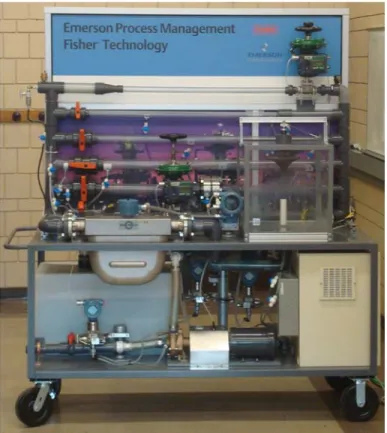
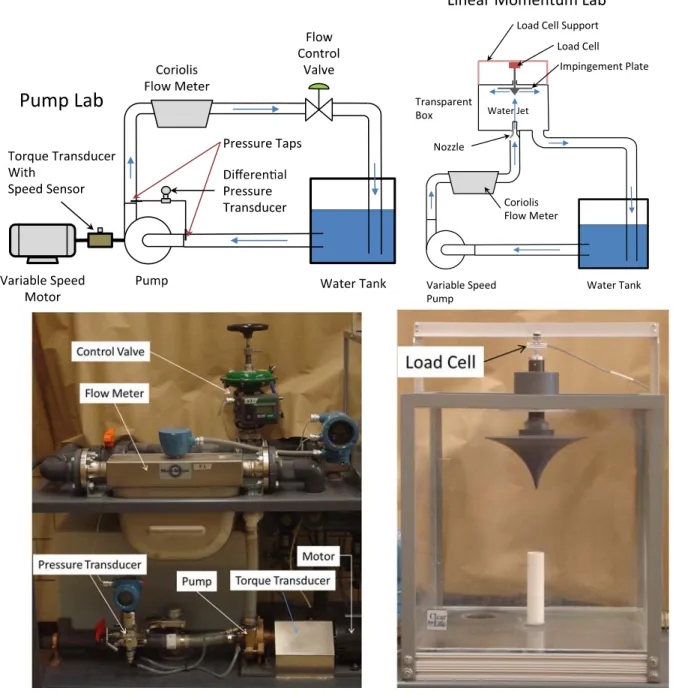
The Fluids experiments were conducted using a bench designed in-house and built by Fisher Controls (Fig. 1). This unit is designed to support five or more laboratory experiments, of which, as explained earlier, we chose the pump and the linear momentum experiments for this pilot study. In the pump experiment, we pump water out of a tank, through a coriolis flow meter, a flow control valve and back into the tank (Fig. 2, left). Measurements are made of the head rise across the pump and the flow rate. A torque sensor with speed pickup is placed between the motor and pump to determine the horsepower driving the pump. Measurements are made at several flow rates between 0% and 100% for a given pump speed. The linear momentum experiment consists of a vertical stream of water directed against a horizontal plate (Fig. 2, right). The vertical momentum is converted to horizontal momentum and a load cell measures the reaction force. The flow rate is again measured and is controlled by varying the pump speed.
Figure 1. The experimental bench used for the fluids laboratory exercises. The bench was developed by Emerson-Fisher Controls several years ago for the fluids course.
4
Figure 2. Schematics and principal components in the pump (left) and linear momentum (right) exercises.
Modifications for remote access: Use of the fluids bench for remote access required replacement of the data acquisition system and accompanying wiring to support remote access and control. We selected an NI cDAQ-9174 compact data acquisition chassis supporting four plug-in DAQ modules: A NI-9219 universal analog input module supplies bridge excitation voltage to the load cell while converting the signals from the load cell and torque sensor. A NI-9203 ±20 mA analog input module is connected to the flow meter and pressure transducer. A NI-9411 digital input module connects the pulse output from the speed sensor to the frequency clock in the cDAQ chassis. Finally, a NI-9265 20 mA analog output module provides control signals to the control valve and the variable Frequency drive (VFD) powering the pump motor. Additionally, a fixed
LoadCell LoadCellSupport
ImpingementPlate VariableSpeed Pump Nozzle WaterTank Transparent
Box WaterJet
Coriolis FlowMeter
5
camera was used for remote observation of the fluids bench. This camera and a pan/tilt/zoom (PTZ) camera were used with the heat exchanger.
Heat transfer experiment – heat exchangers
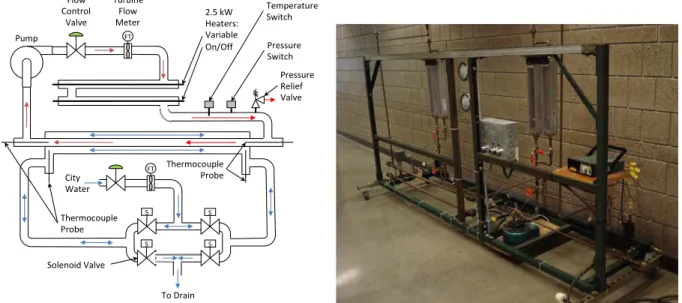
The heat transfer laboratory consists of an in-house built concentric tube heat exchanger that can be operated in parallel and counter flow modes (Fig. 3). The heat exchanger consists of two flow loops. Within the inner loop, water is pumped through a flow control valve, flow meter, two heaters, the inner tube of the heat exchanger and back to the pump. The heaters are 2.5 kW each. One is on/off controlled. The other is variably controlled from 0% to 100% power. This
arrangement allows a continuously variable input power of 0 to 5kW. Redundant safeties include a pressure and a temperature switch that are interlocked with the heater power in order to prevent an explosion in case of overheating. A pressure relief valve is also present in the system. These are mounted between the heaters and the heat exchanger. The outer loop directs city water through a flow control valve, a flow meter, a direction control manifold, the outer tube of the heat exchanger, back to the direction control manifold and then to a drain. Two thermocouples are mounted at each end of the heat exchanger. These are arranged so as to sense the inlet and outlet temperatures of the water in the inner and outer tubes of the heat exchanger.
Figure3.Heatexchangerexerciseschematicandapparatus
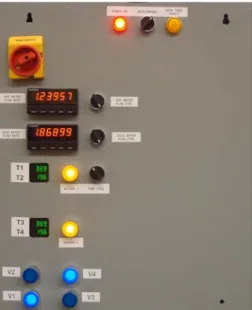
Modifications for remote access: The redesigned apparatus includes a new control console with Auto / Manual control (Fig. 4). Flow control is through proportional solenoid valves activated by Pulse Width Modulation ( PWM ) controllers. Heater control is ON/OFF with one PWM control. Directional control is through ON/OFF control to solenoid valves. Measured parameters are two flow rates and four temperatures.
An NI cDAQ-9174 was again selected for data acquisition and control. The flow and
temperature transmitters provide visual displays as well as 4 to 20 mA outputs. These current outputs are connected to a NI-9203 ±20 mA analog input module. Two NI-9474 digital output modules were used to provide control signals. These signals are used to control solid-state relays
Flow Control Valve S FT FT Pump Turbine Flow Meter 2.5kW Heaters: Variable On/Off Temperature Switch Pressure Switch Pressure Relief Valve Thermocouple Probe S S S City Water ToDrain Thermocouple Probe SolenoidValve
6
(SSR), which activate the solenoid valves and heaters. Manual control is accomplished through lighted pushbutton switches. The lights provide indication for both manual and automatic operation. Variable control for two proportional valves and one heater is provided by PWM circuits controlled by panel-mounted potentiometers. In an over temp condition, safety interlocks deactivate a relay. This relay is part of the control circuit to the heaters and their indicators. It will also light a fault lamp and provide a fault input to the NI-9203 module.
Students are asked to trace the inner and outer loop circuits. The PTZ camera and a fixed camera are arranged to facilitate this assignment.
Figure4.Heatexchangercontrolpaneldevelopedformanual/autoaccess.
Development of the virtual control panel and remote access
The National Instruments LabVIEW software provides a means of creating a virtual control panel on a computer attached to the cDAQ by a USB cable. This software also allows a remote computer to control the system from a remote location through a web browser plug-in. Once a control panel has been created on the attached computer, it takes about 10-15 minutes to set up a server on the machine. A remote machine may then access this server through a web browser. The browser plug-in will then display a control panel identical to the one displayed on the server. Multiple computers may access the server simultaneously. While only one browser can be in control of the equipment at one time, control may be requested from another browser and granted by the one in control.
Remote panels from the fluids labs (Fig. 5) have equipment controls in the top portion. The STOP button resets the controls to their default values and clears the data display before ending the program. The bottom portion is the data display. Fifty data sets are taken over a span of one second and displayed on the graphs. This allows the students to observe the variability in the data. An average value for individual data sets is displayed above the corresponding graph. In these experiments, raw data is displayed. Students are given calibration data so that they can make the conversion to engineering units.
7
Figure5. RemotecontrolpanelsforthePump(left)andLinearMomentum (right)labs.
The panel from the heat transfer lab (Fig. 6) has controls on the left with data displayed on the right. Students are assumed to understand the process of converting raw data to engineering units. Therefore the conversion is done programmatically. Data is displayed in real time. Pressing the STOP button causes the equipment to shut down in a safe manner. Each camera image is presented in its own browser window. The PTZ camera requires a browser plugin. Unfortunately, the camera controls are different depending on which browser is being used.
Assessment and Evaluation
In order to measure the effectiveness of the remote laboratory experience on student learning, part of each class conducted the lab in the traditional in-class format while the remainder
conducted the exercises in the ‘remote’ mode. In both cases, teaching assistant (TA) supervision
Figure6:HeatExchanger RemoteControlPanel.
8
was present for this study and the group size was the same for all the labs (typically 3 students).. We did not modify the laboratory instruction manual to reflect specifics of the virtual control screens nor did we establish the rationale for the remote laboratories to the students through written instructions. Students were told that they were participating in a pilot study by the TAs and were instructed to complete a Likert survey querying them on various aspects of the
laboratory experience, including students’ perception of the lab experience and the role of the lab experience in understanding theoretical concepts. The Likert scale included choices (scores) of strongly agree (5), agree (4), not sure (3), disagree (2) and strongly disagree (1).
All students submit a laboratory report of the experiment, which is then graded by the TAs according to a rubric. The TAs were asked to provide student scores on specific rubric areas pertaining to the laboratory experience as well as the overall student scores. The data for the two sets of the students were compared. This forms a direct assessment of the student learning experience to complement the survey data.
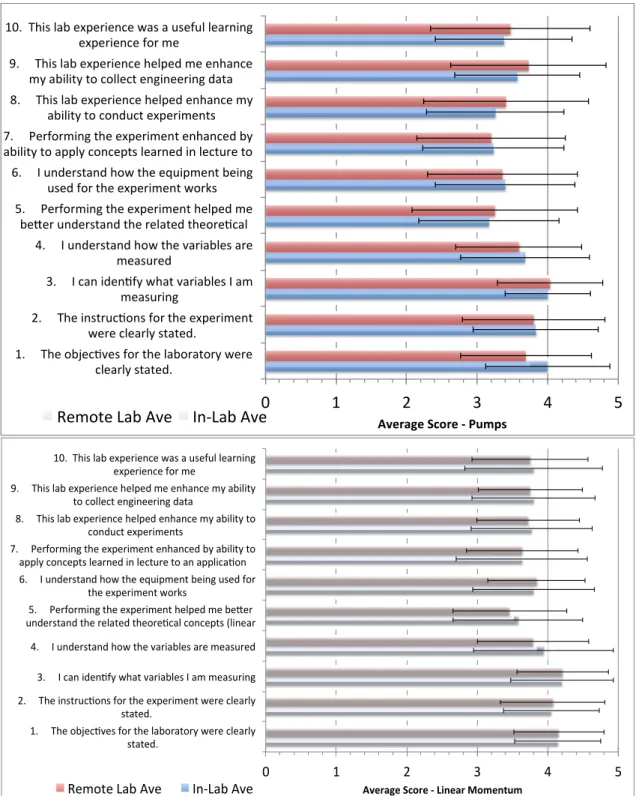
Results for the Fluids Labs: The comparison of the in-lab and remote student scores for the fluids labs are shown in Figures 7. For each question, the average student score and standard deviation shown. 58 students performed the laboratory remotely while 49 students performed the laboratory in the traditional ‘in-lab’ mode. The data between remote and in-lab were not statistically significant. The scores indicate that for these laboratory exercises, the overall student perception of the learning experience was not very different between the in-lab and remote modes. As the data shows, students were able to understand what variables they were measuring and how they were being measured. Moreover students in both modes indicated comparable levels of perception on the usefulness of the laboratory in connecting with theoretical concepts and in enhancing their ability to conduct experiments.
9 Figure 7: Results of the student Likert survey for the two fluids laboratory exercises.
Figure 8 shows the results of the TA assessment of the student lab reports for the fluids laboratory exercises. Again, the data shows that the average student performance is very comparable (not statistically different) between the in-lab and remote groups.
0 1 2 3 4 5
1. Theobjec vesforthelaboratorywere
clearlystated.
2. Theinstruc onsfortheexperiment
wereclearlystated.
3. Icaniden fywhatvariablesIam measuring
4. Iunderstandhowthevariablesare measured
5. Performingtheexperimenthelpedme
be erunderstandtherelatedtheore cal
6. Iunderstandhowtheequipmentbeing
usedfortheexperimentworks
7. Performingtheexperimentenhancedby
abilitytoapplyconceptslearnedinlectureto
8. Thislabexperiencehelpedenhancemy
abilitytoconductexperiments
9. Thislabexperiencehelpedmeenhance
myabilitytocollectengineeringdata
10. Thislabexperiencewasausefullearning
experienceforme
AverageScore‐Pumps RemoteLabAve In‐LabAve
0 1 2 3 4 5
1. Theobjec vesforthelaboratorywereclearly stated.
2. Theinstruc onsfortheexperimentwereclearly stated.
3. Icaniden fywhatvariablesIammeasuring 4. Iunderstandhowthevariablesaremeasured 5. Performingtheexperimenthelpedmebe er understandtherelatedtheore calconcepts(linear 6. Iunderstandhowtheequipmentbeingusedfor
theexperimentworks
7. Performingtheexperimentenhancedbyabilityto applyconceptslearnedinlecturetoanapplica on 8. Thislabexperiencehelpedenhancemyabilityto
conductexperiments
9. Thislabexperiencehelpedmeenhancemyability tocollectengineeringdata
10. Thislabexperiencewasausefullearning experienceforme
AverageScore‐LinearMomentum RemoteLabAve In‐LabAve
10 Figure 8: TA assessment scores for fluids student laboratory reports.
Student comments indicated that the camera was marginally useful in enhancing the remote laboratory experience for the fluids exercises and that the presence of audio would have been beneficial.
Results for the Heat Transfer Lab: The comparison of the in-lab and remote student scores for the heat exchanger laboratory is shown in Figure 9. For each question, the average student score and standard deviation shown. 45 students performed the laboratory remotely while 43 students performed the laboratory in the traditional ‘in-lab’ mode. For this laboratory exercise, the data shows that overall the remote mode resulted in a poorer experience as compared to the in-lab mode. Differences for questions 12, 10 and 9 were statistically significant. In particular, students doing the experiment remotely felt that they did not understand how the variables were being measured and how the equipment was being used for the measurements as compared to the in-lab students. All the students did indicate that they understood what variables were being controlled and how they were being controlled.
Figure 9: Results of the student Likert survey for the heat transfer laboratory exercise.
7.6 8 56 7.5 7.5 55 0 10 20 30 40 50 60 70 Rubricscore‐Results(outof10)
RubricScore‐Analysisand Discussion(outof10) TotalLabscore(outof70)
AverageScore Fluids‐Pumps Remote In‐Lab 7.4 7.6 55 7.3 7.8 53 0 10 20 30 40 50 60 70 Rubricscore‐Results(outof10)
RubricScore‐Analysisand Discussion(outof10) TotalLabscore(outof70)
AverageScore Fluids‐LinearMomentum
Remote In‐Lab
0 1 2 3 4 5
1. Theobjec vesforthelaboratorywereclearly stated.
2. Theinstruc onsfortheexperimentwereclearly stated.
3. Icaniden fywhatvariablesIamcontrolling 4. Iunderstandhowvariablesarebeingcontrolled 5. IunderstandwhatvariablesIammeasuring 6. Iunderstandhowvariablesarebeingmeasured 7. Iunderstandhowtheequipmentbeingused
works
8. Conduc ngtheexperimenthelpedmebe er
understandtheconceptofinternalconvec on
9. Thislabexperiencehelpedenhancemyabilityto
conductexperiments
10. Thislabexperiencehelpedmeenhancemy
abilitytocollectengineeringdata
11.Performingtheexperimentenhancedmyabilityto
relateconceptslearnedinlecturetoanapplica on
12. Thislabexperiencewasausefullearning
experienceforme
AverageScore‐Heatexchangers
11
Consequently the remote students reported lower scores on usefulness of the lab experience and its impact on their ability to conduct experiments and to better understand theoretical concepts as compared to their in-lab counterparts. The TA assessment of the student lab reports for the heat transfer laboratory exercise is shown in Figure 10. This data shows that the average student performance is very comparable (not statistically significant) between the in-lab and remote groups.
Figure 10: TA assessment scores for heat exchanger student laboratory reports.
In reading the student comments and talking to the TAs, we suspect the reason for the low scores are that in two of the sections, a kink in the experimental setup and malfunctioning of the camera led to some delay in completing the experiment. Since the in-lab students were able to directly observe the fixing of the situation whereas the remote students were not, the overall experience was deemed poorer by the remote groups.
Summary and outlook
The results of this pilot study suggest that laboratory experiences where the focus is on data collection and analysis can be ported to a remote or online mode without sacrificing the student learning experience. However, student perception of the laboratory experience was influenced by the smooth running of the experiments. In the case where troubleshooting of the experimental setup was required, it appeared that the remote experience suffered from an inability to observe the troubleshooting process as compared to the in-lab students. The experience suggests that an in-lab support person is important and the ability for that individual to communicate with the remote student groups via an audio-visual interface can enhance the student experience. In addition to the above, future development of this project includes provision of a means to control the PTZ camera, adding an audio feed to give students additional feedback when useful (e.g. fluid flow labs) and developing pre-labs for students to better understand the equipment being used. We are also considering various means to allow students to conference among separate locations in and out of lab. Our plan is to refine the remote setups and redeploy for the coming year and also develop/adapt laboratory experiences in our other laboratory courses including measurements and dynamic systems and controls.
4.62 4.30 4.60 4.45 4.30 4.67 0 1 2 3 4 5 6 RubricScore‐Experimental
procedure(outof5) RubricScore‐Discussion(outof5)
Rubricscore‐RawDataand Calcula ons(outof5)
AverageScore Heattransfer‐HeatExchangers
Remote In‐Lab 93.17 93.72 75 80 85 90 95 100 In‐Lab Remote AverageScore HeatexchangerstotalLabscore
12 Bibliography
1. J. E. Corter, J. V. Nickerson, S. K. Esche, C. Chassapis, J. Ma (2007), "Constructing Reality: A study of remote, hands-on and simulated laboratories", ACM Transactions on Computer Human Interaction 2 (14)
2. Nickerson, J.V., Corter, J.E., Esche, S.K., and C. Chassapis (2007), "A Model for Evaluating the Effectiveness of Remote Engineering Laboratories and Simulations in Education", Computers and Education. 3 (49)
3. P. Bhargava, J. Antonakakis, C. Cunningham and A. T. Zehnder (2006), “Web-based virtual torsion
laboratory,” Computer Applications in Engineering Education, 14, pp 1-8.
4. S. Grober, M. Vetter, B. Eckert and H-J. Jodl (2007), “Experimenting from a distance—remotely controlled
laboratory (RCL)”, Eur. J. Phys. 28 S127–S141.
5. B. Barros, T. Read, and M. Felisa Verdejo (2008), “Virtual Collaborative Experimentation: An Approach
Combining Remote and Local Labs”, IEEE Transactions on Education, v51 (2).
6. L. S. Chumbley, G. Cassucio, D. Kritikos, H. Lentz, C. Mannes and K. Mehta (2002), “Development of a