Purdue University
Purdue e-Pubs
ASEE IL-IN Section Conference
Evaluations of Interactive Learning Tools Among
Engineering Students: Effects of Grit and Gender
Il-Seop ShinEun Go
Western Illinois University Colin Ross Harbke Western Illinois University Prathivadi Ravikumar
Western Illinois University-Quad Cities Blair McDonald
Western Illinois University-Quad Cities See next page for additional authors
Follow this and additional works at:https://docs.lib.purdue.edu/aseeil-insectionconference
This document has been made available through Purdue e-Pubs, a service of the Purdue University Libraries. Please contact [email protected] for additional information.
Shin, Il-Seop; Go, Eun; Harbke, Colin Ross; Ravikumar, Prathivadi; McDonald, Blair; and Zbeeb, Khaled, "Evaluations of Interactive Learning Tools Among Engineering Students: Effects of Grit and Gender" (2018).ASEE IL-IN Section Conference. 3.
Presenter Information
Il-Seop Shin, Eun Go, Colin Ross Harbke, Prathivadi Ravikumar, Blair McDonald, and Khaled Zbeeb
Evaluations of Interactive Learning Tools Among
Engineering Students: Effects of Grit and Gender
Il-Seop Shin, Ph.D., Assistant Professor of Engineering Western Illinois University-Quad Cities, Moline, Illinois Eun Go, Ph.D., Assistant Professor of Journalism and Broadcasting
Western Illinois University, Macomb, Illinois Colin Ross Harbke, Ph.D., Professor of Psychology
Western Illinois University, Macomb, Illinois
Prathivadi Ravikumar, Ph.D., Associate Professor of Engineering Western Illinois University-Quad Cities, Moline, Illinois Blair McDonald, Ph.D., PE, PLS, Associate Professor of Engineering
Western Illinois University-Quad Cities, Moline, Illinois Khaled Zbeeb, Ph.D., Assistant Professor of Engineering Western Illinois University-Quad Cities, Moline, Illinois
Abstract
This study explores what determines engineering students’ evaluations of interactive learning tools (ILTs). Engineering students (n = 323) from large U.S. universities who had used
McGraw-Hill’s SmartBook and Connect participated in the study. This study confirms that grit and gender are important factors in opinions and attitudes toward such tools. Specifically, among males, those with higher grit found ILTs as more useful and usable. Moreover, higher levels of grit were related to favorable attitudes toward ILTs. Interesting to note was that females reported more favorable evaluations on ILTs overall. These findings suggest strategies for the use of interactive learning tools for engineering students to succeed. Implications and recommendations for future research will also discussed.
1. Introduction
In this age of ever-evolving technology, the learning process has become increasingly
interactive. Students usually perform better when they are active learners who engage in their learning process, from evaluating to regulating their learning progress [1]. However, traditional methods of learning used in engineering education, such as listening to lectures, completing homework, taking exams, and receiving feedback, somewhat limit the ability to motivate students to be active learners. Interactive learning tools (ILTs) can help students be active learners. Studies done by Noeth and Volkov [2] have shown that students are not motivated to read assigned readings, for example. With interactive online tools, students can be motivated to read through greater accessibility and interactive features, such as accessing textbooks anytime and anywhere using their mobile devices or tablets [3-4]. Furthermore, each chapter of the online textbooks includes hyperlinks to learning objectives, which allow for information
scaffolding. In addition, self-assessment reports generated by the system allow students to regulate their learning progress easily and quickly. With regularly generated assessment reports, students could strategically study by focusing on areas in which they need to improve, as
indicated on the system-generated reports.
Through the merits of ILTs (e.g., interactive textbooks, recorded lectures, instant feedback, interactive quizzes, and self-assessment reports), students can be more active learners, which ultimately improves their overall academic performance. Especially, students evaluate ILTs favorably. Then, it is expected that they are more willing to use them to benefit their active learning. Thus, this study intends to investigate what factors alter students’ evaluations of ILTs. This study particularly intends to investigate the effects of two factors, grit and gender, both of which are widely explored in engineering education as determinants of students’ academic success. Grit (i.e., the trait of maintaining effort and interest in the face of setbacks) is a critical trait when pursuing engineering education. Findings regarding gender report that females generally have more difficulty in pursuing engineering education. Thus, by identifying how these two factors are associated with evaluations of ILTs, this study aims to offer insights on how to make students with less grit and females both maintain their efforts and interest in engineering by using ILTs.
2. Literature Review
Factors Affecting Evaluations in Interactive Learning Tools
Broadly, technology can be defined as two types: utilitarian value-oriented technology and hedonic value-oriented technology [5]. The utilitarian value-oriented technology is technology that delivers cognitive-oriented benefits [5], for example, word processors. On the other hand, hedonic value-oriented technology mainly focuses on the benefits of affective and sensory
gratification [5]. Game websites and Netflix are examples of hedonic value-oriented technology. Depending on the major purpose of a technology, individuals may have different expectations. For example, if the technology is designed for cognitive purposes or benefits, like educational purposes, individuals expect greater usefulness through utilitarian value-oriented technology than that of hedonic value-oriented technology.
Interactive learning tools (ILTs) can be an example of utilitarian-oriented technology given their educational purposes. Therefore, users, such as instructors and students, expect greater
usefulness from using ILTs. When these users receive what they expect, it ultimately leads to more favorable evaluations of ILTs, including better attitudes, greater satisfaction in using ILTs. Then, what factors would determine such evaluations, especially among students in using ILTs? This study particularly examines two factors that could leverage students’ usefulness
perceptions, usability perception, satisfaction, and attitudes.
First, grit could be one possible factor that determines users’ evaluation of ILTs. In education literature, the concept of grit has been widely explored to explain how students’ personality of perseverance affects their achievement, especially with challenging tasks. According to
Duckworth [6], grit is defined as “perseverance and passion for long-term goals” (p. 1087). Grit represents the trait of “working strenuously toward challenges, maintaining effort and interest
over years despite failure, adversity, and plateaus in progress” (p. 1087). Specifically, grit has two sub-concepts: passion and perseverance. Passion means one’s consistency in maintaining interests, while perseverance means one’s consistency in sustaining effort [6]. Grit has been examined as a predictor of success, including academic success, because such qualities are generally required to complete whatever the task is and indeed has been demonstrated its
predictive power in the academic achievement in previous studies [7-9]. Grit can also determine how students use ILTs. For example, it is predicted that students who exhibit grit might use ILTs better than those who do not because they are more likely to maintain their efforts in using ILTs by exploring diverse functions provided by the system. Therefore, they are able to take advantage of ILTs. Moreover, self-assessment reports generated by the system help students with grit regulate their efforts more easily. Moreover, due to its great accessibility, students who tend to maintain interest in studying a course subject are more likely to access ILTs frequently; therefore, they are able to sustain their interest by accessing diverse course materials like online textbooks and course-relevant end-chapter quizzes anytime. As students with grit use ILTs more effectively, they would have more favorable evaluations of ILTs.
Second, gender is another factor that may determine evaluations of ILTs. In engineering education, the role of gender has been widely discussed and has been an issue since female engineering students reported lower self-efficacy [10], lower interest [11], and lower levels of exposure to engineering before college [12]. To encourage female students to engage in engineering areas, researchers [13-15] have suggested curriculum-based (or instruction-based) approaches to attract female students, given that females and males have different preferences in instructional styles. For example, Colbeck [15] found that females showed greater confidence in their engineering abilities when they received clear and organized instructions, such as clarified assignments and class activity-related assignments; whereas, males showed greater confidence when they had interaction with the instructor. In regard to student–faculty interaction, some studies have demonstrated the different effects of such interaction by gender [16-18]. For example, Sax [19] reported that females showed declined mathematical interest when they had interaction with faculty. Such differences imply the potential of ILTs especially among females in that ILTs can provide sufficient course materials, which can help females who are hesitant to interact with the instructor. For example, The Hint and Guided Solutions provided when taking online quizzes and hyperlinks that direct students to relevant areas in the online textbook help female students understand the fundamentals through step-by-step instruction. Furthermore, since all quizzes are closely related to online textbook readings, such quizzes can serve as supplementary learning materials for females who generally prefer clarified assignments and class activity-related assignments to learn basic engineering concepts. It is necessary to examine the effects of ILTs by disaggregating by gender to better understand its effects.
In summary, based on the aforementioned discussions, the following research questions are suggested.
RQ 1: Is grit associated with the evaluation of ILTs’ perceived usefulness, usability, users’
satisfaction with ILTS, and attitudes regarding ILTs.
RQ 2: Is gender associated with the evaluation of ILTs’ perceived usefulness, usability,
3. Method and Measures
An online survey was conducted for this study. Participants were recruited from large U.S. universities. In total, 323 participants, each of whom use ILTs for engineering courses, have participated in this study. 65.3% of the participants (n=211) were male and 34.7% were female (n=112). The majority of the participants were Caucasian (64.7%) followed by Asian (16.1%), Hispanic (9%), African American (7.7%) and Other (2.5%). The mean (M) age was 25.04 (standard deviation, SD = 6.43).
Grit was assessed using the Short Grit Scale (Grit-S) developed by Duckworth [6]. Eight items were used to assess participants’ “consistency in one’s interest over time (i.e., passion),” and one’s “ability to sustain effort in the face of adversity (i.e., perseverance).” For example, the following items were used: “I often set a goal but later choose to pursue a different one,” “I’m diligent,” “I have difficulty maintaining my focus on projects that take more than a few months to complete.” All items were measured on a 5-point Likert scale (very much like me – not like me at all) (Cronbach’s α= 0.75, M= 3.38, SD= 0.67).
Gender was measured by asking participants to report their gender.
Evaluations of ILTs were dictated by four specific outcomes: Perceived usefulness, usability, satisfaction, and attitudes toward the ILTs. First, perceived usefulness was measured with five items on a 7-point Likert scale adopted from Davis [20]. Five items includes: ILTs (e.g., Connect and SmartBook) (1) allowed me to study more effectively; (2) improved my academic performance; (3) increased my productivity; (4) enhanced my effectiveness in learning; (5) was useful for my learning (Cronbach’s α = 0.94, M = 4.96, SD = 1.29). Perceived usability was assessed with nine items on a 7-point Likert scale developed by Brooke [21]. The participants were asked to indicate their perceptions of the ease of using interactive learning tools. Sample items include: (1) I find interactive learning tools (e.g., Connect and SmartBook) unnecessarily complex (reverse coded); (2) I thought interactive learning tools (e.g., Connect and SmartBook) were easy to use; and (3) Most people will likely learn to use interactive learning tools (e.g., Connect and SmartBook) very quickly (Cronbach’s α = 0.79, M= 4.68, SD= 0.95). Satisfaction was measured with three items adopted from Sundar [22]: (1) I’m satisfied with the performance of the interactive learning tools (e.g., Connect and SmartBook); (2) I’m pleased with the
experience of using the interactive learning tools (e.g., Connect and SmartBook); (3) The interactive learning tools (e.g., Connect and SmartBook) generally meet my expectations (Cronbach’s α = 0.93, M= 5.00, SD= 1.41). Attitudes toward the ILTs were measured on a 7-point Likert scale using 12 adjectives (organized, good, unique, high quality, user-friendly, novel, cool, confusing, sophisticated, attractive, and appealing) adopted from another study done by Sundar [23] (Cronbach’s α= 0.91, M= 4.86, SD= 1.05).
4. Results
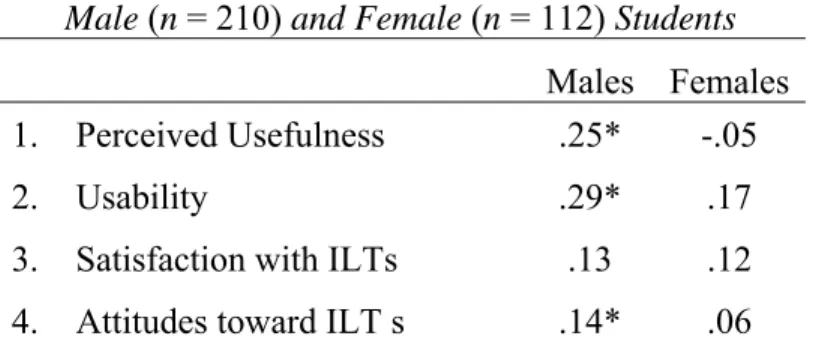
Table 1 displays the correlations between grit and evaluation the perceived usefulness, usability, satisfaction with and overall attitudes toward ILTs separately for male and female students. Grit was significantly related to a perceived usefulness, usability, and overall attitudes toward ILTs
among men. Among women, on the other hand, grit was not significantly related to any of the opinions or attitudes toward ILTs. Along these same lines, the magnitude correlations between grit and attitudes were consistently smaller for female students. As the correlations between grit and opinions of ILTs appeared to differ between genders, moderated regression analyses were subsequently used to further explore the relationship between gender and opinions of ILTs. A series of four moderated regression analyses were completed to further explore potential gender differences opinions of interactive learning tools. More specifically, gender differences in opinions toward ILTs, as well as potential gender differences in the relationship between grit and opinions of a) perceived usefulness, b) perceived usability, c) satisfaction with and d) attitudes toward ILTs were further elucidated with these analyses. Significant (α = .05) mean differences in opinions of ILTs was suggested by the presence of a significant regression
coefficient (b) for gender (males = 0, females = 1), whereas a significant gender × grit interaction indicated a differential relationship grit and opinions of ILTs between genders.
Table 1. Correlations between Grit and Opinions of Interactive Learning Tools for Male (n = 210) and Female (n = 112) Students
Males Females
1. Perceived Usefulness .25* -.05
2. Usability .29* .17
3. Satisfaction with ILTs .13 .12
4. Attitudes toward ILT s .14* .06
a. Perceived Usefulness of ILTs. Overall, women reported higher perceived usefulness of
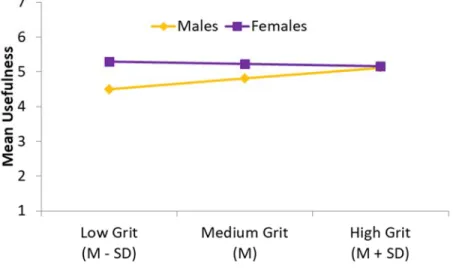
ILTs than men, b = 2.31, t(318) = 2.96, p = .003. In addition a significant gender × grit interaction, (b = –0.56, t[318] = –2.44, p = .02) indicated that the relationship between grit and perceived usefulness of ILTs differed between men and women (see Figure 1a). Although women rated the usefulness of ILTs higher overall, it shows minimal
differences across levels of grit. Among men, on the other hand, those with higher levels of grit reported the highest usefulness of ILTs.
b. Usability of ILTs. Men and women reported similar levels of usability of ILTs, b = 0.55, t(318) = 0.95, p = .34. In addition, the relationship between grit and ILT usability was consistent for both genders, gender × grit interaction b = –0.13, t(318) = –0.79, p = .43. Even though there no gender differences in overall ratings of usability or the relationship between grit and usability, higher grit was significantly related to usability of ILTs (b = 0.39, t[318] = 4.27, p < .001).
c. Satisfaction with ILTs. Overall, men and women reported similar levels of satisfaction
with ILTs, b = 0.41, t(318) = 0.47, p = .64. Similarly, there was no gender differences in the relationship between grit and satisfaction, gender × grit interaction b = 0.01, t(318) = 0.06, p = .07.
d. Attitudes toward ILTs. Men and women also reported similar attitudes toward ILTs (b = 0.56, t[318] = 0.88, p = .38) and the relationship between grit and attitudes toward ILTs was consistent for both genders, gender × grit interaction b = –0.10, t(318) = –0.51, p = .61.
Figure 1. Gender Differences in the Relationship between Grit and Perceived Usefulness of ILTs.
5. Discussion
The present study explored the effects of two factors (grit and gender) on students’ evaluations of interactive learning tools (ILTs). First, only among males, grit showed a significant
relationship with some of the hypothesized outcomes. Specifically, the results revealed that grit significantly influenced perceived usefulness, usability, and attitudes among males. This implies that male students who tend to maintain their interest and efforts consistently evaluated ILTs more favorably than those who had less sustained interest and efforts. These results are similar to what previous research [7-9] has found. However, it is interesting to note that the impact of grit does not remain the same among female students. These results are notable in that grit works differently by gender. In other words, grit’s unique explanatory power on the evaluations of ILTs seems more obvious among male students. Moreover, the result that higher grit was significantly related to usability of ILTs indicates that students who generally make more of an effort will use ILTs more easily without any difficulties. This makes sense in that this type of student would keep maintaining their efforts until they were used to the system. Therefore, if instructors use ILTs for grittier male students, they are able to encourage male engineering students to use ILTs more effectively.
In addition, the present study also demonstrates the effect of gender on evaluations of ILTs, such that females reported higher perceived usefulness of ILTs than males. The results of interaction effects between grit and gender also confirmed that females tended to perceive greater usefulness of ILTs then males overall, regardless of their levels of grit. This result supports the argument made by previous research [13-18] that males and females have different preferred instructional styles. Given that ILTs are more oriented toward organized layout and provide more
text-relevant assignments such as end-chapter quizzes, it is natural that females, who prefer clear and organized instructions but hesitate to interact with an instructor, see this system more favorably than do males. This result implies that ILTs could be a solution to make females engage more in engineering education. If instructors use ILTs to provide organized course materials and/or activities (e.g., quizzes, assignments), then they are able to allow female engineering students to maintain their interest in engineering.
This study also has several limitations. First, this study did not test how ILTs impact students’ academic performance, because this data was gathered from participants who were taking
different engineering courses from diverse universities. As a result, we cannot treat participants’ academic performance equally. Based on what we found in this study, future research should examine how grit and gender can actually improve students’ academic performance. Second, to see the effects of ILTs, this study recruited participants who were using two specific types of ILTs, namely SmartBook and Connect. Thus, even though we collected responses from diverse universities to improve generalizability, our use of these specific ILTs might limit the
generalizability of the study.
References
[1] Prince, M. (2004). Does active learning work? A review of the research. Journal of Engineering Education, 93(3), 223-231.
[2] Noeth, R. J., & Volkov, B. B. (2004). Evaluating the effectiveness of technology in our schools, ACT Policy Report. ACT.
[3] Pachler, N., Bachmair, B., & Cook, J. (2010). Mobile learning: Structures, agency, practices. Springer.
[4] Woodill, G. (2011). The mobile learning edge. McGraw-Hill.
[5] Kempf, D. S. (1999). Attitude formation from product trial: Distinct roles of cognition and affect for hedonic and functional products. Psychology & Marketing, 16(1), 35-50.
[6] Duckworth, A. L., Peterson, C., Matthews, M. D., & Kelly, D. R. (2007). Grit: perseverance and passion for long-term goals. Journal of Personality and Social Psychology, 92(6), 1087.
[7] Strayhorn, T. L. (2014). What role does grit play in the academic success of black male collegians at predominantly white institutions? Journal of African American Studies, 18(1), 1-10.
[8] Wolters, C. A., & Hussain, M. (2015). Investigating grit and its relations with college students’ self-regulated learning and academic achievement. Metacognition and Learning, 10(3), 293-311.
[9] Bowman, N. A., Hill, P. L., Denson, N., & Bronkema, R. (2015). Keep on truckin’or stay the course? Exploring grit dimensions as differential predictors of educational achievement, satisfaction, and intentions. Social Psychological and Personality Science, 6(6), 639-645. [10] Marra, R. M., Rodgers, K. A., Shen, D., & Bogue, B. (2009). Women engineering students
and self‐efficacy: A multi‐year, multi‐institution study of women engineering student self‐ efficacy. Journal of Engineering Education, 98(1), 27-38.
[11] Inda, M., Rodríguez, C., & Peña, J. V. (2013). Gender differences in applying social cognitive career theory in engineering students. Journal of vocational behavior, 83(3), 346-355.
[12] Pierrakos, O., Beam, T. K., Watson, H., Thompson, E., & Anderson, R. (2010, October). Gender differences in freshman engineering students' identification with engineering. In Frontiers in Education Conference (FIE), 2010 IEEE (pp. S3C-1). IEEE.
[13] Knight, D. B., Lattuca, L. R., Yin, A., Kremer, G., York, T., & Ro, H. K. (2012). An exploration of gender diversity in engineering programs: A curriculum and instruction-based perspective. Journal of Women and Minorities in Science and Engineering, 18(1). [14] Marra, R. M., Rodgers, K. A., Shen, D., & Bogue, B. (2009). Women engineering students
and self‐efficacy: A multi‐year, multi‐institution study of women engineering student self‐ efficacy. Journal of Engineering Education, 98(1), 27-38.
[15] Colbeck, C. L., Parente, J. M., & Bjorklund, S. A. (2001). Collaborative learning vs. lecture/discussion: Students' reported learning gains. Journal of Engineering Education, 90(1), 123-130.
[16] Kezar, A., & Moriarty, D. (2000). Expanding our understanding of student leadership development: A study exploring gender and ethnic identity. Journal of College Student Development, 41(1), 55.
[17] Sax, L. J., Bryant, A. N., & Harper, C. E. (2005). The differential effects of student–faculty interaction on college outcomes for women and men. Journal of College Student
Development, 46(6), 642–659.
[18] Kim, Y. K. (2006). Student–faculty interaction in college: Examining its causalities, predictors, and racial differences. Unpublished doctoral dissertation. University of California, Los Angeles.
[19] Sax, L. J. (1994). Predicting gender and major-field differences in mathematical self-concept during college. Journal of Women and Minorities in Science and Engineering, 1(4).
[20] Davis, F.D. (1989). Perceived usefulness, perceived ease of use, and user acceptance of information technology. MIS Quarterly, 319-340.
[21] Brooke, J. (1996). SUS: A “quick and dirty” usability scale. In P. W. Jordan, B. Thomas, B. A. Weerdmeester, & A. L. McClelland (Eds.), Usability evaluation in industry, 189– 194. London, UK: Taylor and Francis.
[22] Sundar, S. S., Go, E., Kim, H.S., & Zhang, B. (2015). Communicating art, virtually! Psychological effects of technological affordances in a virtual museum. International Journal of Human-Computer Interaction, 31(6), 385-401.
[23] Sundar, S. S., Xu, Q., Bellur, S., Oh, J., & Jia, H. (2011). Modality is the message: interactivity effects on perception and engagement. Proceedings of CHI’11 Conference Extended Abstracts on Human Factors in Computing Systems, 4105-4110.