Understanding the Internationalization Process of Small-to
Medium-Sized Manufacturing Enterprises (SMEs): Evidence
from Developing Countries
Nana Osei-Bonsu
Ajman University of Science & Technology, Fujairah Campus, UAE *E-mail of the corresponding author: [email protected]
Special acknowledgement to my research group in European Union, North America & Australia
Abstract
This study explores how firm specific and key personnel factors (resources) influence the internationalization process of small-to-medium-sized enterprises (SMEs) in manufacturing sector in developing countries. SME internationalization has been widely researched but little is known of how and why internationalization takes place in the developing countries, and such lack of evidence in the literature provides strong grounds for this study. The findings indicate that, compared to non-SMEs, developing countries SMEs are less likely to venture into international markets, and those that do, do so to a lesser degree; they are also less likely to engage in networking with other business, but are more likely to exhibit growth intention. Various paces and myriad of entry modes determine the pattern of internationalization undertaken. A traditional internationalization pattern is strongly evident, although some SMEs exhibited born-again global internationalization pattern as a result of occurrence of some critical events within the firm. These include the appointment of managers with the requisite expertise; knowledge and access to international business information. The main drivers of internationalization centered on key personnel managerial capabilities and firm specific factors such as organizational process and networking abilities. The study also found that the production capabilities, domestic market conditions, outcomes (financial and non-financial), are all critical to the international expansion of SMEs in developing countries. Compared to solely focus on the domestic marketplace, there were some financial benefits to be gained by developing countries SMEs in venturing overseas. However, the extent to which they did so had no observable effect on financial performance. Internationalization was found to place a substantial stress and conflicts among the managers and their dependent families. This study provides new knowledge and important insights that will benefit the manufacturing and other sectors in the developing countries.
Keywords: Internationalization, SMEs, Manufacturing, Developing countries 1. Introduction
A plethora of studies on SME internationalization have been conducted in developed industrialized countries (Bell, 2005a; Theodosiou, & Morgan, 2007), however, only recently has research centered on the SMEs in developing countries (Sadler & Chetty, 2000; Etemad, 2004a). Therefore evidence from these countries is still lacking. High rate of returns of SME internationalization in developed countries (Raynard & Forstaster, 2002) demonstrate the benefits developing countries can gain, so they are encouraged to follow the trend by their respect governments. Havens (1998) argued that the developed countries rely on the economic benefits SME internationalization brings. For example, ninety eight (98) percent of exporting companies in Sweden (Bjerke, 2007); over seventy five (75) percent of exporting companies in Finland (Autio, 2008); over seventy (70) percent in Australia (Meredith, 1994); and, ninety seven (97) percent of the SMEs in the US are involved in international activities (Zimmerer & Scarborough, 2002). Significantly, in developing countries over ninety eight (98) percent of all business enterprises are SMEs, which suggests they have a strong role in enhancing the countries employment and socio-economic development through firm internationalization. Most governments from developing countries are taking necessary steps to help the SMEs to become international players. However, a question worth asking is how well do these SMEs understand the internationalization process? What internationalization models or factors would best fit and explain their internationalization pattern.
Consequently, to address this gap, this paper has tried to gain a better understanding into the internationalization behavior (pattern and pace) of SMEs in the manufacturing sector and to arrive at a better insight on what motivates and influences the internationalization process of these SMEs. This is based on Hisrich and Antoncic (2006) premise that internationalization process of small to medium-sized enterprises (SMEs) differs from that of the larger or multinational enterprises (MNEs) in terms of available resources for development, and re-aligns
the firm’s operations at the foreign markets. Hence, the aims of this paper is to explore the key drivers and influential factors such as; firm specific resources and key personnel factors that motivates manufacturing SME in the developing countries to internationalize their operations. Within this aim, various perspectives, such as gradual behavior (Stages) model, networking, and resource-based models have been examined.
In doing so, this paper seeks to address the core question of: how does a firm specific and key resources influence the internationalization process of manufacturing SMEs in developing countries. Firm specific and key personnel factors (resources)in this study are defined as financial, physical, organizational, and managerial capabilities.
2. Literature Review – Internationalization Models
Welch and Luostarinen (1988) anticipate that the internationalization process crosses diverse theories. The literature has identified various views on firms` internationalization, such as: Stage models; Network perspective; Born-global or International New Venture (INV); Resource-based view (RBV); and Eclectic paradigm. These theories have all contributed to the contemporary understanding of firm internationalization (Morgan & Katskas, 1997). Despite the variety of understandings, internationalization theory is still inconclusive (Etemad, 2004; Welch et al., 1988). Many argue that a holistic approach based on a common conceptual framework is lacking. This study therefore document that none of the internationalization models can separately fully capture (i.e. does not explicitly explain) the actual internationalization process of the firms, but rather account for the transformation of the structure as internationalization occurs. The fragmentation of the models provides an opportunity for integration, which could lead to a better understanding of the process of internationalization. As a result, this study has integrated and relies heavily on; gradual behavior-based (Stages), Network, and Resource-based view models to explain and understand the internationalization process of SMEs in developing economies. The gradual behavior-based or Stages (Uppsala and Innovation-related) model views internationalization as a learning process that involves interplay between knowledge development and increasing foreign market commitments (Johanson & Vahlne, 1990). First, the innovation-related model (Bilkey & Tesar, 1977; Cavusgil, 1980), apply at the level of managerial attitudes. Second, the Uppsala model applies at the level of the operation of the firm in terms of the commitment to a particular market, as well as at the managerial level in terms of their knowledge and learning. Once the internationalization process starts, it follows a predetermined set of stages that transforms the operation of the firm in the host country. The stage approach enables managers to learn about foreign markets opportunities and develop the tacit knowledge that is necessary to operate abroad. Although the stages model provides a criterion for selecting among countries (Johanson & Wiedersheim-Paul, 1975), the explanatory power of the model resides primarily at the level of the sequence of activities in the specific operation in the host country, rather than at the level of the overall operations of the firm.
The network model describes internationalization as the development of a network position in foreign markets (Johanson & Mattson, 1988; Bell & McNaughton, 2000). This model applies at the level of the operation of the firm in terms of the commitment to a particular market, as well as at the level of the company through interactions and mutual interdependency. Internationalization process of the firms lies in the emphasis on relationship as an exchange governing mechanism that describes the systems as networks of firm engaged in production and distribution. Firms within this network usually establish business relationships in order to promote linkages among operations and facilitate the transfer of resources, especially knowledge and opportunities. Thus, network relationship emanate at the level of the firm overall, more than at the level of the
particular operations. Using Network model, Johanson and Mattsson (1988) argue a firm’s internationalization
process can be explained by its position in international network. The firm develops business relationship in networks in other countries in three different ways: international extension; international penetration; and
international integration. The firm’s position in the network has a different structure depending on whether the
market has a high or low degree of internationalization. This creates four possible alternatives: the early starter, the lonely international, the later starter and the international among others.
Finally, the resource-based view (RBV) initiated by Penrose (1959) has received extensive interest in the SMEs` internationalization literature (Fillis, 2001). The RBV has two main principles; (1) resources are not homogeneously spread across firms, and (2) these resources cannot be transferred between firms without incurring costs referred to as ‘sticky’ resources, (Shepherd and Wiklund, 2005). However, the mere possession of firm-specific resources does not guarantee competitive advantage. The RBV therefore claims that organizational internal factors are responsible for generating competitive advantage and superior performance through internationalization. RBV explains the importance of internal drivers such as tangible and intangible resources for SME internationalization (Barney, 1991; Penrose, 1959; Shepherd & Wiklund, 2005). RBV applies at the level of the firm as a whole, as well as at the level of the different operations. The transformation of firm activities is guided by a search for opportunities and the creation of value, where the firm adapts its activities as the resources and competitive conditions match one another. This adaptation occurs both in the firm as a whole and in the different operations in each of the countries in which it operates. The creation of value in the firm
leads to the selection of countries in which to operate, methods of operation, and connections among operations in the firm, while the creation of value in each specific foreign operation leads to the selection of methods of operation and the promotion of connections with other parts of the firm.
2.1 Application of RBV to the Internationalization Process of SMEs
George (2005) argues that RBV may influence resource-driving internationalization. This makes it feasible even for resource-constrained firms to use internationalization as a means of accessing and building up needed resources (managerial capabilities, finance, organizational processes and new technology). Following this rationale it is argued that SMEs that face resource constraints especially in advanced technology are likely to use internationalization as a strategy for accessing or acquiring the lacking resources. SMEs in Africa are typically resource-constrained, both in terms of the quantity and the quality of their internal resource (management production methods). Previous research, dealing with aspects of resource constraints and internationalization, has tended to highlight that resource constraints may put off internationalization. For example, an article studying small firms (less than 50 employees) located in Great Britain indicates that resource constraints are among the reasons cited for why these firms are not exporting (Westhead et al., 2001). Furthermore, Smallbone and Wyer (1995) also argue that, the lack of managerial quality can be an important constraint for small firms in trying to develop an international orientation. They concluded that, lack of informational resources might impede the ability of small firms to identify international opportunities and exploit them. However, researching SMEs from RBV may be particularly useful in this study. If in fact SMEs do lag behind their non-SMEs counterparts when growing internationally, then there must be firm-specific factors such as availability of certain resources or ability to reconfigure and leverage resources that cause this to be so. Hence, the development of the firm’s
managerial capabilities is argued to facilitate the successful execution of growth strategies, such as international expansion (Boeker and Karichalil, 2002).
The management of firm-specific resources (evaluating, shedding, adding, bundling and leveraging) is crucial to create value in the market, and particularly important for SMEs intending to internationalize their operations. Carlock and Ward (2001) argued that an international expansion strategy, such as internationalization, is suitable for a company that has strong management and control systems in place. Similarly, Gallo et al. (2002) observed that increasing the managerial capabilities of small firms was essential for internationalization via strategic alliances. Flamholtz (2000) also argues that in order for a firm to grow successfully, it will require to make the
transformation from a management style characterized by the founder to a “professional” style of management.
Accordingly, to successfully progress from a domestic orientation to high levels of internationalization, it is important that SMEs develop the requisite managerial capabilities.
2.2 Application of Network Model to SMEs Internationalization
A key assumption underlying the network model is that ‘the individual firm is dependent on resources controlled by other firms. The firm gets access to these external resources through its network positions’ (Johanson and
Mattson, 1988, p. 295). Through its network relationships, SMEs can collaborate with other firms in order to obtain complementary capabilities and opportunities to internationalize, rather than dwelling upon internal deficiencies that inhibit internationalization (Chetty and Holm, 2000; Hitt et al., 1998). In their study of Japanese SMEs, Lu and Beamish (2001) found that forming alliances with firms that have foreign market knowledge is an
effective internationalization strategy in order to overcome a firm’s resource and capability deficiencies.
According to Sharma and Blomstermo (2003) the selection of foreign market entry mode is based on the existing knowledge of the firm and the knowledge supplied by its network ties. Hitt et al. (1998) argued that both informal and formal (contractual) networks amongst SMEs enable them to remain competitive by reducing the resource and capability advantages of large firms. They emphasize the importance of learning through networks and the significance of weak ties in the internationalization process of firms. Eriksson and Chetty (2003) suggest
that a firm’s perceived lack of foreign market knowledge involves not only the business between domestic
supplier and a foreign customer, but also their perspective networks.
Despite existing literature on networking and SME internationalization, evidence from developing countries still lacking. Many firms from developing countries seek sustainable networks to help them to become internationally competitive firms. These firms are recognized for their networking and they actively seek external relationship as a source of new information and expertise to enhance their international competitiveness. There is also an argument that many small enterprises in developing countries rely on ethnic and cultural networks to internationalize and this is common for some ethnic groups in these countries. These ethnic groups have similar cultural relations (same languages) with countries sharing common borders.
2.3 Application of Gradual Behaviour-Based (Stages) Model to SME Internationalization
The practical application of the stages model and in particular the Uppsala model, have been examined in many studies. One prominent example was the review of SME`s internationalization empirical studies conducted by Coviello and McAuley (1999) between 1989 and 1998. Of the sixteen articles reviewed, thirteen (81 percent) utilized the stage models in their studies, indicating that this model was the most commonly applied theoretical framework (within that period). Some studies strongly support the gradual-behaviour based model (Chetty and Hamilton, 1996), others are fervently opposed to it (Zafarullah and Young, 1998), while others claim there is mixed support for the model (Gankema et al., 1997). Bell (1995b) review of small software firms found total disregard for the stages of internationalization. He found some firms started to export even before selling domestically and thus concluded that industry type and trends were key determinants of the internationalization process. Gankema et al. (1997), partially support the gradual behavior-based model, they found that some SMEs leapfrog the stages confirming Hedlund and Kverneland`s (1993) earlier findings. Similarly, a recent large cross sectional study involving 677 firms located in Finland, Norway and Denmark also found the internationalization process is not consistent with the premises of the stages models (Moen and Servais, 2002). Although, the authors of the Uppsala model believe their model is still applicable, they have advocated a new approach to meet today’s
technology challenges and global competition (Johanson and Valne, 2013b). Other models need to be included to explain the internationalization process, since the stages model work better with smaller and less experienced firms, with few resources, who operate in unstable market conditions (Vissak, 2004).
2.4 Inconsistencies in the Models of Internationalization
The above discussions confirm that there are inconsistencies in the predictions of the mainstream models of internationalization. The table below shows these inconsistencies between the predictions of the mainstream
models. Despite their complementarities’, the three models have different underlying assumptions about the key determinants of internationalization. The gradual-behavior-based (Stages) and Network models are based on the interplay of market knowledge and commitment on the one hand, and relationship development on other hand as means of overcoming limited knowledge and exploiting opportunism.
Table 1. Inconsistencies in the Internationalization Models
Rooted in the behavioral sciences, Brouthers et al. (1999) argued that the stages and network models provide descriptive explanations based on empirical observations rather than prescriptive and normative as the Eclectic paradigm does. Internationalization is moreover, viewed in the gradual-behavior (Stages) models as a rational and purposeful planning process in which firms seek to optimize outcomes and minimize risks given limited knowledge. This contrasts with the Network Perspective that views markets as networks (Johanson & Mattsson,
Assumption
Model Gradual-behaviorist
(Stages) approaches Network approach
Resource-based view approach
Market knowledge ´ ´
Market commitment ´ ´
Rational planning process
(strategic decisions) ´
Emergent and unplanned ´ ´
Risk minimization ´ ´
Relationship formation &
development ´ Predictive power ´ ´ Resource heterogeneity ´ Resource immobility (creation of competitive advantage) ´ ´ Managerial implications ´ ´ ´ Static perspective ´ ´ ´ Objective vs. subjective worldview ´ ´ ´ Descriptive explanations ´ ´
1994), and where internationalization is viewed as a more emergent and unplanned process stemming from the interactions taking place among networks of interconnected firms and other organizations involved in an industry and market. Resource-based view linked theses perspectives because it allows the possible linkages between the learning aspect of gradual approaches and networks. The mainstream models leave some important aspects of the process and dynamics of internationalization poorly explained. These include, but are not limited to, born globals (accelerated internationalization), de-internationalization or other forms of change in mode of entry, and the use of multiple modes of entry at a point in time. The three models differ in terms of their epistemological lens (i.e. behavioral sciences vs. economics), unit of analysis (i.e. firm vs. relationship), phenomenon of interest (i.e. lengthy firm development vs. smaller and younger firms), which in turn influence the explanation and prediction of internationalization.
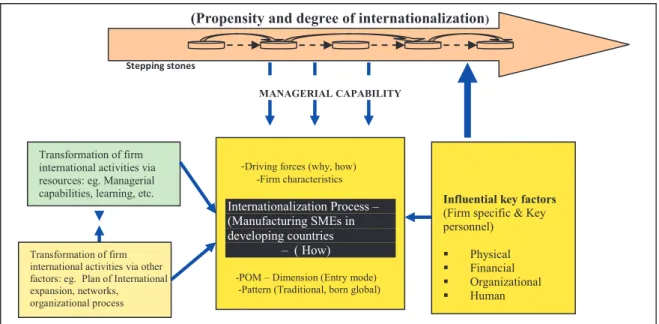
Consistent with the argument presented earlier that one model cannot fully explain the internationalization process of SMEs; this study has integrated the gradual behavior-based (Stages), Network, and Resource-based models of internationalization to investigate the research problem.
Figure 1. Integrated Framework of Internationalization
The gradual behavior-based (Stages) model sees knowledge acquisition as an essential requirement in the internationalization process of firms. Knowledge is, however, acquired experientially. Experiential knowledge enables organizational members to engage in direct knowledge acquisition through reflections on their actions. The experience gained at each stage provides management with the information to adopt or reject the entry option and or commit to international market. Consistent with Stages model, this framework highlights the idea that, the internationalization process of SMEs consists of a series of steps. However, unlike previous stages model, this model does not depict the process as consisting of a series of path dependent steps. SMEs may skip certain steps in their internationalization process, settle at a particular step or may withdraw from their current internationalization state to previous steps in the process.
The literature review is relevant for seeking in-depth knowledge about how SMEs in manufacturing industry from developing countries internationalize their operations and understanding what influences their involvement in international marketplace. Five of the internationalization models were reviewed, but this paper has relied on gradual behavior-based (stages model); network; and resource-based view due to the fact that none can separately fully capture the actual internationalization process of the firms, but rather account for the transformation of the structure as internationalization occurs. The other two, namely, eclectic paradigm and international product life-cycle (IPLC) were not included in the model due to the fact that these models are more useful in explaining the firm structure at latter stages of internationalization and considering the fact that many SMEs from developing countries do not progress beyond a certain stage in the internationalization process. The review of the literature also indicated the inconsistencies in the predictions and the gaps in the mainstream internationalization models. The comparisons of the models and the positioned of this study among these models have been discussed. The discussion outlined each model and provided evidence of their role in the internationalization process. The integrated conceptual framework relevant for the study is developed, and the
Stepping stones
(Propensity and degree of internationalization)
MANAGERIAL CAPABILITY
-Driving forces (why, how) -Firm characteristics
Internationalization Process –
(Manufacturing SMEs in developing countries – ( How) -POM – Dimension (Entry mode) -Pattern (Traditional, born global) Transformation of firm
international activities via other factors: eg. Plan of International expansion, networks, organizational process
Transformation of firm international activities via resources: eg. Managerial capabilities, learning, etc.
Influential key factors (Firm specific & Key personnel) § Physical § Financial § Organizational § Human
critical research gaps in the literature were identified. These helped in clarifying the research question and hypotheses were constructed.
3.Study Methodology
Marschan-Piekkari & Welch (2004); and Peterson (2004) argue that researchers need to move beyond positivism and employ a richer, a more in-depth research approach (via critical realism paradigm), qualitative and quantitative methodologies, if they are to advance research into firm internationalization. Based on this assertion and the arguments put forward by Thomas, (2004); Tashakkori & Teddlie (2003); and Ticehurst et al., (2000), a mixed research method within the critical realism paradigm was adopted in this study. While the quantitative (positivism paradigm) provides rigorous statistical evidence that satisfies the objective reality, it neglects the subjective reality that taps the richness of subjects` experience and perceptions of the complex phenomena of firm internationalization process (Creswell, 2003). However, in this study it does helped to capture the correlation between certain key factors that influence the internationalization process to augment the limitations of the qualitative analysis.
The unit of analysis in this study is the SME in developing countries. An SME is defined in this paper as a firm with more than ten (10) but less than two hundred (200) employees. Longitudinal data for the initial quantitative analysis was collected from one hundred and fourteen (114) registered firms from India, Ghana, Mexico, Venezuela and Malaysia for three consecutive years. These countries were chosen because of their steady growth of economic activities and the keen willingness of firms in these countries to embark on international business operations. The sample firms consist of fifty-seven (57) SMEs; and fifty-seven (57) non-SMEs. The mixture of these two categories of sample was necessary to compare and contrast the propensity for and degree of internationalization awareness of SMEs and non-SMEs. Five (5) hypotheses (H1 – H5) were constructed and tested.
H1: There is a statistically significant difference in the propensity of SMEs and non-SMEs to internationalize
H2: There is a statistically significant difference in the degree of internationalization of SMEs and non-SMEs
H3: There is a statistically significant difference in the financial performance of SMEs according to whether they have internationalized
H4: There is a statistically significant difference in the management team size, professional training and strategic planning of SMEs and non-SMEs according to their degree of internationalization
H5: There is a statistically significant difference in the propensity for SMEs and non-SMEs to develop an international expansion plan according to their degree of internationalization
The quantitative data was analysed by initially testing whether the metric variables used were normally distributed. Two tests were used: the Kolmogorov–Smirnov test and the Shapiro–Wilks test. These tests indicated that all of the metric variables were non–normally distributed. As a result, chi-square and Mann-Whitney non-parametric statistical techniques were used, because they do not require the normality assumption to be met. Logistic regression analysis was also used because it is robust when using non-normal data and categorical variables (Hair et al., 2003).
Eight (8) Case firms were selected based on purposive sampling approach and interviews were confined to using
key personnel as informants. Further, to limit respondent’s memory recall problems, the sampling was restricted
to firms whose key executives are instrumental in the internationalization process are still with the firm and are willing to participate in the study. Key informants (founders, owners, CEOs, managing directors, and other top managers) representing these firms were interviewed through skype video using semi-structured open-end questions format. Each interview covered: (1) internationalization process such as dimensions (speed, entry mode, and scope) and patterns (traditional, rapid, and born global); (2) driving forces such as motives (domestic and global forces); and (3) influential factors such as firm specific factors (firm resources & capabilities, entrepreneurial orientation, and firm characteristics); and key personnel factors (managerial competences, international orientation of executives). Within-case and cross-case analysis was conducted on the data through descriptive coding and topic coding with support from Nvivo software. For the purposes of confidentiality as agreed between the researcher and the case companies, fictitious names were given to each company to protect their identities from their competitors.
4. Data Analysis & Findings
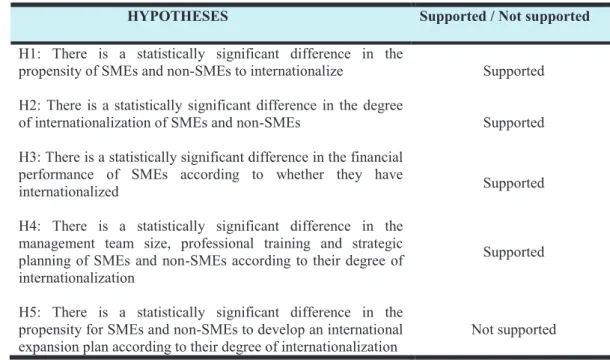
As indicated in Table 2 regarding the results of the hypothesis testing, H1 was supported, as there was a persistent statistically significant negative relationship between the variables SME business and internationalization. Some support was found for H2, as there was a statistically significant negative association between the variables SME business and the degree of internationalization in one of the three years. Although this relationship was not statistically significant in the other two years, a persistent negative relationship between these two variables was found. Overall, these results suggest that, compared to non-SMEs, SMEs are less likely to venture into the international marketplace. Those that do, do so to a lesser degree when compared to non-SMEs. Further analysis into the differences between SMEs and non-SMEs identified several statistical significance differences. SMEs were less likely to engage in networking with other businesses, more likely to exhibit growth profiles and to be smaller in size. These differences may explain why the internationalization of SMEs in developing countries lags behind that of non-SMEs. Firstly, they may lack the networks required for international expansion. Secondly, the traditions of the firm or lifestyle ambitions of owners may foster a preoccupation with the domestic marketplace. Finally, because of their smaller size, they may lack the resources required to develop globally relevant capabilities.
Regarding the outcome of internationalization on financial performance, H3 was supported, as there was
statistically significant positive relationship between the variables “internationalization status” and ROTA in one
of the three years. Although this relationship was not statistically significant in the other two years, a persistent positive relationship between these two variables was found. This suggests that the ROTA of internationally active SMEs is superior to that of SMEs, which solely focus on the domestic market. With regard to H4, managerial capabilities, support was found for the management capacity (management size, expertise and processes) of SMEs were found to be statistically significant less than that of non-SMEs as they grow internationally. These differences were most evident at a high degree of internationalization. No support was found for H5, that is, there was no significant difference in the proportion of SMEs and non-SMEs utilising export planning as they internationalize. Although, significant differences were found between SMEs and non-SMEs with regard to TQM at high levels of internationalization, there were little differences in the usage of JIT as they grew intentionally. This suggests that, compared to non-SMEs, SMEs are less likely to utilise some management control systems as they internationalize.
The findings from the quantitative analysis are explored further in the discussion of the qualitative analysis. Especially, the outcomes of internationalization (financial and non-financial) on SMEs are examined further. Influences on an SME`s propensity for and degree of internationalization as well as factors that influence the ability of SMEs to internationalize will also be explored.
Table 2: Results of Hypotheses Tested
HYPOTHESES Supported / Not supported
H1: There is a statistically significant difference in the
propensity of SMEs and non-SMEs to internationalize Supported
H2: There is a statistically significant difference in the degree
of internationalization of SMEs and non-SMEs Supported
H3: There is a statistically significant difference in the financial performance of SMEs according to whether they have
internationalized Supported
H4: There is a statistically significant difference in the management team size, professional training and strategic planning of SMEs and non-SMEs according to their degree of internationalization
Supported
H5: There is a statistically significant difference in the propensity for SMEs and non-SMEs to develop an international expansion plan according to their degree of internationalization
Not supported
Based on the findings of quantitative analysis, the internationalization behaviour of the eight firms was analysed, and the firms compared (cross-case). Appendix 1 summarizes the trigger, motivation, pattern and pace of the
internationalization of each firm. Appendix 2 summarizes the market entry, strategies, and financing of
internationalization of each firm. Each firm’s internationalization behaviour are compared and contrasted to the
traditional, born global or born-again global pathways to internationalization. 4.1 Trigger and Motivation
During the analysis, this study found that all the case firms´ first steps into the international market were as a result of a reaction to particular circumstances. These include unsolicited orders (KASL, CPC, NSAF, and GIDIS); adverse and limited domestic market conditions (AKSI, PIKIT, FAMGL); and customer takeover (LAGCOM). The international involvements of the case firms were reactive and responsive to the factors outside the business such as unsolicited orders (CPC, AKSI, and GIDIS). The other five firms had experience periods of dedicated international growth as a result of sudden change in focus from domestic to overseas orientation. This
was brought about by critical events within each firm’s history. In the case of KASL, an overseas trip of one their agent was instrumental for the management to develop an overseas vision for the business. In the case of LAGCOM, the takeover of one of its key domestic customers by a multinational firm was the trigger that led the management to develop an international orientation, even though the management was divided over whether to proactively pursue further international operations.
The most common motivations for the firms to internationalize their operations were that it presented a growth opportunity that was not available to them in the domestic market, enhance their competitiveness and ensure their survival. Internationalization was also perceived to be one way to maximize the value of the firm for future sale (CPC). The firms that develop a global orientation and dedication to international growth were also motivated by the desire to exploit opportunities and developed or acquired capabilities from the international market operations. In summary, the trigger and motivation for internationalization of three of the firms (AKSI, CPC, and GIDIS) was similar to that of traditional firms, where the trigger for internationalization was reaction to adverse or saturated domestic market conditions and unsolicited orders. Their main motivation for international activity was the need to grow their business in order to survive and compete. The five other firms, on the other hand exhibited characteristics similar to those of born-again global firms, where a critical event in the history of each firm led to a sudden change in focus from domestic to a global orientation (growth and survival).
4.2 Pattern and Pace of Internationalization
Based on the analysis of the pattern and pace of internationalization, the cases were grouped into one of the three internationalization patterns: static, incremental and rapid. Five of the case firms (KASL, AKSI, CPC, LAGCOM, and NSAF) exhibited an incremental pattern of internationalization; that is, after establishment each firm initially focussed on the domestic market for a period of time prior to internationalizing their operations. Initially, these firms focused on psychically close countries and the pace of their international growth was gradual. NSAF entered both psychically close and distant countries initially, but subsequently focussed on psychically close countries after failed attempt to enter into the UK market. LAGCOM`s initial steps into the international market were customer-driven, the firm initially focused on supplying domestic market, before supplying a manufacturing firm based in a psychically distant country through establishment of production plant. CPC targeted psychically closer markets after focusing on supplying the domestic market initially. The company then targeted psychically distant markets due to the distribution alliance with UK and South America firms. CPC was not different from the other firms that exhibited incremental internationalization pattern. AKSI entered psychically closer countries after it had dominated the domestic market and subsequently focussed on
psychically distant markets. The company’s internationalization intensity figure is artificially high because AKSI
recently experienced declining domestic sales. The scope of internationalization is similar to that of other firms exhibiting an incremental pattern.
Three of the case firms (GIDIS, PIKIT and FAMGL) exhibited rapid or static pattern of internationalization. GIDIS exhibited a pattern of internationalization similar to that of the incremental process as it initially sold its products at the domestic market for twelve years before internationalize to psychically close markets. However, because the management never proactively pursued international operation, it pattern was different to the incremental pattern in that its pace of internationalization remained static before it’s initially steps into the
international market. PIKIT and FAMGL also exhibited patterns of internationalization similar to that of incremental approach as they both initially sold their products in the domestic market for a period of time before becoming internationally active in psychically closer and distant markets as a result of critical events ((a) favourable trade arrangements between UK and Ghana, and (b) decline in the Mexican economy). The internationalization patterns of these two firms were different from both static and incremental patterns. In the case of FAMGL, the joint venture collaboration with the internationally renowned designer with vast experienced in international sales and marketing, led to exponential international growth with over 41 percent of
its sales being from overseas countries. PIKIT on the other hand experienced rapid internationalization when the owner/founder used his contacts and knowledge from the USA market to successfully arranged and commence selling to that market. All, except two of the case firms (AKSI and GIDIS) developed strong networks with customers and other industry actors, predominantly through their active involvement in international trade fairs and shows.
In summary, the internationalization pattern and pace of the two firms (CPC and PIKIT) were similar to that of born-again global firms. Each firm experienced an epoch of domestic market orientation, followed by dedicated and rapid internationalization after critical incidents in their history; for example in the case of PIKIT, the enlargement of EU and the UK developing a closer ties with the new entrants (eastern European). Notwithstanding this, at least, not less than 50 percent of their gross sales were made from their overseas markets. They also exhibited strong evidence of networks developed through international trade fairs. The other six firms exhibited characteristics typical to those of traditional firms. They focused initially on the domestic before gradually expanding into the international market. Additionally, they focused largely on a limited of psychically closer countries. Irrespective of the type of foreign entry method adopted, a number of factors also influenced the selection of trading partners (agents and distributors) such as market position, service and price, and other factors such as sharing a common long-term vision towards business, having common values, and developing personal relationships based on trust were also important. As a result, most of the case firms predominantly dealt with other SMEs when entering foreign markets. For example, as was the case with PIKIT and AKSI, the management often approached agents and distributors of SMEs located abroad, because they share similar vision (growth opportunities).
In conclusion, founders and managements involvement were found in this study to influence the foreign market entry methods used by SMEs, as well as the kind of trading partners (agents and distributors) selected. The foreign entry method of six of the case firms was similar to that of traditional firms in that they used agents and distributors, as well as direct sales to customers as their main methods of entry into foreign markets. The other two firms exhibited characteristics similar to that of born-again global firms, because, in addition to use of agents and distributors, these firms used more advanced foreign market entry methods such as joint venture (JV) and establishment of production plant.
4.3 Internationalization strategies (Business or growth plan)
As depicted in Appendix 2, four firms did not have planned international strategies when they first entered the international market. Rather, their international growth strategies were opportunistic, ad-hoc and reactive to particular circumstances such as unsolicited orders or key customer being bought out by multinational firm. Four firms did exhibit some characteristics of planned international strategies. For example, the management of CPC determined what market to initially enter, how to enter that market as well as development specifically for that,
even though the company had offers from overseas agents at the time when it’s not ready to enter international
markets. Because of the age of the firms, the management and the founders were able to recall how planned their firms international strategies were when they first entered the international market, and like CPC, the founders were purposeful with regard to what foreign market to target first and how to enter those markets. Subsequent, to their first entrance into international markets, four of the firms (KASL, AKSI, NSAF and CPC) revised their international strategies and developed international growth plans. These firms had export market plans in place, although some did not appear to be as comprehensive as others. For example, AKSI was very dependent on its agents and distributors to drive its international growth further. FAMGL, GIDIS, and LAGCOM, however, did not develop comprehensive international growth strategies subsequent to their first steps into the international market and did not have an export market plan in place.
The international growth strategies of FAMGL and GIDIS remained unplanned and opportunistic focussed on growth in domestic market as opposed to the international market. The international growth strategies of LAGCOM were unstructured and loosely planned, predominantly because the management were divided over whether to proactively pursue further internationalization. As regard the product sold internationally, most case firms use either their existing product range and or adapt them to suit needs specific to foreign markets. Only one firm (FAMGL) developed a new product line specifically for Japanese market, while AKSI, revised some of its product lines on the advice of its South Africa agent. A key factor in the rapid international growth of PIKIT was
its ability to quickly produce products that were in strong demand in UK’s market at the time. In summary, the
international strategies of the five of the case firms exhibited characteristics similar to those of traditional firms. Even though some developed or modified their products lines for overseas markets, the international expansion of these four firms was a result of opportunistic discoveries (chance) circumstances rather than a purposive plan. The internationalization strategies of the other three firms exhibited characteristics similar to those of born-again
global firms in that they developed detailed growth plans subsequent to the critical event that led them to become globally oriented. These firms also adapted their existing products for the international markets.
4.4 Financing method for Internationalization
As depicted in Appendix 2, the sources of finance for international operations included internally generated funds (retained profits), capital contributions and reinvestments by owners, and bank finance (loans and overdrafts). However, internally generated funds such as retained earnings were the most dominant source of finance for international growth and activities. CPC, NSAF, PIKIT, and AKSI all had product lines that enjoyed substantial success in the domestic market, thus, enabling them to accumulate profits to finance international operations. AKSI, however, in addition generated extra funds required for international activities through long-term partnership and agreement to supply a South African industrial chemical dealer. LAGCOM used debt to finance its international expansion growth, especially, because of its inability to generate surplus earning from the domestic activities to build a new production plant in South America. KASL, NSAF, and GIDIS all have become reliant on self-financing as a result of a change in attitude towards debt. Four of the firms indicated that grants and activities, such as the central government export initiative grants and organized seminars were important early sources of finance and information when initiating international opportunity and growth strategies. In summary, all except (LAGCOM) primarily relied on internally generated funds from their domestic activities to fund internationalization related strategies. As a result, the financing activities of the other seven firms exhibited characteristics similar to that of traditional firms. LAGCOM was different from others in that its primary source of finance for international operation was bank finance, which make the firm exhibits characteristics more like born-again global firms than traditional or born global firms.
4.5 Pathways of traditional, born global or born-again global to Internationalization
Each firm’s internationalization behaviour was compared with that of traditional, born global or born-again global firms. It was found that none of the firms exhibited characteristics of born global firm in that, none was established with an aggressive global vision or commenced selling to foreign markets within one year of establishment. All six aspects of the internationalization behaviour of AKSI, FAMGL and GIDIS were similar to that of traditional firms and therefore were classified as traditional international firms. Their first steps were unplanned and reactive to external events, consisted of gradual incremental stages of international growth, focused initially on psychically closer markets, sales through agents and distributors, and financing through internally generated funds. Even though, aspects of the internationalization behaviour of KASL, LAGCOM and NSAF, were similar to the activities of born-again global firms, they did not experienced or revealed a characteristics of such firms: dedicated and rapid internationalization to several markets at once. As a consequence, the internationalization behaviour of these firms was more like traditional firms than born-again global firm. Among the case firms, only GIDIS and FAMGL could be classified as “unwilling” international
firms. Even though, they have sold products overseas for the past years despite a lack of commitment to internationalization. The other firms were commitment to the further internationalization of the business. CPC and PIKIT, however, exhibited an internationalization behaviour that was similar to that of born-again global firms in that they were well established firms that had focused on the domestic market for a period of time, and then suddenly embraced rapid and dedicated internationalization as a “result of unexpected events” within the
firms as a results of saturated domestic market and the appointment of export managers with the requisite management and international business operations expertise.
5. Discussion of key findings
The main objective of this paper is to investigate the key resources that influence the internationalization process of developing countries manufacturing SMEs, where resources were defined in this study as financial, physical, organizational and managerial capabilities.
5.1 Financial resources:
Although most of the case firms have an ongoing commitment to internationalization, the implementation of international strategy required access to the necessary financial resources. This were required to fund activities such as exhibitions and participation at international trade fairs, and to bring about the changes required within the firm for internationalization, such as the development of its capabilities. Analysis of the case firms that had an ongoing commitment to internationalization indicated that the degree of internationalization was influenced by their access to financial resources, as well as their willingness to commit financial resources to internationalization-related activities. Financial resources available to the case firms were influenced by several factors, including the firms willingness to borrow funds from financial institutions, the owners personal
contribution, bank overdraft, domestic market performance, and the internally generated funds as well as
retained profits. However, because of the owner and management’s preference for total control, and their risk -averse nature, there was a general reluctance amongst both the owners and the managements to raise financial capital through loans from the lending institutions. Rather, internally generated funds were the most popular source of finance for international growth strategies. This suggests that SMEs adhere to a pecking order when raising additional finance, favouring internally generated over long-term bank loan and overdraft. This finding is consistent and builds on prior research (Gallo et al., 2004; Poutziouris, 2001) by highlighting the influence of the pecking order on the ability of SMEs to grow internationally. The performance of the SMEs in the domestic market, largely determine the funds available for international growth and therefore the pace of their internationalization. As a consequence, the rate at which most of the case firms internationalized was typical of those following traditional pathway to internationalization. Two case firms, however, did experience rapid international growth, which was made possible because of the internally generated funds from their dominant market position. Harmony among the management team and owners was also found to influence the funds available for internationalization. It was found to encourage the management and owners to re-invest the retained profits in the business instead of debt finance. This confirmed their self-imposed restrictions to access finance from the financial institutions and other sources of funds for their operations.
Researchers have often used firm size as a proxy of financial resources available to the firm (Dhanaraj & Beamish, 2003). This suggests that the effect of financial resources on SMEs internationalization is consistent with the quantitative findings of this study. This indicates that firm size was positively associated with the propensity to internationalize. SMEs were found to be smaller (i.e. have less financial resources) than their non-SME counterparts, which may partly explain why the current study found that the internationalization of non-SMEs is less than that of their non-SME counterpart. As a result of their slower growth rate, SMEs take longer to permeate their domestic market and venture overseas. This may partially explain why SMEs lags behind their non-SMEs. Additionally, internationalization of the case firms was dependent on the willingness of the owners and managements to commit financial resources to internationalization-related activities. The willingness to
commit financial resources to such activities was influenced by the founders or manager’s level of commitment
to internationalization as well as attitude to risk-taking. Those firms with a commitment to internationalization all exhibited a tension over when to commit financial resources. Founders or managements who expressed a greater propensity to take risks were more likely to commit financial resources to internationalization-related activities up-front in the hope that such action would be rewarded in terms of international growth. This finding is consistent with previous research (Boter et al., 2005; Fillis, 2000; Leonidou et al., 1998). In summary, the influence of the availability of, and willingness to commit, financial resources provides new insight as to why the internationalization of SMEs lags behind that of their non-SMEs.
5.2 Managerial resources
Analysis of the case firms revealed that SME’s managerial resources had a substantial influence over the
development of the organizational capabilities required for internationalization. The managerial factors that influenced the development of the requisite capabilities needed for internationalization included the entrepreneurial orientation (EO), knowledge, experience & expertise, and networking abilities of the owners & managements. EO of the owners and or management team emerged as an important influence not only on the
commitment of financial resources towards internationalization, but also on the firm’s ability to develop and leverage its capabilities in international market. These include the management’s attitude towards risk-taking, autonomous, innovativeness and proactiveness. Analysis of the case firms revealed it was critical that managements are independent in implementing an internationalization strategy and to bring about changes required for such purposes. An autocratic domineering style of leadership, the unwillingness of the founders to give total control over to the managements deprived them of the independent required to implement internationalization-related strategies. Previous research (Zahra, 2005) has found the length of CEO’s tenure
inhibits entrepreneurial activity such as internationalization, this study however; found that owner’s experienced
affect the SMEs internationalization. The innovativeness of the managements and employees was found to be critical for the SME innovations, an important driver of SME internationalization. This finding is consistent with what is reported in the quantitative analysis, where innovation commitment was positively associated with the propensity for and degree of internationalization of SMEs and non-SMEs. Although consistent with previous SME research (Knight & Cavusgil, 2004; McMahon, 2001), this study has highlighted the valuable contribution that managers of SMEs can make towards the development of the firm innovations. Internationalization also required an element of proactiveness, where the management sought new business opportunities overseas through the development of new and innovative products designs and lines. These findings highlight the
importance of developing and sustaining entrepreneurial orientation within the firm, particularly in the areas of risk-taking, independency, innovativeness and proactiveness.
The areas of expertise held by the managers were found to have a substantial influence over the SME’s ability to
develop the capabilities required for international operations. One of the main reasons why the case firms had survived the test of time was because the managers were highly technical proficient in what they manufactured. However, some of them lacked the management expertise required to develop the firm’s requisite capabilities for
internationalization, particularly its managerial and marketing capabilities. As a consequence, the appointment of a competent managers with expertise in these areas of need was able to bring about changes required to develop
the firm’s managerial and marketing capabilities, and in turn, international growth. Consistent with findings by
Dyer, (1989), this study found the valuable contribution an experienced and expertise manager can make to the internationalization of SME, especially when there is a skills gap in the management team and there is a need to bring about change within the firm. Competence, cultural fit, previous working experience, and having the independency to act were all critical for an appointee manager to bring about the changes required for
internationalization. In addition to building the firm’s capabilities through the appointment of experienced and
expertise manager, some of the case firms solved their limited management expertise by utilizing the services of non-working managers, including the use of non-pay advisors, consultant, or networking with specialized government institutions.
This study highlights the important supportive role that non-pay outside expertise or advisers can play in the internationalization of the SMEs. Even though, most founders of the case firms often lacked expertise in
marketing, the appointment of expertise played an important role in the development of the SME’s international
network relationship, and consequently its internationalization. Many of the owners were characterized by long-term orientation towards business, honesty and integrity, the desire for mutually beneficial business relationships, and accessibility to other. These were found to facilitate the development of business relationships in the international market, particularly other SMEs owners who shared similar characteristics. Consistent with previous research (Brokaw, 2002; Ward, 2007), this study demonstrates that relational capabilities of the owners and or managements facilitate the internationalization of the SME. Hence, it is critically important that owners and or managements are willing to travel internationally to build such relationships through attending exhibitions and trade fairs.
The study also found that key personnel of SMEs had a substantial influence in promoting internationalization. Their competencies, such as broad experience, broad international exposure, distinctive entrepreneurial orientation, good interpersonal skills, competent management capabilities, exceptional personality and attitudes, and strong global and visionary mindsets, were prerequisite in developing the organizational capabilities for internationalization. These characteristics of key personnel are consistent with previous research on firm
internationalization (Ibeh, 2003; Johnson, 2004). These characteristics are supplemented by having “righteous”
personality and attitude in business dealings, which include honesty and high integrity in their business transactions. Taken together, these characteristics enable the SME owners/managers to gain trust and respect, not only from their own employees, but also from business partners and local and foreign associates. Consistent with previous research by Child & Rodriques (2007); Crick et al. (2005), this findings support the view that the
trust-based relationships could result in “serendipitous encounters” which can contribute to success in foreign
markets. The international exposures of the key personnel are likely to shape their entrepreneurial orientations. 5.3 Physical resources
Analysis of the case firms indicated that they had a strong commitment to internationalization, as well as the financial resources required to implement such a strategy. However, it was critical that the firms also had the infrastructure to develop the production capabilities required for internationalization. These included having sufficient production capacity to meet both domestic and international demand, the ability to reliably produce high quality products at internationally competitive cost, and the ability to develop an innovative product lines and designs, or adapt the existing lines, to meet the requirements of international markets. These findings are consistent with previous research by Leonidou (2004) where these capabilities were found to have a low (capacity, quality, product development) to high influence (cost competitiveness) on the international growth of SMEs. These firms were required to undertake substantial changes (reconfigure) to their production infrastructure in order to develop some or all of these production capabilities. This development (production capabilities) would not have been possible unless the founders and or managements had been willing to embrace
change and commit the firm’s resources to bring about such changes. Information technology as a resource was
& Harveston (2002). The development of a comprehensive company website was important for developing brand awareness and attracting direct sales opportunities in overseas markets. It was also an effective way to
provide timely customer service to the firms’ international customers. Additionally, information technology was also important tool for gathering information on issues such as potential customers, competitors, and, product and pricing decisions for particular overseas markets.
5.4 Organizational resources
Apart from the requisite production capabilities, international network relationships, as well as managerial and marketing capabilities are also critical for international growth of the firms. Both the quantitative and qualitative analyses show that international growth was substantially influenced by the firm’s network relationships with
other stakeholders. These relationships not only assisted in the international growth of the case firms, but they
also assisted in the development of the firm’s managerial and marketing capabilities. This finding provides further support to Chetty & Holm, (2000), which argues that internationalization of a firm is largely determined by its network relationships. The quantitative analysis indicated that SMEs were less likely to engage in networking with other businesses as compared to non-SMEs, this finding is consistent with Donckels & Frohlich, (2001). Because SMEs network relationships had a critical influence on the internationalization process, and were less likely to engage in networking with other businesses, this could be a key reason why the international growth of SMEs lags behind that of non-SMEs. This relationship as indicated earlier, could assist the firms in accessing market knowledge, international contacts, and, resources and capabilities needed for international expansion.
Participation in government, industry and export-related associations was found to be a useful way for SMEs in their early stages of internationalization to initiate the development of their international network relationships. Exhibition (rather than mere attendance) at major national and international trade fairs was the most effective way manner for the SMEs to develop their international network relationships. This support the previous findings by Moini (2005) that frequent visits to overseas markets and trade fairs were critical for firms’
international growth. International network relationship often took a considerable time and financial resources; however, it should be seen as part of long-term international growth strategy. As argued by Moini (2005), firms must commit adequate resources to exporting, or they should forget about entering the export markets. The dangerous adventure occurs when firms are not totally committed. As discussed earlier, owners and
managements were found to play an important role in the development of the firm’s network relationships with
other businesses in most part of African, European, Caribbean and North American markets. For example the rapid international growth experienced by one firm was largely due to the relationship formed between an owner and a member of the management team and an overseas distributor at an international trade fair. Owners and or management involvement in networking activities, was found to be a key strategic advantage for SMEs looking to grow their activities internationally. This finding indicates that the international experience of the SME owners and its management increases the rate at which the firms developed international network relationships. 5.5 Managerial capabilities
The qualitative analysis revealed that the SME’s managerial capacity had a substantial effect on its ability to
grow internationally, as well as the outcomes (financial and non-financial) of internationalization. Limited managerial capacity, for example, reduced the time available for the management to plan for and pursue international growth opportunities, such as attending international trade fairs to market the firm and to build the
firm’s international network relationships. Firms that pursue active international growth opportunities with inadequate managerial capacity suffered deterioration in performance in their domestic market. This finding is consistent with Leonidou (2004) observation that, it is important to have a sufficient managerial capacity for international business operations.
Managerial expertise was also found to influence the internationalization process of the case firms. Apart from one case firm, the other firms had more than 40 percent of management with higher business educational qualification, and this was found to be instrumental for bringing about changes required to grow the business internationally. Examples of these changes included the shift from production mindset to customer orientation,
reconfiguration of product lines and designs, improvements to the firm’s product costing system, marketing materials, updated website information, and introduction of new sales and marketing techniques. The appointment of these expertise managers was also found to assist in communicating an image of being a professionally managed, which was important for winning contracts with or from overseas firms. In addition to managerial capacity and expertise, it was also important for the SMEs to develop requisite managerial process,