ABSTRACT
The Master of Science in Teaching (Earth Science) graduate program has been housed in the Department of Geological Sciences since 1975. In recent years the program has undergone a renaissance due to several factors. Among these are the development of an Ohio State Department of Education science model tracking the national science education standards in content and inquiry, and the development of a series of competency tests given to all Ohio K-12 students at several grade levels that include a significant number of Earth/Space science questions. Collaboration between faculty in the Colleges of Science and Mathematics and Education and Human Services has resulted in the redesign of existing courses and the development of new courses that are aligned with the national science education standards for content, inquiry, and professional development of K-12 teachers. Restructuring of the program also included the development of on-line courses, evening hours for on campus course offerings, and summer field-based courses. K-12 educator participation in this Master’s level professional development program has positively impacted departmental graduate enrollment figures, increased their understandings of science and technology, and enhanced the teaching of all sciences in their classrooms.
Keywords: Education-Graduate-Teacher Education
INTRODUCTION
In response to the call for reform of pre-service teacher education and the development of the National Science Education Standards (AAAS 1989, 1994;NRC 1996) many institutions involved in the preparation of pre-service teachers have developed inquiry based courses in science expressly designed to serve future teachers. However, in-service K-12 teachers also need long term professional development in science content and inquiry based pedagogy if we are to make progress towards our national goal of a scientifically literate society. The national science education standards and the Ohio Competency-based Science Model (Ohio Department of Education 1994) placed Earth/Space science on an equal footing with the Physical and Life sciences. The Ohio Competency-based Science Model tracks the national science education standards in spirit and content, and suggests that Earth/Space science be taught in the science curriculum of all K-12 grade levels in Ohio. Earth/Space science questions form a significant portion of the science sections of the Ohio Proficiency Tests, and the Ohio Graduation Test. Passing the Ohio Graduation Test, administered in the Tenth grade, will soon become a graduation requirement. Passing the science portion of this high-stakes examination is difficult without a good working knowledge of Earth/Space science, and the ability to apply their understandings.
Many K-12 educators have had little Earth/Space science in their own academic backgrounds. They now find themselves in a position of having to teach a subject for which they have scant academic preparation. Short in-service workshops provide classroom teachers with much needed exposure to content and best practices in teaching science, but our experience has shown that there are limitations on the amount of material that can be covered in a short workshop. Post-workshop assess-ments indicate that although participants report that workshop topics have been folded into their science teaching, they perceive that without repeated, long term exposure to inquiry based science activities, they do not have the means to fundamentally change the way that they teach science. In order to meet the needs of K-12 educators for long term professional development, and to reach as many teachers as possible, the Department of Geological Sciences has restructured its Master of Science in Teaching (Earth Science) degree program. This restructuring has taken the form of the development of several inquiry based summer field experiences, the development of several asynchronous on-line courses, and the refinement of existing courses to reflect the content and process suggested by the national science education standards.
THE MASTER’S PROGRAM
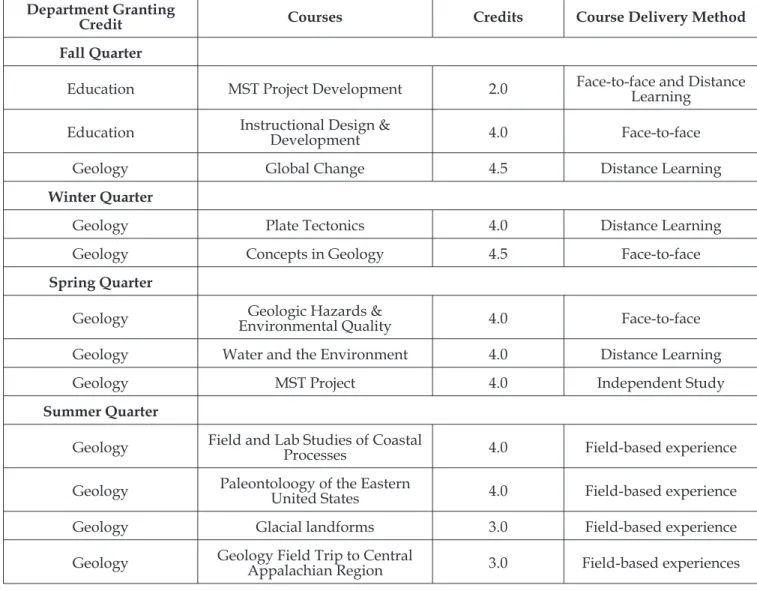
The Master of Science in Teaching (Earth Science) degree program (MST) developed in 1975, is a hybrid program blending science and education. It is housed in the Department of Geological Sciences and the College of Science and Mathematics. The program requires participants to complete a total of 45 quarter hours of graduate credit. Up to 12 graduate credits can be earned by coursework taken in the College of Education and Human Services, and the remaining 33 quarter hours in the Department of Geological Sciences. As in most graduate programs, up to 12 quarter hours of graduate credit may be transferred in upon approval of the participants’ graduate committee made up of faculty from both colleges. The Department of Geological Sciences offers the Master of Science in Teaching (Earth Science) degree to students possessing a Bachelor of Arts or a Bachelor of Science degree from a recognized institution. The Master of Science in Teaching (Earth Science) program is available to teachers of all K-12 grade levels. Extensive undergraduate preparation in Earth and Space science is not an admission requirement. Because Master of Science in Teaching (Earth Science) students enter the degree program with widely different backgrounds and academic preparation in the sciences, programs of study are tailored to individual needs, and consider prior coursework and career plans and goals. Available courses are aligned with the National Science Teachers Association guidelines for the preparation of K-12 teachers, and include courses in Physical and Historical geology, natural resources, Earth systems, and oceanography. See Figure 1 for a typical 45 quarter hour
Supporting the Standards: A Master’s Degree Program for K-12
Teacher Professional Development
William Slattery
Department of Geological Sciences and Teacher Education, Wright State University, Dayton, OH 45435, [email protected]Roderic Brame
Department of Geological Sciences, Wright State Universty, Dayton, OH 45435, [email protected]program of study. A complete list of content courses available to participants in the Master of Science in Teaching (Earth Science) program is available on the Department of Geological Sciences web-site (http:// www.wright.edu/geology). Although the MST pro-gram is non-thesis, a capstone independent study project is required. This project is conceived and developed with the support of a faculty advisement committee, and the project usually takes the form of a project combining Earth and Space science content, pedagogy, and assessment of K-12 student learning. Participants are encouraged to take education courses (e.g. in authentic assessment strategies) that support their research. A two quarter hour course taken in the first quarter of the academic year assists program participants in developing ideas for their projects, and writing project proposals that include a project synopsis, literature search, timeline, and assessment plan. Examples of recent Master of Science in Teaching (Earth Science) projects include the development of a stream monitoring program for middle school students, assessing the impact of technology on elementary school students Earth and Space science learning, and a classroom action research project to assess the efficacy of Earth and Space science laboratories in a high school classroom. The goal of the independent capstone projects in all cases is the
development of reflective teaching practices by classroom teachers.
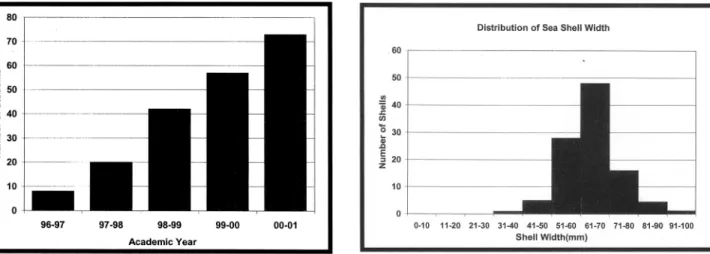
The Master of Science in Teaching (Earth Science) degree program has undergone substantial growth in the past several years (Figure 2) as a result of the convergence of several factors. These are:
·
The development of distance learning courses allows teachers outside the traditional sending area of Wright State University to become MST program participants.· The advent of high-stakes testing in Ohio now requires that K-12 teachers add Earth/Space science to every grade level.
·
Increased Ohio Department of Education requirements for K-12 educator professional development, culminating in the equivalent of a graduate degree within ten years of entering the profession.·
Restructuring of the times that MST program courses are offered to make them more “user friendly”.Participant feedback reveals that the focus on inquiry based learning and content focused on their needs as professional educators is a strong determinant in their
Department Granting
Credit Courses Credits Course Delivery Method Fall Quarter
Education MST Project Development 2.0 Face-to-face and DistanceLearning Education Instructional Design &Development 4.0 Face-to-face
Geology Global Change 4.5 Distance Learning
Winter Quarter
Geology Plate Tectonics 4.0 Distance Learning
Geology Concepts in Geology 4.5 Face-to-face
Spring Quarter
Geology Environmental QualityGeologic Hazards & 4.0 Face-to-face
Geology Water and the Environment 4.0 Distance Learning
Geology MST Project 4.0 Independent Study
Summer Quarter
Geology Field and Lab Studies of CoastalProcesses 4.0 Field-based experience Geology Paleontoloogy of the EasternUnited States 4.0 Field-based experience
Geology Glacial landforms 3.0 Field-based experience
Geology Geology Field Trip to CentralAppalachian Region 3.0 Field-based experiences
Figure 1. Typical program of study for a Master of Science in Teaching (Earth Science) program participants.
choice of the MST program. To give a sense of how specific courses meet these needs, two detailed descriptions of field based courses will be discussed, as well as an overview of the distance learning component of the Master of Science in Teaching (Earth Science) program.
Field and Laboratory Studies of Coastal Processes
-This short, intense summer field course was designed to provide K-12 educators the opportunity to explore the physical and biological aspects of the seashore environment from an inquiry based perspective. Participants meet prior to the field experience for an orientation and preliminary class to familiarize them with equipment to be used, what to bring, and to provide background readings and information. This initial meeting is followed by a four day residential stay at the Sandy Hook New Jersey facilities of the New Jersey Marine Science Consortium. Sandy Hook is the northernmost expression of the New Jersey barrier island complex, and commands the entrance to New York harbor. It is a natural “sourcebook” for inquiry science investigations, and participants are guided by experiences such as those aboard a New Jersey Marine Science Consortium research vessel to collect water samples of ocean, river, and estuary water, trawling for biological specimens in the ocean and estuary, and collecting sediment grabs. Other guided activities include beach profiling, and visiting beaches to explore the impact of human interference with natural systems. The purpose of the guided activities is not to direct the topics of inquiry, but to provide rich opportunity for participants to ask their own questions, and to collaborate with each other to try to answer them. Each group seems to focus on something different. One summer, teachers walking the strandline of the beach at Sandy Hook collecting seashells for their classrooms asked a seemingly simple question. They asked why some clamshells looked like they had holes drilled in them, and what had done the drilling. First they visited the New Jersey Marine Science Consortium laboratory library and identified the shells as soft-shell clams,Mya Arenaria. Further investigation revealed that it looked like the driller was the Atlantic Moon Snail, Polinices
duplicatus. A bit more research revealed that Moon Snails are aggressive hunters, boring through the shells of prey with their radula. There were literally hundreds of “victims” on the beach. A collecting party was organized, and the drilled shells were investigated under binocular microscopes, and then measured along their longest axis and the results graphed. The resulting graph of one groups work is shown as Figure 3. Although several groups of teachers worked independently, each group found that their graphs looked similar. The shell with their longest axis between 61 and 70 millimeters dominated the assemblage. Why were clams that were large, but not too large seemingly preferentially predated? And, why were the drilled holes always in the thinnest portion of the shell, near the beak? A number of hypotheses were suggested, ranging from some kind of chemical signal emitted by clams of varying sizes, to Moon Snails having the ability to determine the size of their prey by touch. Was it instinct that led Moon Snails to drill in the thinnest part of the shell? They suggested that if the Moon Snail chose a clam that was large, but not
Figure 2. Mater of Science in Teaching (Earth Science) program enrollment growth for the last several complete academic years.
Figure 3. Size distribution of predated bivalves randomly collected along the beach at Sandy Hook, New Jersey.
Figure 4. Plot of shell width versus shell volume for predated shells with distinct pallial lines.
too large, they would get the most meat for the least amount of work. Clearly, their respect for the intelligence of Moon Snails was growing. One skeptic was not easily convinced that there was a direct relationship between shell size and volume of meat. So, another experiment was in order. Groups set out to measure shell width versus volume (Figure 4). They made the assumption that the meat would be contained within the confines of the pallial line, and while one group member held their finger under the drill hole, another filled the clamshell with water from a pipette. A third participant recorded the shell width and volume of water the shell held. This led to a discussion of whether or not to double the volume of water, since the living clam had two shells. A teacher with vast experience in eating clams on the half shell shared her experience that the meat was contained on one shell. Her argument carried the day. However, that evening most of the other teachers were seen scrutinizing their seafood dinners with a particularly scientific zeal. No clear answers emerged from their investigations, but they were absorbed in the process of science, and found that rather than always yielding definitive answers, scientific investigations may also lead to additional questions. They will be more likely to translate their own experiences into their classrooms and be more comfortable with guiding students to try to answer their own scientific questions.
Paleontology of the Eastern United States -Teacher participants in the Master of Science in Teaching (Earth Science) program then have a chance to deepen their understandings and make clear links from the modern examples to paleontology, as they take another summer field course called Paleontology of the Eastern United States. During that course, they will see ancient examples of clams bored by gastropods. Teachers will collect Pliocene-Pliestocene fossils from the Clavert Formation and Miocene-Pliocene fossils from the Yorktown Formation. Typical collections include shark teeth, whale bones, gastropods, and clams. Clams will be identified and sorted according to species, whether or not they have predatory drill holes, and their size. Data sets are compiled and graphs are made so that analyses can be made about the paleocommunities, diversity, frequency of predation, and relationships between shell morphology and predation. The data will be collected and documented in a way that make it scientifically useful. The first analyses based on previous teachers’ interest are the comparisons that can be can be made between predation frequency and the morphology of the bi-valvesMya, Mercenaria, Crassatella, and Anadara. The Atlantic moon snails and other species of Polinices are responsible for many of the drill holes found in the ancient bivalves and gastropods. The geologic range of the genusPolinicesextends from the present back in time to the Jurassic. This part of the class ties together modern assemblages and ecology to paleo-assemblages and paleoecology extending back approximately 20 million years. Teachers begin to see differences between the modern assemblages and ancient ones. We anticipate a good deal of discussion.
On-Line Distance Learning Courses - Wright State University has an unusually large sending area. Students from the metropolitan Dayton area attend the
Main Campus, located several miles east of downtown Dayton. There is also a branch campus called the Lake Campus, located approximately 80 miles (130 kilometers) north of Dayton in Celina, Ohio. The Lake Campus serves several rural counties in western Ohio. In keeping with our program philosophy of providing “user friendly” courses for program participants, the Department of Geological Sciences currently offers five internet distance learning courses for program credit. Three have been developed in-house. These include the 2 quarter hour course for MST students to develop their capstone project research plan, and two four quarter hour content courses, Plate Tectonics, and Water and the Environment. In addition, the Department of Geological Sciences currently offers two Earth Systems science courses for K-12 teachers. One of these courses, developed by The Center for Educational Technology and Wheeling Jesuit University is designed for K-4 teachers. In addition an entirely different version designed for teachers of grades 5-8 is also offered. Next year, we will offer the high school version as well. Each of the courses seeks to develop content understandings of Earth systems science, to model pedagogical methods suitable for the designated student age groups, and to foster the use of Internet technology in K-12 classrooms. Each of the courses develops on-line learning communities and familiarity with the course layout during a three-week non-graded ramp up period. Then each course is divided into a series of three-week learning cycles. Participants in the K-4 on-line course observe their students doing science and then use their individual observations to engage in collaborative on-line discussions focusing on questions such as “How do you know students are learning from hands-on activities?” During the second week of the learning cycle, they are asked to investigate essential questions about Earth system content, and discuss their findings with each other. During the third week, they apply their knowledge by developing inquiry based strategies for use in their own classrooms. The on-line course for middle school teachers uses cooperative learning as the pedagogical framework for inquiry learning. During the first week of a learning cycle in this course, participants form four different “Event teams” to study the impact of an event such as the eruption of Mt. Pinatubo on the atmosphere, biosphere, hydrosphere, and lithosphere. During the second week of the cycle new groups having at least one member from each of the four Event Teams interact to develop causal chains on interactions between the four spheres.
During week three, participants develop and post inquiry based activities for their own students, and serve as “critical friends” responding to other participants postings. Problem based learning is the theme of the high school teacher on-line course. Teachers taking this version of the on-line course also act as Researchers, Scholars and Designers while developing content knowledge and strategies for using problem based learning in their own classrooms. No formal textbooks are used in any of the three courses, but participants are provided a variety of teacher sourcebooks and CD-ROM’s selected to assist participants in developing content understandings as well as to assist in the creation of classroom applications. Each of the courses is driven by student interest. Real world events form the focus of
the inquiry, but participants decide what content topics to explore and emphasize in their studies.
CONCLUDING REMARKS
We present the above description of the Master of Science in Teaching (Earth Science) program and some of the courses within the course of study as one possible model for the long term professional development of K-12 teachers. In school districts in western Ohio, Earth/Space science is taught in very few high school curricula. Fewer still are the middle and junior high schools that teach full year Earth/Space science courses. Elementary school teachers report that of all the sciences, they are least confident in teaching Earth/Space science. Graduates of the Master of Science in Teaching (Earth Science) program report new confidence in using inquiry science in their own classrooms; increased Earth/Space science and Earth systems content understandings; and a new awareness of the interdisciplinary nature of the Earth/Space sciences. Many of them use Earth/Space science as a springboard to Physical and Life science investigations, and to reinforce Language Arts, Social Studies, or Mathematics concepts. This is the power of Earth/Space science in the K-12 curriculum. Earth/Space science is inherently interesting. Student interest in Earth /Space science should be used to support and develop conceptual understandings in other sciences. Indeed, K-12 teacher graduates of the Master of Science in Teaching (Earth Science) program report that by using Earth/Space science as a context to investigate the Physical and Life sciences in their classroom student understandings of the content and process of the entire circle of sciences broadens and deepens.
REFERNCES
American Association for the Advancement of Science, 1989, Project 2061, Science for All Americans. Washington, D.C. Oxford Press.
American Association for the Advancement of Science, 1994, Benchmarks for Science Literacy, New York, Oxford Press.
National Research Council, 1996, National Science Education Standards, National Academy Press, Washington, D.C.
Ohio State Board of Education, 1994, Ohio’s Model Competency-Based Science Program. Ohio State Board of Education, Columbus, Ohio .