Operations Evaluation
Ex post evaluation of the use of Framework
Loans to finance EIB investments in the EU,
2000-2011
Synthesis Report
External Consultants
COWI / DFC
Ivory Yong-Prötzel
Prepared by
Operations Evaluation
Bastiaan de Laat (team leader)
Stephen Richards
Axel Hebel
Carlos d’Anglade
EVALUATION REPORT
Ex post evaluation of the use of framework loans to finance EIB
investments in the EU
Prepared by
Operations Evaluation
Operations Evaluation
Bastiaan de Laat (team leader)
Stephen Richards
Axel Hebel
Carlos d’Anglade
External Consultants
COWI
DFC
Ivory Yong-Prötzel
Head of Operations Evaluation
September 2012
* * *
NOTICE
The EIB has an obligation of confidentiality to the owners and operators of the projects referred to in this report. Neither the EIB nor the consultants employed on these studies will disclose to a third party any information that might result in a breach of that obligation, and the EIB and the consultants will neither assume any obligation to disclose any further information nor seek consent from relevant sources to do so.
i
rations Evaluation - Operations Evaluation - Operations Evaluation - Operations Evaluation - Operations Evaluation - Operations Evaluation - Operations Evaluation - Operations Evaluation - Operations Evaluatio
TABLE OF CONTENTS
GLOSSARY OF TERMS AND ABBREVIATIONS ... II EXECUTIVE SUMMARY ... III MANAGEMENT RESPONSE ... VII TABLE OF RECOMMENDATIONS ... VIII
1 INTRODUCTION ... 1
1.1 BACKGROUND TO THE EVALUATION ... 1
1.2 APPROACH AND METHODOLOGY ... 2
1.3 THEMATIC ISSUES SPECIFIC TO FRAMEWORK LOANS ... 3
1.4 STRUCTURE OF THIS REPORT ... 3
2 THE DEVELOPMENT OF THE FRAMEWORK LOAN APPROACH ... 4
2.1 FROM ITALIAN MUNICIPALITIES TO THE NEW MEMBER STATES: THE EVOLUTION OF FLS... 4
2.2 FROM MULTIPLE APPROACHES TO HARMONISATION ... 4
3 PORTFOLIO REVIEW AND SAMPLING ... 7
3.1 CATEGORIES OF FRAMEWORK LOANS ... 7
3.2 SCOPE AND EVOLUTION OF THE FRAMEWORK LOANS PORTFOLIO UNTIL 2011 ... 8
3.3 DISTRIBUTION OF FLOPERATIONS BY SIZE,SECTOR AND COUNTRY ... 8
3.4 SAMPLE ... 9 4 RELEVANCE ... 11 4.1 EVALUATION RESULTS ... 11 4.2 ISSUES ... 13 4.3 CONCLUSIONS ... 15 5 EFFECTIVENESS ... 16 5.1 EVALUATION RESULTS ... 16 5.2 ISSUES ... 17 5.3 CONCLUSIONS ... 19 6 EFFICIENCY ... 20 6.1 EVALUATION RESULTS ... 20 6.2 ISSUES ... 22 6.3 CONCLUSIONS ... 23 7 SUSTAINABILITY ... 24 7.1 EVALUATION RESULTS ... 24 7.2 ISSUES ... 26 7.3 CONCLUSIONS ... 26
8 RATING SUMMARY AND OVERALL RATINGS... 27
9 EIB CONTRIBUTION ... 29
9.1 EVALUATION RESULTS ... 29
9.2 ISSUES ... 30
9.3 CONCLUSIONS ... 32
10 EIB PROJECT CYCLE MANAGEMENT ... 33
10.1 STAGES UP TO SIGNATURE ... 33
10.2 IMPLEMENTATION, ALLOCATION AND DISBURSEMENT PROCESS, IDENTIFICATION & REVIEW OF SUB-PROJECTS ... 33
10.3 MONITORING AND FOLLOW-UP ... 35
10.4 COORDINATION AND COOPERATION ... 36
10.5 CONCLUSIONS ... 36
11 CONCLUSIONS AND RECOMMENDATIONS ... 37
11.1 CONCLUSIONS ... 37
GLOSSARY OF TERMS AND ABBREVIATIONS
Absorption capacity The ability to use approved funds in the timescale and manner envisaged Acquis- The total body of EU law
communautaire
Allocation The attribution of a share of a loan to a specific sub-project or beneficiary (of a multi-beneficiary loan)
Borrower The legal persona with whom the Bank signs a Loan Agreement. bp basis points (one hundredth of one per cent interest)
CA EIB’s Board, The EIB Board of Directors, which has sole power to take decisions in respect of loans, guarantees and borrowings.
CD EIB’s Management Committee (q.v.) Internal EIB committee, comprising the Bank's President and Vice-Presidents
CEE Central and Eastern Europe
CEB Council of Europe Development Bank COP Corporate Operational Plan
DAC (OECD) Development Aid Committee (Organisation for Economic Co-operation and Development) EBRD European Bank for Reconstruction and Development
EC European Commission ECG Evaluation Cooperation Group EIA Environmental Impact Assessment EIB European Investment Bank EIRR Economic Internal Rate of Return ERDF European Regional Development Fund
EU European Union
EU12 New Member States since 2004 EV EIB Operations Evaluation (Ex-Post) FIRR Financial Internal Rate of Return
FL Framework Loan
FVA Financial Value Added GDP Gross Domestic Product
GED Gestion Ēlectronique de Documents (Electronic Documents Management System)
GL Global Loan
IL Investment Loan
L4SME Loan for SMEs
MAs Managing Authorities
NMS New Member States (EU12) OP Operational Programme (EU)
Ops-A EIB Directorate for Lending Operations – EU Members, Acceding, Accession and Candidate States
PCR Project completion report
PJ EIB Projects Directorate – responsible for ex-ante project techno-economic analyses, preparation of Technical Description, physical monitoring of implementation and completion
PPP Public Private Partnership PPR Project Progress Report
Project A clearly defined investment, typically in physical assets, e.g. a specific section of road, a bridge, etc.
Project Pipeline Those projects which have been signalled to the Bank, but have either not yet been approved by the Management Committee, or have been approved but not yet signed. These include projects under active appraisal and those in the process of contract negotiation prior to signature.
PL Programme Loan (or Grouped Projects): an investment programme made up of many schemes implemented by the same promoter or a group of separate projects with different promoters coordinated by a central body (as per PJ procedures)
Promoter Normally the persona responsible for identifying and developing a project. The promoter may also be responsible for operating and/or implementing the project.
RM EIB Risk Management Directorate, responsible for credit appraisal / portfolio management
SERAPIS The Bank’s internal project IT system
SPL Structured Programme Loan, used by the Bank to co-finance Operational Programmes (OP) under the EU Structural Funds regulations
Sub-project (or “scheme”) part of a broader national, regional or local sub-programme, co-financed by the EIB
TA Technical Assistance
TD Technical Description, i.e. Project definition - the basis of the Loan Agreement; prepared by PJ
iii
rations Evaluation - Operations Evaluation - Operations Evaluation - Operations Evaluation - Operations Evaluation - Operations Evaluation - Operations Evaluation - Operations Evaluation - Operations Evaluatio
EXECUTIVE SUMMARY
This evaluation focuses on the use of the Framework Loan instrument used by the EIB to contribute to investment programmes of national, regional and local authorities. The use of this instrument within the EU27 has grown from less than 1% of Bank operations (signatures) in the mid-nineties to a level consistently over 10% since 2002. It peaked in 2010 with nearly EUR 11bn in signatures, i.e. 17% of total signatures that year. It was therefore considered timely to evaluate how this particular type of financial product is performing. The Operations Evaluation (EV) 2010 Activity Report and Work Programme for 2011-12, approved by the
Board of Directors on 21 June 2011 included a thematic evaluation of Framework Loans for the first time since they were introduced in the 1990s. The aim is to establish whether the defining characteristics of the product – the deferment of appraisal to later in the process (see insert) and the increased reliance on the counterparts and their procedures to ensure suitable projects are funded – have a discernible effect on the
relevance, performance and management of those operations. The evaluation is based on a review of the evolution of Framework Loan procedures, a portfolio analysis of EIB Framework Loans from their inception until end 2011, interviews with Bank internal and external stakeholders, and in-depth evaluations of a sample of 24 Framework Loans (FLs) during the 2000-2008 period within the EU27. Of these, 7 were Structural Programme Loans (SPLs), used by the Bank to co-finance Operational Programmes (OP) under the EU Structural Funds regulations.
Overall conclusion
The overall conclusion is that Framework Loans are a relevant and, especially in the SPL case, effective instrument the continued use of which is recommended. The Framework Loan is an EIB product which successfully allows the Bank to target previously not or only partly supported areas of European development. It creates leverage through blending with national, regional or EU grant or loan funding. FLs allow the Bank to reach out to smaller schemes, often in the sub-sovereign (e.g. regions, smaller municipalities) sector.
However, the aspect which most defines Framework Loans – the deferral of appraisal after signature – is also the most challenging. This was so at least in the early years of operation when procedures were still being developed. Greater experience with their use, streamlining and a better understanding of the procedures is expected to have improved performance in the more recent loans. However, there are certainly lessons to be learned from the earlier period that was under scrutiny in this evaluation.
FLs required – and according to the services at present still require – a major effort from the Bank. An initial effort is to be made upstream, to understand the local, regional or national programme the Bank contributes to and to obtain an initial view on possible sub-projects the Bank could co-finance. Efforts made at this stage do not differ much from the effort required for the more complex Investment Loans. The main difference lies downstream, when the Bank has to make sure that (i) sub-project allocations are received, (ii) comply with the Bank’s eligibility criteria and (iii) ultimately add up to the allowed loan volume.
The evaluation shows that this process in the past was far from satisfactory as it required a great amount of work without necessarily obtaining the right level of information on sub-projects – which per operation can run into the hundreds or thousands (in the evaluation sample, from 4 to 14 000). The corresponding effort expended in collecting allocations cannot be spent on other important issues, in particular on the assessment of the EIB contribution to the national, regional or local investment programme. The strong focus on allocations created an illusion of control, which, the evaluation suggests, the Bank ultimately did not really have.
Modalities (current) for appraisal within FLs depend on sub-project size:
• < EUR 25m: “list of allocations” submitted by Promoter ex post, to be confirmed by the Bank
• EUR 25-50m: review of dossier by Bank services, possibly after receiving additional information; ex ante approval by Bank services
• > EUR 50m: full appraisal by the Bank’s services; approval by the EIB Board
Although a proposal for streamlined procedures was made by the Bank’s services in 2009, there is evidence that the implementation of FLs continues to be a challenge – were it only due to the sheer number of sub-projects per operation. Most of the recommendations provided in the present report aim at tackling those challenges by further streamlining the implementation of FLs, hence freeing up resources to further concentrate on the EIB added value to those operations.
Main insights from the 24 in-depth evaluations
The evaluation is based on the in-depth evaluation of 24 FLs, of which 7 were SPLs. The overall ratings of projects were satisfactory with one “excellent” case (an SPL) and one case that turned out impossible to rate in view of the low amount of information available and the weak definition of objectives. The SPLs more frequently were “satisfactory” than the non-SPL FLs. The non-SPL FLs more often only partially reached their objectives and more often also had low efficiency, sustainability and/or relevance. All those FLs were situated in EU15 countries. The only “partly unsatisfactory” SPL co-financed a combination of a local and a EU Structural Fund programme, of which the local part was delayed and ultimately not realised under the operation.
A summary of the ratings and the main conclusions against the evaluation criteria are provided below.
Relevance. Overall, the operations were relevant in relation to EU policies and EIB policies, strategies and objectives, and generally responded well to the national, regional or local needs. Objectives were generally consistent and with a few exceptions, the projects were well designed. The use of the FL instrument appeared justified in most of the cases, given the specific characteristics of the national, regional or local programme it co-financed. In a few cases, a Global Loan or Investment Loan was deemed however a more appropriate solution when it turned out that all sub-projects were, respectively, small or could have been easily known beforehand.
Effectiveness. Effectiveness was rated significantly differently between the SPLs (performing relatively well) and the rest of the sample for which effectiveness was satisfactory (and none excellent) for less than half of the operations. One operation appeared even impossible to rate on this criterion because of the weak initial formulation of operational objectives and a near absence of project completion data. More generally, it appeared often difficult to link the operational objectives of a FL to the contribution it is expected to make to the broader impact of programmes. The programmes to which SPLs contribute were better prepared and their objectives better defined than the rest of the sample, and this preparation contributes also to the relatively better performance of the EIB loan; more upstream EIB involvement (presently weak) would increase relevance and effectiveness of the EIB contribution. For the EIB, sub-project allocation approvals are more based on eligibility and exclusion criteria, and a certain perception of (reputational) risk than on their consistency and actual contribution to the realisation of the objectives of the investment programme. Six operations saw a strong reduction in size as compared to the amounts approved by the Board. These operations obviously did not realise their initially planned operational objectives. Even though reasons for the reduction of scope differed from case to case, the majority concerned intermediated loans which appear to have more difficulties in achieving their objectives than loans directly with a promoter. This may point at a lack of ownership at the side of those financial intermediaries and raises the question about the conditions under which intermediated loans are conducive to achieving the objectives of FLs.
v
rations Evaluation - Operations Evaluation - Operations Evaluation - Operations Evaluation - Operations Evaluation - Operations Evaluation - Operations Evaluation - Operations Evaluation - Operations Evaluatio
Efficiency. In view of the generally high numbers of sub-projects, and their great variety in terms of scope and scale (ranging from several tens of thousands to sometimes several tens of millions of Euros per allocation) it was difficult to establish the efficiency as a simple aggregate of the efficiency of individual projects. This was furthermore complicated by the fact that most of the time sub-projects were not or only partially known at project onset (which is typical, and allowed, for FLs). Moreover, any sort of efficiency calculations were generally not available for review either ex ante or ex post, even for bigger sub-projects. The rating of the efficiency criteria for the operations in the sample had therefore to be very much approached indirectly by analysing process elements (timeliness, procurement, management arrangements) rather than the standard efficiency indicators used by the Bank (cost-effectiveness, FIRR, EIRR).
On this basis, the majority of projects turned out to be efficient. Even so, it is of great concern that the Bank is unable to provide a clear quantitative insight in the efficiency of FL operations.
Sustainability. There was no particular concern over sustainability. However, as flagged in earlier evaluations, sustainability is in many cases dependent on the long term financial health of public sector organisations, therefore attention needs to be paid to this at appraisal stage and completion, especially in the present context.
EIB Contribution. Framework loans represent significant EIB financial contributions, with high to significant financial value added in most countries and occasionally much lower financial value added in highly developed Member States with good access to alternative finance. Here more strategic reasons – e.g. the perceived partnership value of the EIB or EIB “label” – prevail for choosing EIB. Non-financial contribution was found to be consistently low; greater EIB upstream involvement and TA could be used to improve in this area whenever this is relevant.
EIB Project Cycle Management. The sample of SPLs performed more consistently in this area than the rest of the sample. Shortcomings, where they occurred, were during the phases of implementation and monitoring where the tracking of the sub-projects ran into difficulties. For the rest of the sample performance was poorer overall with only about one-third being considered satisfactory. Problems with tracking sub-projects during the life of the project dominated the findings here too, but weaknesses of appraisal, poor transfer of information
requirements into the contract and failure to secure Project Completion Reports (PCRs) also affected the ratings. It is important to stress that “unsatisfactory” ratings were not given for those projects appraised before 2005 because they failed to comply with procedures introduced later on. They were down-rated because the information requirements and follow-up procedures stated in the appraisal stage documents were not respected and because the final level of information on the projects was below normal standards for an EIB loan.
The way forward: working clearly from a programme perspective
Framework Loans appear as a relevant, and especially in the SPL case effective, instrument of which the continued use is recommended. The main issue is the great implementation effort they require from the Bank, without always leading to satisfactory results. In order to make the use of Framework Loans more efficient and ultimately more effective it is recommended that the Bank move towards more of a programme approach for the implementation of Framework Loans wherever possible, i.e. when the promoter’s competence would allow this. It would in such a case agree, in partnership with the promoter, on a set of indicators and targets to be developed from the programme objectives and follow up on these to provide proof of effectiveness, rather than collecting information on huge numbers of individual allocations, without necessarily inquiring about how these have contributed to
the achievement of the wider programme. Such a programmatic approach, which would imply an earlier involvement of the Bank is especially true for SPLs, however it could also be envisaged with other investment programmes provided that promoters are competent.
The Bank perceives several types of risk which today prevent it from working from a “programme perspective” as a programme approach would mean a loss of control over the individual sub-projects co-financed by the Bank. These perceived risks are mainly regulatory (exceeding relevant thresholds going unnoticed; double financing) and reputational (sensitive sectors; procurement). Furthermore the move toward programme funding could imply a de facto move toward budget or sector funding that the Bank so far has formally abstained from. Additionally, from a practical viewpoint, the Bank has little experience in developing programmes together with its partners. However, there may be more risk in creating the illusion of control than in accepting a certain level of risk – the Bank had not, and will probably never have, the resources to control thousands of individual sub-projects thoroughly.
A middle way between a full programme approach and the current, partly unsatisfactory, situation should therefore be found. This may be achieved by a combination of measures that, together, aim at streamlining the FL implementation and allocation process, while enhancing the level of control over the investments made under a FL. Those measures concern an earlier involvement of the Bank in the definition of the programmes it is invited to contribute to; a greater reliance on, and level of, delegation to competent promoters, allowing to spend more time with the weaker ones; a more efficient administration of FLs, by limiting allocations to crucial information but enforcing the information gathering better; by centralising allocation checks within the Bank and learn from the existing processes for GL allocations. Ultimately this would allow the Bank’s services, and in particular the Project Directorate’s staff, to concentrate more on maximising the EIB contribution. The recommendations provided in the table below reflect those measures. They are based on the assumption that Framework Loans would continue to be an instrument provided by the EIB alongside Investment Loans and Global Loans. The recommendations, which are complementary, strongly interrelated and expected to be implemented as one coherent system, are formulated in view of the above conclusions in order to: (1) underline the programmatic character of FLs; (2) enhance the effectiveness and efficiency of Framework Loan implementation; and (3) exploit better the available EIB in-house expertise and increase the EIB added value to the national, local and regional programmes they contribute to.
vii
rations Evaluation - Operations Evaluation - Operations Evaluation - Operations Evaluation - Operations Evaluation - Operations Evaluation - Operations Evaluation - Operations Evaluation - Operations Evaluatio
MANAGEMENT RESPONSE
This evaluation provides an assessment of the Framework Loan (FL) instrument used by the EIB to contribute to investment programmes of national, regional and local authorities. The use of this instrument by the EIB within the EU27 has grown from less than 1% of Bank operations in the mid-nineties to a level consistently over 10% since 2002. Its use peaked in 2010 with nearly EUR 11bn in signatures, equalling 17% of total signatures that year.
The Management Committee (MC) would like to thank Operations Evaluation for the high quality evaluation, based upon extensive field work and thorough consultation with the relevant EIB services. This synthesis report is based on the in-depth evaluation of 24 individual operations in areas as varied as transport, health, tourism, education and disaster risk management. The number of operations evaluated is a significant increase as compared to former ex-post evaluation practice at the EIB.
The Management Committee concur with the main conclusion of the report: Framework Loans are a relevant and effective instrument to achieve the EIB’s objectives. This appears especially so in the case of Structural Programme Loans, co-financed with the EU Structural Funds. The evidence shows that Framework Loans successfully allow the Bank to target previously not or only partly supported areas of European development. They create leverage through blending EIB financing with national, regional or EU grants or loan funding. Finally, they allow the Bank to reach out to smaller schemes, often in the sub-sovereign (e.g. regions, smaller municipalities) sector. In view of existing financial and budgetary constraints across the EU27, which are particularly felt for public investment programmes, the Management Committee endorses EV’s recommendation to continue the use of this instrument.
The Management Committee also acknowledges that Framework Loan implementation requires major efforts from the Bank. The MC believes that, following the outcomes of the evaluation, further efficiency gains are possible and will be sought. The Management Committee accepts the combination of measures proposed by the evaluation report and encourages the EIB services to follow up the various recommendations made. Together, these will further streamline the FL implementation and allocation process, while enhancing the level of control over the investments made under a FL, by moving towards smarter rather than more control.
The Management Committee agrees on the utility of an earlier involvement of the Bank in the definition of the programmes it is invited to contribute to. In this context, the Partnership Agreement (PA) exercise of DG Regio in which the Bank is already engaged, provides a suitable frame for this. The Management Committee will also allow the services to have a greater reliance on, and level of, delegation to promoters as long as these have proven to be competent. Also, for a more efficient administration of Framework Loans, the Management Committee would be in favour of limiting allocation checks to a small amount of critical information.
Against this, in relation to the proposal to develop a product for small promoters, the Management Committee points out that this would involve considerable operational challenges for the Bank and that the existing Framework Loan product already offers sufficient flexibility to address the needs of small promoters.
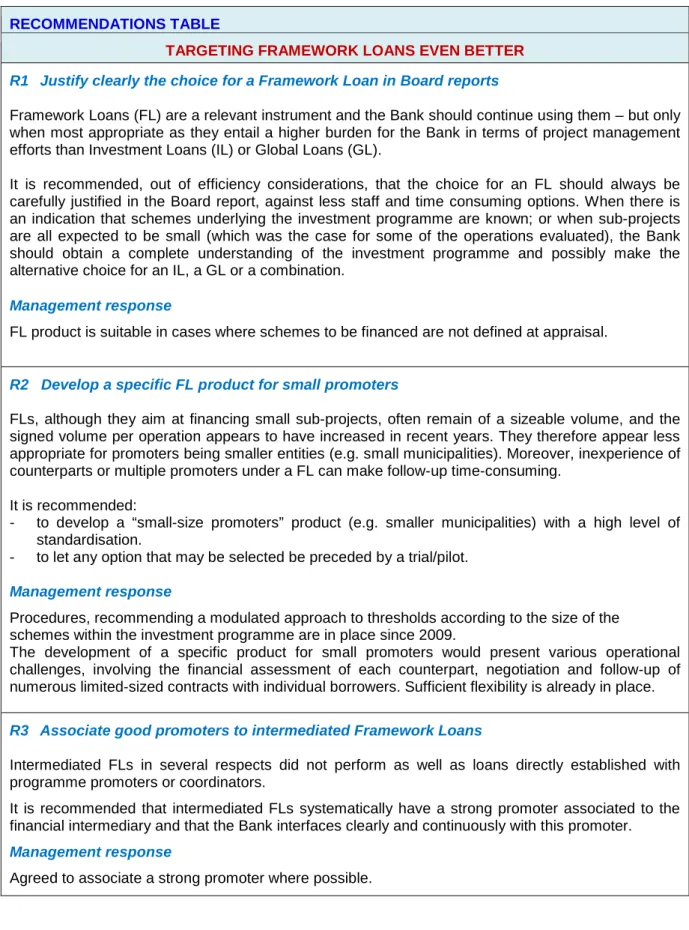
TABLE OF RECOMMENDATIONS
The table below contains recommendation summaries. A full version with underlying justifications can be found in Section 11.2 (“Recommendations”) of the report.
RECOMMENDATIONS TABLE
TARGETING FRAMEWORK LOANS EVEN BETTER R1 Justify clearly the choice for a Framework Loan in Board reports
Framework Loans (FL) are a relevant instrument and the Bank should continue using them – but only when most appropriate as they entail a higher burden for the Bank in terms of project management efforts than Investment Loans (IL) or Global Loans (GL).
It is recommended, out of efficiency considerations, that the choice for an FL should always be carefully justified in the Board report, against less staff and time consuming options. When there is an indication that schemes underlying the investment programme are known; or when sub-projects are all expected to be small (which was the case for some of the operations evaluated), the Bank should obtain a complete understanding of the investment programme and possibly make the alternative choice for an IL, a GL or a combination.
Management response
FL product is suitable in cases where schemes to be financed are not defined at appraisal.
R2 Develop a specific FL product for small promoters
FLs, although they aim at financing small sub-projects, often remain of a sizeable volume, and the signed volume per operation appears to have increased in recent years. They therefore appear less appropriate for promoters being smaller entities (e.g. small municipalities). Moreover, inexperience of counterparts or multiple promoters under a FL can make follow-up time-consuming.
It is recommended:
- to develop a “small-size promoters” product (e.g. smaller municipalities) with a high level of standardisation.
- to let any option that may be selected be preceded by a trial/pilot. Management response
Procedures, recommending a modulated approach to thresholds according to the size of the schemes within the investment programme are in place since 2009.
The development of a specific product for small promoters would present various operational challenges, involving the financial assessment of each counterpart, negotiation and follow-up of numerous limited-sized contracts with individual borrowers. Sufficient flexibility is already in place. R3 Associate good promoters to intermediated Framework Loans
Intermediated FLs in several respects did not perform as well as loans directly established with programme promoters or coordinators.
It is recommended that intermediated FLs systematically have a strong promoter associated to the financial intermediary and that the Bank interfaces clearly and continuously with this promoter. Management response
ix
rations Evaluation - Operations Evaluation - Operations Evaluation - Operations Evaluation - Operations Evaluation - Operations Evaluation - Operations Evaluation - Operations Evaluation - Operations Evaluatio
PREPARATION R4 A stronger upstream involvement
A stronger involvement of EIB is recommended in upstream phases of the investment programmes that may envisage to make use of a FL. This is particularly important for SPLs where EIB already has the formal possibility to be involved in the preparation of programmes but which is used only timidly. EIB contribution is more relevant – both for the OP and in view of the Bank’s own priorities – and more significant when the Bank staff is involved early.
Involvement in the preparation of investment programmes that are non-EU financed, in view of the possible establishment of FLs seems to be more difficult, however here also efforts should be made to get earlier involvement as soon as there is an indication that a national, regional or local authority would want to ask finance from the EIB.
It is recommended that the Bank’s services establish a plan on how to increase their upstream involvement in the preparation of investment programmes that may eventually be co-financed with an FL/SPL.
Management response
This approach is already applied, including EIB involvement in the project definition, where relevant, and where resources are available. The Services are involved in the early planning phase for the next EU programming period.
R5 Explore involvement of JASPERS for SPLs
With the possibility of the Bank to provide advice and TA by itself, in conjunction with the advent of the JASPERS, JEREMIE and JESSICA initiatives, the EIB role in the preparatory phases of Structural Fund programmes has started to change.
It is recommended
- that the Bank make better and more systematic use of the information produced by JASPERS, in particular the completion reports of JASPERS assignments;
- with regard to SPLs, to further clarify and explore JASPERS’ role and association with the Bank’s services, with a view to allowing the Bank to be involved earlier in the preparatory process for the Structural Funds.
Management response
Agreed. An overall good cooperation with JASPERS exists, in particular for individual (major) large schemes i.e. those with total project costs exceeding EUR 50m and being co-financed with the EU Structural and Cohesion Funds.
Any change in the role of JASPERS will have to be agreed by JASPERS’ Steering Committee R6 Tap into existing information sources
In order to obtain a better view on the investment programme to which the Bank contributes, it seems important to tap into other sources of information which generally exist. This is currently not or hardly done.
It is recommended
- that the Bank uses available information (e.g. from EC and MAs in the case of SPLs, from national sources such as Courts of auditors for other FLs), more systematically during appraisal and completion, as applicable. A check on whether such information has been retrieved could be included in the appraisal
- to assemble such information once collected, possibly in GED, in folders e.g. organised by city, region or country as reference both for appraisal and evaluation – particularly when repeat operations occur.
Management response
Agreed. EIB normally relies, in addition to information collected directly from the promoters, on the IT monitoring system of promoters to the extent possible and feasible.
As an independent financing entity, the Bank has the discretion to request additional/specific information.
Supporting documents are already available in the Bank’s electronic document management system, alongside appraisal reports, allocations and follow up documents. Creating additional data sets would be duplication of work.
R7 Review use of PIUs
The value of making Project Implementation Units (PIUs) a condition of some loans is questioned. The evaluation showed that when a PIU was required the verification of its quality and experience was generally poor. Moreover, proper empowerment of the PIU, and more generally of the team implementing the FL on the side of the promoter, is an important success factor.
It is recommended
- that for each FL, Bank or Promoter explicitly nominate a Project Manager or focal point at the counterpart side
- if there is real concern over implementation capacity, to make a thorough review of staffing credentials and empowerment, have recourse to TA if this is deemed a feasible solution or refrain from realising the operation if remediation is deemed impossible. This holds for promoters in all EU27 countries, not only NMS.
Management response
This recommendation is already implemented. The review will be undertaken where appropriate.
APPRAISAL, MONITORING AND INFORMATION REQUESTS
R8 Explore the possibility to co-finance and monitor SPLs at the level of priority/measure/programme
At present, the fact that an OP to which an SPL contributes has monitoring obligations on its own (i.e. imposed by the EC), does not preclude the Bank to perform its own parallel monitoring, in particular in order to prevent non-compliance of sub-projects with EIB requirements and to avoid reputational risk. Especially with high numbers of sub-projects and a small number of those being actually checked on the ground, this does not seem to be an efficient use of EIB resources, even more so as, within the EU-27, where at national levels EU and national legislation is in place and mostly enforced, FLs have so far not led to specific reputational issues for the Bank.
It is recommended
- that the possibility to co-finance and monitor SPLs at the level of the priority, measure or even programme as a whole is explored, and under which conditions (e.g. selecting an “eligible” sub-part of the programme) this can happen, without needing to check individual allocations; once clarity is obtained on the preceding, to act accordingly
- in any case, to harmonise reporting systems between the different parties and avoid additional reporting.
xi
rations Evaluation - Operations Evaluation - Operations Evaluation - Operations Evaluation - Operations Evaluation - Operations Evaluation - Operations Evaluation - Operations Evaluation - Operations Evaluatio
Management response This is already in place.
Programmes are appraised and followed-up on an aggregated level. However, information requirements will continue to be based on the scheme level.
Harmonisation does take place to the extent possible. R9 Streamline the handling of small allocations
A major effort in managing FLs lies in obtaining allocations, without necessarily getting the right information in the end.
It is recommended
- that the allocation process be reviewed by exploring the possibilities for streamlining the allocation-check procedures for “small” allocations (i.e. for sub-projects with a cost below the EUR 25m threshold). This could be based on a small amount of critical information required per allocation, but with this information being actually enforced; an eligibility check on those allocations on the basis of the information; and a more detailed review on a small (e.g. a 5%) sample;
- to this end, to explore the possibilities of creating a joint unit between PJ and OPS to handle all allocation requests and checks, i.e. from FLs and GLs, for sub-projects with a cost below the EUR 25m threshold. The aim is to obtain a higher degree of “industrialisation” of the allocation review and sign-off process than is presently the case for FLs.
As a special case of allocation check, the practice of allocating money under several framework loans to one big project can make transparent tracking of the total contribution to that project difficult; it is recommended that these are specifically identified and that a note summarising the final situation is sent to the file and maybe the CD for information.
Management response
The scope for simplification of the allocation process will continue to be determined subject to the outcome of the project appraisal on a case by case basis. There is little room for synergies and efficiencies in the allocation process between FL and other intermediated loans (e.g. for SME). Given the very specific eligibility criteria for each individual FL, sector expertise remains within the remit of the Projects Directorate.
A note in the appraisal report specific to the relevant large project is deemed sufficient.
R10 Delegate information gathering responsibilities to the more capable promoters; give more scrutiny to the weaker ones
The streamlining of the allocation process goes hand in hand with a greater delegation of the information gathering responsibilities to the promoter, for those promoters that would have the competency and capacity to do so (see also R7 on PIUs) and from whom an extensive project completion report could be required.
It is recommended
- to have a greater delegation of the information gathering responsibilities to the promoter, for those promoters that would have the competency and capacity to do so. From such promoters, and with the reservation concerning the need to avoid potential additional reporting expressed in R8 in the case of SPLs, an extensive project completion report should be required.
Management response - Agreed.
- Agreed.
R11 Design a method to assess the efficiency of FLs
Efficiency calculations prove to be particularly challenging in FLs, both ex ante and ex post, particularly due to the generally very high numbers of sub-projects, their variety in scope and scale, and absence of information at appraisal stage.
It is recommended that the Bank design a method to assess the efficiency of FLs. Management response
Under development. A technical study on a new method to assess indirectly efficiency has been launched in cooperation with the University College London.
R12 Verify and clarify existing procedures and practices, not always aligned
In a certain number of cases, procedures and practice were not always aligned. The following need verification and/or clarification:
• Though the procedures put the responsibility on the OPS loan officer to verify with PJ that all necessary pre-conditions are met before approving a disbursement, there is no physical sign-off by PJ and the verification is not clearly documented. According to the services, the procedures are not well implemented still today, i.e. OPS is not systematically checking with PJ if all conditions are met before disbursement. This should be better enforced.
• Large up front disbursement in an operation is a potential difficulty in obtaining information later. The procedures should be strengthened as to avoid such large disbursements where cooperation and reliability of the counterpart is as yet unproven.
• The hand-over between contact persons is, due to the complexity of FLs, even more important in this type than in other types of operations. It is recommended that the Bank clarifies the procedures for effective handover between contact persons to ensure a consistent approach to promoters and to ensure project history is not lost.
• It is recommended to include a provision in the procedures that when an operation is cancelled the GRM visits the promoter and finds out why. A back-to-office report should close the project.
Management response
The process of verification of all necessary pre-conditions is clearly set out in the Ops Procedure Manual and required that confirmations by the respective services on the fulfilment are filed in the Bank’s Electronic Document Management system. Operational services will ensure full enforcement of these procedures as appropriate.
Upfront disbursements are capped at 30% of the loan amount. The matter has already been addressed.
It is not deemed necessary to visit the promoter to cancel the operation. The internal procedure requests a note to the Finance Directorate to cancel the undisbursed signed amount and to inform the Management Committee through the note prepared by Operational Services to cancel the amount remaining to be signed, including an appropriate justification.
1
INTRODUCTION
1.1
Background to the evaluationA Framework Loan (FL) is a way of delivering EIB finance which is an intermediate category between an Investment Loan (IL) covering one or more defined investment projects (which are all subject to full appraisal before the loan is approved) and a Global Loan (GL) covering a group of typically smaller projects (with a cost below the normal EIB lending threshold of EUR 25m) managed by an intermediary, usually a financial institution (and where the checks prior to loan approval focus on the capabilities of the intermediary). A FL covers multiple sub-projects1, often in multiple sectors. The capabilities of the
Bank’s main counterpart, on whom the Bank places greater reliance than for investment loans to manage the allocation of funds to suitable sub-projects, is very important. The loan contract establishes a framework under which subsequent allocation of funds to specific sub-projects, followed by disbursement of those funds, can be made. The defining characteristic of a framework loan is, therefore, that the operation is not fully defined at appraisal and needs to be checked further downstream in the process, with the intention that sub-projects (or “schemes”) ultimately are all subject to EIB approval. The modalities for
approval depend on the size of the sub-project. At present, for sub-projects below EUR 25m the Bank provides a confirmation ex post based on an “allocation request”, i.e. a list of schemes to be financed, provided by the promoter. For schemes from EUR 25m to EUR 50m the Bank services review the dossier and approve the scheme ex ante; additional information may be required. Sub-projects above EUR 50m are subject to full appraisal based on the dossier, possibly with additional information, and are submitted to the CA for approval. The borders between FL, IL and GL (including special cases Loan for SMEs (L4SME) and MidCap Loans) are depicted in the adjacent graph.
Framework Loans can cover any sector which is eligible for EIB finance and can cover multiple sectors within a single framework, so they are based upon the same Treaty basis as those sectors to which they contribute. The same hurdles for eligibility and quality which apply to investment loans should therefore apply equally to the sub-projects included within the frameworks. The basic requirements of the procedures applicable to investment loans also apply to framework loans but due to the different phasing of some of the checks supplementary procedures have been developed over time to clarify some of the controls required.
A subset of framework loans known as Structural Programme Lending (SPL) cover EIB co-finance of Operational Programmes under EU Structural Funds and have some minor modifications to their operations and procedures to reflect this, as discussed below.
FLs have grown from less than 1% of Bank operations in the mid-nineties to a level consistently over 10% since 2002; it is therefore considered timely to evaluate how this particular type of financial product is performing. The Operations Evaluation (EV) 2010 Activity Report and Work Programme for 2011-12, approved by the Board of Directors on 21 June 2011 (as well as the proposal for that programme made in 2009), therefore included a thematic evaluation of FLs for the first time since they were introduced in the 1990s. The aim is to establish whether the defining characteristics of the product – the deferment of certain checks to later in the process and the increased reliance on the counterparts and their procedures to ensure suitable projects are funded – have a discernible effect on the relevance, performance or management of those operations.
1
2
rations Evaluation - Operations Evaluation - Operations Evaluation - Operations Evaluation - Operations Evaluation - Operations Evaluation - Operations Evaluation - Operations Evaluation - Operations Evaluatio
1.2
Approach and methodologyIn accordance with EV's Terms of Reference and internationally adopted (DAC/OECD and ECG) evaluation criteria, the general objective of the evaluation is to assess the relevance of EIB operations and the EIB contribution, as well as the strategies, policies and procedures that relate to them. The evaluation should help identify the net impact of EIB loans on the projects, the quality and contribution of the ex-ante appraisals and the project follow-up.
The evaluation is intended to provide accountability to the EIB Board of Directors, and more generally to assist the EIB’s governing bodies in the formulation of Bank policy and strategies. It should also offer practical support to the lending directorate and the projects directorate of the Bank. Outside the EIB, the evaluation may also be of interest to the general public, including public authorities, private sector promoters and NGOs.
The evaluation was carried out by internal EV staff with the assistance of consultants; the relevant operational departments (OPS-A, PJ, TMR and RM) were consulted at the various stages of the evaluation.
The following steps have been key elements for this evaluation:
1. A general review of EU, Member State and EIB policies in relation to the use of framework loans (FLs) and understanding the FL as a financing instrument, widely applicable and used in the Bank
2. Elaboration of the portfolio and subsequent portfolio review of 271 FL operations signed until 31.12.2011
3. Sorting and sampling. Starting point has been the abovementioned portfolio of 271 signed FL operations until 31.12.2011. In order to draw the sample, the evaluation team took account of the following:
• a large proportion of FLs had recent signature dates (2007 to 2011), and disbursements of those operations were still at low levels; additionally only very few FLs were signed prior to 2000
• the newly introduced 2005 FL procedural guidelines were revised in 2009; • the need for sufficiently completed projects to draw conclusions ex-post • a discussion on sampling with services in June 2011
In view of those considerations, a sample of 24 operations was drawn from a more restricted set of all completed and on-going FLs with disbursement levels of more than 70%, the threshold value used to include FLs under implementation with an appropriate degree of physical implementation. The sub-set corresponding to this criterion contained 137 operations of which 6 were cancelled after signature and 8 operations which had been ex-post evaluated before would not be included in the sample again.
4. In-depth evaluation of the 24 individual operations, leading to 24 full individual evaluation reports, available from EV on request; summary sheets of those evaluations are appended to the present report.
5. “Emerging issues” workshop to discuss findings with the services, as well as a discussion with relevant services to discuss the current state of procedures in this area in view of more recent changes, as such not covered by the sample.
6. Analysis of the outcomes of all preceding elements and drafting of this synthesis report The sample of 24 projects selected for in-depth evaluation included 7 SPLs, which are provided in conjunction with EU Structural Funds. The sample was built up to be as representative as possible of the whole portfolio in terms of sector and country distribution, loan size and category of FL.
Individual evaluations involved desk study and meetings with the organisations responsible for project implementation, operation and policy. Site visits included meetings with representatives of the promoter, and where relevant representatives from national, local or regional authorities or other
organisations. Each in-depth evaluation has been prepared and the evaluation reports discussed with the operational EIB staff associated with the project; the main elements were provided to project promoters for comments.
In-depth evaluation of individual operations
Within an operation, Operations Evaluation (EV) distinguishes between three levels of objectives: operational, intermediate and global objectives. Operational objectives relate to what is expected to be directly delivered by the implementation of the project or programme (“outputs”). Outputs are under the control of those who implement the intervention (project or programme) that is financed by the Bank. Intermediate objectives correspond to the effects of the intervention on the direct beneficiaries (“results” or “outcomes”). Global objectives correspond to the direct and indirect effects following on from the outcomes, corresponding to, often longer-term, impacts. The more remote the effects are from the intervention’s outputs, the more difficult it is to attribute them to that particular project or programme.
Operations (i.e. the EIB contribution to projects and programmes) are evaluated on the basis of their stated objectives. The comparison of ex-post results with the objectives at appraisal and as presented to the Board is the main basis for the evaluation of the effectiveness of operations. The other evaluation criteria are “relevance”, “efficiency”, “sustainability”, “EIB contribution” and “EIB Project Cycle Management”. Whenever available and possible criteria are compared to relevant benchmarks. In accordance with the Bank’s evaluation procedures, individual projects are rated according to four categories: “Excellent”, “Satisfactory”, “Partly Unsatisfactory” and “Unsatisfactory” (“High“, “Significant“, “Moderate“ and “Low“ for EIB contribution).
1.3
Thematic issues specific to framework loansOn top of the evaluation of operations along the different criteria outlined above, the evaluation focused specifically on issues related to the particular nature of a framework loan operation:
• The suitability of framework loans and justification for their widespread and increasing usage • The relative reliance on the promoter or programme manager to select and, where
necessary, present to the Bank for approval the allocation of funds to projects meeting the conditions of the FL. Do the project procedures followed adequately assess the capabilities of the counterparts in this regard? Does the follow-up by EIB staff ensure this is done correctly?
• For multi-sector FLs how effectively is the required coordination of inputs from the respective sector divisions of PJ carried out?
• For FLs where multiple small projects below the threshold for individual appraisal receive the bulk of the funds how well are the overall limits on EIB intervention rate and the eligibility of the individual projects controlled?
• Are the differences in approach applied to SPLs justified and appropriate to the programmes they co-finance?
• The suitability of the special procedures introduced recently for FLs and SPLs in the light of any problems highlighted in earlier operations
• The issue of categorisation of investment loans as framework loans
A particular difficulty of this evaluation was the large number of sub-projects per operation and the challenge this represented in assessing performance of individual sub-projects and therewith of the overall programme the EIB contributed to. An attempt was made to take a representative sample of these sub-projects for each operation which was subject to in-depth evaluation and to assess performance at sub-project level within the practical constraints of the resources available. Moreover, specific attention was paid to the management of the programmes by the respective promoters.
1.4
Structure of this reportThis report is structured as follows. Chapter 2 analyses the development of the framework loan approach and the procedures and practices used to implement these loans as they evolved over time. Chapter 3 contains the portfolio analysis. Chapter 4 discusses the relevance of the projects whilst Chapters 5, 6 and 7 discuss Effectiveness, Efficiency and Sustainability, respectively. Chapter 8 subsequently summarises the findings and provides the overall ratings for the projects.
The subsequent two chapters relate more specifically to the Bank. Chapter 9 assesses the EIB contribution to the project (added value). Chapter 10 assesses Project Cycle Management (PCM) as it was implemented by the Bank. Chapter 11 summarises the overall conclusions of the evaluation and proposes recommendations.
4
rations Evaluation - Operations Evaluation - Operations Evaluation - Operations Evaluation - Operations Evaluation - Operations Evaluation - Operations Evaluation - Operations Evaluation - Operations Evaluatio
2
THE DEVELOPMENT OF THE FRAMEWORK LOAN APPROACH2.1
From Italian municipalities to the New Member States: the evolution of FLsThe first loans categorised as “Framework Loans” in the Bank’s internal project documentation system SERAPIS (albeit retrospectively: neither SERAPIS nor the term Framework Loan existed at that time) were a set of loans to city and county councils in the UK in 1985 which were arranged with CIPFA (the Charted Institute for Public Finance Accounting) as intermediary. These loans looked similar in nature to an earlier loan through CIPFA which was categorised as a “multi-beneficiary intermediated loan” within the loan type “Global Loans” (GL). Both were loans to public authorities which were too small for direct lending but which in aggregate justified an EIB intervention. In terms of appraisal and documentation they were not dissimilar from global loans but there is specific mention of some further information on the actual projects to be financed being provided later. Such loans remained rare through to the late 1990s (on average about 2 per year) and did not warrant specific procedures to cover them. For some the only noticeable difference from a GL was the potential for some sub-projects to exceed EUR 25m.
The first development of what might be called a standard FL-type product emerged in the support of Italian municipalities with the “Ambiente Urbano” loans. The first was with Bologna in 1996 and soon the cities of Venice, Firenze, Rome, Rimini, and Milan followed suite, extending to similar loans covering regions in Reggio Emilia, Lazio, Lombardia etc. a few years later. This sequence of loans followed a consistent format with a review of the strength of the beneficiary, a review of their multi-annual investment plan and identification of eligible subsectors leading to a technical description of the sectors to be covered under the loan and a brief specification of the information to be submitted later for each project. This information was quite limited (fitting on a document of half to one page) but the right to ask for more was always reserved. The term Framework Loan was not yet used but the archetype for the product was created. It clearly suited the clients in Italian municipalities who had lots of small projects to finance which were eligible and which, over a typical 3-year period, aggregated to a size justifying an EIB loan (typically EUR 25 to 100m).
From 2000 onwards the incidence of such loans started to increase, both in other Member States who had similar programmes to finance but also in pre-accession countries where satisfactory security was available. The use of those loans quickly spread from the urban sector into other sectors, and a greater variety of approaches emerged. For the accession countries post-signature information requirements became spelled out more explicitly and disbursement was linked to approval of such information by the Bank’s services. In single sector loans the sector experts would set different thresholds for detailed appraisal based on the typical scheme size expected and would often require sector-specific policy or strategy documents along with project details. Some sector experts did not favour the framework loan approach and were reluctant to take part in multi-sector loans. The increased volume, the perceived need for consistency and the need to assign responsibilities within PJ prompted calls for a specific sub-category of loans called Framework Loans (FL) to be established in 2005 and for them to be covered in the procedures (see 2.2 below). Another trend which can be seen over the period evaluated (from 2000 to 2008) is that whereas a FL above EUR 100m was rare before 2000 it became increasingly common and loans of several hundred million euros were approved (see the portfolio review below), some loans more recently even exceeding the EUR 1bn. This had the effect that the numbers of sub-projects sometimes ran into the thousands, and the chances of individual projects exceeding the thresholds for individual appraisal and CD/CA approval increased and the importance of setting sensible limits on the amount of upfront disbursement before any allocation requests were made became even greater (eventually OPS procedures limited upfront disbursement for FLs to 30% of total loan amount).
2.2
From multiple approaches to harmonisationFrom 2000 to 2004 the number of framework type loans increased and the sectors in which the approach was tested grew. This period can be viewed as a period of experimentation and learning-by-doing, during which the services tried new ways to meet the needs of their clients whilst respecting the principles of the procedures which existed at that time for investment loans and global loans – often combining aspects of the procedures and documentation from the two official loan
types into hybrid forms. For this period it is not enough to refer to the procedures of the time to establish whether the projects were managed appropriately but it is also necessary to check what proposals were made to the Management Committee (CD) and the EIB Board of Directors (CA) by the services for follow-up post signature and to see if those proposals were respected.
This is the approach taken in this evaluation. If proposals for follow up were made which diverged from the procedures adopted later but these were followed faithfully and provided the information needed by the contact persons to monitor and approve the allocations then ratings given will be positive. Likewise, if the approach taken proved unsuccessful in some respect this will be mentioned – even if the current standard approach is different. In other words, the operations have been evaluated against their own frame of reference.
The first procedures to include specific guidance for FLs were issued in PJ in July 2005 and in OPS in October of that year. An FL was defined as:
“Framework Loans (FL): They correspond to multi-schemes operations where, due to incomplete information at the appraisal stage, decisions concerning the financing of specific sub-schemes have to be taken [by the Bank’s services] after Board approval on the basis of additional information. Structural Programme Lending, which consists of co-financing programmes benefiting from EU Structural or Cohesion Funds, is part of this category.”
This definition has been used as the critical definition of a FL in this evaluation – particularly where there has been disagreement with or between the services on whether a loan is indeed a FL – a loan in which a decision about which sub-projects to finance remains to be made after Board approval on the basis of some additional information.
The actual FL procedures for PJ deal frequently with how to assign responsibilities for and coordinate inputs from various sectors in an organised way but also outline the areas to be covered at appraisal, guidance on size of loans and disbursements, pre- and post-financing, monitoring requirements, the thresholds for additional (deferred) appraisal (now standardised as supplementary appraisal by the services for EUR 25m to EUR 50m and above EUR 50m treated like a normal investment loan), allocation and disbursement procedures (three options are given with varying degrees of ex-ante control) and requirements for progress and completion reporting. Though SPLs are mentioned, the SPL part of the procedure was “under development” in 2005. These procedures include the statement:
“These procedures are immediately applicable to the new FL operations. They are also applicable to outstanding FL operations and the corresponding monitoring and completion phases as far as practicable and to the extent that they are compatible with existing contract documents. “
This seems to suggest an intention to apply procedures retroactively. Nevertheless, as suggested above, in this evaluation for those projects signed before 2005 the monitoring and follow up is compared to the proposals made in the appraisal stage documents rather than the procedures, and only where the later procedure is considered to represent common good practice would reference be made to any deviations from it.
Even before approval of these procedures it was becoming clear that the increasing number of FLs, the increasing size per loan and the multiple sector nature of many of the loans was storing up a large volume of work for PJ and OPS in the review of allocation requests. Particularly where the more stringent options on control of disbursements were adopted (where allocations must be approved before first or subsequent disbursements) such work often arrived without much warning and had to be done under considerable time pressure. There was a great incentive therefore to streamline the procedures as much as possible, to apply the more stringent controls only where necessary and to concentrate the effort of scarce resources where they were needed. This led to proposals in 2008 and 2009 to streamline the procedures, with the table below giving the main changes.
Although most of the projects in the sample for this evaluation are not covered by these changes, they will be discussed in the evaluation as this is the direction in which the services have been developing their approach to FLs and any recommendations made for the future should take into account changes already implemented. For example the shift away from a 5% sample for physical monitoring and completion reporting (see Section 10.3) is in part an acknowledgement of the fact that resources had not allowed compliance with this requirement during the earlier years.
6
rations Evaluation - Operations Evaluation - Operations Evaluation - Operations Evaluation - Operations Evaluation - Operations Evaluation - Operations Evaluation - Operations Evaluation - Operations Evaluatio
Project lifecycle PJ Procedures 2005 Changes in 20092
Internal management of
FL procedures A specific temporary team FLAG (Framework Loans Assessment Group) was established.
Responsibility for maintaining and updating FL procedures attributed to PJ/QUAL and PJ/COENV/PL.
PJ attribution Allocation to PJ/COENV/PL for multi-sector operations and operations with a leading “urban” or territorial development function
FLs for multi-sector investment programmes to the Programme Lending division. If more than two thirds is in one sector attributed to the respective sector division.
Appraisal PJ appraisal according to the size of the scheme. Supplementary appraisal required for schemes above EUR 25m.
PJ Modulation to be endorsed. PJ appraisal will focus on the framework and in principle only on schemes above EUR 50m for individual appraisal.
Large schemes in FL No limitations. A recommendation would be (excluding SPL) to rather limit large individual schemes within a FL.
Time boundaries for expenditures to be included in project investment cost
The duration of works limited to 3 years. The individual schemes shall be completed generally within 3-5 years. In cases of co-financing with Community funds (SPLs), the duration of works can be longer.
Environmental
assessment of schemes in FLs
Provision of information modulated according to thresholds EUR 0-25m, EUR 25-50m, over EUR 50m.
Endorsed principle of delegation of responsibility to the promoter. Full dossier has to be provided only for schemes over EUR 50m. For schemes below EUR 50m a simplified approach applies.
Grouped approach for the presentation of large schemes
Not explicitly foreseen. Individual schemes over EUR 50m included within an FL/SPL operation can be submitted to the Board for approval on a "grouped approach" basis. It should be considered whether the Board Report template will require a review.
Information requirements
for allocation Each scheme should be individually identifiable in a database, allowing the Bank to establish: (i) whether the Scheme is financed by Bank resources; (ii) its location; (iii) its key characteristics; (iv) if relevant, environmental and procurement procedures followed.
Information on implementation, necessary to authorise successive disbursements, should be based on list to be defined according to the sector and operation specifics.
Responsibility for
monitoring Responsibility for monitoring lies with the Bank. Change for SPL: responsibility for monitoring lies with the promoter, primarily in line with the requirements of the EC for SPL. The EIB is still responsible under the MoU with the Commission.
Periodic review of the
framework Not explicitly foreseen. In regular intervals a review of the implementation capacity and performance of the promoter will be performed and may have an impact on future allocation procedures.
Streamlining of monitoring activities (sample checks)
Minimum sample should cover at least 5% of the aggregate cost of small schemes within the framework loan.
Sample checks to be performed only if justified by risk considerations. No minimum size of the sample defined.
Project Completion
Report Requirement for project completion reports for medium size schemes could be modulated.
Requirement for project completion reports for medium size schemes is modulated. Project completion report for the framework only includes references to project
completion reports of the large schemes.
2
Those changes were as such not incorporated in the PJ procedures but were the subject of an internal note to which the current PJ procedures refer.
3
PORTFOLIO REVIEW AND SAMPLINGThis chapter discusses the different terms that were used by the Bank for FL-type of loans in the past. It then considers the scope and evolution of the FL portfolio, and its sector and geographical definition, to finish with the sampling for this evaluation.
3.1
Categories of framework loansFramework loans are not one single category. Over time, there have been many related terms used to describe various sub-categories of FL in papers and in CD notes on the subject such as:
• Urban multi-sector FLs
• Bank-intermediated FLs (for PPPs) • Natural disaster recovery FLs • Single sector FLs
• Public sector programme loans
• FL, where the technical description (TD) describes the schemes • FL, where the TD gives eligibility criteria
There are also other types of loans which look similar but in fact are not framework loans as described in the above introduction (i.e. they do not have the defining characteristic of checks being undertaken after CA approval and signature, although for GLs samples of allocations are currently checked after signature):
• Programme loans or Grouped loans (a loan covering an investment programme of which all elements are appraised prior to approval)
• Corporate programme loans (a corporate loan which happens to cover a programme of measures by that company)
• Global loans (a line of credit to an intermediary which applies EIB eligibility guidelines to on-lend the funds)
The various terms used are useful to explain the specific function of an FL but they do not define distinct typologies of approach – for which the best indication is given by the procedures followed. In both OPS and PJ procedures the distinction
is made between FLs and other loan types (such as global and corporate loans) but within FLs the only major subcategory identified is SPL, which since 2009 have had more “streamlined” procedures than for other FLs, and which are specific to the particular circumstances of EU programmes.
Along with the SPL/non-SPL distinction, certain other characteristics define how the project is approached within PJ:
• Single sector/Multi sector • Urban/non-urban
• Size of the sub-projects within the programme
The first criterion defines whether the FL is appraised by the dedicated sector division of PJ or by the division which handles programme lending. If it is a multi-sector programme but urban in nature and managed by a municipal authority it is appraised by the dedicated urban division. Depending on whether the size of the sub-projects is below EUR 25m, EUR 25m to EUR 50m or above EUR 50m the level of ex-ante appraisal and CD and CA approval required is different (and has varied over the time period covered by this evaluation).
Urban FL
Multi Sector Single Sector
FL
All < 25 M Some > 25 M SPL