Northampton Square, London EC1V 0HB, UK
b
Department of Human Communication Science, University College London, Chandler House, 2 Wakefield Street, London WC1N 1PF, UK
Received 1 April 2004; received in revised form 1 June 2005; accepted 1 July 2005 Available online 3 March 2006
Abstract
In this introductory article we give a brief overview of the description of the constructions in sign language known as classifiers. We focus on the need to carry out theoretically driven linguistic analyses of their use in order to understand the structure and function of these pervasive devices within the grammars of different sign languages. Research on classifiers at the level of phonology, morphology, syntax, semantics and discourse structure as well as in different populations of signers (native, non-native, child and atypical signers) will assist us in the understanding of these complex structures within the context of current research on sign language linguistics.
#2006 Elsevier B.V. All rights reserved.
Keywords: Classifiers; Development; Atypical signers
1. Background
Sign languages are natural, complex human languages, developed independently by deaf communities, and unrelated to the spoken languages of the hearing communities in which they are nested. Thus, British Sign Language (BSL) is not related to English (although it borrows from English, and many signers of BSL are bilingual in BSL and English) and is also not related to American Sign Language (ASL), which is derived from French Sign Language. Different sign languages have different histories: the first records of signing in Britain go back to the 16th century, while Nicaraguan Sign Language is believed to have developed only within the past 30
* Corresponding author.
E-mail address:[email protected] (G. Morgan).
0024-3841/$ – see front matter#2006 Elsevier B.V. All rights reserved. doi:10.1016/j.lingua.2006.01.006
years (Senghas et al., 2004). Unrelated sign languages are not mutually intelligible, but the European sign languages (including ASL) are typologically very similar.
Sign languages have been systematically studied as languages only since the 1950s and early 1960s. At the timeStokoe et al. (1965)were completing the first formal linguistic description of
ASL,Tervoort (1959)tackled the question of how these languages were acquired by young deaf
children. In the past half-century sign language linguistics has moved from being an esoteric field to a position nearer the centre of mainstream linguistics. In particular, attention has focused in recent years on whether there are distinctive typologies for sign and spoken languages: whether the grammatical processes in each language group are linked to the demands of the modalities in which they occur.
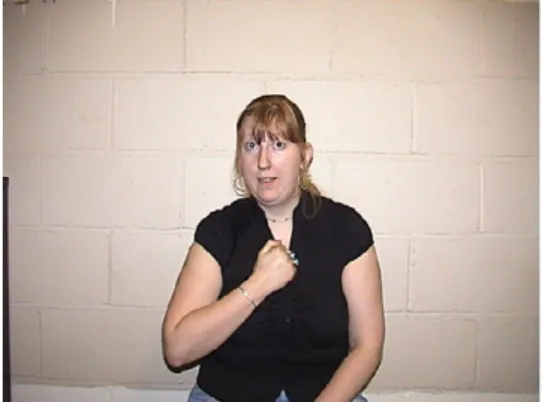
Signs can be decomposed into a set of minimal, meaningless units, including the features: of hand configuration, movement and place of articulation (seeBrentari, 1998andSandler, 1989for more details). Hand configuration (more commonly ‘handshape’) describes the extension or flexion of one or more fingers and the orientation of the hand relative to the body, and can be described in terms of a hierarchy of complexity, where the ‘simplest’ handshapes involve the fewest number of features (selection of fingers, contact between fingers, etc.). For example, the handshape inFig. 1(MY in BSL) involves the full flexion of all fingers. The same handshape can be found in BROTHER, CORRECT, SOVIET UNION, NUT, etc.1
Although sign languages are often described as ‘manual’ languages, multiple channels are used. The hands are the major articulators and their configuration, movement, and arrangement in space provide most lexical and grammatical information. However, other articulators are also involved. Mouth actions include mouthings, which provide lexical information derived from spoken language forms, while mouth gestures are also used for adverbials and echo phonology (Woll, 2001). The role of the voice in spoken language as a carrier of affect, intonation and prosodic structure is undertaken by the face, head and body. The eyes, head and body also indicate semantic and discourse roles (see role-shift below), with their movements correlating with lexical, grammatical and discourse features (Sutton-Spence and Woll, 1999).
The resources of the visual-gestural modality appear to allow more frequent iconicity in sign language lexicons in comparison to spoken languages (Taub, 2001; Mandel, 1977). A
Fig. 1. Still image of sign with the handshape A.
1Handshapes are conventionally referred to using labels from the American 1-handed manual alphabet. Signs are
2. Verb typology and classifiers
There are three basic classes of verbs in European sign languages: plain verbs, agreeing verbs, and spatial verbs. Classifiers are found only in spatial verbs, but a brief introduction will be given to all three types.
2.1. Plain verbs
Plain verbs undergo relatively little modification and do not move through space to show grammatical information. Examples in BSL include: RIDE-A-BICYCLE, LOVE, RESEARCH, RUN, SMOKE, THINK, and UNDERSTAND. Many plain verbs are made using the body as the location (‘‘body-anchored’’).
2.2. Agreement verbs
Agreement verbs allow the inclusion of information about person and number of the subject and object. Information about who is carrying out the action, and who or what is affected by the action is shown by changes in movement and orientation of the verb. The start and end locations of the verb ‘‘agree’’ with the locations assigned to the person and number of the agent/subject and/or the patient/object.
Examples of agreement verbs in BSL are: ASK, GIVE, TELL, TELEPHONE, TEASE, CRITICISE, BLAME, FILM (-by-camera) and SAY-NO-TO.
2.3. Spatial verbs
These include verbs of movement and location and are sometimes called ‘classifier verbs’. They use topographic space, and rather than inflecting for person or number they give information about the path, trajectory, speed and location. The movement and location of these spatial verbs are ‘‘isomorphic’’ with the real world. They also provide information about the class of noun moved or located by means of classifiers which comprise the handshape element in these verbs. Examples in BSL include RUN-DOWNSTAIRS, GO-TO, DRIVE-TO, PUNCH-(someone), SHAVE-(somewhere), CARRY-BY-HAND, or PUT-(somewhere). In the verb CARRY, the handshape varies according to what is being carried (e.g., BAG, CARRY-BABY or CARRY-BOX). In all examples of spatial verbs, information is provided obligatorily about the location of a referent, where it moves from and to, how fast it moves, and what semantic class it belongs to.
Perspective shifts form another prominent feature in sign languages. The words, actions and thoughts of characters can be described through direct discourse. This has been referred to in the sign linguistics literature as ‘role-shift’ (Loew, 1984); ‘referential shift’ (Emmorey and Reilly, 1998) and ‘constructed action’ (a particular form of role shift:Metzger, 1994; Winston, 1995). The example in (1) andFig. 2shows a user of Nicaraguan Sign Language describing the actions of a person through both signs and role-shift (RS).
(1) WOMAN WALK-ELEGANTLY (RS) PLACE-MONEY (RS) LET-FALL (RS) ‘The rich lady hands over some money but lets a bundle of notes fall without realising it’
2.4. Classifiers
The term classifier as used in the linguistic analysis of sign languages such as BSL, ASL or Sign language of the Netherlands (SLN) stems from its use in spoken language linguistics (cf. Craig, 1986). Classifiers have been reported to occur in virtually all sign languages, from all regions of the world, with rare exceptions (Nyst, 2004). This is in striking contrast to the more limited distribution of classifiers cross spoken languages. Although different analyses have been offered, classifiers in the literature on the linguistics of spoken languages, are morphemes that indicate semantic class of items belong. Predicate classifiers (Allan, 1977) are the category of spoken language classifier to which sign language classifiers have been compared to most often. An example is shown in (2) where the part of the predicate meaning ‘collection’ specifies the characteristics of the referent and the class of object (flat, flexible, in a pile, etc.) to which it belongs.
(2) be´e´so` sı`-nı`l
money PERF-lie: collection ‘A pile of change is lying there’
These specialized grammatical elements form constituents with certain types of noun phrases with the choice of classifier determined by the semantic characteristics of the head noun (Trask, 1993). Across languages that have classifiers, the basis of classification is diverse, including classification in terms of shape, size, colour, movability, animacy, status and so on, but in all cases, classifiers denote some salient, perceived or imputed characteristic of the entity to which the associated noun refers (Allan, 1977). While there is some disagreement in the spoken language linguistics literature on the use of the term, this lack of consensus is much more profound in current research on classifiers in sign languages (seeEmmorey, 2003). Constructions
shape of the hand represents the shape of the referent class (e.g., in BSL a G-handshape (an index finger point) can represent PERSON, PENCIL, TOOTHBRUSH or TUBE-TRAIN 2. Handling/instrument classifiers show the configuration of the hand as it moves or uses an
object or object part (e.g., in BSL an F-handshape (like an ‘OK’ gesture) can refer to (holding) a sheet of paper.
3. Size and shape specifiers (SASS) (also called extension classifiers) trace the shape of an object (e.g., in BSL a G-handshape (index finger extended) may be used to draw a circle. 4. In body and body part classifiers, the hands or other body parts are used to refer to body parts of
humans or other animates (e.g., a B handshape (flat hand) can represent a seal’s flippers). Some examples of classifiers are shown inFig. 3.
Classifiers can also describe spatial relations in terms of a correspondence between real-world entities and an array represented in sign space as a spatial map (see Morgan et al., this issue).
3. Looking at classifiers from converging perspectives
The study of classifiers is interesting for mainstream linguistics and psychology because they contain many levels of complex linguistic and conceptual structure packed together in one ‘umbrella’ form. Classifiers can be studied at the level of phonology, syntax, semantics, morphology and discourse (as the papers in this issue do), as well as the interaction between these different levels. Additionally we need to explore how classifiers interact with other linguistic devices such as role-shift or verb agreement. Finally it is important to compare classifier use in different sign languages and among various populations of signers with different experiences. Research on this last topic is briefly reviewed in this section.
3.1. Child signers
There are few studies of classifier acquisition in the literature (seeKantor, 1980; Schick, 1990;
Supalla, 1982). Developmental data are incomplete but in general describe a prolonged
developmental timetable. Native signing children were reported to start using the ASL classifier system from 4;6, although initially with errors (Schick, 1990). In two handed classifier constructions, where one handshape represents the figure and the other the ground, the handshape for figure is generally semantically appropriate, although there are frequent omissions of ground handshapes (e.g., the B-handshape representing a TABLE-SURFACE is omitted in CUP-ON-TABLE). Any difficulties in selecting appropriate classifiers disappear by the age of 5–6 years but the complex syntactic environments within which classifiers appear (verbs of motion and location) may continue to cause specific problems for the child.
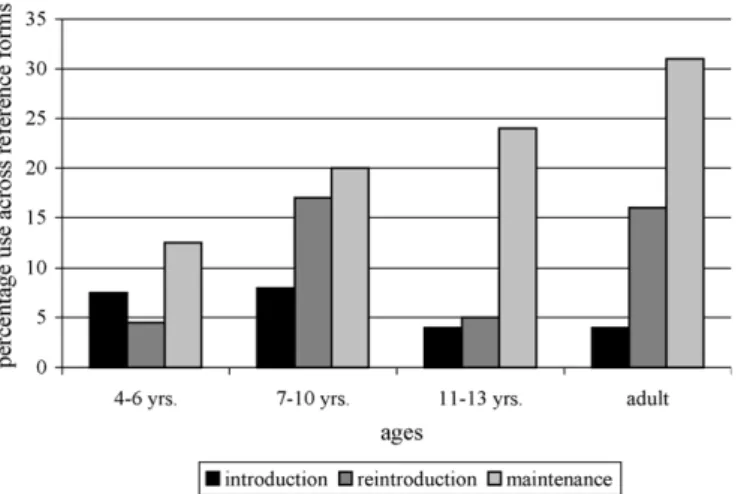
Other studies have looked at children’s use of classifiers in discourse. InMorgan and Woll (2003)reference forms appearing in signed narratives were coded for whether they introduced, reintroduced, or maintained reference to a character. In adult signed discourse nearly 1/3 (31%) of the total number of tokens for reference maintenance used whole entity classifiers, although only 4% of the total number of reference introductions used this device.
This pattern contrasts with the use of classifiers in narratives produced by 12 deaf native and near-native signing children ages 4–13 years old (seeFig. 4). The youngest children (4–6-year-olds) used whole entity classifiers markedly less for maintenance than the adult signers (12.5% of total reference maintainers); this use increased with age (20% for 7–10-year-olds, and 24% for the 11–13-year-old group).
Control of the pragmatic role of the whole entity classifier and referential shift in discourse is gradually developed. Young children may use these constructions correctly at the sentential level, but fail to use them appropriately in relation to their referential function in discourse.
3.2. Impairments in adult signers and neuro-cognitive studies of classifiers
Emmorey et al. (1995)andEmmorey (1996)have reported a hearing native ASL signer, DN,
who had impairments in producing and comprehending simple ASL commands involving classifiers, for example ‘place the pen on the book’ as a result of right hemisphere damage. No such impairment was evident when the task was delivered in English, where the spatial relation is encoded using the preposition ‘on’. She was unimpaired in her comprehension and generation of ASL sentences involving spatial verbs (such as COME-TO; BRING), which may make less topographic use of space than representations of the locations of objects. Emmorey reported another patient with right hemisphere damage who shows a similar pattern to DN. AR was impaired at matching the location of a classifier in sign space with the position of the referent object in a picture, but not in her comprehension of ASL spatial prepositions such as ON and IN. Signers with left hemisphere damage showed the reverse pattern; impaired comprehension of prepositions but not classifiers (Emmorey, 2002).
Fig. 4. Adult and child use of object/semantic classifiers as a percentage of total number of reference forms across each referential function.
Given that classifier constructions are topographic representations; that is, the location and orientation of the classifier must be analysed correctly to successfully interpret the sentence, these case studies suggest that topographically organised signed sentences may require right hemisphere (specifically, parietal lobe) processing.
A recent study of non-impaired adults explored the localisation of processing of topographic and non-topographic sentences using fMRI (MacSweeney et al., 2002). Sentences were presented to native signers (hearing and deaf) and, translated into English, to hearing non-signers. Processing of the BSL topographic sentences with classifiers activated left parietal regions not normally utilised for spoken language processing, rather than the right parietal regions which the authors had hypothesised would be used. The authors suggest that simple comprehension of topographic sentences may require left parietal regions to a greater extent than right. However, mapping the linguistic information to or from another framework, such as a visual scene, may further recruit the functions of the right hemisphere. The increased demands of discourse, where referents’ locations need to be maintained across several sentences, may also place greater demands on right hemisphere processing resources. There are therefore two conclusions: topographic sentences require processing by brain regions specialised for spatial processing which are not normally used for linguistic processing. However, these are left hemisphere areas proximal to those used for spoken language and not right hemisphere areas used for non-linguistic visual-spatial processing.
Atkinson et al. (2002) described the case of an individual (‘‘Heather’’) who is congenitally deaf and who has a developmental visual-spatial disorder. Her profile resembles that of Williams Syndrome: she presents as a highly fluent signer, but with severe non-linguistic visual-spatial processing impairments. Within the linguistic domain, she shows consistent impairment in the use of spatial verbs. She deals with some of these difficulties by choosing English-like structures and a fixed sign order resembling English, and by using prepositions rather than classifiers.
Heather is able to understand the use of simple placement and classifiers when used by others and has some knowledge of how to produce these structures individually. However, she has severe problems in integrating these structures to show the spatial relationships between referents in topographic space. Where she does use classifiers these are often bizarre, with no recognition of the need for spatial arrangement in signing space.
Language acquisition data reveal how children build up and impose linguistic structure (e.g.,
Supalla, 1982) on their developing language systems. Comparative studies of children’s
acquisition of spoken languages with classifiers (e.g., Chinese or Tzeltal) are needed in order to understand the universal and language-specific features in sign language acquisition. Studies of developmental and acquired language impairments as well as the use of fMRI and other techniques with signers is beginning to reveal how the processing of classifiers depends on intact linguistic and non-linguistic visuo-spatial cognition.
4. Final remarks
Research on sign languages can contribute greatly to current theoretical debates in linguistics. Much more research will be required on sign language structure at all levels of linguistic organisation, as well as more studies of the use of sign languages and classifiers across different linguistic contexts and in different signing populations before we can come to a definitive answer to what sign language classifiers really are. The papers in this volume will add to current mainstream linguistic research as well as provide valuable cross-modality insights into how language functions when the demands of articulation and perception radically shift.
Emmorey, K., 2003. Perspectives on Classifier Constructions in Sign Language. Erlbaum, Mahwah, NJ.
Emmorey, K., Lillo-Martin, D., 1995. Processing spatial anaphora: referent reactivation with overt and null pronouns in American Sign Language. Language and Cognitive Processes 10, 631–664.
Emmorey, K., Corina, D., Bellugi, U., 1995. Differential processing of topographic and referential functions of space. In: Emmorey, K., Reilly, J. (Eds.), Language, Gesture, and Space. Erlbaum, Hillsdale, NJ, pp. 43–62.
Emmorey, K., Reilly, J., 1998. The development of quotation and reported action: conveying perspective in ASL. In: Clark, E. (Ed.), The Proceedings of the Twenty-ninth Annual Child Language Research Forum. CSLI Publications, Stanford, CA, pp. 81–90.
Kantor, R., 1980. Communicative interactions: mother modification and child acquisition of American Sign Language. Sign Language Studies 11 (36), 233–282.
Liddell, S.K., 2003. Grammar, Gesture, and Meaning in American Sign Language. Cambridge University Press, Cambridge.
Loew, R., 1984. Roles and reference in American Sign Language: a developmental perspective. Unpublished doctoral dissertation, University of Minnesota.
MacSweeney, M., Woll, B., Campbell, R., Calvert, G., McGuire, P., David, A., Simmons, A., Brammer, M., 2002. Neural correlates of British Sign Language comprehension: spatial processing demands of topographic language. Journal of Cognitive Neuroscience 14 (7), 1064–1075.
Mandel, M.A., 1977. Iconic devices in American Sign Language. In: Friedman, L.A. (Ed.), On the Other Hand: New Perspectives on American Sign Language. Academic Press, New York, pp. 57–107.
Meier, R.P., 1990. Person deixis in American Sign Language. In: Fischer, S.D., Simp, P. (Eds.), Theoretical Issues in Sign Language Research, vol. 1: Linguistics, International Conference on Theoretical Issues in Sign Language Research. University of Chicago Press, Chicago, London, pp. 175–190.
Meier, R.P., 2002. The acquisition of verb agreement: pointing out arguments for the linguistic status of verb agreement in signed languages. In: Morgan, G., Woll, B. (Eds.), Directions in Sign Language Acquisition. John Benjamins, Amsterdam, pp. 115–142.
Metzger, M., 1994. Constructed dialogue and constructed action in American Sign Language. In: Lucas, C. (Ed.), Sociolinguistics in Deaf Communities. Gallaudet University Press, Washington, pp. 255–271.
Morgan, G., Woll, B., 2003. The development of reference switching encoded through body classifiers in British Sign Language. In: Emmorey, K. (Ed.), Perspectives on Classifier Constructions in Sign Languages. Lawrence Erlbaum Associates, Mahwah, NJ, pp. 297–310.
Nyst, V., 2004. Verbs of motion in Adamorobe Sign Language. In: Poster presented at TISLR 8 Barcelona, September 30– October 2. Programme and Abstracts (International Conference on Theoretical Issues in Sign Language Research, vol. 8), 2004, pp. 127–129.
Sandler, W., 1989. Phonological Representation of the Sign: Linearity and Nonlinearity in Sign Language Phonology. Foris, Dordrecht.
Schick, B., 1990. The effects of morphosyntactic structure on the acquisition of classifier predicates in ASL. In: Ceil, C.L. (Ed.), Sign Language Research. Theoretical Issues. Gallaudet University Press, Washington, pp. 358–374. Senghas, A., Kita, S., O˝ zyu˝rek, A., 2004. Children creating core properties of language: evidence from an emerging sign
language in Nicaragua. Science 305, 1779–1782.
Slobin, D., Hoiting, N., Kuntze, K., Lindert, R., Weinberg, A., Pyers, J., Anthony, M., Biederman, Y., Thumann, H., 2003. A cognitive/functional perspective on the acquisition of ‘classifiers’. In: Emmorey, K. (Ed.), Perspectives on Classifier Constructions in Sign Languages. Lawrence Erlbaum Associates, Mahwah, NJ, pp. 297–310. Stokoe, W., Casterline, D., Croneberg, C., 1965. A Dictionary of American Sign Language on Linguistic Principles.
Supalla, T., 1982. Structure and acquisition of verbs of motion and location in American Sign Language. Unpublished Doctoral thesis, University of California, San Diego, San Diego.
Supalla, T., 1986. The classifier system in American Sign Language. In: Craig, C. (Ed.), Noun Classes and Categorization. Benjamins, Amsterdam, pp. 181–214.
Sutton-Spence, R., Woll, B., 1999. The Linguistics of British Sign Language: An Introduction. Cambridge University Press, Cambridge.
Taub, S.F., 2001. Language from the Body: Iconicity and Metaphor in American Sign Language. Cambridge University Press, Cambridge.
Tervoort, B., 1959. Language development in young deaf children. In: Proceedings of the 39th Convention of the American Instructors of the Deaf, Colorado Springs, pp. 120–124.
Trask, R.L., 1993. A Dictionary of Grammatical Terms in Linguistics. Routledge, New York.
Winston, E., 1995. Spatial mapping in comparative discourse frames. In: Emmorey, K., Reilly, J. (Eds.), Language, Gesture and Space. Lawrence Erlbaum Associates, Cambridge, pp. 87–114.
Woll, B., 2001. The sign that dares to speak its name: echo phonology in British Sign Language. In: Boyes Braem, P., Sutton-Spence, R. (Eds.), The Hands are the Head of the Mouth: the Mouth as Articulator in Sign Language. International Studies on Sign Language and Communication of the Deaf, vol. 39. Signum, Hamburg, pp. 87–98.