Available at:
http://hdl.handle.net/2078.1/151995 [Downloaded 2019/04/19 at 09:25:00 ]
Bukowski, Henryk
Abstract
Perspective-taking (PT) performance is widely considered and assessed as a static and one-dimensional ability. This thesis provides evidence across 4 studies that PT performance fluctuates and is underpinned by two dimensions: (1) the ability to handle conflicts between our egocentric perspective and another person’s perspective and (2) the relative priority given to the processing of the egocentric perspective over another person’s perspective. We have highlighted the effects of task instructions, emotions, and motivation on PT performance. We also found that each of the two dimensions underlying PT can be specifically affected or associated with factors such as guilt, shame, narcissism, and self-reported PT habits. Finally, we found that individuals strongly vary independently on both dimensions so that some people are more or less efficient at perspectives conflict handling and others are altercentric (i.e. prioritizing the other person’s perspective) or egocentric perspecti...
Document type : Thèse (Dissertation)
Référence bibliographique
Bukowski, Henryk. What influences perspective taking ? A dynamic and multidimensional approach. Prom. : Samson, DanaWhat influences perspective taking?
A dynamic and multidimensional approach
Henryk Bukowski
Promotrice
Dana Samson (UCL) Comité d’encadrement Bruno Rossion (UCL) Nicolas Vermeulen (UCL)
Thèse présentée en vue de l’obtention du grade de Docteur en sciences psychologiques et de l’éducation
Comité d’accompagnement et jury Marcel Brass (UGent)
Valérie Goffaux (UCL) Bruno Rossion (UCL) Nicolas Vermeulen (UCL)
Tables of contents
Tables of contents 5 Résumé 11 Abstract 11 Remerciements 13 General introduction 171. Are adults flawless perspective-takers? 18
2. What influences adults’ performance in taking another person’s perspective? 20
3. Beyond a static view 22
4. Beyond a one-dimensional view 23
5. Visual perspective taking 27
6. The dot visual perspective-taking task 29
7. Outline of the thesis 30
What triggers the computation of what other people are looking at? Revisiting the
automaticity hypothesis 35 1. Introduction 35 2. Experiment 1 38 2.1 Method 39 2.1.1 Participants 39 2.1.2 Apparatus. 39
2.1.3 Stimuli and procedure. 39
2.2 Result 40
2.2.1 Reaction times. 40
2.2.2 Error rates. 41
3.1 Method 42
3.1.1 Participants. 42
3.1.2 Apparatus. 42
3.1.3 Stimuli and procedure. 42
The gaze cueing task. 42
The VPT task. 43
3.2 Result 45
3.2.1 The VPT task. 45
Reaction times. 45
Error rates. 46
3.2.2 The gaze cueing task. 46
Reaction times. 46 Error rates. 47 3.2.3 Tasks comparison. 47 4. Experiment 3 48 4.1 Method 48 4.1.1 Participants. 48 4.1.2 Apparatus. 48
4.1.3 Stimuli and procedure. 49
The gaze cueing task. 49
The VPT task. 49
4.2 Result 50
4.2.1 The VPT task. 50
Reaction times. 50
Error rates. 51
4.2.2 The gaze cueing task. 52
Reaction times. 52
Error rates. 53
5. General discussion 54
6. Conclusion 56
7. Appendix 1 58
7.1 Results at the VPT task in Experiment 2 58
7.1.1 Reaction times. 58
7.1.2 Error rates. 58
7.2 Results at the VPT task in Experiment 3 59
7.2.1 Reaction times. 59
7.2.2 Error rates. 59
Effects of guilt, anger, and shame on perspective taking 61
1. Introduction 61
2.1 Method 64
2.1.1 Participants. 64
2.1.2 Material and procedure. 65
Initial social interaction. 65
Emotional induction with the Card Picking Game. 65
Visual perspective-taking task. 66
Prosocial behaviour assessment with the Raffle task. 67
Induction efficacy. 68
Debriefing. 68
2.2 Results 68
2.2.1 Induction efficacy. 68
2.2.2 Equivalence of participants’ characteristics across the three experimental
conditions. 70
2.2.3 Visual perspective-taking task. 70
Reaction times. 70 Error rates. 72 2.2.4 Raffle task. 73 2.3 Intermediary discussion 74 3. Experiment 2 75 3.1 Method 75 3.1.1 Participants. 75
3.1.2 Material and procedure. 75
Visual perspective-taking task, raffle task, induction efficacy and debriefing. 76
3.2 Results 76
3.2.1 Induction efficacy. 76
3.2.2 Equivalence of participants’ characteristics between the two experimental
conditions. 77
3.2.3 Visual perspective-taking task. 77
Reaction times. 77
Error rates. 78
3.2.4 Raffle task. 79
4. General discussion 79
4.1 The effects of emotional state on perspective taking 80 4.2 The effects of emotional state on prosocial behaviour 83
5. Conclusion 84
6. Appendix 1 86
6.1 Guilt replication experiment 86
6.1.1 Method. 86
Participants. 86
Material and procedure. 86
6.1.2 Results. 86
Induction efficacy. 86
7. Supplementary information 88
7.1 Implementation of the Card Picking Game 88
7.2 Induction efficacy in Experiments 1 and 2 88
7.2.1 Experiment 1. 89
7.2.2 Experiment 2. 90
Narcissists do not lack perspective-taking abilities 93
1. Introduction 93
2. Method 95
2.1 Participants 95
2.2 Stimuli and Procedure 95
2.3 Data analyses 97
3. Results 98
3.1 Narcissism and perspective-taking performance 98
3.1.1 Reaction times. 98
3.1.2 Error rates. 99
3.2 Correlations 100
4. Discussion 102
5. Conclusion 104
Beyond good versus poor perspective-takers: A two-dimensional approach to
characterize perspective-taking performance 107
1. Introduction 107
2. Method 112
2.1 Participants 112
2.2 Instruments 113
2.2.1 Visual perspective-taking task. 113
2.2.2 Dispositional perspective taking. 114
2.3 Data analyses 114 2.3.1 Indexes computation. 114 2.3.2 Cluster analyses. 115 2.3.3 Regression analyses. 115 2.3.4 Tests of independence. 115 3. Results 116
3.1 One-dimensional cluster analysis. 116
3.2 Two-dimensional cluster analysis. 117
3.3 Predicting self-reported everyday life perspective-taking habits with a
one-dimensional versus two-one-dimensional measures. 119
3.4 Comparison of the one-dimensional profiles and the two-dimensional profiles.120 3.5 Distribution of profiles across emotion induction conditions. 121
4. Discussion 122
5. Conclusion 125
6. Appendix 1 127
Summary, discussion, & conclusion 129
1. Summary 129
1.1 Perspective taking is a dynamic ability 129
1.2 Perspective taking is a multidimensional ability 130
2. Discussion 132
2.1 Generalizability of our findings 132
2.2 Extending the two-dimensional account outside visual perspective taking 133 2.3 A salience account of the explicit – implicit PT division 135 2.4 Does automatic perspective taking reflect mentalizing? 137
2.5 Beyond two dimensions 138
2.6 Are the two dimensions independent? 141
2.7 Perspective taking under emotion 142
2.8 Future studies 143
3. Conclusion 144
References 146
Appendix A: What does reflect the high difficulties to judge from one perspective over
another? 171
Appendix B: Effects of sadness and happiness on visual perspective taking and gaze
cueing 173
1.1 Method 173
1.1.1 Participants. 173
1.1.2 Material and procedure. 173
Emotional induction. 174
Visual perspective-taking task. 174
False Belief task. 175
Exit questionnaire. 175
2. Experiment 2 175
2.1 Method 175
2.1.1 Participants. 175
2.1.2 Material and procedure. 176
Questionnaires prior emotional induction. 176
Visual perspective-taking task. 176
Gaze cuing task. 176
Résumé
Nos performances de prise de perspective (PdP) sont largement considérées et mesurées comme une capacité statique et unidimensionnelle. Cette thèse a pour objectif de démontrer que nos performances de PdP fluctuent et sont sous-tendues par deux dimensions : (1) notre capacité à gérer les conflits entre notre perspective égocentrique et celle d’une autre personne et (2) la priorité relative donnée au traitement de notre perspective égocentrique par rapport à celle d’une autre personne. Nous avons mis en évidence l’influence des instructions, des émotions, et de la motivation sur nos performances de PdP. Nous avons également montré que chacune des dimensions peut être spécifiquement influencée ou associée avec des facteurs tels que la culpabilité, la honte, le narcissisme, et les habitudes auto-rapportées de PdP. Enfin, nous avons montré que les individus diffèrent fortement les uns des autres sur les deux dimensions de telle sorte que certaines personnes sont plus ou moins aptes à gérer les conflits de perspectives et d’autres sont particulièrement altercentriques (.i.e. qui traitent en priorité le point de vue de l’autre) ou égocentriques. Globalement, au travers de notre étude de ce qui influence nos performances de PdP, nous avons démontré la pertinence théorique et l’intérêt d’étudier la PdP comme une capacité dynamique et multidimensionnelle.
Abstract
Perspective-taking (PT) performance is widely considered and assessed as a static and one-dimensional ability. This thesis provides evidence across 4 studies that PT performance fluctuates and is underpinned by two dimensions: (1) the ability to handle conflicts between our egocentric perspective and another person’s perspective and (2) the relative priority given to the processing of the egocentric perspective over another person’s perspective. We have highlighted the effects of task instructions, emotions, and motivation on PT performance. We also found that each of the two dimensions underlying PT can be specifically affected or associated with factors such as guilt, shame, narcissism, and self-reported PT habits. Finally, we found that individuals strongly vary independently on both dimensions so that some people are more or less efficient at perspectives conflict handling and others are altercentric (i.e. prioritizing the other person’s perspective) or egocentric perspective-takers. Overall, while investigating what influences PT performance, we demonstrated the theoretical relevance and usefulness of studying PT as a dynamic and multidimensional ability.
Remerciements
Quel parcours pour en arriver à ce stade de ma carrière de chercheur ! Beaucoup de projets et d’embûches, mais surtout beaucoup de rencontres ! Vous êtes tant de personnes à m’avoir directement ou indirectement aidé à tracer mon chemin que des remerciements méthodiques s’imposent pour concilier exhaustivité et concision. Je souhaite cependant remercier spécifiquement Dana Samson. La richesse de ses réflexions, sa patience, sa gentillesse, et son grand sens de la pédagogie m’ont énormément aidé à réaliser cette thèse et à me réaliser en tant que chercheur.
Légende : Ambiance de Travail (AT), Assistance Logistique et Administrative (ALA), Assistance Statistique (AS), Conseils Professionnels (CP), Inspiration Professionnelle et/ou Pédagogique (IPP), Soutien Moral (SM), Soutien Professionnel (SP), Relecture (R).
Adélaïde de Heering (AT,CP) Adriano Booremanse (AT++) Agnes Jasinska (AT)
Agnesa Pillon (AT,AS,CP) Alexandre Heeren (AT++,CP+) Alexandre Zénon (CP+) Alexy Assaf Beck (AT) Alice De Visscher (AT++) Anand Ramamoorthy (AT++) André Mouraux (AT,SP) Andrew Surtees (AT,CP,SP) Antonio Damasio (IPP++,SP) Aude Poncin (AT)
Aurélie Biervoye (AT) Benvenuto Jacob (ALA++) Bernand Hanseeuw (AT,AS) Brigitte Champagne (ALA) Bruno Rossion (AT,CP,SP++,IPP) Caroline Ego (AT)
Caroline Michel (AT++) Clément Letesson (AT) Corentin Jacques (AT) Dana Samson
(AT,AS,CP,SM,SP++,IPP++,R) Daniela Ebner (AT+)
Dave Herman (AT+) Delphine Grynberg (SP) Diana Miletich (AT,R)
Dominique Hougardy (ALA++,AT) Elisabeth Colon (AT)
Elodie Lerens (AT++,ALA,SM++) Emily Delespaux (AT)
Erwan Guillery (AT+) Evelyne Treinen (AT,SP) Frank Van Overwalle (SP) Gaëlle Meert (AT,AS,R) Geert-Jan Will (AT) George Mangun (SP)
Gilles Vannuscorps (AT++,SP,CP,SM) Gloria Wan (ALA)
Goedelle Van Belle (AT) Guy Lories (IPP,CP) Hanna Damasio (IPP,SP) Isabelle Legrain (ALA++) Jean-Louis Thonnard (AT) Jessica Wang (AT,SP) Joan Liu (AT)
Karl-Andrew Woltin (CP,SP) Laétitia Leloup (AT,SM) Laurence Dricot (AT+,AS++) Lei Liew (AT++,ALA,SP,CP) Lisa Aziz-Zadeh (AT,SP+,CP) Lisa Quenon (AT)
Lize De Coster (AT) Marcel Brass (SP,CP) Mariane Frenay (CP) Marie Alsamour (AT) Marie Gryspeert (AT)
Martin Edwards (AT,CP, ALA) Martine Janssens (ALA)
Massimo Silvetti (IPP,CP) Mauro Pesenti (AT,IPP) Maxime Résibois (AT+,AS,SP) Meike Ramon (AT,SP)
Michael Andres (AT,CP) Mona Sobhani (AT) Moïra Mikolajczak (SP,CP) Nicolas Masson (AT++) Nicolas Michaux (AT++)
Nicolas Vermeulen (AT,CP,SP,IPP) Noémie Baudoin (AT)
Olivier Corneille (SP,CP) Olivier Luminet (SP,CP) Pierre Maurage (AT,CP)
Pierre-Alexandre Klein (AT+,CP) Renaud Laguesse (AT++) Rodrigo Araneda (AT+) Rolando Jaumain (ALA) Savio Wong (AT)
Séverine Balon (AT) Silvia Bunge (SP) Stéphane Grade (AT++) Susan Lynch (ALA)
Susanne Quadflieg (AT,AS,CP,SP) Sylvie Nozaradan (AT+)
Terry Eskenazy (AT,CP,SP) Thomas Busigny (AT++) Tong Sheng (AT++,ALA,SP) Valérie Dehon (AT)
Valérie Dormal (AT) Valérie Goffaux (AT,CP,SP) Valéry Legrain (AT) Vilay Khandelwal (AT) Vincent Théate (AT++) Vincent Yzerbyt (SP) Xiaofei Yang (AT) Yolande Nivaille (ALA++)
Mis à part mes collègues, il est impératif que je remercie mes parents et beaux-parents pour leur compréhension et leur soutien inébranlable. Je suis particulièrement reconnaissant envers ma mère pour m’avoir donné les moyens d’atteindre (peut-être) mes ambitions. Je remercie également mes amis, frères, et ex-collocs (Aline, Alex, Anto, Cam, Jon, Laurent, Marine, Manu, Palo, Raph, Sim, Tad) pour avoir supporté mes horaires parfois nocturnes et mon manque de disponibilité et pour avoir malgré cela porté une oreille attentive durant les hauts et bas de ma thèse. Last but not least, je ne remercierai jamais assez Elodie pour m’avoir rejoint dans cette aventure et y avoir apporté tant de bonheur et de sagesse !
Chapter 1
General introduction
General introduction
We have – of course – no immediate experience of what other men feel; so the only way we can get an idea of what someone else is feeling is by thinking about what we would feel if we were in his situation … Adam Smith, The theory of moral sentiments, 1759
There is a world invisible to us. This world encompasses the intentions, desires, beliefs, and emotions of other human beings. We have no access to what others are thinking nor any means to ascertain that they are actually thinking. When did we realize that this invisible world exists? When did we start to understand that other people’s sounds and movements are ruled by abstract representations such as intentions, beliefs, and knowledge? The answer is still far from clear, because we have no access to what children are thinking (Heyes, 2014a; Scholl & Leslie, 2001; Wellman, Cross, & Watson, 2001). Nevertheless, developmental psychologists have designed tests to assess whether children impute mental states to other social agents. I will present the two historically most famous tests. The first test is called the False Belief task (Wimmer & Perner, 1983) and consists in asking children where another child named Maxi will look for his chocolate after they have seen that, while Maxi was away, his mother moved the chocolate from where Maxi had put it (location A) to another place (location B). To pass this test, children must indicate that Maxi will erroneously go to location A to find his chocolate despite the fact that they know that the chocolate is in location B. The second test is called the Three Mountains task (Piaget & Inhelder, 1948) and consists in asking children facing a miniature model of three mountains how a doll sitting at the other side of the model sees the three mountains. To pass this test, children must pick the card depicting how the three mountains look from the doll’s differing visual perspective. Successful performance in these two tasks is assumed to reflect the ability to impute mental states and to understand that others may have mental experiences of their own that are thus different from what we know or see from our egocentric perspective. This ability has received several names depending on the fields of the researchers who have studied it. Theory of mind (ToM), perspective taking (PT), mentalizing, folk psychology, and cognitive empathy are, in descending order, the terms most often used to refer to this ability. In practice and in this thesis, ToM refers to the general ability to ascribe mental states to others (Premack & Woodruff, 1978) whereas PT refers to the ability to non-egocentrically ascribe mental states to others. ToM and PT thus particularly refer to the inferential process and the capacity to decentre from the egocentric perspective, respectively. Throughout my thesis, I will present my work that is essentially related to PT but I will also often refer to ToM as an umbrella concept that includes PT as a specific ability among others. Finally, a close neighbour to PT and ToM is empathy in the sense that empathy allows to feel and understand the emotional state of another person (Preston & de Waal, 2002). However, PT and ToM are not about feeling but understanding
and refer to the understanding of all mental states rather than emotional states only. The division between affective and cognitive empathy is sometimes adopted to clearly dissociate the ability to feel another person’s emotional state (also referred to as emotional contagion) and the ability to understand another person’s emotional state, respectively (Shamay-Tsoory, Aharon-Peretz, & Perry, 2009).
If a child performs successfully in either the False Belief task or the Three mountains task, it is assumed that the child has acquired a mature ToM ability. However, tasks assessing mental state inference have varying orders of sophistication and assess different facets of ToM. Thus, while six-year old children have good performance in the False Belief task, they may have poor performance in another ToM task. For example, in a task called Strange Stories (Happé, 1994), six-year-old children face more difficulties when asked what a war prisoner who wants to mislead the enemy about the location of his army will say if he knows that the enemy knows he will be lying. Accordingly, at this age ToM and PT abilities are still developing and it is not until adulthood that successful performance in complex tasks is expected. Adulthood is thus considered as the end point of ToM and PT development.
1.
Are adults flawless perspective-takers?
For decades, in order to study the development of children’s PT ability, developmental psychologists designed tasks in which adults systematically displayed ceiling performance. Studies from developmental psychology have consistently shown that adults are able to succeed on relatively complex PT tasks. This observation was not deemed surprising given that adulthood was considered as the end point of PT development. However, researchers from social psychology have shown that adults do not always fully exploit their full-fledged PT ability and make social judgments that are egocentrically biased. This egocentric bias has received several names such as the curse of knowledge, the illusion of transparency, or the false consensus effect. The illusion of transparency describes adults’ tendency to overestimate how transparent to others are their mental states such as their emotions (Gilovich et al., 1998) and their preferences in negotiations (Boven, Gilovich, & Medvec, 2003). The curse of knowledge describes adults’ failure to completely ignore privileged knowledge when asked to the take the perspective of a naïve person when making estimates concerning, for examples, the likelihood of historical events (Fischhoff, 1975), earnings of a company (Camerer, Loewenstein, & Weber, 1989), the sarcasm of a message (Keysar, 1994), the value of a company’s share (Keysar, Ginzel, & Bazerman, 1995), or the meaning of unfamiliar idioms (Keysar & Bly, 1995). The false-consensus effect describes adults’ tendency to overestimate the extent to which other people share their own characteristics, opinions and decisions such as the decision to contest a fine (Ross, Greene, & House, 1977) or their answers in a personality test (Krueger & Clement, 1994). Other similar biases in social psychology have been reported (Epley & Caruso, 2008; Royzman, Cassidy, & Baron, 2003) but they all describe adults’ tendency to rely on what they think or experience from their egocentric perspective to infer other people’s mental states.
It would therefore seem that adults are far from flawless perspective-takers. But why are we not always using our full-fledged PT ability? A dominant interpretation originates from the discovery that, to avoid effortful and lengthy thinking, humans often reason by making approximations, called heuristics (Tversky & Kahneman, 1974). Egocentric biases have been proposed to originated from the tendency to use two of these heuristics: the anchoring and the accessibility heuristics (Epley, Keysar, Van Boven, & Gilovich, 2004). Together, they refer to the tendency to rely on the most accessible source of information as a basis, or anchor, to make estimates about particular topics irrespectively of the relevance of the anchor (Tversky & Kahneman, 1974). For example, when asked to estimate the number of African countries in the United Nations, healthy adults tended to provide an estimate close to a random number they had just obtained on a wheel of fortune (Tversky & Kahneman, 1974). Applied to PT, the egocentric perspective is viewed as the most accessible source of information, which serves as an anchor for inferring others’ mental states.
In parallel to social psychology, interest for PT among healthy adults emerged also from cognitive psychology and psycholinguistics. The analysis of word utterances and eye-movements in real-time conversations and of reaction times (RTs) under time-pressured situations allowed to reveal subtle egocentric biases, which are often referred to as egocentric errors or egocentric interferences. For example, studies from cognitive psychology show that adults tend to be slower at judging what another person might perceive or think when what they experience or think from their egocentric perspective is conflicting with the other person’s perspective relatively to when perspectives are not conflicting (Apperly, Back, Samson, & France, 2008; Samson et al., 2010; A. D. R. Surtees & Apperly, 2012).
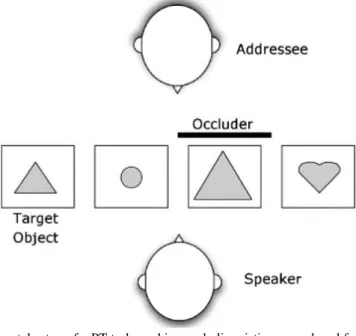
Similarly, studies from psycholinguistics show that adults often indicate objects to another person by referring to descriptions irrelevant to the addressee’s understanding (Heller, Gorman, & Tanenhaus, 2012; Horton & Keysar, 1996; Kaland, Krahmer, & Swerts, 2011; Lane, Groisman, & Ferreira, 2006; Wu & Keysar, 2007b) or that adults tend to look at objects that a speaker cannot see in response to a speaker’ reference to another object (see Figure 1; Barr, 2008; Hanna, Tanenhaus, & Trueswell, 2003; Keysar, Barr, Balin, & Brauner, 2000; Keysar, Lin, & Barr, 2003). In line with social psychologists, these findings have been interpreted as resulting from the natural use of the egocentric frame of reference to infer what others are talking about because it is a cognitively less costly strategy and because potential egocentric mishaps can be adjusted afterwards if needed (Keysar et al., 2000, 2003).
Figure 1. Experimental setup of a PT task used in psycholinguistics, reproduced from Wardlow Lane
et al. (2006). The participant is the speaker and he must ask the addressee to give him the small triangle while having privileged knowledge that there is also a big triangle. Note that in a similar setup used by Keysar et al. (2000) the participant is the addressee and the big triangle is hidden to the speaker’s (here called director) visual perspective.
To sum up, although adults have a full-fledged PT ability, there is a vast amount of findings showing that adults are not flawless perspective-takers because they are egocentrically biased. The dominant interpretation is that “One’s own perspective is typically immediate, automatic, and easy, whereas reasoning about another’s perspective is typically slow, deliberate, and difficult.” (Epley & Caruso, 2008). Critically, the theoretical consensus assumes that PT is a one-dimensional ability since the unique and key ability considered to underpin PT performance is the ability to adjust the egocentric mental state initially imputed to adequate it with a more plausible estimate of someone else’s mental state; this adjustment is cognitively effortful and therefore not always made (Epley et al., 2004; Gilovich & Savitsky, 1999; Tamir & Mitchell, 2010).
2.
What influences adults’ performance in taking another
person’s perspective?
Numerous studies from developmental psychology have investigated what factors could influence PT performance in children. These studies have highlighted that according to their differences in terms of age, country, socio-economical level, parenting practice, verbal ability, fantasy play, or executive functioning, children could have strikingly different PT performances (e.g., Carlson, Moses, & Breton, 2002; Farrant, Devine, Maybery, & Fletcher, 2012; Hughes et al., 2012; Taylor & Carlson, 1997; Wellman et al., 2001).
In contrast, the investigation of differences in PT among healthy adults originated essentially from social psychology and was essentially studied in relation to trait-like, or enduring, characteristics such as personality traits or behavioural tendencies. These studies assessed PT almost exclusively by means of questionnaires measuring self-reported perspective-taking habits. The most widely-used questionnaire on perspective taking is the Interpersonal Reactivity Scale (IRI; Davis, 1980). The IRI provides scores of agreement on several statements related to empathic experiences and habits, including 7 statements specifically related to PT (referred to as PT-IRI). For example, one of these 7 statements is “I try to look at everybody's side of a disagreement before I make a decision”. In the non-clinical population, PT-IRI scores are positively correlated with individual differences in measures of self-esteem (Davis, 1983), proneness to experience guilt (Joireman, 2004; Leith & Baumeister, 1998), prosocial behaviour (Carlo, Allen, & Buhman, 1999), propensity to forgive (Rizkalla, Wertheim, & Hodgson, 2008), age (O’Brien, Konrath, Grühn, & Hagen, 2013), the level of glutamate in the prefrontal cortex (Montag, Schubert, Heinz, & Gallinat, 2008), the likelihood of choosing the psychology major (Harton & Lyons, 2003) and the likelihood of reaching a deal in negotiations (Galinsky, Maddux, Gilin, & White, 2008). Furthermore, IRI-PT scores are negatively correlated with individual differences in measures of proneness to anger (Mohr, Howells, Gerace, Day, & Wharton, 2007), dispositional hostility (Loudin, Loukas, & Robinson, 2003; Richardson, Hammock, Smith, Gardner, & Signo, 1994), narcissism (Delič, Novak, Kovačič, & Avsec, 2011; Hepper, Hart, & Sedikides, 2014), avoiding attachment (Corcoran & Mallinckrodt, 2000), alexithymia (Grynberg, Luminet, Corneille, Grèzes, & Berthoz, 2010), destructive conflict resolution (Arriaga & Rusbult, 1998) and social dominance orientation (Pratto, Sidanius, Stallworth, & Malle, 1994).
In contrast to questionnaire studies, individual differences in PT performance measured through behavioural tasks in the non-clinical adult population are scarce: PT performance has been positively associated with executive functioning (working memory and inhibitory control; Brown-Schmidt, 2009; Lin, Keysar, & Epley, 2010; Wardlow, 2013), relationship satisfaction and closeness (Schröder-Abé & Schütz, 2011), and cultural interdependence (China vs. USA; Wu & Keysar, 2007a) and negatively associated with aging (T. P. German & Hehman, 2006), schizotypy (Langdon & Coltheart, 1999, 2001) and alexithymia (Wastell & Taylor, 2002). Irrespective of the method, however, given that PT was measured to predict scores on static trait-like characteristics or dispositions, it was implicitly assumed that PT itself was a static trait-like characteristic or disposition. In addition, individual differences have so far been captured through single scores of PT, where individuals could vary only along a one-dimensional continuum and could be classified as either poor or good perspective-takers.
The view that the ability to take another person’s perspective is static and one-dimensional seems however to be progressively more compromised in regard of some more recent findings. The findings compromising the view of PT as a static and one-dimensional ability are reviewed in turns in the two following sections.
3.
Beyond a static view
Research from developmental psychology has focused on the development of children’s PT abilities (i.e., what they are able to do) and, given the high diversity of tasks and task variations used, some researchers have looked at the influence of the PT tasks parameters as potential transient situational factors influencing PT performance. For example, a meta-analysis of children’s performance in the False Belief task revealed that, irrespectively of their age, the level of active engagement of children in the story and the level of salience of the protagonist’s false belief (e.g., whether it is stated in the test question that the protagonist has a belief or whether a thought bubble is drawn over the protagonist in the drawing version of False Belief test to indicate that the protagonist has a belief) significantly influenced children’s performance (Wellman et al., 2001)
In social psychology, PT performance has been theorized with regard to heuristics theory and therefore has been measured as a tendency (i.e., what healthy adults actually do usually; Tversky & Kahneman, 1974). Paradoxically, however, given the important focus on individual differences, very few studies looked at the influence of transient factors on adult PT performance. Nevertheless, the malleability of PT performance has been largely supported by demonstrations that PT performance can be altered following priming manipulations or direct PT instructions.
PT performance was found to be influenced under priming manipulations such as when priming a sense of high or low power (Galinsky, Magee, Inesi, & Gruenfeld, 2006), a low versus high social status (Rutherford, 2004), a focus on perceptual dissimilarities versus similarities (Todd, Hanko, Galinsky, & Mussweiler, 2011), or the benefits of multiculturalism versus colour-blindness (Todd & Galinsky, 2012).
Further evidence of malleability comes from the studies that exploited PT as an independent variable by explicitly instructing participants to make the effort of engaging in taking another person’s or another group’s perspective (for a review, see Todd & Galinsky, 2014). Accordingly, participants who received explicit perspective-taking instructions (versus no instruction or objective perspective instructions) before describing, watching, or reading about another person or group’s life or characteristics were found to provide less stereotypic descriptions (Dovidio et al., 2004; Ku, Wang, & Galinsky, 2010), to express more stereotypic descriptions or behaviours (Galinsky & Moskowitz, 2000; Galinsky, Wang, & Ku, 2008; Skorinko & Sinclair, 2013), to have more positive attitudes towards the other person or group (Batson, Polycarpou, Harmon-Jones, & Imhoff, 1997; Bruneau & Saxe, 2012; Finlay & Stephan, 2000; Vescio, Sechrist, & Paolucci, 2003), to show more positive implicit associations with other person or group (Todd, Bodenhausen, Richeson, & Galinsky, 2011; Todd & Burgmer, 2013), to be more likely to acknowledge inequalities or discriminations towards another group (Todd, Bodenhausen, & Galinsky, 2012), to be more willing to engage in contact with negatively-stereotyped or stigmatized individuals (C. S. Wang, Kenneth, Ku, & Galinsky, 2014), to more automatically imitate an out-group member’s movements (Müller et al., 2011), or to perceive another person or group as more
similar or close (Davis, Conklin, Smith, & Luce, 1996; Galinsky & Moskowitz, 2000; Laurent & Myers, 2011).
Altogether, empirical evidence from social psychology clearly supports the idea that PT performance is malleable but the influential factors investigated so far are experimental methods that do not reflect real-life transient factors; which therefore does not directly compromise the view that our everyday PT performance is stable, or static.
However, in psycholinguistics and cognitive psychology, a few recent studies have looked at three important transient situational factors: the cognitive resource availability of executive functions, the salience of egocentric information, and the overlap of information between perspectives. Firstly, in situations where participants performed a task taxing working memory or inhibitory control prior to or in parallel with a PT task, participants were found with poorer PT performance (Fennis, 2011; T. P. German & Hehman, 2006; Lin et al., 2010; Newton & de Villiers, 2007; Qureshi, Apperly, & Samson, 2010). Secondly, adults were found with poorer PT performance when increasing the salience of egocentric information (privileged knowledge) by increasing the motivation to conceal privileged information (Kaland et al., 2011; Lane et al., 2006; Lane & Liersch, 2012) or increasing the requirement to pay attention to egocentric information (Lane & Ferreira, 2008). Thirdly, Wu and Keysar (2007b) showed that increasing the degree of perceived overlap between the egocentric and another person’s visual perspective increased adults’ failure to not refer to privileged information. Altogether, these findings are informative about the underlying factors that may influence PT performance (and are discussed in the next section) but are relatively opaque to point out real-life situations through which PT performance may change.
Finally, the most direct demonstration that PT performance fluctuates in everyday life comes from two studies that looked at the impact of individuals’ emotional state on PT performance. The first study induced feelings of sadness or happiness and found poorer PT performance among the participants of the happiness induction condition (Converse, Lin, Keysar, & Epley, 2008). The second study induced feelings of guilt and shame and found better PT performance among the participants of the guilt induction condition (Yang, Yang, & Chiou, 2010).
To sum up, previous studies largely focused on individual differences or on manipulating PT through explicit instructions. Hence, very few studies have highlighted the dynamic nature of PT performance in the sense that one can have different PT performances from one everyday life situation to another and from one moment to another. This thesis aims to explore this new avenue of research.
4.
Beyond a one-dimensional view
Whereas in social psychology PT performance was thought to be determined uniquely by our ability to adequately adjust our initial reliance upon our egocentric perspective
(Epley et al., 2004; Gilovich & Savitsky, 1999; Tamir & Mitchell, 2010), multidimensional conceptions of PT had been proposed early on in developmental psychology. The most influential model has been formulated by Leslie (Leslie, Friedman, & German, 2004; Leslie, 1987). Leslie proposed that there are two central abilities underpinning PT: an innate and modular ToM ability, called ToM Mechanism (ToMM), that allows us to pay attention to people and infer mental states from their behaviour based on the most salient information, and a later developing domain-general ability, called Selection Process (SP), that allows us to select what information to use to infer mental states thanks to executive functioning. Given that the most salient information is always considered to be one’s own mental state (i.e., egocentric perspective), when one’s own mental state cannot explain another person’s behaviour (e.g., in the False Belief task), it is proposed that the SP intervenes by inhibiting the salient egocentric information (e.g., I know the chocolate is in location B) to select an alternative and more suitable mental state to impute (e.g., Maxi believes that the chocolate is in location A). However, it must be acknowledged that there is an on-going debate about whether the ToMM is innate and whether children’s ability to pass the False Belief test results from the maturity of the SP (performance hypothesis; Chandler, Fritz, & Hala, 1989; Fodor, 1992; Scholl & Leslie, 2001). Some authors argue that there is no innate ToM module and therefore propose that the children’s ability to pass the False Belief test results from a conceptual change occurring in the development that allows children to represent others’ mental states as independent from their own reality, that is to say, from their own egocentric view of the world (competence hypothesis; Perner, 1995; Wellman et al., 2001).
Irrespective of whether ToM is innate or not, Leslie’s model is a one-dimensional model when applied to adults since the ToMM is supposed to be fully developed at adulthood. One exception concerns the SP, which refers to the same effortful and controlled adjustment process proposed by several social psychologists (Epley et al., 2004) and underpinned by executive functions (T. P. German & Hehman, 2006; Lin et al., 2010). Importantly, and in line with interpretations from social psychology and psycholinguistics, this model assumes that our egocentric perspective is the most salient candidate mental state imputed to others.
However, some recent studies conducted on infants and adults suggest that the egocentric perspective is not always the most salient mental state. Instead, the perspective of another person, which we call the altercentric perspective (alter means “other” in Latin), might be equally or more salient than the egocentric perspective. Experiments conducted on infants, with therefore immature executive functioning to inhibit their egocentric perspective, have revealed that these infants behaved as if they had imputed a non-egocentric mental state to a social agent. The first study to provide such evidence comes from Onishi and Baillargeon (2005) who showed that 15-months infants were less surprised (as measured by looking times) to see a social agent looking for an object in the location where the social agent erroneously believed the object was than in the location where only the infants knew the object was. This finding led authors to infer that the infants had
understood that the social agent has a false belief about the location of the object and thus expected he would go to the wrong location. Similar findings were found with slight variations of the False Belief task (for a review, see Baillargeon, Scott, & He, 2010) by measuring anticipatory looking (Senju, Southgate, Snape, Leonard, & Csibra, 2011; Southgate, Senju, & Csibra, 2007), violations of expectations (looking times; Kovács, Téglás, & Endress, 2010; Sodian, Thoermer, & Metz, 2007; Song & Baillargeon, 2008; Song, Onishi, Baillargeon, & Fisher, 2008; Surian, Caldi, & Sperber, 2007), or which location the infants will go to help the social agent holding the false belief (Buttelmann, Carpenter, & Tomasello, 2009; Southgate, Chevallier, & Csibra, 2010). In sum, infants behaved as if they had correctly imputed to a social agent a mental state that was conflicting with their reality of the world. Importantly, given that infants have immature executive functioning and are limited in their ability to select information, they process information that is the most salient (or accessible) to them. Consequently, infants must have been able to infer the social agent’s mental states because the information needed to construe the social agent’s mental state was more salient (and therefore prioritized) than the information pertaining to their egocentric view of the world.
In adults, studies have also reported findings supporting a low salience of the egocentric perspective relatively to the altercentric perspective (i.e., the perspective of another person). Given that adults do possess mature EF, evidence comes from the observation that adults seem to automatically compute another person’s mental state. This automatic computation of another person’s mental state has been evidenced in two PT tasks: the False Belief task (Kovács et al., 2010; Schneider, Nott, & Dux, 2014; van der Wel, Sebanz, Knoblich, & Wel, 2014) and the dot visual PT task (Samson et al., 2010; Santiesteban, Catmur, Coughlan Hopkins, Bird, & Heyes, 2013; A. D. R. Surtees & Apperly, 2012), which is an adaptation of the Three Mountains task designed by Piaget (Piaget & Inhelder, 1948). For example, Kovács et al. (2010) have instructed participants to press a key when they see a ball revealed behind a screen. Before that box is removed, they see if the ball gets behind the screen and an irrelevant social agent could sometimes see or not see where the ball eventually went. When the social agent could not see it, the agent held a false belief of whether the ball is behind the screen or not. Although whether the ball gets behind the screen was not predictive of whether the ball would be behind the screen once the screen was removed, participants were faster to detect the ball when they had previously seen the ball getting behind the screen than when the ball did not get behind the screen. The key finding was that they were also faster when the social agent had seen the ball getting behind the screen despite the fact that, after the agent left the scene, they had seen that the ball eventually left the screen before the screen was removed. This finding was suggested to reflect that the social agent’s belief was automatically computed and influenced participants’ behaviour. In the same line of evidence, Samson et al. (2010) have shown that adults were slower and made more errors when making judgments about their egocentric visual experience when another person, irrelevant to the task (in Experiment 3), had a different visual experience; which suggests that what another person could see was automatically computed and influenced participants’ behaviour as if what the other person
was seeing confused their judgement about their egocentric visual experience. These studies, along with several replications (McCleery, Surtees, Graham, Richards, & Apperly, 2011; Qureshi et al., 2010; Ramsey, Hansen, Apperly, & Samson, 2013; Senju, Southgate, White, & Frith, 2009; A. D. R. Surtees & Apperly, 2012) and similar findings on other tasks (Sebanz, Knoblich, & Prinz, 2003; Zwickel, 2009), strongly support the view that the altercentric perspective is sometimes automatically computed.
These findings suggesting appropriate PT performance in infants and automatic PT in adults have been recently accounted for in a multidimensional model proposed by Apperly and Butterfill (2009; see also Mitchell, Currie, & Ziegler, 2009). Following this model, PT is underpinned by two independent systems: A slow, deliberate, difficult but also more controlled and flexible system, and a rapid, automatic, efficient but cognitively limited and non-flexible system (Apperly & Butterfill, 2009; see also Gilbert, 1989; Satpute & Lieberman, 2006). The second system is specialized to attend, construe, and remember unique associations between a social agent, the object he interacts with, and the location of the interaction. These associations, called registrations, would form a sufficient basis for infants to pass several PT tasks and for adults to automatically construe what another person thinks or experiences. These associations are not mental state per se and can be used in a cognitively limited range of PT situations. Importantly, the same children were found with opposing performance in the same false belief task depending on whether anticipatory looking or verbal responses were measured (Clements & Perner, 1994); which was interpreted as evidence that the efficient and flexible systems are independent (see also Ruffman, Garnham, Import, & Connolly, 2001; for a review, see Schneider, Slaughter, & Dux, 2014). Although this model provides an elegant account of the recent findings and is multidimensional, the two systems are expected to intervene alone, one for each type of PT. Therefore, this dual-system model is actually composed of two disconnected one-dimensional accounts of PT performance.
An alternative (but quite complementary) account to the findings of infants’ success on PT tasks and adults’ automatic PT is that these findings reflect situations in which the egocentric information was less or as salient as the information needed to construe the altercentric perspective. Although the egocentric perspective is consensually viewed as an invariable obstacle to take another person’s perspective because of its high accessibility (Epley et al., 2004) or its high salience (Leslie et al., 2004), several studies managed to change the salience (or accessibility) of the information pertaining to our egocentric perspective. For examples, increasing the requirement to pay attention to the egocentric information (Kaland et al., 2011; Lane & Ferreira, 2008; Lane et al., 2006; Lane & Liersch, 2012) and making egocentric information accessible only once the altercentric perspective has been inferred (Bailey & Henry, 2008; Samson, Apperly, Kathirgamanathan, & Humphreys, 2005; van der Meer, Groenewold, Nolen, Pijnenborg, & Aleman, 2011) affected PT performance. Based on these encouraging preliminary findings, we propose to investigate whether the view that the egocentric perspective is always the most salient source of information for mental state inference by manipulating what information
individuals are required to pay attention to (Chapter 2) and by capturing PT performances that are specifically due to the relative salience of the egocentric and altercentric perspectives (Chapters 3, 4, and 5).
If we were to provide evidence that manipulating and assessing the relative salience of information pertaining to the egocentric and altercentric perspectives is possible, meaningful, and predictive of PT performance, we would find a new dimension underpinning PT performance that has never been assessed before. The salience of information is however unlikely to be fully predictive of adult PT performance given that this salience can be modified in a top-down controlled fashion by executive functions abilities when, for instance, the egocentric perspective is salient and conflicts with the altercentric perspective (T. P. German & Hehman, 2006; Lin et al., 2010). Therefore, our ability to modify this salience (i.e., to suppress irrelevant information and select relevant information) to overcome conflicts between perspectives is a critical additional dimension that should be assessed along with the relative salience of the egocentric and altercentric perspectives. This two-dimensional account would be able to explain PT performance both in terms of the domain-general ability to inhibit the egocentric perspective and in terms of the relative salience of the egocentric and altercentric perspectives. Introducing and investigating the predictive strength of this multidimensional account is the second main objective of this thesis.
In the two following sections I introduce the main experimental task of the thesis and its theoretical relevance to the objectives of my thesis.
5.
Visual perspective taking
There is mounting evidence that, irrespective of the mental state to infer, PT performance is often dependent on the ability to handle our conflicting egocentric perspective and I have proposed in addition that the relative salience of the egocentric and someone else’s perspective should be another critical dimension underpinning PT performance irrespective of the mental state to infer. However, we have seen so far that PT entails the inference of many different mental states; they can be beliefs, knowledge, intentions, and visual, tactile or emotional experiences. Thus, the inferential process can be very different depending on the mental state to infer. Accordingly, the inferential process might be facilitated if the perspective-taker has already (1) some knowledge or experience of what the other person is experiencing, (2) learned many of the infinite causal relations proper to the social domain (e.g., if someone slams a door, it means that something or someone angered him), or (3) good reasoning skills to apprehend the other person’s situation in its full complexity. The dependence on these other abilities should strongly vary following the type of mental state to infer; which impedes the study of PT. Hence, an adequate measure of PT performance should aim to reduce the complexity of the inferential process to its minimum. This is why visual perspectives-taking (VPT) is probably one of the most adequate types of PT to study.
The inferential process of what another person is looking at is considered to develop the earliest (Flavell, 2004) and has even been proposed to be largely modular and innate (Baron-Cohen, 1995). Accordingly, in their first year, infants pay more attention to the eyes than other parts of the face (Maurer, 1985) and start to follow where others’ eyes are looking (Hood, Willen, & Driver, 1998). During their second year, they follow less another person’s head turns towards an object when the person cannot see the object such as when the person is blindfolded or when an opaque screen occlude his line of sight (Brooks & Meltzoff, 2002; Butler, Caron, & Brooks, 2000). Moreover, two-year-old children check whether adults look where they point (Butterworth, 1991; Franco & Butterworth, 1996) and actively put their drawings in adults’ line of sight (Lempers, Flavell, & Flavell, 1977).
Successful VPT performance (i.e., the ability to non-egocentrically infer the other person’s visual perspective) was initially evidenced with the Three Mountains test among seven-year-old children (Piaget & Inhelder, 1948) but successful VPT was also found, later on, in four- and even two-year-old children in a simplified version of this test (Flavell, Everett, Croft, & Flavell, 1981; Moll & Tomasello, 2006). This discrepancy of PT performance across different versions of VPT tasks led Flavell and collaborators (1981) to distinguish two levels of VPT complexity: Level 1 VPT allows inferring which objects someone else can or cannot see and level 2 VPT allows inferring how an object looks from someone else’s visual perspective (e.g. whether a “9” looks like a “6” to someone else’s perspective). Level 1 VPT requires a very basic inferential process, which consists in drawing a mental line (of sight) from a person to an object to judge whether the object is visible from his visual perspective (Michelon & Zacks, 2006). Level 1 VPT is found in two-year-old children (Baron-Cohen, 1989; Leslie & Frith, 1988; Moll & Tomasello, 2006) and among several non-human primates (Bräuer, Call, & Tomasello, 2007; Shillito, Shumaker, Gallup Jr, & Beck, 2005), mammals such as dogs (Bräuer, Call, & Tomasello, 2004; Hare, Brown, Williamson, & Tomasello, 2002), marmosets (Burkart & Heschl, 2007) and goats (Kaminski, Riedel, Call, & Tomasello, 2005), and even among some bird species (Emery & Clayton, 2004). In contrast, level 2 VPT requires a more cognitively effortful inferential process because the perspective-taker must mentally rotate to align with another person’s visual perspective (Kessler & Rutherford, 2010; Michelon & Zacks, 2006; A. Surtees, Apperly, & Samson, 2013); which is probably why level 2 VPT is not found in children under 4 years of age (Flavell et al., 1981; Masangkay et al., 1974) and has never been found in other species.
To sum up, level 1 VPT is likely to be the type of PT that is best suited to study the core mechanisms or dimensions underpinning PT performance because the inferential process of level 1 VPT is very basic and efficient and thus less prone to be influenced by experimental factors, which would otherwise reduce the generalizability of our findings to other types of PT.
6.
The dot visual perspective-taking task
From the beginning to the end of this thesis I consistently used the dot VPT task designed by Samson et al. (2010), which will be referred to as the VPT task in this thesis. The main interests of this task are twofold: First, it measures level 1 VPT, which we have seen is the form of PT best suited to optimize the generalizability of our potential findings to other forms of PT. Second, it allows to separately assess the two dimensions underpinning PT we focus on.
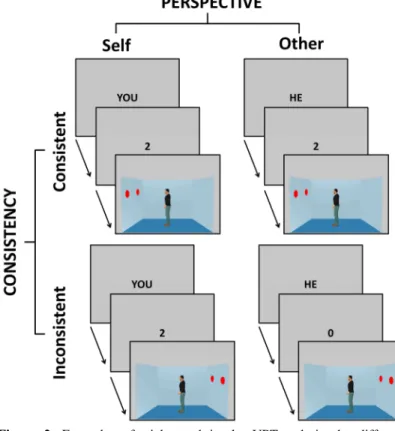
In the VPT task, participants are instructed to make judgments from either their own or someone else’s visual perspective in situations where both perspectives are either conflicting (i.e., inconsistent) or consistent (see Figure 2 for details). By contrasting orthogonally the perspective taken (self-perspective vs. other-perspective) and whether what is visible from both perspectives is different or not (consistent vs. inconsistent), we could obtain two measures of PT performance that respectively and specifically assess the ability to handle conflicting perspectives and the relative priority given to the egocentric and altercentric perspective (for a detailed technical explanation of how the VPT task assess the latter dimension, see Appendix A).
Figure 2. Examples of trials used in the VPT task in the different experimental conditions.
Participants were asked to judge whether the number prompt (ranging from 0 to 3) matches the number of discs visible from the prompted perspective, which could be either their own perspective
(self-perspective condition) or the perspective of the person in the room (other-perspective condition). The other person and the participants could see either the same number of discs (consistent condition) or a different number of discs (inconsistent condition).
Performance along these two dimensions is measured through reaction times (RT) and error rates (ER). Longer RTs and/or a higher ER when the egocentric and altercentric perspectives are inconsistent than when they are consistent reflect the higher difficulty, or cognitive cost, in handling the conflict between perspectives. Longer RTs and/or a higher ER when prompted to take the self- perspective than when instructed to take the other person’s perspective reflect a relative higher difficulty, or cognitive cost, in taking the egocentric perspective over the altercentric perspective. However, because there is no baseline condition in this experimental task design, the latter observation could also be framed as a lower difficulty, or cognitive cost in taking the altercentric perspective over the egocentric perspective.
At the individual or group level, expected effects on performance can be found on RTs, on ERs, on both measures, or on neither of them. Variability between these 4 patterns of findings is namely driven by the fact that, from one situation to another and from one individual to another, individuals may favour speed over accuracy, or inversely, in their goal to attain successful performance (e.g., Förster, Higgins, & Bianco, 2003). Moreover, the size and direction of an effect found on one measure may need to be revised downward or upward if the opposite effect or the same effect is found on the other measure, respectively. One way to tackle this issue is to use the inverse efficiency score (IES) because it combines ERs and RTs by weighting the average RT by the ER (IES = RT / (1-ER); Townsend & Ashby, 1978). More specifically, using the IES allows to take into account the potential speed-accuracy trade-offs, to homogenize the different patterns of speed-accuracy trade-offs within a group of individuals, and to compare several groups via a unique measure. However, the IES presents the main disadvantage that its variability is increased because it adds up the sampling error of the two measures and because the RTs are non-linearly multiplied (almost exponentially) as the ERs increase (e.g., an increment of ER from .10 to .20 and from .40 to .50 increases the RT by 69 ms and 167 ms, respectively). This non-linear multiplication of RTs led Bruyer and Brysbaert (2011) to argue that the use of the IES should be avoided if the average ER is beyond .10 and when the results found on the RTs and ERs are not in line with those found on the IESs (Bruyer & Brysbaert, 2011). If these two criteria are met, the analysis of performance on the VPT task will be complemented by analyses on IESs to compare performances between different groups of individuals.
7.
Outline of the thesis
This thesis had two main objectives. The first was to investigate the dynamic nature of PT performance in the sense that one can have different PT performances from one situation to another and from one moment to another. This new avenue of research would challenge the widespread view that PT is a static (or trait-like) characteristic and that it
should be studied as such. The second objective was to investigate whether the ability to handle conflicting perspectives and the relative salience of the egocentric versus another person’s perspective are two core dimensions underpinning PT performance. Providing evidence of the possibility and usefulness of this two-dimensional account of PT would challenge the widespread view that PT is a unitary construct and that it should be studied as such.
In Chapter 2, we tested across 3 experiments the role of 3 situational factors in explaining why what another person is looking at interferes more strongly with our judgement of what we see in the VPT task than in the gaze cueing paradigm (i.e., a task where participants must detect or identify an object located either within or outside the line of sight of an irrelevant gazing stimulus). In Experiment 1 we looked at the role of the visual stimuli of the VPT task that could have a different visual salience and may have boosted the interference. In Experiment 2 we looked at the role of the higher task complexity of the VPT task and in Experiment 3 we tested the role of task instructions in influencing the attentional deployment onto another person. This study therefore explored the role of situational factors in influencing PT performance. If such an influence were found, it would support the view that PT performance varies from one situation to another and is therefore a dynamic ability.
In Chapter 3, we tested across 2 experiments how inducing an emotional state of guilt, anger, or shame would affect PT performance relatively to individuals induced in a neutral state. Given that emotions are typically transient and recurrent states of the mind, evidence that guilt, anger, or shame impacts on PT performance would support the view that PT is a dynamic ability. Moreover, as PT performance was measured with the VPT task, we also tested whether emotions would affect overall performance (main effect of emotions) or specifically one of the two dimensions we proposed to underpin PT performance. If emotions were to impact specifically one of the dimensions, it would add some theoretical and ecological validity to the two-dimensional account.
In Chapter 4, we tested whether and how narcissism affects VPT performance. Narcissism has been consistently negatively association with self-reported PT habits. However, previous studies suggest that PT performance can be enhanced when providing to participants the motivation to engage in PT. Here, we explored whether the tendency to report less PT habits might actually be driven by motivational factors, which could further highlight the dynamic nature of PT. In addition, because narcissists are characterized for their highly self-interested behaviour, we examined whether narcissism would be specifically associated with differences in the relative salience of the egocentric and altercentric perspectives rather than with the other dimension or the overall performance on the VPT task.
In Chapter 5, we tested the specific hypothesis that there exists a significant and independent amount of inter-individual variability in both dimensions. To test this hypothesis, we examined how a large number of participants who completed the VPT task
would cluster following an algorithm aiming to maximize the explanation of PT inter-individual variability. If we were to find that both dimensions are necessary to describe how individuals cluster and differ in terms of PT performance, it would suggest that inter-individual differences in PT performance (which was traditionally scored along a one-dimensional poor-to good performance continuum) should be scaled up in a two-dimensional space defined by the ability to handle conflicting perspectives and the relative salience of the egocentric and altercentric perspectives.
Finally, in Chapter 6, I discuss the theoretical implications of our findings within and outside the field of PT.
Chapter 2
What triggers the computation of what
other people are looking at? Revisiting
the automaticity hypothesis
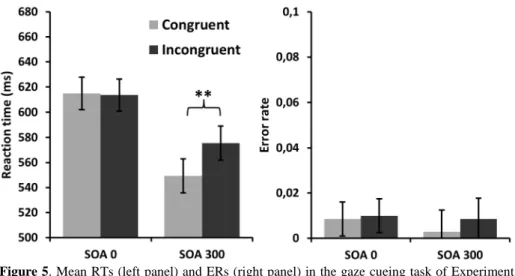
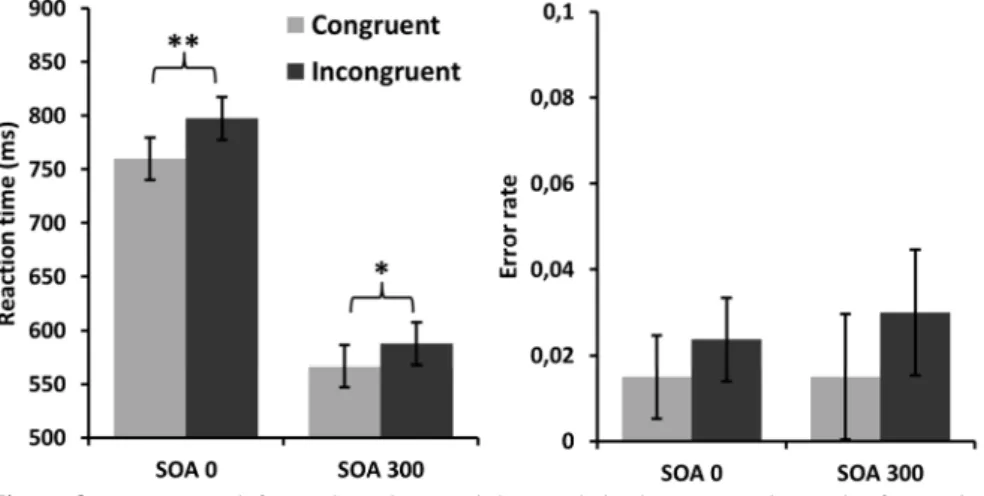
Computing what other people are looking at plays a central role in human interactions as it helps understanding what other people want, are about to do, know, or talk about. Two separate lines of research have suggested that such computation occurs automatically. In the context of a visual perspective-taking task in which participants are asked to make judgments based on their own visual perception in the presence of another perceiver, it has been shown that participants automatically compute what the other person is seeing. In the context of an attention orienting paradigm in which participants have to detect a target preceded by a face with averted gaze, it has been shown that participants’ attention is automatically shifted in the same direction where the other person is gazing at. Intriguingly, the sensitivity to what someone else is looking at is much higher and more robust in the context of the visual perspective-taking paradigm than in the context of the gaze cueing paradigm. The current study examined the origin of this difference in three experiments. The results showed that the higher robustness of the sensitivity to someone else’s gaze in the visual perspective-taking paradigm is not due to a difference in visual settings (Experiment 1) or task complexity (Experiment 2) but that it is caused by how attention is deployed in response to task instructions (Experiment 3). Our results provide important insights into the conditions in which we compute what another person is looking at, and qualify the automaticity of this computation.
What triggers the computation of what
other people are looking at? Revisiting
the automaticity hypothesis
Henryk Bukowski1, Jari K. Hietanen2, Dana Samson1
1Institut de recherche en sciences psychologiques, Université catholique de Louvain,
Louvain-La-Neuve, Belgium
2Human Information Processing Laboratory, School of Social Sciences and Humanities,
University of Tampere, Finland
1.
Introduction
Our ability to compute what people see, known as visual perspective taking (VPT), offers us very useful information during our social interactions (Baron-Cohen, 1995); it helps understanding what other people talk about, what they like or dislike, what they intend to do, and what knowledge or beliefs of the world they form. Thus, VPT is an essential building block of “Theory of Mind”, that is, our ability to reason about other people's mental states (Premack & Woodruff, 1978).
The most basic form of VPT, also referred to as level 1 VPT, allows to infer which objects someone else can or cannot see (as opposed to level 2 VPT which allows to infer that an object may have a different appearance to someone else; Flavell et al., 1981). Level 1 VPT is known to be an early developing ability in children (Flavell et al., 1981) and is available even to nonhuman species (e.g., Hare, Call, Agnetta, & Tomasello, 2000). It has also been proposed that level 1 VPT is achieved via the computation of the other person’s line of sight (Kessler & Rutherford, 2010; Michelon & Zacks, 2006; A. D. R. Surtees, Apperly, & Samson, 2013) and that such computation occurs automatically (Samson et al., 2010). For example, Samson et al. (2010) showed participants pictures of a room with discs pinned on the left and/or right wall and a centrally positioned human avatar facing either the left or the right wall. The discs were displayed in such a way that on half of the trials, some of these discs were not visible to the avatar. The authors found that when the participants were asked to verify the number of discs they could see from their own point of view, they were slowed down and less accurate in their judgments when the number of discs in the room did not match the number of discs that the avatar could see, suggesting that participants automatically processed what the avatar could see even when it was not relevant for their judgment.
Interestingly, in a parallel line of research it has been shown that our attention is reflexively oriented towards what someone else is looking at. This phenomenon is typically observed in a gaze cueing paradigm where participants are faster at detecting or identifying an object when it appears in the gaze direction of a preceding social cue (e.g., eye gaze or